Batch Me If You Can: Coverage-guided RPKI Fuzzing at Scale
Pith reviewed 2026-06-29 17:11 UTC · model grok-4.3
The pith
A new fuzzer called CAT tests RPKI validators by handling hundreds of interdependent objects at once and finds 21 previously unknown vulnerabilities.
A machine-rendered reading of the paper's core claim, the machinery that carries it, and where it could break.
Core claim
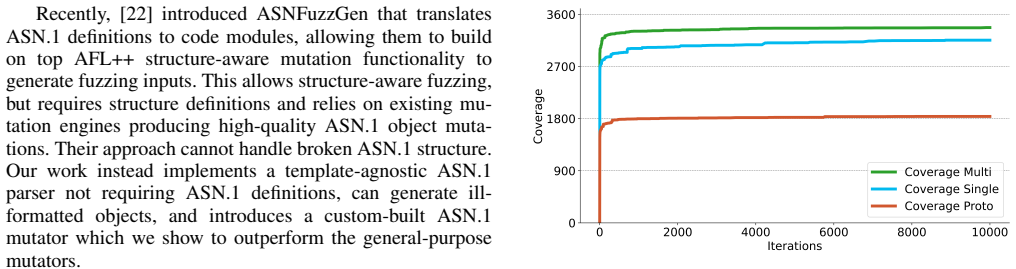
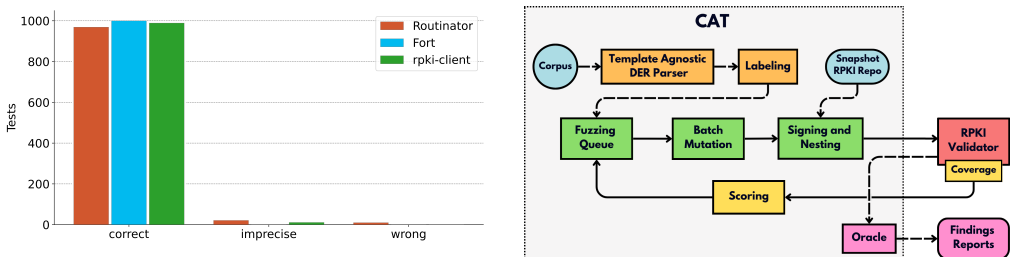
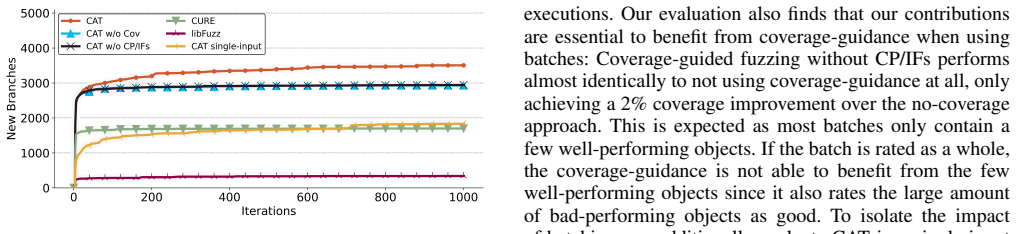
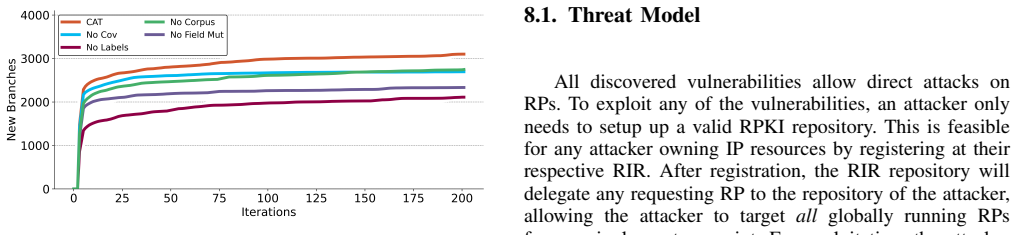
By replacing sequential execution with continuous sampling and function side-channels for per-object coverage, and by parsing repository inputs into a labeled tree that permits structural mutations while preserving cryptographic validity, the CAT fuzzer reaches 66x higher throughput than sequential methods and covers 24-47% more unique paths than libFuzzer. When applied to production RPKI validators it located 21 previously unknown vulnerabilities, eight of which have been assigned CVEs with scores from 7.5 to 9.8.
What carries the argument
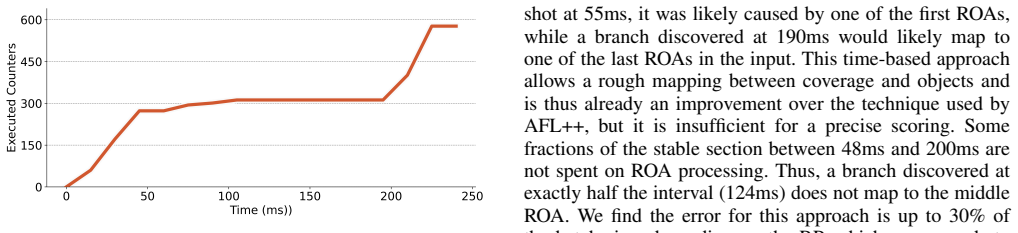
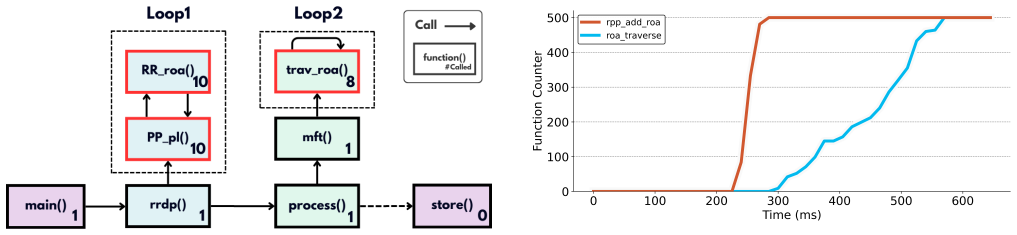
Continuous sampling with function side-channels for per-object coverage attribution, together with a template-agnostic ASN.1 mutation engine that operates on a labeled parse tree of the repository.
If this is right
- RPKI validators become subject to systematic coverage-guided testing instead of only shallow parsing checks.
- Vulnerabilities such as buffer overflows, denial-of-service conditions, and repository-poisoning logic errors become discoverable before deployment.
- The same non-sequential approach can be reused on other multi-object cryptographic protocols such as DNSSEC.
- Open-sourcing the tool allows validator developers to integrate it into their own testing pipelines.
Where Pith is reading between the lines
- Wider adoption of such fuzzers could reduce the window during which route-hijacking exploits remain possible.
- Validator maintainers might add automated fuzzing runs to continuous-integration systems to catch regressions.
- The labeled-tree mutation technique could be generalized to any protocol whose inputs are ASN.1 structures with cross-object signatures.
Load-bearing premise
Continuous sampling and function side-channels can attribute coverage to the correct object inside a repository of hundreds of linked objects without missing paths or creating many false positives.
What would settle it
Running CAT on a hand-crafted repository where every object’s true coverage has been measured by separate instrumentation and checking whether the reported per-object coverage matches the ground truth within a small error margin.
Figures

read the original abstract
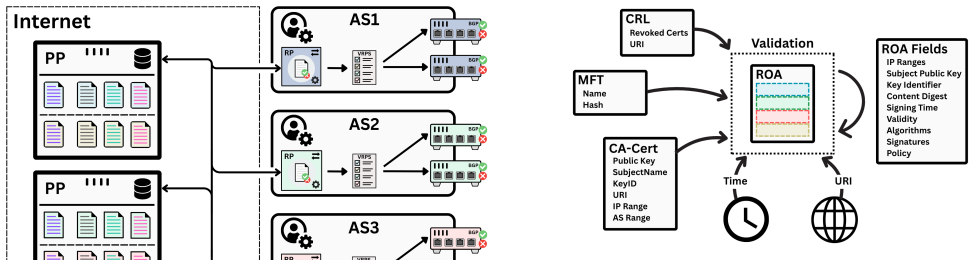
The Resource Public Key Infrastructure (RPKI) has become essential to secure inter-domain routing. Despite its critical role, RPKI software remains largely untested beyond shallow parsing. Existing fuzzers, like AFL++ or libFuzzer, do not work well for RPKI as they assume a single, self-contained input per execution, while RPKI repositories contain hundreds of interdependent cryptographically linked objects. Existing fuzzers fail to handle this complexity and lack the ability for precise coverage attribution in multi-object repositories, breaking feedback-based exploration and thereby missing most severe vulnerabilities in RPKI validation. In this paper, we overcome these limitations through novel fuzzing techniques, including continuous sampling and using functions as side-channels for per-object coverage attribution in large input repositories. We further show how parsing inputs to a labeled tree allows structural and semantic mutations while preserving cryptographic validity in mutated repositories. We implement our new techniques into a powerful fuzzing tool called CAT, combining non-sequential fuzzing with our template-agnostic ASN.1 mutation engine to achieve 66x throughput improvement over sequential fuzzing and exploring 24 - 47% more unique code paths compared to libFuzzer and previous work. Evaluating CAT on RPKI validators uncovered 21 previously unknown vulnerabilities with 8 CVEs already assigned (CVSS 7.5 - 9.8). These include a buffer overflow, Denial-of-Service (DoS), and exploitable repository-poisoning logic flaws. We open-source CAT to enable reproducibility, further research, and adaptation of our methods to other complex cryptography-based protocols such as DNSSEC and TLS.
Editorial analysis
A structured set of objections, weighed in public.
Referee Report
Summary. The paper claims that standard coverage-guided fuzzers fail on RPKI because repositories contain hundreds of cryptographically interdependent objects; it introduces continuous sampling plus function side-channels for per-object coverage attribution, a template-agnostic ASN.1 mutation engine that preserves cryptographic validity, and the CAT tool that combines non-sequential fuzzing with these techniques. CAT is reported to deliver 66x throughput over sequential fuzzing, 24-47% more unique paths than libFuzzer and prior work, and 21 previously unknown vulnerabilities (8 CVEs, CVSS 7.5-9.8) in RPKI validators. The tool is open-sourced.
Significance. If the coverage-attribution and throughput claims hold under rigorous validation, the work would be a meaningful advance in applying feedback-driven fuzzing to complex, multi-object cryptographic protocols; the open-source release and explicit extension path to DNSSEC/TLS are concrete strengths that lower the barrier for follow-on research.
major comments (2)
- [Novel fuzzing techniques / Evaluation] The central performance and vulnerability claims rest on the assertion that function side-channels deliver accurate per-object coverage attribution in repositories containing hundreds of cryptographically linked objects; the manuscript provides no quantitative error analysis, false-positive rate, or missed-path measurements on realistic RPKI data sets, leaving open the possibility that attribution errors corrupt the feedback loop (see description of novel fuzzing techniques and the evaluation of CAT).
- [Evaluation / Abstract] The abstract and evaluation report concrete throughput (66x) and path-coverage (24-47%) gains plus 21 vulnerabilities, yet supply no details on experimental setup, baseline configurations for libFuzzer and prior tools, statistical significance testing, or how coverage was aggregated across interdependent objects; these omissions make it impossible to assess whether the reported improvements are attributable to the new methods.
minor comments (2)
- [Evaluation] Clarify the precise definition and measurement of 'unique code paths' when objects are interdependent; a short paragraph or table would help readers replicate the metric.
- [ASN.1 mutation engine] The claim that the ASN.1 mutation engine is 'template-agnostic' would benefit from an explicit statement of which structural constraints are still enforced versus freely mutated.
Simulated Author's Rebuttal
We thank the referee for the constructive feedback on our manuscript. We address each major comment below and will revise the paper to incorporate additional evaluation details and analysis as outlined.
read point-by-point responses
-
Referee: [Novel fuzzing techniques / Evaluation] The central performance and vulnerability claims rest on the assertion that function side-channels deliver accurate per-object coverage attribution in repositories containing hundreds of cryptographically linked objects; the manuscript provides no quantitative error analysis, false-positive rate, or missed-path measurements on realistic RPKI data sets, leaving open the possibility that attribution errors corrupt the feedback loop (see description of novel fuzzing techniques and the evaluation of CAT).
Authors: We agree that the manuscript would benefit from explicit quantitative validation of the side-channel attribution accuracy. The technique instruments validator functions with unique signatures tied to specific object-processing paths, which limits cross-object interference in practice. In the revised version we will add a dedicated subsection reporting attribution error rates, false-positive counts, and missed-path measurements obtained from ground-truth labeled RPKI repositories containing 100–500 interdependent objects. revision: yes
-
Referee: [Evaluation / Abstract] The abstract and evaluation report concrete throughput (66x) and path-coverage (24-47%) gains plus 21 vulnerabilities, yet supply no details on experimental setup, baseline configurations for libFuzzer and prior tools, statistical significance testing, or how coverage was aggregated across interdependent objects; these omissions make it impossible to assess whether the reported improvements are attributable to the new methods.
Authors: The full manuscript already describes the hardware platform, number of independent runs (10), and baseline parameters for libFuzzer and prior tools in Section 5. We acknowledge, however, that the aggregation method across objects and statistical significance tests are not stated with sufficient clarity. We will expand the evaluation section to explicitly describe coverage aggregation (union of per-object coverage maps) and report p-values from paired t-tests comparing CAT against the baselines. revision: yes
Circularity Check
No circularity: empirical tool evaluation with no derivations or self-referential claims
full rationale
The paper describes implementation of a fuzzing tool (CAT) using continuous sampling and function side-channels for coverage attribution in multi-object RPKI repositories, followed by empirical evaluation showing throughput gains and vulnerability discovery. No equations, fitted parameters, predictions, or first-principles derivations are present in the provided text. Central claims rest on measured results from running the tool, not on any chain that reduces to its own inputs by construction. Self-citations, if any, are not load-bearing for the reported outcomes.
Axiom & Free-Parameter Ledger
Reference graph
Works this paper leans on
-
[1]
Securing internet applications from routing attacks,
Y . Sun, M. Apostolaki, H. Birge-Lee, L. Vanbever, J. Rexford, M. Chiang, and P. Mittal, “Securing internet applications from routing attacks,”Commun. ACM, vol. 64, no. 6, pp. 86–96, 2021
2021
-
[2]
Reporting on border gate- way protocol risk mitigation progress: Notice of proposed rulemak- ing, ps docket nos. 24-146 and 22-90,
Federal Communications Commission, “Reporting on border gate- way protocol risk mitigation progress: Notice of proposed rulemak- ing, ps docket nos. 24-146 and 22-90,” https://docs.fcc.gov/public/ attachments/DOC-402609A1.pdf, May 2024, publication date: May 16, 2024; accessed August 25, 2025
2024
-
[3]
Roadmap to enhancing internet routing security: A report by the white house office of the national cyber director,
Office of the National Cyber Director, The White House, “Roadmap to enhancing internet routing security: A report by the white house office of the national cyber director,” Sep. 2024, published September 2024; accessed August 25, 2025. [Online]. Available: https://bidenwhitehouse.archives.gov/wp-content/uploads/ 2024/09/Roadmap-to-Enhancing-Internet-Routi...
2024
-
[4]
Resolverfuzz: Automated discovery of dns resolver vulnerabilities with query- response fuzzing,
Q. Zhang, X. Bai, X. Li, H. Duan, Q. Li, and Z. Li, “Resolverfuzz: Automated discovery of dns resolver vulnerabilities with query- response fuzzing,” inProceedings of the 33rd USENIX Security Symposium, 2024
2024
-
[5]
Route to Bugs: Analyzing the Security of BGP Message Parsing,
D. dos Santos, S. Guiot, S. Dashevskyi, and O. K. Amine Amri, “Route to Bugs: Analyzing the Security of BGP Message Parsing,” 2023. [Online]. Available: https://i.blackhat.com/BH-US-23/Presentations/ US-23-dosSantos-Route-to-Bugs-Analyzing-the-Security-of-BGP. pdf
2023
-
[6]
MESSI: Behavioral Testing of BGP Implemen- tations,
R. Singha, R. Mondal, R. Beckett, S. K. R. Kakarla, T. Millstein, and G. Varghese, “MESSI: Behavioral Testing of BGP Implemen- tations,” in21st USENIX Symposium on Networked Systems Design and Implementation (NSDI 24), 2024, pp. 1009–1023
2024
-
[7]
The cure to vulnerabilities in rpki validation,
D. Mirdita, H. Schulmann, N. V ogel, and M. Waidner, “The cure to vulnerabilities in rpki validation,”NDSS Symposium, 2024
2024
-
[8]
The harder you try, the harder you fail: The keytrap denial-of-service algorithmic complexity attacks on dnssec,
E. Heftrig, H. Schulmann, N. V ogel, and M. Waidner, “The harder you try, the harder you fail: The keytrap denial-of-service algorithmic complexity attacks on dnssec,” inProceedings of the 2024 on ACM SIGSAC Conference on Computer and Communications Security, 2024, pp. 497–510
2024
-
[9]
Rpfuzzer: A framework for dis- covering router protocols vulnerabilities based on fuzzing
Z. Wang, Y . Zhang, and Q. Liu, “Rpfuzzer: A framework for dis- covering router protocols vulnerabilities based on fuzzing.”KSII Transactions on Internet & Information Systems, vol. 7, no. 8, 2013
2013
-
[10]
A messy state of the union: Taming the composite state machines of TLS,
B. Beurdouche, K. Bhargavan, A. Delignat-Lavaud, C. Fournet, M. Kohlweiss, A. Pironti, and P.-Y . Strub, “A messy state of the union: Taming the composite state machines of TLS,” inProceedings of the 2015 IEEE Symposium on Security and Privacy, ser. SP ’15. Washington, DC, USA: IEEE Computer Society, 2015, pp. 535–552. [Online]. Available: https://doi.org...
-
[11]
Practical dns fuzzing,
Z. Liu, K. He, T. Zhu, and J. C. Lui, “Practical dns fuzzing,” in Proceedings of the 2020 ACM SIGSAC Conference on Computer and Communications Security (CCS), 2020, pp. 1093–1106
2020
-
[12]
{SCALE}: Automatically finding{RFC}compliance bugs in {DNS}nameservers,
S. K. R. Kakarla, R. Beckett, T. Millstein, and G. Varghese, “{SCALE}: Automatically finding{RFC}compliance bugs in {DNS}nameservers,” in19th USENIX Symposium on Networked Systems Design and Implementation (NSDI 22), 2022, pp. 307–323
2022
-
[13]
Resolfuzz: Differential fuzzing of dns re- solvers,
J. Bushart and C. Rossow, “Resolfuzz: Differential fuzzing of dns re- solvers,” inEuropean Symposium on Research in Computer Security. Springer, 2023, pp. 62–80
2023
-
[14]
Takanen, J
A. Takanen, J. DeMott, and C. Miller,Fuzzing for Software Security Testing and Quality Assurance. Artech House, 2018
2018
-
[15]
Stateful black- box fuzzing for encryption protocols and its application in ipsec,
J. Guo, C. Gu, X. Chen, X. Zhang, K. Tian, and J. Li, “Stateful black- box fuzzing for encryption protocols and its application in ipsec,” Computer Networks, p. 110605, 2024
2024
-
[16]
Automated whitebox fuzz testing,
P. Godefroid, M. Y . Levin, and D. Molnar, “Automated whitebox fuzz testing,” inProceedings of the Network and Distributed System Security Symposium (NDSS), 2008
2008
-
[17]
AFL++: Combin- ing incremental steps of fuzzing research,
A. Fioraldi, D. Maier, H. Eißfeldt, and M. Heuse, “AFL++: Combin- ing incremental steps of fuzzing research,” in14th USENIX Workshop on Offensive Technologies (WOOT 20). USENIX Association, Aug. 2020
2020
-
[18]
Guided, deep testing of x. 509 certificate validation via coverage transfer graphs,
J. Zhu, C. Wan, P. Nie, Y . Chen, and Z. Su, “Guided, deep testing of x. 509 certificate validation via coverage transfer graphs,” in2020 IEEE International Conference on Software Maintenance and Evolution (ICSME). IEEE, 2020, pp. 243–254
2020
-
[19]
Dy fuzzing: formal dolev- yao models meet cryptographic protocol fuzz testing,
M. Ammann, L. Hirschi, and S. Kremer, “Dy fuzzing: formal dolev- yao models meet cryptographic protocol fuzz testing,” in2024 IEEE Symposium on Security and Privacy (SP). IEEE, 2024, pp. 1481– 1499
2024
-
[20]
Guided differential testing of certificate valida- tion in ssl/tls implementations,
Y . Chen and Z. Su, “Guided differential testing of certificate valida- tion in ssl/tls implementations,” inProceedings of the 2015 10th Joint Meeting on F oundations of Software Engineering, 2015, pp. 793–804
2015
-
[21]
Using frankencerts for automated adversarial testing of certificate validation in ssl/tls implementations,
C. Brubaker, S. Jana, B. Ray, S. Khurshid, and V . Shmatikov, “Using frankencerts for automated adversarial testing of certificate validation in ssl/tls implementations,” in2014 IEEE Symposium on Security and Privacy. IEEE, 2014, pp. 114–129
2014
-
[22]
Ransacked: A domain-informed approach for fuzzing lte and 5g ran-core interfaces,
N. Bennett, W. Zhu, B. Simon, R. Kennedy, W. Enck, P. Traynor, and K. R. Butler, “Ransacked: A domain-informed approach for fuzzing lte and 5g ran-core interfaces,” inProceedings of the 2024 on ACM SIGSAC Conference on Computer and Communications Security, 2024, pp. 2027–2041
2024
-
[23]
Fuzzing rpki validators with semantic and structural awareness,
Z. Shang, J. Cao, Z. Lin, Y . Liu, M. Xu, Y . Wang, and J. Li, “Fuzzing rpki validators with semantic and structural awareness,” in Proceedings of the ACM SIGCOMM 2025 Posters and Demos, 2025, pp. 19–21
2025
-
[24]
Detecting critical bugs in smt solvers using blackbox mutational fuzzing,
M. N. Mansur, M. Christakis, V . W ¨ustholz, and F. Zhang, “Detecting critical bugs in smt solvers using blackbox mutational fuzzing,” in Proceedings of the 28th ACM Joint meeting on european software engineering conference and symposium on the foundations of software engineering, 2020, pp. 701–712
2020
-
[25]
Nyx: Greybox hypervisor fuzzing using fast snapshots and affine types,
S. Schumilo, C. Aschermann, A. Abbasi, S. W ¨orner, and T. Holz, “Nyx: Greybox hypervisor fuzzing using fast snapshots and affine types,” in30th USENIX Security Symposium (USENIX Security 21), 2021, pp. 2597–2614
2021
-
[26]
Systematic fuzzing and testing of tls libraries,
J. Somorovsky, “Systematic fuzzing and testing of tls libraries,” in Proceedings of the 2016 ACM SIGSAC conference on computer and communications security, 2016, pp. 1492–1504
2016
-
[27]
Directed greybox fuzzing,
M. B ¨ohme, V . Feldt, and H. Pashakhanlou, “Directed greybox fuzzing,” inProc. of the ACM SIGSAC Conference on Computer and Communications Security, 2016
2016
-
[28]
An asn. 1 uper encoding based fuzzing method for radio resource control protocol,
R. Wang, D. Liu, X. Liu, L. Ma, H. Zhang, Y . Wang, Z. Li, F. Zhang, and L. Sun, “An asn. 1 uper encoding based fuzzing method for radio resource control protocol,” in2023 International Conference on Networking and Network Applications (NaNA). IEEE, 2023, pp. 268–273
2023
-
[29]
On the effectiveness of address-space randomization,
H. Shacham, M. Page, B. Pfaff, E.-J. Goh, N. Modadugu, and D. Boneh, “On the effectiveness of address-space randomization,” inProceedings of the 11th ACM conference on Computer and com- munications security, 2004, pp. 298–307
2004
-
[30]
A longitudinal, end-to-end view of the dnssec ecosystem,
T. Chung, R. van Rijswijk-Deij, B. Chandrasekaran, D. Choffnes, D. Levin, B. M. Maggs, A. Mislove, and C. Wilson, “A longitudinal, end-to-end view of the dnssec ecosystem,” in26th USENIX Security Symposium (USENIX Security 17), 2017, pp. 1307–1322
2017
-
[31]
Nist rpki monitor,
NIST, “Nist rpki monitor,” 2026, accessed: April 9 2026. [Online]. Available: https://rpki-monitor.antd.nist.gov/
2026
-
[32]
Rovista,
Netsecurelab, “Rovista,” 2026, accessed: April 9 2026. [Online]. Available: https://rovista.netsecurelab.org/
2026
-
[33]
Ethical issues in computer security research: What practitioners say,
M. Bishop and D. V . Bailey, “Ethical issues in computer security research: What practitioners say,” inProceedings of the 4th Workshop on Ethics in Computer Security Research (WECSR). Springer, 2008
2008
-
[34]
The menlo report: Ethical principles guiding information and communication technology research,
D. Dittrich and E. Kenneally, “The menlo report: Ethical principles guiding information and communication technology research,” U.S. Department of Homeland Security, Tech. Rep. 11-01, August 2012
2012
-
[35]
Sharing sensitive data with confidence: The data tags system,
L. Sweeney, M. Crosas, and M. Bar-Sinai, “Sharing sensitive data with confidence: The data tags system,”Technology Science, Septem- ber 2015. [Online]. Available: https://techscience.org/a/2015092901 Appendix A. Meta-Review The following meta-review was prepared by the program committee for the 2026 IEEE Symposium on Security and Privacy (S&P) as part of ...
-
[36]
This is a technically useful capa- bility that may prove valuable beyond RPKI, espe- cially for fuzzing targets whose inputs are ASN.1- encoded
CAT features a fine-grained, structure- and encoding-aware mutation engine for inputs encoded as ASN.1 values. This is a technically useful capa- bility that may prove valuable beyond RPKI, espe- cially for fuzzing targets whose inputs are ASN.1- encoded
-
[37]
This design appears to improve fuzzing throughput and exploration depth relative to prior approaches that process one input at a time
CAT supports batching multiple RPKI objects into a single test case while attributing code coverage to individual inputs. This design appears to improve fuzzing throughput and exploration depth relative to prior approaches that process one input at a time
-
[38]
CAT uncovered 21 previously unknown vulnerabil- ities in existing RPKI validator implementations, including implementations that had already been tested by prior work. A.4. Noteworthy Concerns None
discussion (0)
Sign in with ORCID, Apple, or X to comment. Anyone can read and Pith papers without signing in.