REVIEW 4 major objections 6 minor 29 references
Attention-Steered Vision-Language Models for Sign Language Translation
T0 review · 4 major / 6 minor · reviewed 2026-08-04 · deepseek-v4-flash
Pith's one-line read This paper claims that a general vision-language model becomes a state-of-the-art sign language translator when its visual attention is explicitly steered toward the signer's hands and face in each frame and toward motion-peak keyframes ove
desk verdict A credible VLM-based SLT training recipe, but the headline gains are small and the RL layer choice is test-selected. read the letter →
The pith
A machine-rendered reading of the paper's core claim, the machinery that carries it, and where it could break.
The reading
What carries the argument
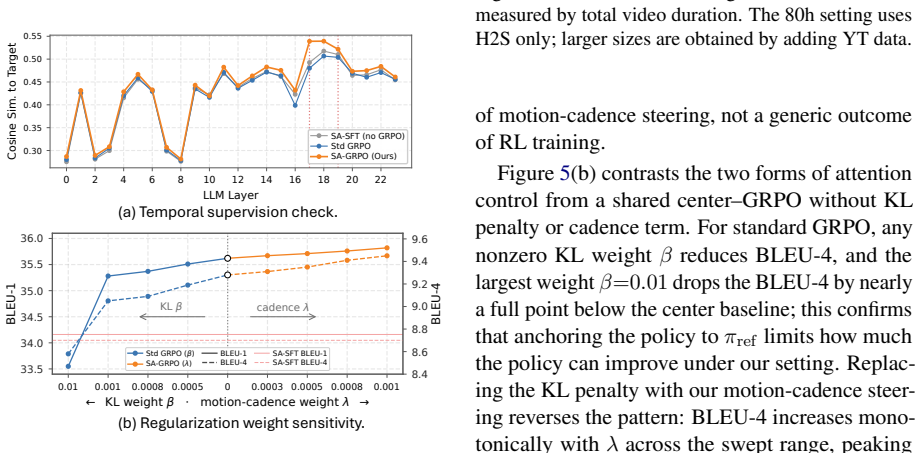
Two KL-based attention-steering losses carry the argument. Spatial steering: per-frame attention over the 8x8 visual-token grid is matched to a soft foreground distribution built from hand-and-face masks, applied at mid-depth decoder layers during supervised fine-tuning. Temporal steering: per-frame attention over video frames is matched to a Gaussian-smoothed distribution centered on motion-energy peaks, applied at upper-middle decoder layers during policy-gradient RL, replacing the standard KL penalty that anchors the policy to a reference model. A correlation probe between attention concentration and BLEU-1 selects which layers to supervise.
What would settle it
Replace the motion-peak target with an alternative content anchor, such as peaks in handshape-change rate, frames selected by a separate sign-segmentation model, or human-annotated sign boundaries, and check whether the BLEU-4 gain from cadence steering persists; a large drop or reversal would indicate the gain is specific to motion peaks rather than to any sign-aligned frame selection. Likewise, applying the pipeline to a sign language with different temporal prosody, such as BSL or DGS, and observing harm would falsify the generality claim.
Extended reading notes
Core claim
The central claim is that the failure of VLM-based sign language translators is poor spatial-temporal visual grounding, and that this can be fixed by supervising attention directly rather than relying on text-only cross-entropy. In the SFT stage, the paper builds a soft foreground target over the 8x8 visual-token grid from face and hand detection masks, then adds a KL loss between the model's per-frame visual attention and that target. In the RL stage, a statistical analysis shows that temporal attention concentration at certain decoder layers correlates positively with translation quality, so the authors replace the generic KL penalty with a cadence loss that pulls per-frame attention towar
Load-bearing premise
The motion-cadence target assumes that peaks in grayscale frame-to-frame difference mark the frames that carry sign-relevant linguistic content; if much of the information sits in holds, handshapes, or non-manual markers that do not coincide with motion peaks, steering attention there could pull the model away from informative frames.
Editorial extensions
If this is right
- No gloss annotations are required; the pipeline trains end-to-end from video-text pairs, making it scalable to web-scale corpora.
- The spatial supervision also improves interpretability, since post-training attention maps concentrate on the signer's hands and face, providing a sanity check for the translation.
- Replacing the policy-anchoring KL term with motion-cadence steering consistently outperforms both standard RL and RL without any regularization, showing that task-specific temporal structure is more useful than generic policy anchoring.
- The same stage-wise gains transfer across two benchmarks and different training-data scales, including when a large weakly-aligned web corpus is added.
- The layer-selection probe, which correlates attention concentration with translation quality, identifies where to supervise, and steering at those layers outperforms steering elsewhere.
Reading between the lines
- The motion-peak target is one candidate for an 'informative frame' prior; alternative anchors such as handshape-change peaks or human-annotated sign boundaries could be tested and might capture holds and non-manual markers that motion energy misses.
- Because attention steering is task-agnostic in spirit, the same spatial/temporal supervision recipe could transfer to other video-language tasks where grounding matters, such as action recognition or dense video captioning.
- The finding that removing the KL anchor helps suggests that on narrow tasks, aggressive policy optimization with task-specific rewards may be preferable to staying close to the reference policy; cadence steering provides that task signal.
- The attention-quality correlation used for layer selection is correlational; an intervention test such as perturbing attention at those layers during inference could establish whether the correlation reflects a causal pathway.
Editorial analysis
A structured set of objections, weighed in public.
Referee Report
Summary. The paper proposes AttnSign, a two-stage training framework that adapts a general-purpose vision-language model (InternVL-2.5-1B) to sign language translation. Stage one, SA-SFT, augments standard instruction fine-tuning with a spatial attention-supervision loss that encourages the model's per-frame visual attention to concentrate on MediaPipe-derived hand and face regions. Stage two, SA-GRPO, replaces the KL penalty in standard GRPO with a motion-cadence steering loss that aligns the model's per-frame temporal attention to a Gaussian-smoothed target derived from motion-energy peaks. Experiments on How2Sign and OpenASL report BLEU-4 of 15.54 and 20.75 respectively, claiming consistent improvements over specialized SLT methods and zero-shot VLMs. The paper also includes extensive ablations, a random-peak control, and a layer-selection analysis.
Significance. If the reported gains are statistically robust and the design choices are selected without using the test set, the paper would make a useful contribution: it demonstrates a concrete mechanism for injecting sign-specific spatial-temporal priors into a VLM without changing its architecture, and it provides falsifiable ablations. The random-peak control (Appendix H) is a particularly good check that the temporal target's content alignment matters, and the use of external MediaPipe masks rather than metric-derived supervision is a strength. However, the central claim of consistent, leading performance rests on small BLEU-4 differences and on a layer-selection procedure that appears to use test-video statistics, so the evidence as presented is not yet conclusive.
major comments (4)
- [§3.4, Figure 3, Appendix I] The SA-GRPO supervised layers (17 and 19) are selected from a correlation between attention concentration and BLEU-1 computed 'across both training and test videos' (Figure 3). The subsequent comparison in Table 3 (SA-GRPO vs. GRPO w/o KL, 15.54 vs. 15.38) and the layer-falsification in Appendix I (Table 8) then evaluate exactly those selected layers. This is not a held-out evaluation of the layer-choice design: the configuration was chosen using the same test set on which it is reported. The Appendix I comparison of layers 5/7 vs. 17/19 is a restatement of the selection, not an independent falsification. To support the claim that cadence steering is beneficial, the layer selection must be made on a validation split or the paper must report performance for all layer choices and show the advantage is not a selection artifact.
- [§4.3, Tables 1, 3, 9] Several of the headline improvements are very small: Table 1 shows AttnSign at 15.54 BLEU-4 vs. SSVP-SLT-LSP at 15.50 on H2S+YT, and Table 3 shows SA-GRPO vs. GRPO w/o KL at 15.54 vs. 15.38. No error bars, multiple seeds, or significance tests are reported anywhere in the paper. BLEU-4 differences of 0.04–0.16 are within ordinary run-to-run variation for RL-based translation training, especially with group size G=4 and a 10K-sample training set. The claim of 'consistent' outperformance requires at least a small number of independent runs or a paired bootstrap/permutation test with confidence intervals.
- [§3.4, Eqs. (10)–(11), Appendix H] The motion-cadence target assumes that grayscale frame-difference motion peaks mark sign-relevant keyframes. The random-peak control (Table 7) shows that peak positions matter, but it does not validate that motion peaks are the correct content anchor. In ASL, linguistic content is also carried by holds, handshapes, and non-manual markers that may not coincide with local maxima of frame-difference energy; steering attention to motion peaks could therefore bias the model away from informative frames. A concrete test would be to compare the proposed cadence target against alternative anchors such as handshape-change peaks or annotated sign boundaries on a validation split. This is a correctness-risk concern for the central mechanism, not a failure of the control experiment itself.
- [§4.5, Figures 4–5, Appendix E/G] The paper does not clearly state whether a validation split is used for hyperparameter selection. Default values for gamma (0.15), temperature T (0.5), lambda (0.001), the supervised layer sets (13/16 for Sattn and 17/19 for Scadence), and the reward combination are all chosen from sweeps that appear to be evaluated on How2Sign, with Section 4.5 saying all analyses are 'evaluated on How2Sign.' Section 4.2 also contains the confusing sentence 'For How2Sign evaluation, we use the How2Sign training split.' If the test set is used to select these hyperparameters, then all reported comparisons to baselines are optimistic. Please clarify the exact split used for each sweep and, if the test set was used, re-run the selection on a held-out validation set.
minor comments (6)
- [§1] Typo: 'We hypothesis that' should be 'We hypothesize that'.
- [§4.2] The sentence 'For How2Sign evaluation, we use the How2Sign training split, and for OpenASL evaluation, we use the OpenASL training split' is ambiguous and likely should say 'for RL training' rather than 'evaluation.' Please fix.
- [Figure 3] The correlation plot lacks axis labels, sample size, and a precise statement of how the correlation is computed. Adding these would help readers assess the strength (r≈0.32) and the train/test mixing issue.
- [§3.4] The phrase 'both training and test videos' in the layer-selection analysis should be made prominent and precise. As written, it is buried in the prose; it is central to the validity of the design choice.
- [Appendix I] The term 'falsification' is too strong for a comparison that uses the same test-selected layers. Please describe the result as a consistency check conditional on the selection method, not as an independent falsification.
- [Tables 1 and 2] The tables report zero-shot VLM baselines and specialized methods but do not state whether the specialized methods use the same training data (H2S vs. H2S+YT) in all cases. For example, the C2RL row in Table 1 is reported without the +YT tag; adding this for clarity would help.
Circularity Check
SA-GRPO layer selection is validated on the same test videos used to select it, so the 'probe predicts best layers' claim is circular; the rest of the pipeline is externally anchored.
-
fitted input called prediction
[Section 3.4 (Statistical Analysis, Figure 3); Section 4.2 (RL stage, layers 17/19); Appendix I (Table 8)]
"Figure 3 shows that there exists a positive correlation relationship between C and BLEU-1, computed across both training and test videos, especially peaks at the upper-middle 17th and 19th layers (r≈+0.32), indicating that enhancing such an attention concentration at these layers during optimization can potentially improve the translation quality during inference. ... To check that the probe genuinely predicts the best layers, we move the motion-cadence steering to the 5th and 7th layers, where the analysis shows weak or negative correlation."
The layer indices 17/19 are chosen because the correlation C vs BLEU-1 is computed 'across both training and test videos'; the same test videos are then used in Appendix I to compare SA-GRPO at 17/19 vs 5/7 and to report the BLEU gains in Tables 3, 8, and 9. This is not an out-of-sample check: the 'probe' was fit to the very data used to falsify it. The conclusion that the probe is a predictive signal is therefore forced by the selection procedure, and the reported benefit of cadence steering over GRPO w/o KL (+0.16 BLEU-4 on How2Sign) may reflect test-set overfitting of the layer hyperparameter rather than an independent confirmation.
full rationale
The core spatial and temporal supervision signals are not circular: MediaPipe foreground masks and motion-peak targets are external priors, the random-peak control (Appendix H) isolates peak-position content, and OpenASL results provide a partial cross-dataset transfer check. However, the SA-GRPO layer-selection analysis is circular in an important way: the 'statistical analysis' selects layers 17/19 from a correlation computed on both training and test videos, then Appendix I uses the same test set to claim the probe is predictive. This is a fitted hyperparameter being validated on the data that produced it, so the specific claim that cadence steering at 17/19 is superior to 5/7 is not held out. Reward selection and other hyperparameters (Table 4, Figures 4/5/7) are also tuned on How2Sign without an explicit validation split, which is a correctness risk but not a derivation-circularity step by itself. No load-bearing self-citation or ansatz-smuggling is present. Overall, the central benchmark claims are not reduced to the paper's inputs by construction, but the layer-probe validation is partially circular, warranting a moderate score.
Assumptions & free parameters
free parameters (7)
- gamma (spatial attention loss weight) =
0.15
- T (softmax temperature) =
0.5
- lambda (cadence loss weight) =
0.001
- sigma (Gaussian smoothing bandwidth)
- Supervised layers S_attn and S_cadence =
S_attn={13,16}, S_cadence={17,19}
- RL reward weights (BLEU-1 + ROUGE-L) =
equal weights
- GRPO training sample count =
10K
assumptions (6)
- domain assumption MediaPipe accurately localizes hands and face in SLT videos
- domain assumption Sign language linguistic content is carried primarily by hands and face
- domain assumption Motion peaks in grayscale frame differences mark informative sign keyframes
- ad hoc to paper The correlation between attention concentration and BLEU-1 on training+test videos is a valid guide for layer selection
- standard math Standard GRPO and its clipped surrogate apply to VLM text generation
- domain assumption LoRA and full ViT fine-tuning preserve VLM capabilities while adapting to SLT
Cite this review
Pith. "Pith review of Attention-Steered Vision-Language Models for Sign Language Translation." pith.science (2026). https://pith.science/paper/SLFF4WID
@misc{pith2026260800235,
  author       = {Pith},
  title        = {Pith review of: Attention-Steered Vision-Language Models for Sign Language Translation},
  year         = {2026},
  howpublished = {\url{https://pith.science/paper/SLFF4WID}},
  note         = {Machine review of arXiv:2608.00235}
}
read the original abstract
Vision-language models (VLMs) have emerged as a powerful framework for multimodal video understanding. However, they remain limited in the sign language translation task, where we identify a key failure mode of existing VLMbased translators: poor spatial-temporal visual grounding. In particular, we find that standard next-token cross-entropy does not directly provide signal for where and when the model should attend, causing models to overlook sign-relevant regions and frames. To address this challenge, we propose AttnSign, a VLM-based spatial-temporal attention steering framework for sign language translation. AttnSign first introduces spatial attention supervision for sign-relevant regions, such as face and hands, in each frame; then develops an RL-based motion-cadence steering method that encourages the model to explore and focus on sign-level keyframes. Experimental results on How2Sign and OpenASL benchmarks show that our proposed AttnSign consistently outperforms existing methods.
Figures


Figures from the paper (6 more)




Reference graph
Works this paper leans on
-
[2]
arXiv preprint arXiv:2309.16609
Qwen technical report. arXiv preprint arXiv:2309.16609. Shuai Bai, Keqin Chen, Xuejing Liu, Jialin Wang, Wen- bin Ge, Sibo Song, Kai Dang, Peng Wang, Shijie Wang, Jun Tang, and 1 others
-
[5]
Gemini 2.5: Pushing the frontier with advanced reasoning, multimodality, long context, and next generation agentic capabilities.arXiv preprint arXiv:2507.06261. Amanda Duarte, Shruti Palaskar, Lucas Ventura, Deepti Ghadiyaram, Kenneth DeHaan, Florian Metze, Jordi Torres, and Xavier Giro-i Nieto
-
[7]
Eui Jun Hwang, Sukmin Cho, Junmyeong Lee, and Jong C Park
Open- reasoner-zero: An open source approach to scaling up reinforcement learning on the base model.arXiv preprint arXiv:2503.24290. Eui Jun Hwang, Sukmin Cho, Junmyeong Lee, and Jong C Park
-
[9]
InFindings of the Association for Computational Linguistics: ACL 2025, pages 3691–3706
Signalignlm: Integrating multimodal sign language processing into large language models. InFindings of the Association for Computational Linguistics: ACL 2025, pages 3691–3706. Youngjoon Jang, Haran Raajesh, Liliane Momeni, Gül Varol, and Andrew Zisserman
2025
-
[10]
and OpenASL (Table 11), with each example reporting the ground-truth ref- erence alongside the output of AttnSign. AttnSign successfully captures the semantic information in most examples and generates sentences close to the ground-truth references, while still struggling on more complex cases, as shown in the last example of each table. Reference: I’m Ca...
1909
-
[11]
Jungeun Kim, Hyeongwoo Jeon, Jongseong Bae, and Ha Young Kim
Semantic communities and boundary-spanning lyrics in k-pop: A graph- based unsupervised analysis.arXiv preprint arXiv:2602.12881. Jungeun Kim, Hyeongwoo Jeon, Jongseong Bae, and Ha Young Kim
-
[12]
Leveraging the power of mllms for gloss-free sign language translation. In ICCV. Alexander C Li, Yuandong Tian, Beidi Chen, Deepak Pathak, and Xinlei Chen. 2024a. On the surprising effectiveness of attention transfer for vision trans- formers.Advances in Neural Information Processing Systems, 37:113963–113990. Bo Li, Yuanhan Zhang, Dong Guo, Renrui Zhang,...
-
[13]
arXiv preprint arXiv:2501.15187
Uni-sign: Toward unified sign language understanding at scale. arXiv preprint arXiv:2501.15187. Han Liang, Chengyu Huang, Yuecheng Xu, Cheng Tang, Weicai Ye, Juze Zhang, Xin Chen, Jingyi Yu, and Lan Xu
Show all 29 references
-
[14]
Llava-slt: Visual language tun- ing for sign language translation.arXiv preprint arXiv:2412.16524. Scott K. Liddell and Robert E. Johnson
-
[15]
Haotian Liu, Chunyuan Li, Qingyang Wu, and Yong Jae Lee
Gloss-free end- to-end sign language translation.arXiv preprint arXiv:2305.12876. Haotian Liu, Chunyuan Li, Qingyang Wu, and Yong Jae Lee
-
[17]
Kishore Papineni, Salim Roukos, Todd Ward, and Wei- Jing Zhu
Dinov2: Learning robust visual features without supervision.arXiv preprint arXiv:2304.07193. Kishore Papineni, Salim Roukos, Todd Ward, and Wei- Jing Zhu
-
[19]
Zhi Rao, Yucheng Zhou, Benjia Zhou, Yiqing Huang, Sergio Escalera, and Jun Wan
Signdpo: Multi-level direct preference optimisation for skeleton-based gloss-free sign language transla- tion.arXiv preprint arXiv:2604.18034. Zhi Rao, Yucheng Zhou, Benjia Zhou, Yiqing Huang, Sergio Escalera, and Jun Wan
-
[20]
Phillip Rust, Bowen Shi, Skyler Wang, Necati Cihan Camgöz, and Jean Maillard
Rvlf: A reinforcing vision-language framework for gloss- free sign language translation.arXiv preprint arXiv:2512.07273. Phillip Rust, Bowen Shi, Skyler Wang, Necati Cihan Camgöz, and Jean Maillard
-
[21]
Thibault Sellam, Dipanjan Das, and Ankur Parikh
Towards privacy- aware sign language translation at scale.arXiv preprint arXiv:2402.09611. Thibault Sellam, Dipanjan Das, and Ankur Parikh
-
[22]
Bowen Shi, Diane Brentari, Gregory Shakhnarovich, and Karen Livescu
Deepseekmath: Pushing the limits of mathematical reasoning in open language models.arXiv preprint arXiv:2402.03300. Bowen Shi, Diane Brentari, Gregory Shakhnarovich, and Karen Livescu
-
[23]
Hugo Touvron, Thibaut Lavril, Gautier Izacard, Xavier Martinet, Marie-Anne Lachaux, Timothée Lacroix, Baptiste Rozière, Naman Goyal, Eric Hambro, Faisal Azhar, and 1 others
Gemini: a family of highly capable multimodal models.arXiv preprint arXiv:2312.11805. Hugo Touvron, Thibaut Lavril, Gautier Izacard, Xavier Martinet, Marie-Anne Lachaux, Timothée Lacroix, Baptiste Rozière, Naman Goyal, Eric Hambro, Faisal Azhar, and 1 others
-
[24]
Dave Uthus, Garrett Tanzer, and Manfred Georg
Llama: Open and effi- cient foundation language models.arXiv preprint arXiv:2302.13971. Dave Uthus, Garrett Tanzer, and Manfred Georg
-
[25]
arXiv preprint arXiv:2405.04164
Sign2gpt: Leveraging large language models for gloss-free sign language translation. arXiv preprint arXiv:2405.04164. Kun Yan, Zeyu Wang, Lei Ji, Yuntao Wang, Nan Duan, and Shuai Ma
-
[26]
V oila-a: Aligning vision- language models with user’s gaze attention.Ad- vances in neural information processing systems, 37:1890–1918. Qiying Yu, Zheng Zhang, Ruofei Zhu, Yufeng Yuan, Xiaochen Zuo, Yu Yue, Tiantian Fan, Gaohong Liu, Lingjun Liu, Xin Liu, Haibin Lin, Zhiqi Li...
1918
-
[27]
Biao Zhang, Mathias Müller, and Rico Sennrich
Dapo: An open-source llm reinforcement learning system at scale.arXiv preprint arXiv:2503.14476. Biao Zhang, Mathias Müller, and Rico Sennrich
-
[28]
Biao Zhang, Garrett Tanzer, and Orhan Firat
Sltunet: A simple unified model for sign language translation.arXiv preprint arXiv:2305.01778. Biao Zhang, Garrett Tanzer, and Orhan Firat
-
[2002]
Bleu: a method for automatic evalu- ation of machine translation. InACL. Roland Pfau, Josep Quer, and 1 others. 2010.Nonman- uals: Their grammatical and prosodic roles. na. Matt Post
2010
-
[2019]
Maxime Oquab, Timothée Darcet, Théo Moutakanni, Huy V o, Marc Szafraniec, Vasil Khalidov, Pierre Fer- nandez, Daniel Haziza, Francisco Massa, Alaaeldin El-Nouby, and 1 others
Mediapipe: A framework for building perception pipelines.arXiv preprint arXiv:1906.08172. Maxime Oquab, Timothée Darcet, Théo Moutakanni, Huy V o, Marc Szafraniec, Vasil Khalidov, Pierre Fer- nandez, Daniel Haziza, Francisco Massa, Alaaeldin El-Nouby, and 1 others
1906 arXiv
-
[2021]
Hezhen Hu, Weichao Zhao, Wengang Zhou, and Houqiang Li
Lora: Low-rank adap- tation of large language models.arXiv preprint arXiv:2106.09685. Hezhen Hu, Weichao Zhao, Wengang Zhou, and Houqiang Li
-
[2022]
A simple multi-modality transfer learning baseline for sign language translation. In CVPR. Zhe Chen, Weiyun Wang, Yue Cao, Yangzhou Liu, Zhangwei Gao, Erfei Cui, Jinguo Zhu, Shenglong Ye, Hao Tian, Zhaoyang Liu, and 1 others. 2024a. Expanding performance boundaries of open-sou...
-
[2023]
Jinze Bai, Shuai Bai, Yunfei Chu, Zeyu Cui, Kai Dang, Xiaodong Deng, Yang Fan, Wenbin Ge, Yu Han, Fei Huang, and 1 others
Gpt-4 techni- cal report.arXiv preprint arXiv:2303.08774. Jinze Bai, Shuai Bai, Yunfei Chu, Zeyu Cui, Kai Dang, Xiaodong Deng, Yang Fan, Wenbin Ge, Yu Han, Fei Huang, and 1 others
-
[2024]
Mert Inan, Anthony Sicilia, and Malihe Alikhani
An efficient sign language transla- tion using spatial configuration and motion dynamics with llms.arXiv preprint arXiv:2408.10593. Mert Inan, Anthony Sicilia, and Malihe Alikhani
-
[2025]
5-vl technical report.arXiv preprint arXiv:2502.13923
Qwen2. 5-vl technical report.arXiv preprint arXiv:2502.13923. Diane Brentari and Petra Eccarius. 2010.Handshape contrasts in sign language phonology. na. Geoffrey Brookshire, Jenny Lu, Howard C. Nusbaum, Susan Goldin-Meadow, and Daniel Casasanto
2010 arXiv
-
[2026]
Oktay Karaku¸ s
Think in latent thoughts: A new paradigm for gloss-free sign language translation.arXiv preprint arXiv:2604.15301. Oktay Karaku¸ s
Reviewed August 4, 2026 · model on record in the stance chip above.
Discussion (0). Continue with ORCID to comment.