REVIEW 3 major objections 4 minor 86 references
Architectural Implications of Agentic AI Workflows
T0 review · 3 major / 4 minor · reviewed 2026-08-06 · deepseek-v4-flash
Pith's one-line read Agentic AI execution is fragmented and heterogeneous, stranding CPU and GPU capacity on conventional servers.
desk verdict A serious first characterization of agentic AI workloads with a real fleet trace and a working prototype; the missing fleet-attribution methodology is the main thing to fix. read the letter →
The pith
A machine-rendered reading of the paper's core claim, the machinery that carries it, and where it could break.
The reading
What carries the argument
The object that carries the argument is the workflow graph—a data-dependent graph whose nodes are LLM inferences, tool invocations, and control decisions—organized by a taxonomy with three platform-relevant dimensions: orchestration (host logic or the model decides what runs next), execution structure (sequential or parallel arrangement of steps), and model composition (homogeneous or heterogeneous model mix). The graph explains how fragmentation turns into resource demand: host-side orchestration and tools place the CPU on the critical path; execution structure sets the temporal load pattern, with low medians and stage-release bursts; model composition determines how evenly the workflow uses the GPU pool. The design claim is carried by Agora, a prototype server runtime for commodity servers, whose mechanisms—CPU harvesting with orchestrator hints and adaptive retreat, GPU consolidation with memory oversubscription and state prefetching, and role-aware core pooling with per-task pinning—are each keyed to a taxonomy position and load level.
What would settle it
Re-analyze the same 24-hour production trace with an independent, source-validated role-attribution method (for example, tagging each host process by its role at the point of creation) and check whether the per-role resource signatures still separate as reported; if runners and control roles show overlapping or swapped profiles, the role-heterogeneity claim is falsified. Separately, rerun the controlled workloads with performance counters disabled to test whether the PMU measurements themselves perturbed execution, and check whether the burst and MPKI patterns persist.
Extended reading notes
Core claim
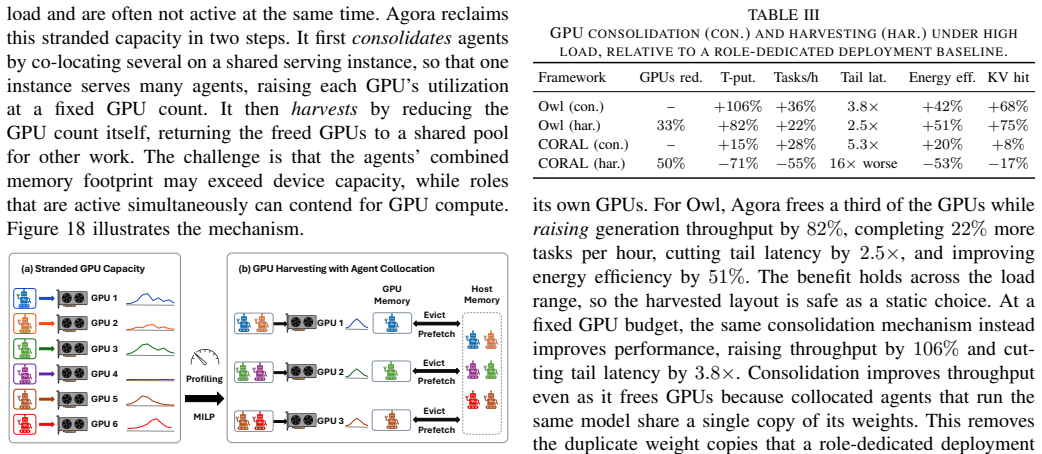
The paper's central claim is that agentic execution is fundamentally fragmented and heterogeneous, unlike both traditional CPU-centric cloud services and monolithic LLM inference. Each request unfolds as a data-dependent graph of model calls, tool invocations, and control decisions that repeatedly cross the CPU–GPU boundary, and the paper shows that the CPU sits on the critical path because orchestration and tool execution run on the host. This fragmentation produces low average CPU and GPU utilization with sudden bursts, GPU pools where some devices saturate while others idle, and host cores whose caches and branch predictors are thrashed when many agents are multiplexed onto them. The paper presents these as three architectural mismatches of conventional uniform servers: stranded capacity, inefficient homogeneous CPU provisioning across roles, and degraded microarchitectural locality. Guided by these findings, the paper builds a prototype server runtime called Agora and reports that CPU harvesting recovers 95% of a co-located workload's standalone throughput while limiting agent slowdown to under 3%, GPU harvesting frees a third of the GPUs while raising generation throughput by 82%, and role-aware pooling cuts tool CPU demand by up to 46%.
Load-bearing premise
The load-bearing premise is that the production fleet measurements correctly attributed time, tool activity, and CPU metrics to the three host roles (scheduler, orchestrator, runner); if that attribution is wrong or the instrumentation perturbed the workloads, the role-provisioning and locality conclusions would not follow.
Editorial extensions
If this is right
- Static, uniform CPU/GPU provisioning is the wrong operating point for agentic workloads: provisioning for the peak strands capacity between bursts, while provisioning for the average leaves no headroom when tool bursts arrive.
- Host-side orchestration and tool execution are first-class contributors to end-to-end latency, so optimizing only the inference engine leaves a large fraction of agent latency unaddressed.
- Role-aware core pools and task pinning reduce tool CPU demand and worst-case tool latency while retaining about 99% of serving throughput, so the host should be managed as heterogeneous role-specific pools, not one shared pool.
- Homogeneous workflows can be consolidated onto fewer GPUs with shared weights and larger KV caches, raising throughput and cutting tail latency, whereas parallel, tool-saturated workflows should not have GPUs harvested.
- Future hardware should offload agent scheduling and context switching from the OS, partition microarchitectural structures to isolate agents, and mix core types matched to the scheduler, orchestrator, and runner roles.
Reading between the lines
- If fragmentation is structural rather than a quirk of today's frameworks, then making workflow graphs visible to the runtime (as host-orchestrated workflows already do) should allow substantially deeper burst anticipation than Agora's hint mechanism, for example by prefetching tool execution environments before a stage releases its tool calls.
- The taxonomy implies that a workload that shifts between sequential and parallel stages mid-run would need policy switches on the fly; Agora's tuning hints at this, but a systematic study of policy-switching dynamics would test whether the grace-window and retreat parameters remain stable across transitions.
- The finding that tasks and tools, not just framework architecture, set the resource signature suggests that agentic benchmark suites should be stratified along the taxonomy dimensions, since a single framework's CPU-to-GPU ratio does not predict another's.
- At fleet scale, the three roles could be separated across machines—dedicated control-plane servers and runner servers—rather than pooled within each server; this is a direct extension of the role-pooling result that the paper does not evaluate.
Editorial analysis
A structured set of objections, weighed in public.
Referee Report
Summary. This paper presents a taxonomy of agentic AI workflows along three dimensions (orchestration, execution structure, model composition) and combines a production fleet study at Microsoft Azure with a controlled study of four open-source frameworks (SWE-Agent, Trae, CORAL, Owl) to argue that agentic execution is fragmented and heterogeneous: requests repeatedly cross the CPU-GPU boundary, host CPU utilization is low on average with sudden bursts, GPU power draw is uneven across devices, and host roles (schedulers, orchestrators, runners) exhibit distinct resource and PMU signatures. From these observations the paper derives three architectural mismatches of conventional uniform servers and builds Agora, a prototype that harvests idle CPU cores, consolidates and harvests GPU capacity, and pools/pins cores by role. Agora is evaluated on real hardware and reports substantial utilization and throughput gains while preserving agent tail latency, including a negative result for GPU harvesting on a parallel tool-saturated workload.
Significance. If the characterization is sound, this is a useful and timely contribution: it is the first production-scale architectural study of agentic AI that the reviewer is aware of, it provides a concrete taxonomy that later systems work can use, and it demonstrates three concrete mechanisms (CPU harvesting, GPU consolidation, role-aware pooling) on real hardware. The paper honestly reports the negative GPU-harvesting result for CORAL, which strengthens credibility, and the controlled study independently reproduces the core fragmentation and burstiness claims. The taxonomy and the Agora design principles are likely to influence future server design for agentic workloads. However, the paper's load-bearing role-heterogeneity claims rest on a fleet-attribution methodology that is not described, and most quantitative results are reported without variance or sensitivity analysis, so the significance is conditional on those being addressed.
major comments (3)
- [Section IV, Figures 9-10] The fleet study's role-attribution methodology is absent and this is load-bearing for the central claim that 'different software roles make homogeneous CPU provisioning inefficient.' Section IV states only that 'we collect a 24-hour trace of production agentic requests and attribute time, tool activity, and CPU metrics to software roles (schedulers, orchestrators, and runners),' and Figure 9's caption refers to 'production hosts dedicated to these roles.' No description is given of how hosts or processes were classified, how the trace was sampled, whether the dedicated hosts have identical CPU/memory/NUMA configurations, or how PMU counters were collected. If the dedicated hosts differ in hardware, the resource signatures in Figures 9-10 confound software role with machine type. This directly undermines the role-aware pooling design in Section V-B and the abstract's claim about homogeneous CPU provisioning. The authors should provide the classification rules, host inventory, and either a trace release or an explicit statement of the confound and its likely direction.
- [Section V-A, Tables II-III and Figures 13-14] The central quantitative claims are reported without any measure of variance. For example, Table II reports '95.0%' average harvested throughput and '2.8%' slowdown at low load, and Table III reports '82%' generation-throughput improvement and '2.5x' tail-latency reduction for Owl, all as single numbers. No error bars, confidence intervals, or number of repeated runs are given for these results, nor for the medians in Figures 13-14. Since the paper's conclusions are partly quantitative (e.g., 'CPU harvesting recovers 95% of a co-located workload's standalone throughput'), the absence of variance makes it impossible to assess whether the reported benefits are stable or reflect a single favorable run. The authors should report means and variances over at least 3-5 runs, and ideally per-framework breakdowns for the headline averages.
- [Section V-A and Section V-B (Figures 16, 19; Tables II-V)] Agora's mechanisms depend on several free parameters (grace-window duration, recovery-window duration, tool-type hint threshold, runner-pool pinning width), but the paper does not describe how these are set, whether they are tuned per workload, or how sensitive the results are to them. The text says Agora 'automatically tunes all of these mechanisms to the running workload' (Section V), yet no tuning algorithm, convergence criterion, or sensitivity study is provided. A reader cannot tell whether the reported gains in Tables II-V are robust or are artifacts of hand-picked parameters. The authors should either provide the tuning procedure or include a sensitivity analysis over the key parameter ranges.
minor comments (4)
- [Figures 2, 4, 9, 10] Several figure captions and axis labels contain unreadable glyph sequences (e.g., Figure 2, Figure 4, Figure 9, Figure 10). The paper should be re-rendered so that all text in figures is legible, and Figures 9-10 should have explicitly labeled axes and units.
- [Section I and References [57], [76]] The paper claims to present the 'first' architectural characterization of agentic AI, but references [57] and [76] appear to be prior characterizations of agentic CPU usage and workload characteristics. The text should explicitly distinguish the contributions here (production fleet scale, role attribution, PMU-level analysis) from those prior works, or soften the 'first' claim.
- [Section IV-B, Figure 15] The involuntary-context-switch measurement (Figure 15) is presented for only Owl and SWE-Agent at one load point; it would be stronger to show all four frameworks or to state why the other two are omitted.
- [Section V-A.2, Table III] The CORAL GPU-harvesting negative result (71% throughput loss) deserves a more prominent discussion, since it is the key boundary condition for the harvesting design. The current text mentions it but does not connect it to the taxonomy-based adaptation rule until the following paragraph; making the connection explicit earlier would improve readability.
Circularity Check
No load-bearing circularity; the agentic-fragmentation claims rest on independent measurements, and Agora is evaluated in-paper against baselines.
full rationale
The paper's derivation chain is not circular. The central claim that agentic execution is fragmented and heterogeneous is supported by two independent empirical measurements: a 24-hour production fleet trace (Section IV: "we collect a 24-hour trace of production agentic requests and attribute time, tool activity, and CPU metrics to software roles") and a controlled study of four open-source frameworks on a 96-core AMD EPYC server with eight A100 GPUs. These are external measurements, not outputs of a fitted model or of an assumed taxonomy. The taxonomy (Section III, Table I) is descriptive: it organizes workflows along orchestration, execution-structure, and model-composition axes, and the "implication for platform design" column states design observations rather than equations that reduce to themselves. Agora's mechanisms (CPU harvesting, GPU consolidation, role-aware pooling and pinning) are evaluated in this paper against static baselines (Tables II-V, Figures 16-19), so their claimed benefits are measured, not imported. The authors' prior systems HardHarvest [64] and Mosaic [61] are cited as related harvesting/pooling background and as building blocks, but nothing in the central characterization or the Agora evaluation depends on accepting those citations as proof; the paper states the design is "guided by our findings" from Sections IV-V. This is minor self-citation, not load-bearing circularity. The one notable weakness is methodological rather than circular: Section IV gives no procedure for classifying hosts or processes into scheduler/orchestrator/runner roles, so Figures 9-10 could be confounded by hardware differences across "dedicated" hosts. That is a verifiability and correctness risk, not a reduction of a prediction to its inputs. No self-definitional, fitted-input-called-prediction, uniqueness-imported, or ansatz-smuggling step was found.
Assumptions & free parameters
free parameters (4)
- grace window duration in CPU harvesting
- recovery window duration in CPU harvesting
- tool-type hint threshold for compute-bound vs I/O-bound tools
- runner pool pinning width =
2 tasks per pool
assumptions (5)
- domain assumption Production telemetry can be attributed to schedulers, orchestrators, and runners accurately.
- domain assumption Four open-source frameworks and selected task sets represent the space of agentic AI workloads.
- domain assumption GPU power draw is a valid proxy for GPU compute activity.
- domain assumption Results on one server platform generalize to other datacenter servers.
- domain assumption Instrumentation does not perturb production workloads.
Cite this review
Pith. "Pith review of Architectural Implications of Agentic AI Workflows." pith.science (2026). https://pith.science/paper/SLJBTUYK
@misc{pith2026260804458,
  author       = {Pith},
  title        = {Pith review of: Architectural Implications of Agentic AI Workflows},
  year         = {2026},
  howpublished = {\url{https://pith.science/paper/SLJBTUYK}},
  note         = {Machine review of arXiv:2608.04458}
}
read the original abstract
Agentic AI is emerging in datacenters, but its architectural implications remain unexplored. We organize agentic workflows in a taxonomy and present its first architectural characterization with a production study at Microsoft Azure and a controlled study of open-source frameworks. We show that agentic execution is fragmented and heterogeneous. Requests expand into a workflow of LLM inferences, tool invocations, and orchestration decisions that repeatedly cross the CPU-GPU boundary. Our taxonomy explains how this fragmentation turns into resource demand. As orchestration and tools run on the host, the CPU sits on the critical path. Execution structure sets the load over time, which stays low with sudden spikes. Model composition sets how evenly the workflow uses the GPUs. Diversity in tasks and tools widens this range even further. These characteristics expose architectural mismatches of conventional uniform servers. Fragmented execution strands CPU and GPU capacity despite bursty demand. Different software roles make homogeneous CPU provisioning inefficient. Finally, multiplexing many agents onto shared cores degrades microarchitectural locality. Guided by our findings, we derive implications for agentic servers and examine them through Agora, our prototype for commodity servers. Agora dynamically harvests idle CPU cores for co-located throughput work, while protecting agentic tail latency against tool spikes. It oversubscribes GPU memory by placing more agents on each GPU, prefetching the next agent's state to hide swap latency. To match the machine to the heterogeneous roles, Agora pools cores by role and applies affinity-aware scheduling to restore locality. It automatically tunes mechanisms to the workload. Agora improves utilization and server throughput while preserving agent tail latency. Our insights also identify key directions for future server architectures for agentic AI.
Figures


Figures from the paper (11 more)






Reference graph
Works this paper leans on
-
[1]
Software-Defined Agentic Serving,
S. Agarwal, M. Laju, J. Srinivasa, M. Lee, and A. Akella, “Software-Defined Agentic Serving,” 2026. [Online]. Available: https: //arxiv.org/abs/2601.03197
-
[2]
Micro-Sliced Virtual Processors to Hide the Effect of Discontinuous CPU Availability for Consolidated Systems,
J. Ahn, C. H. Park, and J. Huh, “Micro-Sliced Virtual Processors to Hide the Effect of Discontinuous CPU Availability for Consolidated Systems,” inProceedings of the 47th Annual IEEE/ACM International Symposium on Microarchitecture (MICRO ’14), 2014
2014
-
[3]
LLM in a flash: Efficient Large Language Model Inference with Limited Memory,
K. Alizadeh, I. Mirzadeh, D. Belenko, K. Khatamifard, M. Cho, C. C. D. Mundo, M. Rastegari, and M. Farajtabar, “LLM in a flash: Efficient Large Language Model Inference with Limited Memory,”arXiv preprint arXiv:2312.11514, 2024
arXiv 2024
-
[4]
Agentic AI with AWS Databases,
Amazon AWS, “Agentic AI with AWS Databases,” https://aws.amazon. com/products/databases/agentic-ai/, 2026
2026
-
[5]
Agent Computers. Powering the Future of Agentic AI
AMD, “Agent Computers. Powering the Future of Agentic AI.” https://www.amd.com/en/products/processors/consumer/agent- computers.html, 2026
2026
-
[6]
Processing Architecture for Power Efficiency and Performance,
ARM, “Processing Architecture for Power Efficiency and Performance,”
-
[7]
Arm AGI CPU: The world’s most efficient agentic CPU,
Arm, “Arm AGI CPU: The world’s most efficient agentic CPU,” https: //www.arm.com/products/cloud-datacenter/arm-agi-cpu, 2026
2026
-
[8]
Efficient and Scalable Agentic AI with Heterogeneous Systems,
Z. Asgar, M. Nguyen, and S. Katti, “Efficient and Scalable Agentic AI with Heterogeneous Systems,” 2025. [Online]. Available: https://arxiv.org/abs/2507.19635
arXiv 2025
Show all 86 references
-
[9]
Small Language Models are the Future of Agentic AI,
P. Belcak, G. Heinrich, S. Diao, Y . Fu, X. Dong, S. Muralidharan, Y . C. Lin, and P. Molchanov, “Small Language Models are the Future of Agentic AI,” 2025. [Online]. Available: https://arxiv.org/abs/2506.02153
2025 arXiv
-
[10]
Tokendance: Scaling multi-agent llm serving via collective kv cache sharing,
Z. Bian, F. Wu, C. Zhang, H. Dong, Y . Liang, and Y . Zhuo, “Tokendance: Scaling multi-agent llm serving via collective kv cache sharing,”arXiv preprint arXiv:2604.03143, 2026
2026 arXiv
-
[11]
Murakkab: Resource-Efficient Agentic Workflow Orchestration in Cloud Platforms,
G. I. Chaudhry, E. Choukse, H. Qiu, I. Goiri, R. Fonseca, A. Belay, and R. Bianchini, “Murakkab: Resource-Efficient Agentic Workflow Orchestration in Cloud Platforms,” in20th USENIX Symposium on Operating Systems Design and Implementation (OSDI ’26), 2026
2026
-
[12]
ReConcile: Round-Table Conference Improves Reasoning via Consensus among Diverse LLMs,
J. C.-Y . Chen, S. Saha, and M. Bansal, “ReConcile: Round-Table Conference Improves Reasoning via Consensus among Diverse LLMs,” inProceedings of the 62nd Annual Meeting of the Association for Computational Linguistics (Volume 1: Long Papers). Association for Computational Lin...
2024
-
[13]
Barbarians at the Gate: How AI is Upending Systems Research,
A. Chenget al., “Barbarians at the Gate: How AI is Upending Systems Research,” 2025. [Online]. Available: https://arxiv.org/abs/2510.06189
2025
-
[14]
Fast and Flexible Multi-Agent Automation Framework,
crewAI, “Fast and Flexible Multi-Agent Automation Framework,” https: //github.com/crewaiinc/crewai, 2026
2026
-
[15]
RPCValet: NI-Driven Tail- Aware Balancing ofµs-Scale RPCs,
A. Daglis, M. Sutherland, and B. Falsafi, “RPCValet: NI-Driven Tail- Aware Balancing ofµs-Scale RPCs,” inProceedings of the Twenty- Fourth International Conference on Architectural Support for Program- ming Languages and Operating Systems (ASPLOS ’19), 2019
2019
-
[16]
FlashAttention: Fast and Memory-Efficient Exact Attention with IO-Awareness,
T. Dao, D. Y . Fu, S. Ermon, A. Rudra, and C. R ´e, “FlashAttention: Fast and Memory-Efficient Exact Attention with IO-Awareness,”arXiv preprint arXiv:2205.14135, 2022
2022 arXiv
-
[17]
Hybrid LLM: Cost-Efficient and Quality-Aware Query Routing,
D. Ding, A. Mallick, C. Wang, R. Sim, S. Mukherjee, V . Ruehle, L. V . S. Lakshmanan, and A. Awadallah, “Hybrid LLM: Cost-Efficient and Quality-Aware Query Routing,” inProceedings of the International Conference on Learning Representations (ICLR ’24), 2024
2024
-
[18]
Agentic AI Market Size,
Fortune Business Insights, “Agentic AI Market Size,” https://www. fortunebusinessinsights.com/agentic-ai-market-114233, 2026
2026
-
[19]
Agentic AI Requires More CPUs,
S. Fowler, J. Segovia, L. Leung, L. Fordham, and S. Holt, “Agentic AI Requires More CPUs,” https://www.intel.com/content/www/us/en/ content-details/916705/agentic-ai-requires-more-cpus.html, 2026
2026
-
[20]
Memory-Harvesting VMs in Cloud Platforms,
A. Fuerst, S. Novakovic, I. Goiri, G. I. Chaudhry, P. Sharma, K. Arya, K. Broas, E. Bak, M. Iyigun, and R. Bianchini, “Memory-Harvesting VMs in Cloud Platforms,” inProceedings of the 27th ACM International Conference on Architectural Support for Programming Languages and Opera...
2022
-
[21]
An Open-Source Bench- mark Suite for Microservices and Their Hardware-Software Implications for Cloud & Edge Systems,
Y . Gan, Y . Zhang, D. Cheng, A. Shetty, P. Rathi, N. Katarki, A. Bruno, J. Hu, B. Ritchken, B. Jackson, K. Hu, M. Pancholi, Y . He, B. Clancy, C. Colen, F. Wen, C. Leung, S. Wang, L. Zaruvinsky, M. Espinosa, R. Lin, Z. Liu, J. Padilla, and C. Delimitrou, “An Open-Source Bench...
2019
-
[22]
The world’s most widely adopted AI developer tool,
GitHub, “The world’s most widely adopted AI developer tool,” https: //github.com/features/copilot, 2024
2024
-
[23]
Acceler- ating scientific discovery with co-scientist,
J. Gottweis, W.-H. Weng, A. Daryin, T. Tu, P. Sirkovic, A. Myaskovsky, G. Glowaty, F. Weissenberger, A. Orlandi, D. Popoviciet al., “Acceler- ating scientific discovery with co-scientist,”Nature, pp. 1–3, 2026
2026
-
[24]
The Architectural Implications of Facebook’s DNN-Based Personalized Rec- ommendation,
U. Gupta, C.-J. Wu, X. Wang, M. Naumov, B. Reagen, D. Brooks, B. Cottel, K. Hazelwood, M. Hempstead, B. Jia, H.-H. S. Lee, A. Male- vich, D. Mudigere, M. Smelyanskiy, L. Xiong, and X. Zhang, “The Architectural Implications of Facebook’s DNN-Based Personalized Rec- ommendation,...
2020
-
[25]
MetaGPT: Meta Programming for A Multi-Agent Collaborative Framework,
S. Hong, M. Zhuge, J. Chen, X. Zheng, Y . Cheng, C. Zhang, J. Wang, Z. Wang, S. K. S. Yau, Z. Lin, L. Zhou, C. Ran, L. Xiao, C. Wu, and J. Schmidhuber, “MetaGPT: Meta Programming for A Multi-Agent Collaborative Framework,” 2024. [Online]. Available: https://arxiv.org/abs/2308.00352
2024 arXiv
-
[26]
OWL: Optimized Workforce Learning for General Multi-Agent Assistance in Real-World Task Automation,
M. Hu, Y . Zhou, W. Fan, Y . Nie, B. Xia, T. Sun, Z. Ye, Z. Jin, Y . Li, Q. Chen, Z. Zhang, Y . Wang, Q. Ye, B. Ghanem, P. Luo, and G. Li, “OWL: Optimized Workforce Learning for General Multi-Agent Assistance in Real-World Task Automation,” 2025. [Online]. Available: https://a...
2025 arXiv
-
[27]
The nanoPU: A Nanosecond Network Stack for Data- centers,
S. Ibanez, A. Mallery, S. Arslan, T. Jepsen, M. Shahbaz, C. Kim, and N. McKeown, “The nanoPU: A Nanosecond Network Stack for Data- centers,” inProceedings of the 15th USENIX Symposium on Operating Systems Design and Implementation (OSDI’21), 2021
2021
-
[28]
What is a multi-agent system?
IBM, “What is a multi-agent system?” https://www.ibm.com/think/ topics/multiagent-system, 2026
2026
-
[29]
Agentic AI in enterprise workflow automation,
A. Jain and A. Biazetti, “Agentic AI in enterprise workflow automation,” https://developer.ibm.com/articles/agentic-ai-workflow-automation/, 2026
2026
-
[30]
Profiling a warehouse-scale computer,
S. Kanev, J. P. Darago, K. Hazelwood, P. Ranganathan, T. Moseley, G.-Y . Wei, and D. Brooks, “Profiling a warehouse-scale computer,” in Proceedings of the 42nd Annual International Symposium on Computer Architecture (ISCA’15), 2015
2015
-
[31]
Thunderagent: A simple, fast and program-aware agentic inference system,
H. Kang, Z. Li, X. Yang, W. Xu, Y . Chen, J. Wang, B. Chen, T. Krishna, C. Xu, and S. Arora, “Thunderagent: A simple, fast and program-aware agentic inference system,”arXiv preprint arXiv:2602.13692, 2026
2026 arXiv
-
[32]
A Hardware Accelerator for Protocol Buffers,
S. Karandikar, C. Leary, C. Kennelly, J. Zhao, D. Parimi, B. Nikolic, K. Asanovic, and P. Ranganathan, “A Hardware Accelerator for Protocol Buffers,” inProceedings of the 54th Annual IEEE/ACM International Symposium on Microarchitecture (MICRO’21), 2021
2021
-
[33]
CDPU: Co-designing Compression and Decom- pression Processing Units for Hyperscale Systems,
S. Karandikar, A. N. Udipi, J. Choi, J. Whangbo, J. Zhao, S. Kanev, E. Lim, J. Alakuijala, V . Madduri, Y . S. Shao, B. Nikolic, K. Asanovic, and P. Ranganathan, “CDPU: Co-designing Compression and Decom- pression Processing Units for Hyperscale Systems,” inProceedings of the ...
2023
-
[34]
MorphCore: An Energy-Efficient Microarchitecture for High Performance ILP and High Throughput TLP,
Khubaib, M. A. Suleman, M. Hashemi, C. Wilkerson, and Y . N. Patt, “MorphCore: An Energy-Efficient Microarchitecture for High Performance ILP and High Throughput TLP,” inProceedings of the 45th Annual IEEE/ACM International Symposium on Microarchitecture (MICRO ’12), 2012
2012
-
[35]
LIA: A Single-GPU LLM Inference Acceleration with Cooper- ative AMX-Enabled CPU-GPU Computation and CXL Offloading,
H. Kim, N. Wang, Q. Xia, J. Huang, A. Yazdanbakhsh, and N. S. Kim, “LIA: A Single-GPU LLM Inference Acceleration with Cooper- ative AMX-Enabled CPU-GPU Computation and CXL Offloading,” in Proceedings of the 52nd Annual International Symposium on Computer Architecture (ISCA ’25), 2025
2025
-
[36]
The cost of dynamic reasoning: Demystifying AI agents and test-time scaling from an AI infrastructure perspective,
J. Kim, B. Shin, J. Chung, and M. Rhu, “The cost of dynamic reasoning: Demystifying AI agents and test-time scaling from an AI infrastructure perspective,”arXiv preprint arXiv:2506.04301, 2025
2025
-
[37]
PhaseWeave: Phase-Aware Execution on Heterogeneous Chiplet Architectures for Dat- acenters,
J. Kim, C. Zhang, I. Goiri, C. Rossbach, and J. Stojkovic, “PhaseWeave: Phase-Aware Execution on Heterogeneous Chiplet Architectures for Dat- acenters,” inProceedings of the 53rd Annual International Symposium on Computer Architecture (ISCA ’26), 2026
2026
-
[38]
Single-ISA heterogeneous multi-core architectures for multithreaded workload performance,
R. Kumar, D. Tullsen, P. Ranganathan, N. Jouppi, and K. Farkas, “Single-ISA heterogeneous multi-core architectures for multithreaded workload performance,” inProceedings of the 31st Annual International Symposium on Computer Architecture (ISCA’04), 2004
2004
-
[39]
Efficient Memory Management for Large Language Model Serving with PagedAttention,
W. Kwon, Z. Li, S. Zhuang, Y . Sheng, L. Zheng, C. H. Yu, J. E. Gonzalez, H. Zhang, and I. Stoica, “Efficient Memory Management for Large Language Model Serving with PagedAttention,” inProceedings of the 29th Symposium on Operating Systems Principles (SOSP ’23), 2023. 12
2023
-
[40]
langgraph: Low-level orchestration framework for building stateful agents,
LangChain, “langgraph: Low-level orchestration framework for building stateful agents,” https://github.com/langchain-ai/langgraph, 2026
2026
-
[41]
AiF: Accelerating On-Device LLM Inference Using In-Flash Processing,
J. Lee, H. Kim, S. Oh, M. Chun, M. Kim, and J. Kim, “AiF: Accelerating On-Device LLM Inference Using In-Flash Processing,” inProceedings of the 52nd Annual International Symposium on Computer Architecture (ISCA ’25), 2025
2025
-
[42]
H2-LLM: Hardware-Dataflow Co- Exploration for Heterogeneous Hybrid-Bonding-based Low-Batch LLM Inference,
C. Li, Y . Yin, X. Wu, J. Zhu, Z. Gao, D. Niu, Q. Wu, X. Si, Y . Xie, C. Zhang, and G. Sun, “H2-LLM: Hardware-Dataflow Co- Exploration for Heterogeneous Hybrid-Bonding-based Low-Batch LLM Inference,” inProceedings of the 52nd Annual International Symposium on Computer Architec...
2025
-
[43]
Kernelevolve: Scaling agentic kernel coding for heterogeneous ai accelerators at meta,
G. Liao, H. Qin, Y . Wang, A. Golden, M. Kuchnik, Y . Yetim, J. J. Ang, C. Fu, Y . He, S. Hsiaet al., “Kernelevolve: Scaling agentic kernel coding for heterogeneous ai accelerators at meta,”arXiv preprint arXiv:2512.23236, 2025
2025 arXiv
-
[44]
Agentix: An Efficient Serving Engine for LLM Agents as General Programs,
M. Luo, X. Shi, C. Cai, T. Zhang, J. Wong, Y . Wang, C. Wang, Y . Huang, Z. Chen, J. E. Gonzalez, and I. Stoica, “Agentix: An Efficient Serving Engine for LLM Agents as General Programs,” inProceedings of the 23rd USENIX Symposium on Networked Systems Design and Implementation...
2026
-
[45]
Decentralized Multi-Agent Systems with Shared Context,
Y . Mao and A. Mirhoseini, “Decentralized Multi-Agent Systems with Shared Context,” 2026. [Online]. Available: https://arxiv.org/abs/2606. 10662
2026
-
[46]
GAIA: A Benchmark for General AI Assistants,
G. Mialon, C. Fourrier, C. Swift, T. Wolf, Y . LeCun, and T. Scialom, “GAIA: A Benchmark for General AI Assistants,” inInternational Conference on Learning Representations, 2024. [Online]. Available: https://arxiv.org/abs/2311.12983
2024 arXiv
-
[47]
SpotServe: Serving Generative Large Language Models on Preemptible Instances,
X. Miao, C. Shi, J. Duan, X. Xi, D. Lin, B. Cui, and Z. Jia, “SpotServe: Serving Generative Large Language Models on Preemptible Instances,” inProceedings of the 29th ACM International Conference on Archi- tectural Support for Programming Languages and Operating Systems (ASPLO...
2024
-
[48]
AutoGen: A programming framework for agentic AI,
Microsoft, “AutoGen: A programming framework for agentic AI,” https: //github.com/microsoft/autogen, 2026
2026
-
[49]
Enhancing Server Efficiency in the Face of Killer Microseconds,
A. Mirhosseini, A. Sriraman, and T. F. Wenisch, “Enhancing Server Efficiency in the Face of Killer Microseconds,” inProceedings of the IEEE International Symposium on High Performance Computer Architecture (HPCA’19), 2019
2019
-
[50]
AlphaEvolve: A coding agent for scientific and algorithmic discovery,
A. Novikov, N. V ˜u, M. Eisenberger, E. Dupont, P.-S. Huang, A. Z. Wagner, S. Shirobokov, B. Kozlovskii, F. J. R. Ruiz, A. Mehrabian, M. P. Kumar, A. See, S. Chaudhuri, G. Holland, A. Davies, S. Nowozin, P. Kohli, and M. Balog, “AlphaEvolve: A coding agent for scientific and a...
2025 arXiv
-
[51]
TensorRT-LLM’s Documentation,
NVIDIA, “TensorRT-LLM’s Documentation,” https://nvidia.github.io/ TensorRT-LLM/, 2024
2024
-
[52]
Web Search,
Open AI, “Web Search,” https://developers.openai.com/api/docs/guides/ tools-web-search, 2026
2026
-
[53]
Splitwise: Efficient generative LLM inference using phase splitting,
P. Patel, E. Choukse, C. Zhang, A. Shah, I. Goiri, S. Maleki, and R. Bianchini, “Splitwise: Efficient generative LLM inference using phase splitting,” inISCA, 2024
2024
-
[54]
Verimoa: A mixture-of-agents framework for spec-to-hdl generation,
H. Ping, A. Bhattacharjee, P. Zhang, S. Li, W. Yang, A. Cheng, X. Zhang, J. Thomason, A. Jannesari, N. Ahmedet al., “Verimoa: A mixture-of-agents framework for spec-to-hdl generation,”arXiv preprint arXiv:2510.27617, 2025
2025 arXiv
-
[55]
Enterprise deep research: Steerable multi-agent deep research for enterprise analytics,
A. Prabhakar, R. Ram, Z. Chen, S. Savarese, F. Wang, C. Xiong, H. Wang, and W. Yao, “Enterprise deep research: Steerable multi-agent deep research for enterprise analytics,”arXiv preprint arXiv:2510.17797, 2025
2025
-
[56]
CORAL: Towards Autonomous Multi-Agent Evolution for Open-Ended Discovery,
A. Qu, H. Zheng, Z. Zhou, Y . Yan, Y . Tang, S. Y . Ong, F. Hong, K. Zhou, C. Jiang, M. Kong, J. Zhu, X. Jiang, S. Li, C. Wu, B. K. H. Low, J. Zhao, and P. P. Liang, “CORAL: Towards Autonomous Multi-Agent Evolution for Open-Ended Discovery,” 2026. [Online]. Available: https://...
2026 arXiv
-
[57]
A CPU-Centric Perspective on Agentic AI,
R. Raj, H. Wang, and T. Krishna, “A CPU-Centric Perspective on Agentic AI,” 2025. [Online]. Available: https://arxiv.org/abs/2511.00739
2025 arXiv
-
[58]
AOrchestra: Automating Sub- Agent Creation for Agentic Orchestration,
J. Ruan, Z. Xu, Y . Peng, F. Ren, Z. Yu, X. Liang, J. Xiang, B. Liu, C. Wu, Y . Luo, and J. Zhang, “AOrchestra: Automating Sub- Agent Creation for Agentic Orchestration,” 2026. [Online]. Available: https://arxiv.org/abs/2602.03786
2026
-
[59]
Paper2Code: Automating Code Generation from Scientific Papers in Machine Learning,
M. Seo, J. Baek, S. Lee, and S. J. Hwang, “Paper2Code: Automating Code Generation from Scientific Papers in Machine Learning,” 2025. [Online]. Available: https://arxiv.org/abs/2504.17192
2025
-
[60]
Accelerometer: Understanding Accel- eration Opportunities for Data Center Overheads at Hyperscale,
A. Sriraman and A. Dhanotia, “Accelerometer: Understanding Accel- eration Opportunities for Data Center Overheads at Hyperscale,” in Proceedings of the Twenty-Fifth International Conference on Archi- tectural Support for Programming Languages and Operating Systems (ASPLOS’20), 2020
2020
-
[61]
Mosaic: Harnessing the Micro-Architectural Resources of Servers in Serverless Environments,
J. Stojkovic, E. Choukse, E. Saurez, I. Goiri, and J. Torrellas, “Mosaic: Harnessing the Micro-Architectural Resources of Servers in Serverless Environments,” inProceedings of the 57th IEEE/ACM International Symposium on Microarchitecture (MICRO’24), 2024
2024
-
[62]
AccelFlow: Orchestrating an On-Package Ensemble of Fine-Grained Accelerators for Microservices,
J. Stojkovic, A. Farrell, Z. Gong, C. J. Hughes, and J. Torrellas, “AccelFlow: Orchestrating an On-Package Ensemble of Fine-Grained Accelerators for Microservices,” inProceedings of the IEEE Interna- tional Symposium on High Performance Computer Architecture (HPCA ’26), 2026
2026
-
[63]
µManycore: A Cloud-Native CPU for Tail at Scale,
J. Stojkovic, C. Liu, M. Shahbaz, and J. Torrellas, “µManycore: A Cloud-Native CPU for Tail at Scale,” inProceedings of the 50th Annual International Symposium on Computer Architecture (ISCA’23), 2023
2023
-
[64]
HardHarvest: Hardware-Supported Core Harvesting for Microservices,
J. Stojkovic, C. Liu, M. Shahbaz, and J. Torrellas, “HardHarvest: Hardware-Supported Core Harvesting for Microservices,” inProceed- ings of the 52nd Annual International Symposium on Computer Archi- tecture (ISCA’25), 2025
2025
-
[65]
ToolOrchestra: Elevating Intelligence via Efficient Model and Tool Orchestration,
H. Su, S. Diao, X. Lu, M. Liu, J. Xu, X. Dong, Y . Fu, P. Belcak, H. Ye, H. Yin, Y . Dong, E. Bakhturina, T. Yu, Y . Choi, J. Kautz, and P. Molchanov, “ToolOrchestra: Elevating Intelligence via Efficient Model and Tool Orchestration,” 2025. [Online]. Available: https://arxiv.o...
2025
-
[66]
DCPerf: An Open-Source, Battle-Tested Performance Benchmark Suite for Dat- acenter Workloads,
W. Su, A. Dhanotia, C. Torres, J. Gandhi, N. Gholkar, S. Kanaujia, M. Naumov, K. Subramanian, V . Andrei, Y . Yuan, and C. Tang, “DCPerf: An Open-Source, Battle-Tested Performance Benchmark Suite for Dat- acenter Workloads,” inProceedings of the 52nd Annual International Sympo...
2025
-
[67]
Trae Agent: An LLM-based Agent for Software Engineering with Test-time Scaling,
T. R. Team, P. Gao, Z. Tian, X. Meng, X. Wang, R. Hu, Y . Xiao, Y . Liu, Z. Zhang, J. Chen, C. Gao, Y . Lin, Y . Xiong, C. Peng, and X. Liu, “Trae Agent: An LLM-based Agent for Software Engineering with Test-time Scaling,” 2025. [Online]. Available: https://arxiv.org/abs/2507.23370
2025 arXiv
-
[68]
Attention is All You Need,
A. Vaswani, N. Shazeer, N. Parmar, J. Uszkoreit, L. Jones, A. N. Gomez, Ł. Kaiser, and I. Polosukhin, “Attention is All You Need,”Advances in Neural Information Processing Systems (NeurIPS), 2017
2017
-
[69]
SmartHarvest: Har- vesting Idle CPUs Safely and Efficiently in the Cloud,
Y . Wang, K. Arya, M. Kogias, M. Vanga, A. Bhandari, N. J. Yadwadkar, S. Sen, S. Elnikety, C. Kozyrakis, and R. Bianchini, “SmartHarvest: Har- vesting Idle CPUs Safely and Efficiently in the Cloud,” inProceedings of the Sixteenth European Conference on Computer Systems (EuroSy...
2021
-
[70]
WSC-LLM: Efficient LLM Service and Architecture Co- exploration for Wafer-scale Chips,
Z. Xu, D. Kong, J. Liu, J. Li, J. Hou, X. Dai, C. Li, S. Wei, Y . Hu, and S. Yin, “WSC-LLM: Efficient LLM Service and Architecture Co- exploration for Wafer-scale Chips,” inProceedings of the 52nd Annual International Symposium on Computer Architecture (ISCA ’25), 2025
2025
-
[71]
SWE-agent: Agent-Computer Interfaces Enable Automated Software Engineering,
J. Yang, C. E. Jimenez, A. Wettig, K. Lieret, S. Yao, K. Narasimhan, and O. Press, “SWE-agent: Agent-Computer Interfaces Enable Automated Software Engineering,” 2024. [Online]. Available: https: //arxiv.org/abs/2405.15793
2024 arXiv
-
[72]
React: Synergizing reasoning and acting in language models,
S. Yao, J. Zhao, D. Yu, N. Du, I. Shafran, K. Narasimhan, and Y . Cao, “React: Synergizing reasoning and acting in language models,” 2023. [Online]. Available: https://arxiv.org/abs/2210.03629
2023 arXiv
-
[73]
Speculative Actions: A Lossless Framework for Faster Agentic Systems,
N. Ye, A. Ahuja, G. Liargkovas, Y . Lu, K. Kaffes, and T. Peng, “Speculative Actions: A Lossless Framework for Faster Agentic Systems,” 2026. [Online]. Available: https://arxiv.org/abs/2510.04371
2026 arXiv
-
[74]
Orca: A Distributed Serving System for Transformer-Based Generative Models,
G.-I. Yu, J. S. Jeong, G.-W. Kim, S. Kim, and B.-G. Chun, “Orca: A Distributed Serving System for Transformer-Based Generative Models,” inOSDI, 2022
2022
-
[75]
Pythia: Exploiting workflow predictability for efficient agent-native llm serving,
S. Yu, J. Shu, Y . Ni, K. Qian, X. Li, Y . Wang, J. Zhang, Z. Xu, S. Yang, L. Zhuet al., “Pythia: Exploiting workflow predictability for efficient agent-native llm serving,”arXiv preprint arXiv:2604.25899, 2026
2026 arXiv
-
[76]
Agentic AI workload characteristics,
Y . Yuan, A. Nayak, S. Kundu, and N. Talati, “Agentic AI workload characteristics,”arXiv preprint arXiv:2605.26297, 2026
2026 arXiv
-
[77]
AccelOpt: A Self-Improving LLM Agentic System for AI Accelerator Kernel Optimization,
G. Zhang, S. Zhu, A. Wei, Z. Song, A. Nie, Z. Jia, N. Vijaykumar, Y . Wang, and K. Olukotun, “AccelOpt: A Self-Improving LLM Agentic System for AI Accelerator Kernel Optimization,” 2025. [Online]. Available: https://arxiv.org/abs/2511.15915
2025 arXiv
-
[78]
Faster and Cheaper Serverless Computing on Harvested Resources,
Y . Zhang, I. Goiri, G. I. Chaudhry, R. Fonseca, S. Elnikety, C. Delim- itrou, and R. Bianchini, “Faster and Cheaper Serverless Computing on Harvested Resources,” inProceedings of the International Symposium on Operating Systems Principles (SOSP ’21), 2021. 13
2021
-
[79]
History-Based Harvesting of Spare Cycles and Storage in Large-Scale Datacenters,
Y . Zhang, G. Prekas, G. M. Fumarola, M. Fontoura, I. Goiri, and R. Bianchini, “History-Based Harvesting of Spare Cycles and Storage in Large-Scale Datacenters,” inProceedings of the 12th USENIX Sym- posium on Operating Systems Design and Implementation (OSDI ’16), 2016
2016
-
[80]
ALTOCUMULUS: Scalable Scheduling for Nanosecond-Scale Remote Procedure Calls,
J. Zhao, I. Uwizeyimana, K. Ganesan, M. C. Jeffrey, and N. E. Jerger, “ALTOCUMULUS: Scalable Scheduling for Nanosecond-Scale Remote Procedure Calls,” in2022 55th IEEE/ACM International Symposium on Microarchitecture (MICRO ’22), 2022
2022
-
[81]
ALISA: Accelerating Large Lan- guage Model Inference via Sparsity-Aware KV Caching,
Y . Z. Zhao, D. W. Wu, and J. Wang, “ALISA: Accelerating Large Lan- guage Model Inference via Sparsity-Aware KV Caching,” inProceedings of the 51st Annual International Symposium on Computer Architecture (ISCA ’24), 2024
2024
-
[82]
MAGE: A Multi-Agent Engine for Automated RTL Code Generation,
Y . Zhao, H. Zhang, H. Huang, Z. Yu, and J. Zhao, “MAGE: A Multi-Agent Engine for Automated RTL Code Generation,” arXiv preprint arXiv:2412.07822, 2024. [Online]. Available: https: //arxiv.org/abs/2412.07822
2024 arXiv
-
[83]
SGLang: Efficient Execution of Structured Language Model Programs,
L. Zheng, L. Yin, Z. Xie, C. Sun, J. Huang, C. H. Yu, S. Cao, C. Kozyrakis, I. Stoica, J. E. Gonzalez, C. Barrett, and Y . Sheng, “SGLang: Efficient Execution of Structured Language Model Programs,”
-
[84]
PetS: A unified framework for parameter-efficient transformers serving,
Z. Zhou, X. Wei, J. Zhang, and G. Sun, “PetS: A unified framework for parameter-efficient transformers serving,” inProceedings of the USENIX Annual Technical Conference (USENIX ATC ’22), 2022. 14
2022
-
[2024]
Available: https://arxiv.org/abs/2312.07104
[Online]. Available: https://arxiv.org/abs/2312.07104
-
[2025]
Available: https://www.arm.com/technologies/big-little
[Online]. Available: https://www.arm.com/technologies/big-little
Reviewed August 6, 2026 · model on record in the stance chip above.
Discussion (0). Sign in to comment.