REVIEW 4 major objections 4 minor 1 cited by
The Onset of Feedback in Abell 1885: Evidence for Large-Scale Quenching Despite a Young Central AGN
T0 review · 4 major / 4 minor · reviewed 2026-08-07 · deepseek-v4-flash
Pith's one-line read Abell 1885 shows a quenched cluster core alongside a young, rapidly accreting AGN—evidence that feedback heats the gas on a slower timescale than it feeds the black hole.
desk verdict A useful multiwavelength case study with one genuinely new detection, but the headline two-timescale claim rests on unquantified non-detections and a rarity estimate that uses a cluster outside the stated sample selection. read the letter →
The pith
A machine-rendered reading of the paper's core claim, the machinery that carries it, and where it could break.
The reading
What carries the argument
The central object is the two-timescale model of AGN feedback, diagnosed by comparing the cooling state of the intracluster medium with the radio morphology of the central AGN. The critical measurements are the central cooling time (about $0.43$ Gyr), the maximal cooling rate without feedback (about $200\,M_\odot$/yr), the upper limit on star formation (below $0.4\,M_\odot$/yr), the jet power inferred from radio luminosity (about $10^{44}$ erg/s), and the parsec-scale radio structure from very long baseline interferometry. The mismatch between these macro- and micro-scale diagnostics is the evidence that carries the argument: a young, compact AGN coexisting with a strongly quenched cool core. The paper supports the slow-dissipation interpretation by showing that the radio spectrum of Abell 1885 resembles the compact core of Hydra A rather than its extended lobes, and by appealing to simulations of episodic feedback in which turbulence persists long after an outburst.
What would settle it
A deep X-ray observation of Abell 1885, with exposure reaching the surface-brightness sensitivity needed to detect the ghost cavities seen in other cool-core clusters, would either find such cavities—showing that large-scale feedback did occur recently—or place upper limits that would strengthen the delayed-dissipation interpretation. A deep low-frequency radio observation that resolves extended lobe emission would likewise weaken the claim that the AGN is in its first feedback episode.
Extended reading notes
Core claim
The paper establishes a mismatch between the macro-scale thermodynamic state of the intracluster medium and the micro-scale state of the central AGN in Abell 1885. The cooling time at the center is about $0.43$ Gyr, the estimated maximal cooling rate without heating is roughly $200\,M_\odot$/yr, and the observed star formation rate is below $0.4\,M_\odot$/yr, implying that more than 99.75% of the expected cooling is offset. Yet the AGN shows all the signs of having recently turned on: an X-ray point source, a radio spectrum matching a compact core with no extended emission down to arcsecond scales, and parsec-scale two-sided radio jets. The paper argues that the only way to reconcile these observations is to allow the heating timescale in the cluster gas to be much longer than the accretion duty cycle, so that energy from a previous outburst is still being dissipated while the black hole has already resumed accretion. It therefore proposes two distinct timescales for AGN feedback—fast micro-scale feeding and feedback, and slow macro-scale dissipation—and interprets the data as evidence against rapid shock heating and in favor of slow turbulent mixing.
Load-bearing premise
The argument treats the non-detection of extended radio emission and X-ray cavities as proof that no large-scale mechanical feedback has acted recently, even though the current surveys and the 8.5 ks X-ray image are not deep enough to rule out faint lobes or ghost cavities.
Editorial extensions
If this is right
- Abell 1885 shows that the presence of a young, compact central AGN does not imply the intracluster medium has not been recently heated; surveys that select 'pre-feedback' clusters by radio morphology alone will miss systems whose cooling is already quenched by older outbursts.
- The rarity bound—at most about 4% of $z\sim0.15$ clusters host an X-ray-bright central AGN—makes Abell 1885 a rare transition state in the AGN duty cycle and motivates completing the cluster census to refine the fraction.
- If the two-timescale picture is correct, the current AGN power cannot be used as a direct proxy for the current heating rate of the cluster gas, because energy from previous outbursts is still being dissipated.
- The data favor turbulent dissipation over shock heating as the dominant large-scale energy-distribution mechanism, since shocks would couple the feeding and feedback timescales and produce a visible large-scale jet during the active phase.
Reading between the lines
- If the two-timescale decoupling is generic, deep X-ray and low-frequency radio searches for ghost cavities and faint lobes should reveal a population of cool-core clusters whose cooling is quenched but whose current AGN is radio-quiet or compact—'hidden feedback' systems that single-epoch snapshots would classify as pre-feedback.
- The rarity estimate rests on a single detection; if Abell 1885 is not representative of the cluster sample, the 4% bound could shift, but the qualitative decoupling of feeding and dissipation timescales would still need to be explained if another such system is found.
- One can test the model statistically by asking whether the fraction of cool-core clusters with quenched cooling but no large-scale radio structure matches the fraction of the AGN duty cycle spent in the compact young phase; a mismatch would point to an additional heat source or different dissipation physics.
- The accretion rate inferred from the X-ray point source assumes the nuclear emission is not heavily obscured or beamed; higher-quality X-ray spectroscopy measuring the intrinsic column density would sharpen the conclusion that Abell 1885 is a genuinely low-Eddington, young system.
Editorial analysis
A structured set of objections, weighed in public.
Referee Report
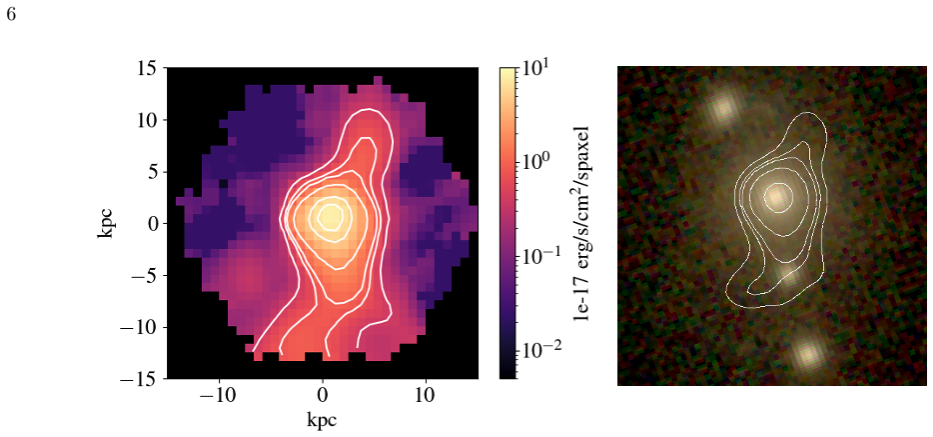
Summary. The paper presents a new 8.5 ks Chandra ACIS-I observation of the galaxy cluster Abell 1885, supplemented by VLBA imaging, archival radio survey data from 144 MHz to 150 GHz, and SDSS MaNGA integral-field spectroscopy. From these data the authors report that A1885 is a strong cool core (central cooling time ~0.4 Gyr), hosts an X-ray luminous central point source (L_2-10 keV ~1.5-2.3 x 10^42 erg/s), and shows no evidence of large-scale radio lobes or X-ray cavities. They combine these measurements with the CEREAL cluster sample to place a 95% upper limit of 4.1% on the fraction of z~0.15 clusters with X-ray bright central AGN. The central interpretive claim is that the galaxy is strongly quenched on >10 kpc scales despite a young, compact central AGN, implying that AGN feedback energy is dissipated on a timescale much longer than the accretion duty cycle (e.g., via turbulent mixing rather than prompt shocks).
Significance. If the central interpretation holds, the paper provides a valuable multiwavelength case study of a rare transitional state in cluster AGN feedback, with the potential to constrain the duty cycle and dissipation mechanisms of mechanical feedback. The new Chandra observation, the VLBA pc-scale morphology, and the MaNGA H-alpha map are useful additions to the literature on cool-core clusters, and the rarity estimate is a step toward a less biased census of X-ray bright central AGN. The paper is also commendable for combining independent data sets and for explicitly identifying follow-up observations needed to test its conclusions. However, the key inference - that large-scale quenching coexists with an absence of any recent large-scale feedback - is currently underdetermined by the data, because the non-detections are not quantified as upper limits and the available exposure is shallow. The central claim is therefore interesting and plausible but needs stronger support before it can be accepted as established.
major comments (4)
- [§3.1, §3.3, §4.2] The central claim that A1885 lacks recent large-scale mechanical feedback rests on the absence of detected X-ray cavities and extended radio emission, but no quantitative upper limits are provided. The X-ray data are only 8.5 ks, and the authors themselves state in §3.1 that 'we require deeper Chandra observations to confirm this' absence of cavities. Similarly, the radio surveys listed in §2.3 are not used to place surface-brightness or luminosity upper limits on a possible low-surface-brightness lobe at 144 MHz or other frequencies. Without such limits, the possibility remains that cavities or lobes from a previous feedback episode are simply below current sensitivity; in that case the system would be naturally interpreted as later in a normal episodic AGN cycle, and the need for a dissipation timescale longer than the feeding duty cycle would not be established. Please add quantitative upper limits on cavity enthalpy/power and radio lobe surface brightness/luminosity, or explicitly reframe the conclusions to acknowledge this degeneracy.
- [§2.1.1] The detection significance and net counts of the central X-ray point source are not reported. The paper quotes a best-fit cstat=8.66 for 13 degrees of freedom for a power-law model with no background, and notes that the expected background and thermal contributions are ~0.014 and ~1.6 counts, respectively, but it does not state the total number of source counts or the Poisson probability that the source is real. Given that the point source is one of the two pillars of the 'young AGN' interpretation and of the rarity estimate, please report the net counts, the signal-to-noise ratio, and the significance (e.g., Poisson probability or equivalent Gaussian sigma), along with the energy range used.
- [§2.1.3, §3.2] The central cooling time and the mass cooling rate are derived from Vikhlinin temperature and density profile models that are fitted to only six annular spectra from an 8.5 ks exposure. The inner bin boundary is chosen to exclude the central point source, and the cooling time at r=10 kpc (0.34 Gyr) is an interpolation/extrapolation of these model profiles rather than a direct measurement. The quoted uncertainties (e.g., 0.34+0.10-0.04 Gyr) do not appear to include systematic uncertainties from the choice of profile shape, the projection correction, or the metallicity assumed in the cooling function. Please quantify how sensitive the strong-cool-core classification and the '>99.75% quenching' statement are to these modeling choices, for example by varying the profile functional form or fitting the density and temperature profiles independently.
- [§4.1] The rarity estimate of 'no more than 4.1%' is based on 135 CEREAL clusters that include Abell 1885, but A1885 has z=0.089, which is outside the stated CEREAL redshift selection of 0.15<z<0.25 (main sample) or 0.1<z<0.2 (low-mass extension). The abstract and introduction describe A1885 as part of a low-mass extension, but the paper does not explicitly demonstrate that A1885 satisfies the mass and redshift criteria of the sample used for the binomial statistics. If A1885 is not a valid draw from the same parent population, the binomial upper limit is not applicable. Please clarify the selection criteria for the 135 observed clusters, state whether A1885 is included, and recompute the limit either excluding A1885 or with a clearly defined parent sample that includes it.
minor comments (4)
- [Abstract, §2.1.1, §3.2, §5] There are several numerical inconsistencies between the abstract, main text, and conclusion: the 2-10 keV luminosity is given as 2.3^+0.9_-0.7 x 10^42 erg/s in the abstract but 1.53^+0.42_-0.34 x 10^42 erg/s in §2.1.1; the central cooling time is 0.43 Gyr in the abstract, 0.42^+0.11_-0.08 Gyr in Figure 3, and 0.34^+0.10_-0.04 Gyr at r=10 kpc in §3.2; and the maximal cooling rate is 198 +/- 30 M_sun/yr in §3.2 but 175 +/- 15 M_sun/yr in conclusion item 3. Please reconcile these values and ensure the quoted numbers are consistent throughout.
- [§2.3, Figure 5] The text contains a typographical error in the VLBA flux density at 8.4 GHz: '26.12.6 mJy' should presumably read '26.1 +/- 2.6 mJy'. Also, 'LOF AR' appears in §2.3 and should be 'LOFAR'.
- [§2.2, Figure 4] The instrument is referred to as both 'MaNGA' and 'MANGA' in the text; please use a consistent nomenclature (the official name is 'MaNGA').
- [§3.2] The sentence in §3.2 refers to 'the 24 µm-derived (and likely AGN-contaminated) rate' but the comparison to the Quillen et al. (2008) 70 µm upper limit is only given parenthetically; it would be clearer to show the 70 µm-derived SFR upper limit explicitly in the text or a table alongside the H-alpha and Spitzer values.
Circularity Check
No significant circularity: the new Chandra, VLBA, and MaNGA data are independent measurements, and the long-dissipation-timescale claim is an underdetermined interpretation rather than a definitional reduction or fitted-input prediction.
full rationale
The paper's core measurements are new and independent: the Chandra-derived cooling time (0.43 Gyr), the X-ray point-source luminosity, the MaNGA H-alpha star-formation upper limit, and the VLBA parsec-scale jet detection. The 4.1% rarity bound is a direct binomial upper limit from 1 detection among 135 CEREAL clusters, not a re-use of the target quantity as an input. The 'young AGN' characterization is supported by the VLBA pc-scale morphology and the unresolved radio survey data, and the cited Ubertosi et al. (2023) 'pre-feedback' classification is invoked as prior context rather than as a substitute for the new data; the paper states that the new results 'confirm the predictions' of that work. The main interpretive step, attributing large-scale quenching to long-lived heat from previous AGN episodes, is underdetermined: Section 3.1 concedes that 'we do not show evidence of X-ray cavities' and that deeper Chandra observations are required to confirm their absence, so the premise of absent large-scale feedback is not firmly established. Underdetermination by shallow data is an evidentiary weakness, not a circular derivation. The same-group simulations (Gaspari et al. 2011, 2012) are cited as physical support for slow dissipation, but they do not enter the derivation of the measured cooling, star-formation, or radio properties. No step equates a fitted parameter with a prediction, and no conclusion is forced by definition or by a self-citation chain; the modest score reflects the paper's reliance on its own prior classification and simulations as interpretive scaffolding, not any formal circularity.
Assumptions & free parameters
free parameters (5)
- Vikhlinin temperature profile parameters =
not tabulated in paper
- Vikhlinin density profile parameters =
not tabulated in paper
- Metallicity profile parameters =
not tabulated in paper
- Intrinsic absorption column density =
0 to 1.62e22 cm^-2
- Powerlaw photon index =
1.31 +1.23/-0.47
assumptions (6)
- domain assumption Gas in collisional ionization equilibrium with Sutherland and Dopita cooling function at [Fe/H] = -0.05
- domain assumption Classical maximal cooling rate assumes no heating or mixing and that all gas with tcool below 7.7 Gyr cools
- domain assumption Halpha emission is photoionized by young stars with Kennicutt conversion, and AGN contamination only raises the upper limit
- domain assumption Abell 1885 is drawn from the same selection as the 135 CEREAL clusters used for the rarity estimate
- domain assumption Absence of detected extended radio emission and cavities implies no recent large-scale mechanical feedback
- standard math Standard spectral fitting and XSPEC atomic models
Cite this review
Pith. "Pith review of The Onset of Feedback in Abell 1885: Evidence for Large-Scale Quenching Despite a Young Central AGN." pith.science (2026). https://pith.science/paper/SLPFJK6P
@misc{pith2026250603277,
  author       = {Pith},
  title        = {Pith review of: The Onset of Feedback in Abell 1885: Evidence for Large-Scale Quenching Despite a Young Central AGN},
  year         = {2026},
  howpublished = {\url{https://pith.science/paper/SLPFJK6P}},
  note         = {Machine review of arXiv:2506.03277}
}
read the original abstract
We present a new 8.5 ks Chandra observation of Abell 1885, obtained as part of the Cluster Evolution Reference Ensemble At Low-z (CEREAL) survey of ~200 low-z galaxy groups and clusters. These data reveal that Abell 1885 is a strong cool core, with a central cooling time of 0.43 Gyr, and that the central galaxy hosts an X-ray luminous point source at its center (L=2.3x10^42 erg/s), indicative of a rapidly accreting supermassive black hole. In the context of the larger CEREAL sample, we constrain the fraction of clusters at z~0.15 with X-ray bright central AGN to be no more than 4.1%. Including radio data from LOFAR, GMRT, ASKAP, and the VLA and optical integral field unit data from SDSS MaNGA, we probe the details of cooling, feeding, and feedback in this system. These data reveal that cooling of the intracluster medium is highly suppressed on large (>10 kpc) scales despite a central supermassive black hole that is in the early stages of the self-regulation cycle (characterized by rapid accretion, physically small jets, and no large-scale low-frequency radio emission). To reconcile the large-scale quenching with a lack of visible large-scale feedback, we propose that the timescale on which energy is dissipated on large scales is significantly longer than the timescale on which black hole feeding operates on small (~pc) scales. These observations suggest that there are two separate timescales characterizing AGN feedback in clusters: the short timescale of small-scale feeding and feedback processes and a longer timescale by which energy is dissipated on large physical scales in the intracluster medium. This interpretation disfavors a model in which the energy is rapidly dissipated (e.g. shocks), which would synchronize the feeding and feedback timescales, and favors a model in which the heating effects of AGN feedback can linger long after the outburst has passed (e.g. turbulent mixing).
Figures


Figures from the paper (3 more)


Forward citations
Cited by 1 Pith paper
-
JVLA and VLBA study of the merging cool core CHIPS 1911+4455 at z~0.5: radio emission from an infant AGN and from a rapidly star-forming BCG
The central AGN of cool-core cluster CHIPS 1911+4455 has recently turned on (60 pc jets, spectral peak near 1.9 GHz rest frame), while 10 kpc radio whiskers trace a starburst with a radio SFR of 100-155 M_sun/yr.
Reference graph
Works this paper leans on
-
[1]
1989, GeoCoA, 53, 197, doi: 10.1016/0016-7037(89)90286-X
Anders, E., & Grevesse, N. 1989, GeoCoA, 53, 197, doi: 10.1016/0016-7037(89)90286-X
-
[2]
Arnaud, K. A. 1996, in Astronomical Society of the Pacific Conference Series, Vol. 101, Astronomical Data Analysis Software and Systems V, ed. G. H. Jacoby & J. Barnes, 17 Astropy Collaboration, Robitaille, T. P., Tollerud, E. J., et al. 2013, A&A, 558, A33, doi: 10.1051/0004-6361/201322068 Astropy Collaboration, Price-Whelan, A. M., Sip˝ ocz, B. M., et a...
-
[3]
Bregman, J. N., Fabian, A. C., Miller, E. D., & Irwin, J. A. 2006, ApJ, 642, 746, doi: 10.1086/501112
doi:10.1086/501112 2006
-
[4]
Bundy, K., Bershady, M. A., Law, D. R., et al. 2015, ApJ, 798, 7, doi: 10.1088/0004-637X/798/1/7
-
[5]
Cavagnolo, K. W., Donahue, M., Voit, G. M., & Sun, M. 2009, ApJS, 182, 12, doi: 10.1088/0067-0049/182/1/12
-
[6]
Cavagnolo, K. W., McNamara, B. R., Nulsen, P. E. J., et al. 2010, ApJ, 720, 1066, doi: 10.1088/0004-637X/720/2/1066
-
[7]
2005, MNRAS, 363, L91, doi: 10.1111/j.1745-3933.2005.00093.x
Churazov, E., Sazonov, S., Sunyaev, R., et al. 2005, MNRAS, 363, L91, doi: 10.1111/j.1745-3933.2005.00093.x
arXiv 2005
-
[8]
Fabian, A. C. 1999, MNRAS, 306, 857, doi: 10.1046/j.1365-8711.1999.02583.x
arXiv 1999
Show all 52 references
-
[9]
M., & Rieke, G
Diamond-Stanic, A. M., & Rieke, G. H. 2012, ApJ, 746, 168, doi: 10.1088/0004-637X/746/2/168
2012 doi
-
[10]
Fabian, A. C. 2012, ARA&A, 50, 455, doi: 10.1146/annurev-astro-081811-125521
2012 doi
-
[11]
C., Allen, G
Fruscione, A., McDowell, J. C., Allen, G. E., et al. 2006, in Society of Photo-Optical Instrumentation Engineers (SPIE) Conference Series, Vol. 6270, Observatory Operations: Strategies, Processes, and Systems, ed. D. R. Silva & R. E. Doxsey, 62701V, doi: 10.1117/12.671760
2006 doi
-
[12]
2017, MNRAS, 466, 677, doi: 10.1093/mnras/stw3108
Gaspari, M., Temi, P., & Brighenti, F. 2017, MNRAS, 466, 677, doi: 10.1093/mnras/stw3108
2017 doi
-
[13]
2020, Nature Astronomy, 4, 10, doi: 10.1038/s41550-019-0970-1 G¨ urkan, G., Hardcastle, M
Gaspari, M., Tombesi, F., & Cappi, M. 2020, Nature Astronomy, 4, 10, doi: 10.1038/s41550-019-0970-1 G¨ urkan, G., Hardcastle, M. J., Jarvis, M. J., et al. 2015, MNRAS, 452, 3776, doi: 10.1093/mnras/stv1502
2020 doi
-
[14]
L., McConnell, D., Thomson, A
Hale, C. L., McConnell, D., Thomson, A. J. M., et al. 2021, PASA, 38, e058, doi: 10.1017/pasa.2021.47
2021 doi
-
[15]
C., Edge, A
Hlavacek-Larrondo, J., Fabian, A. C., Edge, A. C., et al. 2013, MNRAS, 431, 1638, doi: 10.1093/mnras/stt283
2013 doi
-
[16]
Hogan, M. T. 2014, PhD thesis, Durham University, UK
2014
-
[17]
T., Edge, A
Hogan, M. T., Edge, A. C., Geach, J. E., et al. 2015a, MNRAS, 453, 1223, doi: 10.1093/mnras/stv1518
-
[18]
T., Edge, A
Hogan, M. T., Edge, A. C., Hlavacek-Larrondo, J., et al. 2015b, MNRAS, 453, 1201, doi: 10.1093/mnras/stv1517 11
-
[19]
F., Richards, G
Hopkins, P. F., Richards, G. T., & Hernquist, L. 2007, ApJ, 654, 731, doi: 10.1086/509629
2007 doi
-
[20]
S., Mittal, R., Reiprich, T
Hudson, D. S., Mittal, R., Reiprich, T. H., et al. 2010, A&A, 513, A37, doi: 10.1051/0004-6361/200912377
2010 doi
-
[21]
T., Jagannathan, P., Mooley, K
Intema, H. T., Jagannathan, P., Mooley, K. P., & Frail, D. A. 2017, The GMRT 150 MHz all-sky radio survey. First alternative data release TGSS ADR1, doi: 10.1051/0004-6361/201628536
2017 doi
-
[22]
M., Fabian, A
Johnstone, R. M., Fabian, A. C., & Nulsen, P. E. J. 1987, MNRAS, 224, 75, doi: 10.1093/mnras/224.1.75
1987 doi
-
[23]
1998, ARA&A, 36, 189, doi: 10.1146/annurev.astro.36.1.189
Kennicutt, Robert C., J. 1998, ARA&A, 36, 189, doi: 10.1146/annurev.astro.36.1.189
1998 doi
-
[24]
C., & McNamara, B
Kirkpatrick, C. C., & McNamara, B. R. 2015, MNRAS, 452, 4361, doi: 10.1093/mnras/stv1574
2015 doi
-
[25]
A., Chandler, C
Lacy, M., Baum, S. A., Chandler, C. J., et al. 2020, PASP, 132, 035001, doi: 10.1088/1538-3873/ab63eb
2020 doi
-
[26]
C., et al
Li, Y., Calzetti, D., Kennicutt, R. C., et al. 2010, ApJ, 725, 677, doi: 10.1088/0004-637X/725/1/677
2010 doi
-
[27]
D., et al
Lusso, E., Comastri, A., Simmons, B. D., et al. 2012, MNRAS, 425, 623, doi: 10.1111/j.1365-2966.2012.21513.x
2012
-
[28]
2004, MNRAS, 351, 169, doi: 10.1111/j.1365-2966.2004.07765.x
Marconi, A., Risaliti, G., Gilli, R., et al. 2004, MNRAS, 351, 169, doi: 10.1111/j.1365-2966.2004.07765.x
2004
-
[29]
L., Lenc, E., et al
McConnell, D., Hale, C. L., Lenc, E., et al. 2020, PASA, 37, e048, doi: 10.1017/pasa.2020.41
2020 doi
-
[30]
J., & Ma, C.-P
McConnell, N. J., & Ma, C.-P. 2013, ApJ, 764, 184, doi: 10.1088/0004-637X/764/2/184
2013 doi
-
[31]
Tremblay, G. R. 2018, ApJ, 858, 45, doi: 10.3847/1538-4357/aabace
2018 doi
-
[32]
R., Calzadilla, M
McDonald, M., McNamara, B. R., Calzadilla, M. S., et al. 2021, ApJ, 908, 85, doi: 10.3847/1538-4357/abd47f
2021 doi
-
[33]
A., Vikhlinin, A., et al
McDonald, M., Benson, B. A., Vikhlinin, A., et al. 2013, ApJ, 774, 23, doi: 10.1088/0004-637X/774/1/23
2013 doi
-
[34]
R., & Nulsen, P
McNamara, B. R., & Nulsen, P. E. J. 2007, ARA&A, 45, 117, doi: 10.1146/annurev.astro.45.051806.110625 —. 2012, New Journal of Physics, 14, 055023, doi: 10.1088/1367-2630/14/5/055023
2007 arXiv
-
[35]
2019, MNRAS, 488, 5185, doi: 10.1093/mnras/stz2016 O’Dea, C
Netzer, H. 2019, MNRAS, 488, 5185, doi: 10.1093/mnras/stz2016 O’Dea, C. P., Baum, S. A., Privon, G., et al. 2008, ApJ, 681, 1035, doi: 10.1086/588212
2019 doi
-
[36]
R., & Fabian, A
Peterson, J. R., & Fabian, A. C. 2006, PhR, 427, 1, doi: 10.1016/j.physrep.2005.12.007
2006 doi
-
[37]
R., Kahn, S
Peterson, J. R., Kahn, S. M., Paerels, F. B. S., et al. 2003, ApJ, 590, 207, doi: 10.1086/374830 Planck Collaboration, Ade, P. A. R., Aghanim, N., et al. 2016, A&A, 594, A27, doi: 10.1051/0004-6361/201525823
2003 doi
-
[38]
C., Zufelt, N., Park, J., et al
Quillen, A. C., Zufelt, N., Park, J., et al. 2008, ApJS, 176, 39, doi: 10.1086/525560
2008 doi
-
[39]
B., Tang, Y., de Bruyn, A
Rengelink, R. B., Tang, Y., de Bruyn, A. G., et al. 1997, A&AS, 124, 259, doi: 10.1051/aas:1997358
1997 doi
-
[40]
Broderick, A. E. 2015, MNRAS, 451, 588, doi: 10.1093/mnras/stv954
2015 doi
-
[41]
R., Fabian, A
Russell, H. R., Fabian, A. C., McNamara, B. R., et al. 2018, MNRAS, 477, 3583, doi: 10.1093/mnras/sty835
2018 doi
-
[42]
R., McNamara, B
Russell, H. R., McNamara, B. R., Edge, A. C., et al. 2013, MNRAS, 432, 530, doi: 10.1093/mnras/stt490
2013 doi
-
[43]
W., Hardcastle, M
Shimwell, T. W., Hardcastle, M. J., Tasse, C., et al. 2022, A&A, 659, A1, doi: 10.1051/0004-6361/202142484
2022 doi
-
[44]
W., Stalder, B., & Stark, A
Somboonpanyakul, T., McDonald, M., Lin, H. W., Stalder, B., & Stark, A. 2018, ApJ, 863, 122, doi: 10.3847/1538-4357/aace55
2018 doi
-
[45]
A., Gammie, C
Stark, A. A., Gammie, C. F., Wilson, R. W., et al. 1992, ApJS, 79, 77, doi: 10.1086/191645
1992 doi
-
[46]
2009, ApJ, 704, 1586, doi: 10.1088/0004-637X/704/2/1586
Sun, M. 2009, ApJ, 704, 1586, doi: 10.1088/0004-637X/704/2/1586
2009 doi
-
[47]
S., & Dopita, M
Sutherland, R. S., & Dopita, M. A. 1993, ApJS, 88, 253, doi: 10.1086/191823
1993 doi
-
[48]
2023, A&A, 673, A52, doi: 10.1051/0004-6361/202345894
Ubertosi, F., Gitti, M., Brighenti, F., et al. 2023, A&A, 673, A52, doi: 10.1051/0004-6361/202345894
2023 doi
-
[49]
2006, ApJ, 640, 691, doi: 10.1086/500288
Vikhlinin, A., Kravtsov, A., Forman, W., et al. 2006, ApJ, 640, 691, doi: 10.1086/500288
2006 doi
-
[50]
R., Forman, W., et al
Vikhlinin, A., McNamara, B. R., Forman, W., et al. 1998, ApJ, 502, 558, doi: 10.1086/305951
1998 doi
-
[51]
H., Egami, E., et al
Xu, L., Rieke, G. H., Egami, E., et al. 2015, ApJ, 808, 159, doi: 10.1088/0004-637X/808/2/159
2015 doi
-
[52]
2018, ApJ, 859, 65, doi: 10.3847/1538-4357/aabfd7
Yang, L., Tozzi, P., Yu, H., et al. 2018, ApJ, 859, 65, doi: 10.3847/1538-4357/aabfd7
2018 doi
Reviewed August 7, 2026 · model on record in the stance chip above.
Discussion (0). Sign in to comment.