Massive boson stars: Stability and GW emission in head-on mergers
Pith reviewed 2026-05-16 22:08 UTC · model grok-4.3
The pith
Quartically self-interacting massive boson stars remain stable only up to the first maximum on their mass curve, and equal-mass head-on collisions produce one of three outcomes depending on compactness.
A machine-rendered reading of the paper's core claim, the machinery that carries it, and where it could break.
Core claim
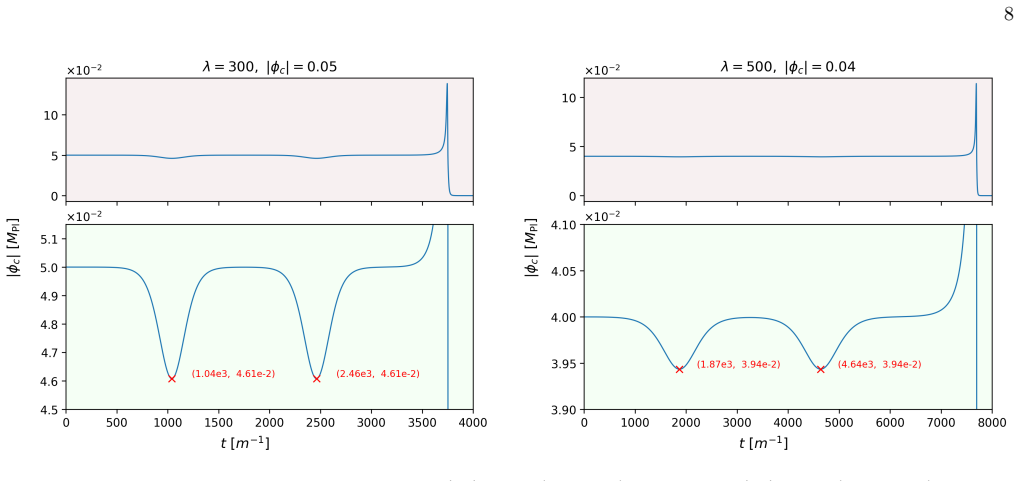
Along sequences of equilibrium configurations for quartically self-interacting massive boson stars the mass M plotted against central amplitude |φ_c| develops multiple extrema, yet stability is lost only after the first maximum, with subsequent models highly compact and susceptible to collapse from numerical perturbations, sometimes showing brief double-dive behavior near criticality. Head-on collisions between equal-mass stars fall into three classes: formation of a remnant boson star, black hole creation at the moment of contact, or each star collapsing individually to a black hole before contact occurs. The gravitational-wave energy radiated in these events arises from the tension between
What carries the argument
The mass curve M(|φ_c|) along equilibrium sequences that sets stability thresholds, together with numerical dynamical evolution of head-on collisions that classifies the three outcomes and measures gravitational-wave emission.
If this is right
- Configurations past the first mass maximum collapse under numerically induced perturbations, restricting the stable region of parameter space.
- Gravitational-wave energies emitted in mergers vary with self-interaction strength through the opposing effects of compactness and tidal deformability.
- The pre-contact collapse branch displays non-monotonic energy dependence at large self-interaction strengths.
- The generated catalogue of initial conditions and waveforms enables construction of surrogate models for rapid gravitational-wave signal prediction.
Where Pith is reading between the lines
- Detected gravitational-wave events could be compared against these waveforms to place limits on boson star parameters in nature.
- The three-outcome classification may extend to spinning or unequal-mass cases, offering additional channels for observable signals.
- Surrogate models trained on this catalogue could speed up parameter estimation for exotic compact object mergers in future detector data.
Load-bearing premise
Stability of boson star configurations changes only at the first maximum of the mass curve M as a function of central amplitude, with all more compact solutions being unstable to collapse.
What would settle it
A long-term stable numerical evolution of a configuration lying past the first maximum on the mass curve would falsify the stability threshold.
Figures





read the original abstract
We investigate quartically self-interacting massive boson stars by constructing equilibrium sequences and performing dynamical evolutions. The mass curve $M(|\phi_c|)$ along these sequences develops multiple extrema, yet stability changes only at the first maximum; configurations beyond it become highly compact and collapse under numerically induced perturbations, with near-critical models displaying a short-lived double-dive behaviour. Head-on collisions of equal-mass stars yield three distinct outcomes -- boson star remnants, black hole formation at contact, and collapse of each star to a black hole prior to contact. The associated gravitational-wave energies reflect a competition between increasing compactness, which enhances the efficiency of gravitational-wave emission, and decreasing tidal deformability, which suppresses merger asymmetries, and at large self-interaction strengths the collapse-before-contact branch exhibits a pronounced non-monotonic structure. The simulations reported here constitute a substantial catalogue of initial conditions and waveforms, providing a natural basis for constructing surrogate models capable of rapidly predicting gravitational-wave signals across an extended parameter space.
Editorial analysis
A structured set of objections, weighed in public.
Referee Report
Summary. The paper investigates quartically self-interacting massive boson stars by constructing equilibrium sequences and performing dynamical evolutions. The mass curve M(|φ_c|) develops multiple extrema, yet stability changes only at the first maximum; configurations beyond it become highly compact and collapse under numerically induced perturbations, with near-critical models showing short-lived double-dive behaviour. Head-on collisions of equal-mass stars produce three distinct outcomes—boson star remnants, black hole formation at contact, and collapse of each star to a black hole prior to contact—with associated gravitational-wave energies reflecting a competition between increasing compactness (enhancing emission efficiency) and decreasing tidal deformability (suppressing merger asymmetries). At large self-interaction strengths the collapse-before-contact branch exhibits non-monotonic structure. The simulations provide a catalogue of initial conditions and waveforms for surrogate models.
Significance. If the stability classification and merger outcomes are robust, the work provides a substantial numerical catalogue of boson-star head-on mergers and waveforms that can serve as a basis for surrogate models across an extended parameter space. This is a concrete strength for the field, as it supplies reproducible initial data and signals for exotic compact-object gravitational-wave phenomenology without relying on fitted parameters in the central derivations.
major comments (2)
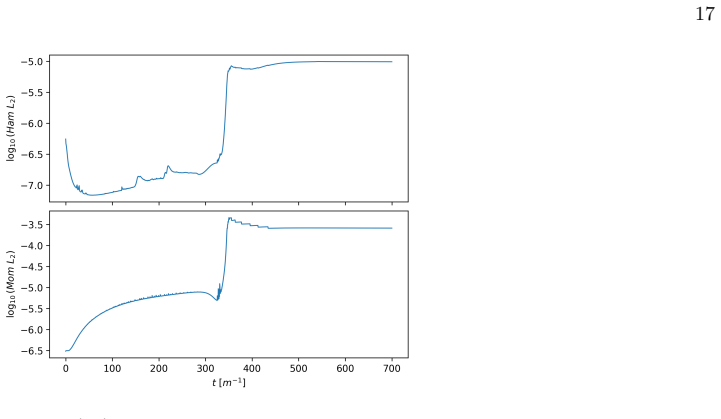
- [Stability analysis and equilibrium sequences] The assertion that stability changes only at the first maximum of M(|φ_c|), with post-maximum configurations collapsing under numerically induced perturbations, underpins the separation into three distinct merger outcomes (including the pre-contact collapse branch). This claim rests on dynamical evolutions showing collapse, yet no resolution studies, isolated-star control runs, or convergence tests are described to establish that the instability is physical rather than a grid artifact. If the collapse is resolution-dependent, the reported GW energy trends and the compactness-versus-tidal-deformability competition become unreliable.
- [Dynamical evolutions and gravitational-wave emission] The non-monotonic structure reported for the collapse-before-contact branch at large self-interaction strengths, and the overall GW energy scaling, depend directly on the robustness of the pre-contact versus at-contact black-hole formation distinction. Without quantified convergence for the near-critical double-dive behaviour and the stability threshold, these trends cannot be taken as physical predictions.
minor comments (2)
- [Abstract] The abstract introduces 'near-critical models displaying a short-lived double-dive behaviour' without a concise definition or reference to the relevant figure or section; this should be clarified early in the main text.
- [Notation and equilibrium construction] Notation for the central scalar amplitude |φ_c| and its relation to the equilibrium sequence parameter should be stated explicitly once in the methods or equilibrium-construction section to avoid ambiguity in later figures.
Simulated Author's Rebuttal
We thank the referee for the careful and constructive review of our manuscript on massive boson stars. The concerns regarding the lack of documented resolution studies for the stability classification and the convergence of the dynamical merger simulations are well taken. We address each major comment below and will revise the manuscript to incorporate additional tests and clarifications.
read point-by-point responses
-
Referee: [Stability analysis and equilibrium sequences] The assertion that stability changes only at the first maximum of M(|φ_c|), with post-maximum configurations collapsing under numerically induced perturbations, underpins the separation into three distinct merger outcomes (including the pre-contact collapse branch). This claim rests on dynamical evolutions showing collapse, yet no resolution studies, isolated-star control runs, or convergence tests are described to establish that the instability is physical rather than a grid artifact. If the collapse is resolution-dependent, the reported GW energy trends and the compactness-versus-tidal-deformability competition become unreliable.
Authors: We agree that the manuscript does not currently describe resolution studies or convergence tests for the isolated-star evolutions. The collapses observed beyond the first mass maximum are consistent with the turning-point method and occur under small numerical perturbations, but we acknowledge that this requires quantitative support to rule out grid artifacts. In the revised manuscript we will add a dedicated subsection presenting resolution studies for representative models, including near-critical cases exhibiting the short-lived double-dive behaviour. These tests will confirm convergence of the collapse dynamics and thereby strengthen the separation into the three merger outcomes. revision: yes
-
Referee: [Dynamical evolutions and gravitational-wave emission] The non-monotonic structure reported for the collapse-before-contact branch at large self-interaction strengths, and the overall GW energy scaling, depend directly on the robustness of the pre-contact versus at-contact black-hole formation distinction. Without quantified convergence for the near-critical double-dive behaviour and the stability threshold, these trends cannot be taken as physical predictions.
Authors: We concur that the reported non-monotonic GW energy trends and the distinction between pre-contact and at-contact collapse require demonstrated numerical convergence. The current text does not include quantified convergence tests for the head-on collision runs. We will add convergence analyses for selected models in the collapse-before-contact branch at large self-interaction strengths, showing that the non-monotonic structure persists under increased resolution. This will substantiate the physical competition between compactness and tidal deformability as the driver of the observed GW energy patterns. revision: yes
Circularity Check
No circularity: outcomes are direct numerical outputs
full rationale
The paper constructs equilibrium sequences by solving the Einstein-Klein-Gordon system for quartically self-interacting massive boson stars and evolves the initial-value problem in full numerical relativity. Reported outcomes (remnant types, GW energies, pre-contact collapse) follow directly from the time-dependent simulations without any parameter fitted to a subset of data and then renamed as a prediction. The statement that stability changes only at the first mass maximum is an inference from observed collapse under grid perturbations, not a self-definitional or self-citation reduction. No ansatz is smuggled via prior work, no uniqueness theorem is imported from the same authors, and no known empirical pattern is merely relabeled. The derivation chain is therefore self-contained against the numerical evolution code.
Axiom & Free-Parameter Ledger
free parameters (1)
- quartic self-interaction strength
axioms (2)
- standard math The Einstein-Klein-Gordon equations govern the dynamics of the massive scalar field with quartic self-interaction.
- domain assumption Numerical perturbations are sufficient to trigger collapse of configurations past the first mass maximum.
Lean theorems connected to this paper
-
IndisputableMonolith/Cost/FunctionalEquation.leanwashburn_uniqueness_aczel unclear?
unclearRelation between the paper passage and the cited Recognition theorem.
stability changes only at the first maximum; configurations beyond it become highly compact and collapse under numerically induced perturbations
-
IndisputableMonolith/Foundation/AlexanderDuality.leanalexander_duality_circle_linking unclear?
unclearRelation between the paper passage and the cited Recognition theorem.
mass curve M(|φ_c|) develops multiple extrema, yet stability changes only at the first maximum
What do these tags mean?
- matches
- The paper's claim is directly supported by a theorem in the formal canon.
- supports
- The theorem supports part of the paper's argument, but the paper may add assumptions or extra steps.
- extends
- The paper goes beyond the formal theorem; the theorem is a base layer rather than the whole result.
- uses
- The paper appears to rely on the theorem as machinery.
- contradicts
- The paper's claim conflicts with a theorem or certificate in the canon.
- unclear
- Pith found a possible connection, but the passage is too broad, indirect, or ambiguous to say the theorem truly supports the claim.
Forward citations
Cited by 2 Pith papers
-
Timing-Window Mechanism for Chain-Like Transients in Collisions of Radially Excited Boson Stars
Chain-like transients in boson star collisions are governed by a timing window set by the binary collision time relative to isolated breathing clocks rather than excitation level alone.
-
Boson star-black hole binaries: initial data and head-on collisions
A one-body conformal-factor correction stabilizes boson star-black hole initial data, enabling gravitational-wave analysis that shows higher multipoles can discriminate mixed mergers from pure black-hole binaries.
discussion (0)
Sign in with ORCID, Apple, or X to comment. Anyone can read and Pith papers without signing in.