REVIEW 3 major objections 6 minor 2 cited by
Monosilane Worlds: Sub-Neptunes with Atmospheres Shaped by Reduced Magma Oceans
T0 review · 3 major / 6 minor · reviewed 2026-08-15 · deepseek-v4-flash
Pith's one-line read Water dissolved in magma lets monosilane persist in sub-Neptune skies
desk verdict H2O dissolution into reduced magma oceans flips the predicted SiH4 abundance in sub-Neptune atmospheres; the effect is real, but the 0.1–10% persistence claim rides on an SiO-rainout assumption the authors themselves flag. read the letter →
The pith
A machine-rendered reading of the paper's core claim, the machinery that carries it, and where it could break.
The reading
What carries the argument
The argument rides on a closed H-O-Si mass balance at the magma-atmosphere interface. SiO2 liquid vaporizes (R1), the released oxygen forms H2O with H2 (R2), and SiO plus H2 makes SiH4 (R3); a water-solubility law (Eq. 7) ties the mass of H2O dissolved in the magma to the ground H2O partial pressure, while condensation of SiO (R5) and/or SiO2 (R4) with complete rainout removes oxygen and silicon aloft. Solving the dissolved-water and gas reservoirs together through Eq. (24) is what makes SiH4 the third-most-abundant gas and prevents its reoxidation in the upper atmosphere.
What would settle it
A cloud-microphysics calculation or laboratory experiment that determines whether SiO or SiO2 is the dominant condensate and how completely grains rain out would settle the claim: if SiO2 dominates or rainout is inefficient, the predicted SiH4 fraction at 0.1 bar should drop well below 0.1 percent across the parameter space, contradicting the paper's central result.
Extended reading notes
Core claim
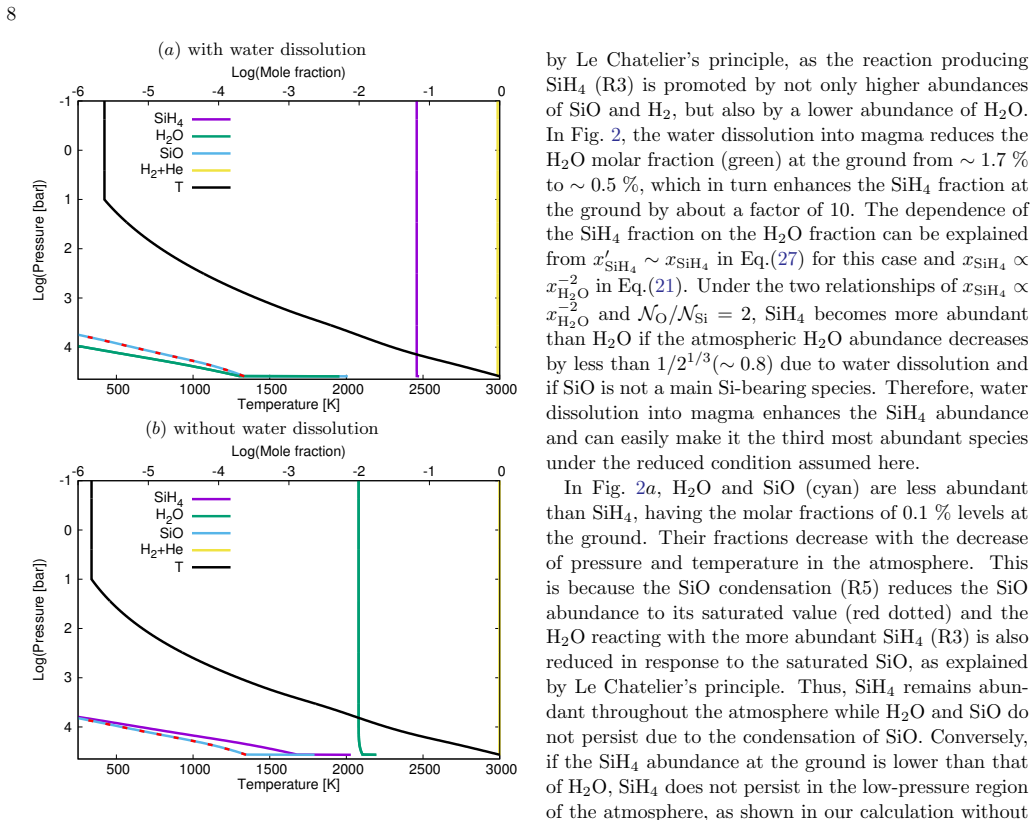
The central claim is that on a sub-Neptune with an FeO-free magma ocean, dissolution of H2O into the melt makes the atmosphere more reduced and thereby allows SiH4 to remain abundant from the ground up to 0.1 bar. In their one-dimensional chemical-equilibrium model, the dissolution lowers the ground H2O fraction, which by Le Chatelier's principle drives the reaction SiO + 3H2 ⇌ SiH4 + H2O toward SiH4; with SiO condensation and complete rainout removing oxygen aloft, SiH4 stays near its ground value instead of collapsing to fractions below $10^{-5}$. The paper states the result directly: the dissolution of H2O enhances the SiH4 molar fraction to levels of 0.1 to 10 percent, preventing it from reverting to silicates in the upper atmospheric layers. This SiH4-rich regime occupies a broad parameter space at ground temperatures of 2000–6000 K and hydrogen pressures of $10^2$–$10^5$ bar.
Load-bearing premise
The persistence of SiH4 at 0.1 bar rests on the assumption that silicon monoxide vapor condenses and the grains fall out completely, stripping oxygen from the gas; if silicon dioxide dominates condensation or the rainout is incomplete, the extra oxygen would reoxidize SiH4 and deplete it in the observable layer.
Editorial extensions
If this is right
- SiH4-rich atmospheres should exist across a wide range of ground temperatures and hydrogen pressures, reaching molar fractions above 0.1 percent at 0.1 bar over most of the explored parameter space.
- Such atmospheres have a high mean molecular weight (up to about 6.2 times the hydrogen atom mass), reducing the scale height and planetary radius, while SiH4's high heat capacity raises the tropopause temperature.
- SiH4-rich atmospheres would be depleted in C-, N-, and O-bearing gases, and they could contain other silanes such as SiH2, Si2H6, and Si3H8, especially in hotter upper layers.
- Transmission spectra of these atmospheres show four characteristic SiH4 bands near 2–3, 3–4, 4–7, and 7–18 microns, distinguishable from H2O- and CH4-rich spectra.
- A confirmed SiH4 detection in a sub-Neptune would indicate a highly reduced, FeO-free magma ocean in contact with a hydrogen-dominated atmosphere; most sub-Neptunes already observed with H2O or carbon-bearing molecules are unlikely to be in this regime.
Reading between the lines
- A testable extension is to replace the imposed temperature-pressure profile with a radiative-convective equilibrium calculation once SiH4 opacity shortward of 2 microns is measured, which could either widen or narrow the region where SiH4 persists.
- The most sensitive hinge is condensation microphysics: if SiO2 rather than SiO turns out to be the dominant condensate, or if rainout is incomplete, the predicted SiH4 fraction at 0.1 bar should drop substantially, so this is the first place to look for a contradiction.
- Because alternative water-solubility laws with $\beta = 0.5$ give even higher dissolved-water fractions, the paper's nominal case is likely a conservative estimate of the SiH4-rich parameter space rather than an upper bound.
- Observationally, featureless sub-Neptune spectra now attributed to high mean molecular weight or hazes could be re-examined as candidate silane worlds, since the model predicts both high mean molecular weight and strong SiH4 absorption.
Signed reviews
Editorial analysis
A structured set of objections, weighed in public.
Referee Report
Summary. The paper proposes that monosilane (SiH4) can be abundant and persist to observable pressures (0.1 bar) in sub-Neptune atmospheres overlying FeO-free (SiO2) magma oceans, provided that H2O dissolution into the magma is taken into account. The authors construct a 1D chemical-equilibrium model of a hydrogen-dominated atmosphere with H-O-Si chemistry, mass balance at the surface (Eqs. 16 and 24), a prescribed adiabatic/isothermal temperature profile, and rainout of SiO and SiO2 condensates. They find that H2O dissolution lowers the atmospheric H2O fraction, which enhances SiH4 at the surface and, together with SiO condensation/rainout that depletes H2O in the upper atmosphere, allows SiH4 to survive to 0.1 bar at molar fractions of 0.1-10% across a broad parameter space (Tgr = 2000-6000 K, PH2,gr = 1e2-1e5 bar). The paper also computes planetary radii and transmission spectra for these 'silane worlds' and discusses redox-state, magma-depth, and opacity caveats.
Significance. If the central claim holds, the paper identifies a new, observationally testable pathway to SiH4 in sub-Neptune atmospheres, with clear spectral signatures (2-18 μm) and a high mean molecular weight that affects transit radii. The core mechanism is clean: mass balance and the x_SiH4 ∝ x_H2O^-2 relation (Eq. 21) are transparent, and the no-dissolution control (Fig. 2b) demonstrates that H2O dissolution is the cause of the SiH4 enhancement. The authors provide sensitivity tests for water-solubility parameters, magma-ocean mass fraction, and non-ideal EOS effects, and they candidly acknowledge missing SiH4 opacity and uncertain condensation physics. The prediction is falsifiable with JWST/Ariel observations. These strengths make the paper valuable despite the uncertainties discussed below.
major comments (3)
- [Secs. 2.2.2, 3.2, and 4.4 (rainout and condensate identity)] The persistence of SiH4 to 0.1 bar and the pressure boundaries in Fig. 5a rest on two mechanistically load-bearing assumptions: (i) SiO(c) (R5), not SiO2(c) (R4), is the dominant condensate, and (ii) condensates completely rain out at every altitude. The paper states in Sec. 4.4 that equilibrium chemistry alone cannot establish the dominant condensate, and it cites a measured SiO sticking coefficient of 0.016 (Kimura et al. 2022), implying inefficient growth and therefore incomplete rainout. If SiO2(c) dominates, or if rainout is incomplete so that condensed oxygen returns to the gas, the O/Si removal ratio changes and the back-reaction of R3 (SiH4 + H2O → SiO + 3H2) may consume SiH4 before the 0.1-bar layer is reached. The sentence in Sec. 4.4 that the model is a 'lower estimate' if SiO2 dominates is not supported by a quantitative demonstration, and it does not address the separate issue of finite rainout efficiency, which would likely reduce SiH4. Since the quantitative 0.1-10% abundances and even part of the parameter space in Fig. 5a are contingent on this scheme, I ask the authors to (a) explicitly test the sensitivity to the condensate identity by imposing SiO2-only rainout, (b) introduce a rainout-efficiency parameter (e.g., the fraction of condensate removed per scale height) and show how the 0.1-bar SiH4 fraction and the boundaries in Fig. 5a respond, or (c) clearly reframe the persistence claim as conditional on efficient SiO rainout and state what observational or experimental evidence would be needed to validate this assumption.
- [Secs. 2.1.2 and 4.3.2 (extrapolation of water solubility)] The water solubility law (Eq. 7) is calibrated with α and β fitted to experiments at 900-1700 K and 1-3e4 bar (Papale 1997; Schaefer et al. 2016), yet the model applies it at ground temperatures up to 6000 K and hydrogen pressures up to 1e5 bar. The sensitivity tests in Fig. 9 use alternative solubility laws that are also calibrated at low temperatures (≤2173 K), so none of them constrain the 3000-6000 K regime. Because the surface SiH4 abundance scales as x_H2O^-2 (Eq. 21), this extrapolation directly propagates into the claimed 0.1-10% values. The authors should either present a scaling argument for how the solubility law might behave at extreme temperatures (e.g., a thermodynamic model of H2O speciation in SiO2 melt at high T and P) or explicitly state that the quantitative abundance range is subject to unquantified extrapolation error, and identify the experiments needed to reduce this uncertainty.
- [Secs. 2.2 and 4.5.2 (imposed temperature profile)] The temperature-pressure profile is prescribed (adiabatic up to Prcb, isothermal above) because SiH4 opacity data are unavailable. The altitude at which SiO condensation and rainout occur, and thus the efficiency of H2O depletion, depends on the T-P profile. A radiative-convective or conductive profile, such as those explored by Misener et al. (2023), could place the condensation level at a different pressure or temperature, potentially shifting the boundary where SiH4 survives to 0.1 bar. The authors acknowledge this limitation, but since the 0.1-bar persistence is the central observational claim, they should include a brief exploration of how the results change under alternative plausible T-P profiles (e.g., warmer or colder deep atmospheres) or state more rigorously what profile assumptions are needed for the conclusion to hold.
minor comments (6)
- [Sec. 2.2.2 (typo)] In the sentence 'These condensates are assumed to completelly rain out', 'completelly' should be 'completely'.
- [Sec. 2.1.3 (notation)] Equations (11) and (12) use the same symbols N_O and N_Si on the left-hand side (the new quantities) and on the right-hand side (the exotic oxygen/silicon terms). Please rename the exotic terms (e.g., N_O^ex, N_Si^ex) to avoid confusion.
- [Secs. 3.2 and 4.3.1 (reaction numbering)] The text refers to 'the reaction producing SiH4 from SiO and H2 (R4)' in two places; the correct reaction is R3, not R4. R4 is the SiO2(c) condensation reaction.
- [Fig. 5 caption (typo)] In the caption of Figure 5, 'at grand' should be 'at ground'.
- [Sec. 4.6.1 (typo)] In the discussion of silane decomposition, 'archived' should be 'achieved'.
- [Sec. 3.1 (clarity)] In the paragraph explaining the Si/O = 1 boundary, the sentence 'the fraction of SiH4 relative to H2 at ground approximately equals to that of H2O' could be clarified by stating explicitly that this corresponds to x_SiH4 ≈ x_H2O when O2 is negligible.
Circularity Check
No significant circularity: the SiH4 enhancement is derived from independent equilibrium constants and solubility data, and the remaining caveats are model limitations rather than circular reductions.
full rationale
The central derivation is self-contained. Ground composition is obtained by solving chemical equilibrium for R1-R5 with equilibrium constants from JANAF and Gail et al. (2013), together with water solubility from Papale (1997)/Schaefer et al. (2016) and the mass-balance relation NO = 2NSi. The predicted SiH4 enhancement follows algebraically from the equilibrium expressions (notably x_SiH4 proportional to x_H2O^-2, Eq. 21) once water dissolution lowers the ground H2O abundance through Eqs. (22)-(24). No parameter is fitted to the target SiH4 abundance, and the no-dissolution case (Fig. 2b) provides a genuine control that removes the effect. The condensation/rainout scheme (R4/R5 with complete rainout) is an assumed physical process, and Sec. 4.4 explicitly states that the dominance of SiO over SiO2 condensates and the efficiency of particle growth/rainout are not established by equilibrium chemistry; these are model uncertainties, not cases where a predicted quantity is identical to an input by construction. Self-citations (e.g., Seo et al. 2024; Ohno et al. 2025) appear only in contextual or observational remarks and are not load-bearing for the paper's claims. No circular step is present.
Assumptions & free parameters
free parameters (3)
- zeta (magma ocean mass fraction in core) =
0.5 nominal; 0.1 and 0.01 in sensitivity runs
- alpha and beta in water solubility law =
alpha = 3.44e-4.3 bar^-0.74, beta = 0.74
- XH2O upper limit =
10 wt%
assumptions (7)
- domain assumption FeO-free magma ocean with unity SiO2 activity (a_SiO2(l)=1), representing a highly reduced interior with no FeO buffering.
- domain assumption Elemental ratio NO = 2 NSi, i.e., all O and Si in the atmosphere plus magma derive from SiO2 vaporization with negligible exotic O, C, N, S.
- domain assumption Ideal gas and unity fugacity coefficients for all species, including H2 and H2O, up to 10^5 bar.
- domain assumption Adiabatic temperature profile from ground to tropopause and isothermal above, with the tropopause at Prcb (1 to 100 bar).
- domain assumption Thermodynamic data from JANAF are valid, including extrapolation of SiO2(l) data above 4500 K to 6000 K (Eq. 6) and water solubility law extrapolated to 2000 to 6000 K and up to 10^5 bar.
- domain assumption Complete rainout of condensates and chemical equilibrium at every altitude.
- domain assumption Reaction network limited to H-O-Si species; C-, N-, and S-bearing gases are neglected.
Cite this review
Pith. "Pith review of Monosilane Worlds: Sub-Neptunes with Atmospheres Shaped by Reduced Magma Oceans." pith.science (2026). https://pith.science/paper/SLVH7V7S
@misc{pith2026250503200,
  author       = {Pith},
  title        = {Pith review of: Monosilane Worlds: Sub-Neptunes with Atmospheres Shaped by Reduced Magma Oceans},
  year         = {2026},
  howpublished = {\url{https://pith.science/paper/SLVH7V7S}},
  note         = {Machine review of arXiv:2505.03200}
}
abstract
High-precision infrared spectroscopic measurements now enable detailed characterization of sub-Neptune atmospheres, potentially providing constraints on their interiors. Motivated by this, atmospheric models have been developed to explore chemical interactions between hydrogen-dominated atmospheres and possibly underlying magma oceans with various redox states. Recent models have predicted monosilane (SiH$_4$) as a potential atmospheric species derived from magma oceans in sub-Neptunes, but suggested that it is highly depleted in the observable atmospheric layers. Here, we propose that SiH$_4$ can persist throughout the atmospheres of sub-Neptunes with FeO-free reduced magma oceans by considering the dissolution of H$_2$O into the magma oceans, a factor not accounted for in previous models. We construct a one-dimensional atmospheric model to simulate the chemical equilibrium composition of hydrogen-dominated atmospheres overlying FeO-free magma oceans, incorporating H-O-Si chemistry. Our results show that the dissolution of H$_2$O enhances the SiH$_4$ molar fraction to levels of 0.1--10~\%, preventing it from reverting to silicates in the upper atmospheric layers. We find that SiH$_4$-rich atmospheres can exist across a broad parameter space with ground temperatures of 2000--6000~K and hydrogen pressures of 10$^2$--10$^5$~bar. We discuss that SiH$_4$-rich atmospheres could contain the other silanes but lack C-/N-/O-bearing species. The detection of SiH$_4$ in future observations of sub-Neptunes would provide compelling evidence for the presence of a rocky core with a reduced magma ocean. However, the accuracy of our model is limited by the lack of data on the non-ideal behavior and radiative properties of SiH$_4$, highlighting the need for further numerical and laboratory investigations.
Figures


Figures from the paper (11 more)


Forward citations
Cited by 2 Pith papers
-
Mineral cloud formation above magma oceans in sub-Neptune atmospheres
Mineral clouds form readily above magma oceans in sub-Neptune atmospheres, with vertical cloud structure controlled by atmospheric mixing.
-
Atmospheric C/O Ratios of Sub-Neptunes with Magma Oceans: Homemade rather than Inherited
Atmospheric C/O ratios of magma-ocean sub-Neptunes are set by equilibrium with the molten interior, not inherited from the protoplanetary disk, and can be depressed by carbon sequestration into metal.
Reference graph
Works this paper leans on
-
[1]
, " * write output.state after.block = add.period write newline
ENTRY address archivePrefix author booktitle chapter doi edition editor eprint howpublished institution journal key month number organization pages publisher school series title misctitle type volume year version url label extra.label sort.label short.list INTEGERS output.state before.all mid.sentence after.sentence after.block FUNCTION init.state.consts ...
-
[2]
write newline
" write newline "" before.all 'output.state := FUNCTION format.url url empty "" new.block "" url * "" * if FUNCTION format.eprint eprint empty "" archivePrefix empty "" archivePrefix "arXiv" = new.block " " eprint * " " * new.block " " eprint * " " * if if if FUNCTION format.doi doi empty "" " " doi * " " * if FUNCTION format.pid doi empty eprint empty ur...
-
[3]
PDq;awfgwܹ_9agVS Nv+uO7̸ L @ @ @ @ @ @ @ @ @ @ @ hh4 (F * ^ 4A @ @ @ @ @ @ @ @ @ @ y @ Pp D H H H H H H H H H H H (W
thebibliography [1] 20pt to REFERENCES 6pt =0pt -12pt 10pt plus 3pt =0pt =0pt =1pt plus 1pt =0pt =0pt -12pt =13pt plus 1pt =20pt =13pt plus 1pt \@M =10000 =-1.0em =0pt =0pt 0pt =0pt =1.0em @enumiv\@empty 10000 10000 `\.\@m \@noitemerr \@latex@warning Empty `thebibliography' environment \@ifnextchar \@reference \@latexerr Missing key on reference command E...
2021
-
[4]
R., Seager , S., & Elkins-Tanton , L
Adams , E. R., Seager , S., & Elkins-Tanton , L. 2008, , 673, 1160, 10.1086/524925
doi:10.1086/524925 2008
-
[5]
F., Changeat , Q., Waldmann , I
Al-Refaie , A. F., Changeat , Q., Waldmann , I. P., & Tinetti , G. 2021, , 917, 37, 10.3847/1538-4357/ac0252
-
[6]
K., Gao , P., Adams Redai , J., et al
Alam , M. K., Gao , P., Adams Redai , J., et al. 2025, , 169, 15, 10.3847/1538-3881/ad8eb5
-
[7]
Alderson , L., Batalha , N. E., Wakeford , H. R., et al. 2024, , 167, 216, 10.3847/1538-3881/ad32c9
-
[8]
Armstrong, L. S., Hirschmann, M. M., Stanley, B. D., Falksen, E. G., & Jacobsen, S. D. 2015, Geochimica et Cosmochimica Acta, 171, 283, https://doi.org/10.1016/j.gca.2015.07.007
Show all 106 references
-
[9]
G., Welbanks , L., Schlawin , E., et al
Beatty , T. G., Welbanks , L., Schlawin , E., et al. 2024, , 970, L10, 10.3847/2041-8213/ad55e9
2024 doi
- [10]
-
[11]
2002, American Mineralogist, 87, 1717, 10.2138/am-2002-11-1222
Berndt , J., Liebske , C., Holtz , F., et al. 2002, American Mineralogist, 87, 1717, 10.2138/am-2002-11-1222
2002 doi
-
[12]
J., Hakim , K., Sossi , P
Bower , D. J., Hakim , K., Sossi , P. A., & Sanan , P. 2022, , 3, 93, 10.3847/PSJ/ac5fb1
2022 doi
-
[13]
Brande , J., Crossfield , I. J. M., Kreidberg , L., et al. 2024, , 961, L23, 10.3847/2041-8213/ad1b5c
2024 doi
-
[14]
2024, Nature Astronomy, 8, 463, 10.1038/s41550-023-02183-7
Burn , R., Mordasini , C., Mishra , L., et al. 2024, Nature Astronomy, 8, 463, 10.1038/s41550-023-02183-7
2024 doi
-
[15]
2021, , 917, 4, 10.3847/1538-4357/abfc48
Chabrier , G., & Debras , F. 2021, , 917, 4, 10.3847/1538-4357/abfc48
2021 doi
-
[16]
Chachan , Y., & Stevenson , D. J. 2018, , 854, 21, 10.3847/1538-4357/aaa459
2018 doi
-
[17]
2023, , 674, A224, 10.1051/0004-6361/202245763
Charnoz , S., Falco , A., Tremblin , P., et al. 2023, , 674, A224, 10.1051/0004-6361/202245763
2023 doi
-
[18]
1998, NIST-JANAF Thermochemical Tables, 4th Edition (American Institute of Physics, -1)
Chase, M. 1998, NIST-JANAF Thermochemical Tables, 4th Edition (American Institute of Physics, -1)
1998
-
[19]
P., M^^c3^^a9vel, R., & Lacoste, D
Chatelain, K. P., M^^c3^^a9vel, R., & Lacoste, D. A. 2020, Combustion and Flame, 217, 346, https://doi.org/10.1016/j.combustflame.2020.03.028
2020 doi
-
[20]
2022, , 336, 291, 10.1016/j.gca.2022.09.012
Dasgupta , R., Falksen , E., Pal , A., & Sun , C. 2022, , 336, 291, 10.1016/j.gca.2022.09.012
2022 doi
- [21]
- [22]
-
[23]
2004, Phys
De Bleecker, K., Bogaerts, A., Gijbels, R., & Goedheer, W. 2004, Phys. Rev. E, 69, 056409, 10.1103/PhysRevE.69.056409
2004 doi
-
[24]
E., STOLPER, E
DIXON, J. E., STOLPER, E. M., & HOLLOWAY, J. R. 1995, Journal of Petrology, 36, 1607, 10.1093/oxfordjournals.petrology.a037267
1995 doi
- [25]
-
[26]
J., & Lagage , P.-O
Falco , A., Tremblin , P., Charnoz , S., Ridgway , R. J., & Lagage , P.-O. 2024, , 683, A194, 10.1051/0004-6361/202347650
2024 doi
-
[27]
1994, , 110, 117, 10.1006/icar.1994.1111
Fegley , Bruce, J., & Lodders , K. 1994, , 110, 117, 10.1006/icar.1994.1111
1994
-
[28]
A., Nakajima, Y., Campbell, A
Fischer, R. A., Nakajima, Y., Campbell, A. J., et al. 2015, Geochimica et Cosmochimica Acta, 167, 177, https://doi.org/10.1016/j.gca.2015.06.026
2015 doi
-
[29]
A., Hess , P
Fogel , R. A., Hess , P. C., & Rutherford , M. J. 1989, , 53, 2735, 10.1016/0016-7037(89)90145-2
1989 doi
-
[30]
J., Lupu , R
Fortney , J. J., Lupu , R. E., Morley , C. V., Freedman , R. S., & Hood , C. 2019, , 880, L16, 10.3847/2041-8213/ab2a10
2019 doi
-
[31]
J., Marley , M
Fortney , J. J., Marley , M. S., & Barnes , J. W. 2007, , 659, 1661, 10.1086/512120
2007 doi
-
[32]
French , B. M. 1966, Reviews of Geophysics and Space Physics, 4, 223, 10.1029/RG004i002p00223
1966 doi
-
[33]
Frost , B. R. 1979, American Journal of Science, 279, 1033, 10.2475/ajs.279.9.1033
1979 doi
-
[34]
J., & McCammon , C
Frost , D. J., & McCammon , C. A. 2008, Annual Review of Earth and Planetary Sciences, 36, 389, 10.1146/annurev.earth.36.031207.124322
2008
-
[35]
P., Wetzel , S., Pucci , A., & Tamanai , A
Gail , H. P., Wetzel , S., Pucci , A., & Tamanai , A. 2013, , 555, A119, 10.1051/0004-6361/201321807
2013 doi
-
[36]
2022, Earth and Planetary Science Letters, 577, 117255, 10.1016/j.epsl.2021.117255
Gaillard , F., Bernadou , F., Roskosz , M., et al. 2022, Earth and Planetary Science Letters, 577, 117255, 10.1016/j.epsl.2021.117255
2022
-
[37]
Gao , P., Piette , A. A. A., Steinrueck , M. E., et al. 2023, , 951, 96, 10.3847/1538-4357/acd16f
2023 doi
-
[38]
1987, Combustion and Flame, 68, 43, https://doi.org/10.1016/0010-2180(87)90064-2
Hartman, J., Famil-Ghiriha, J., Ring, M., & O'Neal, H. 1987, Combustion and Flame, 68, 43, https://doi.org/10.1016/0010-2180(87)90064-2
1987 doi
-
[39]
Haynes , W. M. 2014, CRC Handbook of Chemistry and Physics, 95th edition
2014
-
[40]
R., & Tsai , S.-M
Heng , K., Lyons , J. R., & Tsai , S.-M. 2016, , 816, 96, 10.3847/0004-637X/816/2/96
2016 doi
-
[41]
M., Withers , A
Hirschmann , M. M., Withers , A. C., Ardia , P., & Foley , N. T. 2012, Earth and Planetary Science Letters, 345, 38, 10.1016/j.epsl.2012.06.031
2012 doi
-
[42]
M., Ghiorso , M
Hirschmann , M. M., Ghiorso , M. S., Davis , F. A., et al. 2008, Geochemistry, Geophysics, Geosystems, 9, Q03011, 10.1029/2007GC001894
2008 doi
-
[43]
Holloway, J. R. 1981, Volatile Interactions in Magmas, ed. R. C. Newton, A. Navrotsky, & B. J. Wood (New York, NY: Springer New York), 273--293, 10.1007/978-1-4612-5871-1_13
1981 doi
-
[44]
R., & Blank, J
Holloway, J. R., & Blank, J. G. 1994, Chapter 6. APPLICATION OF EXPERIMENTAL RESULTS TO C-O-H SPECIES IN NATURAL MELTS, ed. M. R. Carroll & J. R. Holloway (Berlin, Boston: De Gruyter), 187--230, doi:10.1515/9781501509674-012
1994 doi
-
[45]
2024, , 683, L2, 10.1051/0004-6361/202348238
Holmberg , M., & Madhusudhan , N. 2024, , 683, L2, 10.1051/0004-6361/202348238
2024 doi
-
[46]
2000, American Mineralogist, 85, 682, 10.2138/am-2000-5-604
Holtz, F., Roux, J., Behrens, H., & Pichavant, M. 2000, American Mineralogist, 85, 682, 10.2138/am-2000-5-604
2000 doi
-
[47]
W., Prakapenka , V., Chariton , S., Speziale , S., & Shim , S
Horn , H. W., Prakapenka , V., Chariton , S., Speziale , S., & Shim , S. H. 2023, , 4, 30, 10.3847/PSJ/acab03
2023 doi
-
[48]
E., Isella , A., et al
Izidoro , A., Schlichting , H. E., Isella , A., et al. 2022, , 939, L19, 10.3847/2041-8213/ac990d
2022 doi
-
[49]
2010, Earth and Planetary Science Letters, 293, 259, https://doi.org/10.1016/j.epsl.2010.02.033
Javoy, M., Kaminski, E., Guyot, F., et al. 2010, Earth and Planetary Science Letters, 293, 259, https://doi.org/10.1016/j.epsl.2010.02.033
2010 doi
-
[50]
2018, , 853, 163, 10.3847/1538-4357/aa9f1e
Jin , S., & Mordasini , C. 2018, , 853, 163, 10.3847/1538-4357/aa9f1e
2018 doi
-
[51]
Kempton , E. M. R., Zhang , M., Bean , J. L., et al. 2023, , 620, 67, 10.1038/s41586-023-06159-5
2023 doi
-
[52]
C., Wasserburg , G
Kennedy , G. C., Wasserburg , G. J., Heard , H. C., & Newton , R. C. 1962, American Journal of Science, 260, 501, 10.2475/ajs.260.7.501
1962 doi
-
[53]
2023, Proceedings of the National Academy of Science, 120, e2309786120, 10.1073/pnas.2309786120
Kim , T., Wei , X., Chariton , S., et al. 2023, Proceedings of the National Academy of Science, 120, e2309786120, 10.1073/pnas.2309786120
2023 doi
-
[54]
K., Inatomi , Y., Ferguson , F
Kimura , Y., Tanaka , K. K., Inatomi , Y., Ferguson , F. T., & Nuth , J. A. 2022, , 934, L10, 10.3847/2041-8213/ac8002
2022 doi
-
[55]
S., Fegley , Bruce, J., Schaefer , L., & Ford , E
Kite , E. S., Fegley , Bruce, J., Schaefer , L., & Ford , E. B. 2020, , 891, 111, 10.3847/1538-4357/ab6ffb
2020 doi
-
[56]
W., & Patzer , A
Kitzmann , D., Stock , J. W., & Patzer , A. B. C. 2024, , 527, 7263, 10.1093/mnras/stad3515
2024 doi
-
[57]
A., Benneke , B., Deming , D., & Homeier , D
Knutson , H. A., Benneke , B., Deming , D., & Homeier , D. 2014, , 505, 66, 10.1038/nature12887
2014 doi
-
[58]
L., D \'e sert , J.-M., et al
Kreidberg , L., Bean , J. L., D \'e sert , J.-M., et al. 2014, , 505, 69, 10.1038/nature12888
2014 doi
-
[59]
1996, , 101, 14909, 10.1029/96JE00940
Kuramoto , K., & Matsui , T. 1996, , 101, 14909, 10.1029/96JE00940
1996 doi
-
[60]
2021, , 914, L4, 10.3847/2041-8213/ac0146
Lichtenberg , T. 2021, , 914, L4, 10.3847/2041-8213/ac0146
2021 doi
-
[61]
2021, , 217, 44, 10.1007/s11214-021-00825-8
Lodders , K. 2021, , 217, 44, 10.1007/s11214-021-00825-8
2021 doi
-
[62]
2023, , 956, L13, 10.3847/2041-8213/acf577
Madhusudhan , N., Sarkar , S., Constantinou , S., et al. 2023, , 956, L13, 10.3847/2041-8213/acf577
2023 doi
-
[63]
2009, , 690, 1056, 10.1088/0004-637X/690/2/1056
Miller-Ricci , E., Seager , S., & Sasselov , D. 2009, , 690, 1056, 10.1088/0004-637X/690/2/1056
2009 doi
-
[64]
Miller-Ricci Kempton , E., Zahnle , K., & Fortney , J. J. 2012, , 745, 3, 10.1088/0004-637X/745/1/3
2012 doi
-
[65]
Misener , W., & Schlichting , H. E. 2022, , 514, 6025, 10.1093/mnras/stac1732
2022 doi
-
[66]
E., & Young , E
Misener , W., Schlichting , H. E., & Young , E. D. 2023, , 524, 981, 10.1093/mnras/stad1910
2023 doi
-
[67]
1976, Journal of Crystal Growth, 33, 1, https://doi.org/10.1016/0022-0248(76)90072-5
Murthy, T., Miyamoto, N., Shimbo, M., & Nishizawa, J. 1976, Journal of Crystal Growth, 33, 1, https://doi.org/10.1016/0022-0248(76)90072-5
1976 doi
-
[68]
E., Brett , A., Beckett , J
Newcombe , M. E., Brett , A., Beckett , J. R., et al. 2017, , 200, 330, 10.1016/j.gca.2016.12.026
2017 doi
-
[69]
C., & Manning , C
Newton , R. C., & Manning , C. E. 2008, Earth and Planetary Science Letters, 274, 241, 10.1016/j.epsl.2008.07.028
2008 doi
-
[70]
2017, Geochimica et Cosmochimica Acta, 204, 68, https://doi.org/10.1016/j.gca.2016.12.042
Novella, D., Dolej^^c5^^a1, D., Myhill, R., et al. 2017, Geochimica et Cosmochimica Acta, 204, 68, https://doi.org/10.1016/j.gca.2016.12.042
2017 doi
-
[71]
I., Facchini , S., & Anderson , D
\"O berg , K. I., Facchini , S., & Anderson , D. E. 2023, , 61, 287, 10.1146/annurev-astro-022823-040820
2023 doi
-
[72]
J., et al
Ohno , K., Schlawin , E., Bell , T. J., et al. 2025, , 979, L7, 10.3847/2041-8213/ada02c
2025 doi
-
[73]
O'Neill , H. S. C. 2002, Journal of Petrology, 43, 1049, 10.1093/petrology/43.6.1049
2002 doi
-
[74]
A., & Panfilov, V
Onischuk, A. A., & Panfilov, V. N. 2001, Russian Chemical Reviews, 70, 321, 10.1070/RC2001v070n04ABEH000603
2001 doi
-
[75]
Owens , A., Yachmenev , A., Thiel , W., Tennyson , J., & Yurchenko , S. N. 2017, , 471, 5025, 10.1093/mnras/stx1952
2017 doi
-
[76]
1997, Contributions to Mineralogy and Petrology, 126, 237, 10.1007/s004100050247
Papale , P. 1997, Contributions to Mineralogy and Petrology, 126, 237, 10.1007/s004100050247
1997 doi
-
[77]
2024, , 974, L10, 10.3847/2041-8213/ad6f00
Piaulet-Ghorayeb , C., Benneke , B., Radica , M., et al. 2024, , 974, L10, 10.3847/2041-8213/ad6f00
2024 doi
-
[78]
R., Danielson , L., Pando , K., & Newville , M
Righter , K., Sutton , S. R., Danielson , L., Pando , K., & Newville , M. 2016, American Mineralogist, 101, 1928, 10.2138/am-2016-5638
2016 doi
-
[79]
Ringwood, A. E. 1977, GEOCHEMICAL JOURNAL, 11, 111, 10.2343/geochemj.11.111
1977 doi
- [80]
-
[81]
1990, in Origin of the Earth, ed
Sasaki , S. 1990, in Origin of the Earth, ed. H. E. Newsom & J. H. Jones , 195--209
1990
-
[82]
R., et al
Scarsdale , N., Wogan , N., Wakeford , H. R., et al. 2024, , 168, 276, 10.3847/1538-3881/ad73cf
2024 doi
-
[83]
D., Berta-Thompson , Z., & Sasselov , D
Schaefer , L., Wordsworth , R. D., Berta-Thompson , Z., & Sasselov , D. 2016, , 829, 63, 10.3847/0004-637X/829/2/63
2016 doi
-
[84]
J., et al
Schlawin , E., Ohno , K., Bell , T. J., et al. 2024, , 974, L33, 10.3847/2041-8213/ad7fef
2024 doi
- [85]
-
[86]
L., Sossi , P
Seidler , F. L., Sossi , P. A., & Grimm , S. L. 2024, , 691, A159, 10.1051/0004-6361/202450546
2024 doi
- [87]
-
[88]
2013, American Mineralogist, 98, 1604, 10.2138/am.2013.4434
Shinozaki , A., Hirai , H., Ohfuji , H., et al. 2013, American Mineralogist, 98, 1604, 10.2138/am.2013.4434
2013
-
[89]
2016, Physics and Chemistry of Minerals, 43, 277, 10.1007/s00269-015-0792-3
Shinozaki , A., Kagi , H., Hirai , H., et al. 2016, Physics and Chemistry of Minerals, 43, 277, 10.1007/s00269-015-0792-3
2016 doi
-
[90]
2014, American Mineralogist, 99, 1265, 10.2138/am.2014.4798
Shinozaki , A., Kagi , H., Noguchi , N., et al. 2014, American Mineralogist, 99, 1265, 10.2138/am.2014.4798
2014
-
[91]
Shorttle , O., Jordan , S., Nicholls , H., Lichtenberg , T., & Bower , D. J. 2024, , 962, L8, 10.3847/2041-8213/ad206e
2024 doi
-
[92]
A., Burnham , A
Sossi , P. A., Burnham , A. D., Badro , J., et al. 2020, Science Advances, 6, eabd1387, 10.1126/sciadv.abd1387
2020 doi
-
[93]
A., Tollan , P
Sossi , P. A., Tollan , P. M. E., Badro , J., & Bower , D. J. 2023, Earth and Planetary Science Letters, 601, 117894, 10.1016/j.epsl.2022.117894
2023
-
[94]
2024, , 963, 157, 10.3847/1538-4357/ad217c
Tian , M., & Heng , K. 2024, , 963, 157, 10.3847/1538-4357/ad217c
2024 doi
-
[95]
2022, in European Planetary Science Congress, EPSC2022--1114, 10.5194/epsc2022-1114
Tinetti , G., Eccleston , P., Lueftinger , T., et al. 2022, in European Planetary Science Congress, EPSC2022--1114, 10.5194/epsc2022-1114
2022 doi
-
[96]
D., & O'Connell , R
Valencia , D., Sasselov , D. D., & O'Connell , R. J. 2007, , 665, 1413, 10.1086/519554
2007 doi
-
[97]
2013, , 767, L12, 10.1088/2041-8205/767/1/L12
Visscher , C., & Fegley , Bruce, J. 2013, , 767, L12, 10.1088/2041-8205/767/1/L12
2013 doi
-
[98]
2010, , 716, 1060, 10.1088/0004-637X/716/2/1060
Visscher , C., Lodders , K., & Fegley , Bruce, J. 2010, , 716, 1060, 10.1088/0004-637X/716/2/1060
2010 doi
-
[99]
L., Batalha , N
Wallack , N. L., Batalha , N. E., Alderson , L., et al. 2024, , 168, 77, 10.3847/1538-3881/ad3917
2024 doi
-
[100]
1981, Philosophical Transactions of the Royal Society of London Series A, 303, 287, 10.1098/rsta.1981.0203
Wanke , H. 1981, Philosophical Transactions of the Royal Society of London Series A, 303, 287, 10.1098/rsta.1981.0203
1981
-
[101]
Warren, P. H. 2011, Earth and Planetary Science Letters, 311, 93, https://doi.org/10.1016/j.epsl.2011.08.047
2011 doi
-
[102]
Wilson , L., & Head , J. W. 1981, , 86, 2971, 10.1029/JB086iB04p02971
1981 doi
-
[103]
M., Preston, T
Wyller, G. M., Preston, T. J., Anjitha, S., Skare, M. O., & Marstein, E. S. 2020, Journal of Crystal Growth, 530, 125305, https://doi.org/10.1016/j.jcrysgro.2019.125305
2020
-
[104]
M., Preston, T
Wyller, G. M., Preston, T. J., Klette, H., et al. 2016, Energy Procedia, 92, 904, https://doi.org/10.1016/j.egypro.2016.07.100
2016 doi
-
[105]
M., Preston, T
Wyller, G. M., Preston, T. J., Mongstad, T. T., et al. 2017, Energy Procedia, 124, 814, https://doi.org/10.1016/j.egypro.2017.09.352
2017 doi
-
[106]
2009, , 73, 2089, 10.1016/j.gca.2009.01.021
Zhang , C., & Duan , Z. 2009, , 73, 2089, 10.1016/j.gca.2009.01.021
2009 doi
Reviewed August 15, 2026 · model on record in the stance chip above.
Discussion (0). Continue with ORCID to comment.