SAGUI: SED-based Segmentation of Multi-band Galaxy Images -- Application to JADES in GOODS-South
Pith reviewed 2026-05-10 03:35 UTC · model grok-4.3
The pith
SAGUI segments multi-band galaxy images by combining starlet decomposition with spectral-similarity grouping and copula recovery of faint features.
A machine-rendered reading of the paper's core claim, the machinery that carries it, and where it could break.
Core claim
SAGUI extends the spectro-spatial paradigm to imaging data through a two-stage strategy: starlet-based multi-scale decomposition first identifies and masks spatial structures while suppressing noise, after which spectral-similarity analysis partitions the image into coherent pixel groups that preserve spectral consistency. The framework adds a dedicated copula-transform treatment to identify and recover faint diffuse low-surface-brightness components, and the approach is demonstrated on morphologically diverse galaxies from the JADES GOODS-South field.
What carries the argument
The central mechanism is the two-stage segmentation that pairs starlet-based multi-scale decomposition for spatial structure detection and noise suppression with spectral-similarity partitioning for pixel grouping, augmented by a copula transform to recover low-surface-brightness features.
If this is right
- Enables characterization of complex galaxy structures including clumps, bars, interacting systems, and low-surface-brightness features.
- Delivers a coherent pixel-level treatment of spatial and spectral information across multiple bands.
- Supports synergies with integral-field spectroscopy for spatially resolved galaxy studies.
- Facilitates analysis of faint components in deep surveys such as JADES.
Where Pith is reading between the lines
- The segmentation output could be combined with existing photometry pipelines to improve measurements of galaxy stellar populations in large surveys.
- The approach might help isolate diffuse features that influence models of galaxy assembly and evolution.
- Extension to additional wavelength regimes could reveal how spectral consistency holds or breaks across different instruments.
Load-bearing premise
The method assumes that starlet decomposition plus spectral-similarity partitioning will form pixel groups that keep spectral consistency across bands, and that the copula transform will recover true faint low-surface-brightness structures without creating artifacts or false features.
What would settle it
Apply SAGUI to simulated multi-band galaxy images that contain known injected low-surface-brightness components and check whether the output segmentation recovers those exact components without adding spurious structures or missing real ones; systematic mismatches would falsify the claim.
Figures


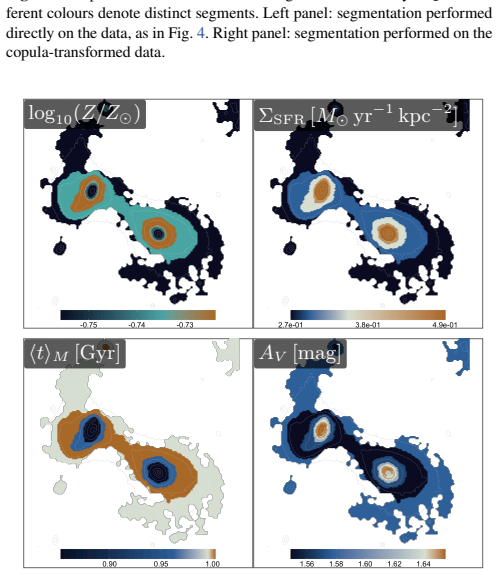
read the original abstract
We present sagui, a modular framework for the analysis of multi-band imaging data in spatially resolved galaxies, with synergies to integral-field spectroscopy (IFS). Building on the spectro-spatial paradigm introduced by capivara for IFS data, sagui extends this approach to imaging datasets, enabling a coherent, pixel-level treatment of spatial and spectral information across multiple bands. The method follows a two-stage strategy: a starlet-based decomposition is first used to identify and mask spatial structures across multiple scales while suppressing noise, and a spectral-similarity analysis then partitions the image into coherent pixel groups that preserve spectral consistency. In addition to compact and high-contrast structures, the framework incorporates a dedicated statistical treatment, based on a copula transform, to identify and recover faint, diffuse low-surface-brightness components. We demonstrate the method across a diverse range of galaxy morphologies, highlighting its ability to characterize complex spatial structures, including clumps, bars, interacting systems, and low-surface-brightness features. As a case study, we apply it to eleven morphologically diverse galaxies from the James Webb Space Telescope Advanced Deep Extragalactic Survey in the GOODS--South field. sagui is released under an MIT license and is available at https://rafaelsdesouza.github.io/sagui/.
Editorial analysis
A structured set of objections, weighed in public.
Referee Report
Summary. The paper introduces SAGUI, a modular framework extending the CAPIVARA spectro-spatial approach from IFS to multi-band imaging data. It employs a two-stage pipeline—starlet-based multi-scale decomposition to identify spatial structures and suppress noise, followed by spectral-similarity partitioning to group pixels while preserving spectral consistency—plus a copula transform to recover faint diffuse low-surface-brightness components. The method is demonstrated qualitatively on 11 morphologically diverse galaxies from the JADES survey in GOODS-South, with open-source code released under MIT license.
Significance. If the LSB recovery and segmentation claims hold under quantitative scrutiny, SAGUI would provide a useful open tool for coherent pixel-level analysis of complex galaxy structures (clumps, bars, interactions, diffuse features) in JWST multi-band imaging while maintaining spectral fidelity, with potential synergies to IFS studies. The public code release is a clear strength supporting reproducibility.
major comments (2)
- [Abstract and case-study application] Abstract and demonstration on JADES galaxies: the central claim that the copula transform accurately identifies and recovers faint LSB components without introducing artifacts or false structures rests on qualitative examples only; no completeness, purity, flux-recovery fractions, or controlled tests on simulated images with injected LSB signals at known surface-brightness levels and noise realizations are reported, leaving the performance unverified.
- [Methods] Methods description of the two-stage strategy: no quantitative error analysis, baseline comparisons (e.g., against standard segmentation tools), or details on parameter choices for starlet scales and spectral-similarity thresholds are supplied, which is load-bearing for assessing whether the partitioning truly preserves spectral consistency across bands.
minor comments (1)
- [Abstract] The abstract states the code is available at a GitHub link but does not include a direct citation or DOI for the CAPIVARA framework it builds upon.
Simulated Author's Rebuttal
We thank the referee for the careful and constructive review of our manuscript. The comments identify key areas where additional rigor would strengthen the presentation of SAGUI. We address each major comment point by point below, indicating the revisions we will implement.
read point-by-point responses
-
Referee: [Abstract and case-study application] Abstract and demonstration on JADES galaxies: the central claim that the copula transform accurately identifies and recovers faint LSB components without introducing artifacts or false structures rests on qualitative examples only; no completeness, purity, flux-recovery fractions, or controlled tests on simulated images with injected LSB signals at known surface-brightness levels and noise realizations are reported, leaving the performance unverified.
Authors: We agree that the current demonstration is based on qualitative assessment of real JADES data across 11 morphologically diverse galaxies. While this choice emphasizes applicability to complex observational datasets, we acknowledge that quantitative validation would better support the LSB recovery claims. In the revised manuscript we will add a dedicated section presenting controlled tests on simulated images with injected LSB signals, including completeness, purity, and flux-recovery metrics across multiple noise realizations. revision: yes
-
Referee: [Methods] Methods description of the two-stage strategy: no quantitative error analysis, baseline comparisons (e.g., against standard segmentation tools), or details on parameter choices for starlet scales and spectral-similarity thresholds are supplied, which is load-bearing for assessing whether the partitioning truly preserves spectral consistency across bands.
Authors: We accept that the methods section would benefit from greater quantitative support. The original text describes the starlet decomposition and spectral-similarity partitioning but does not include formal error analysis or direct comparisons. We will revise the methods to incorporate quantitative error analysis, baseline comparisons against standard tools such as SExtractor, and explicit details on the selection of starlet scales and spectral-similarity thresholds together with sensitivity tests confirming preservation of spectral consistency. revision: yes
Circularity Check
SAGUI presents independent methodological extensions without derivation circularity
full rationale
The manuscript introduces SAGUI as a new two-stage pipeline (starlet decomposition followed by spectral-similarity partitioning, augmented by a copula transform for LSB recovery) that extends the prior CAPIVARA framework to imaging data. No equations or steps in the provided description reduce the core outputs (pixel groups, recovered LSB components) to quantities fitted from the same JADES dataset by construction. The application to eleven galaxies is a demonstration rather than a self-referential prediction. The self-citation to CAPIVARA is explicit but does not serve as the sole justification for the new imaging-specific components or claims; those rest on the described algorithmic choices and qualitative results. This is a standard case of building on prior work without tautological reduction.
Axiom & Free-Parameter Ledger
Forward citations
Cited by 1 Pith paper
-
Lightstack: A Python Package for Creating Photometric Data Cubes
lightstack is a Python package that creates photometric data cubes from standalone multi-band images via cropping, stacking, and PSF matching.
discussion (0)
Sign in with ORCID, Apple, or X to comment. Anyone can read and Pith papers without signing in.