REVIEW 3 major objections 4 minor 43 references
Spin-reorientation Driven Temperature Dependent Intrinsic Anomalous Hall Conductivity in Fe$_3$Ge, a Ferromagnetic Topological Metal
T0 review · 3 major / 4 minor · reviewed 2026-08-06 · deepseek-v4-flash
Pith's one-line read The paper argues that cooling Fe3Ge rotates its easy magnetization axis, which makes the Berry-curvature part of the Hall conductivity temperature-dependent.
desk verdict A worthwhile spin-reorientation AHE study with genuinely new angle-dependent DFT, but the experimental case for temperature-dependent intrinsic AHC rests on fragile two-block TYJ fits that need error bars and a consistent subtraction. read the letter →
The pith
A machine-rendered reading of the paper's core claim, the machinery that carries it, and where it could break.
The reading
What carries the argument
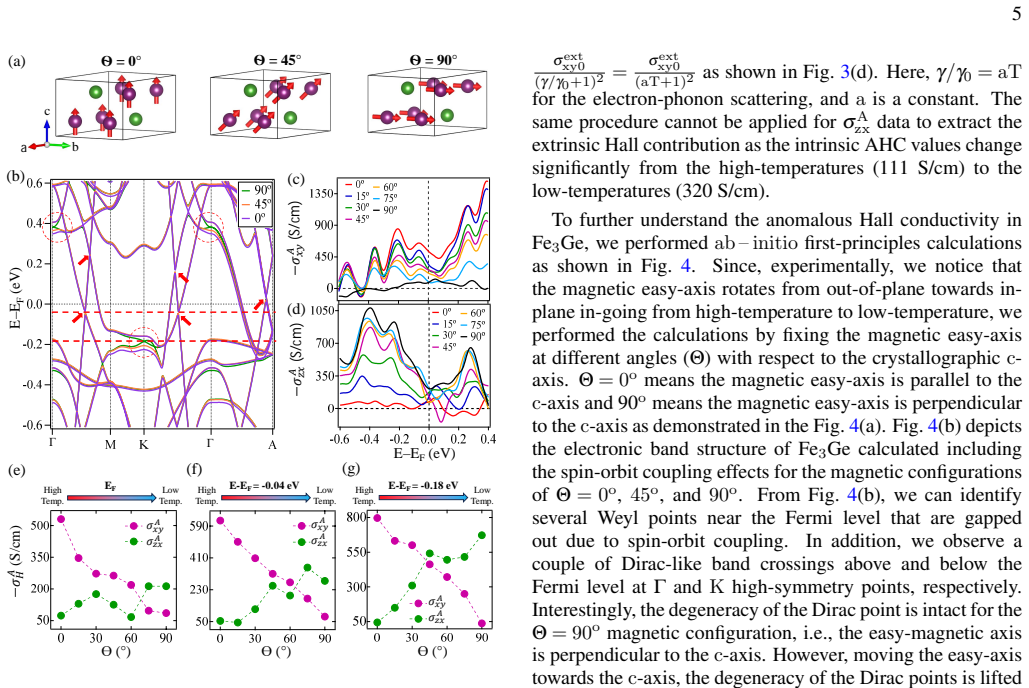
The workhorse is the TYJ scaling law, an empirical relation that expresses the anomalous Hall conductivity as a slope term proportional to the square of the longitudinal conductivity plus a temperature-dependent intercept $b(T)$; the intercept is what the paper counts as the intrinsic, Berry-curvature contribution. The physical driver is the spin-reorientation transition at about 340 K, where magnetization data show the Fe moments canting from the $z$-axis toward the $xy$-plane as temperature falls. The band-structure calculations supply the link between the two: for magnetization angles $\Theta = 0^\circ$, $45^\circ$, and $90^\circ$, spin-orbit coupling gaps at Weyl and Dirac points change with $\Theta$, which redistributes the integrated Berry curvature between in-plane and out-of-plane Hall conductivities and matches the experimental crossover.
What would settle it
Repeat the scaling analysis on a Fe$_3$Ge crystal whose magnetization is pinned by a strong magnetic field so that the easy axis cannot rotate as temperature is swept through the spin-reorientation transition; if the fitted intrinsic intercept changes anyway, the central claim is wrong.
Extended reading notes
Core claim
The central claim is that the intrinsic anomalous Hall conductivity of Fe$_3$Ge is not a fixed band-structure property but changes with temperature because the easy magnetization axis rotates. In the TYJ scaling law, $$-\sigma_{xy}^{A}(T)=\rho_{xy0}^{\mathrm{ext}}\sigma_{xx}^{2}(T)+b(T),$$ the intercept $b(T)$ is read as the intrinsic Hall contribution; the paper reports $b$ moving from 170 to 112 S/cm in-plane and from 111 to 320 S/cm out-of-plane between the high- and low-temperature regions. The remaining Hall signal is identified as extrinsic skew scattering, whose temperature decay is fit by $\sigma_{xy}^{\mathrm{ext}}(T)=\sigma_{xy0}^{\mathrm{ext}}/(aT+1)^2$ via electron-phonon scattering. Density functional theory calculations with the magnetization angle set to $0^\circ$, $45^\circ$, and $90^\circ$ reproduce the qualitative crossover in which in-plane intrinsic anomalous Hall conductivity dominates above the spin-reorientation transition and out-of-plane intrinsic anomalous Hall conductivity dominates below it.
Load-bearing premise
The quantitative case rests on the assumption that the scaling-law plots can be split into two straight-line blocks with a constant intrinsic intercept inside each block, so the change in the fitted intercept is the only carrier of the temperature dependence.
Editorial extensions
If this is right
- In Fe$_3$Ge the intrinsic anomalous Hall conductivity is not a fixed constant: rotating the easy axis from out-of-plane to in-plane changes the fitted intrinsic intercept from 170 to 112 S/cm in-plane and from 111 to 320 S/cm out-of-plane.
- The sharp rise in total anomalous Hall conductivity below about 200 K is dominated by extrinsic skew scattering, while the rise above 200 K comes from the high-temperature intrinsic contribution.
- The extrinsic skew-scattering contribution decays as $\sigma_{xy}^{\mathrm{ext}}(T)=\sigma_{xy0}^{\mathrm{ext}}/(aT+1)^2$, a temperature dependence set by electron-phonon scattering.
- The crossover in which current direction has the larger intrinsic Hall conductivity is reproduced qualitatively by density functional theory as the magnetization angle is varied, indicating that the spin-reorientation transition itself is the control parameter.
- The result gives an experimental route to Berry-curvature engineering in kagome ferromagnets: choose a material with a spin-reorientation transition, and cool it to select the intrinsic Hall response.
Reading between the lines
- Inference: applying the same two-block scaling analysis at intermediate temperatures should show the intrinsic intercept moving continuously between the high- and low-temperature values, tracking the gradual canting angle; finer temperature windows would test this directly.
- Inference: if the mechanism is easy-axis rotation rather than thermal smearing, a Fe$_3$Ge crystal pinned by a magnetic field so that the easy axis cannot rotate should show a nearly temperature-independent intrinsic intercept across the spin-reorientation region.
- Inference: other ferromagnets with spin-reorientation transitions and nearby Weyl or Dirac nodes should show analogous temperature dependence in the intrinsic anomalous Hall conductivity, so reanalyzing existing AHE data across such transitions could reveal the same effect.
- Inference: because the calculated Dirac-node gap depends on magnetization angle, angle-resolved photoemission across the spin-reorientation region could observe the gap opening and closing, giving a band-structure-level check of the Berry-curvature redistribution.
Signed reviews
Editorial analysis
A structured set of objections, weighed in public.
Referee Report
Summary. The paper reports anisotropic anomalous Hall conductivity in the ferromagnetic kagome metal Fe3Ge and attributes its temperature dependence to a spin-reorientation transition that tunes the magnetization direction from out-of-plane to in-plane with decreasing temperature. The experimental Hall conductivity data are analyzed within the Tian-Ye-Jin (TYJ) scaling framework, Eq. (5), in two temperature blocks, yielding different intercepts b (170 to 112 S/cm in-plane, 111 to 320 S/cm out-of-plane) that are identified as the temperature-dependent intrinsic anomalous Hall conductivity. Density functional theory calculations with magnetization oriented at different angles reproduce the qualitative trend of a crossover between in-plane and out-of-plane intrinsic conductivity. The paper also models the temperature decay of the extrinsic contribution as σ_ext(T)=σ_ext0/(aT+1)^2 due to electron-phonon scattering.
Significance. If the experimental claim is correct, this would be a rare direct observation of temperature-dependent intrinsic anomalous Hall conductivity arising from a magnetic transition, and it would be of interest to the condensed-matter community studying Berry-curvature engineering and kagome magnets. A clear strength is the independent DFT calculation: the computed evolution of σ_xy^A and σ_zx^A with the magnetization angle qualitatively supports the experimental scenario without being fitted to the transport data. However, the quantitative experimental evidence for the central claim rests entirely on two-block linear fits of the TYJ scaling relation, and the manuscript currently provides insufficient statistical detail and contains an internally inconsistent subtraction procedure. These issues must be resolved before the claim can be accepted.
major comments (3)
- [Section III, Eq. (5), Figs. 3(b)-3(c)] The central claim that the intrinsic AHC is temperature dependent rests on the change of the fitted intercept b between two temperature blocks. The manuscript reports neither the slope (A in Eq. 5) nor the uncertainties for these fits, nor a statistical comparison of the two-block model against a single linear fit. Because the intercept is an extrapolation to σ_xx^2=0, a temperature-dependent slope within either block could produce a spurious intercept shift. Please provide the full fitting parameters, confidence intervals, and a goodness-of-fit comparison (e.g., an F-test) for the piecewise versus single-line model.
- [Section III, Fig. 3(d)] The extrinsic AHC is obtained by subtracting the low-temperature intercept b=112 S/cm from the total AHC at all temperatures, even though the high-temperature block fit gives b=170 S/cm. This choice is inconsistent and unsubstantiated; it biases the extracted σ_ext_xy and thereby the claimed (aT+1)^-2 temperature dependence. Please justify the subtraction or re-extract σ_ext_xy using the appropriate block-dependent intrinsic value.
- [Section III, Eq. (5)] The TYJ decomposition assumes a single linear relation σ_A = A σ_xx^2 + b valid over each temperature block, with b identified as the intrinsic contribution. Given that the spin reorientation is gradual, as shown in Figs. 2(a)-2(d), the coefficient A itself is expected to vary with temperature; the paper does not show that A is constant within each block or across the full range, and a temperature-dependent A would directly affect the inferred b values. Please address the sensitivity of the intercepts to the block choice (e.g., by moving the block boundary) and to a model with a temperature-dependent slope.
minor comments (4)
- [Equation (5)] The first term on the right-hand side, ρ_ext_xy0 σ_xx^2(T), mixes resistivity and conductivity notation; Fig. 3(d) and the text use σ_ext_xy0. Please clarify the notation and the units of the coefficient.
- [Section III, before Eq. (4)] The phrase 'some of all three contributions' should be 'sum of all three contributions'.
- [Figs. 3(b)-3(c)] The data points are shown without error bars; given that the intercepts are central to the claim, please include error estimates from the fits.
- [Introduction] The sentence beginning 'In this paper, the kagome lattice...' is grammatically incomplete; 'In this paper' appears to be a leftover from editing and should be removed or the sentence restructured.
Circularity Check
No significant circularity: the DFT result is independent of the transport fits, and the experimental b-values are fit outputs presented as measurements, not as predictions.
full rationale
The paper's experimental claim of temperature-dependent intrinsic anomalous Hall conductivity rests on two-block linear fits of Eq. (5), where b is the intercept assigned to the intrinsic Berry-curvature contribution. This is an empirical extraction, not a prediction, and it is not circular in the narrow sense of the derivation being equivalent to its inputs: the raw inputs are measured Hall resistivities and longitudinal conductivities, and b is obtained from least-squares intercepts. The independent first-principles calculation (Fig. 4) computes the anomalous Hall conductivity from Berry curvature for fixed magnetization angles and finds the same qualitative crossover (in-plane AHC decreases and out-of-plane AHC increases as the easy axis rotates from out-of-plane to in-plane). That calculation is not fitted to the transport data, so the central claim has independent content. The paper's own statement that the same extraction procedure cannot be applied to the out-of-plane data because the intrinsic contribution changes significantly is a consistency check, not a circular step. The one internal inconsistency, subtracting b=112 S/cm at all temperatures for the extrinsic in-plane conductivity even though the high-temperature fit gives b=170 S/cm, is a data-reduction and statistical concern rather than a circularity. The paper cites the authors' prior Fe3Sn work (Ref. [21]) for the electron-phonon skew-scattering model, but the model itself is attributed to Shitade and Nagaosa (Ref. [42]), and this self-citation is not load-bearing for the main claim. No self-definitional, uniqueness-imported, or ansatz-smuggled steps are present. Overall score 2 reflects one minor, non-load-bearing self-citation, with no circular derivation of the central result.
Assumptions & free parameters
free parameters (6)
- b_xy intrinsic AHC, low-temperature block =
112 S/cm
- b_xy intrinsic AHC, high-temperature block =
170 S/cm
- b_zx intrinsic AHC, low-temperature block =
320 S/cm
- b_zx intrinsic AHC, high-temperature block =
111 S/cm
- sigma_ext_xy0 =
not reported in text
- a =
not reported in text
assumptions (6)
- domain assumption TYJ scaling law in Eq. 5 separates intrinsic and extrinsic AHC as -sigma_A = rho_ext sigma_xx^2 + b, with b independent of longitudinal conductivity within each temperature block.
- domain assumption Matthiessen's rule applies to AHC, so sigma_AH = sigma_int + sigma_sk + sigma_sj (Eq. 4).
- domain assumption The side-jump contribution is negligible in Fe3Ge.
- domain assumption Static DFT spin configurations at angles theta = 0, 45, and 90 degrees represent the temperature evolution of the easy axis.
- domain assumption The electron-phonon scattering rate is proportional to temperature, gamma/gamma0 = aT, giving the form sigma_ext = sigma_ext0/(aT+1)^2.
- domain assumption PBE-GGA with spin-orbit coupling and Wannier interpolation gives a quantitatively reliable Berry curvature and AHC.
Cite this review
Pith. "Pith review of Spin-reorientation Driven Temperature Dependent Intrinsic Anomalous Hall Conductivity in Fe$_3$Ge, a Ferromagnetic Topological Metal." pith.science (2026). https://pith.science/paper/SMKCQCKK
@misc{pith2026250712777,
  author       = {Pith},
  title        = {Pith review of: Spin-reorientation Driven Temperature Dependent Intrinsic Anomalous Hall Conductivity in Fe$_3$Ge, a Ferromagnetic Topological Metal},
  year         = {2026},
  howpublished = {\url{https://pith.science/paper/SMKCQCKK}},
  note         = {Machine review of arXiv:2507.12777}
}
abstract
We investigate the temperature dependence of the intrinsic anomalous Hall conductivity in Fe$_3$Ge, which is a ferromagnetic topological metal. We observe a significant anisotropy in the anomalous Hall conductivity between in-plane and out-of-plane directions. We further identify that the total Hall conductivity is contributed extrinsically due to the skew-scattering mechanism and intrinsically due to nonzero Berry curvature in the momentum space. Most importantly, we demonstrate the temperature dependence of the intrinsic Hall contribution, a rare phenomenon to visualize experimentally, due to tuning the easy-magnetic axis from the out-of-plane to the in-plane with decreasing temperature. We also show that the extrinsic Hall conductivity decreases with temperature as $\sigma_{xy}^{ext}(T)=\frac{\sigma_{xy0}^{ext}}{(aT+1)^2}$ due to electron-phonon scattering.
Figures


Figures from the paper (5 more)


Reference graph
Works this paper leans on
-
[1]
Kittel, Solid state physics , V ol
C. Kittel, Solid state physics , V ol. 3 (Shell Development Company Emeryville, 1955)
work page 1955
-
[2]
N. W. Ashcroft and N. D. Mermin, Solid State Physics (Cengage Learning, 1976)
work page 1976
-
[3]
Chien, The Hall effect and its applications (Springer Science & Business Media, 2013)
C. Chien, The Hall effect and its applications (Springer Science & Business Media, 2013)
work page 2013
-
[4]
Nagaosa, J
N. Nagaosa, J. Sinova, S. Onoda, A. H. MacDonald, and N. P. Ong, Anomalous Hall effect, Rev. Mod. Phys.82, 1539 (2010)
2010
-
[5]
Smit and J, The spontaneous Hall effect in ferromagnetics I, Physica 21, 877 (1955)
work page 1955
-
[6]
Berger, Side-jump mechanism for the Hall effect of ferromagnets, Physical Review B 2, 4559 (1970)
L. Berger, Side-jump mechanism for the Hall effect of ferromagnets, Physical Review B 2, 4559 (1970)
work page 1970
-
[7]
R. Karplus and J. M. Luttinger, Hall Effect in Ferromagnetics, Physical Review 95, 1154 (1954)
work page 1954
-
[8]
T. Jungwirth, Q. Niu, and A. H. MacDonald, Anomalous Hall Effect in Ferromagnetic Semiconductors, Phys. Rev. Lett. 88, 207208 (2002)
work page 2002
Show all 43 references
-
[9]
L. Ye, Y . Tian, X. Jin, and D. Xiao, Temperature dependence of the intrinsic anomalous Hall effect in nickel, Phys. Rev. B 85, 220403 (2012)
2012
-
[10]
directions were then obtained by integrating the z- and y-components of the Berry curvature over the entire Brillouin zone using the WannierTools code [32]. III. RESULTS AND DISCUSSIONS The left panel in Fig. 1(a) depicts the schematic view of the hexagonal crystal structure o...
2023
-
[11]
M. Kang, L. Ye, S. Fang, J.-S. You, A. Levitan, M. Han, J. I. Facio, C. Jozwiak, A. Bostwick, E. Rotenberg, M. K. Chan, R. D. McDonald, D. Graf, K. Kaznatcheev, E. Vescovo, D. C. Bell, E. Kaxiras, J. van den Brink, M. Richter, M. Prasad Ghimire, J. G. Checkelsky, and R. Comin,...
2019
-
[12]
J.-X. Yin, B. Lian, and M. Z. Hasan, Topological kagome magnets and superconductors, Nature 612, 647 (2022)
2022
-
[13]
J. Sau, H. Banerjee, S. Saha, N. Kumar, and M. Kumar, Exploring magnetic and topological complexity in MgMn6Sn6: from frustrated ground states to nontrivial Hall conductivity (2024), arXiv:2408.02504 [cond-mat.str-el]
2024 arXiv
-
[14]
Morali, R
N. Morali, R. Batabyal, P. K. Nag, E. Liu, Q. Xu, Y . Sun, B. Yan, C. Felser, N. Avraham, and H. Beidenkopf, Fermi- arc diversity on surface terminations of the magnetic Weyl semimetal Co3Sn2S2, Science 365, 1286 (2019)
2019
-
[15]
Nakatsuji, N
S. Nakatsuji, N. Kiyohara, and T. Higo, Large anomalous Hall effect in a non-collinear antiferromagnet at room temperature, Nature 527, 212 (2015)
2015
-
[16]
Q. Wang, Q. Yin, and H. Lei, Giant topological Hall effect of ferromagnetic kagome metal Fe3Sn2, Chinese Physics B 29, 017101 (2020)
2020
-
[17]
Q. Wang, Y . Xu, R. Lou, Z. Liu, M. Li, Y . Huang, D. Shen, H. Weng, S. Wang, and H. Lei, Large intrinsic anomalous Hall effect in half-metallic ferromagnet Co3Sn2S2 with magnetic Weyl fermions, Nat. Commun. 9, 3681 (2018)
2018
-
[18]
A. K. Nayak, J. E. Fischer, Y . Sun, B. Yan, J. Karel, A. C. Komarek, C. Shekhar, N. Kumar, W. Schnelle, J. K¨ubler, et al., Large anomalous Hall effect driven by a nonvanishing Berry curvature in the noncolinear antiferromagnet Mn 3Ge, Science advances 2, e1501870 (2016)
2016
-
[19]
K ¨ubler and C
J. K ¨ubler and C. Felser, Weyl fermions in antiferromagnetic Mn3Sn and Mn3Ge, EPL (Europhysics Letters) 120, 47002 (2018)
2018
-
[20]
Z. Hou, W. Ren, B. Ding, G. Xu, Y . Wang, B. Yang, Q. Zhang, Y . Zhang, E. Liu, F. Xu, W. Wang, G. Wu, X. Zhang, B. Shen, and Z. Zhang, Observation of Various and Spontaneous Magnetic Skyrmionic Bubbles at Room Temperature in a Frustrated Kagome Magnet with Uniaxial Magnetic A...
2017 doi
-
[21]
L. Ye, M. K. Chan, R. D. McDonald, D. Graf, M. Kang, J. Liu, T. Suzuki, R. Comin, L. Fu, and J. G. Checkelsky, de Haas- van Alphen effect of correlated Dirac states in kagome metal Fe3Sn2, Nat. Commun. 10, 4870 (2019)
2019
-
[22]
A. Low, S. Ghosh, S. Ghorai, and S. Thirupathaiah, Effect of electron-phonon scattering on the anomalous Hall conductivity of Fe 3Sn: A kagome ferromagnetic metal, Phys. Rev. B 108, 094404 (2023)
2023
-
[23]
J. W. Drijver, S. G. Sinnema, and F. Van Der Woude, Magnetic properties of hexagonal and cubic Fe3Ge, Journal of Physics F 7 Metal Physics 6, 2165 (1976)
1976
-
[24]
Z. Li, Y . Wang, Z. Xia, Q. Zhang, Z. Li, E. Liu, and Z. Liu, Anomalous Hall effect dominated by intrinsic mechanism in Fe3Ge with hexagonal DO19 Kagome lattice and cubic DO3 structure, Appl. Phys. Lett. 122, 10.1063/5.0118768 (2023)
2023 doi
-
[25]
Albertini, D
F. Albertini, D. Negri, L. Pareti, E. B. Watts, Z. Arnold, J. Kamarad, G. Calestani, A. Deriu, and S. Besseghini, Magnetocrystalline anisotropy of Fe3Ge single crystal: Effect of pressure and Mn substitution for Fe, J Appl Phys 96, 2110 (2004)
2004
-
[26]
Zhang, M
Z. Zhang, M. Zhao, L. Ma, G. Li, C. Zhen, D. Zhao, and D. Hou, Large topological Hall effect arising from spin reorientation in kagome magnet Fe3Ge (2024), arXiv:2403.17354 [cond-mat.mtrl-sci]
2024 arXiv
-
[27]
R. Lou, L. Zhou, W. Song, A. Fedorov, Z. Tu, B. Jiang, Q. Wang, M. Li, Z. Liu, X. Chen, O. Rader, B. B¨uchner, Y . Sun, H. Weng, H. Lei, and S. Wang, Orbital-selective effect of spin reorientation on the Dirac fermions in a non-charge-ordered kagome ferromagnet Fe3Ge, Nat. Com...
2024
-
[28]
See Supplemental Materials at [URL] for additional experimental and theoretical data
-
[29]
Giannozzi, S
P. Giannozzi, S. Baroni, N. Bonini, M. Calandra, R. Car, C. Cavazzoni, D. Ceresoli, G. L. Chiarotti, M. Cococcioni, I. Dabo, A. Dal Corso, S. de Gironcoli, S. Fabris, G. Fratesi, R. Gebauer, U. Gerstmann, C. Gougoussis, A. Kokalj, M. Lazzeri, L. Martin-Samos, N. Marzari, F. Ma...
2009
-
[30]
Vanderbilt, Soft self-consistent pseudopotentials in a generalized eigenvalue formalism, Physical Review B41, 7892 (1990)
D. Vanderbilt, Soft self-consistent pseudopotentials in a generalized eigenvalue formalism, Physical Review B41, 7892 (1990)
1990
-
[31]
A. A. Mostofi, J. R. Yates, G. Pizzi, Y .-S. Lee, I. Souza, D. Vanderbilt, and N. Marzari, An updated version of wannier90: A tool for obtaining maximally-localised Wannier functions, Comput. Phys. Commun. 185, 2309 (2014)
2014
-
[32]
D. J. Thouless, M. Kohmoto, M. P. Nightingale, and M. den Nijs, Quantized Hall Conductance in a Two-Dimensional Periodic Potential, Physical Review Letters 49, 405 (1982)
1982
-
[33]
Q.-S. Wu, S. Zhang, H. Song, M. Troyer, and A. Soluyanov, WannierTools: An open-source software package for novel topological materials, Computer Physics Communications 224, 10.1016/j.cpc.2017.09.033 (2017)
2017 doi
-
[34]
G. v. Minnigerode, G¨oran Grimvall, E. P. Wohlfahrt (Eds.): The Electron-Phonon Interaction in Metals, V ol. 16, aus: Selected Topics in Solid State Physics. North Holland Publishing Company, Amsterdam, New York, Oxford 1981. 304 Seiten, Dfl 125,—, Berichte der Bunsengesellsch...
1983
-
[35]
Nandi, B
S. Nandi, B. B. Maity, V . Sharma, R. Verma, V . Saini, B. Singh, D. Aoki, and A. Thamizhavel, Magnetotransport and Fermi surface studies of a purported nodal line semimetal ZrAs2, Phys. Rev. B 109, 075155 (2024)
2024
-
[36]
Wiesmann, M
H. Wiesmann, M. Gurvitch, H. Lutz, A. Ghosh, B. Schwarz, M. Strongin, P. B. Allen, and J. W. Halley, Simple Model for Characterizing the Electrical Resistivity in A – 15 Superconductors, Phys. Rev. Lett. 38, 782 (1977)
1977
-
[37]
Neubauer, C
A. Neubauer, C. Pfleiderer, B. Binz, A. Rosch, R. Ritz, P. G. Niklowitz, and P. B¨oni, Topological Hall Effect in the A Phase of MnSi, Phys. Rev. Lett. 102, 186602 (2009)
2009
-
[38]
Y . Tian, L. Ye, and X. Jin, Proper Scaling of the Anomalous Hall Effect, Phys Rev Lett 103, 087206 (2009)
2009
-
[39]
Singh, J
M. Singh, J. Sau, B. Rai, A. Panda, M. Kumar, and N. Kumar, Tuning intrinsic anomalous Hall effect from large to zero in two ferromagnetic states of SmMn2Ge2, Phys. Rev. Mater. 8, 084201 (2024)
2024
-
[40]
Q. Wang, S. Sun, X. Zhang, F. Pang, and H. Lei, Anomalous Hall effect in a ferromagnetic Fe3Sn2 single crystal with a geometrically frustrated Fe bilayer kagome lattice, Phys Rev B 94, 075135 (2016)
2016
-
[41]
S. Roy, R. Singha, A. Ghosh, A. Pariari, and P. Mandal, Anomalous Hall effect in the half-metallic Heusler compound Co2TiX (X = Si, Ge), Phys. Rev. B 102, 085147 (2020)
2020
-
[42]
Onoda, N
S. Onoda, N. Sugimoto, and N. Nagaosa, Intrinsic Versus Extrinsic Anomalous Hall Effect in Ferromagnets, Phys. Rev. Lett. 97, 126602 (2006)
2006
-
[43]
Shitade and N
A. Shitade and N. Nagaosa, Anomalous Hall Effect in Ferromagnetic Metals: Role of Phonons at Finite Temperature, Journal of the Physical Society of Japan 81, 083704 (2012). VII. SUPPLEMENTAL INFORMA TION Atomic (%) Weight (%)Element 76.22571.125Fe 23.77528.875Ge Intensity (arb...
2012
Reviewed August 6, 2026 · model on record in the stance chip above.
Discussion (0). Continue with ORCID to comment.