REVIEW 3 major objections 5 minor 83 references
In-medium bound states of two bosonic impurities in a one-dimensional Fermi gas
T0 review · 3 major / 5 minor · reviewed 2026-08-14 · deepseek-v4-flash
Pith's one-line read A one-dimensional Fermi gas induces additional attraction between two bosonic impurities, binding them below their vacuum two-boson energy in the exactly solvable case.
desk verdict Solid, honest Bethe-ansatz benchmark for two-boson in-medium binding in a 1D Fermi gas; the central attractive-case energy holds up, though the ground-state branch is not independently confirmed in the −2<c<0 window. read the letter →
The pith
A machine-rendered reading of the paper's core claim, the machinery that carries it, and where it could break.
The reading
What carries the argument
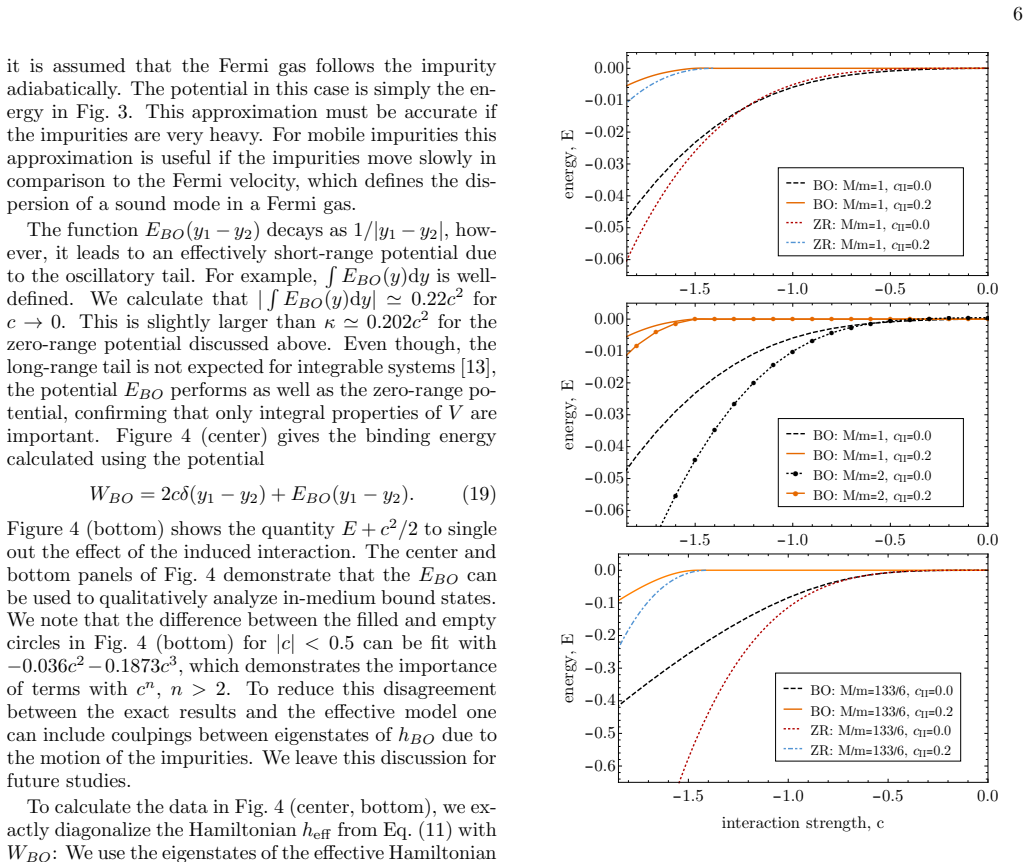
The central object is the Bethe-ansatz solution of the one-dimensional Hamiltonian (5) for $N=N_f+2$ particles, in which the wave function is a sum of plane waves in each ordering and the quasi-momenta $k_j$ together with two rapidity parameters $\Lambda_1,\Lambda_2$ satisfy the equations (6). Solving these numerically for finite particle number and extrapolating to the thermodynamic limit gives $\varepsilon_\infty$, from which the in-medium binding energy $E = \varepsilon_\infty - 2E_{\rm one}$ is formed. The second piece of machinery is the effective two-body Hamiltonian (11) with effective mass and an induced potential $W(y_1-y_2)$, benchmarked against the Bethe-ansatz curve and then used for non-integrable systems; both a zero-range potential matched to single-phonon exchange and a Born-Oppenheimer potential from static impurities are tested.
What would settle it
An independent numerical solution of Hamiltonian (5) for a finite number of fermions and two bosons at fixed density, extrapolated to the thermodynamic limit, should reproduce an in-medium binding energy strictly below $-c^2/2$ for attractive $c$; if it returns the vacuum dimer energy or a positive value, the central claim is falsified. Spectroscopically, a two-impurity line sitting at the vacuum dimer position with no shift would likewise contradict the predicted fermion-mediated attraction.
Extended reading notes
Core claim
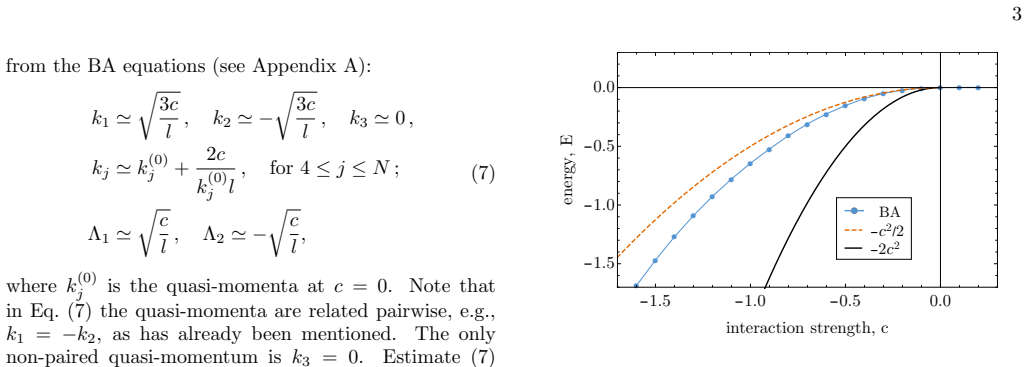
For the Bethe-ansatz-solvable case $c_{II}=c$ and $m=M$, the ground-state energy of two bosonic impurities in a Fermi gas yields an in-medium binding energy $E = \varepsilon_\infty - 2E_{\rm one}$, where $E_{\rm one}$ is the single-impurity energy gain. The paper finds $E<0$ for attractive interactions and, more specifically, $E$ lies below the vacuum two-boson binding energy $-c^2/2$: the fermionic medium deepens the dimer. For repulsive interactions the numerical result is $E=0$ within accuracy, meaning no in-medium bound state. The lowering of the energy is interpreted as a fermion-mediated attractive boson-boson interaction, and the exact curve is used to benchmark the effective models that extend the analysis to unequal masses and unequal interactions.
Load-bearing premise
The effective two-body model used for unequal masses or unequal interactions is assumed to be accurate; if it is not, the predicted critical coupling and the in-medium bound states of repelling bosons would not follow. The exactly solvable equal-mass, equal-coupling result does not depend on this assumption.
Editorial extensions
If this is right
- For attractive interactions in the symmetric case, the Fermi gas adds an attractive channel: the in-medium binding energy lies below the vacuum dimer energy $-c^2/2$.
- For repulsive interactions in the symmetric case, the calculation gives no in-medium bound state ($E=0$ within numerical accuracy).
- The effective model predicts that bosons which repel each other in vacuum form an in-medium bound state once $c < -\pi\sqrt{c_{II}}$, equivalently $c_{II}^{\rm cr}\simeq c^2/\pi^2$, and this threshold is nearly independent of the mass ratio.
- Heavier impurities give larger in-medium binding energies, so heavy-light Bose-Fermi mixtures are the more favorable setting for observing the effect; for parameters quoted in the paper the binding energy reaches roughly $22\,\mathrm{nK}\times k_B$.
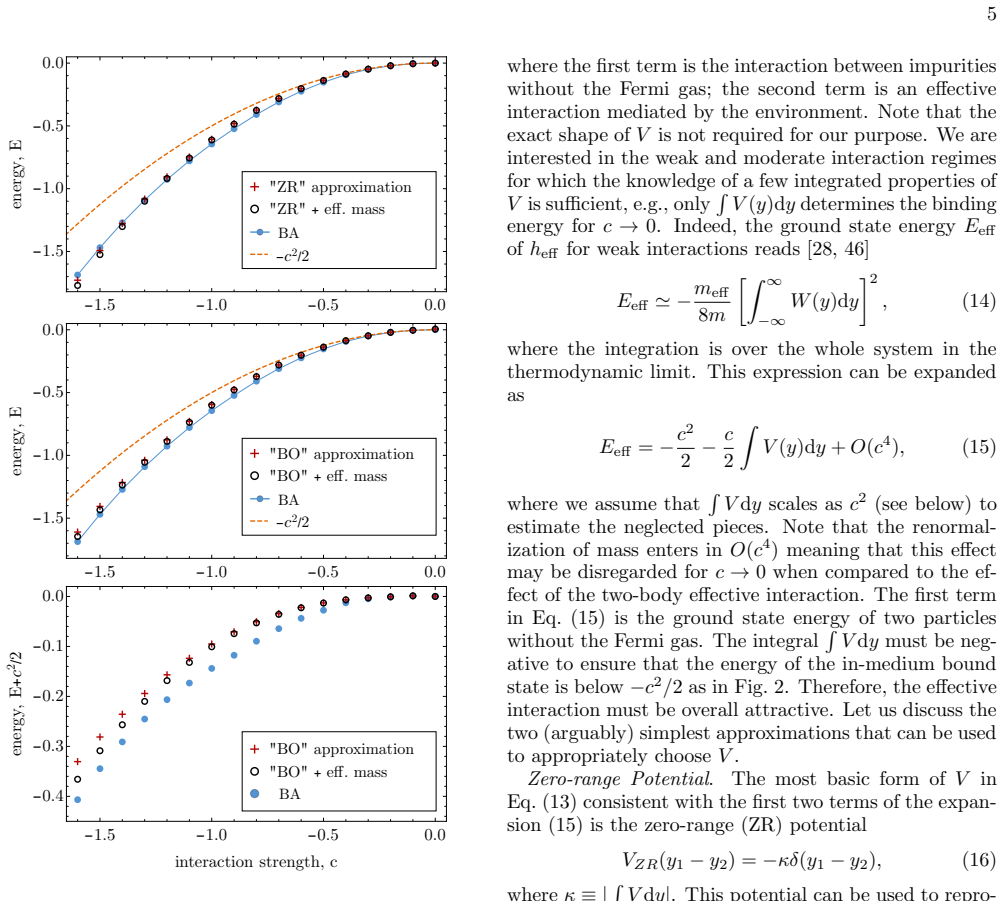
- Both the zero-range and the Born-Oppenheimer effective potentials reproduce the exact Bethe-ansatz binding qualitatively, which is the paper's justification for using them beyond the integrable limit.
Reading between the lines
- Beyond the paper, the weak-coupling formula shows that only the integrated induced potential $\int V(y)\,dy$ enters the leading binding shift, so the exact Bethe-ansatz curve can serve as a calibration point for the integrated fermion-mediated interaction in other one-dimensional impurity models.
- Beyond the paper, a testable extension would tune $c_{II}$ across the predicted critical value in a mixture whose bosons repel in vacuum and look for the onset of binding exactly where the induced attraction overtakes the bare repulsion.
- Beyond the paper, because the exact result applies at finite coupling, its curve could be used to assess how much of the induced attraction is captured by single-phonon exchange versus adiabatic static-impurity physics outside the weak-coupling limit.
Signed reviews
Editorial analysis
A structured set of objections, weighed in public.
Referee Report
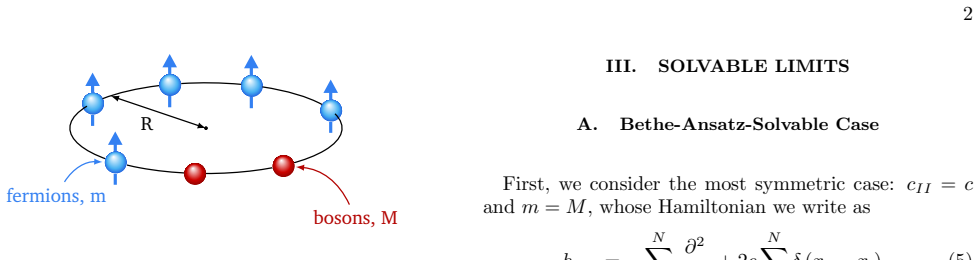
Summary. The paper studies two bosonic impurities immersed in a one-dimensional spin-polarized Fermi gas with delta-function interactions. In the exactly solvable case m=M and cII=c, the authors solve the Bethe ansatz equations (6) for finite particle numbers, extrapolate to the thermodynamic limit, and compare the resulting in-medium binding energy E = eps_infinity - 2E with the vacuum two-boson binding energy -c^2/2. Their central result is that for attractive interactions c in (-2,0), E lies below -c^2/2, which they interpret as an attractive boson-boson interaction induced by the Fermi gas; for repulsive interactions c>0 they find no in-medium bound state. They then construct two effective two-body models, a zero-range potential matched to single-phonon exchange and a Born-Oppenheimer potential obtained from static impurities, benchmark them against the exact Bethe ansatz result, and use them to predict in-medium bound states in non-integrable systems with cII != c and/or M != m, including a critical line ccr_II ~ c^2/pi^2 for bosons that repel each other in vacuum.
Significance. If the central exact result holds, this paper provides a rare nonperturbative benchmark for fermion-mediated interactions between two impurities in one dimension and makes concrete, experimentally testable predictions for ultracold Bose-Fermi mixtures. The strengths of the paper are real: the Bethe-ansatz calculation is cross-checked against McGuire's single-impurity result in Appendix D, the thermodynamic limit is examined with two different extrapolation forms, and the effective-potential parameters come from independent single-phonon-exchange and Born-Oppenheimer calculations rather than being fitted to the target quantity. The main caveats are that the followed Bethe-ansatz branch is not proven to be the ground state over the whole attractive interval, and the non-integrable predictions rest on an uncontrolled effective Hamiltonian.
major comments (3)
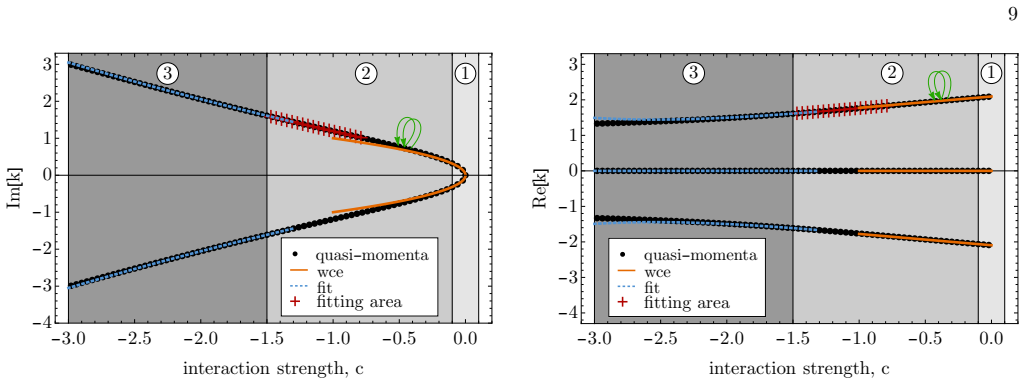
- [Sec. III.A and Appendix B] The identification of the followed Bethe-ansatz branch as the ground state is not established. The Newton continuation starts from the c=0 solution (Eq. (7)) and follows one branch, but the authors themselves note that for c -> -infinity a trimer branch with vacuum energy -2c^2 dominates. They do not compute the in-medium trimer branch or show that it lies above the followed branch for all c in (-2,0). If the trimer branch crossed before c=-2, the curves in Fig. 2 would be an excited-state branch rather than the ground-state in-medium binding energy, and the interpretation in terms of a two-boson bound state induced by the Fermi gas would need revision. Please provide an independent check for small Nf (e.g., exact diagonalization or a DMRG calculation on a lattice analog), or solve the Bethe-ansatz string equations for the trimer branch and compare energies over the full range c in (-2,0).
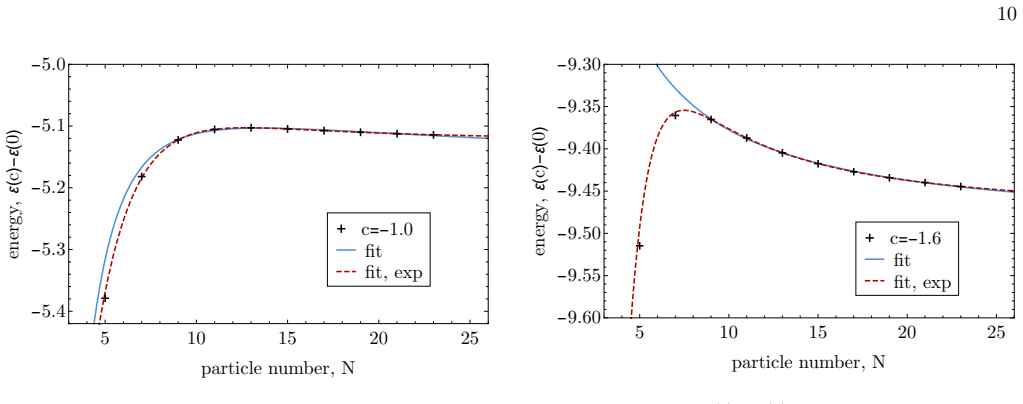
- [Sec. III.A and Appendix C] The thermodynamic-limit extrapolation is not independently verified. The energies for N up to about 25 are fitted with the two forms in Eqs. (C1) and (C2); for c=-1 these give eps_infinity = -5.176 and -5.125, respectively, a difference of about 0.05 in the total energy. Since E is obtained by subtracting two extrapolated quantities, the systematic error in E may be comparable to the small-c gap E + c^2/2 shown in Fig. 4 (bottom). Please either provide a consistency check with larger-N Bethe-ansatz solutions or an independent numerical method, and quantify the extrapolation uncertainty directly in E rather than only through the dot size in Fig. 2.
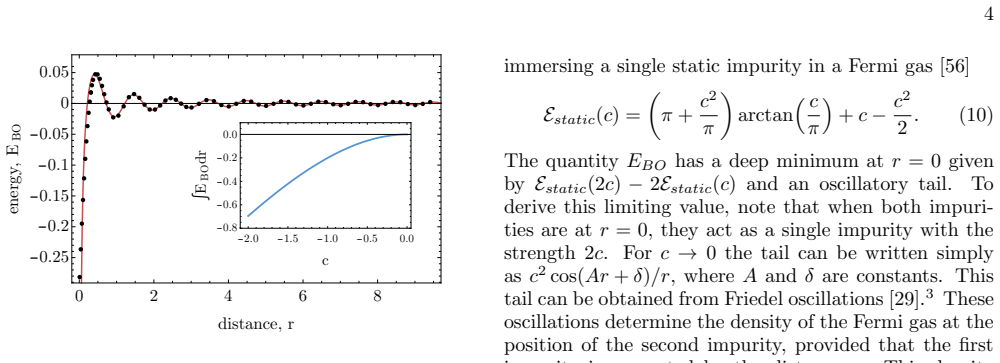
- [Sec. IV.B and Eq. (20)] The predictions for non-integrable systems use the effective Hamiltonian heff with meff=M and with V taken from either the static-impurity Born-Oppenheimer energy or a zero-range term matched to single-phonon exchange. This is an uncontrolled approximation: the good agreement in the integrable case does not by itself validate the model when M != m or cII != c. In particular, the critical line ccr_II ~ c^2/pi^2 in Eq. (21) comes from the zero-range model, and the Born-Oppenheimer model gives a slightly different threshold. Please benchmark the effective model against an independent many-body calculation for at least one mass-imbalanced or interaction-asymmetric case, or clearly state in the abstract and conclusions that these non-integrable results are uncontrolled model predictions.
minor comments (5)
- [Sec. III.A] The symbol E is used both for the single-impurity energy gain and for the in-medium binding energy E = eps_infinity - 2E; this is confusing. Please rename one of the two quantities.
- [Fig. 2] The solid black curve -2c^2 is the vacuum trimer energy, not the in-medium trimer energy. Since it lies below the Bethe-ansatz curve for c < -0.8, the figure should carry a caveat explaining that this comparison is not the in-medium trimer branch and does not by itself indicate a level crossing.
- [Eq. (7)] For c<0 the square roots in Eq. (7) are imaginary; the text should state explicitly that k1, k2 and Lambda1, Lambda2 become complex and specify the branch choice used in the continuation.
- [Appendix D] There is a typo: 'desribed' should be 'described'. There are also minor typos in Section IV.A ('coulpings' should be 'couplings') and in Fig. 3's inset ('present' should be 'presents').
- [References] Some references are arXiv-only without journal information (e.g., Refs. [63] and [72]); please update them if they have appeared in print.
Circularity Check
No significant circularity: the Bethe-ansatz result is solved from the Hamiltonian, and effective-model parameters come from independent single-phonon/Born-Oppenheimer calculations rather than from the target binding energy.
full rationale
The exact Bethe-ansatz branch is computed directly from the many-body Hamiltonian (5) via the BA equations (6), with the thermodynamic limit obtained by extrapolating finite-N solutions using two independent fit forms (Appendix C) that agree to the third digit. The in-medium binding energy E = eps_infinity - 2E is a definitional subtraction of the independently computed single-impurity energy, not a fit to the quantity being predicted; it isolates impurity-impurity correlations and does not reduce to its inputs. The effective-model parameters are also independent: the zero-range strength kappa = 2c^2/pi^2 is taken from single-phonon exchange, and the Born-Oppenheimer potential EBO is computed from a static-impurity one-body problem. These potentials are benchmarked against the exact BA result in Fig. 4, not tuned to it; the mass renormalization (12) comes from published effective-mass results. The non-integrable predictions in Sec. IV.B are explicit extrapolations of this benchmarked effective model, with meff = M stated as an approximation; this is an uncontrolled-model concern, not a circular reduction. The paper itself flags its limitations: it restricts attractive interactions to c & -2 ('In the rest of the paper, we only explore c & -2') and notes that the thermodynamic extrapolation is not independently validated for all finite c (Appendix C). These are numerical/scoping caveats, not examples of a claim being equivalent to its input by construction. The self-citations (e.g., Ref. [52] for the spin-chain mapping) are used for technical support or motivation and are not load-bearing for the central binding-energy claim. No uniqueness theorem is imported, and no fitted parameter is renamed as a prediction. Therefore no circular step is present.
Assumptions & free parameters
free parameters (2)
- Thermodynamic extrapolation amplitudes A1 and A2 (and alpha, beta in the alternate form) =
not tabulated; fitted for each c
- Born-Oppenheimer tail fit parameters A, B, delta =
fitted per c; example c=-0.5 shown in Fig. 3
assumptions (5)
- standard math The Bethe ansatz equations (6) provide the exact ground state of the delta-interaction Hamiltonian hBA for N=Nf+2 particles with two bosonic symmetries.
- domain assumption The two physical bosonic impurities can be represented as a distinguishable 1+1 subsystem whose ground state has bosonic exchange symmetry, allowing the mapping to hBA.
- ad hoc to paper Finite-N energies converge to the thermodynamic limit according to the assumed forms epsilon_infinity + A1/N + A2/N^2 or epsilon_infinity + A1/N^alpha + A2 e^{-beta N}.
- domain assumption The low-energy spectrum of two impurities in a Fermi gas is described by the effective Hamiltonian heff with one effective mass and a two-body potential W(y1-y2).
- domain assumption For non-integrable cases, the induced potential is either the static-impurity Born-Oppenheimer energy EBO(y1-y2) or the zero-range term matched to single-phonon exchange, and meff=M.
Cite this review
Pith. "Pith review of In-medium bound states of two bosonic impurities in a one-dimensional Fermi gas." pith.science (2026). https://pith.science/paper/SMPWKMVH
@misc{pith2026190802483,
  author       = {Pith},
  title        = {Pith review of: In-medium bound states of two bosonic impurities in a one-dimensional Fermi gas},
  year         = {2026},
  howpublished = {\url{https://pith.science/paper/SMPWKMVH}},
  note         = {Machine review of arXiv:1908.02483}
}
read the original abstract
We investigate the ground-state energy of a one-dimensional Fermi gas with two bosonic impurities. We consider spinless fermions with no fermion-fermion interactions. The fermion-impurity and impurity-impurity interactions are modelled with Dirac delta functions. First, we study the case where impurity and fermions have equal masses, and the impurity-impurity two-body interaction is identical to the fermion-impurity interaction, such that the system is solvable with the Bethe ansatz. For attractive interactions, we find that the energy of the impurity-impurity subsystem is below the energy of the bound state that exists without the Fermi gas. We interpret this as a manifestation of attractive boson-boson interactions induced by the fermionic medium, and refer to the impurity-impurity subsystem as an in-medium bound state. For repulsive interactions, we find no in-medium bound states. Second, we construct an effective model to describe these interactions, and compare its predictions to the exact solution. We use this effective model to study non-integrable systems with unequal masses and/or potentials. We discuss parameter regimes for which impurity-impurity attraction induced by the Fermi gas can lead to the formation of in-medium bound states made of bosons that repel each other in the absence of the Fermi gas.
Figures
Figures from the paper (5 more)

Reference graph
Works this paper leans on
-
[1]
ε∞ + A1 N + A2 N2 , (C1)
-
[2]
ZR" approximation
(10) The quantity EBO has a deep minimum at r = 0 given byEstatic(2c)− 2Estatic(c) and an oscillatory tail. To derive this limiting value, note that when both impuri- ties are at r = 0, they act as a single impurity with the strength 2c. For c→ 0 the tail can be written simply as c2 cos(Ar +δ)/r, where A and δ are constants. This tail can be obtained from...
2020
-
[3]
delta-potential boundary conditions
ε∞ + A1 Nα +A2e−βN . (C2) To illustrate the fits, we show in Figs. 8 and 9 the ex- act energies as functions of N for two different interac- tion strengths together with the corresponding fits. Both functions (C1) and (C2) appear to represent the data well. They also produce similar results for N→∞ . The values of ε∞ from the two fits differ only in the third ...
1965
-
[4]
Symmetric “bound states”: −2κe κl 2 +κr( 2ce−κl +ge−κl−κr + 2ce−κr + 2ce−2κr −2κe−κl−κr + 2κe−κ−r) = 0. (E3)
-
[5]
Antisymmetric “bound states”: 2e κl 2 +κr( 2ce−κl− 2ce−κl−κr− 2ce−κr + 2ce−2κr +2κe−κl−κr− 2κe−κr) = 0. (E4)
-
[6]
Symmetric “scattering states”: k [ 2c ( cos (kl 2 ) + cos (1 2k(l− 2r) )) −2k sin (kl 2 )] = 0. (E5)
-
[7]
Antisymmetric “scattering states”: 8c cos (1 2k(l− 2r) ) − 8c cos (kl 2 ) (E6) + 8k sin (kl 2 ) = 0. (E7) To solve the equations, a genetic algorithm first finds approximate solutions for k,κ . These are then used in the Newton’s iteration method as an initial guess. We calculate as many energy levels as particles we consider
-
[8]
L. D. Landau and S. I. Pekar, J. Exp. Theor. Phys 18, 419 (1948)
work page 1948
Show all 83 references
-
[9]
Pekar., Research in Electron Theory of Crystals (AEC-tr-555, US Atomic Energy Commission, 1963)
S. Pekar., Research in Electron Theory of Crystals (AEC-tr-555, US Atomic Energy Commission, 1963)
1963
-
[10]
A. S. Alexandrov and N. F. Mott, Polarons and Bipolarons (World Scientific, Singapore, 1995)
1995
-
[11]
Baym and C
G. Baym and C. Pethick, Landau Fermi-Liquid Theory: Concepts and Applications (2008)
2008
-
[12]
Kutschera and W
M. Kutschera and W. W´ ojcik, Phys. Rev. C 47, 1077 (1993)
1993
-
[13]
Schirotzek, C.-H
A. Schirotzek, C.-H. Wu, A. Sommer, and M. W. Zwier- lein, Phys. Rev. Lett. 102, 230402 (2009)
2009
-
[14]
Nascimb` ene, N
S. Nascimb` ene, N. Navon, K. J. Jiang, L. Tarruell, M. Te- ichmann, J. McKeever, F. Chevy, and C. Salomon, Phys. Rev. Lett. 103, 170402 (2009)
2009
-
[15]
Massignan, M
P. Massignan, M. Zaccanti, and G. M. Bruun, Rep. Prog. Phys. 77, 034401 (2014)
2014
-
[16]
M.-G. Hu, M. J. Van de Graaff, D. Kedar, J. P. Corson, E. A. Cornell, and D. S. Jin, Phys. Rev. Lett. 117, 055301 (2016)
2016
-
[17]
N. B. Jørgensen, L. Wacker, K. T. Skalmstang, M. M. Parish, J. Levinsen, R. S. Christensen, G. M. Bruun, and J. J. Arlt, Phys. Rev. Lett. 117, 055302 (2016)
2016
-
[18]
Schmidt, M
R. Schmidt, M. Knap, D. A. Ivanov, J.-S. You, M. Cetina, and E. Demler, Rep. Prog. Phys. 81, 024401 (2018)
2018
-
[19]
Bruderer, A
M. Bruderer, A. Klein, S. R. Clark, and D. Jaksch, Phys. Rev. A 76, 011605 (2007)
2007
-
[20]
Schecter and A
M. Schecter and A. Kamenev, Phys. Rev. Lett. 112, 155301 (2014)
2014
-
[21]
Keiler, S
K. Keiler, S. Kr¨ onke, and P. Schmelcher, New Journal of Physics 20, 033030 (2018)
2018
-
[22]
Naidon, Journal of the Physical Society of Japan 87, 043002 (2018)
P. Naidon, Journal of the Physical Society of Japan 87, 043002 (2018)
2018
-
[23]
A. S. Dehkharghani, A. G. Volosniev, and N. T. Zinner, Phys. Rev. Lett. 121, 080405 (2018)
2018
-
[24]
Camacho-Guardian and G
A. Camacho-Guardian and G. M. Bruun, Phys. Rev. X 8, 031042 (2018)
2018
-
[25]
Camacho-Guardian, L
A. Camacho-Guardian, L. A. Pe˜ na Ardila, T. Pohl, and G. M. Bruun, Phys. Rev. Lett. 121, 013401 (2018)
2018
-
[26]
A. I. Pavlov, J. van den Brink, and D. V. Efremov, Phys. Rev. B 98, 161410 (2018)
2018
-
[27]
Mistakidis, G
S. Mistakidis, G. Katsimiga, G. Koutentakis, and P. Schmelcher, New Journal of Physics21, 043032 (2019)
2019
-
[28]
S. I. Mistakidis, L. Hilbig, and P. Schmelcher, arXiv:1905.02624 (2019)
2019 arXiv
-
[29]
Reichert, Z
B. Reichert, Z. Ristivojevic, and A. Petkovic, New Jour- 12 nal of Physics 21, 053024 (2019)
2019
-
[30]
B. J. DeSalvo, K. Patel, G. Cai, and C. Chin, Nature 568, 61 (2019)
2019
-
[31]
Alexandrov and N
A. Alexandrov and N. F. Mott, Rep. Prog. Phys. 57, 1197 (1994)
1994
-
[32]
Adamowski, Phys
J. Adamowski, Phys. Rev. B 39, 3649 (1989)
1989
-
[33]
Schmickler, H.-W
C. Schmickler, H.-W. Hammer, and A. Volosniev, Physics Letters B 798, 135016 (2019)
2019
-
[34]
Takada, Phys
Y. Takada, Phys. Rev. B 26, 1223 (1982)
1982
-
[35]
L. D. Landau and E. M. Lifschitz, Quantum Mechanics: Non-relativistic Theory (3rd edition) (Elsevier Butterworth-Heinemann, 1977)
1977
-
[36]
Friedel, Il Nuovo Cimento (1955-1965) 7, 287 (1958)
J. Friedel, Il Nuovo Cimento (1955-1965) 7, 287 (1958)
1958
-
[37]
M. A. Cazalilla, R. Citro, T. Giamarchi, E. Orignac, and M. Rigol, Rev. Mod. Phys. 83, 1405 (2011)
2011
-
[38]
X.-W. Guan, M. T. Batchelor, and C. Lee, Rev. Mod. Phys. 85, 1633 (2013)
2013
-
[39]
M. T. Batchelor and A. Foerster, Journal of Physics A: Mathematical and Theoretical 49, 173001 (2016)
2016
-
[40]
A. N. Wenz, G. Z¨ urn, S. Murmann, I. Brouzos, T. Lompe, and S. Jochim, Science 342, 457 (2013)
2013
-
[41]
N. T. Zinner, EPJ Web of Conferences113, 01002 (2016)
2016
-
[42]
Rammelm¨ uller, W
L. Rammelm¨ uller, W. J. Porter, J. Braun, and J. E. Drut, Phys. Rev. A 96, 033635 (2017)
2017
-
[43]
Pagano, M
G. Pagano, M. Mancini, G. Cappellini, P. Lombardi, F. Sch¨ afer, H. Hu, X.-J. Liu, J. Catani, C. Sias, M. In- guscio, and L. Fallani, Nature Physics 10, 198 (2014)
2014
-
[44]
Ferrier-Barbut, M
I. Ferrier-Barbut, M. Delehaye, S. Laurent, A. T. Grier, M. Pierce, B. S. Rem, F. Chevy, and C. Salomon, Science 345, 1035 (2014), https://science.sciencemag.org/content/345/6200/1035.full.pdf
2014
-
[45]
C.-H. Wu, I. Santiago, J. W. Park, P. Ahmadi, and M. W. Zwierlein, Phys. Rev. A 84, 011601 (2011)
2011
-
[46]
C. N. Yang, Phys. Rev. Lett. 19, 1312 (1967)
1967
-
[47]
C. K. Lai and C. N. Yang, Phys. Rev. A 3, 393 (1971)
1971
-
[48]
M. T. Batchelor, M. Bortz, X. W. Guan, and N. Oelkers, Phys. Rev. A 72, 061603 (2005)
2005
-
[49]
Imambekov and E
A. Imambekov and E. Demler, Phys. Rev. A 73, 021602 (2006)
2006
-
[50]
J. B. McGuire, Journal of Mathematical Physics 6, 432 (1965)
1965
-
[51]
J. B. McGuire, Journal of Mathematical Physics 7, 123 (1966)
1966
-
[52]
J. B. McGuire, Journal of Mathematical Physics 5, 622 (1964), https://doi.org/10.1063/1.1704156
1964 doi
-
[53]
Simon, Ann
B. Simon, Ann. Phys. 97, 279 (1976)
1976
-
[54]
A. G. Volosniev, D. V. Fedorov, A. S. Jensen, M. Va- liente, and N. T. Zinner, Nature Communications 5, 5300 (2014)
2014
-
[55]
Deuretzbacher, D
F. Deuretzbacher, D. Becker, J. Bjerlin, S. M. Reimann, and L. Santos, Phys. Rev. A 90, 013611 (2014)
2014
-
[56]
A. G. Volosniev, D. Petrosyan, M. Valiente, D. V. Fe- dorov, A. S. Jensen, and N. T. Zinner, Phys. Rev. A 91, 023620 (2015)
2015
-
[57]
Massignan, J
P. Massignan, J. Levinsen, and M. M. Parish, Phys. Rev. Lett. 115, 247202 (2015)
2015
-
[58]
Deuretzbacher, D
F. Deuretzbacher, D. Becker, J. Bjerlin, S. M. Reimann, and L. Santos, Phys. Rev. A 95, 043630 (2017)
2017
-
[59]
A. G. Volosniev, Few-Body Systems 58, 54 (2017)
2017
-
[60]
R. P. Hodgson and J. B. Parkinson, Journal of Physics C: Solid State Physics 17, 3223 (1984)
1984
-
[61]
Recati, J
A. Recati, J. N. Fuchs, C. S. Pe¸ ca, and W. Zwerger, Phys. Rev. A 72, 023616 (2005)
2005
-
[62]
J. N. Fuchs, A. Recati, and W. Zwerger, Phys. Rev. A 75, 043615 (2007)
2007
-
[63]
Parisi and S
L. Parisi and S. Giorgini, Phys. Rev. A95, 023619 (2017)
2017
-
[64]
P. W. Anderson, Phys. Rev. Lett. 18, 1049 (1967)
1967
-
[65]
Castella and X
H. Castella and X. Zotos, Phys. Rev. B 47, 16186 (1993)
1993
-
[66]
Giraud and R
S. Giraud and R. Combescot, Phys. Rev. A 79, 043615 (2009)
2009
-
[67]
R. Mao, X. W. Guan, and B. Wu, Phys. Rev. A 94, 043645 (2016)
2016
-
[68]
A. G. Volosniev and H.-W. Hammer, New Journal of Physics 19, 113051 (2017)
2017
-
[69]
Vansant, M
P. Vansant, M. A. Smondyrev, F. M. Peeters, and J. T. Devreese, Journal of Physics A: Mathematical and Gen- eral 27, 7925 (1994)
1994
- [70]
-
[71]
Flicker and E
M. Flicker and E. H. Lieb, Phys. Rev. 161, 179 (1967)
1967
-
[72]
Rammelm¨ uller, W
L. Rammelm¨ uller, W. J. Porter, J. E. Drut, and J. Braun, Phys. Rev. D 96, 094506 (2017)
2017
-
[73]
Rammelm¨ uller, J
L. Rammelm¨ uller, J. E. Drut, and J. Braun, Journal of Physics: Conference Series 1041, 012006 (2018)
2018
-
[74]
Girardeau, Journal of Mathematical Physics 1, 516 (1960), https://doi.org/10.1063/1.1703687
M. Girardeau, Journal of Mathematical Physics 1, 516 (1960), https://doi.org/10.1063/1.1703687
1960 doi
-
[75]
Grusdt, G
F. Grusdt, G. E. Astrakharchik, and E. Demler, New Journal of Physics 19, 103035 (2017)
2017
-
[76]
Pastukhov, Phys
V. Pastukhov, Phys. Rev. A 96, 043625 (2017)
2017
-
[77]
Kain and H
B. Kain and H. Y. Ling, Phys. Rev. A 98, 033610 (2018)
2018
-
[78]
S. I. Mistakidis, G. C. Katsimiga, G. M. Koutentakis, T. Busch, and P. Schmelcher, Phys. Rev. Lett. 122, 183001 (2019)
2019
-
[79]
Paeckel, T
S. Paeckel, T. K¨ ohler, A. Swoboda, S. R. Manmana, U. Schollw¨ ock, and C. Hubig, (2019), arXiv:1901.05824
2019 arXiv
-
[80]
Schollw¨ ock, Rev
U. Schollw¨ ock, Rev. Mod. Phys.77, 259 (2005)
2005
-
[81]
E. Gull, A. J. Millis, A. I. Lichtenstein, A. N. Rubtsov, M. Troyer, and P. Werner, Rev. Mod. Phys. 83, 349 (2011)
2011
- [82]
-
[83]
Oelkers, M
N. Oelkers, M. T. Batchelor, M. Bortz, and X.-W. Guan, Journal of Physics A: Mathematical and General 39, 1073 (2006)
2006
Reviewed August 14, 2026 · model on record in the stance chip above.
Discussion (0). Continue with ORCID to comment.