Efficient Description of Parametric Amplification of Quantum Pulses
Pith reviewed 2026-06-28 06:24 UTC · model grok-4.3
The pith
Parametric amplification of a quantum pulse maps to vacuum amplification followed by a transformed creation operator, yielding exact output states analytically.
A machine-rendered reading of the paper's core claim, the machinery that carries it, and where it could break.
Core claim
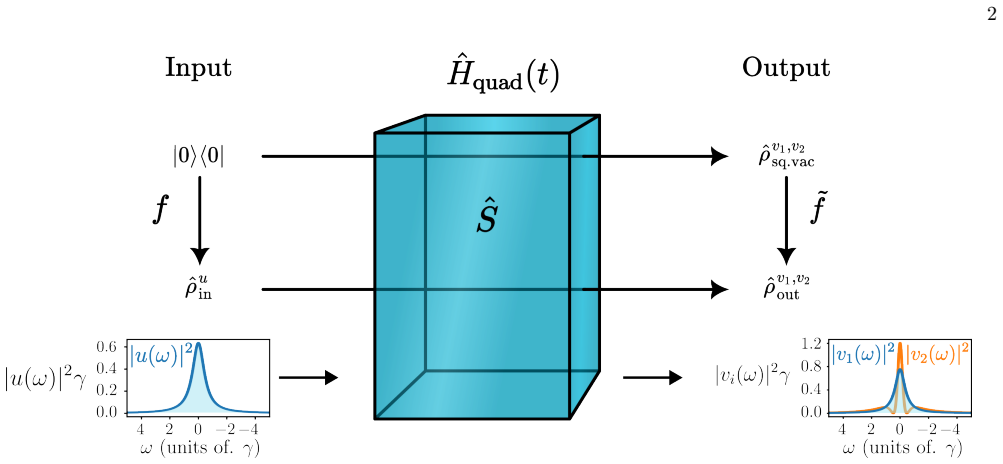
A single quantum pulse undergoing parametric amplification feeds into at most two pulses in the output. The quantum state of these output modes is obtained by applying the amplification to the vacuum and then using a transformed version of the operator that creates the input state from vacuum. Given the input and output pulse mode functions, this yields an analytical description of the output quantum states.
What carries the argument
The transformed creation operator applied after vacuum amplification, which carries the input state information into the amplified output modes.
If this is right
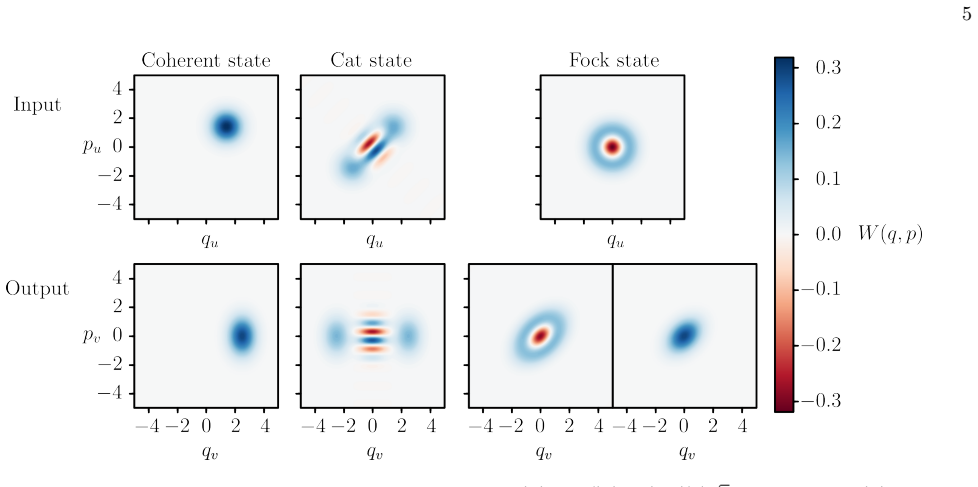
- The output state for a coherent-state input is obtained by displacing the two-mode squeezed vacuum according to the transformed operator.
- The output state for a Schrödinger cat or single-photon input follows by applying the corresponding creation operator to the two-mode squeezed vacuum.
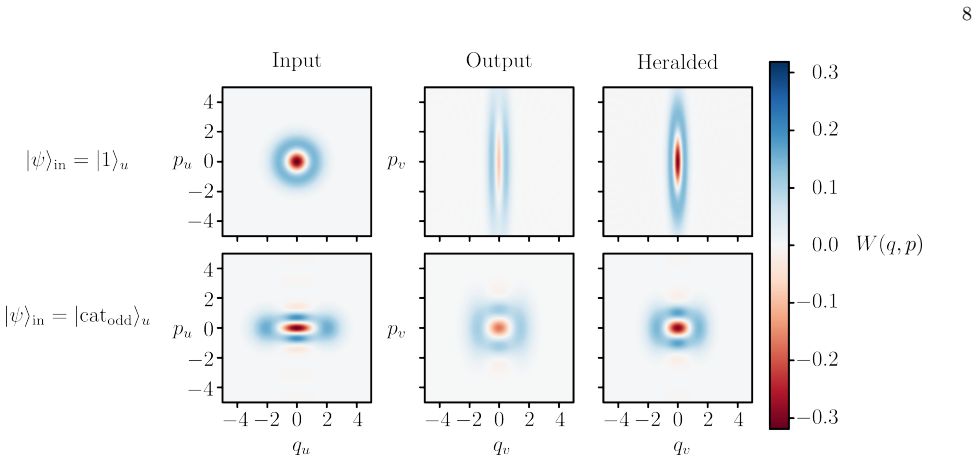
- Detection of vacuum in the less-populated output mode projects the other mode onto a specific heralded state whose wavefunction is given directly by the method.
- The same procedure extends without change to multiple non-vacuum input modes.
Where Pith is reading between the lines
- The method could be used to design pulse shapes that minimize unwanted correlations between the two output modes.
- It supplies an efficient route to computing entanglement measures between the two output pulses for arbitrary input states.
- The approach may generalize to time-dependent parametric processes if the instantaneous mode functions can still be supplied as input.
Load-bearing premise
The input and output pulse mode functions are known in advance and the amplification admits an exact description via vacuum amplification plus the transformed creation operator.
What would settle it
A direct numerical simulation or experiment that produces output states differing from those computed by applying the transformed creation operator to the amplified vacuum, for the same input and output mode functions.
Figures
read the original abstract
A single quantum pulse undergoing parametric amplification feeds into at most two pulses in the output. In this work, we present an efficient, analytical method for finding the quantum state of these output modes. Our method applies the amplification to the vacuum rather than to the input state, and subsequently applies a transformed version of the operator that creates the input state from vacuum. Given the input and output pulse mode functions, the method is analytical, and therefore computationally very efficient, and it can be readily generalized to multiple non-vacuum input modes. We exemplify the method by computing the output quantum states resulting from the input of a coherent, a Schr\"odinger cat, and a single photon input quantum state. We further employ the method to obtain the quantum state in one of the two output modes heralded upon detection of vacuum in the other, least populated, mode.
Editorial analysis
A structured set of objections, weighed in public.
Referee Report
Summary. The manuscript presents an analytical method to obtain the output quantum state after parametric amplification of a single input pulse (which produces at most two output pulses). The approach first applies the parametric process to the vacuum and then applies a Bogoliubov-transformed version of the input-state creation operator; given the input and output mode functions, all required coefficients are inner products and the procedure is claimed to remain fully analytical. The method is illustrated by explicit calculations for coherent, Schrödinger-cat, and single-photon inputs, and is used to derive the heralded state in one output mode conditioned on vacuum detection in the other.
Significance. If the central construction holds, the work supplies a computationally lightweight, closed-form route to non-classical output states that would otherwise require numerical integration of the full multimode dynamics. The explicit examples for cat and single-photon inputs, together with the heralding application, demonstrate immediate utility for quantum-optics protocols that rely on pulsed parametric amplifiers.
minor comments (3)
- [Abstract and §5] The abstract asserts that the method 'can be readily generalized to multiple non-vacuum input modes,' yet the main text provides neither an explicit formula nor a worked example for more than one input mode; adding this would strengthen the generality claim.
- [§4] In the examples of §4, the output density matrices or Wigner functions are stated to be obtained analytically, but no explicit expressions for the overlap integrals between the given mode functions are supplied; including one representative calculation would make the 'analytical' claim more transparent.
- [§2] The manuscript does not discuss how the input and output pulse mode functions themselves are obtained or validated; a short remark on this prerequisite would clarify the scope of applicability.
Simulated Author's Rebuttal
We thank the referee for the positive assessment of our manuscript and the recommendation of minor revision. The referee's summary accurately captures our central contribution: an analytical procedure that applies the parametric process to vacuum and then transforms the input creation operator via the known input/output mode functions. No major comments were provided in the report.
Circularity Check
No significant circularity
full rationale
The paper's method derives the output state by applying the standard unitary evolution of a quadratic parametric amplifier Hamiltonian to the vacuum, then composing with the Bogoliubov-transformed input creation operator. This follows directly from the linear action of the evolution on creation operators (standard in quantum optics) once input/output mode functions are supplied as external data. All coefficients are inner products of those given functions; no parameters are fitted to data, no self-citation chain is load-bearing for the central claim, and no ansatz is smuggled in. The derivation is self-contained against external benchmarks and does not reduce to its inputs by construction.
Axiom & Free-Parameter Ledger
Reference graph
Works this paper leans on
-
[1]
Semper Ardens
These form the displacement vector ¯ r=⟨ˆ r⟩, whereˆ r= (ˆq1, . . . ,ˆqn,ˆp1, . . . ,ˆpn)T, and the co- variancematrixσwithentriesσ kl =⟨{ˆrk,ˆrl}⟩−2⟨ˆrk⟩ ⟨ˆrl⟩ [33, 34]. A. The transformed vacuum in phase space We start by calculating the displacement vector and the covariance matrix of the generalN-mode squeezed vacuum output state of the parametric amp...
-
[2]
H. J. Kimble, The quantum internet, Nature453, 1023 (2008)
2008
-
[3]
J. L. O’Brien, A. Furusawa, and J. Vučković, Photonic quantum technologies, Nature Photonics3, 687 (2009)
2009
-
[4]
C. M. Caves, Quantum-mechanical noise in an interfer- ometer, Phys. Rev. D23, 1693 (1981). 12
1981
-
[5]
C.M.Caves,Quantumlimitsonnoiseinlinearamplifiers, Phys. Rev. D26, 1817 (1982)
1982
-
[6]
C.M.Caves,Reframingsu(1,1)interferometry,Advanced Quantum Technologies3, 1900138 (2020)
2020
-
[7]
B. J. Lawrie, P. D. Lett, A. M. Marino, and R. C. Pooser, Quantum sensing with squeezed light, ACS Photonics 10.1021/acsphotonics.9b00250 (2019)
-
[8]
Brecht, D
B. Brecht, D. V. Reddy, C. Silberhorn, and M. G. Raymer,Photontemporalmodes: Acompleteframework for quantum information science, Phys. Rev. X5, 041017 (2015)
2015
-
[9]
Fabre and N
C. Fabre and N. Treps, Modes and states in quantum optics, Rev. Mod. Phys.92, 035005 (2020)
2020
-
[10]
D. J. Weigand and B. M. Terhal, Generating grid states from schrödinger-cat states without postselection, Phys. Rev. A97, 022341 (2018)
2018
-
[11]
Yanagimoto, R
R. Yanagimoto, R. Nehra, R. Hamerly, E. Ng, A. Marandi, and H. Mabuchi, Quantum nondemolition measurements with optical parametric amplifiers for ul- trafast universal quantum information processing, PRX Quantum4, 010333 (2023)
2023
-
[12]
Huang, H
K. Huang, H. LeJeannic, J. Ruaudel, V. B. Verma, M. D. Shaw, F. Marsili, S. W. Nam, E. Wu, H. Zeng, Y.-C. Jeong, R. Filip, O. Morin, and J. Laurat, Optical syn- thesis of large-amplitude squeezed coherent-state super- positions with minimal resources, Phys. Rev. Lett.115, 023602 (2015)
2015
-
[13]
Takase, J.-i
K. Takase, J.-i. Yoshikawa, W. Asavanant, M. Endo, and A. Furusawa, Generation of optical schrödinger cat states by generalized photon subtraction, Phys. Rev. A103, 013710 (2021)
2021
-
[14]
Chen, H.-Y
Y.-R. Chen, H.-Y. Hsieh, J. Ning, H.-C. Wu, H. L. Chen, Z.-H. Shi, P. Yang, O. Steuernagel, C.-M. Wu, and R.-K. Lee, Generation of heralded optical cat states by photon addition, Phys. Rev. A110, 023703 (2024)
2024
-
[15]
Asavanant, K
W. Asavanant, K. Nakashima, Y. Shiozawa, J.-I. Yoshikawa, and A. Furusawa, Generation of highly pure schrödinger’s cat states and real-time quadrature mea- surements via optical filtering, Opt. Express25, 32227 (2017)
2017
-
[16]
M. V. Larsen, X. Guo, C. R. Breum, J. S. Neergaard- Nielsen, and U. L. Andersen, Deterministic generation of a two-dimensional cluster state, Science366, 369 (2019), https://www.science.org/doi/pdf/10.1126/science.aay4354
-
[17]
Larsen, X
M. Larsen, X. Guo, C. Breum, J. Neergaard-Nielsen, and U. Andersen, Deterministic multi-mode gates on a scalable photonic quantum computing platform, Nature Physics17, 1018 (2021), publisher Copyright:©2021, The Author(s), under exclusive licence to Springer Na- ture Limited
2021
-
[18]
Yuet al., A universal programmable Gaussian boson sampler for drug discovery, Nature Computat
S. Yuet al., A universal programmable Gaussian boson sampler for drug discovery, Nature Computat. Sci.3, 839 (2023), arXiv:2210.14877 [quant-ph]
arXiv 2023
-
[19]
C. S. Hamilton, R. Kruse, L. Sansoni, S. Barkhofen, C. Silberhorn, and I. Jex, Gaussian boson sampling, Phys. Rev. Lett.119, 170501 (2017)
2017
-
[20]
Macklin, K
C. Macklin, K. O’Brien, D. Hover, M. E. Schwartz, V. Bolkhovsky, X. Zhang, W. D. Oliver, and I. Siddiqi, A near-quantum-limited josephson traveling-wave para- metric amplifier, Science350, 307 (2015)
2015
-
[21]
J. Y. Qiu, A. Grimsmo, K. Peng, B. Kannan, B. Lien- hard, Y. Sung, P. Krantz, V. Bolkhovsky, G. Calu- sine, D. Kim, A. Melville, B. M. Niedzielski, J. Yo- der, M. E. Schwartz, T. P. Orlando, I. Siddiqi, S. Gus- tavsson, K. P. O’Brien, and W. D. Oliver, Broadband squeezed microwaves and amplification with a josephson travelling-wave parametric amplifier, N...
2023
-
[22]
Kalash and M
M. Kalash and M. V. Chekhova, Wigner function tomog- raphy via optical parametric amplification, Optica10, 1142 (2023)
2023
-
[23]
T. Li, B. E. Anderson, T. Horrom, B. L. Schmittberger, K. M. Jones, and P. D. Lett, Improved measurement of two-mode quantum correlations using a phase-sensitive amplifier, Opt. Express25, 21301 (2017)
2017
-
[24]
Hubenschmid, T
E. Hubenschmid, T. L. M. Guedes, and G. Burkard, Complete positive operator-valued measure description of multichannel quantum electro-optic sampling with monochromatic field modes, Phys. Rev. A106(2022)
2022
-
[25]
Hubenschmid, T
E. Hubenschmid, T. L. Guedes, and G. Burkard, Optical time-domain quantum state tomography on a subcycle scale, Phys. Rev. X14(2024)
2024
-
[26]
Hubenschmid and G
E. Hubenschmid and G. Burkard, Time-domain field cor- relation measurements enable tomography of highly mul- timode quantum states of light, Communications Physics 9, 89 (2026)
2026
-
[27]
Lloyd and S
S. Lloyd and S. L. Braunstein, Quantum computation over continuous variables, Phys. Rev. Lett.82, 1784 (1999)
1999
-
[28]
Le Jeannic, A
H. Le Jeannic, A. Cavaillès, K. Huang, R. Filip, and J. Laurat, Slowing quantum decoherence by squeezing in phase space, Phys. Rev. Lett.120, 073603 (2018)
2018
-
[29]
Filip, and U
K.Park, J.Hastrup, J.S.Neergaard-Nielsen, J.B.Brask, R. Filip, and U. L. Andersen, Slowing quantum decoher- ence of oscillators by hybrid processing, npj Quantum Information8, 67 (2022)
2022
-
[30]
X. Pan, J. Schwinger, N.-N. Huang, P. Song, W. Chua, F. Hanamura, A. Joshi, F. Valadares, R. Filip, and Y. Y. Gao, Protecting the quantum interference of cat states by phase-space compression, Phys. Rev. X13, 021004 (2023)
2023
-
[31]
Tziperman, V
O. Tziperman, V. R. Christiansen, I. Kaminer, and K. Mølmer, Parametric amplification of a quantum pulse, Phys. Rev. A110, 053712 (2024)
2024
-
[32]
S. L. Braunstein, Squeezing as an irreducible resource, Phys. Rev. A71, 055801 (2005)
2005
-
[33]
Wasilewski, A
W. Wasilewski, A. I. Lvovsky, K. Banaszek, and C. Radzewicz, Pulsed squeezed light: Simultaneous squeezing of multiple modes, Physical Review A73, 063819 (2006)
2006
-
[34]
Weedbrook, S
C. Weedbrook, S. Pirandola, R. García-Patrón, N. J. Cerf, T. C. Ralph, J. H. Shapiro, and S. Lloyd, Gaus- sian quantum information, Reviews of Modern Physics 84, 621 (2012)
2012
-
[35]
Adesso, S
G. Adesso, S. Ragy, and A. R. Lee, Continuous vari- able quantum information: Gaussian states and beyond, Open Systems & Information Dynamics21, 1440001 (2014)
2014
-
[36]
V.V.Dodonov, O.V.Man’ko,andV.I.Man’ko,Multidi- mensional hermite polynomials and photon distribution for polymode mixed light, Phys. Rev. A50, 813 (1994)
1994
-
[37]
M. M. Mizrahi, Generalized hermite polynomials, Jour- nal of Computational and Applied Mathematics1, 137 (1975)
1975
-
[38]
Kok and S
P. Kok and S. L. Braunstein, Multi-dimensional hermite polynomials in quantum optics, Journal of Physics A: Mathematical and General34, 6185 (2001)
2001
-
[39]
B. Gupt, J. Izaac, and N. Quesada, The walrus: a library 13 for the calculation of hafnians, hermite polynomials and gaussian boson sampling, Journal of Open Source Soft- ware4, 1705 (2019)
2019
-
[40]
V. R. Christiansen, Github, San Francisco https://github.com/Vicedor/QuPulses/tree/main/ parametric_amplification (2026)
2026
-
[41]
S. Onoe, T. L. M. Guedes, A. S. Moskalenko, A. Leiten- storfer, G. Burkard, and T. C. Ralph, Realizing a rapidly switched Unruh-DeWitt detector through electro-optic sampling of the electromagnetic vacuum, Physical Re- view D105, 56023 (2022)
2022
-
[42]
Johansson, P
J. Johansson, P. Nation, and F. Nori, Qutip: An open- source python framework for the dynamics of open quan- tum systems, Computer Physics Communications183, 1760 (2012)
2012
-
[43]
Johansson, P
J. Johansson, P. Nation, and F. Nori, Qutip 2: A python framework for the dynamics of open quantum systems, Computer Physics Communications184, 1234 (2013)
2013
-
[44]
C. W. Gardiner, P. Zoller, C. W. Gardiner, and P. Zoller, Quantum noise : a handbook of Markovian and non- Markovian quantum stochastic methods with applications to quantum optics., 2nd ed., Springer series in synergetics (Springer, New York, 2000)
2000
-
[45]
H. Goto, Z. Lin, T. Yamamoto, and Y. Nakamura, On- demand generation of traveling cat states using a para- metric oscillator, Phys. Rev. A99, 023838 (2019)
2019
-
[46]
Ourjoumtsev, H
A. Ourjoumtsev, H. Jeong, R. Tualle-Brouri, and P. Grangier, Generation of optical ‘schrödinger cats’ from photon number states, Nature448, 784 (2007)
2007
-
[47]
J. S. Neergaard-Nielsen, B. M. Nielsen, C. Hettich, K. Mølmer, and E. S. Polzik, Generation of a superposi- tion of odd photon number states for quantum informa- tion networks, Phys. Rev. Lett.97, 083604 (2006)
2006
-
[48]
Lodahl, S
P. Lodahl, S. Mahmoodian, and S. Stobbe, Interfacing single photons and single quantum dots with photonic nanostructures, Rev. Mod. Phys.87, 347 (2015)
2015
-
[49]
J. C. Loredo, L. Stefan, B. Krogh, R. Jensen, I. Suleiman, S. Krüger, M. Bergamin, H. Thyrrestrup, S. Budtz, J. Roulund, Z. Liu, X. Zhao, L. Vertchenko, A. Lud- wig, O. A. D. Sandberg, and P. Lodahl, Determin- istic quantum dot single-photon sources: operational principles and state-of-the-art specifications (2025), arXiv:2511.23232 [physics.optics]
arXiv 2025
-
[50]
Eckstein, B
A. Eckstein, B. Brecht, and C. Silberhorn, A quantum pulse gate based on spectrally engineered sum frequency generation, Opt. Express19, 13770 (2011)
2011
-
[51]
I. N. Agafonov, M. V. Chekhova, and G. Leuchs, Two- color bright squeezed vacuum, Phys. Rev. A82, 011801 (2010)
2010
-
[52]
M. Poloczek, A. Paniate, A. Zilli, V. Sultanov, Y. Luan, T. Santiago-Cruz, L. Carletti, M. Finazzi, M. Genovese, I. Ruo-Berchera, M. Ferrera, A. Toma, F. Monticone, M. Celebrano, and M. Chekhova, Efficient photon-pair emission from a nanostructured resonator and its theo- retical description (2026), arXiv:2603.24351 [quant-ph]
Pith/arXiv arXiv 2026
-
[53]
L. L. Volpe, S. De, T. Kouadou, D. Horoshko, M. I. Kolobov, C. Fabre, V. Parigi, and N. Treps, Multimode single-pass spatio-temporal squeezing, Opt. Express28, 12385 (2020)
2020
-
[54]
Z. Li, X. Guo, H. Sun, K. Liu, and J. Gao, Manipulation of continuous variable orbital angular momentum squeez- ingandentanglementbypumpshaping,Opt.Express31, 3651 (2023)
2023
-
[55]
J. Wang, Y. Lou, H. He, S. Liu, and J. Jing, Experimen- tal realization of orbital angular momentum multiplexed four-beam quadrature squeezing, Fundamental Research 5, 1954 (2025)
1954
-
[56]
Kizmann, T
M. Kizmann, T. L. d. M. Guedes, D. V. Seletskiy, A. S. Moskalenko, A. Leitenstorfer, and G. Burkard, Subcycle squeezing of light from a time flow perspective, Nature Physics15, 960 (2019)
2019
-
[57]
Cariolaro and G
G. Cariolaro and G. Pierobon, Reexamination of bloch- messiah reduction, Phys. Rev. A93, 062115 (2016)
2016
discussion (0)
Sign in with ORCID, Apple, or X to comment. Anyone can read and Pith papers without signing in.