REVIEW 4 major objections 4 minor 33 references
Three-dimensional universality class of Ising model with power-law-correlated critical disorder
T0 review · 4 major / 4 minor · reviewed 2026-08-14 · deepseek-v4-flash
Pith's one-line read The 3D Ising model with power-law-correlated bond disorder from critical Ising configurations has a single transition in a new universality class, νd=1.13(5), ηd=0.48(3), clearly different from the Weinrib-Halperin predictions.
desk verdict Careful Monte Carlo study with a new disorder-generation scheme, but the new-universality-class claim rests on a beta_c extrapolation validated with the very exponent it produces. read the letter →
The pith
A machine-rendered reading of the paper's core claim, the machinery that carries it, and where it could break.
The reading
What carries the argument
The central object is the disorder-generation map Jij=1+(Si+1)(Sj+1)/4, applied to equilibrium critical configurations of the pure 3D Ising model. It defines two-valued random bonds (1 and 2) whose spatial correlations inherit the pure spin correlation exponent a=d−2+η_pure≈1.036, yielding slowly decaying power-law disorder with a<d. This construction is what brings the Weinrib-Halperin criterion into play, since that criterion predicts a new fixed point for such slow decay, with νd=2/a≈1.93 and ηd=0. The analysis machinery is finite-size scaling of disorder-averaged susceptibility, χ∼$L^{{2−η}}$, and Binder-parameter derivative, gT∼$L^{{1/ν}}$, at the extrapolated transition temperature, with parallel tempering and population annealing Monte Carlo used for equilibration.
What would settle it
Compute the disorder-averaged bond correlation function C(r)=[(J_ij−J̄)(J_kl−J̄)] as a function of separation in large systems and extract its decay exponent; if it is much larger than 1.036, or if the two finite-size peaks move apart rather than merging when L exceeds 50, the claim of a single new universality class driven by slow power-law disorder is falsified.
Extended reading notes
Core claim
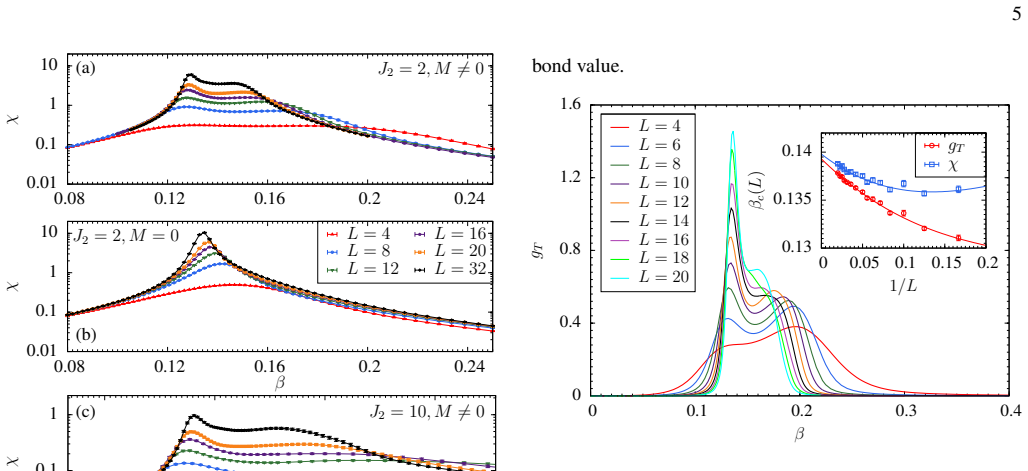
The central discovery is that the 3D Ising model with quenched bond disorder constructed from critical pure Ising spin configurations—setting Jij=1+(Si+1)(Sj+1)/4 so that bonds inside spin-up clusters are strong (J=2) and all others weak (J=1)—belongs to a universality class distinct from both the pure Ising class and the Weinrib-Halperin prediction. Finite-size scaling of the Binder-parameter derivative and susceptibility at the extrapolated critical temperature gives νd=1.13(5) and ηd=0.48(3). The authors interpret the two-peak structure seen in disorder-averaged quantities for small systems as a finite-size artifact of the disorder-averaging and generation procedure, not as two transitions: each disorder realization has a single peak, the two peak temperatures approach each other as L grows, and restricting the generating configurations to zero magnetization eliminates the second peak.
Load-bearing premise
The analysis leans on the claim that the random bonds built from critical Ising configurations are power-law correlated with exponent a=d−2+η_pure≈1.036; if the actual bond-bond correlations decay faster or are not characterized by this exponent, the comparison with Weinrib-Halperin theory and the interpretation of νd and ηd would need revision.
Editorial extensions
If this is right
- The long-range correlations in the disorder are relevant: the measured exponents differ from both pure Ising (ν≈0.630, η≈0.036) and uncorrelated bond disorder (ν≈0.685, η≈0.036), confirming a distinct universality class.
- There is a single phase transition in the thermodynamic limit despite finite-size two-peak structures; the double peaks arise from disorder realizations with a majority of strong or weak bonds and vanish when the generating ensemble is restricted to zero magnetization.
- The Weinrib-Halperin criterion correctly predicts that a new universality class emerges for slowly decaying power-law disorder, but its quantitative exponents (νd=2/a, ηd=0) do not describe the bimodal bond distribution studied here; higher-order corrections or a different fixed point are needed.
- A layered non-random model with strong and weak bond halves has two genuine transitions and can be tuned to design magnetization curves, for example m(β)=∑_i ω_i m0(J_i β) for multilayers.
- Parallel tempering is more efficient than population annealing for studying phase transitions of pure or weakly disordered systems, where equilibrating directly near the transition is faster than a full temperature sweep.
Reading between the lines
- If the reported exponents hold, the specific-heat exponent given by hyperscaling αd=2−dνd≈−1.39 is negative, so the transition should remain sharp at large sizes, with disorder rounding rather than a true double transition; this is a checkable prediction for future larger-scale runs.
- The same disorder-generation recipe applied to other O(N) models in three dimensions would produce power-law-correlated bonds with a≈1+η_pure(N); comparing νd/(2/a) across models could reveal whether the deviation from the Weinrib-Halperin value seen here is a universal correction or specific to the bimodal bond distribution.
- The double-peak diagnostic suggests a practical rule for simulations of correlated disorder: restrict the generating ensemble to fixed magnetization; if the second peak disappears, it is a finite-size artifact, while persistence would signal genuine multiple transitions.
Signed reviews
Editorial analysis
A structured set of objections, weighed in public.
Referee Report
Summary. The manuscript studies the three-dimensional Ising model with quenched random bonds generated from critical equilibrium configurations of the pure 3D Ising model. The random couplings take two values and are intended to be power-law correlated with exponent a≈1.036. Using parallel tempering and population annealing, the authors perform large-scale Monte Carlo simulations for system sizes up to L=50 and analyze finite-size scaling of the Binder-ratio derivative and the susceptibility. They report a single phase transition in the thermodynamic limit with exponents νd=1.13(5) and ηd=0.48(3), which differ from both the pure Ising and uncorrelated-disorder universality classes and from the Weinrib-Halperin prediction. They also argue that the double-peak structure in disorder-averaged quantities for finite sizes is a finite-size effect, and they contrast this with a bilayer model that genuinely has two transitions.
Significance. If confirmed, the result is significant: it provides a simple numerical construction of power-law-correlated disorder with a small decay exponent, evidence for a universality class different from both pure and uncorrelated-disorder Ising models, and a concrete test of the Weinrib-Halperin criterion outside its Gaussian-disorder assumption. The strengths of the paper include the use of two independent Monte Carlo algorithms, large disorder samples (2000-5000 realizations), bootstrap error estimates, the data collapse in Fig. 4, and the direct comparison with pure, uncorrelated, and layer models. The main weaknesses are the circular validation of the βc extrapolation, the absence of an exponent analysis for the single-peaked M=0 ensemble, and the unproven inheritance of the spin correlation exponent by the composite bond disorder.
major comments (4)
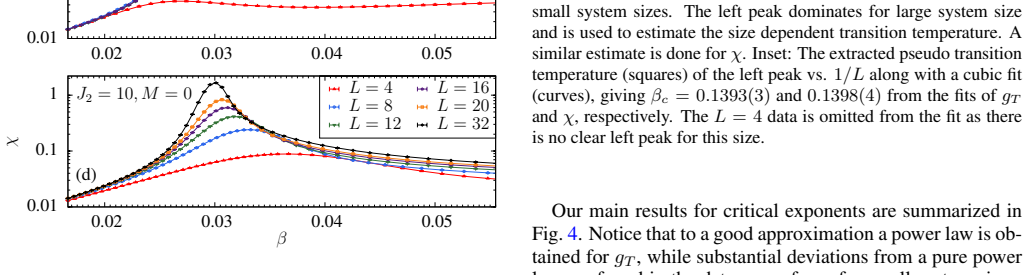
- [Sec. III B (paragraph after Fig. 3)] The thermodynamic transition temperature βc=0.1396(3) is obtained by a cubic-polynomial extrapolation of the left-peak positions in 1/L, yet the only stated validation of that extrapolation is that it was verified using scaling fits assuming νd=1.13 estimated below—the very exponent that is then extracted from finite-size scaling at the estimated βc. This validation is circular. Please replace it with an independent determination of βc, for example a simultaneous fit of βc(L)=βc + a L^{-1/νd} with νd free, or an analysis of the M=0 ensemble, whose susceptibility is single-peaked at all sizes (Fig. 2).
- [Sec. III A and Sec. III B, Figs. 2-4] The restricted M=0 disorder ensemble is used only to demonstrate that the two-peak structure is a finite-size effect; no finite-size scaling or exponent estimates are reported for that ensemble. Because the reported νd and ηd come entirely from the unrestricted M≠0 ensemble, where the disorder-averaged χ and c have two competing peaks, a quantitative cross-check of the exponents in the M=0 ensemble is needed to rule out that νd=1.13(5) and ηd=0.48(3) are effective values tied to the peak-selection procedure.
- [Sec. II A, second paragraph] The statement that the random couplings inherit the spin correlation exponent a=d−2+η_pure≈1.036 is asserted without derivation. Since Jij=1+(Si+1)(Sj+1)/4 is a composite of neighboring spins, its covariance contains both spin-spin and energy-density contributions; the leading large-distance decay should be derived explicitly, and ideally confirmed by a direct measurement of the bond-bond correlation function, because the comparison with the Weinrib-Halperin criterion depends directly on the value of a.
- [Sec. III B, Fig. 4] The exponents are obtained from power-law fits over the seven largest sizes, but the paper does not report the fit range, goodness-of-fit, or the stability of νd and ηd when the analysis window is varied. Since Fig. 4(a) shows visible curvature in χ for smaller sizes, evidence that the corrections to scaling have converged by L≈24 is necessary to support the claim that νd=1.13(5) and ηd=0.48(3) represent an asymptotic universality class rather than an effective finite-size description.
minor comments (4)
- [Sec. III B] The phrase 'Ideally one may would like' should read 'Ideally one would like'.
- [Table I] The entry for the PT simulations is unclear: '16 − 6×10^6' should specify the number of replicas and the number of sweeps unambiguously.
- [Eq. (11)] The expression m0(βJdn/Jup) should be written as m0(β Jdn/Jup) or with an explicit multiplication symbol to avoid ambiguity.
- [Sec. IV] The sentence 'This prediction agrees with our simulation results but the predicted exponents disagree' is potentially confusing; since the model explicitly violates the Gaussian-disorder assumption of WH, please clarify whether the agreement is only about the existence of a new fixed point, with the exponent comparison intended as a heuristic test.
Circularity Check
No significant circularity: the disordered exponents are measured from independent finite-size scaling, and the only self-referential consistency check does not feed back into the fits.
full rationale
The paper's central result, nu_d=1.13(5) and eta_d=0.48(3), is obtained by finite-size scaling of g_T and chi at a thermodynamic beta_c estimated by a cubic polynomial extrapolation in 1/L (Sec. III B), not from any quantity that already contains the disordered exponents. The power-law correlation exponent a=1.036298(2) is inherited from the pure Ising spin correlation function and is an input from external conformal bootstrap results, not from the disordered system's fitted exponents. The WH prediction nu_d=2/a is computed independently from that external input. The sentence 'The validity of this method was verified using the scaling fits assuming nu_d = 1.13 estimated below' is a post-hoc consistency check; it does not enter the beta_c extrapolation or the exponent extraction, so it is not circular by construction. Self-citations (Refs. 18, 20, 24, 29) concern Monte Carlo algorithms and are not load-bearing for the universality-class claim. The restricted M=0 ensemble is used to argue the two-peak structure is a finite-size effect, and the paper explicitly reports exponents only for the unrestricted ensemble; no fitted exponent is renamed as a prediction. Thus the derivation chain is self-contained against external benchmarks and no circular step is exhibited.
Assumptions & free parameters
free parameters (1)
- J2 (strong bond strength) =
2
assumptions (4)
- domain assumption The bond-bond correlation function of the generated disorder decays as 1/r^a with a = d - 2 + η_pure, inherited from the pure Ising spin-spin correlation exponent.
- domain assumption The Weinrib-Halperin criterion, derived for Gaussian power-law-correlated disorder, remains a valid guide for the bimodal (two-value) disorder distribution.
- domain assumption Finite-size scaling holds for the disordered system at the estimated βc, with scaling corrections negligible for L ≥ 16.
- standard math The critical point of the pure 3D Ising model and its exponents (βc,pure = 0.22165455(3), ν_pure = 0.629971(4), η_pure = 0.036298(2)) are taken as external inputs.
Cite this review
Pith. "Pith review of Three-dimensional universality class of Ising model with power-law-correlated critical disorder." pith.science (2026). https://pith.science/paper/SMU4HXJT
@misc{pith2026190801880,
  author       = {Pith},
  title        = {Pith review of: Three-dimensional universality class of Ising model with power-law-correlated critical disorder},
  year         = {2026},
  howpublished = {\url{https://pith.science/paper/SMU4HXJT}},
  note         = {Machine review of arXiv:1908.01880}
}
abstract
We use large-scale Monte Carlo simulations to test the Weinrib-Halperin criterion that predicts new universality classes in the presence of sufficiently slowly decaying power-law-correlated quenched disorder. While new universality classes are reasonably well established, the predicted exponents are controversial. We propose a method of growing such correlated disorder using the three-dimensional Ising model as benchmark systems both for generating disorder and studying the resulting phase transition. Critical equilibrium configurations of a disorder-free system are used to define the two-value distributed random bonds with a small power-law exponent given by the pure Ising exponent. Finite-size scaling analysis shows a new universality class with a single phase transition, but the critical exponents $\nu_d=1.13(5), \eta_d=0.48(3)$ differ significantly from theoretical predictions. We find that depending on details of the disorder generation, disorder-averaged quantities can develop peaks at two temperatures for finite sizes. Finally, a layer model with the two values of bonds spatially separated to halves of the system genuinely has multiple phase transitions and thermodynamic properties can be flexibly tuned by adjusting the model parameters.
Figures

Figures from the paper (2 more)


Reference graph
Works this paper leans on
-
[1]
states that weak uncorrelated disorder is irrelevant if the heat capacity exponent of the corresponding pure, disorder- free system is negative, αpure < 0 or the correlation length exponent νpure > 2/d assuming the hyperscaling relation dν = 2−α. For power-law-correlated disorder, this is gener- alized to the Weinrib-Halperin (WH) criterion [2], which pre...
-
[2]
Define a set of random coupling constants from an equilibrium spin configuration of the pure model. For bonds within spin-up clusters set Jij = 2 , and oth- erwise Jij = 1 , i.e., either within spin-down clus- ters and at cluster boundaries. More precisely, Jij = 1 + (Si + 1)(Sj + 1)/4. The resulting values J1 = 1,J 2 = 2 are fixed unless other- wise specifie...
-
[3]
Simulate the pure 3D Ising model and generate equilib- rium configurations at the phase transition
-
[4]
V . V . Prudnikov, P. V . Prudnikov, B. Zheng, S. V . Dorofeev, and V . Y . Kolesnikov,Short-Time Critical Dynamics of the Three- Dimensional Systems with Long-Range Correlated Disorder , Progress of Theoretical Physics 117, 973 (2007)
work page 2007
-
[5]
and the references therein for a more detailed discussion. In this work we study power-law-correlated quenched dis- order generated from equilibrium spin configurations of a ∗Electronic address: wenlongcmp@gmail.com pure, i.e., disorder-free zero-field Ising model at the phase transition. This correlated disorder distribution avoids possi- ble ambiguities d...
work page Pith review arXiv 1908
-
[6]
A. B. Harris, Effect of random defects on the critical behaviour of Ising models , Journal of Physics C: Solid State Physics 7, 1671 (1974)
work page 1974
-
[7]
A. Weinrib and B. I. Halperin, Critical phenomena in systems with long-range-correlated quenched disorder , Phys. Rev. B 27, 413 (1983)
work page 1983
-
[8]
H. G. Ballesteros and G. Parisi, Site-diluted three-dimensional Ising model with long-range correlated disorder, Phys. Rev. B 60, 12912 (1999)
work page 1999
Show all 33 references
-
[9]
Ivaneyko and B
D. Ivaneyko and B. Berche and Yu. Holovatch and J. Ilnytskyi, On the universality class of the 3d Ising model with long-range- correlated disorder, Physica A: Statistical Mechanics and its Applications 387, 4497 (2008)
2008
-
[10]
V . V . Prudnikov and A. A. Fedorenko,Critical behaviour of 3D systems with long-range correlated quenched defects , Journal of Physics A: Mathematical and General 32, L399 (1999)
1999
-
[11]
V . V . Prudnikov, P. V . Prudnikov, and A. A. Fedorenko,Static and dynamic critical properties of 3D systems with long-range correlated quenched defects, Journal of Physics A: Mathemati- cal and General 32, 8587 (1999)
1999
-
[12]
V . V . Prudnikov, P. V . Prudnikov, and A. A. Fedorenko,Field- theory approach to critical behavior of systems with long-range correlated defects, Phys. Rev. B 62, 8777 (2000)
2000
-
[13]
M. I. Marqu ´es, J. A. Gonzalo, and J.´I˜niguez, Universality class of thermally diluted Ising systems at criticality , Phys. Rev. E 62, 191 (2000)
2000
-
[14]
Chatelain, Hyperscaling violation in the 2D 8-state Potts model with long-range correlated disorder , EPL (Europhysics Letters) 102, 66007 (2013)
C. Chatelain, Hyperscaling violation in the 2D 8-state Potts model with long-range correlated disorder , EPL (Europhysics Letters) 102, 66007 (2013)
2013
-
[15]
Chatelain, Griffiths phase and critical behavior of the two- dimensional Potts models with long-range correlated disorder, Phys
C. Chatelain, Griffiths phase and critical behavior of the two- dimensional Potts models with long-range correlated disorder, Phys. Rev. E 89, 032105 (2014)
2014
-
[16]
R. H. Swendsen and J.-S. Wang, Replica Monte Carlo simula- tions of spin glasses, Phys. Rev. Lett. 57, 2607 (1986)
1986
-
[17]
Geyer, in Computing Science and Statistics: 23rd Sympo- sium on the Interface , edited by E
C. Geyer, in Computing Science and Statistics: 23rd Sympo- sium on the Interface , edited by E. M. Keramidas (Interface Foundation, Fairfax Station, 1991), p. 156
1991
-
[18]
Hukushima and K
K. Hukushima and K. Nemoto, Exchange Monte Carlo method and application to spin glass simulations, J. Phys. Soc. Jpn. 65, 1604 (1996)
1996
-
[19]
Hukushima and Y
K. Hukushima and Y . Iba, in The Monte Carlo method in the physical sciences: celebrating the 50th anniversary of the Metropolis algorithm, edited by J. E. Gubernatis (AIP, 2003), vol. 690, p. 200
2003
-
[20]
Zhou and X
E. Zhou and X. Chen, in Proceedings of the 2010 Winter Sim- ulation Conference (WSC) (Springer, Baltimore MD, 2010), p. 1211
2010
-
[21]
Machta, Population annealing with weighted averages: A Monte Carlo method for rough free-energy landscapes , Phys
J. Machta, Population annealing with weighted averages: A Monte Carlo method for rough free-energy landscapes , Phys. Rev. E 82, 026704 (2010)
2010
-
[22]
W. Wang, J. Machta, and H. G. Katzgraber, Population anneal- ing: Theory and application in spin glasses , Phys. Rev. E 92, 063307 (2015)
2015
-
[23]
L. Y . Barash, M. Weigel, M. Borovsk, W. Janke, and L. N. Shchur, GPU accelerated population annealing algorithm , Computer Physics Communications 220, 341 (2017)
2017
-
[24]
W. Wang, J. Machta, and H. G. Katzgraber, Comparing Monte Carlo methods for finding ground states of Ising spin glasses: Population annealing, simulated annealing, and parallel tem- pering, Phys. Rev. E 92, 013303 (2015)
2015
-
[25]
Deng and H
Y . Deng and H. W. J. Bl ¨ote, Simultaneous analysis of several models in the three-dimensional Ising universality class , Phys. Rev. E 68, 036125 (2003)
2003
-
[26]
F. Kos, D. Poland, D. Simmons-Duffin, and A. Vichi, Precision islands in the Ising and O(N) models , Journal of High Energy Physics 2016, 36 (2016)
2016
-
[27]
Wolff, Collective Monte Carlo updating for spin systems , Phys
U. Wolff, Collective Monte Carlo updating for spin systems , Phys. Rev. Lett. 62, 361 (1989)
1989
-
[28]
W. Wang, J. Machta, and H. G. Katzgraber, Evidence against a mean-field description of short-range spin glasses revealed through thermal boundary conditions, Phys. Rev. B90, 184412 (2014)
2014
-
[29]
https://www.open-mpi.org
see e.g. https://www.open-mpi.org
-
[30]
see https://www.openmp.org
-
[31]
M. I. Marqu ´es and J. A. Gonzalo, Irrelevance of canonical or grand canonical constraints near a random fixed point in large L systems, Phys. Rev. E 65, 057104 (2002)
2002
-
[32]
P. E. Theodorakis and N. G. Fytas, Wang-Landau study of the 3D Ising model with bond disorder , The European Physical Journal B 81, 245 (2011)
2011
-
[33]
W. Wang, R. D ´ıaz-M´endez, M. Wallin, J. Lidmar, and E. Babaev, Melting of a two-dimensional monodisperse cluster crystal to a cluster liquid, Phys. Rev. E 99, 042140 (2019)
2019
Reviewed August 14, 2026 · model on record in the stance chip above.
Discussion (0). Continue with ORCID to comment.