REVIEW 4 major objections 5 minor 96 references
Ensemble Foreground Management for Unsupervised Object Discovery
T0 review · 4 major / 5 minor · reviewed 2026-08-06 · deepseek-v4-flash
Pith's one-line read An ensemble of 784 min-cut voters recovers the union of all foreground regions in an image without any labels, and a distilled version, UnionSeg, makes the same prediction at 125 frames per second.
desk verdict UnionCut is a real new technique, but the paper overstates its gains over FOUND and the appendix 'proof' is empirical, not mathematical. read the letter →
The pith
A machine-rendered reading of the paper's core claim, the machinery that carries it, and where it could break.
The reading
What carries the argument
The central object is the Unit Voter (UV), a weak classifier built from one seed patch, the set of patches with negative cosine similarity to the seed (anti-seed patches), and a graph min-cut that separates a Source-connected region (similar to the seed) from a Target-connected region (similar to anti-seeds). The load-bearing identity is the voting asymmetry quantified in Inequality 12: background-seeded UVs return roughly 55-76% of background patches but only about 2-6% of foreground patches, while foreground-seeded UVs return only about 12-20% of background patches and about 20% of foreground patches; this difference makes the aggregated heat map favour background even when foreground occupies more area. Ensemble theory supplies the justification that 784 diverse weak voters form a strong classifier, and the anti-seed construction is what breaks the symmetry of plain feature matching.
What would settle it
Take a held-out set of images with extreme scene composition (foreground covering more than about 87% of the area, or highly textured backgrounds with many distinct clusters), run UnionCut, and check two things: whether the four Monte Carlo probabilities re-estimated on that set still satisfy Inequality 12, and whether the top half of Mean-Shift clusters of the inverted heat map still matches the true foreground union; one image where a background cluster outvotes a foreground cluster in the retained half would refute the robustness claim.
Extended reading notes
Core claim
UnionCut is introduced as a robust foreground prior: for a 224x224 image, each of the 784 8x8 patches seeds one Unit Voter, which models the image as a graph whose n-links encode patch-feature similarity and whose t-links attach the seed to a Source terminal and anti-seed patches to a Target terminal; the min-cut returns the region most similar to the seed. Aggregating all voters gives a heat map in which background patches accumulate far more votes than foreground patches, so after inversion and Mean-Shift thresholding (keeping the top half of clusters) the result is a binary union of foreground regions, optionally corrected by a four-corner prior. The robustness claim is grounded in a probabilistic inequality: with the four conditional probabilities estimated by Monte Carlo on COCO, ECSSD, and DUTS, the background heat-map intensity dominates foreground whenever the background occupies more than about 13.4% to 19.7% of the image, depending on the dataset. UnionSeg is then distilled from UnionCut, using UnionCut's mask as training labels with a self-correction rule that prefers UnionSeg's own prediction when it already agrees with UnionCut.
Load-bearing premise
The load-bearing premise is that the four conditional probabilities measured on COCO, ECSSD, and DUTS with ground-truth masks describe UV behaviour on every future test image, so that Inequality 12 holds whenever background occupies more than roughly 13.4-19.7% of the image; if a test image's feature statistics fall outside this empirical range, the heat-map inversion and top-half thresholding can fail.
Editorial extensions
If this is right
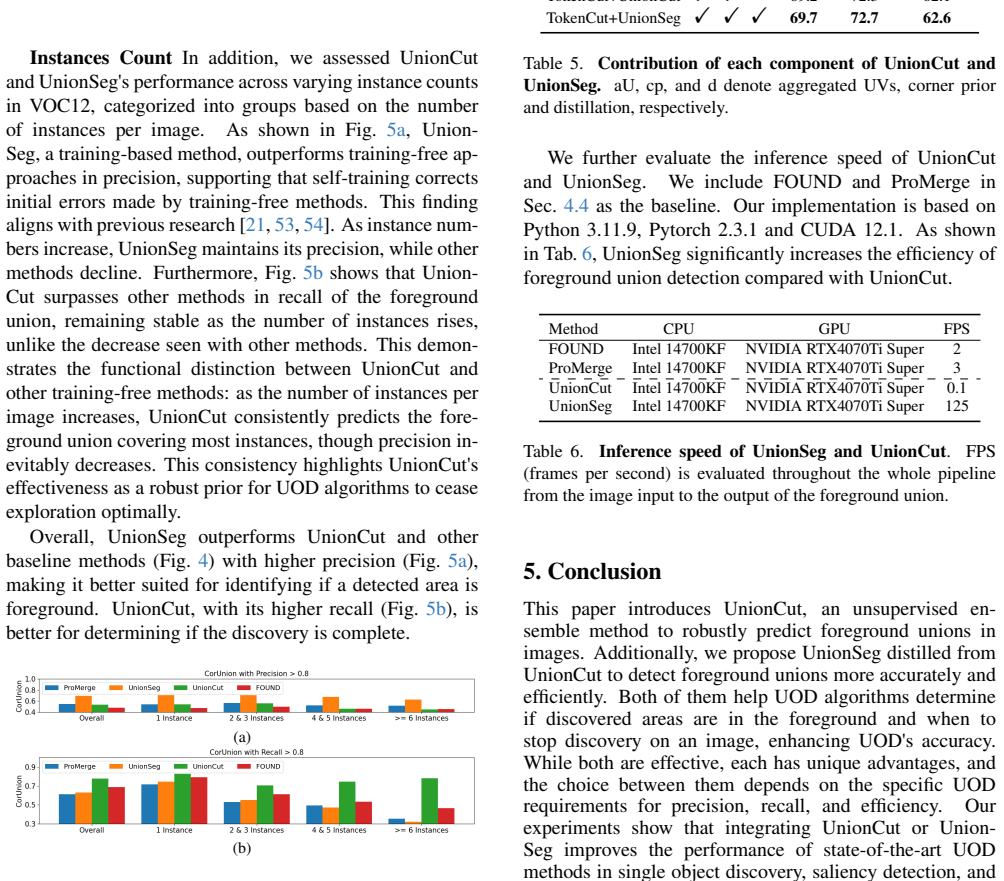
- Combining LOST, TokenCut, or FOUND with UnionCut/UnionSeg raises single-object CorLoc on VOC07, VOC12, and COCO20K, with the largest gains on COCO20K (e.g. TokenCut from 58.8 to 62.1/62.6).
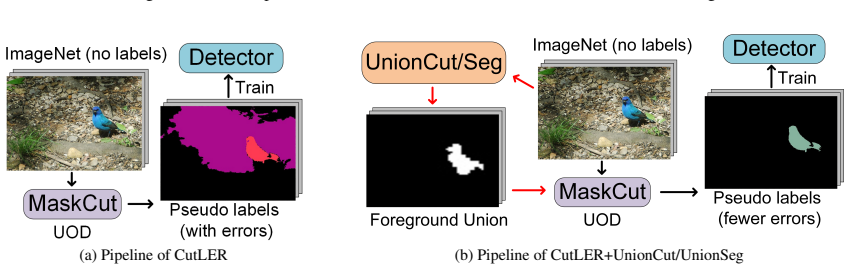
- Saliency detection on ECSSD, DUTS-TE, and DUT-OMRON improves after integration; TokenCut+UnionSeg reaches the best no-learning results, and CutLER+UnionSeg gains up to 18.1 points of maxF on DUTS-TE.
- For self-supervised instance segmentation, CutLER+UnionSeg improves AP on COCO20K and COCO val2017, and on VOC12 the UnionCut-boosted pseudo-labels improve SOLOv2 AP for both TokenCut and CutLER.
- UnionSeg runs at 125 FPS versus 0.1 FPS for UnionCut, so the prior is cheap enough to use as a default for UOD pipelines.
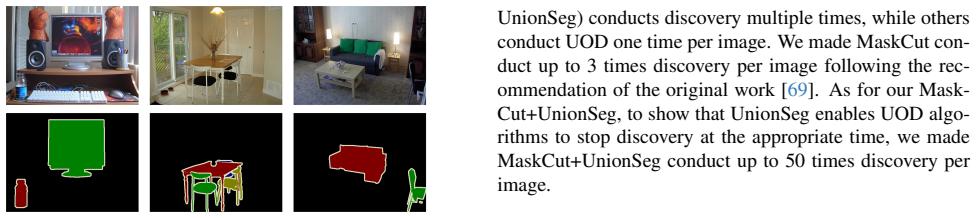
- The stopping rule—stop when 80% of the foreground union is discovered—lets multi-object methods like MaskCut avoid both under- and over-segmentation without fixing the number of iterations.
Reading between the lines
- If the background-vs-foreground voting asymmetry is as stable as the paper's Monte Carlo estimates suggest, the same aggregated heat map could serve as a general 'backgroundness' score for other label-free tasks, such as ranking background patches for saliency refinement or rejecting false positives in open-set detection; the paper does not test this.
- The inequality's threshold varies across datasets (13.4% to 19.7% background), so deploying UnionCut in a new domain with very different scene statistics would require re-estimating the four probabilities; the paper's guarantee is not a universal mathematical proof.
- Because UnionSeg is trained on DUTS-TR with UnionCut labels and a self-correction rule, it inherits and may amplify dataset-specific biases of both DINO features and UnionCut; out-of-distribution robustness is untested.
- The 784-min-cut cost limits UnionCut itself to offline pseudo-label generation, but the distillation step suggests an iterative loop: run UnionCut on samples to improve UnionSeg, then use UnionSeg to scale masking to larger datasets.
Editorial analysis
A structured set of objections, weighed in public.
Referee Report
Summary. The paper proposes UnionCut, an ensemble of 784 graph-based min-cut voters (Unit Voters) that estimates the union of foreground regions in an image using DINO features, plus UnionSeg, a distilled ViT that predicts the same foreground union more efficiently. The authors integrate these foreground priors into LOST, TokenCut, FOUND, and CutLER, replacing the methods' default heuristics, and report improvements on single-object discovery (CorLoc on VOC07/12, COCO20K), unsupervised saliency detection (ECSSD, DUTS-TE, DUT-OMRON), and self-supervised instance segmentation (COCO20K/COCO val). The paper also includes an appendixed mathematical analysis of UnionCut's robustness based on Monte Carlo estimates of conditional probabilities, a comparison with cosine-similarity matching, and experiments on foreground-union detection accuracy.
Significance. If the empirical claims hold, the proposed foreground-union prior would be a useful and broadly applicable component for unsupervised object discovery, replacing several task-specific heuristics with a single method that can also signal when to stop iterative discovery. The paper ships code, evaluates on standard benchmarks, and provides an unusually detailed appendix analyzing why the ensemble works, including a quantitative comparison against cosine-similarity matching. The reported gains for LOST, TokenCut, and CutLER are substantial on several benchmarks, especially in saliency detection, which makes the central idea worth considering. However, the central claim as worded in the abstract and contributions—that previous state-of-the-art UOD methods 'witness an increase'—is not supported for FOUND when the comparison is made against the published FOUND numbers rather than the authors' lower replication baseline.
major comments (4)
- [Sec. 4.1, Tables 1 and 2] The paper's central claim that previous state-of-the-art UOD methods witness an increase is not supported for FOUND when evaluated against the published numbers. In Table 1, the deltas for FOUND+UnionCut and FOUND+UnionSeg are computed against the authors' replication row (FOUND‡, 71.4/75.7/62.9 on VOC07/VOC12/COCO20K) rather than against the published FOUND row (72.5/76.1/62.9). Against the published numbers, FOUND+UnionSeg is −0.2 on VOC07 and −0.2 on VOC12, and only +0.2 on COCO20K; FOUND+UnionCut is +0.1/0.0/+0.1. Similarly, in Table 2 on ECSSD, FOUND+UnionCut and FOUND+UnionSeg fall below the published FOUND on all three metrics (Acc/IoU/maxF). The abstract and contribution list explicitly claim FOUND is improved, so this discrepancy is load-bearing. Please recompute all deltas against the published baseline and revise the wording of the central claim, or provide evidence that the replication baseline is the correct point of comparison (e.g., by matching the original evaluation protocol exactly and showing the replication gap is due to environment, not protocol).
- [Appendix 6, Inequality (12), Tables 7 and 9] The robustness guarantee for UnionCut is not a parameter-free mathematical derivation. The four conditional probabilities in Inequality (12) are Monte Carlo estimates obtained with ground-truth masks on COCO, ECSSD, and DUTS (Table 7), and solving Inequality (12) yields a background-fraction lower bound of 13.44%–19.67% depending on the dataset (Table 9). The claim that UnionCut is 'mathematically and statistically robust' therefore rests on the unstated empirical assumption that these benchmark statistics transfer to arbitrary test images. Please state explicitly that the analysis is an empirical validation on the benchmark distribution, and add stress tests on images with unusually large foreground or feature statistics outside the estimated range, since the paper's own examples in Figure 6 cannot establish the general claim.
- [Sec. 3.2.1] The thresholding procedure that retains the 'top half' of the Mean-Shift clusters is not justified. Mean-Shift can return a variable number of clusters, and keeping the top half by cluster center implicitly assumes that foreground clusters always constitute at most half of the clusters and that no background cluster has a higher center than a foreground cluster. The paper gives no ablation or sensitivity analysis for this free parameter. If the number of clusters is odd, the rule is ambiguous, and for images with many small background clusters the top-half rule could retain background. Please justify the rule theoretically or empirically, or replace it with a criterion derived from the MCE analysis.
- [Sec. 3.3, Eq. (6)] The self-labeling scheme in Eq. (6) makes part of UnionSeg's accuracy gain potentially self-referential. When IoU(U_h_seg, U_cut) ≥ 0.5, the training label L is UnionSeg's own hard output rather than UnionCut's output, so the model is trained to confirm its own initial predictions. This could inflate the reported accuracy of UnionSeg relative to UnionCut in Table 4 and Figure 4. Please add an ablation that always trains with L = U_cut (i.e., no self-labeling branch) and report the difference in foreground-union accuracy and downstream UOD performance.
minor comments (5)
- [Abstract and Sec. 1] The phrase 'mathematically and statistically robust' is stronger than what Appendix 6 establishes; consider rephrasing to 'empirically validated on standard benchmarks' or add a formal guarantee with explicitly stated assumptions.
- [Sec. 3.2.1] Please specify how ties are broken in the 'top half' cluster selection when the number of clusters is odd, and state what happens when Mean-Shift returns a single cluster.
- [Appendix 11.5.1] There are typos in the appendix where 'UnionSeg' is written as 'UniongSeg' (e.g., 'UnionCut/UniongSeg' appears multiple times); please fix these.
- [References] Reference [21] is formatted as 'Y . Wanget al.'; the author name should be cleaned up.
- [Sec. 4.4, CorUnion] The CorUnion metric is introduced as a success-rate metric but the threshold values and the choice of metric for Figure 4 could be stated more explicitly in the main text; currently the reader must infer the exact procedure from the appendix.
Circularity Check
No significant circularity: the UnionCut derivation is self-contained and benchmark evaluations are external.
full rationale
UnionCut is constructed from 784 min-cut voters whose seed patches and anti-seed patches are derived from DINO features, with no ground-truth labels in the loop; the Mean-Shift top-half retention and corner prior are heuristics evaluated against external benchmarks, not fitted parameters renamed as predictions. The Appendix 6 inequality argument is the closest thing to a first-principles claim, but it is an empirical post-hoc analysis: the four conditional probabilities are Monte-Carlo estimates from ground-truth datasets, and solving Inequality 12 yields a posterior background-occupancy threshold. This does not feed back into UnionCut's construction or into the reported benchmark scores, so no fitted input is renamed as a prediction. The self-referential training rule in Eq. (6), where the label switches to UnionSeg's own hard output when IoU with UnionCut is at least 0.5, is a standard self-training mechanism rather than a definitional reduction: UnionSeg is trained on DUTS-TR and evaluated on held-out VOC12 ground truth, so the measured accuracy is not forced to equal the training label by construction. There are no load-bearing self-citations; the mathematical references (min-cut, mean-shift, ensemble theory) and UOD baselines are external. One evaluation concern that is not circularity: the FOUND deltas in Table 1 are computed against the authors' replication row (71.4/75.7/62.9) instead of the published FOUND row (72.5/76.1/62.9), so the claimed increase for FOUND+UnionSeg is partly an artifact of the baseline choice; against the published numbers FOUND+UnionSeg is 72.3/75.9/63.1. This weakens the abstract's wording for FOUND but does not make the method's derivation circular.
Assumptions & free parameters
free parameters (4)
- cluster retention fraction =
0.5 (top half)
- precision threshold theta =
0.5
- stop ratio gamma =
0.8
- anti-seed similarity threshold =
0
assumptions (5)
- domain assumption DINO-pretrained ViT patch key features encode object-level semantic similarity
- standard math Min-cut on the constructed graph isolates the region most similar to the seed
- domain assumption The MCE estimates in Tab. 7 generalize to test images
- domain assumption Background patches receive more aggregate votes than foreground patches, enabling inversion
- ad hoc to paper Corner prior: foreground union rarely occupies all four image corners
Cite this review
Pith. "Pith review of Ensemble Foreground Management for Unsupervised Object Discovery." pith.science (2026). https://pith.science/paper/SMWYF7WX
@misc{pith2026250720860,
  author       = {Pith},
  title        = {Pith review of: Ensemble Foreground Management for Unsupervised Object Discovery},
  year         = {2026},
  howpublished = {\url{https://pith.science/paper/SMWYF7WX}},
  note         = {Machine review of arXiv:2507.20860}
}
read the original abstract
Unsupervised object discovery (UOD) aims to detect and segment objects in 2D images without handcrafted annotations. Recent progress in self-supervised representation learning has led to some success in UOD algorithms. However, the absence of ground truth provides existing UOD methods with two challenges: 1) determining if a discovered region is foreground or background, and 2) knowing how many objects remain undiscovered. To address these two problems, previous solutions rely on foreground priors to distinguish if the discovered region is foreground, and conduct one or fixed iterations of discovery. However, the existing foreground priors are heuristic and not always robust, and a fixed number of discoveries leads to under or over-segmentation, since the number of objects in images varies. This paper introduces UnionCut, a robust and well-grounded foreground prior based on min-cut and ensemble methods that detects the union of foreground areas of an image, allowing UOD algorithms to identify foreground objects and stop discovery once the majority of the foreground union in the image is segmented. In addition, we propose UnionSeg, a distilled transformer of UnionCut that outputs the foreground union more efficiently and accurately. Our experiments show that by combining with UnionCut or UnionSeg, previous state-of-the-art UOD methods witness an increase in the performance of single object discovery, saliency detection and self-supervised instance segmentation on various benchmarks. The code is available at https://github.com/YFaris/UnionCut.
Figures


Figures from the paper (9 more)





Reference graph
Works this paper leans on
-
[1]
Detreg: Unsupervised pretrain- ing with region priors for object detection
Amir Bar, Xin Wang, Vadim Kantorov, Colorado J Reed, Roei Herzig, Gal Chechik, Anna Rohrbach, Trevor Dar- rell, and Amir Globerson. Detreg: Unsupervised pretrain- ing with region priors for object detection. InProceedings of the IEEE/CVF conference on computer vision and pattern recognition, pages 14605–14615, 2022. 7
2022
-
[2]
An experimental comparison of min-cut/max-flow algorithms for energy min- imization in vision.IEEE transactions on pattern analysis and machine intelligence, 26(9):1124–1137, 2004
Yuri Boykov and Vladimir Kolmogorov. An experimental comparison of min-cut/max-flow algorithms for energy min- imization in vision.IEEE transactions on pattern analysis and machine intelligence, 26(9):1124–1137, 2004. 1, 4
2004
-
[3]
Interactive graph cuts for optimal boundary & region segmentation of objects in nd images
Yuri Y Boykov and M-P Jolly. Interactive graph cuts for optimal boundary & region segmentation of objects in nd images. InProceedings eighth IEEE international confer- ence on computer vision. ICCV 2001, pages 105–112. IEEE,
2001
-
[4]
Bagging predictors.Machine learning, 24: 123–140, 1996
Leo Breiman. Bagging predictors.Machine learning, 24: 123–140, 1996. 3
1996
-
[5]
Pasting small votes for classification in large databases and on-line.Machine learning, 36:85–103, 1999
Leo Breiman. Pasting small votes for classification in large databases and on-line.Machine learning, 36:85–103, 1999. 3
1999
-
[6]
Random forests.Machine learning, 45:5–32,
Leo Breiman. Random forests.Machine learning, 45:5–32,
-
[7]
Cascade r-cnn: Delv- ing into high quality object detection
Zhaowei Cai and Nuno Vasconcelos. Cascade r-cnn: Delv- ing into high quality object detection. InProceedings of the IEEE conference on computer vision and pattern recogni- tion, pages 6154–6162, 2018. 7, 6
2018
-
[8]
Unsupervised learning of visual features by contrasting cluster assignments.Ad- vances in neural information processing systems, 33:9912– 9924, 2020
Mathilde Caron, Ishan Misra, Julien Mairal, Priya Goyal, Pi- otr Bojanowski, and Armand Joulin. Unsupervised learning of visual features by contrasting cluster assignments.Ad- vances in neural information processing systems, 33:9912– 9924, 2020. 2, 7
2020
Show all 96 references
-
[9]
Emerg- ing properties in self-supervised vision transformers
Mathilde Caron, Hugo Touvron, Ishan Misra, Herv ´e J´egou, Julien Mairal, Piotr Bojanowski, and Armand Joulin. Emerg- ing properties in self-supervised vision transformers. InPro- ceedings of the IEEE/CVF international conference on com- puter vision, pages 9650–9660, 2021. 1,...
2021
-
[10]
A simple framework for contrastive learning of visual representations
Ting Chen, Simon Kornblith, Mohammad Norouzi, and Ge- offrey Hinton. A simple framework for contrastive learning of visual representations. InInternational conference on ma- chine learning, pages 1597–1607. PMLR, 2020
2020
-
[11]
Exploring simple siamese rep- resentation learning
Xinlei Chen and Kaiming He. Exploring simple siamese rep- resentation learning. InProceedings of the IEEE/CVF con- ference on computer vision and pattern recognition, pages 15750–15758, 2021. 2
2021
-
[12]
Semi-supervised semantic segmentation with cross pseudo supervision
Xiaokang Chen, Yuhui Yuan, Gang Zeng, and Jingdong Wang. Semi-supervised semantic segmentation with cross pseudo supervision. InProceedings of the IEEE/CVF Con- ference on Computer Vision and Pattern Recognition, pages 2613–2622, 2021. 1
2021
-
[13]
Class re-activation maps for weakly-supervised semantic segmentation
Zhaozheng Chen, Tan Wang, Xiongwei Wu, Xian-Sheng Hua, Hanwang Zhang, and Qianru Sun. Class re-activation maps for weakly-supervised semantic segmentation. InPro- ceedings of the IEEE/CVF Conference on Computer Vision and Pattern Recognition, pages 969–978, 2022. 1
2022
-
[14]
The cityscapes dataset for semantic urban scene understanding
Marius Cordts, Mohamed Omran, Sebastian Ramos, Timo Rehfeld, Markus Enzweiler, Rodrigo Benenson, Uwe Franke, Stefan Roth, and Bernt Schiele. The cityscapes dataset for semantic urban scene understanding. InProc. of the IEEE Conference on Computer Vision and Pattern Recognition...
2016
-
[15]
Unsupervised learning from video to de- tect foreground objects in single images
Ioana Croitoru, Simion-Vlad Bogolin, and Marius Leordeanu. Unsupervised learning from video to de- tect foreground objects in single images. InProceedings of the IEEE International Conference on Computer Vision, pages 4335–4343, 2017. 1
2017
-
[16]
Unsupervised learning of foreground ob- ject segmentation.International Journal of Computer Vision, 127:1279–1302, 2019
Ioana Croitoru, Simion-Vlad Bogolin, and Marius Leordeanu. Unsupervised learning of foreground ob- ject segmentation.International Journal of Computer Vision, 127:1279–1302, 2019. 1
2019
-
[17]
Imagenet: A large-scale hierarchical image database
Jia Deng, Wei Dong, Richard Socher, Li-Jia Li, Kai Li, and Li Fei-Fei. Imagenet: A large-scale hierarchical image database. In2009 IEEE conference on computer vision and pattern recognition, pages 248–255. Ieee, 2009. 6
2009
-
[18]
Ensemble methods in machine learn- ing
Thomas G Dietterich. Ensemble methods in machine learn- ing. InInternational workshop on multiple classifier systems, pages 1–15. Springer, 2000. 1, 3, 4
2000
-
[19]
An image is worth 16x16 words: Trans- formers for image recognition at scale
Alexey Dosovitskiy, Lucas Beyer, Alexander Kolesnikov, Dirk Weissenborn, Xiaohua Zhai, Thomas Unterthiner, Mostafa Dehghani, Matthias Minderer, Georg Heigold, Syl- vain Gelly, et al. An image is worth 16x16 words: Trans- formers for image recognition at scale. InInternational ...
2020
-
[20]
Bb-unet: U-net with bounding box prior.IEEE Journal of Selected Topics in Signal Processing, 14(6):1189– 1198, 2020
Rosana El Jurdi, Caroline Petitjean, Paul Honeine, and Fahed Abdallah. Bb-unet: U-net with bounding box prior.IEEE Journal of Selected Topics in Signal Processing, 14(6):1189– 1198, 2020. 1
2020
-
[21]
Wanget al
Y . Wanget al. Self-supervised transformers for unsupervised object discovery using normalized cut. InCVPR, 2022. 1, 2, 5, 6, 7, 8
2022
-
[22]
The pascal visual object classes (voc) challenge.International journal of computer vision, 88(2):303–338, 2010
Mark Everingham, Luc Van Gool, Christopher KI Williams, John Winn, and Andrew Zisserman. The pascal visual object classes (voc) challenge.International journal of computer vision, 88(2):303–338, 2010. 5, 7
2010
-
[23]
A decision-theoretic generalization of on-line learning and an application to boosting.Journal of computer and system sciences, 55(1): 119–139, 1997
Yoav Freund and Robert E Schapire. A decision-theoretic generalization of on-line learning and an application to boosting.Journal of computer and system sciences, 55(1): 119–139, 1997. 3
1997
-
[24]
The estimation of the gradient of a density function, with applications in pat- tern recognition.IEEE Transactions on information theory, 21(1):32–40, 1975
Keinosuke Fukunaga and Larry Hostetler. The estimation of the gradient of a density function, with applications in pat- tern recognition.IEEE Transactions on information theory, 21(1):32–40, 1975. 5
1975
-
[25]
Bootstrap your own latent-a new approach to self-supervised learning.Advances in neural information processing systems, 33:21271–21284, 2020
Jean-Bastien Grill, Florian Strub, Florent Altch ´e, Corentin Tallec, Pierre Richemond, Elena Buchatskaya, Carl Doersch, Bernardo Avila Pires, Zhaohan Guo, Mohammad Ghesh- laghi Azar, et al. Bootstrap your own latent-a new approach to self-supervised learning.Advances in neura...
2020
-
[26]
Emanuela Haller, Adina Magda Florea, and Marius Leordeanu. Iterative knowledge exchange between deep learning and space-time spectral clustering for unsupervised segmentation in videos.IEEE Transactions on Pattern Anal- ysis and Machine Intelligence, 44(11):7638–7656, 2021. 1 9
2021
-
[27]
Mask r-cnn
Kaiming He, Georgia Gkioxari, Piotr Doll ´ar, and Ross Gir- shick. Mask r-cnn. InProceedings of the IEEE international conference on computer vision, pages 2961–2969, 2017. 7
2017
-
[28]
Momentum contrast for unsupervised visual rep- resentation learning
Kaiming He, Haoqi Fan, Yuxin Wu, Saining Xie, and Ross Girshick. Momentum contrast for unsupervised visual rep- resentation learning. InProceedings of the IEEE/CVF con- ference on computer vision and pattern recognition, pages 9729–9738, 2020. 2, 7
2020
-
[29]
Adversarial learning for semi-supervised semantic segmentation.arXiv preprint arXiv:1802.07934, 2018
Wei-Chih Hung, Yi-Hsuan Tsai, Yan-Ting Liou, Yen-Yu Lin, and Ming-Hsuan Yang. Adversarial learning for semi-supervised semantic segmentation.arXiv preprint arXiv:1802.07934, 2018. 1
2018 arXiv
-
[30]
Unsupervised detection of regions of interest using iterative link analysis.Advances in neural information processing systems, 22, 2009
Gunhee Kim and Antonio Torralba. Unsupervised detection of regions of interest using iterative link analysis.Advances in neural information processing systems, 22, 2009. 6, 7
2009
-
[31]
Adam: A method for stochastic optimization.arXiv preprint arXiv:1412.6980,
Diederik P Kingma and Jimmy Ba. Adam: A method for stochastic optimization.arXiv preprint arXiv:1412.6980,
-
[32]
Segment any- thing
Alexander Kirillov, Eric Mintun, Nikhila Ravi, Hanzi Mao, Chloe Rolland, Laura Gustafson, Tete Xiao, Spencer White- head, Alexander C Berg, Wan-Yen Lo, et al. Segment any- thing. InProceedings of the IEEE/CVF International Con- ference on Computer Vision, pages 4015–4026, 2023. 1
2023
-
[33]
Box2seg: Attention weighted loss and discriminative feature learning for weakly supervised segmentation
Viveka Kulharia, Siddhartha Chandra, Amit Agrawal, Philip Torr, and Ambrish Tyagi. Box2seg: Attention weighted loss and discriminative feature learning for weakly supervised segmentation. InEuropean Conference on Computer Vision, pages 290–308. Springer, 2020. 1
2020
-
[34]
Bbam: Bounding box attribution map for weakly super- vised semantic and instance segmentation
Jungbeom Lee, Jihun Yi, Chaehun Shin, and Sungroh Yoon. Bbam: Bounding box attribution map for weakly super- vised semantic and instance segmentation. InProceedings of the IEEE/CVF conference on computer vision and pattern recognition, pages 2643–2652, 2021. 1
2021
-
[35]
Promerge: Prompt and merge for unsupervised instance segmentation
Dylan Li and Gyungin Shin. Promerge: Prompt and merge for unsupervised instance segmentation. InECCV, 2024. 1, 2, 7
2024
-
[36]
A weighted sparse cod- ing framework for saliency detection
Nianyi Li, Bilin Sun, and Jingyi Yu. A weighted sparse cod- ing framework for saliency detection. InProceedings of the IEEE conference on computer vision and pattern recogni- tion, pages 5216–5223, 2015. 7
2015
-
[37]
Microsoft coco: Common objects in context
Tsung-Yi Lin, Michael Maire, Serge Belongie, James Hays, Pietro Perona, Deva Ramanan, Piotr Doll´ar, and C Lawrence Zitnick. Microsoft coco: Common objects in context. In Computer Vision–ECCV 2014: 13th European Conference, Zurich, Switzerland, September 6-12, 2014, Proceeding...
2014
-
[38]
Decoupled weight decay regularization.arXiv preprint arXiv:1711.05101, 2017
Ilya Loshchilov and Frank Hutter. Decoupled weight decay regularization.arXiv preprint arXiv:1711.05101, 2017. 5
2017 arXiv
-
[39]
Pcams: Weakly super- vised semantic segmentation using point supervision.arXiv preprint arXiv:2007.05615, 2020
R Austin McEver and BS Manjunath. Pcams: Weakly super- vised semantic segmentation using point supervision.arXiv preprint arXiv:2007.05615, 2020. 1
2007 arXiv
-
[40]
Deep spectral methods: A surprisingly strong baseline for unsupervised semantic segmentation and localization
Luke Melas-Kyriazi, Christian Rupprecht, Iro Laina, and Andrea Vedaldi. Deep spectral methods: A surprisingly strong baseline for unsupervised semantic segmentation and localization. InProceedings of the IEEE/CVF Conference on Computer Vision and Pattern Recognition, pages 836...
2022
-
[41]
Deepusps: Deep robust unsupervised saliency prediction via self-supervision.Advances in Neu- ral Information Processing Systems, 32, 2019
Tam Nguyen, Maximilian Dax, Chaithanya Kumar Mum- madi, Nhung Ngo, Thi Hoai Phuong Nguyen, Zhongyu Lou, and Thomas Brox. Deepusps: Deep robust unsupervised saliency prediction via self-supervision.Advances in Neu- ral Information Processing Systems, 32, 2019. 7
2019
-
[42]
Dinov2: Learning robust visual features without super- vision.Transactions on Machine Learning Research, 2023
Maxime Oquab, Timoth ´ee Darcet, Th´eo Moutakanni, Huy V V o, Marc Szafraniec, Vasil Khalidov, Pierre Fernandez, Daniel HAZIZA, Francisco Massa, Alaaeldin El-Nouby, et al. Dinov2: Learning robust visual features without super- vision.Transactions on Machine Learning Research, 2023. 2
2023
-
[43]
Semi- supervised semantic segmentation with cross-consistency training
Yassine Ouali, C ´eline Hudelot, and Myriam Tami. Semi- supervised semantic segmentation with cross-consistency training. InProceedings of the IEEE/CVF Conference on Computer Vision and Pattern Recognition, pages 12674– 12684, 2020. 1
2020
-
[44]
Weakly supervised scene parsing with point-based distance metric learning
Rui Qian, Yunchao Wei, Honghui Shi, Jiachen Li, Jiaying Liu, and Thomas Huang. Weakly supervised scene parsing with point-based distance metric learning. InProceedings of the AAAI Conference on Artificial Intelligence, pages 8843– 8850, 2019. 1
2019
-
[45]
Most: Multiple object localization with self-supervised transformers for object discovery
Sai Saketh Rambhatla, Ishan Misra, Rama Chellappa, and Abhinav Shrivastava. Most: Multiple object localization with self-supervised transformers for object discovery. In Proceedings of the IEEE/CVF International Conference on Computer Vision, pages 15823–15834, 2023. 6, 7
2023
-
[46]
Mudit Adityaja, Saurabh J
Kovvuri Sai Gopal Reddy, Bodduluri Saran, A. Mudit Adityaja, Saurabh J. Shigwan, Nitin Kumar, and Snehasis Mukherjee. Unsegarmanet: Unsupervised image segmen- tation using graph neural networks with convolutional arma filters, 2024. 7
2024
-
[47]
Faster r-cnn: Towards real-time object detection with region proposal networks.IEEE transactions on pattern analysis and machine intelligence, 39(6):1137–1149, 2016
Shaoqing Ren, Kaiming He, Ross Girshick, and Jian Sun. Faster r-cnn: Towards real-time object detection with region proposal networks.IEEE transactions on pattern analysis and machine intelligence, 39(6):1137–1149, 2016. 7
2016
-
[48]
U- net: Convolutional networks for biomedical image segmen- tation
Olaf Ronneberger, Philipp Fischer, and Thomas Brox. U- net: Convolutional networks for biomedical image segmen- tation. InMedical Image Computing and Computer-Assisted Intervention–MICCAI 2015: 18th International Conference, Munich, Germany, October 5-9, 2015, Proceedings, Par...
2015
-
[49]
” grabcut” interactive foreground extraction using iterated graph cuts.ACM transactions on graphics (TOG), 23(3): 309–314, 2004
Carsten Rother, Vladimir Kolmogorov, and Andrew Blake. ” grabcut” interactive foreground extraction using iterated graph cuts.ACM transactions on graphics (TOG), 23(3): 309–314, 2004. 4
2004
-
[50]
Normalized cuts and image segmentation.IEEE Transactions on pattern analysis and machine intelligence, 22(8):888–905, 2000
Jianbo Shi and Jitendra Malik. Normalized cuts and image segmentation.IEEE Transactions on pattern analysis and machine intelligence, 22(8):888–905, 2000. 2
2000
-
[51]
Hierarchical image saliency detection on extended cssd.IEEE transac- tions on pattern analysis and machine intelligence, 38(4): 717–729, 2015
Jianping Shi, Qiong Yan, Li Xu, and Jiaya Jia. Hierarchical image saliency detection on extended cssd.IEEE transac- tions on pattern analysis and machine intelligence, 38(4): 717–729, 2015. 6, 1, 2, 3, 4
2015
-
[52]
Unsuper- vised salient object detection with spectral cluster voting
Gyungin Shin, Samuel Albanie, and Weidi Xie. Unsuper- vised salient object detection with spectral cluster voting. In Proceedings of the IEEE/CVF Conference on Computer Vi- sion and Pattern Recognition, pages 3971–3980, 2022. 5, 6, 7 10
2022
-
[53]
Localizing objects with self-supervised transformers and no labels
Oriane Sim ´eoni, Gilles Puy, Huy V V o, Simon Roburin, Spyros Gidaris, Andrei Bursuc, Patrick P ´erez, Renaud Mar- let, and Jean Ponce. Localizing objects with self-supervised transformers and no labels. InBMVC 2021-32nd British Ma- chine Vision Conference, 2021. 1, 2, 4, 5, ...
2021
-
[54]
Unsupervised object localization: Observing the background to discover objects
Oriane Sim ´eoni, Chlo ´e Sekkat, Gilles Puy, Anton ´ın V obeck`y, ´Eloi Zablocki, and Patrick P ´erez. Unsupervised object localization: Observing the background to discover objects. InProceedings of the IEEE/CVF Conference on Computer Vision and Pattern Recognition, pages 31...
2023
-
[55]
Semi supervised semantic segmentation using generative ad- versarial network
Nasim Souly, Concetto Spampinato, and Mubarak Shah. Semi supervised semantic segmentation using generative ad- versarial network. InProceedings of the IEEE international conference on computer vision, pages 5688–5696, 2017. 1
2017
-
[56]
Mean teachers are better role models: Weight-averaged consistency targets improve semi-supervised deep learning results.Advances in neural information processing systems, 30, 2017
Antti Tarvainen and Harri Valpola. Mean teachers are better role models: Weight-averaged consistency targets improve semi-supervised deep learning results.Advances in neural information processing systems, 30, 2017. 1
2017
-
[57]
Boxinst: High-performance instance segmentation with box annotations
Zhi Tian, Chunhua Shen, Xinlong Wang, and Hao Chen. Boxinst: High-performance instance segmentation with box annotations. InProceedings of the IEEE/CVF Conference on Computer Vision and Pattern Recognition, pages 5443– 5452, 2021. 1
2021
-
[58]
Selective search for object recognition.International journal of computer vision, 104: 154–171, 2013
Jasper RR Uijlings, Koen EA Van De Sande, Theo Gev- ers, and Arnold WM Smeulders. Selective search for object recognition.International journal of computer vision, 104: 154–171, 2013. 6, 7
2013
-
[59]
Discovering object masks with transformers for unsupervised semantic segmentation.arXiv preprint arXiv:2206.06363, 2022
Wouter Van Gansbeke, Simon Vandenhende, and Luc Van Gool. Discovering object masks with transformers for unsupervised semantic segmentation.arXiv preprint arXiv:2206.06363, 2022. 1, 2, 7, 3
2022 arXiv
-
[60]
Rapid object detection using a boosted cascade of simple features
Paul Viola and Michael Jones. Rapid object detection using a boosted cascade of simple features. InProceedings of the 2001 IEEE computer society conference on computer vision and pattern recognition. CVPR 2001, pages I–I. Ieee, 2001. 3
2001
-
[61]
Toward unsu- pervised, multi-object discovery in large-scale image col- lections
Huy V V o, Patrick P ´erez, and Jean Ponce. Toward unsu- pervised, multi-object discovery in large-scale image col- lections. InComputer Vision–ECCV 2020: 16th European Conference, Glasgow, UK, August 23–28, 2020, Proceed- ings, Part XXIII 16, pages 779–795. Springer, 2020. 5, 6, 7
2020
-
[62]
Large-scale unsupervised object dis- covery.Advances in Neural Information Processing Systems, 34:16764–16778, 2021
Van Huy V o, Elena Sizikova, Cordelia Schmid, Patrick P´erez, and Jean Ponce. Large-scale unsupervised object dis- covery.Advances in Neural Information Processing Systems, 34:16764–16778, 2021. 6, 7
2021
-
[63]
Object segmentation without labels with large-scale genera- tive models
Andrey V oynov, Stanislav Morozov, and Artem Babenko. Object segmentation without labels with large-scale genera- tive models. InInternational Conference on Machine Learn- ing, pages 10596–10606. PMLR, 2021. 6, 7
2021
-
[64]
Learning to de- tect salient objects with image-level supervision
Lijun Wang, Huchuan Lu, Yifan Wang, Mengyang Feng, Dong Wang, Baocai Yin, and Xiang Ruan. Learning to de- tect salient objects with image-level supervision. InProceed- ings of the IEEE conference on computer vision and pattern recognition, pages 136–145, 2017. 5, 6, 1, 2, 3, 4
2017
-
[65]
Solov2: Dynamic and fast instance segmenta- tion.Advances in Neural information processing systems, 33:17721–17732, 2020
Xinlong Wang, Rufeng Zhang, Tao Kong, Lei Li, and Chun- hua Shen. Solov2: Dynamic and fast instance segmenta- tion.Advances in Neural information processing systems, 33:17721–17732, 2020. 7
2020
-
[66]
Dense contrastive learning for self-supervised visual pre-training
Xinlong Wang, Rufeng Zhang, Chunhua Shen, Tao Kong, and Lei Li. Dense contrastive learning for self-supervised visual pre-training. InProceedings of the IEEE/CVF con- ference on computer vision and pattern recognition, pages 3024–3033, 2021. 1, 2, 7
2021
-
[67]
Freesolo: Learning to segment objects without annotations
Xinlong Wang, Zhiding Yu, Shalini De Mello, Jan Kautz, Anima Anandkumar, Chunhua Shen, and Jose M Alvarez. Freesolo: Learning to segment objects without annotations. InProceedings of the IEEE/CVF Conference on Computer Vision and Pattern Recognition, pages 14176–14186, 2022. 1...
2022
-
[68]
Contrastmask: Contrastive learn- ing to segment every thing
Xuehui Wang, Kai Zhao, Ruixin Zhang, Shouhong Ding, Yan Wang, and Wei Shen. Contrastmask: Contrastive learn- ing to segment every thing. InProceedings of the IEEE/CVF Conference on Computer Vision and Pattern Recognition, pages 11604–11613, 2022. 1
2022
-
[69]
Cut and learn for unsupervised object detection and instance segmentation
Xudong Wang, Rohit Girdhar, Stella X Yu, and Ishan Misra. Cut and learn for unsupervised object detection and instance segmentation. InProceedings of the IEEE/CVF Conference on Computer Vision and Pattern Recognition, pages 3124– 3134, 2023. 1, 2, 5, 6, 7, 8
2023
-
[70]
Unsupervised object discovery and co-localization by deep descriptor transformation.Pattern Recognition, 88:113–126, 2019
Xiu-Shen Wei, Chen-Lin Zhang, Jianxin Wu, Chunhua Shen, and Zhi-Hua Zhou. Unsupervised object discovery and co-localization by deep descriptor transformation.Pattern Recognition, 88:113–126, 2019. 6, 7
2019
-
[71]
Perturbation consistency and mutual information regularization for semi-supervised semantic seg- mentation.Multimedia Systems, 29(2):511–523, 2023
Yulin Wu, Chang Liu, Lei Chen, Dong Zhao, Qinghe Zheng, and Hongchao Zhou. Perturbation consistency and mutual information regularization for semi-supervised semantic seg- mentation.Multimedia Systems, 29(2):511–523, 2023. 1
2023
-
[72]
Leveraging auxiliary tasks with affinity learning for weakly supervised semantic segmentation
Lian Xu, Wanli Ouyang, Mohammed Bennamoun, Farid Boussaid, Ferdous Sohel, and Dan Xu. Leveraging auxiliary tasks with affinity learning for weakly supervised semantic segmentation. InProceedings of the IEEE/CVF international conference on computer vision, pages 6984–6993, 2021. 1
2021
-
[73]
Hierarchical saliency detection
Qiong Yan, Li Xu, Jianping Shi, and Jiaya Jia. Hierarchical saliency detection. InProceedings of the IEEE conference on computer vision and pattern recognition, pages 1155–1162,
-
[74]
Saliency detection via graph-based man- ifold ranking
Chuan Yang, Lihe Zhang, Huchuan Lu, Xiang Ruan, and Ming-Hsuan Yang. Saliency detection via graph-based man- ifold ranking. InProceedings of the IEEE conference on computer vision and pattern recognition, pages 3166–3173,
-
[75]
Object discovery from a single unlabeled image by mining frequent itemsets with multi-scale features.IEEE Transactions on Image Pro- cessing, 29:8606–8621, 2020
Runsheng Zhang, Yaping Huang, Mengyang Pu, Jian Zhang, Qingji Guan, Qi Zou, and Haibin Ling. Object discovery from a single unlabeled image by mining frequent itemsets with multi-scale features.IEEE Transactions on Image Pro- cessing, 29:8606–8621, 2020. 6, 7
2020
-
[76]
Image bert pre-training with online tokenizer
Jinghao Zhou, Chen Wei, Huiyu Wang, Wei Shen, Cihang Xie, Alan Yuille, and Tao Kong. Image bert pre-training with online tokenizer. InInternational Conference on Learning Representations, 2021. 2
2021
-
[77]
Saliency optimization from robust background detection
Wangjiang Zhu, Shuang Liang, Yichen Wei, and Jian Sun. Saliency optimization from robust background detection. In Proceedings of the IEEE conference on computer vision and pattern recognition, pages 2814–2821, 2014. 7 11
2014
-
[78]
Deformable detr: Deformable trans- formers for end-to-end object detection.arXiv preprint arXiv:2010.04159, 2020
Xizhou Zhu, Weijie Su, Lewei Lu, Bin Li, Xiaogang Wang, and Jifeng Dai. Deformable detr: Deformable trans- formers for end-to-end object detection.arXiv preprint arXiv:2010.04159, 2020. 7
2010 arXiv
-
[79]
Deep learning in remote sensing: A comprehensive review and list of resources.IEEE geoscience and remote sensing magazine, 5(4):8–36, 2017
Xiao Xiang Zhu, Devis Tuia, Lichao Mou, Gui-Song Xia, Liangpei Zhang, Feng Xu, and Friedrich Fraundorfer. Deep learning in remote sensing: A comprehensive review and list of resources.IEEE geoscience and remote sensing magazine, 5(4):8–36, 2017. 1
2017
-
[80]
Edge boxes: Lo- cating object proposals from edges
C Lawrence Zitnick and Piotr Doll ´ar. Edge boxes: Lo- cating object proposals from edges. InComputer Vision– ECCV 2014: 13th European Conference, Zurich, Switzer- land, September 6-12, 2014, Proceedings, Part V 13, pages 391–405. Springer, 2014. 6, 7 12 Ensemble Foreground Ma...
2014
-
[81]
Mathematical and Statistical Explanation for UnionCut In this section, we mathematically discuss the effective- ness of UnionCut and explain why it works. Suppose P={p 1, p2, ..., p784}is the set of patches of an image, and FandBare subsets ofPrepresenting the set of foregroun...
1981
-
[82]
3.2 that UnionCut can stay effective on images of large foreground areas
Examples of Foreground Union Detection on Images with Large Foreground In this section, we show UnionCut and UnionSeg's suc- cessful examples on images whose background is smaller than the foreground to support our claim in Sec. 3.2 that UnionCut can stay effective on images o...
1968
-
[83]
Here, we make matching similar patches with cosine similarity used by [53, 54, 59] as an example
Comparison between UV and Straitforward Feature Matching In this section, we continue to use the mathematical and sta- tistical methods in Appendix 6 to demonstrate the unique advantages and necessity of UV , compared with other straightforward feature matching methods. Here, ...
-
[84]
Specifically, we calculate the success rate by assessing the proportion of images in each dataset where the union of the ground truth occupies less than four corners of the image
Reliability of Corner Prior To explore the reliability of the corner prior used by Union- Cut, we focus on its success rate on images from differ- ent datasets [37, 51, 64, 74]. Specifically, we calculate the success rate by assessing the proportion of images in each dataset w...
-
[85]
UnionSeg Fig
FOUND vs. UnionSeg Fig. 7 compares the pipeline of FOUND [54] and Union- Seg. In [54], an unnamed UOD method, here referred to as “FOUND-”, is proposed to conduct UOD on the dataset DUTS-TR [64]. After that, the object discovered by FOUND- is used as pseudo-labels to train a V...
-
[86]
their loss functions and training settings are different
-
[87]
In contrast, UnionSeg's pseudo- labels are generated by UnionCut and are designed to cover most of the object regions in the image, i.e., the foreground union
Their pseudo-labels have different sources and represent different meanings: the pseudo-labels for FOUND are gen- erated by FOUND- and represent the objects discovered in the image (which do not necessarily cover the majority of objects in the image). In contrast, UnionSeg's p...
-
[88]
The comparison of the framework between FOUND [54] and UnionSeg
Based on the difference mentioned above, the function of UnionSeg and FOUND are also different: FOUND and 4 Figure 7. The comparison of the framework between FOUND [54] and UnionSeg. (a) Pipeline of CutLER (b) Pipeline of CutLER+UnionCut/UnionSeg Figure 8. The comparison betwe...
-
[89]
In this section, we intro- duce how to apply UnionCut/UnionSeg to existing UOD methods
Combining UnionCut/UnionSeg with Ex- isting UOD methods and Implementation Details The core idea of combining UnionCut or UnionSeg with ex- isting UOD methods is to replace their default foreground priors with UnionCut/UnionSeg. In this section, we intro- duce how to apply Uni...
-
[90]
For judging whether a discovered area belongs to the foreground, an area will be considered as part of the fore- ground in the image if its precision is higher than a prede- termined thresholdθ(e.g. 0.5)
-
[91]
80% area) of the foreground union given by UnionCut or UnionSeg has been discovered
To determine when to stop further discovery, exploration stops if the majority (a percentageγ,e.g. 80% area) of the foreground union given by UnionCut or UnionSeg has been discovered. In practice, we recommend settingθ= 0.5andγ= 0.8 when using the basic usage of UnionCut or Un...
-
[92]
the num- ber of links connected to a patch) in ascending order, and the first patch after being sorted is made as the foreground seed based on the assumption made by Sim ´eoniet al
Then all patches are sorted by their degrees (i.e. the num- ber of links connected to a patch) in ascending order, and the first patch after being sorted is made as the foreground seed based on the assumption made by Sim ´eoniet al. that the area occupied by the foreground sho...
-
[93]
Performance Upper Boundary of UOD Methods Designed for Multiple Objects Discovery on Single Object Discovery Single object discovery requires UOD algorithms to predict only one bounding box for an image, and CorLoc is cal- culated by checking if the predicted bounding box matc...
-
[94]
After that, these pseudo- labels are used to train a class-agnostic SOLOv2 [65] model
UnionCut's Effectiveness on Self- supervised Instance Segmentation In this section, CutLER (MaskCut) and TokenCut are com- bined with UnionCut before being used to generate pseudo- labels for images in the dataset. After that, these pseudo- labels are used to train a class-agn...
-
[95]
As shown in Fig
Examples of Images without Foreground Union Fully Annotated This section provides example images from VOC12, where the union of the ground truth does not fully cover the fore- ground union. As shown in Fig. 9, the keyboard, stereo, cup, etc., are not labelled by the ground tru...
-
[96]
TokenCut and MaskCut, and provide more visualization
Qualitative Analysis In this section, we visualize and analyse how UnionCut and UnionSeg boost the performance of our selected baseline UOD algorithms,i.e. TokenCut and MaskCut, and provide more visualization. Foreground JudgementUnionCut/UnionSeg enables UOD methods to judge ...
Reviewed August 6, 2026 · model on record in the stance chip above.
Discussion (0). Continue with ORCID to comment.