REVIEW 3 major objections 5 minor 56 references
Federated prediction for scalable and privacy-preserved knowledge-based planning in radiotherapy
T0 review · 3 major / 5 minor · reviewed 2026-08-07 · deepseek-v4-flash
Pith's one-line read Federated models match pooled-data accuracy in radiotherapy
desk verdict A real systems/engineering contribution with a promising gRPC-based FL platform, but the headline NVFlare comparison is confounded by different models and the paper overstates privacy guarantees. read the letter →
The pith
A machine-rendered reading of the paper's core claim, the machinery that carries it, and where it could break.
The reading
What carries the argument
The load-bearing component is SA-Net, a scale-attention encoder-decoder that reweights multi-scale feature maps with squeeze-and-excitation blocks before fusing them, which the paper credits for the predictive accuracy across all three tasks. The communication backbone is a remote procedure call (gRPC) stack over HTTP/2 that handles both centralized and peer-to-peer exchange. On top sit two families of algorithms: centralized FedAvg and FedProx, which average site models on a server, and the decentralized Gossip Contrastive Mutual Learning (GCML), where sender and receiver sites exchange models directly by gossip pairing and train each other with a regional contrastive KL-divergence, weighting the fused model by validation losses. This machinery carries the paper's argument that distributed training can approach pooled accuracy while tolerating unstable participation.
What would settle it
Run the tumor segmentation benchmark on both platforms with identical model architecture, initial weights, and hyperparameters; if the accuracy and wall-clock differences disappear or reverse, the claimed platform-level superiority is not established.
Extended reading notes
Core claim
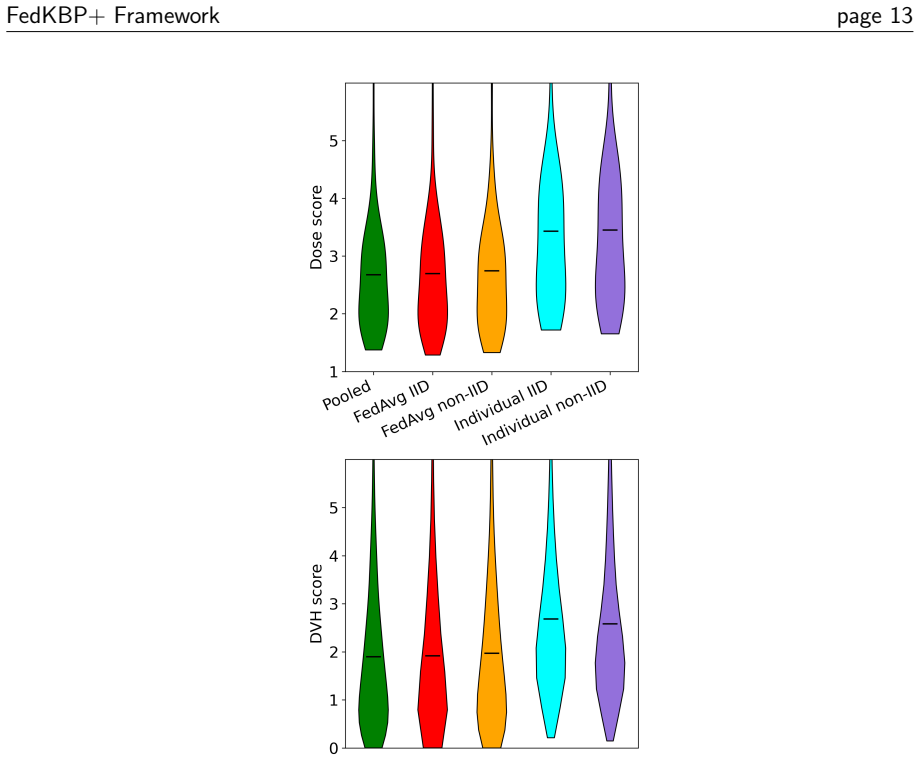
FedKBP+ establishes that federated learning can serve as a privacy-preserving substitute for centralized data aggregation across the main predictive tasks in radiotherapy. With SA-Net as the backbone model, the framework's FedAvg implementation produced dose-prediction accuracy on the OpenKBP test set essentially equal to pooled training (dose score 2.6953 vs 2.6758, DVH score 1.9196 vs 1.8990), far ahead of any single site's local model. On BraTS tumor segmentation, FedKBP+ reached 92.38% mean Dice in 5.92 hours against 90.75% in 7.78 hours for the alternative platform, with FedProx following the same pattern; the authors attribute the margin primarily to SA-Net's scale-attention design. Robustness is handled by the decentralized GCML algorithm, whose gossip-based contrastive mutual learning keeps organ segmentation performance indistinguishable from the full-participation baseline even with up to 40% random site dropout (ANOVA p=0.9097). The conclusion the authors draw is that FedKBP+ is an effective, efficient, and robust platform for federated prediction in radiation therapy.
Load-bearing premise
The framework comparison in tumor segmentation assumes both systems are evaluated with equivalent predictive models, but each platform actually runs a different neural network, so the reported advantage in accuracy and training time could be caused by the network architecture rather than by the platform itself.
Editorial extensions
If this is right
- Hospitals could train dose prediction, tumor segmentation, and organ segmentation models together across institutions without exporting imaging or dosimetric data, lowering regulatory barriers to collaboration.
- Federated averaging can serve as a direct replacement for pooled-data training in head-and-neck dose prediction, since the observed accuracy gap is small in both IID and non-IID splits.
- The decentralized GCML algorithm's tolerance for up to 40% random site dropout suggests that production federations can keep working through network failures and workstation shutdowns.
- A single framework spanning the three main predictive steps of radiotherapy planning offers a standardized base for future multi-institutional model development and clinical deployment.
Reading between the lines
- Editorial inference: the residual gap between non-IID federated training and pooled training (dose score 2.7452 vs 2.6758) suggests site-imbalance remains a limiting factor; testing client-weighted aggregation or per-site personalization on the same dataset would quantify how much of that gap is recoverable.
- Editorial inference: the wall-clock speedups rely on each site training on a dedicated GPU in parallel, so on a fixed GPU budget the framework's efficiency advantage would shrink to communication and scheduling overhead alone.
- Editorial inference: the contrastive mutual learning idea, where a peer model's errors define where to disagree, could transfer to other medical imaging tasks such as lesion detection or image reconstruction in federated settings.
- Editorial inference: a clean head-to-head of the two platforms using the exact same architecture and initialized weights would decide whether the reported accuracy advantage comes from the framework or from the backbone network; the current experiments attribute it primarily to the network.
Editorial analysis
A structured set of objections, weighed in public.
Referee Report
Summary. The paper introduces FedKBP+, a federated learning framework for radiotherapy-planning prediction tasks, and evaluates it on three public datasets: OpenKBP dose prediction, BraTS tumor segmentation, and PanSeg pancreas/OAR segmentation. The framework supports both centralized FL (FedAvg, FedProx) and a fully decentralized P2P mode (GCML), and uses gRPC for communication. The main reported results are that FedAvg with FedKBP+ matches pooled training on OpenKBP, that FedKBP+ outperforms NVFlare on BraTS in both DSC and training time, and that GCML remains robust when up to 40% of sites drop out randomly. The paper concludes that FedKBP+ is effective, efficient, and robust as an FL platform for radiotherapy.
Significance. If the claims are substantiated, FedKBP+ would be a useful contribution to federated learning in radiotherapy, particularly because it addresses three distinct predictive tasks and provides a decentralized P2P option. The paper uses public datasets and reports concrete numbers, and the OpenKBP result with standard FedAvg is a valid demonstration that FL can approach pooled-data performance. The PanSeg dropout study, including an ANOVA test (p=0.9097), is a concrete robustness evaluation. The main concern is that the headline framework-vs-framework comparison against NVFlare is confounded by different backbone architectures, and the paper itself attributes the gain primarily to SA-Net. Because the abstract and conclusion claim framework-level superiority, this confound is load-bearing and must be addressed before the central claim can be accepted.
major comments (3)
- [Section III.B.3 and III.B.4] The BraTS comparison between FedKBP+ and NVFlare is confounded by the use of different predictive models: NVFlare uses the BraTS 2018 winner, while FedKBP+ uses SA-Net. Section III.B.4 explicitly states that the performance gain is 'primarily attributed to the advanced scale attention mechanism embedded in SA-Net.' Under these conditions, the reported accuracy advantage (92.38% vs 90.75% for FedAvg) and the training-time advantage (5.92 h vs 7.78 h) cannot be attributed to the FedKBP+ platform rather than to the model architecture. To support the claim that FedKBP+ surpasses NVFlare as a framework, the two frameworks should be evaluated with the same backbone model, or the conclusion should be re-scoped to a combined model-plus-platform comparison.
- [Sections III.A.4, III.B.4 and Figure 12] All head-to-head performance claims are based on single runs with no confidence intervals, error bars, or repeated-seed experiments. For example, the IID FedAvg dose score of 2.6953 is reported as comparable to the pooled score of 2.6758, but without variance information it is not possible to judge whether the difference is meaningful; likewise, the BraTS DSC differences (92.38% vs 90.75%) may be within run-to-run variability. The authors should provide repeated runs with different random seeds and data partitions, or at least report error bars and appropriate statistical tests, for the comparisons that support the abstract's effectiveness and efficiency claims.
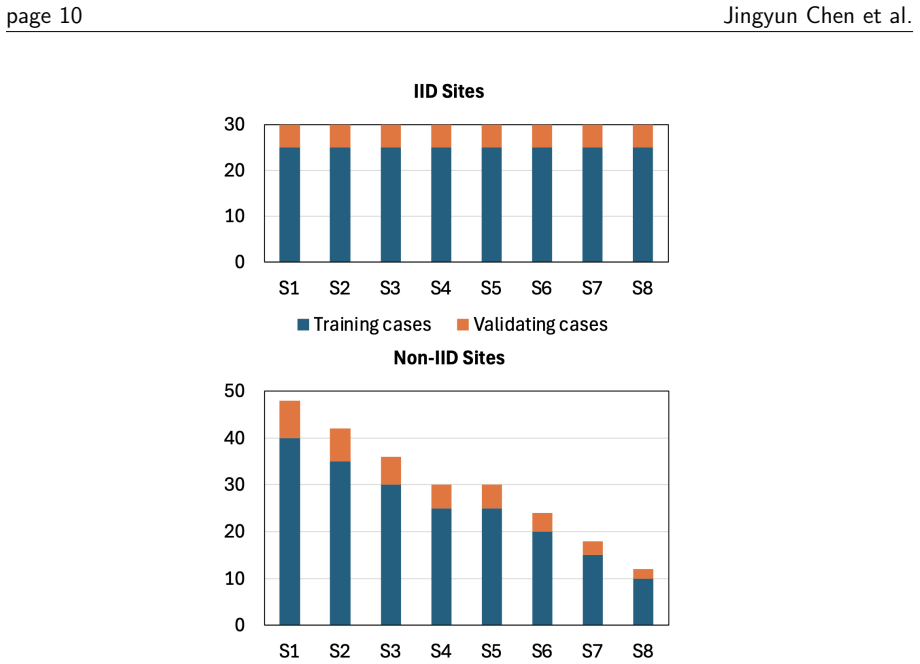
- [Section III.A.1 and III.A.4] The OpenKBP non-IID setting is implemented only by varying the number of cases per site; it does not introduce distribution shift across sites in imaging protocol, treatment technique, or patient population. The paper acknowledges this limitation in the Discussion, but the results are nevertheless used to draw conclusions about the impact of data heterogeneity. A more realistic non-IID partition, or a revised claim that only case-count imbalance was tested, would make the interpretation more accurate.
minor comments (5)
- [Section III.B.3] The implementations section does not report local optimization details such as batch size, optimizer, learning-rate schedule, number of local epochs per FL round, or number of FL rounds; without these details the reported training-time comparisons are difficult to reproduce or interpret.
- [Section III.C.2, Algorithm 2] In Algorithm 2, the loop condition uses 'R_max' but the input list defines 'R_total'; this appears to be a typo, and the pseudocode should be corrected for clarity.
- [Equation (3)] The term D_CKL is referred to as 'regional contrastive K-L Divergence' but is not defined in this paper; a brief definition or a more explicit reference to the equation in [33] would make the algorithm self-contained.
- [Section III.C.4] The statement that GCML 'yielded better segmentation results' and is 'comparable to the pooled model' is supported only by a single example case and a box plot of dropout scenarios; reporting the mean and standard deviation of DSC for GCML, pooled, and individual training would strengthen the claim.
- [Section II.C and Table 1] There are several typographical and wording issues, e.g., 'Compare of' in Table 1 caption, 'primals' should be 'primarily', and 'centerlized/decentralzied' misspellings in Section III.C.2; these should be corrected during revision.
Circularity Check
No significant circularity; the core FL evaluations are self-contained public-benchmark experiments.
full rationale
The paper's load-bearing empirical claims are (1) FedAvg on OpenKBP approaching pooled training, (2) FedKBP+ versus NVFlare on BraTS, and (3) GCML robustness under site dropout on PanSeg. Each is a direct experiment on public data with stated baselines and standard metrics (dose/DVH, DSC, ANOVA p=0.9097); none is defined in terms of the quantity it claims to predict. The FedAvg update (Eq. 1), FedProx update (Eq. 2), and GCML update (Eq. 3) are algorithm prescriptions, not fitted predictions whose outputs are forced by construction. The self-citations to SA-Net [34,35] and GCML [33] are used as components whose prior performance is externally benchmarked (BraTS 2021 2nd place, code release, prior TMI publication), and the present paper re-measures them on new public data against pooled/individual baselines; hence these citations are real evidence rather than circular load-bearing. The NVFlare comparison uses different model architectures (SA-Net vs BraTS 2018 winner) and the paper explicitly attributes the gain primarily to SA-Net; that is a model-matching confound relevant to correctness, not a circular derivation. Overall no step reduces by construction to its input, so circularity is minimal.
Assumptions & free parameters
free parameters (4)
- GCML loss balance parameter lambda (Eq. 3) =
Not reported in preprint
- FedProx proximity parameter mu (Eq. 2) =
Not reported in preprint
- Local learning rate eta_i (Eq. 1) =
Not reported in preprint
- Training epoch counts (100, 400, 500) =
100 (OpenKBP), 400 (BraTS), 500 (PanSeg)
assumptions (5)
- domain assumption Random partitioning of OpenKBP into 8 uneven groups adequately simulates non-IID federated data.
- domain assumption Framework comparison isolates the framework rather than the predictive model.
- domain assumption Withholding raw images and sharing model weights preserves patient privacy.
- domain assumption gRPC over HTTP/2 and TCP provides scalable and reliable communication in real deployments.
- domain assumption The synthetic drop-in and drop-out process in Algorithm 2 models realistic site availability.
Cite this review
Pith. "Pith review of Federated prediction for scalable and privacy-preserved knowledge-based planning in radiotherapy." pith.science (2026). https://pith.science/paper/SN24EIHK
@misc{pith2026250514507,
  author       = {Pith},
  title        = {Pith review of: Federated prediction for scalable and privacy-preserved knowledge-based planning in radiotherapy},
  year         = {2026},
  howpublished = {\url{https://pith.science/paper/SN24EIHK}},
  note         = {Machine review of arXiv:2505.14507}
}
read the original abstract
Background: Deep learning has potential to improve the efficiency and consistency of radiation therapy planning, but clinical adoption is hindered by the limited model generalizability due to data scarcity and heterogeneity among institutions. Although aggregating data from different institutions could alleviate this problem, data sharing is a practical challenge due to concerns about patient data privacy and other technical obstacles. Purpose: This work aims to address this dilemma by developing FedKBP+, a comprehensive federated learning (FL) platform for predictive tasks in real-world applications in radiotherapy treatment planning. Methods: We implemented a unified communication stack based on Google Remote Procedure Call (gRPC) to support communication between participants whether located on the same workstation or distributed across multiple workstations. In addition to supporting the centralized FL strategies commonly available in existing open-source frameworks, FedKBP+ also provides a fully decentralized FL model where participants directly exchange model weights to each other through Peer-to-Peer communication. We evaluated FedKBP+ on three predictive tasks using scale-attention network (SA-Net) as the predictive model. Conclusions: Our results demonstrate that FedKBP+ is highly effective, efficient and robust, showing great potential as a federated learning platform for radiation therapy.
Figures


Figures from the paper (12 more)






Reference graph
Works this paper leans on
- [1]
-
[2]
C. Li, H. Bagher-Ebadian, R. I. Sultan, M. Elshaikh, B. Movsas, D. Zhu, and I. J. Chetty, A new architecture combining convolutional and transformer-based networks for automatic 3D multi-organ segmentation on CT images, Medical Physics 50 , 6990--7002 (2023)
work page 2023
-
[3]
F. Tian, Z. Tian, Z. Chen, D. Zhang, and S. Du, Surface-GCN: Learning interaction experience for organ segmentation in 3D medical images, Medical Physics 50 , 5030--5044 (2023)
work page 2023
-
[4]
H. Lin, Z. Li, Z. Yang, and Y. Wang, Variance-aware attention U-Net for multi-organ segmentation, Medical Physics 48 , 7864--7876 (2021)
work page 2021
-
[5]
Y. Liu, Y. Lei, Y. Fu, T. Wang, X. Tang, X. Jiang, W. J. Curran, T. Liu, P. Patel, and X. Yang, CT-based multi-organ segmentation using a 3D self-attention U-net network for pancreatic radiotherapy, Medical Physics 47 , 4316--4324 (2020)
work page 2020
-
[6]
S. Baek, D. H. Ye, and O. Lee, UNet-based multi-organ segmentation in photon counting CT using virtual monoenergetic images, Medical Physics 52 , 481--488 (2025)
work page 2025
- [7]
-
[8]
K. Dong, P. Hu, Y. Zhu, Y. Tian, X. Li, T. Zhou, X. Bai, T. Liang, and J. Li, Attention-enhanced multiscale feature fusion network for pancreas and tumor segmentation, Medical Physics 51 , 8999--9016 (2024)
work page 2024
Show all 56 references
-
[9]
J. Li, G. Huang, J. He, Z. Chen, C.-M. Pun, Z. Yu, W.-K. Ling, L. Liu, J. Zhou, and J. Huang, Shift-channel attention and weighted-region loss function for liver and dense tumor segmentation, Medical Physics 49 , 7193--7206 (2022)
2022
-
[10]
Zhuge, A
Y. Zhuge, A. V. Krauze, H. Ning, J. Y. Cheng, B. C. Arora, K. Camphausen, and R. W. Miller, Brain tumor segmentation using holistically nested neural networks in MRI images, Medical Physics 44 , 5234--5243 (2017)
2017
-
[11]
B. Wu, F. Ricchetti, G. Sanguineti, M. Kazhdan, P. Simari, M. Chuang, R. Taylor, R. Jacques, and T. McNutt, Patient geometry‐driven information retrieval for IMRT treatment plan quality control, Medical Physics 36 , 5497--5505 (2009)
2009
-
[12]
Yuan, T.-C
Y. Yuan, T.-C. Tseng, and Y.-C. Lo, 3d deep planning radiotherapy system and method, 2018
2018
-
[13]
Babier, B
A. Babier, B. Zhang, R. Mahmood, K. L. Moore, T. G. Purdie, A. L. McNiven, and T. C. Y. Chan, OpenKBP: The open‐access knowledge‐based planning grand challenge and dataset, Medical Physics 48 , 5549--5561 (2021)
2021
-
[14]
J. Chen, M. King, and Y. Yuan, FedKBP: Federated dose prediction framework for knowledge-based planning in radiation therapy, (2024)
2024
-
[15]
R. He, J. Wang, W. Wu, H. Zhang, Y. Liu, Y. Luo, X. Zhang, Y. Ma, X. Liu, Y. Li, H. Peng, P. He, and Q. Li, Deep learning-based Monte Carlo dose prediction for heavy-ion online adaptive radiotherapy and fast quality assurance: A feasibility study, Medical Physics 52 , 2570--25...
2025
-
[16]
Fransson, R
S. Fransson, R. Strand, and D. Tilly, Deep learning-based dose prediction for magnetic resonance-guided prostate radiotherapy, Medical Physics 51 , 8087--8095 (2024)
2024
-
[17]
McMahan, E
B. McMahan, E. Moore, D. Ramage, S. Hampson, and B. A. y Arcas, Communication-Efficient Learning of Deep Networks from Decentralized Data, in Proceedings of the 20th International Conference on Artificial Intelligence and Statistics , edited by A. Singh and J. Zhu, volume 54, ...
2017
-
[18]
Rieke, J
N. Rieke, J. Hancox, W. Li, F. Milletarì, H. R. Roth, S. Albarqouni, S. Bakas, M. N. Galtier, B. A. Landman, K. Maier-Hein, S. Ourselin, M. Sheller, R. M. Summers, A. Trask, D. Xu, M. Baust, and M. J. Cardoso, The future of digital health with federated learning, npj Digital M...
2020
-
[19]
Y. Shen, A. Sowmya, Y. Luo, X. Liang, D. Shen, and J. Ke, A Federated Learning System for Histopathology Image Analysis With an Orchestral Stain-Normalization GAN, IEEE Transactions on Medical Imaging 42 , 1969--1981 (2023)
2023
-
[20]
C.-M. Feng, Y. Yan, S. Wang, Y. Xu, L. Shao, and H. Fu, Specificity-Preserving Federated Learning for MR Image Reconstruction, IEEE Transactions on Medical Imaging 42 , 2010--2021 (2023)
2023
-
[21]
N. Dong, M. Kampffmeyer, I. Voiculescu, and E. Xing, Federated Partially Supervised Learning With Limited Decentralized Medical Images, IEEE Transactions on Medical Imaging 42 , 1944--1954 (2023)
2023
-
[22]
Pati et al., Federated learning enables big data for rare cancer boundary detection, Nature Communications 13 , 7346 (2022)
S. Pati et al., Federated learning enables big data for rare cancer boundary detection, Nature Communications 13 , 7346 (2022)
2022
-
[23]
Foley, M
P. Foley, M. J. Sheller, B. Edwards, S. Pati, W. Riviera, M. Sharma, P. N. Moorthy, S. han Wang, J. Martin, P. Mirhaji, P. Shah, and S. Bakas, OpenFL: the open federated learning library, Physics in Medicine & Biology 67 , 214001 (2022)
2022
-
[24]
H. R. Roth, D. Yang, W. Li, A. Myronenko, W. Zhu, Z. Xu, X. Wang, and D. Xu, Federated Whole Prostate Segmentation in MRI with Personalized Neural Architectures , pages 357--366, 2021
2021
-
[25]
D. J. Beutel, T. Topal, A. Mathur, X. Qiu, J. Fernandez-Marques, Y. Gao, L. Sani, K. H. Li, T. Parcollet, P. P. B. de Gusmão, and N. D. Lane, Flower: A Friendly Federated Learning Research Framework, (2020)
2020
-
[26]
T. Li, A. K. Sahu, M. Zaheer, M. Sanjabi, A. Talwalkar, and V. Smith, Federated Optimization in Heterogeneous Networks, (2018)
2018
-
[27]
Wahrstätter, S
A. Wahrstätter, S. Khan, and D. Svetinovic, OpenFL: A scalable and secure decentralized federated learning system on the Ethereum blockchain, Internet of Things 26 , 101174 (2024)
2024
-
[28]
H. R. Roth et al., NVIDIA FLARE: Federated Learning from Simulation to Real-World, (2022)
2022
-
[29]
Client Controlled Workflows in Nvidia Flare, https://nvflare.readthedocs.io/en/2.4/programming_guide/controllers/client_controlled_workflows.html, Accessed: 2025-04-10
2025
-
[30]
Yu and J
L. Yu and J. Huang, Cyclic Federated Learning Method Based on Distribution Information Sharing and Knowledge Distillation for Medical Data, Electronics 11 (2022)
2022
-
[31]
Z. Gao, F. Wu, W. Gao, and X. Zhuang, A New Framework of Swarm Learning Consolidating Knowledge From Multi-Center Non-IID Data for Medical Image Segmentation, IEEE Transactions on Medical Imaging 42 , 2118--2129 (2023)
2023
-
[32]
Federated Learning with XGBoost and Flower, https://github.com/adap/flower/tree/main/examples/xgboost-comprehensive, Accessed: 2025-04-10
2025
-
[33]
Chen and Y
J. Chen and Y. Yuan, Decentralized Personalization for Federated Medical Image Segmentation via Gossip Contrastive Mutual Learning, IEEE Transactions on Medical Imaging (2025)
2025
-
[34]
Yuan, Automatic Head and Neck Tumor Segmentation in PET/CT with Scale Attention Network, in Head and Neck Tumor Segmentation , edited by V
Y. Yuan, Automatic Head and Neck Tumor Segmentation in PET/CT with Scale Attention Network, in Head and Neck Tumor Segmentation , edited by V. Andrearczyk, V. Oreiller, and A. Depeursinge, pages 44--52, Springer International Publishing, 2021
2021
-
[35]
Yuan, Automatic Brain Tumor Segmentation with Scale Attention Network, in Brainlesion: Glioma, Multiple Sclerosis, Stroke and Traumatic Brain Injuries , edited by A
Y. Yuan, Automatic Brain Tumor Segmentation with Scale Attention Network, in Brainlesion: Glioma, Multiple Sclerosis, Stroke and Traumatic Brain Injuries , edited by A. Crimi and S. Bakas, pages 285--294, Springer International Publishing, 2021
2021
-
[36]
K. He, X. Zhang, S. Ren, and J. Sun, Deep Residual Learning for Image Recognition, in 2016 IEEE Conference on Computer Vision and Pattern Recognition (CVPR) , pages 770--778, IEEE, 2016
2016
-
[37]
J. Hu, L. Shen, and G. Sun, Squeeze-and-Excitation Networks, in 2018 IEEE/CVF Conference on Computer Vision and Pattern Recognition , pages 7132--7141, 2018
2018
-
[38]
Y. Yuan, T. Tseng, M. Chao, R. Stock, and Y. Lo, Predicting three dimensional dose distribution with deep convolutional neural networks, Med. Phys 44 (2017)
2017
-
[39]
Yuan, Automatic Head and Neck Tumor Segmentation in PET/CT with Scale Attention Network, medRxiv , 2020.11.11.20230185 (2020)
Y. Yuan, Automatic Head and Neck Tumor Segmentation in PET/CT with Scale Attention Network, medRxiv , 2020.11.11.20230185 (2020)
2020
-
[40]
Yuan, Evaluating Scale Attention Network for Automatic Brain Tumor Segmentation with Large Multi-parametric MRI Database , pages 42--53, 2022
Y. Yuan, Evaluating Scale Attention Network for Automatic Brain Tumor Segmentation with Large Multi-parametric MRI Database , pages 42--53, 2022
2022
-
[41]
X. Wang, H. Zhao, and J. Zhu, GRPC: a communication cooperation mechanism in distributed systems, SIGOPS Oper. Syst. Rev. 27 , 75–86 (1993)
1993
-
[42]
G. C. Kessler, An overview of TCP/IP protocols and the internet, InterNIC Document, Dec 29 , 42 (2004)
2004
-
[43]
Belshe, R
M. Belshe, R. Peon, and M. Thomson, RFC 7540: Hypertext Transfer Protocol Version 2 (HTTP/2), 2015
2015
-
[44]
Baid et al., The RSNA-ASNR-MICCAI BraTS 2021 Benchmark on Brain Tumor Segmentation and Radiogenomic Classification, (2021)
U. Baid et al., The RSNA-ASNR-MICCAI BraTS 2021 Benchmark on Brain Tumor Segmentation and Radiogenomic Classification, (2021)
2021
-
[45]
Zhang et al., Large-Scale Multi-Center CT and MRI Segmentation of Pancreas with Deep Learning, arXiv: 2405.12367 (2024)
Z. Zhang et al., Large-Scale Multi-Center CT and MRI Segmentation of Pancreas with Deep Learning, arXiv: 2405.12367 (2024)
2024 arXiv
-
[46]
Adabi, T.-C
S. Adabi, T.-C. Tzeng, and Y. Yuan, Predicting 3D dose distribution with scale attention network for prostate cancer radiotherapy, in Medical Imaging 2022: Image-Guided Procedures, Robotic Interventions, and Modeling , volume 12034, pages 270--276, SPIE, 2022
2022
-
[47]
Myronenko, 3D MRI brain tumor segmentation using autoencoder regularization, CoRR abs/1810.11654 (2018)
A. Myronenko, 3D MRI brain tumor segmentation using autoencoder regularization, CoRR abs/1810.11654 (2018)
2018 arXiv
-
[48]
C. Li, G. Li, and P. K. Varshney, Decentralized Federated Learning via Mutual Knowledge Transfer, IEEE Internet of Things Journal 9 , 1136--1147 (2022)
2022
-
[49]
L. He, S. P. Karimireddy, and M. Jaggi, Byzantine-Robust Decentralized Learning via ClippedGossip, (2022)
2022
-
[50]
C. Che, X. Li, C. Chen, X. He, and Z. Zheng, A Decentralized Federated Learning Framework via Committee Mechanism With Convergence Guarantee, IEEE Transactions on Parallel and Distributed Systems 33 , 4783--4800 (2022)
2022
-
[51]
S. J. Alnaghy, T. Causer, N. Roberts, B. Oborn, U. Jelen, B. Dong, M. Gargett, J. Begg, G. Liney, M. Petasecca, A. B. Rosenfeld, L. Holloway, and P. Metcalfe, High resolution silicon array detector implementation in an inline MRI-linac, Medical Physics 47 , 1920--1929 (2020)
2020
-
[52]
Baraglia, P
R. Baraglia, P. Dazzi, M. Mordacchini, and L. Ricci, A peer-to-peer recommender system for self-emerging user communities based on gossip overlays, Journal of Computer and System Sciences 79 , 291--308 (2013)
2013
-
[53]
A. Mao, M. Mohri, and Y. Zhong, Cross-Entropy Loss Functions: Theoretical Analysis and Applications, in Proceedings of the 40th International Conference on Machine Learning , edited by A. Krause, E. Brunskill, K. Cho, B. Engelhardt, S. Sabato, and J. Scarlett, volume 202 of Pr...
2023
-
[54]
Y. Yuan, M. Chao, and Y. C. Lo, Automatic Skin Lesion Segmentation Using Deep Fully Convolutional Networks With Jaccard Distance, IEEE Transactions on Medical Imaging 36 , 1876--1886 (2017)
2017
-
[55]
, " * write output.state after.block =
") INTEGERS output.state before.all mid.sentence after.sentence after.block FUNCTION init.state.consts #0 'before.all := #1 'mid.sentence := #2 'after.sentence := #3 'after.block := STRINGS s t FUNCTION output.nonnull 's := output.state mid.sentence = ", " * write output.state...
-
[56]
write newline
" write newline "" before.all 'output.state := FUNCTION fin.entry add.period write newline FUNCTION new.block output.state before.all = 'skip after.block 'output.state := if FUNCTION new.sentence skip FUNCTION not #0 #1 if FUNCTION and 'skip pop #0 if FUNCTION or pop #1 'skip ...
Reviewed August 7, 2026 · model on record in the stance chip above.
Discussion (0). Continue with ORCID to comment.