REVIEW 3 major objections 4 minor 70 references
Revisiting Thermal Scalability for Large-Scale Superconducting Quantum Systems
T0 review · 3 major / 4 minor · reviewed 2026-08-06 · deepseek-v4-flash
Pith's one-line read Readout-amplifier heat—dissipation plus bias-wire conduction—is the dominant thermal bottleneck in modern superconducting quantum systems, and omitting it overestimates qubit capacity by up to about a factor of two.
desk verdict Careful model that adds a real missing term, but the flashy result (144→80 qubits) depends on AWG30 copper wire and 4× multiplexing; still worth refereeing. read the letter →
The pith
A machine-rendered reading of the paper's core claim, the machinery that carries it, and where it could break.
The reading
What carries the argument
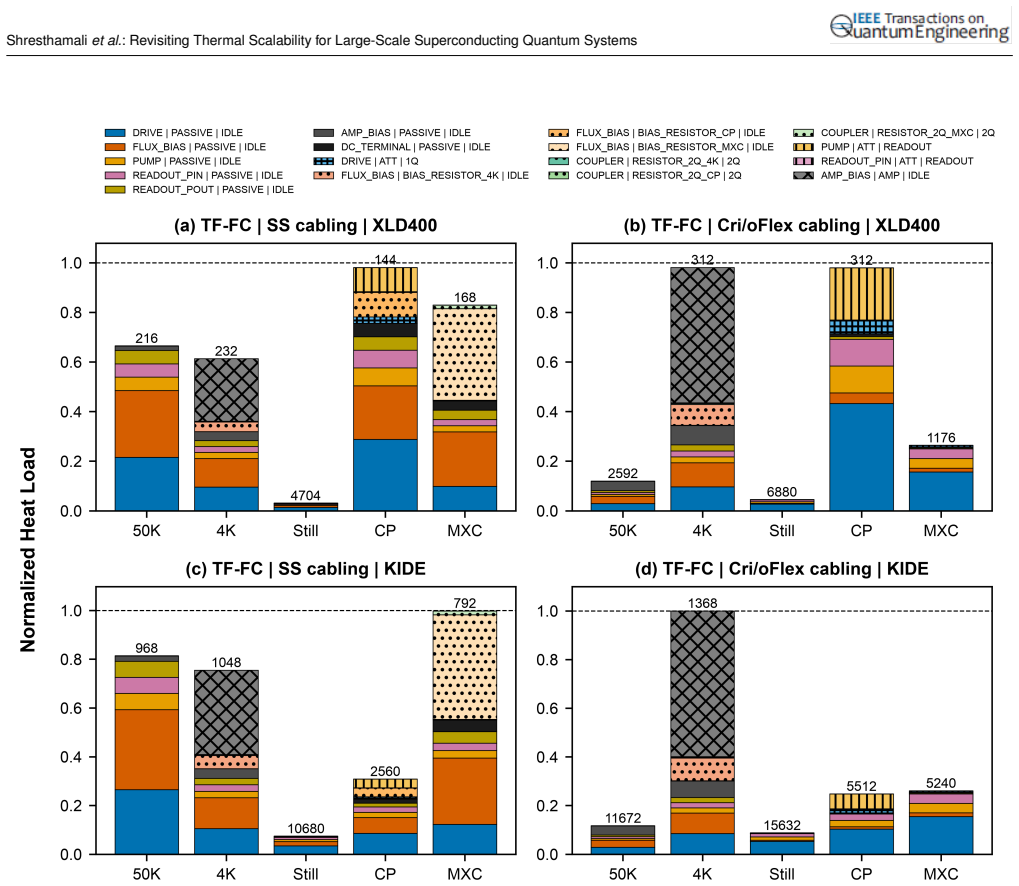
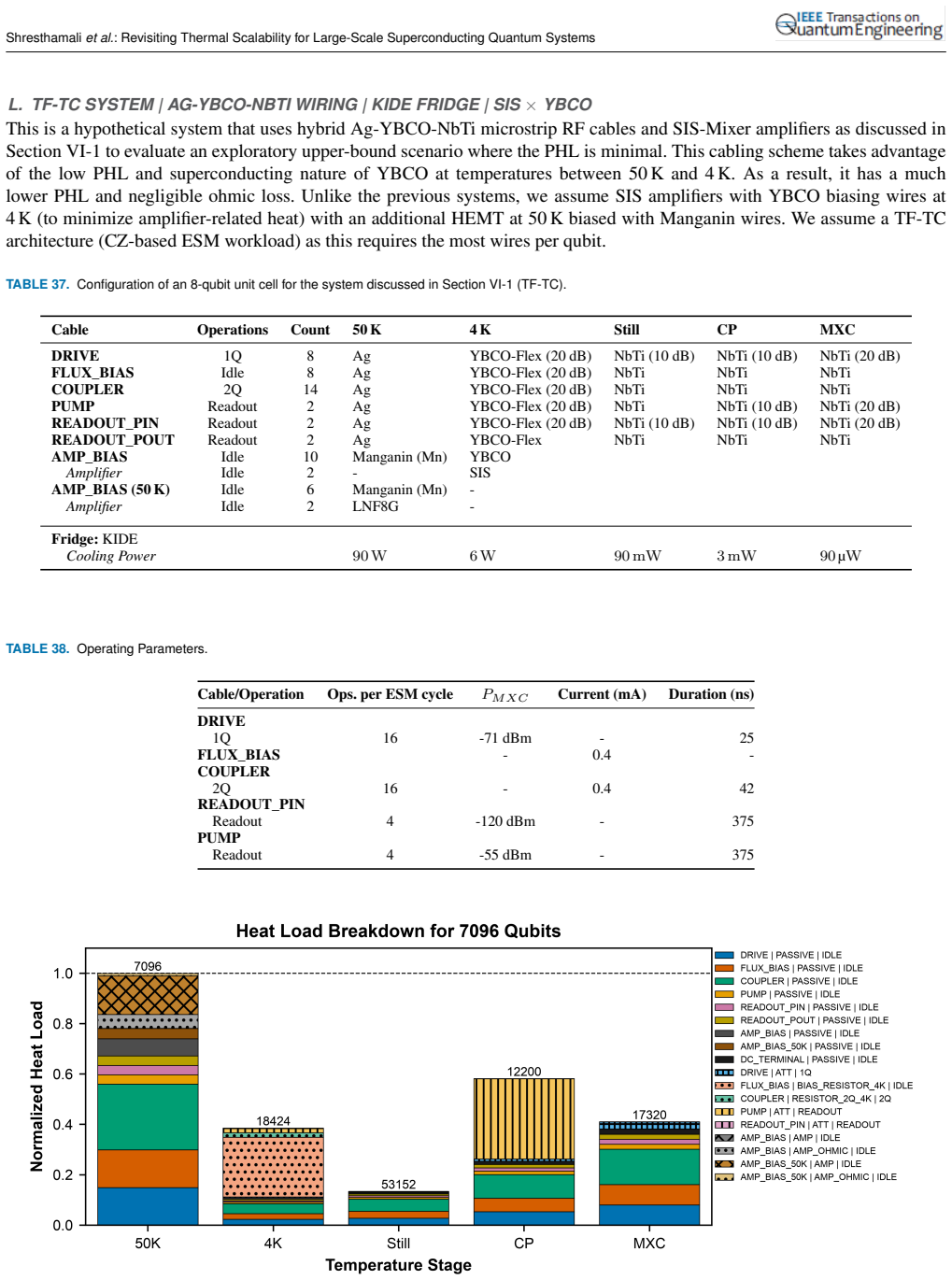
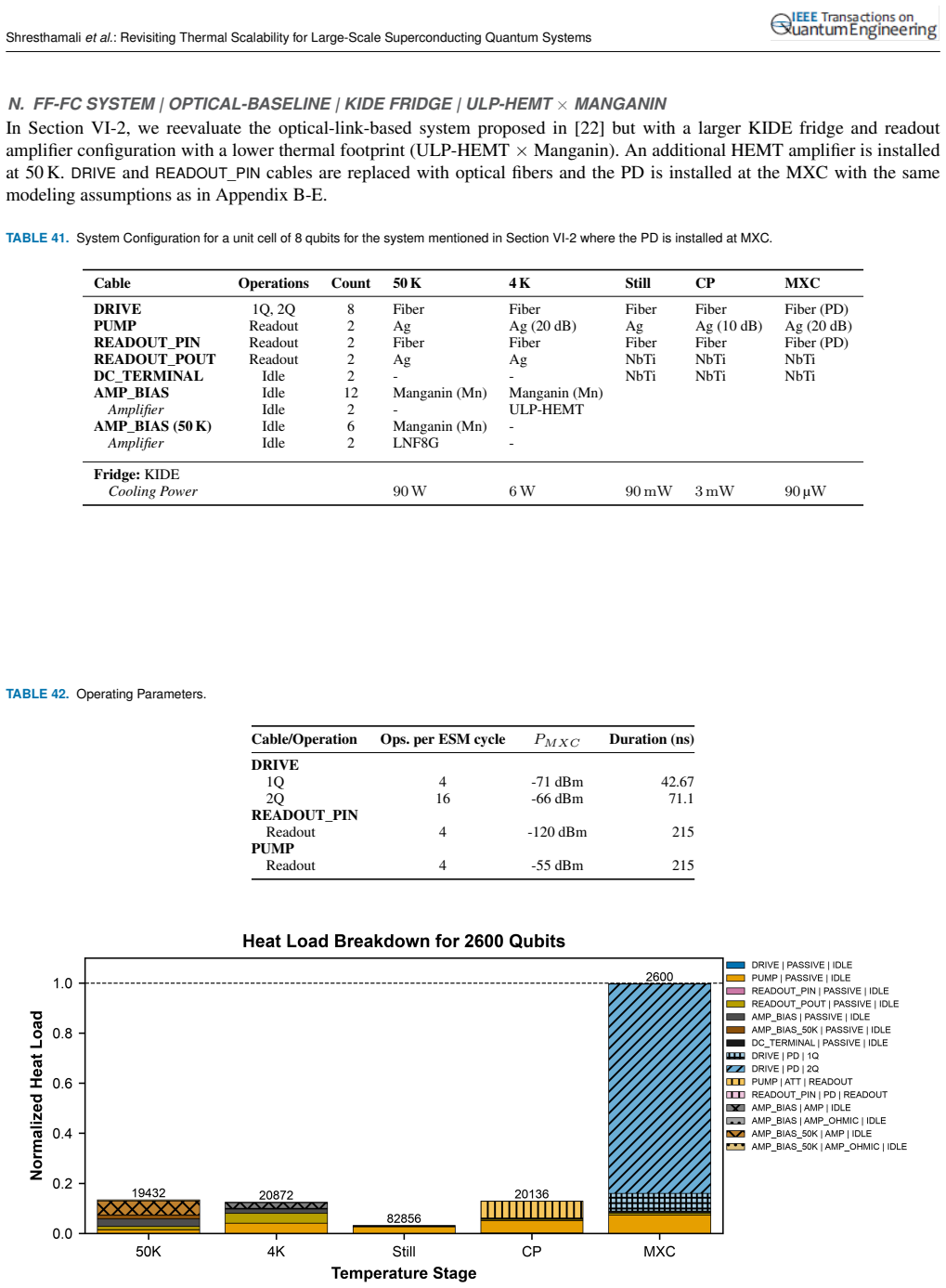
The carrying device is a stage-by-stage ledger of normalised heat load (NHL): each contribution—passive conduction, active dissipation, ohmic (Joule) heating—is divided by the cooling power of the stage that absorbs it, and the first stage whose cumulative NHL reaches unity sets the physical-qubit capacity. The new term inserted into that ledger is the amplifier module's full three-part load, and the argument's engine is bottleneck migration: improving wiring and refrigeration moves the limiting stage from the cold plate toward 4 K, where the amplifier terms dominate.
What would settle it
Measure the actual residual cooling power of a KIDE-class platform at 4 K and CP under load, and calorimetrically measure the steady heat conducted into 4 K by one AWG30 copper amplifier-bias wire over the 50 K–4 K span. If the per-wire conduction is well below the model's roughly 6.8 mW, or if the real 4 K capacity is much larger than 6 W, the claim that amplifier bias wires dominate the modern 4 K budget and cap capacity at about 80 qubits in the HDW case would fail, and the bottleneck would sit elsewhere.
Extended reading notes
Core claim
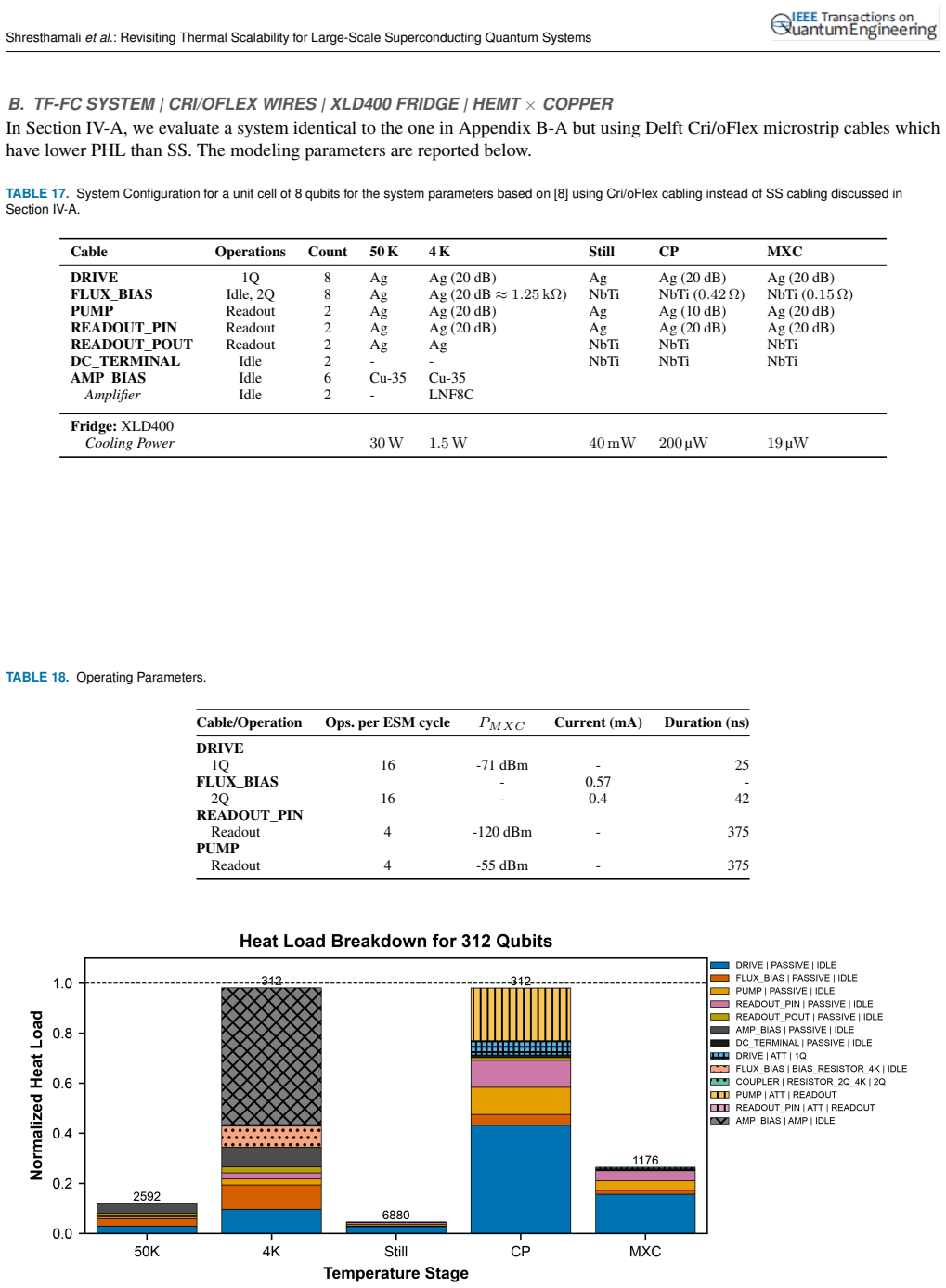
The paper's central discovery is that amplifier-associated heat—three mechanisms bundled in one module: the always-on dissipation of the cryogenic readout amplifier, passive conduction through its DC bias wires, and Joule heating in those same wires—emerges as the dominant normalised heat load at the 4 K stage once modern low-PHL wiring and higher-capacity refrigerators relieve the millikelvin stages. Where prior models placed the bottleneck at the cold plate (as in the stainless-steel, XLD400 system that supports 144 qubits), the modernised configuration (Cri/oFlex wiring in a KIDE fridge) shifts the bottleneck to 4 K and makes amplifier heat the first constraint; when bias-wire passive con
Load-bearing premise
The modern-system numbers rest on an unverified input: the cooling powers assumed for the KIDE refrigerator (90 W at 50 K, 6 W at 4 K, 90 mW at Still, 3 mW at CP, 90 µW at MXC) are estimates obtained by treating KIDE as three independent XLD1000sl-class units, because measured values are not public; if the real 4 K or CP cooling profile differs materially, the point at which amplifier heat becomes the dominant bottleneck, and the headline capacity figures, would shift.
Editorial extensions
If this is right
- Systems designed with older models will underestimate the 4 K stage's stress; adding amplifier bias-line passive conduction alone cuts the HDW/XLD1000sl capacity from about 144 to about 80 physical qubits.
- Reducing amplifier active power is not sufficient: with copper bias wires every amplifier option is dominated by bias-wire passive conduction, so the lowest-active-power amplifier (ULP-HEMT) carries the largest total load when paired with copper.
- Amplifier-heat reductions saturate: once the per-amplifier 4 K budget drops below about 2 mW, the bottleneck migrates to MXC at roughly 4,688 qubits, so further amplifier improvements add no capacity.
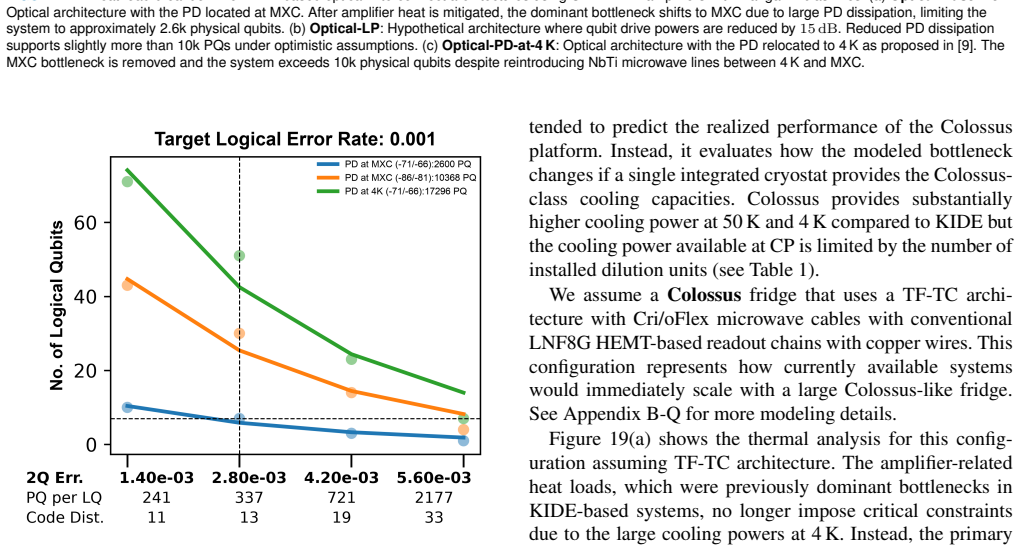
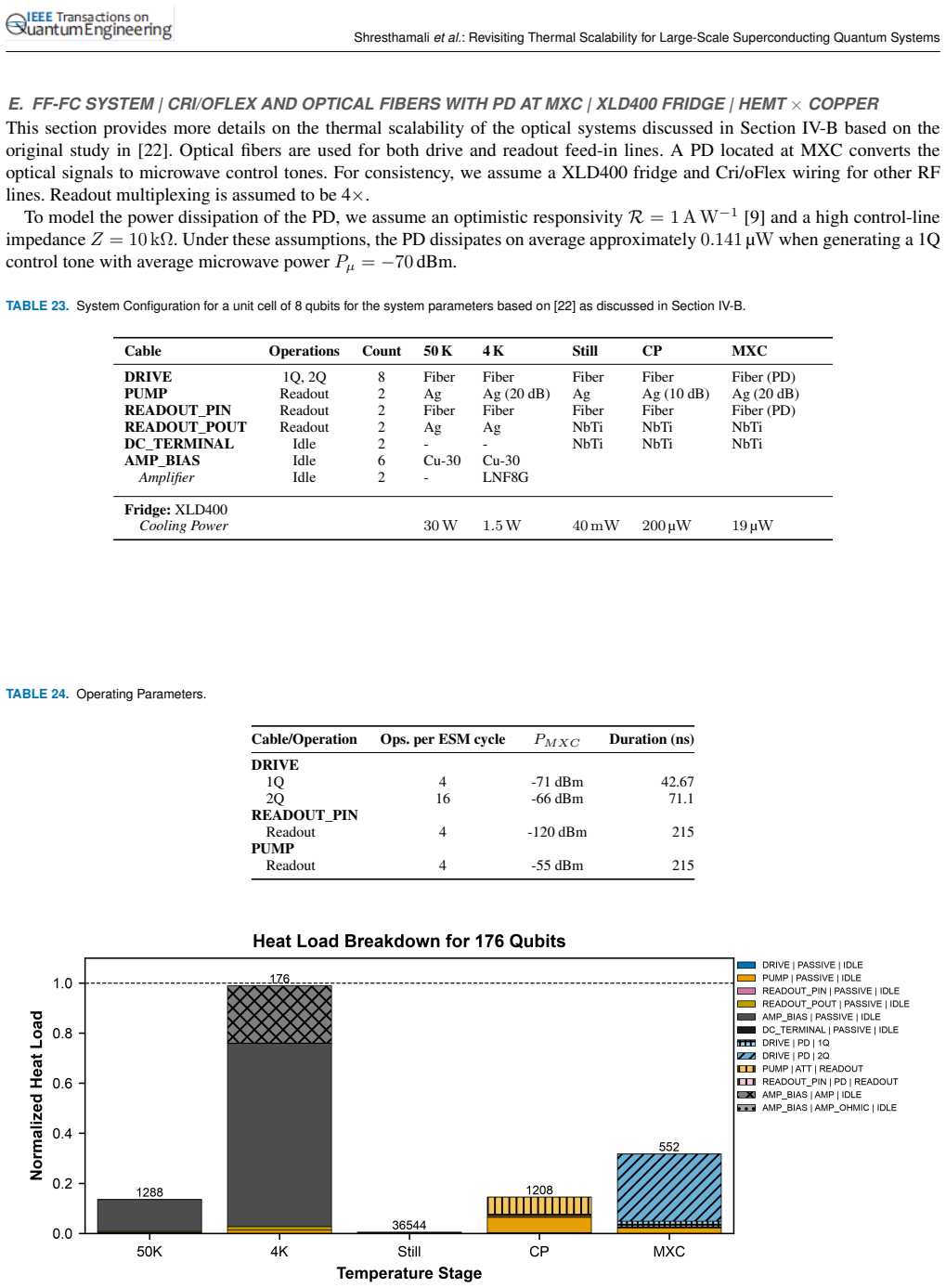
- With today's components in a KIDE-class fridge the system reaches only about 700–800 physical qubits; reaching 10k requires optical interconnects with the photodetector at 4 K, YBCO-based superconducting microwave striplines, or a Colossus-class fridge with dilution units redistributed toward the cold plate.
- Even if lower-gain amplifier chains degrade measurement error by up to 4x, the larger physical-qubit budget still yields more logical qubits than the current HEMT-copper baseline (about 4 versus 2 at a target logical error rate of 0.001).
Reading between the lines
- If the paper's accounting is right, an immediate test is available from operating hardware: calorimetric measurement of the 4 K heat floor of one tiled readout chain (amplifier plus its bias wires) in a production dilution refrigerator would either confirm or contradict the roughly 7 mW per wire of passive conduction that drives the headline result.
- The same three-term ledger should apply to any other always-on component with room-temperature-to-4 K wiring—bias-T networks, DC blocks, cryogenic CMOS control electronics—so the framework is a template for auditing those subsystems as they scale.
- The results imply readout multiplexing is a thermal lever as much as a wiring one: doubling multiplexing from 4x to 8x halves the number of amplifier modules and, with copper wiring, nearly halves the dominant 4 K load—a tradeoff the paper flags but does not quantify.
- A testable engineering corollary: because bias-wire material alone moves the per-amplifier load by nearly two orders of magnitude, swapping copper bias wires for Manganin or YBCO in an existing machine should measurably extend the 4 K margin before any amplifier or fridge upgrade.
Editorial analysis
A structured set of objections, weighed in public.
Referee Report
Summary. The paper develops a steady-state thermal scalability model for large-scale superconducting quantum systems, adding previously omitted readout-amplifier heat terms: active dissipation, passive conduction through bias wires, and ohmic (Joule) heating in those wires. The model is validated against the 100-qubit-scale system of [8], reproducing its 144-qubit capacity with CP as the bottleneck. The authors then apply the model to modern configurations with lower-PHL wiring (HDW, Cri/oFlex) and higher-capacity fridges (KIDE), concluding that amplifier-associated heat at 4 K becomes the dominant bottleneck and that prior system-level models that omit amplifier bias-wire loads misidentify the bottleneck and overestimate physical-qubit capacity. The paper also explores mitigation options (Manganin or YBCO bias wires, ULP-HEMT and SIS amplifiers, current splitting), integrates surface-code logical-error simulations to estimate logical-qubit yield, and assesses forward-looking 10k-qubit pathways with optical interconnects and the Colossus platform.
Significance. If the central claim survives scrutiny, this is a useful and timely correction to system-level cryogenic scalability models: it identifies a concrete, currently omitted heat term that changes the location of the thermal bottleneck and the estimated qubit capacity of modern systems. The framework is flexible and transparent, with the full implementation publicly available, validation against a real system (Section IV-A), and a conservative treatment of several secondary heat sources. The T-pad attenuator analysis (Appendix A-E) and the optimal current-splitting expression (Eq. 8) are clean and transferable. However, the main quantitative conclusions are conditional on a few unvaried architectural assumptions, so the strength of the abstract currently runs ahead of the demonstrated robustness.
major comments (3)
- [Section IV-C / Table 3 / Appendix B-G] The HDW comparison that yields the headline 'roughly half' capacity reduction (144 to ~80 qubits) is driven by the choice of AWG30 copper bias wires, whose PHL into 4 K is 6.81 mW/wire, versus 1.23 mW/wire for the AWG35 wires used in [8]. Using AWG35, the per-amplifier 4 K load in Table 10 would be about 7.8 mW + 3×1.23 mW ≈ 11.5 mW instead of 28.07 mW, which could largely or entirely close the gap with [11]'s 144-qubit estimate. The paper does not report this sensitivity, even though AWG35 is a plausible installed-wire choice. The claim that omitting bias-line PHL causes a ~2× overestimation therefore needs to be quantified as a function of wire gauge.
- [Section V / Section IV-A] All system-level results assume 4× readout multiplexing, which fixes one amplifier per four qubits. Section V acknowledges that 8× multiplexing halves the number of amplifiers and their associated heat, but no system-level sweep over the multiplexing factor is presented. Since the central claim is that amplifier heat is the dominant 4 K bottleneck, halving that load could shift the bottleneck to CP or MXC under otherwise identical assumptions. The abstract and the Section IV-A conclusion should either be conditioned on the multiplexing factor or accompanied by a sensitivity analysis showing that the bottleneck identification is robust.
- [Appendix A-A / Table 1] The modern-system scenarios in Section IV-A and Section V rely on KIDE cooling powers (90 W at 50 K, 6 W at 4 K, 90 mW at Still, 3 mW at CP, 90 µW at MXC) estimated by treating KIDE as three independent XLD1000sl-class dilution units. These values are not measured, as the paper states. The claim that the bottleneck 'has shifted to 4 K' and is dominated by amplifier heat depends on these assumed powers. The authors should provide a sensitivity analysis varying the KIDE cooling profile, or explicitly restrict the conclusion to 'under the assumed KIDE cooling budget.'
minor comments (4)
- [Eq. (3) and Eq. (4)] The notation 'L / A(TH-TL) ∫' is ambiguous: it should be written as (L/(A(TH-TL))) ∫ or with explicit parentheses, since it could be read as L/(A(TH-TL)) or L/A × (TH-TL).
- [Table 3] The resistance entries for AWG35 copper are listed as '-' even though the OHL for the [8] reconstruction depends on it. If AWG35 resistance is unavailable, the text should state the impact of this missing parameter on the relevant heat budgets.
- [Section VI-1] The PHL of the hypothetical shielded YBCO stripline is set to 5× the PHL of a single YBCO bias wire by assumption. This multiplier directly affects the 12k/16k qubit estimates. It is flagged in the text as an estimate, but the basis for the factor of five should be stated more explicitly.
- [Abstract / Section VII] Section VII appropriately states that the model identifies trends rather than exact operating points, but the abstract states the bottleneck shift as an unconditional result. The abstract should be softened to reflect the parametric dependence noted above.
Circularity Check
No significant circularity: the bottleneck analysis follows from external component data and disclosed assumptions; no prediction is equivalent to an input by construction.
full rationale
The paper builds a steady-state thermal model from independently reported component data (cable PHL, amplifier AHL, fridge cooling powers) and then computes stage-level normalized heat loads. The central claim that amplifier-associated heat becomes the dominant bottleneck in modern configurations is a calculated output, not a restatement of an input. Section III-B2 explicitly discloses that AWG30 copper bias wires are assumed for all configurations other than the [8] system, and Section V discloses the uniform 4x readout multiplexing assumption. These are legitimate parameter choices, and the paper itself notes in Section V that increasing multiplexing to 8x would halve amplifier heat. Section VII further limits the model to identifying trends rather than exact operating points, which is an honest scope statement rather than a hidden circular move. The reconstruction of the [8] system in Section IV-A reproduces the published 144-qubit CP-bottleneck result, providing an external validation check. The only self-citation ([10], grouped with prior scalability models) is not load-bearing, since the omission claim is corroborated by the external references [8], [9], and [11]. No equation is defined in terms of its own conclusion, no fitted parameter is renamed as a prediction, and no uniqueness claim is imported from the authors' prior work. The derivation chain is therefore self-contained and not circular.
Assumptions & free parameters
free parameters (7)
- KIDE cooling powers =
50K: 90 W, 4K: 6 W, Still: 90 mW, CP: 3 mW, MXC: 90 uW
- Colossus cooling powers =
50K: 9 kW, 4K: 200 W, 2K: 10 W, Still: 100 mW, CP: 3 mW, MXC: 300 uW
- Bias wire material and geometry =
AWG30 copper PHL 6.81 mW per wire at 4 K; Manganin 25.47 uW; YBCO 3.84 uW
- Readout multiplexing factor =
4x
- Physical error probabilities =
1Q 6.2e-4, 2Q 2.8e-3, measurement 8e-3, reset 1.5e-3, idle 9e-3
- Optical link constants and Optical-LP drive power reduction =
R = 1 A/W, Z = 10 kOhm; drive powers reduced by 15 dB in Optical-LP
- YBCO microwave stripline PHL multiplier =
5x the PHL of a single YBCO bias wire
assumptions (10)
- domain assumption Each fridge stage maintains its specified operating temperature whenever the total heat load is below the stage cooling power, with no inter-stage thermodynamic coupling or temperature rise.
- domain assumption An 8-qubit unit cell scales linearly to N qubits, ignoring boundary effects, geometric crowding, routing congestion, crosstalk, and chip-layout constraints.
- domain assumption Attenuators dissipate all incident signal power as heat at the stage where they are anchored.
- domain assumption Passive heat conduction into a stage comes only from the immediately warmer flange; radiation and conduction through insulation are omitted.
- ad hoc to paper KIDE behaves as three independent XLD1000sl-class dilution units with functionally separated cryocoolers.
- ad hoc to paper Colossus-CP can reassign two dilution units from MXC to CP without thermodynamic coupling penalties.
- ad hoc to paper A shielded YBCO microwave stripline has PHL equal to 5x the PHL of a single YBCO bias wire and is usable from 50 K to 4 K at large scale.
- domain assumption Optical photonic links operate with responsivity 1 A/W and 10 kOhm control-line impedance, and the relocated 4 K termination has at least 35 dB isolation.
- domain assumption All qubits are continuously engaged in repeated ESM cycles with high activity.
- domain assumption Skin-effect and microwave-frequency conductor loss in control and readout lines are negligible relative to the modeled heat loads.
invented entities (2)
-
Ag-YBCO-NbTi microwave stripline
-
Colossus-CP fridge configuration
Cite this review
Pith. "Pith review of Revisiting Thermal Scalability for Large-Scale Superconducting Quantum Systems." pith.science (2026). https://pith.science/paper/SNBV5RDN
@misc{pith2026260800990,
  author       = {Pith},
  title        = {Pith review of: Revisiting Thermal Scalability for Large-Scale Superconducting Quantum Systems},
  year         = {2026},
  howpublished = {\url{https://pith.science/paper/SNBV5RDN}},
  note         = {Machine review of arXiv:2608.00990}
}
read the original abstract
The readout amplification chain imposes a critical thermal scalability bottleneck in large-scale superconducting quantum systems. This happens through three mechanisms: amplifier dissipation, passive conduction through bias wiring and Joule heating within that same wiring. These terms are absent or only partially represented in several prior system-level thermal-scalability models, leading to bottleneck misidentification and scalability overestimation. In this work, we improve upon previous system-level heat estimation models by fully accounting for the major heat sources in modern cryogenic quantum systems including the active dissipation, passive conduction, and Joule heating in the readout amplifier module. Our analysis demonstrates that amplifier-associated heat emerges as the dominant thermal bottleneck that fundamentally alters the thermal landscape of modern large-scale cryogenic systems. We explore various technology options and their tradeoffs to identify configurations that reduce this critical heat load and improve scalability. Finally, we evaluate forward-looking system configurations, including larger refrigeration platforms and optical approaches, and analyze forward-looking pathways toward single-fridge 10k-qubit cryogenic systems.
Figures


Figures from the paper (44 more)













Reference graph
Works this paper leans on
-
[8]
Engineering cryogenic setups for 100-qubit scale superconduct- ing circuit systems
Sebastian Krinner, Simon Storz, Philipp Kurpiers, Paul Magnard, Johannes Heinsoo, Raphael Keller, Janis Luetolf, Christopher Eichler, and Andreas Wallraff. Engineering cryogenic setups for 100-qubit scale superconduct- ing circuit systems. EPJ Quantum Technology, 6(1):2, 2019
work page 2019
-
[11]
Cryogenic thermal modeling of microwave high density signaling
Naomi Raicu, Tom Hogan, Xian Wu, Mehrnoosh Vahidpour, David Snow, Matthew Hollister, and Mark Field. Cryogenic thermal modeling of microwave high density signaling. EPJ Quantum Technology, 12(1):124, 2025
work page 2025
-
[9]
Scaling up superconducting quantum computers with cryogenic rf-photonics
Sanskriti Joshi and Sajjad Moazeni. Scaling up superconducting quantum computers with cryogenic rf-photonics. Journal of Lightwave Technology, 42(1):166–175, 2023
work page 2023
-
[1]
How to build a quantum supercomputer: Scaling from hundreds to millions of qubits
Masoud Mohseni, Artur Scherer, K Grace Johnson, Oded Wertheim, Matthew Otten, Navid Anjum Aadit, Yuri Alexeev, Kirk M Bresniker, Kerem Y Camsari, Barbara Chapman, et al. How to build a quantum supercomputer: Scaling from hundreds to millions of qubits. arXiv preprint arXiv:2411.10406, 2024
arXiv 2024
-
[2]
Enabling technolo- gies for scalable superconducting quantum computing
Xanthe Croot, Kasra Nowrouzi, Christopher Spitzer, Carmen G Al- mudever, Alexandre Blais, Malcolm Carroll, Jerry Chow, Daniel Fried- man, Masao Tokunari, Edoardo Charbon, et al. Enabling technolo- gies for scalable superconducting quantum computing. arXiv preprint arXiv:2512.15001, 2025
arXiv 2025
-
[3]
Abanin, Laleh Aghababaie-Beni, Igor Aleiner, Trond I
Rajeev Acharya, Dmitry A. Abanin, Laleh Aghababaie-Beni, Igor Aleiner, Trond I. Andersen, Markus Ansmann, Frank Arute, Kunal Arya, Abraham Asfaw, Nikita Astrakhantsev, Juan Atalaya, Ryan Babbush, Dave Bacon, Brian Ballard, Joseph C. Bardin, Johannes Bausch, Andreas Bengtsson, Alexander Bilmes, Sam Blackwell, Sergio Boixo, Gina Bortoli, Alexan- dre Bourass...
work page 2025
-
[4]
IBM. Ibm technology roadmap. https://www.ibm.com/roadmaps/ quantum/2025/, 2025. [Accessed 04-11-2025]
work page 2025
-
[5]
Roadmap | Google Quantum AI — quantumai.google
Google. Roadmap | Google Quantum AI — quantumai.google. https: //quantumai.google/roadmap, 2025. [Accessed 04-11-2025]
work page 2025
Show all 70 references
-
[6]
Fujitsu starts official development of plus-10,000 qubit su- perconducting quantum computer targeting completion in 2030
Fujitsu. Fujitsu starts official development of plus-10,000 qubit su- perconducting quantum computer targeting completion in 2030. https: //global.fujitsu/en-global/pr/news/2025/08/01-01-en, 2025. [Accessed 04- 11-2025]
-
[7]
QuantWare announces scaling breakthrough with VIO- 40K™, delivering 10,000 qubit Quantum Processors for the first time | Quantware — quantware.com
QuantWare. QuantWare announces scaling breakthrough with VIO- 40K™, delivering 10,000 qubit Quantum Processors for the first time | Quantware — quantware.com. https://quantware.com/news/ quantware-announces-scaling-breakthrough-with-vio-40k, 08-12-2025. [Accessed 29-01-2026]
2025
-
[10]
Qisim: Architecting 10+ k qubit qc interfaces toward quantum supremacy
Dongmoon Min, Junpyo Kim, Junhyuk Choi, Ilkwon Byun, Masamitsu Tanaka, Koji Inoue, and Jangwoo Kim. Qisim: Architecting 10+ k qubit qc interfaces toward quantum supremacy. In Proceedings of the 50th Annual International Symposium on Computer Architecture, pages 1–16, 2023
2023
-
[12]
Flexible cryogenic i/o
Delft Circuits. Flexible cryogenic i/o. https://photonteck.com/uploads/ 20241109/b3531c2c55a53a8e034ba1e998f3f7ee.pdf, 22-02-2024. [Ac- cessed 19-12-2025]
2024
-
[13]
High-Density Wiring — bluefors.com
BlueFors. High-Density Wiring — bluefors.com. https://bluefors.com/ products/measurement-infrastructure/high-density-wiring/, 2025. [Ac- cessed 11-12-2025]
2025
-
[14]
KIDE Cryogenic Platform — bluefors.com
BlueFors. KIDE Cryogenic Platform — bluefors.com. https://bluefors. com/products/kide-cryogenic-platform/, 2025. [Accessed 07-11-2025]
2025
-
[15]
A large millikelvin platform at fermilab for quantum computing applications
Matthew I Hollister, Ram C Dhuley, and Grzegorz L Tatkowski. A large millikelvin platform at fermilab for quantum computing applications. In IOP Conference Series: Materials Science and Engineering, volume 1241, page 012045. IOP Publishing, 2022
2022
-
[16]
An update on the colossus mk platform at fermilab
Matthew I Hollister, Ram C Dhuley, Christopher James, and Grzegorz L Tatkowski. An update on the colossus mk platform at fermilab. In IOP Conference Series: Materials Science and Engineering, volume 1302, page 012030. IOP Publishing, 2024
2024
-
[17]
Thermal capacity mapping of cryogenic platforms for quantum computers
Scott A Manifold, George B Long, and Jonathan J Burnett. Thermal capacity mapping of cryogenic platforms for quantum computers. arXiv preprint arXiv:2503.10775, 2025
2025 arXiv
-
[18]
Cryogenic Catalogue 2022
coax.co.jp. Cryogenic Catalogue 2022. https://www.coax.co.jp/wcaxp/ wp-content/uploads/2022/10/Cryogenic_catalogue_2022.pdf, 2022. [Ac- cessed 15-07-2026]
2022
-
[19]
Effect of neutron irradiation on the density of low-energy excitations in vitreous silica
Terry Lee Smith, PJ Anthony, and AC Anderson. Effect of neutron irradiation on the density of low-energy excitations in vitreous silica. Physical Review B, 17(12):4997, 1978
1978
-
[20]
Equivalence of flexible stripline and coaxial cables for superconducting qubit control and readout pulses
VY Monarkha, Slawomir Simbierowicz, M Borrelli, R van Gulik, N Drobotun, D Kuitenbrouwer, D Bouman, Debom Datta, Patrik Eske- linen, Elsa Mannila, et al. Equivalence of flexible stripline and coaxial cables for superconducting qubit control and readout pulses. Applied Physics ...
2024
-
[21]
Thermalization of a flexible microwave stripline measured by a superconducting qubit
Patrick Paluch, Martin Spiecker, Nicolas Gosling, Viktor Adam, Jakob Kammhuber, Kiefer Vermeulen, Daniël Bouman, Wolfgang Wernsdorfer, and Ioan M Pop. Thermalization of a flexible microwave stripline measured by a superconducting qubit. Applied Physics Letters, 126(3), 2025. 5...
2025
-
[22]
Control and readout of a superconducting qubit using a photonic link
Florent Lecocq, Franklyn Quinlan, Katarina Cicak, Jose Aumentado, SA Diddams, and JD Teufel. Control and readout of a superconducting qubit using a photonic link. Nature, 591(7851):575–579, 2021
2021
-
[23]
LNF-NANO9M - Low Noise Factory — lownoisefac- tory.com
Low Noise Factory. LNF-NANO9M - Low Noise Factory — lownoisefac- tory.com. https://lownoisefactory.com/product/lnf-nano9m/, 2025. [Ac- cessed 18-12-2025]
2025
-
[24]
Development of a cryogenic system for the characterization of advanced cmos technologies down to 350 mk
Martínez-R Ismael, Omar López-L, Daniel Ferrusca, Miguel Velázquez, EA Gutiérrez-D, D Durini, et al. Development of a cryogenic system for the characterization of advanced cmos technologies down to 350 mk. In 2021 IEEE International Instrumentation and Measurement Technology C...
2021
-
[25]
Ybco-on-kapton: Material for high-density quantum computer interconnects with ultra-low thermal loss
Vyacheslav Solovyov, Olli-Pentti Saira, Zachary Mendleson, and Ilya Drozdov. Ybco-on-kapton: Material for high-density quantum computer interconnects with ultra-low thermal loss. IEEE Transactions on Applied Superconductivity, 31(5):1–5, 2021
2021
-
[26]
Cryogenic material properties OFHC Copper — trc.nist.gov
NIST. Cryogenic material properties OFHC Copper — trc.nist.gov. https://trc.nist.gov/cryogenics/materials/OFHC%20Copper/OFHC_ Copper_rev1.htm, 2010. [Accessed 18-12-2025]
2010
-
[27]
Cryogenic Properties of Copper — copper.org
Copper Development Association Inc. Cryogenic Properties of Copper — copper.org. https://www.copper.org/resources/properties/cryogenic/,
-
[28]
twire.co.jp
Tokyo Wire Works. twire.co.jp. https://www.twire.co.jp/english/ {A}lloy2-en.html, 2026. [Accessed 10-02-2026]
2026
-
[29]
Characterization of the pressure coefficient of manganin and temperature evolution of pressure in piston-cylinder cells
Li Xiang, Elena Gati, Sergey L Bud’ko, Raquel A Ribeiro, Arif Ata, Ulrich Tutsch, Michael Lang, and Paul C Canfield. Characterization of the pressure coefficient of manganin and temperature evolution of pressure in piston-cylinder cells. Review of Scientific Instruments, 91(9), 2020
2020
-
[30]
Cryogenic wire — lakeshore.com
Lakeshore Cryotronics. Cryogenic wire — lakeshore.com. https://www.lakeshore.com/products/categories/specification/ temperature-products/cryogenic-accessories/cryogenic-wire, 2025. [Accessed 18-12-2025]
2025
-
[31]
Microwaves in quantum computing
Joseph C Bardin, Daniel H Slichter, and David J Reilly. Microwaves in quantum computing. IEEE journal of microwaves, 1(1):403–427, 2021
2021
-
[32]
Calibration of a cross-resonance two-qubit gate between directly coupled transmons
AD Patterson, J Rahamim, T Tsunoda, PA Spring, S Jebari, K Ratter, M Mergenthaler, G Tancredi, B Vlastakis, M Esposito, et al. Calibration of a cross-resonance two-qubit gate between directly coupled transmons. Physical Review Applied, 12(6):064013, 2019
2019
-
[33]
First- principles analysis of cross-resonance gate operation
Moein Malekakhlagh, Easwar Magesan, and David C McKay. First- principles analysis of cross-resonance gate operation. arXiv preprint arXiv:2005.00133, 2020
2005 arXiv
-
[34]
Quantum supremacy using a programmable super- conducting processor
Frank Arute, Kunal Arya, Ryan Babbush, Dave Bacon, Joseph C Bardin, Rami Barends, Rupak Biswas, Sergio Boixo, Fernando GSL Brandao, David A Buell, et al. Quantum supremacy using a programmable super- conducting processor. Nature, 574(7779):505–510, 2019
2019
-
[35]
LNF-LNC4_8G - Low Noise Factory — lownoise- factory.com
Low Noise Factory. LNF-LNC4_8G - Low Noise Factory — lownoise- factory.com. https://lownoisefactory.com/wp-content/uploads/2022/03/ lnf-lnc4_8c.pdf, 2022-03-28. [Accessed 23-02-2026]
2022
-
[36]
LNF-LNC4_8G - Low Noise Factory — lownoisefac- tory.com
Low Noise Factory. LNF-LNC4_8G - Low Noise Factory — lownoisefac- tory.com. https://lownoisefactory.com/product/lnf-lnc4_8g/, 2025. [Ac- cessed 04-12-2025]
2025
-
[37]
A 300-µw cryogenic hemt lna for quantum computing
Eunjung Cha, Niklas Wadefalk, Giuseppe Moschetti, Arsalan Pourk- abirian, Jörgen Stenarson, and Jan Grahn. A 300-µw cryogenic hemt lna for quantum computing. In 2020 IEEE/MTT-S International Microwave Symposium (IMS), pages 1299–1302. IEEE, 2020
2020
-
[38]
Sub-mw cryogenic inp hemt lna for qubit readout
Yin Zeng, Jörgen Stenarson, Peter Sobis, Niklas Wadefalk, and Jan Grahn. Sub-mw cryogenic inp hemt lna for qubit readout. IEEE Transactions on Microwave Theory and Techniques, 72(3):1606–1617, 2023
2023
-
[39]
Characterization of a low- noise superconductor–insulator–superconductor-based microwave ampli- fier with local oscillator phase-adjusting architecture
T Kojima, S Masui, W Shan, and Y Uzawa. Characterization of a low- noise superconductor–insulator–superconductor-based microwave ampli- fier with local oscillator phase-adjusting architecture. Applied Physics Letters, 122(7), 2023
2023
-
[40]
Fabrication and evaluation of waveguide josephson array oscillators at millimeter- wave lengths for sis mixer-based amplifiers
Yosuke Murayama, Akira Kawakami, Wenlei Shan, Shohei Ezaki, Akihira Miyachi, Sho Masui, Takafumi Kojima, and Yoshinori Uzawa. Fabrication and evaluation of waveguide josephson array oscillators at millimeter- wave lengths for sis mixer-based amplifiers. IEEE Transactions on Ap...
2024
-
[41]
A near–quantum-limited josephson traveling-wave parametric amplifier
Chris Macklin, K O’brien, D Hover, ME Schwartz, V Bolkhovsky, X Zhang, WD Oliver, and I Siddiqi. A near–quantum-limited josephson traveling-wave parametric amplifier. Science, 350(6258):307–310, 2015
2015
-
[42]
rf- squid-based traveling-wave parametric amplifier with input saturation power of- 84 dbm across more than one octave in bandwidth
Victor Gaydamachenko, Christoph Kissling, and Lukas Grünhaupt. rf- squid-based traveling-wave parametric amplifier with input saturation power of- 84 dbm across more than one octave in bandwidth. Physical Review Applied, 23(6):064053, 2025
2025
-
[43]
Product Leaflet: SHFQA 8.5 GHz Quantum An- alyzer
Zurich Instruments. Product Leaflet: SHFQA 8.5 GHz Quantum An- alyzer. https://www.zhinst.com/sites/default/files/documents/2023-02/zi_ shfqa_leaflet.pdf, 2023-02. [Accessed 09-02-2026]
2023
-
[44]
Fault-tolerant quantum computation by anyons
A Yu Kitaev. Fault-tolerant quantum computation by anyons. Annals of physics, 303(1):2–30, 2003
2003
-
[45]
Quantum codes on a lattice with boundary
Sergey B Bravyi and A Yu Kitaev. Quantum codes on a lattice with boundary. arXiv preprint quant-ph/9811052, 1998
1998 arXiv
-
[46]
Fault-tolerant quantum com- putation with high threshold in two dimensions
Robert Raussendorf and Jim Harrington. Fault-tolerant quantum com- putation with high threshold in two dimensions. Physical review letters, 98(19):190504, 2007
2007
-
[47]
Surface codes: Towards practical large-scale quantum compu- tation
Austin G Fowler, Matteo Mariantoni, John M Martinis, and Andrew N Cleland. Surface codes: Towards practical large-scale quantum compu- tation. Physical Review A—Atomic, Molecular, and Optical Physics, 86(3):032324, 2012
2012
-
[48]
Scalable quantum circuit and control for a supercon- ducting surface code
Richard Versluis, Stefano Poletto, Nader Khammassi, Brian Tarasinski, Nadia Haider, David J Michalak, Alessandro Bruno, Koen Bertels, and Leonardo DiCarlo. Scalable quantum circuit and control for a supercon- ducting surface code. Physical Review Applied, 8(3):034021, 2017
2017
-
[49]
Demonstration of a high-fidelity cnot gate for fixed-frequency transmons with engineered zz suppression
Abhinav Kandala, Ken X Wei, Srikanth Srinivasan, Easwar Magesan, S Carnevale, GA Keefe, D Klaus, O Dial, and DC McKay. Demonstration of a high-fidelity cnot gate for fixed-frequency transmons with engineered zz suppression. Physical Review Letters, 127(13):130501, 2021
2021
-
[50]
Fast multiplexed superconducting-qubit readout with intrinsic purcell filtering using a mul- ticonductor transmission line
Peter A Spring, Luka Milanovic, Yoshiki Sunada, Shiyu Wang, Arjan F Van Loo, Shuhei Tamate, and Yasunobu Nakamura. Fast multiplexed superconducting-qubit readout with intrinsic purcell filtering using a mul- ticonductor transmission line. PRX Quantum, 6(2):020345, 2025
2025
-
[51]
Realization of high-fidelity cz and zz- free iswap gates with a tunable coupler
Youngkyu Sung, Leon Ding, Jochen Braumüller, Antti Vepsäläinen, Bharath Kannan, Morten Kjaergaard, Ami Greene, Gabriel O Samach, Chris McNally, David Kim, et al. Realization of high-fidelity cz and zz- free iswap gates with a tunable coupler. Physical Review X, 11(2):021058, 2021
2021
-
[52]
Benchmarking coherent er- rors in controlled-phase gates due to spectator qubits
Sebastian Krinner, Stefania Lazar, Ants Remm, Christian K Andersen, Nathan Lacroix, Graham J Norris, Christoph Hellings, Mihai Gabureac, Christopher Eichler, and Andreas Wallraff. Benchmarking coherent er- rors in controlled-phase gates due to spectator qubits. Physical Review...
2020
-
[53]
Using cryogenic cmos control electronics to enable a two-qubit cross-resonance gate
Devin Underwood, Joseph A Glick, Ken Inoue, David J Frank, John Timmerwilke, Emily Pritchett, Sudipto Chakraborty, Kevin Tien, Mark Yeck, John F Bulzacchelli, et al. Using cryogenic cmos control electronics to enable a two-qubit cross-resonance gate. PRX Quantum, 5(1):010326, 2024
2024
-
[54]
Stim: a fast stabilizer circuit simulator
Craig Gidney. Stim: a fast stabilizer circuit simulator. Quantum, 5:497, July 2021
2021
-
[55]
Sparse Blossom: correcting a million errors per core second with minimum-weight matching
Oscar Higgott and Craig Gidney. Sparse Blossom: correcting a million errors per core second with minimum-weight matching. Quantum, 9:1600, January 2025
2025
-
[56]
Machine learning assisted superconducting qubit readout
Benjamin Lienhard. Machine learning assisted superconducting qubit readout. PhD thesis, Massachusetts Institute of Technology, 2021
2021
-
[57]
Andersen, Markus Ansmann, Frank Arute, Kunal Arya, Abraham Asfaw, Juan Atalaya, Ryan Babbush, Dave Bacon, Joseph C
Rajeev Acharya, Igor Aleiner, Richard Allen, Trond I. Andersen, Markus Ansmann, Frank Arute, Kunal Arya, Abraham Asfaw, Juan Atalaya, Ryan Babbush, Dave Bacon, Joseph C. Bardin, Joao Basso, Andreas Bengtsson, Sergio Boixo, Gina Bortoli, Alexandre Bourassa, Jenna Bovaird, Leon ...
2023
-
[58]
Dispersive qubit readout with intrinsic resonator reset
M Jerger, F Motzoi, Y Gao, C Dickel, L Buchmann, A Bengtsson, G Tancredi, CW Warren, J Bylander, D DiVincenzo, et al. Dispersive qubit readout with intrinsic resonator reset. arXiv preprint arXiv:2406.04891, 2024
2024 arXiv
-
[59]
Removing leakage-induced correlated errors in superconducting quantum error correction
Matt McEwen, Dvir Kafri, Z Chen, Juan Atalaya, KJ Satzinger, Chris Quintana, Paul Victor Klimov, Daniel Sank, C Gidney, AG Fowler, et al. Removing leakage-induced correlated errors in superconducting quantum error correction. Nature communications, 12(1):1761, 2021
2021
-
[60]
Fast readout and reset of a superconducting qubit coupled to a resonator with an intrinsic purcell filter
Yoshiki Sunada, Shingo Kono, Jesper Ilves, Shuhei Tamate, Takanori Sugiyama, Yutaka Tabuchi, and Yasunobu Nakamura. Fast readout and reset of a superconducting qubit coupled to a resonator with an intrinsic purcell filter. Physical Review Applied, 17(4):044016, 2022
2022
-
[61]
Fast reset and suppressing spontaneous emission of a superconducting qubit
Matthew D Reed, Blake R Johnson, Andrew A Houck, Leonardo DiCarlo, Jerry M Chow, David I Schuster, Luigi Frunzio, and Robert J Schoelkopf. Fast reset and suppressing spontaneous emission of a superconducting qubit. Applied Physics Letters, 96(20), 2010
2010
-
[62]
Fast unconditional reset and leakage reduc- tion in fixed-frequency transmon qubits
Liangyu Chen, Simon Pettersson Fors, Zixian Yan, Anaida Ali, Tahereh Abad, Amr Osman, Eleftherios Moschandreou, Benjamin Lienhard, San- doko Kosen, Hang-Xi Li, et al. Fast unconditional reset and leakage reduc- tion in fixed-frequency transmon qubits. arXiv preprint arXiv:2409...
2024 arXiv
-
[63]
New Products: Enhanced Cooling, High-Density Flex Wiring, and LD400sl — bluefors.com
Bluefors. New Products: Enhanced Cooling, High-Density Flex Wiring, and LD400sl — bluefors.com. https://bluefors.com/news/ new-products-enhanced-cooling-high-density-flex-wiring-and-ld400sl/, 17-March-2025. [Accessed 15-02-2026]
2025
-
[64]
Delft circuits product roadmap
Delft Circuits. Delft circuits product roadmap. https://delft-circuits.com/ wp-content/uploads/2025/09/Roadmap_2025.pdf, 2025. [Accessed 04- 11-2025]
2025
-
[65]
The connection of refrigeration to a superconducting magnet with a minimum amount of cryogen
Michael A Green and Heng Pan. The connection of refrigeration to a superconducting magnet with a minimum amount of cryogen. In IOP Conference Series: Materials Science and Engineering, volume 278, page 012180. IOP Publishing, 2017
2017
-
[66]
National Bureau of Standards and RW Powell
United States. National Bureau of Standards and RW Powell. Thermal conductivity of selected materials, volume 8. US Government Printing Office, 1966
1966
-
[67]
Kerr reversal in josephson meta-material and traveling wave parametric amplification
Arpit Ranadive, Martina Esposito, Luca Planat, Edgar Bonet, Cécile Naud, Olivier Buisson, Wiebke Guichard, and Nicolas Roch. Kerr reversal in josephson meta-material and traveling wave parametric amplification. Nature communications, 13(1):1737, 2022
2022
-
[68]
Qmc-cryocoupler-20nm
Quantum Microwave. Qmc-cryocoupler-20nm. https: //quantummicrowave.com/wp-content/uploads/2023/01/ {Q}{M}{C}-{C}{R}{Y}{O}{C}{O}{U}{P}{L}{E}{R}-20{N}{M}-2. pdf, 2026. [Accessed 21-07-2026]. SHASWOT SHRESTHAMALIreceived his B.E. in Electronics and Communication Engineering from ...
2023
-
[2015]
His research interests include quantum computer system architecture, edge computing systems, and secure computer architecture. YOSHINORI UZAWAis the Director of Ad- vanced Technology Center of National Astronom- ical Observatory of Japan (NAOJ) and a professor in The Graduate ...
1991
-
[2025]
[Accessed 08-01-2026]
2026
Reviewed August 6, 2026 · model on record in the stance chip above.
Discussion (0). Sign in to comment.