REVIEW 4 major objections 4 minor 19 references
An on-production high-resolution longitudinal neonatal fingerprint database in Brazil
T0 review · 4 major / 4 minor · reviewed 2026-08-16 · deepseek-v4-flash
Pith's one-line read This paper reports the creation of a longitudinal neonatal fingerprint database in Brazil: more than 450 children, 1,284 collection sessions, and roughly 776 GB of high-resolution fingerprint video from birth to twelve months, intended to…
desk verdict A genuinely gap-filling longitudinal neonatal fingerprint collection, but the paper's core counts don't reconcile and no data is released, so treat it as a promising data descriptor in need of major revision. read the letter →
The pith
A machine-rendered reading of the paper's core claim, the machinery that carries it, and where it could break.
The reading
What carries the argument
The load-bearing object is the longitudinal database itself: repeated, high-resolution captures of the same infants' ten fingers across developmental milestones, paired with metadata on age, gestational history, and collection conditions. The enabling premise is fingerprint permanence—the assumption that ridge and valley topology is stable during infancy and only scale changes—which is what makes the collected time series useful for training growth-emulation models. The protocol carries the argument: a 5,000 ppi infant-specific scanner, ten-finger capture plus pinch-finger video, and home visits at fixed milestones so that the same child is re-identified months later.
What would settle it
Measure, on the collected sessions, the fraction of minutiae detected at birth that can be re-matched to the same infant's later captures with a standard matcher after only scale normalization; if the match rate is no better than chance or falls sharply by six months, the permanence assumption fails and growth-emulation models trained on this data cannot deliver the claimed benefit.
Extended reading notes
Core claim
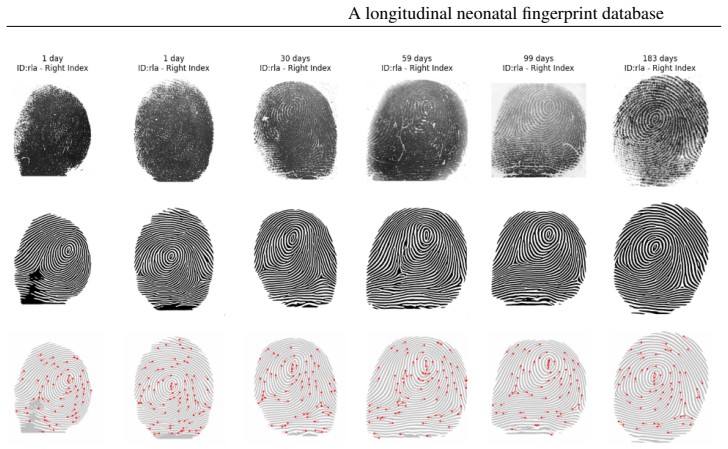
The central claim is that a longitudinal neonatal fingerprint database of this scale can be produced in a hospital-to-home protocol: over 450 children enrolled at birth, with follow-up captures at roughly 7 days, 14 days, 1 month, 2 months, 3 months, 6 months, and 12 months, for a total of 1,284 sessions. The protocol calls for 14 fingerprint videos per infant per session—ten fingers plus repeated captures of the thumbs and index fingers—and the accumulated collection totals 9,940 biometric video files, about 776 GB. The paper's permanence hypothesis is illustrated by one child's prints from birth to six months: the overall ridge-and-valley pattern stays the same while the finger simply enlarges, so minutiae present at birth are still present later, spaced farther apart. On that basis the authors propose deep learning models that combine the raw image, segmentation, and minutiae to predict growth-related changes, moving beyond linear scaling.
Load-bearing premise
The load-bearing premise is that an infant's fingerprint ridge-and-valley pattern stays stable over the first months of life, changing mainly in size, so the same minutiae can be followed across sessions; the paper's support for this is visual inspection of one child, not quantitative comparison across the cohort.
Editorial extensions
If this is right
- If the database is real and complete as described, it becomes a benchmark for studying how infant fingerprints change over the first year of life.
- It would allow deep learning models to be trained on raw images, ridge-and-valley structure, and minutiae jointly, and tested against scaling-factor baselines such as fixed and age-category scaling.
- Reliable growth emulation would directly improve matching across time for vaccination tracking, nutrition program monitoring, and newborn identification in hospitals.
- A successful permanence finding would support the design of national identity systems that enroll children at birth and re-identify them later without re-enrollment.
Reading between the lines
- The permanence claim currently rests on one child's visual example; the dataset itself could settle it quantitatively by measuring, across all 1,284 sessions, how many birth minutiae are re-detectable at later ages after scale normalization.
- The paper does not describe a public release mechanism for the dataset; its practical value for the field depends on whether it is eventually shared or benchmarked publicly.
- Because the captures use a 5,000 ppi infant-specific scanner, the findings may not transfer directly to lower-resolution or contactless devices used in field conditions; an extension would test the same permanence question on images downsampled to more common sensor resolutions.
- If the permanence assumption fails for some infants, the same data could instead support template-updating strategies rather than static growth emulation.
Signed reviews
Editorial analysis
A structured set of objections, weighed in public.
Referee Report
Summary. The paper describes the design, protocol, and preliminary results of a longitudinal neonatal fingerprint collection effort in Brazil. The authors report enrollment of over 450 children, 1,284 biometric sessions across milestones from birth to 12 months, totaling 9,940 video files (roughly 776 GB), and claim this is one of the most comprehensive longitudinal neonatal biometric datasets. The stated scientific goal is to enable deep learning models that emulate growth-induced distortions of neonatal minutiae maps more faithfully than the scaling-factor models in the literature. Section 4 also presents a single-child visual comparison of fingerprints from birth to 6 months to support the permanence of ridge patterns under growth.
Significance. If the dataset is real and of the reported scale, it would fill a genuine gap: current public longitudinal neonatal fingerprint collections reach at most a few hundred subjects and typically only two sessions. The protocol's strengths include ethical approval through Plataforma Brasil, a multi-milestone follow-up schedule (7 days, 14 days, 1, 2, 3, 6, and 12 months), a 5000 ppi scanner, ten-finger capture plus repeated pinch-finger captures, and rich metadata such as gestational information, infant behavior, and environmental conditions. However, the paper currently provides no public access to the data, no objective quality metrics, and the reported counts do not reconcile internally. Because the paper is a database descriptor, these issues are central, not cosmetic. There is no mathematical derivation, fitted model, or machine-checked artifact; the credibility of the contribution rests entirely on the trustworthiness of self-reported counts and the reproducibility of the protocol, so the inconsistencies in the core numbers must be resolved.
major comments (4)
- [Section 4, Table 2] The table's follow-up rows sum to 832 sessions (164 + 147 + 140 + 118 + 113 + 101 + 49), not the 829 home-based re-collection sessions stated in the text; the total of 1,284 sessions is consistent with 452 + 832, but only if the text's '829' is a typo. Additionally, the duplicated '1 month' row (140 and 118) makes the table ambiguous. Since the session total is the paper's primary quantitative claim, the authors should reconcile these numbers and explain whether the two rows correspond to distinct sub-cohorts or to an error.
- [Section 4] The statement 'Each biometric session includes 14 individual fingerprint videos per child' is inconsistent with the reported total of 9,940 biometric video files: 1,284 sessions × 14 = 17,976, and even the 829 home sessions × 14 = 11,606. The protocol change from still images to video after the first few months can explain part of this discrepancy, but then the sentence is false for early sessions and no per-session or per-age breakdown of the video count is provided. The authors should report the actual number of videos per session and reconcile it with the stated total.
- [Section 4, Figure 2] The claim that 'the fingerprints do not change in their fundamental pattern, only in scale' is supported only by visual inspection of one child. Because the entire motivation of the database is to study non-linear growth distortions, and because Section 2 emphasizes the difficulty of obtaining sufficient minutiae quality in young children, the paper should include quantitative evidence—such as minutiae counts, NFIQ or other quality scores, or recognition rates across ages—for at least a subset of the cohort. Without such evidence, the 'high-quality' and 'permanence' claims are unsupported.
- [Sections 3–4] The paper does not state how or when the database will be made available: there is no URL, repository identifier, or data-sharing plan. For a dataset-description paper, the absence of an access mechanism prevents readers from verifying any of the reported counts and limits the scientific reuse of the resource. Please add a data availability statement describing the intended distribution model (open, restricted, or by request) and the conditions under which the data would be shared.
minor comments (4)
- [Section 4, Figure 2] The caption states that 'each column represents one child's fingerprint at different ages' while the text says 'we present a series of images of one child'; this should be clarified to avoid ambiguity about whether the figure shows one child or multiple children.
- [Table 1] The columns 'People per ss' and 'Total images' mix values of different granularities across rows (e.g., '1', '308, 186, 123', '>= 45395'), and the footnotes define session, finger, and scanner abbreviations but not how per-session values are aggregated; please add a legend.
- [References] Several references are incomplete or inconsistently formatted: [IN25] lacks a title, the citation '[J 19]' contains an extra space and appears in Table 1 as is, and the UNICEF/WHO reports ([UN23a], [UN23b], [WH23a], [WH23b]) would benefit from access dates.
- [Section 2] The reference '[HGB19]' appears twice in the same sentence in the discussion of growth models; please remove the duplicate or indicate that two different works are intended.
Circularity Check
No circularity: the paper reports dataset construction and does not derive any fitted prediction from its own inputs.
full rationale
The paper is a dataset descriptor rather than a derivation. Its central claim is that the authors designed a collection protocol and assembled a longitudinal neonatal fingerprint database. No quantity in the paper is fitted against another quantity and then re-presented as a prediction: there are no scaling factors, no learned growth model, and no recognition experiment whose outcome is an input to the argument. The permanence observation (Section 4, 'the overall pattern of ridges and valleys remains consistent') is a visual claim about one child, not a conclusion derived from the same claim, so it is an evidentiary weakness rather than circularity. The counts in Table 2 are internally inconsistent with the text's stated total of 9,940 videos and 829 home sessions, but that is a data-consistency and verifiability problem, not a circular-reasoning problem. The only vendor citation, Infant.ID [IN25], is used to describe scanner suitability, and this is not load-bearing for any mathematical derivation and is not a self-citation. Because no derivation chain exists, there is no step that reduces to its own inputs; a non-finding with score 0 is the appropriate outcome.
Assumptions & free parameters
assumptions (3)
- domain assumption Fingerprint ridge and valley patterns are stable from birth to at least 6 months, changing mainly in scale.
- domain assumption The 5000 ppi Infant.ID optical scanner captures sufficient ridge detail from delicate neonate skin at all ages.
- domain assumption The self-reported session counts and metadata are accurate.
Cite this review
Pith. "Pith review of An on-production high-resolution longitudinal neonatal fingerprint database in Brazil." pith.science (2026). https://pith.science/paper/SO3HCTF5
@misc{pith2026250420104,
  author       = {Pith},
  title        = {Pith review of: An on-production high-resolution longitudinal neonatal fingerprint database in Brazil},
  year         = {2026},
  howpublished = {\url{https://pith.science/paper/SO3HCTF5}},
  note         = {Machine review of arXiv:2504.20104}
}
read the original abstract
The neonatal period is critical for survival, requiring accurate and early identification to enable timely interventions such as vaccinations, HIV treatment, and nutrition programs. Biometric solutions offer potential for child protection by helping to prevent baby swaps, locate missing children, and support national identity systems. However, developing effective biometric identification systems for newborns remains a major challenge due to the physiological variability caused by finger growth, weight changes, and skin texture alterations during early development. Current literature has attempted to address these issues by applying scaling factors to emulate growth-induced distortions in minutiae maps, but such approaches fail to capture the complex and non-linear growth patterns of infants. A key barrier to progress in this domain is the lack of comprehensive, longitudinal biometric datasets capturing the evolution of neonatal fingerprints over time. This study addresses this gap by focusing on designing and developing a high-quality biometric database of neonatal fingerprints, acquired at multiple early life stages. The dataset is intended to support the training and evaluation of machine learning models aimed at emulating the effects of growth on biometric features. We hypothesize that such a dataset will enable the development of more robust and accurate Deep Learning-based models, capable of predicting changes in the minutiae map with higher fidelity than conventional scaling-based methods. Ultimately, this effort lays the groundwork for more reliable biometric identification systems tailored to the unique developmental trajectory of newborns.
Figures

Reference graph
Works this paper leans on
-
[4]
[ECJ18] Engelsma, Joshua J; Cao, Kai; Jain, Anil K: Fingerprint match in box. 2018 IEEE 9th International Conference on Biometrics Theory, Applications and Systems (BTAS), abs/1804.08659:1–10,
work page Pith review arXiv 2018
-
[6]
[Gr14] Grantham-McGregor, SM; Fernald, LCH; Kagawa, RMC; Walker, S: Effects of integrated child development and nutrition interventions on child development and nutritional status (vol 1308, pg 11, 2014). ANNALS REPORTS, 1309:63–63,
work page 2014
-
[12]
In: 2017 IST-Africa Week Conference (IST-Africa)
[Ma17a] Macharia, Paul; Muiruri, Peter; Kumar, Pratap; Ngari, Boniface; Wario, Ruth: The fea- sibility of using an Android-based infant fingerprint biometrics system for treatment follow-up. In: 2017 IST-Africa Week Conference (IST-Africa). IEEE, Windhoek, Namibia, S. 1–9,
work page 2017
-
[13]
In: 2017 International Symposium on Micro- NanoMechatronics and Human Science (MHS)
[Ma17b] Ma’sum, M Anwar; Dharma, I Gede Wahyu Surya; Arsa, Dewa Made Sri; Jat- miko, Wisnu; Yazid, Setiadi; Arymurthy, Aniati Murni: Telebiometric system for in- fant and toddler fingerprint recognition. In: 2017 International Symposium on Micro- NanoMechatronics and Human Science (MHS). National Library of Medicine, Bathesda, US, S. 1–7,
work page 2017
-
[14]
Luiz F. P. Southier et. al. [MRK21] Mukoya, Esther; Rimiru, Richard; Kimwele, Michael: Feasibility Study And Empiri- cal Analysis Of A Low-cost Fingerprint Recognition For Immunization Tracing. In: WWW/INTERNET 2021 AND APPLIED COMPUTING. Association for Computing Machinery, New York, NY , United States, S. 117,
work page 2021
-
[17]
In: 2009 IEEE 3rd Interna- tional Conference on Biometrics: Theory, Applications, and Systems
[UW09] Uhl, Andreas; Wild, Peter: Comparing verification performance of kids and adults for fin- gerprint, palmprint, hand-geometry and digitprint biometrics. In: 2009 IEEE 3rd Interna- tional Conference on Biometrics: Theory, Applications, and Systems. IEEE, Washington, DC, USA, S. 1–6,
work page 2009
-
[18]
[WH23a] WHO World Health Organization: , Immunization Agenda 2030: A Global Strategy To Leave No One Behind,
-
[19]
[WH23b] WHO World Health Organization: , Immunization coverage, 2023
work page 2023
Show all 19 references
-
[1899]
In: 2018 International Conference of the Biometrics Special Interest Group (BIOSIG)
[GHB18a] Galbally, Javier; Haraksim, Rudolf; Beslay, Laurent: Fingerprint quality: A lifetime story. In: 2018 International Conference of the Biometrics Special Interest Group (BIOSIG). IEEE, Darmstadt, Germany, S. 1–5,
2018
-
[2003]
In: 2016 International Conference of the Biometrics Special Interest Group (BIOSIG)
[KHJ16] Koda, Yoshinori; Higuchi, Teruyuki; Jain, Anil K: Advances in capturing child finger- prints: A high resolution CMOS image sensor with SLDR method. In: 2016 International Conference of the Biometrics Special Interest Group (BIOSIG). IEEE, Darmstadt, Ger- many, S. 1–4,
2016
-
[2014]
In: Knowledge-Based Intelligent In- formation and Engineering Systems: 7th International Conference, KES 2003, Oxford, UK, September
[Jo03] Joun, Sungwook; Kim, Hakil; Chung, Yongwha; Ahn, Dosung: An experimental study on measuring image quality of infant fingerprints. In: Knowledge-Based Intelligent In- formation and Engineering Systems: 7th International Conference, KES 2003, Oxford, UK, September
2003
-
[2016]
In: 2019 International Conference of the Biometrics Special Interest Group (BIOSIG)
[Ko19] Koda, Yoshinori; Takahashi, Ai; Ito, Koichi; Aoki, Takafumi; Kaneko, Satoshi; Nzou, Samson Muuo: Development of 2,400 ppi fingerprint sensor for capturing neonate fin- gerprint within 24 hours after birth. In: 2019 International Conference of the Biometrics Special Inte...
2019
-
[2017]
In: 2018 International Workshop on Big Data and Information Security (IWBIS)
[Dh18] Dharma, I Gede Wahyu Surya; Ma’sum, M Anwar; Jatmiko, Wisnu; Hilman, Muham- mad Hafizhuddin: Level 2 Features with Feedback Mechanism for Toddler Fingerprint Recognition. In: 2018 International Workshop on Big Data and Information Security (IWBIS). IEEE, Jakarta, Indone...
2018
-
[2018]
In: 2017 International Conference of the Biometrics Special Interest Group (BIOSIG)
[Ca17] Camacho, Vanina; Garella, Guillermo; Franzoni, Francesco; Di Martino, Luis; Carbajal, Guillermo; Preciozzi, Javier; Fern´andez, Alicia: Recognizing infants and toddlers over an on-production fingerprint database. In: 2017 International Conference of the Biometrics Speci...
2017
-
[2019]
In: 2022 International Conference of the Biometrics Special Interest Group (BIOSIG)
[Ko22] Koda, Yoshinori; Imai, Haruki; Sasuga, Nagisa; Ito, Koichi; Aoki, Takafumi; Kaneko, Satoshi; Nzou, Samson Muuo: Fundamental Study of Neonate Fingerprint Recognition Using Fingerprint Classification. In: 2022 International Conference of the Biometrics Special Interest Gr...
2022
-
[2021]
In: 2021 International Conference on Data and Software Engineering (ICoDSE)
[Nu21] Nugroho, Anto Satriyo; Hapsari, Nurdianti Rizki; Kusumajaya, Rully; Wibowanto, Gem- bong Satrio et al.: Image Enhancement of Infant’s Fingerprints. In: 2021 International Conference on Data and Software Engineering (ICoDSE). IEEE, Bandung, Indonesia, S. 1–6,
2021
-
[2022]
In: 2017 IEEE International Joint Conference on Biometrics (IJCB)
[Ba17] Basak, Pratichi; De, Saurabh; Agarwal, Mallika; Malhotra, Aakarsh; Vatsa, Mayank; Singh, Richa: Multimodal biometric recognition for toddlers and pre-school children. In: 2017 IEEE International Joint Conference on Biometrics (IJCB). IEEE, Denver, CO, USA, S. 627–633,
2017
-
[2023]
[Un23c] United Nations - Department of Economic and Social Affairs: , World Population Prospects 2022,
2022
-
[2025]
CoRR, abs/1904.01091:67–74,
[J 19] J Engelsma, Joshua; Deb, Debayan; Jain, Anil; Bhatnagar, Anjoo; Sewak Sudhish, Prem: Infant-prints: Fingerprints for reducing infant mortality. CoRR, abs/1904.01091:67–74,
1904 arXiv
Reviewed August 16, 2026 · model on record in the stance chip above.
Discussion (0). Continue with ORCID to comment.