Local Linear Convergence of the Alternating Direction Method of Multipliers for Semidefinite Programming under Strict Complementarity
Pith reviewed 2026-05-22 23:31 UTC · model grok-4.3
The pith
ADMM attains local linear convergence for semidefinite programming whenever the optimal primal-dual solutions satisfy strict complementarity.
A machine-rendered reading of the paper's core claim, the machinery that carries it, and where it could break.
Core claim
The alternating direction method of multipliers applied to semidefinite programming attains local linear convergence provided that the converged primal-dual optimal solutions satisfy strict complementarity. This convergence is independent of nondegeneracy conditions. The argument proceeds by direct local linearization of the ADMM iteration operator together with a refined error bound on the projection onto the positive semidefinite cone that improves on prior estimates by exposing the anisotropic character of the residuals.
What carries the argument
Direct local linearization of the ADMM operator together with a refined error bound for the projection onto the positive semidefinite cone; this pair produces a contraction whose rate is controlled by the strict complementarity gap.
If this is right
- ADMM reaches high-accuracy solutions on SDP instances where strict complementarity holds at optimality.
- Local linear rates appear even when nondegeneracy conditions fail.
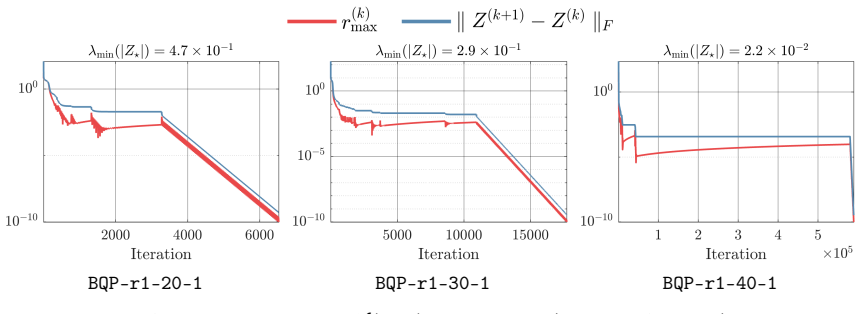
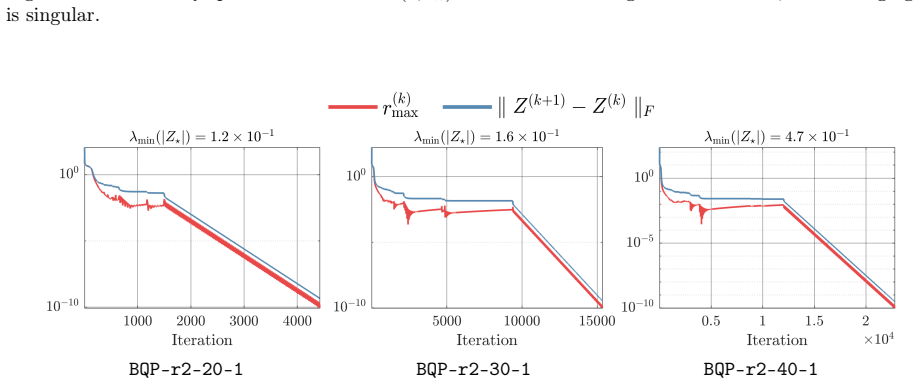
- Convergence slows when strict complementarity is nearly violated, matching patterns seen in linear programming.
- The anisotropic residuals in the projection bound explain direction-dependent error decay.
Where Pith is reading between the lines
- The linearization technique could extend to other first-order splitting methods on conic programs.
- A diagnostic that measures the strict complementarity gap at a candidate solution could predict attainable accuracy before running the method.
- The refined projection bound may apply to related matrix cones beyond the positive semidefinite case.
Load-bearing premise
Strict complementarity must hold exactly at the optimal solutions so that the refined projection error bound produces a contraction factor strictly less than one.
What would settle it
Run ADMM on an SDP instance whose optimal solutions satisfy strict complementarity and check whether the tail of the sequence shows only sublinear error reduction; linear reduction would support the claim while persistent sublinear reduction would refute it.
Figures





read the original abstract
We investigate the local linear convergence properties of the Alternating Direction Method of Multipliers (ADMM) when applied to Semidefinite Programming (SDP). A longstanding belief suggests that ADMM is only capable of solving SDPs to moderate accuracy, primarily due to its sublinear worst-case complexity and empirical observations of slow convergence. We challenge this notion by introducing a new sufficient condition for local linear convergence: as long as the converged primal-dual optimal solutions satisfy strict complementarity, ADMM attains local linear convergence, independent of nondegeneracy conditions. Our proof is based on a direct local linearization of the ADMM operator and a refined error bound for the projection onto the positive semidefinite cone, improving previous bounds and revealing the anisotropic nature of projection residuals. Extensive numerical experiments confirm the significance of our theoretical results, demonstrating that ADMM achieves local linear convergence and computes high-accuracy solutions in a variety of SDP instances, including those cases where nondegeneracy fails. Furthermore, we identify where ADMM struggles, linking these difficulties with near violations of strict complementarity-a phenomenon that parallels recent findings in linear programming.
Editorial analysis
A structured set of objections, weighed in public.
Referee Report
Summary. The manuscript proves local linear convergence of ADMM applied to semidefinite programming whenever a primal-dual optimal solution pair satisfies strict complementarity. The argument proceeds by direct local linearization of the ADMM operator together with a refined, anisotropic error bound on the projection onto the positive-semidefinite cone; the resulting rate is independent of nondegeneracy. Numerical experiments on a range of SDP instances, including those violating nondegeneracy, are presented as corroboration, and the authors link observed slow convergence to near-violations of strict complementarity.
Significance. If the linearization and projection bound are valid, the result is significant: it supplies an explicit, checkable sufficient condition for linear convergence of ADMM on SDPs and removes the need for nondegeneracy, thereby addressing a longstanding practical limitation. The refined projection analysis and the explicit identification of failure modes near strict-complementarity boundaries constitute clear advances over prior work.
minor comments (3)
- [Introduction / Section 3] The abstract states that the projection bound 'improves previous bounds,' but no explicit comparison (e.g., to the bound in reference X) appears in the main text; adding a short remark or table entry would strengthen the claim.
- [Numerical Experiments] In the numerical section the authors report iteration counts and residual decay but do not tabulate the observed linear rates against the theoretically predicted constant; a single additional table or plot would make the validation more quantitative.
- [Preliminaries] Notation for the dual variable and the projection residual is introduced without a consolidated list; a short notation table would aid readability.
Simulated Author's Rebuttal
We thank the referee for the positive summary and significance assessment of our manuscript on local linear convergence of ADMM for SDPs under strict complementarity. The recommendation of minor revision is noted. No major comments appear in the report, so we have no points to address point-by-point at this stage and will handle any minor issues in the revision.
Circularity Check
No significant circularity; derivation is self-contained
full rationale
The paper's central result (local linear convergence of ADMM on SDP under strict complementarity) is established via direct linearization of the iteration map and a refined anisotropic error bound on the PSD projection operator. No equations reduce by construction to fitted parameters, self-defined quantities, or load-bearing self-citations. The argument relies on standard operator properties and the strict complementarity hypothesis without importing uniqueness theorems or ansatzes from prior author work. Numerical experiments are presented as corroborative only. This matches the default case of an independent theoretical derivation.
Axiom & Free-Parameter Ledger
axioms (1)
- standard math Standard properties of the metric projection onto the positive semidefinite cone
Reference graph
Works this paper leans on
-
[1]
Farid Alizadeh, Jean-Pierre A Haeberly, and Michael L Overton. Complementarity and nondegeneracy in semidefinite programming.Mathematical Programming, 77(1):111–128, 1997
work page 1997
-
[2]
Farid Alizadeh, Jean-Pierre A Haeberly, and Michael L Overton. Primal–dual interior-point methods for semidefinite programming: Convergence rates, stability and numerical results.SIAM Journal on Optimization, 8(3):746–768, 1998
work page 1998
-
[3]
David Applegate, Oliver Hinder, Haihao Lu, and Miles Lubin. Faster first-order primal–dual methods for linear programming using restarts and sharpness.Mathematical Programming, 201(1):133–184, 2023. 54 hamming-10-2 hamming-8-3-4 hamming-9-5-6 Figure 14: More Hamming graph problems with with random (standard Gaussian) initial guess. In all cases, the conve...
work page 2023
-
[4]
MOSEK optimization toolbox for MATLAB.User’s Guide and Reference Manual, Version, 4(1), 2019
Mosek ApS. MOSEK optimization toolbox for MATLAB.User’s Guide and Reference Manual, Version, 4(1), 2019
work page 2019
-
[5]
Heinz H Bauschke, JY Bello Cruz, Tran TA Nghia, Hung M Pha, and Xianfu Wang. Optimal rates of linear convergence of relaxed alternating projections and generalized Douglas–Rachford methods for two subspaces.Numerical Algorithms, 73:33–76, 2016
work page 2016
-
[6]
Springer, Berlin, Heidelberg, 2017
Heinz H Bauschke and Patrick L Combettes.Convex Analysis and Monotone Operator Theory in Hilbert Spaces. Springer, Berlin, Heidelberg, 2017
work page 2017
-
[7]
Nicolas Boumal, Vlad Voroninski, and Afonso Bandeira. The non-convex Burer–Monteiro approach works on smooth semidefinite programs.Advances in Neural Information Processing Systems, 29, 2016
work page 2016
-
[8]
Samuel Burer and Renato DC Monteiro. A nonlinear programming algorithm for solving semidefinite programs via low-rank factorization.Mathematical Programming, 95(2):329–357, 2003
work page 2003
-
[9]
Zi Xian Chan and Defeng Sun. Constraint nondegeneracy, strong regularity, and nonsingularity in semidefinite programming.SIAM Journal on Optimization, 19(1):370–396, 2008
work page 2008
-
[10]
Liang Chen, Xudong Li, Defeng Sun, and Kim-Chuan Toh. On the equivalence of inexact proximal ALM and ADMM for a class of convex composite programming.Mathematical Programming, 185(1):111–161, 2021
work page 2021
-
[11]
Liang Chen, Defeng Sun, and Kim-Chuan Toh. An efficient inexact symmetric Gauss–Seidel based ma- jorized ADMM for high-dimensional convex composite conic programming.Mathematical Programming, 161:237–270, 2017
work page 2017
-
[12]
Ying Cui, Defeng Sun, and Kim-Chuan Toh. On the asymptotic superlinear convergence of the aug- mented Lagrangian method for semidefinite programming with multiple solutions. arXiv preprint arXiv:1610.00875, 2016
work page internal anchor Pith review Pith/arXiv arXiv 2016
-
[13]
Damek Davis and Wotao Yin. Faster convergence rates of relaxed Peaceman-Rachford and ADMM under regularity assumptions.Mathematics of Operations Research, 42(3):783–805, August 2017
work page 2017
-
[14]
Timothy A. Davis and Yifan Hu. The University of Florida sparse matrix collection.ACM Transactions on Mathematical Software (TOMS), 38(1):1–25, 2011
work page 2011
-
[15]
Wei Deng and Wotao Yin. On the global and linear convergence of the generalized alternating direction method of multipliers.Journal of Scientific Computing, 66(3):889–916, March 2016
work page 2016
-
[16]
Lijun Ding and Benjamin Grimmer. Revisiting spectral bundle methods: Primal–dual (sub) linear convergence rates.SIAM Journal on Optimization, 33(2):1305–1332, 2023
work page 2023
-
[17]
Lijun Ding and Madeleine Udell. A strict complementarity approach to error bound and sensitivity of solution of conic programs.Optimization Letters, 17(7):1551–1574, 2023
work page 2023
-
[18]
Dmitriy Drusvyatskiy and Adrian S. Lewis. Optimality, identifiability, and sensitivity.Mathematical Programming, 147(1):467–498, 2014
work page 2014
-
[19]
Giovanni Fantuzzi and Federico Fuentes. Global minimization of polynomial integral functionals.SIAM Journal on Scientific Computing, 46(4):A2123–A2149, 2024
work page 2024
-
[20]
Michael Garstka, Mark Cannon, and Paul Goulart. Cosmo: A conic operator splitting method for convex conic problems.Journal of Optimization Theory and Applications, 190(3):779–810, 2021
work page 2021
-
[21]
Many photonic design problems are sparse QCQPs.Science Advances, 11(1):eadl3237, 2025
Shai Gertler, Zeyu Kuang, Colin Christie, Hao Li, and Owen D Miller. Many photonic design problems are sparse QCQPs.Science Advances, 11(1):eadl3237, 2025. 57
work page 2025
-
[22]
Deren Han, Defeng Sun, and Liwei Zhang. Linear rate convergence of the alternating direction method of multipliers for convex composite programming.Mathematics of Operations Research, 43(2):622–637, 2018
work page 2018
-
[23]
Building rome with convex optimization.arXiv preprint arXiv:2502.04640, 2025
Haoyu Han and Heng Yang. Building rome with convex optimization.arXiv preprint arXiv:2502.04640, 2025
-
[24]
Qiushi Han, Chenxi Li, Zhenwei Lin, Caihua Chen, Qi Deng, Dongdong Ge, Huikang Liu, and Yinyu Ye. A low-rank ADMM splitting approach for semidefinite programming.arXiv preprint arXiv:2403.09133, 2024
-
[25]
Christoph Helmberg and Franz Rendl. A spectral bundle method for semidefinite programming.SIAM Journal on Optimization, 10(3):673–696, 2000
work page 2000
-
[26]
Alan J. Hoffman. On approximate solutions of systems of linear inequalities. InSelected Papers Of Alan J Hoffman: With Commentary, pages 174–176. World Scientific, Singapore, 2003
work page 2003
-
[27]
On the linear convergence of the alternating direction method of multipliers
Mingyi Hong and Zhi-Quan Luo. On the linear convergence of the alternating direction method of multipliers. Mathematical Programming, 162(1):165–199, 2017
work page 2017
-
[28]
Sparse polynomial optimization with unbounded sets
Lei Huang, Shucheng Kang, Jie Wang, and Heng Yang. Sparse polynomial optimization with unbounded sets. arXiv preprint arXiv:2401.15837, 2024
-
[29]
Xin Jiang and Lieven Vandenberghe. Bregman primal–dual first-order method and application to sparse semidefinite programming.Computational Optimization and Applications, 81(1):127–159, 2022
work page 2022
-
[30]
Global contact-rich planning with sparsity-rich semidefi- nite relaxations
Shucheng Kang, Guorui Liu, and Heng Yang. Global contact-rich planning with sparsity-rich semidefi- nite relaxations. arXiv preprint arXiv:2502.02829, 2025
-
[31]
Fast and certifiable trajectory optimization
Shucheng Kang, Xiaoyang Xu, Jay Sarva, Ling Liang, and Heng Yang. Fast and certifiable trajectory optimization. In International Workshop on the Algorithmic Foundations of Robotics, 2024
work page 2024
- [32]
-
[33]
Activesets, nonsmoothness, andsensitivity
AdrianS.Lewis. Activesets, nonsmoothness, andsensitivity. SIAM Journal on Optimization, 13(3):702– 725, 2002
work page 2002
-
[34]
Yongfeng Li, Zaiwen Wen, Chao Yang, and Ya-Xiang Yuan. A semismooth newton method for semidef- inite programs and its applications in electronic structure calculations. SIAM Journal on Scientific Computing, 40(6):A4131–A4157, 2018
work page 2018
-
[35]
Jingwei Liang, Jalal Fadili, and Gabriel Peyré. Local convergence properties of Douglas–Rachford and alternating direction method of multipliers.Journal of Optimization Theory and Applications, 172:874– 913, 2017
work page 2017
-
[36]
Feng-Yi Liao, Lijun Ding, and Yang Zheng. An overview and comparison of spectral bundle methods for primal and dual semidefinite programs.arXiv preprint arXiv:2307.07651, 2023
-
[37]
Feng-Yi Liao, Lijun Ding, and Yang Zheng. Inexact augmented Lagrangian methods for conic optimiza- tion: Quadratic growth and linear convergence.Advances in Neural Information Processing Systems, 37:41013–41050, 2024
work page 2024
-
[38]
Feng-Yi Liao and Yang Zheng. A bundle-based augmented Lagrangian framework: Algorithm, conver- gence, and primal–dual principles.arXiv preprint arXiv:2502.08835, 2025. 58
-
[39]
Yongchao Liu, Xiaoming Yuan, Shangzhi Zeng, and Jin Zhang. Partial error bound conditions and the linear convergence rate of the alternating direction method of multipliers.SIAM Journal on Numerical Analysis, 56(4):2095–2123, January 2018
work page 2095
-
[40]
On the geometry and refined rate of primal–dual hybrid gradient for linear programming
Haihao Lu and Jinwen Yang. On the geometry and refined rate of primal–dual hybrid gradient for linear programming. Mathematical Programming, pages 1–39, 2024
work page 2024
-
[41]
World Scientific, Singapore, 2023
Victor Magron and Jie Wang.Sparse Polynomial Optimization: Theory and Practice. World Scientific, Singapore, 2023
work page 2023
-
[42]
Hans D. Mittelmann. Several SDP-codes on sparse and other SDP problems, 2006
work page 2006
-
[43]
Jiawang Nie.Moment and Polynomial Optimization. SIAM, Philadelphia, PA, 2023
work page 2023
-
[44]
Ageneralanalysis of the convergence of ADMM
RobertNishihara, LaurentLessard, BenRecht, AndrewPackard, andMichaelJordan. Ageneralanalysis of the convergence of ADMM. InInternational Conference on Machine learning, pages 343–352. PMLR, 2015
work page 2015
-
[45]
Daniel O’Connor and Lieven Vandenberghe. On the equivalence of the primal–dual hybrid gradient method and Douglas–Rachford splitting.Mathematical Programming, 179(1-2):85–108, 2020
work page 2020
-
[46]
SCS: Splitting conic solver, version 3.2.4
Brendan O’Donoghue, Eric Chu, Neal Parikh, and Stephen Boyd. SCS: Splitting conic solver, version 3.2.4. https://github.com/cvxgrp/scs, November 2023
work page 2023
-
[47]
Parlett.The symmetric eigenvalue problem
Beresford N. Parlett.The symmetric eigenvalue problem. SIAM, Philadelphia, PA, 1998
work page 1998
-
[48]
The DIMACS library of semidefinite-quadratic-linear programs
Gabor Pataki and Stefan Schmieta. The DIMACS library of semidefinite-quadratic-linear programs. 1999
work page 1999
-
[49]
Michael J. D. Powell. A method for nonlinear constraints in minimization problems.Optimization, pages 283–298, 1969
work page 1969
-
[50]
R Tyrrell Rockafellar. Augmented lagrangians and applications of the proximal point algorithm in convex programming.Mathematics of operations research, 1(2):97–116, 1976
work page 1976
-
[51]
Cambridge University Press, Cambridge, 2022
Ernest K Ryu and Wotao Yin.Large-scale convex optimization: algorithms & analyses via monotone operators. Cambridge University Press, Cambridge, 2022
work page 2022
-
[52]
Kathrin Schacke. On the Kronecker product. Master’s thesis, University of Waterloo, 2004
work page 2004
-
[53]
Jos F. Sturm. Error bounds for linear matrix inequalities.SIAM Journal on Optimization, 10(4):1228– 1248, 2000
work page 2000
-
[54]
Semismooth matrix-valued functions.Mathematics of Operations Research, 27(1):150–169, 2002
Defeng Sun and Jie Sun. Semismooth matrix-valued functions.Mathematics of Operations Research, 27(1):150–169, 2002
work page 2002
-
[55]
A feasible method for general convex low-rank SDP problems
Tianyun Tang and Kim-Chuan Toh. A feasible method for general convex low-rank SDP problems. arXiv preprint arXiv:2312.07908, 2023
-
[56]
Jie Wang and Liangbing Hu. Solving low-rank semidefinite programs via manifold optimization.arXiv preprint arXiv:2303.01722, 2023
-
[57]
Jie Wang, Victor Magron, and Jean B Lasserre. Certifying global optimality of ac-opf solutions via sparse polynomial optimization.Electric Power Systems Research, 213:108683, 2022
work page 2022
-
[58]
Zaiwen Wen, Donald Goldfarb, and Wotao Yin. Alternating direction augmented Lagrangian methods for semidefinite programming.Mathematical Programming Computation, 2(3):203–230, 2010. 59
work page 2010
-
[59]
Springer Science & Business Media, Berlin, Heidelberg, 2012
Henry Wolkowicz, Romesh Saigal, and Lieven Vandenberghe.Handbook of semidefinite programming: theory, algorithms, and applications, volume 27. Springer Science & Business Media, Berlin, Heidelberg, 2012
work page 2012
-
[60]
Stephen J. Wright. Identifiable surfaces in constrained optimization.SIAM Journal on Control and Optimization, 31(4):1063–1079, 1993
work page 1993
-
[61]
A quaternion-based certifiably optimal solution to the wahba problem with outliers
Heng Yang and Luca Carlone. A quaternion-based certifiably optimal solution to the wahba problem with outliers. InInternational Conference on Computer Vision, pages 1665–1674, 2019
work page 2019
-
[62]
Heng Yang and Luca Carlone. Certifiably optimal outlier-robust geometric perception: Semidefinite relaxations and scalable global optimization. IEEE Transactions on Pattern Analysis and Machine Intelligence, 45(3):2816–2834, 2022
work page 2022
-
[63]
Heng Yang, Ling Liang, Luca Carlone, and Kim-Chuan Toh. An inexact projected gradient method with rounding and lifting by nonlinear programming for solving rank-one semidefinite relaxation of polynomial optimization. Mathematical Programming, 201(1):409–472, 2023
work page 2023
-
[64]
Liuqin Yang, Defeng Sun, and Kim-Chuan Toh. SDPNAL+: A majorized semismooth Newton-CG aug- mented Lagrangian method for semidefinite programming with nonnegative constraints.Mathematical Programming Computation, 7(3):331–366, 2015
work page 2015
-
[65]
Xiaoming Yuan, Shangzhi Zeng, and Jin Zhang. Discerning the linear convergence of ADMM for structured convex optimization through the lens of variational analysis.Journal of Machine Learning Research, 21(83):1–75, 2020
work page 2020
-
[66]
Moslem Zamani, Hadi Abbaszadehpeivasti, and Etienne de Klerk. The exact worst-case convergence rate of the alternating direction method of multipliers.Mathematical Programming, 208(1):243–276, 2024
work page 2024
-
[67]
Ning Zhang, Jia Wu, and Liwei Zhang. A linearly convergent majorized ADMM with indefinite prox- imal terms for convex composite programming and its applications. Mathematics of Computation, 89(324):1867–1894, 2020
work page 2020
-
[68]
Xin-Yuan Zhao, Defeng Sun, and Kim-Chuan Toh. A Newton-CG augmented Lagrangian method for semidefinite programming.SIAM Journal on Optimization, 20(4):1737–1765, 2010
work page 2010
-
[69]
Yang Zheng, Giovanni Fantuzzi, Antonis Papachristodoulou, Paul Goulart, and Andrew Wynn. Fast ADMM for homogeneous self-dual embedding of sparse SDPs.IFAC-PapersOnLine, 50(1):8411–8416, 2017. 60
work page 2017
discussion (0)
Sign in with ORCID, Apple, or X to comment. Anyone can read and Pith papers without signing in.