REVIEW 3 major objections 5 minor 1 cited by
PairEdit: Learning Semantic Variations for Exemplar-based Image Editing
T0 review · 3 major / 5 minor · reviewed 2026-08-07 · deepseek-v4-flash
Pith's one-line read PairEdit learns an edit from one image pair, no text needed.
desk verdict PairEdit is a genuine, well-executed extension of exemplar-based editing with one untested schedule-transfer assumption that deserves a targeted experiment. read the letter →
The pith
A machine-rendered reading of the paper's core claim, the machinery that carries it, and where it could break.
The reading
What carries the argument
The central object is the guidance-based target noise prediction, Eq. 9: $\epsilon^* = \beta\epsilon_0 + \eta(x_0^A - x_0^B)$. It turns the semantic variation between paired images into a CFG-style guidance direction in noise space, allowing a LoRA adapter to learn that direction. The companion machinery is the content-preserving noise schedule $x_t = x_0 + t\beta\epsilon$, which makes the semantic difference survive at large $t$ and stabilizes training; and the two-LoRA split (content LoRA vs semantic LoRA) that disentangles what stays the same from what changes.
What would settle it
Train PairEdit on a set of pairs, then edit images under FLUX's standard schedule with the semantic LoRA disabled for only a few initial steps; if identity preservation or semantic fidelity collapses when the sampling schedule deviates from the training schedule, the central transfer assumption fails. Alternatively, measure whether the content LoRA can reconstruct source images under the content-preserving schedule at $t=1$; if not, the content-semantic disentanglement is compromised.
Extended reading notes
Core claim
The paper proposes PairEdit, a training procedure for FLUX-based diffusion models that learns a semantic edit from paired images. The central identity is the target noise prediction $\epsilon^* = \beta\epsilon_0 + \eta(x_0^A - x_0^B)$, where $\epsilon_0$ is the noise added to the source image and $x_0^A - x_0^B$ is the pixel difference between source and target, scaled by $\eta$. This converts the semantic variation between paired images into a CFG-style guidance direction. To make the weight of the pixel difference time-independent, the paper introduces a content-preserving noise schedule $x_t = x_0 + t\beta\epsilon$, which keeps content information even when $t=1$. Two LoRAs are optimized jointly: a content LoRA reconstructs the source, while a semantic LoRA is pushed toward the target noise; only the semantic LoRA receives the semantic loss. The paper reports that this yields superior identity preservation and semantic fidelity compared to several existing exemplar-based editing methods, and supports continuous editing via the semantic LoRA scaling factor.
Load-bearing premise
The method trains the semantic LoRA under a content-preserving noise schedule ($x_t = x_0 + t\beta\epsilon$) but applies it during inference under FLUX's standard sampling schedule, assuming the pretrained model can denoise this new noising and the LoRA will adapt; this transfer is an empirical hope rather than a proven property.
Editorial extensions
If this is right
- A user can teach a new edit with a single image pair and no text prompt, lowering the barrier for personalized editing.
- The learned edit direction is continuous: adjusting the semantic LoRA scaling factor produces gradual semantic changes, from subtle to strong.
- Multiple learned edits can be composed by merging semantic LoRAs, enabling stacked edits like age plus smile plus glasses on the same image.
- Because content and semantic LoRAs are separate, identity preservation improves over methods that learn a single adapter.
- The method works on real images via a reconstruction LoRA plus guidance-based LoRA fusion, extending beyond synthetic sources.
Reading between the lines
- An implication not pursued in the paper: if the guidance-direction mechanism generalizes, the same target-noise-prediction trick could apply to other rectified-flow or flow-matching models, not just FLUX.
- The explicit guidance direction suggests that semantic edits might be measured or interpolated in noise space, potentially enabling arithmetic like 'smile plus glasses' beyond simple LoRA merging.
- A testable extension: collect paired images with varying degrees of the same semantic, for instance multiple ages, and check whether the learned direction's strength scales monotonically with $\eta$; if not, the fixed-weight assumption may need revisiting.
- The reliance on paired images might be relaxed if the guidance direction could be estimated from a single image plus a learned prior, but the paper does not explore this.
Editorial analysis
A structured set of objections, weighed in public.
Referee Report
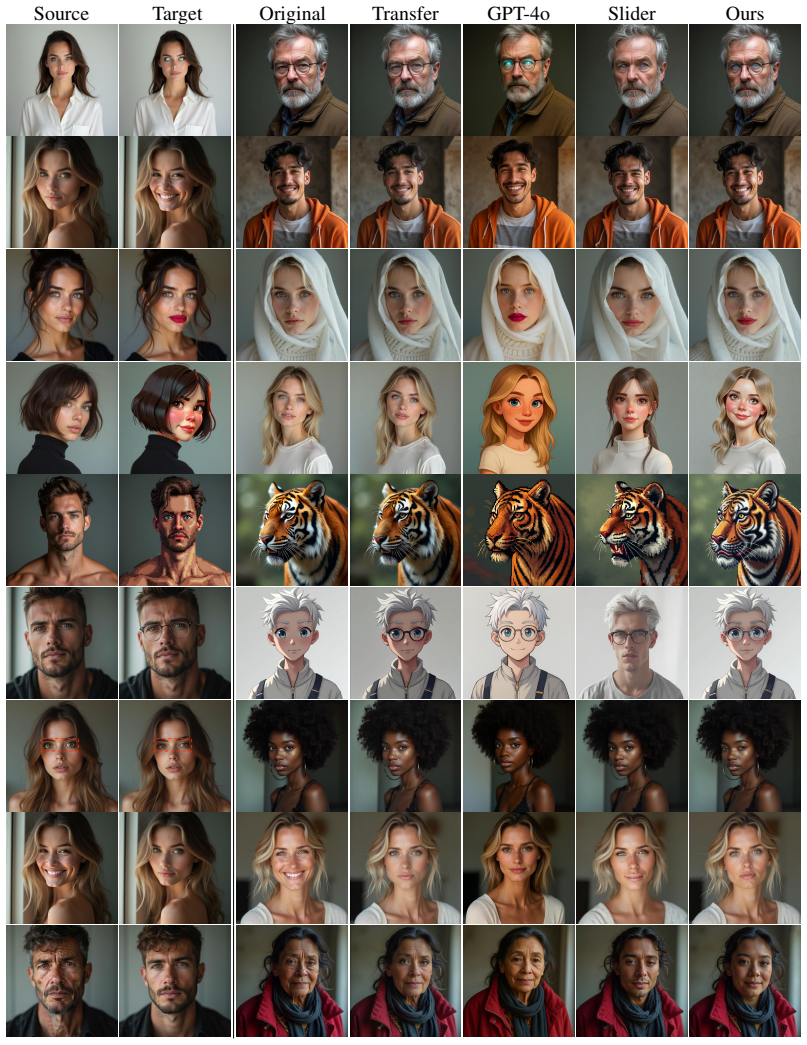
Summary. PairEdit proposes a text-free, exemplar-based image editing method built on FLUX.1-dev. The paper introduces two LoRA modules: a content LoRA that reconstructs the source image and a semantic LoRA trained to predict a guidance-style target noise epsilon* = beta * epsilon0 + eta * (x0^A - x0^B). To make the pair difference enter the target with a time-independent weight, the semantic LoRA is trained under a content-preserving schedule x_t = x0 + t*beta*epsilon, while inference uses the standard rectified-flow schedule x_t = (1-t)x0 + t*epsilon. Experiments cover qualitative comparisons, a quantitative identity-preservation table, a user study, real-image editing, sequential edits, and ablations.
Significance. If the method works as described, it addresses a real gap: transferring a semantic edit from one or a few image pairs without text, with adjustable strength and improved identity preservation. The two-LoRA disentanglement and the explicit guidance target are sensible design ideas, and the reported qualitative results are compelling. However, the derivation of the target noise contains an unstated identification, and the train/inference schedule mismatch is only asserted. These issues concern the core mechanism, so the paper needs revision before the central claims are fully supported.
major comments (3)
- [Section 3.2, Eqs. (5)-(7)] The derivation of epsilon* identifies two different objects. In Eq. (5), the bracket is (x_t^A - Delta_t * epsilon_t^A) - (x_t^A - Delta_t * epsilon_t^B). Eq. (6) equates this bracket to x_{t-Delta_t}^A - x_{t-Delta_t}^B. Under the stated denoising rule, x_{t-Delta_t}^B = x_t^B - Delta_t * epsilon_t^B, so the second term in the bracket, x_t^A - Delta_t * epsilon_t^B, equals x_{t-Delta_t}^B only if x_t^A = x_t^B or if epsilon_t^B is redefined as (x_t^A - x_{t-Delta_t}^B)/Delta_t. The paper says epsilon_t^B 'denoises the source image towards the target image', which is a different role from the noise prediction attached to x_t^B. Because this step is how x_0^A - x_0^B enters Eq. (9) and therefore the semantic loss in Eq. (10), the derivation needs to be re-worked with an explicit definition of epsilon_t^B and x_{t-Delta_t}^B; otherwise the target noise is not a consequence of the preceding equations.
- [Section 3.2, Eq. (8) vs. Eq. (1); Section 4.3, Ablation C] The semantic LoRA is trained exclusively on inputs from x_t = x0 + t*beta*epsilon but is evaluated under the standard rectified-flow schedule x_t = (1-t)x0 + t*epsilon. The paper asserts that the pretrained model can denoise the new schedule and that LoRA can adapt, but no evidence is provided that the learned direction is correctly scaled inside the standard-schedule latent trajectory, especially since the semantic LoRA is switched on only after the first 14 inference steps. Ablation C removes the mismatch by training under the standard schedule and does not isolate whether the Eq. (8)-trained LoRA transfers. Please add a direct experiment comparing inference under Eq. (8) and Eq. (1), or otherwise quantify the distribution shift; this is load-bearing for the reusable, strength-adjustable edit direction.
- [Table 1] The quantitative comparison is reported without error bars, confidence intervals, or significance tests. Several CLIP differences are small (e.g., Age 0.2382 vs. 0.2285), and although LPIPS differences are larger, the claim of 'significantly improving' identity preservation is not supported by a statistical test. The setup says 500 pairs are generated with one random seed; please report multiple seeds or a paired bootstrap and state explicitly how 'similar editing magnitude' was enforced across methods.
minor comments (5)
- [Section 3.2, Eq. (11)] Eq. (11) minimizes over both theta_c and theta_s, but the text states that the semantic loss updates only theta_s and stops gradients to theta_c. Please clarify the actual gradient flow used in training.
- [Section 4.1] The Visual Concept Slider baseline [17] is a reimplementation without an official Flux version; please state whether this implementation was validated against the original SDXL results, as this affects the fairness of the comparison in Table 1 and Figure 3.
- [Section 4.1 and Eq. (9)] The roles of beta, eta, and lambda are not discussed in terms of the target scale in Eq. (9); for example, beta=3 for global edits and beta=1 for local edits changes the scale of epsilon* while eta is fixed, and the effect on the learned LoRA magnitude is unclear.
- [References] The reference list contains duplicated entries ([13] and [14] are the same paper; [33] and [34] are also duplicates) and the figures use 'Slider' and 'Concept Slider' inconsistently.
- [Appendix G] The user study reports 720 responses from 24 participants, but the number of questions per baseline is not stated; please include this detail so the preference percentages can be interpreted.
Circularity Check
No significant circularity: Eq. 9 is a supervised target derived from measured pair differences, and the only self-citation is motivational and independently supported.
full rationale
PairEdit's core construction is not circular. The target noise in Eq. 9, epsilon* = beta*epsilon0 + eta*(x0_A - x0_B), is derived algebraically from the CFG-style guidance decomposition (Eqs. 4-6), the rectified-flow interpolation (Eq. 1), and the proposed content-preserving schedule (Eq. 8). The pair difference x0_A - x0_B is measured from the provided source-target training images, and epsilon0 is the noise actually added during training; neither quantity comes from the model's own inference output. The semantic loss (Eq. 10) is a supervised regression of the combined LoRA prediction onto this fixed target, with gradient stopped with respect to the content LoRA, so the learned direction is not a fitted parameter being relabeled as a prediction on the same evaluation data. Generalization is tested on held-out originals (Figures 3-6, Table 1), giving the central claim independent empirical content. The only self-citation is Ref. [7] (ConsisLoRA, sharing co-authors Qing Li and Xudong Mao), used in the sentence 'Inspired by recent studies in image stylization [27, 7], we jointly optimize two distinct LoRAs...'. That same sentence also cites the independent Pair Customization [27], and Ablation B in Section 4.3 independently shows that removing the content LoRA degrades results, so the self-citation is not load-bearing. The asserted transfer from the content-preserving training schedule (Eq. 8) to the standard Flux schedule (Eq. 1) at inference is an empirical assumption, and Ablation C removes the mismatch rather than demonstrating transfer; this is a generalization risk, not circularity.
Assumptions & free parameters
free parameters (3)
- beta =
3 (global), 1 (local)
- eta =
4
- lambda =
1
assumptions (3)
- domain assumption Paired images share identical content except the target semantic; the latent difference x0_A - x0_B faithfully encodes the semantic variation.
- domain assumption The pretrained Flux model can adapt to the content-preserving noise schedule through LoRA, and the learned semantic LoRA transfers to the standard inference schedule.
- standard math Applying identical Gaussian noise to both source and target images preserves the difference relation x_A_t - x_B_t = (1-t+dt)(x0_A-x0_B) under the standard schedule and x_A_t - x_B_t = x0_A-x0_B under the content-preserving schedule.
Cite this review
Pith. "Pith review of PairEdit: Learning Semantic Variations for Exemplar-based Image Editing." pith.science (2026). https://pith.science/paper/SQEODXCR
@misc{pith2026250607992,
  author       = {Pith},
  title        = {Pith review of: PairEdit: Learning Semantic Variations for Exemplar-based Image Editing},
  year         = {2026},
  howpublished = {\url{https://pith.science/paper/SQEODXCR}},
  note         = {Machine review of arXiv:2506.07992}
}
read the original abstract
Recent advancements in text-guided image editing have achieved notable success by leveraging natural language prompts for fine-grained semantic control. However, certain editing semantics are challenging to specify precisely using textual descriptions alone. A practical alternative involves learning editing semantics from paired source-target examples. Existing exemplar-based editing methods still rely on text prompts describing the change within paired examples or learning implicit text-based editing instructions. In this paper, we introduce PairEdit, a novel visual editing method designed to effectively learn complex editing semantics from a limited number of image pairs or even a single image pair, without using any textual guidance. We propose a target noise prediction that explicitly models semantic variations within paired images through a guidance direction term. Moreover, we introduce a content-preserving noise schedule to facilitate more effective semantic learning. We also propose optimizing distinct LoRAs to disentangle the learning of semantic variations from content. Extensive qualitative and quantitative evaluations demonstrate that PairEdit successfully learns intricate semantics while significantly improving content consistency compared to baseline methods. Code will be available at https://github.com/xudonmao/PairEdit.
Figures


Figures from the paper (10 more)




Forward citations
Cited by 1 Pith paper
-
Reversible Inversion for Training-Free Exemplar-guided Image Editing
Exemplar-guided editing is reformulated as forward-only two-stage generation from noise—source-guided first, reference-guided second—with mask-based background preservation, reporting SOTA quality and fewer NFEs.
Reference graph
Works this paper leans on
-
[1]
Blended diffusion for text-driven editing of natural images
Omri Avrahami, Dani Lischinski, and Ohad Fried. Blended diffusion for text-driven editing of natural images. InCVPR, 2022
2022
-
[2]
Blended latent diffusion
Omri Avrahami, Ohad Fried, and Dani Lischinski. Blended latent diffusion. InSIGGRAPH, 2023
2023
-
[3]
Amir Bar, Yossi Gandelsman, Trevor Darrell, Amir Globerson, and Alexei A. Efros. Visual prompting via image inpainting. InNeurIPS, 2022
2022
-
[4]
Ledits++: Limitless image editing using text-to-image models
Manuel Brack, Felix Friedrich, Katharina Kornmeier, Linoy Tsaban, Patrick Schramowski, Kristian Kersting, and Apolinário Passos. Ledits++: Limitless image editing using text-to-image models. InCVPR, 2024
2024
-
[5]
Tim Brooks, Aleksander Holynski, and Alexei A. Efros. Instructpix2pix: Learning to follow image editing instructions. InCVPR, 2023
2023
-
[6]
Masactrl: Tuning-free mutual self-attention control for consistent image synthesis and editing
Mingdeng Cao, Xintao Wang, Zhongang Qi, Ying Shan, Xiaohu Qie, and Yinqiang Zheng. Masactrl: Tuning-free mutual self-attention control for consistent image synthesis and editing. InICCV, 2023
work page 2023
-
[7]
Bolin Chen, Baoquan Zhao, Haoran Xie, Yi Cai, Qing Li, and Xudong Mao. Consislora: Enhanc- ing content and style consistency for lora-based style transfer.arXiv preprint arXiv:2503.10614, 2025
arXiv 2025
-
[8]
Lan Chen, Qi Mao, Yuchao Gu, and Mike Zheng Shou. Edit transfer: Learning image editing via vision in-context relations.arXiv preprint arXiv:2503.13327, 2025
arXiv 2025
Show all 69 references
-
[9]
Anydoor: Zero-shot object-level image customization
Xi Chen, Lianghua Huang, Yu Liu, Yujun Shen, Deli Zhao, and Hengshuang Zhao. Anydoor: Zero-shot object-level image customization. InCVPR, 2024
2024
-
[10]
On the detection of synthetic images generated by diffusion models
Riccardo Corvi, Davide Cozzolino, Giada Zingarini, Giovanni Poggi, Koki Nagano, and Luisa Verdoliva. On the detection of synthetic images generated by diffusion models. InICASSP, 2023
2023
-
[11]
Diffedit: Diffusion- based semantic image editing with mask guidance
Guillaume Couairon, Jakob Verbeek, Holger Schwenk, and Matthieu Cord. Diffedit: Diffusion- based semantic image editing with mask guidance. InICLR, 2022
2022
-
[12]
Fluxspace: Disentangled semantic editing in rectified flow transformers.arXiv preprint arXiv:2412.09611, 2024
Yusuf Dalva, Kavana Venkatesh, and Pinar Yanardag. Fluxspace: Disentangled semantic editing in rectified flow transformers.arXiv preprint arXiv:2412.09611, 2024
2024 arXiv
-
[13]
Scaling rectified flow transformers for high-resolution image synthesis
Patrick Esser, Sumith Kulal, Andreas Blattmann, Rahim Entezari, Jonas Müller, Harry Saini, Yam Levi, Dominik Lorenz, Axel Sauer, Frederic Boesel, Dustin Podell, Tim Dockhorn, Zion English, Kyle Lacey, Alex Goodwin, Yannik Marek, and Robin Rombach. Scaling rectified flow transf...
2024
-
[14]
Scaling rectified flow transformers for high-resolution image synthesis.arXiv preprint arXiv:2403.03206, 2024
Patrick Esser, Sumith Kulal, Andreas Blattmann, Rahim Entezari, Jonas Müller, Harry Saini, Yam Levi, Dominik Lorenz, Axel Sauer, Frederic Boesel, Dustin Podell, Tim Dockhorn, Zion English, Kyle Lacey, Alex Goodwin, Yannik Marek, and Robin Rombach. Scaling rectified flow transf...
2024 arXiv
-
[15]
Personalize anything for free with diffusion transformer.arXiv preprint arXiv:2503.12590, 2025
Haoran Feng, Zehuan Huang, Lin Li, Hairong Lv, and Lu Sheng. Personalize anything for free with diffusion transformer.arXiv preprint arXiv:2503.12590, 2025
2025 arXiv
-
[16]
Guiding instruction-based image editing via multimodal large language models
Tsu-Jui Fu, Wenze Hu, Xianzhi Du, William Yang Wang, Yinfei Yang, and Zhe Gan. Guiding instruction-based image editing via multimodal large language models. InICLR, 2024
2024
-
[17]
Concept sliders: Lora adaptors for precise control in diffusion models
Rohit Gandikota, Joanna Materzynska, Tingrui Zhou, Antonio Torralba, and David Bau. Concept sliders: Lora adaptors for precise control in diffusion models. InECCV, 2024
2024
-
[18]
Instructdiffusion: A generalist modeling interface for vision tasks
Zigang Geng, Binxin Yang, Tiankai Hang, Chen Li, Shuyang Gu, Ting Zhang, Jianmin Bao, Zheng Zhang, Han Hu, Dong Chen, and Baining Guo. Instructdiffusion: A generalist modeling interface for vision tasks. InCVPR, 2024. 10
2024
-
[19]
Generative adversarial nets
Ian Goodfellow, Jean Pouget-Abadie, Mehdi Mirza, Bing Xu, David Warde-Farley, Sherjil Ozair, Aaron Courville, and Yoshua Bengio. Generative adversarial nets. InNeurIPS, 2014
2014
-
[20]
Analogist: Out-of-the-box visual in-context learning with image diffusion model
Zheng Gu, Shiyuan Yang, Jing Liao, Jing Huo, and Yang Gao. Analogist: Out-of-the-box visual in-context learning with image diffusion model. InSIGGRAPH, 2024
2024
-
[21]
Prompt-to-prompt image editing with cross attention control.arXiv preprint arXiv:2208.01626, 2022
Amir Hertz, Ron Mokady, Jay Tenenbaum, Kfir Aberman, Yael Pritch, and Daniel Cohen-Or. Prompt-to-prompt image editing with cross attention control.arXiv preprint arXiv:2208.01626, 2022
2022 arXiv
-
[22]
Denoising diffusion probabilistic models
Jonathan Ho, Ajay Jain, and Pieter Abbeel. Denoising diffusion probabilistic models. In NeurIPS, 2020
2020
-
[23]
LoRA: Low-rank adaptation of large language models
Edward J Hu, yelong shen, Phillip Wallis, Zeyuan Allen-Zhu, Yuanzhi Li, Shean Wang, Lu Wang, and Weizhu Chen. LoRA: Low-rank adaptation of large language models. In ICLR, 2022
2022
-
[24]
In-context lora for diffusion transformers.arXiv preprint arXiv:2410.23775, 2024
Lianghua Huang, Wei Wang, Zhi-Fan Wu, Yupeng Shi, Huanzhang Dou, Chen Liang, Yutong Feng, Yu Liu, and Jingren Zhou. In-context lora for diffusion transformers.arXiv preprint arXiv:2410.23775, 2024
2024 arXiv
-
[25]
Diffusion model-based image editing: A survey
Yi Huang, Jiancheng Huang, Yifan Liu, Mingfu Yan, Jiaxi Lv, Jianzhuang Liu, Wei Xiong, He Zhang, Liangliang Cao, and Shifeng Chen. Diffusion model-based image editing: A survey. arXiv preprint arXiv:2402.17525, 2024
2024 arXiv
-
[26]
Smartedit: Exploring complex instruction-based image editing with multimodal large language models
Yuzhou Huang, Liangbin Xie, Xintao Wang, Ziyang Yuan, Xiaodong Cun, Yixiao Ge, Jiantao Zhou, Chao Dong, Rui Huang, Ruimao Zhang, and Ying Shan. Smartedit: Exploring complex instruction-based image editing with multimodal large language models. InCVPR, 2024
2024
-
[27]
Customizing text-to-image models with a single image pair
Maxwell Jones, Sheng-Yu Wang, Nupur Kumari, David Bau, and Jun-Yan Zhu. Customizing text-to-image models with a single image pair. InSIGGRAPH Asia, 2024
2024
-
[28]
Flux already knows – activating subject-driven image generation without training
Hao Kang, Stathi Fotiadis, Liming Jiang, Qing Yan, Yumin Jia, Zichuan Liu, Min Jin Chong, and Xin Lu. Flux already knows – activating subject-driven image generation without training. arXiv preprint arXiv:2504.11478, 2025
2025 arXiv
-
[29]
Imagic: Text-based real image editing with diffusion models
Bahjat Kawar, Shiran Zada, Oran Lang, Omer Tov, Huiwen Chang, Tali Dekel, Inbar Mosseri, and Michal Irani. Imagic: Text-based real image editing with diffusion models. InCVPR, 2023
2023
-
[30]
Diffusionclip: Text-guided diffusion models for robust image manipulation
Gwanghyun Kim, Taesung Kwon, and Jong Chul Ye. Diffusionclip: Text-guided diffusion models for robust image manipulation. InCVPR, 2022
2022
-
[31]
Flux, 2024
Black Forest Labs. Flux, 2024
2024
-
[32]
Yaron Lipman, Ricky T. Q. Chen, Heli Ben-Hamu, Maximilian Nickel, and Matt Le. Flow matching for generative modeling. InICLR, 2023
2023
-
[34]
Flow straight and fast: Learning to generate and transfer data with rectified flow
Xingchao Liu, Chengyue Gong, and Qiang Liu. Flow straight and fast: Learning to generate and transfer data with rectified flow. InICLR, 2023
2023
-
[35]
Unifying image processing as visual prompting question answering
Yihao Liu, Xiangyu Chen, Xianzheng Ma, Xintao Wang, Jiantao Zhou, Yu Qiao, and Chao Dong. Unifying image processing as visual prompting question answering. InICML, 2024
2024
-
[36]
Ace++: Instruction-based image creation and editing via context-aware content filling.arXiv preprint arXiv:2501.02487, 2025
Chaojie Mao, Jingfeng Zhang, Yulin Pan, Zeyinzi Jiang, Zhen Han, Yu Liu, and Jingren Zhou. Ace++: Instruction-based image creation and editing via context-aware content filling.arXiv preprint arXiv:2501.02487, 2025
2025 arXiv
-
[37]
Sdedit: Guided image synthesis and editing with stochastic differential equations
Chenlin Meng, Yutong He, Yang Song, Jiaming Song, Jiajun Wu, Jun-Yan Zhu, and Stefano Ermon. Sdedit: Guided image synthesis and editing with stochastic differential equations. In ICLR, 2022. 11
2022
-
[38]
Instructgie: Towards generalizable image editing
Zichong Meng, Changdi Yang, Jun Liu, Hao Tang, Pu Zhao, and Yanzhi Wang. Instructgie: Towards generalizable image editing. InECCV, 2024
2024
-
[39]
Visual instruction inversion: Image editing via visual prompting
Thao Nguyen, Yuheng Li, Utkarsh Ojha, and Yong Jae Lee. Visual instruction inversion: Image editing via visual prompting. InNeurIPS, 2023
2023
-
[40]
Glide: Towards photorealistic image generation and editing with text-guided diffusion models.arXiv preprint arXiv:2112.10741, 2021
Alex Nichol, Prafulla Dhariwal, Aditya Ramesh, Pranav Shyam, Pamela Mishkin, Bob McGrew, Ilya Sutskever, and Mark Chen. Glide: Towards photorealistic image generation and editing with text-guided diffusion models.arXiv preprint arXiv:2112.10741, 2021
2021 arXiv
-
[41]
Zero-shot image-to-image translation
Gaurav Parmar, Krishna Kumar Singh, Richard Zhang, Yijun Li, Jingwan Lu, and Jun-Yan Zhu. Zero-shot image-to-image translation. InSIGGRAPH, 2023
2023
-
[42]
Localizing object-level shape variations with text-to-image diffusion models
Or Patashnik, Daniel Garibi, Idan Azuri, Hadar Averbuch-Elor, and Daniel Cohen-Or. Localizing object-level shape variations with text-to-image diffusion models. InICCV, 2023
2023
-
[43]
Scalable diffusion models with transformers
William Peebles and Saining Xie. Scalable diffusion models with transformers. InICCV, 2023
2023
-
[44]
Learning transferable visual models from natural language supervision
Alec Radford, Jong Wook Kim, Chris Hallacy, Aditya Ramesh, Gabriel Goh, Sandhini Agarwal, Girish Sastry, Amanda Askell, Pamela Mishkin, Jack Clark, et al. Learning transferable visual models from natural language supervision. InICML, 2021
2021
-
[45]
High-resolution image synthesis with latent diffusion models
Robin Rombach, Andreas Blattmann, Dominik Lorenz, Patrick Esser, and Björn Ommer. High-resolution image synthesis with latent diffusion models. InCVPR, 2022
2022
-
[46]
U-net: Convolutional networks for biomedical image segmentation
Olaf Ronneberger, Philipp Fischer, and Thomas Brox. U-net: Convolutional networks for biomedical image segmentation. InMICCAI, 2015
2015
-
[48]
Semantic image inversion and editing using rectified stochastic differential equa- tions
Litu Rout, Yujia Chen, Nataniel Ruiz, Constantine Caramanis, Sanjay Shakkottai, and Wen- Sheng Chu. Semantic image inversion and editing using rectified stochastic differential equa- tions. InICLR, 2025
2025
-
[49]
Interpreting the latent space of gans for semantic face editing
Yujun Shen, Jinjin Gu, Xiaoou Tang, and Bolei Zhou. Interpreting the latent space of gans for semantic face editing. InCVPR, 2020
2020
-
[50]
Emu edit: Precise image editing via recognition and generation tasks
Shelly Sheynin, Adam Polyak, Uriel Singer, Yuval Kirstain, Amit Zohar, Oron Ashual, Devi Parikh, and Yaniv Taigman. Emu edit: Precise image editing via recognition and generation tasks. InCVPR, 2024
2024
-
[51]
Weiss, Niru Maheswaranathan, and Surya Ganguli
Jascha Sohl-Dickstein, Eric A. Weiss, Niru Maheswaranathan, and Surya Ganguli. Deep unsupervised learning using nonequilibrium thermodynamics. InICML, 2015
2015
-
[52]
Denoising diffusion implicit models.arXiv preprint arXiv:2010.02502, 2020
Jiaming Song, Chenlin Meng, and Stefano Ermon. Denoising diffusion implicit models.arXiv preprint arXiv:2010.02502, 2020
2010 arXiv
-
[53]
Lora of change: Learning to generate lora for the editing instruction from a single before-after image pair.arXiv preprint arXiv:2411.19156, 2024
Xue Song, Jiequan Cui, Hanwang Zhang, Jiaxin Shi, Jingjing Chen, Chi Zhang, and Yu-Gang Jiang. Lora of change: Learning to generate lora for the editing instruction from a single before-after image pair.arXiv preprint arXiv:2411.19156, 2024
2024 arXiv
-
[54]
Generative modeling by estimating gradients of the data distribution
Yang Song and Stefano Ermon. Generative modeling by estimating gradients of the data distribution. InNeurIPS, 2019
2019
-
[55]
Objectstitch: Generative object compositing
Yizhi Song, Zhifei Zhang, Zhe Lin, Scott Cohen, Brian Price, Jianming Zhang, Soo Ye Kim, and Daniel Aliaga. Objectstitch: Generative object compositing. InCVPR, 2023
2023
-
[56]
Imagebrush: Learning visual in-context instructions for exemplar-based image manipulation
Yasheng Sun, Yifan Yang, Houwen Peng, Yifei Shen, Yuqing Yang, Han Hu, Lili Qiu, and Hideki Koike. Imagebrush: Learning visual in-context instructions for exemplar-based image manipulation. InNeurIPS, 2023
2023
-
[57]
Plug-and-play diffusion features for text-driven image-to-image translation
Narek Tumanyan, Michal Geyer, Shai Bagon, and Tali Dekel. Plug-and-play diffusion features for text-driven image-to-image translation. InCVPR, 2023. 12
2023
-
[58]
Taming rectified flow for inversion and editing.arXiv preprint arXiv:2411.04746, 2024
Jiangshan Wang, Junfu Pu, Zhongang Qi, Jiayi Guo, Yue Ma, Nisha Huang, Yuxin Chen, Xiu Li, and Ying Shan. Taming rectified flow for inversion and editing.arXiv preprint arXiv:2411.04746, 2024
2024 arXiv
-
[59]
Sheng-Yu Wang, Oliver Wang, Richard Zhang, Andrew Owens, and Alexei A. Efros. Cnn- generated images are surprisingly easy to spot... for now. InCVPR, 2020
2020
-
[60]
Fleet, Radu Soricut, Jason Baldridge, Mohammad Norouzi, Peter Anderson, and William Chan
Su Wang, Chitwan Saharia, Ceslee Montgomery, Jordi Pont-Tuset, Shai Noy, Stefano Pellegrini, Yasumasa Onoe, Sarah Laszlo, David J. Fleet, Radu Soricut, Jason Baldridge, Mohammad Norouzi, Peter Anderson, and William Chan. Imagen editor and editbench: Advancing and evaluating te...
2023
-
[61]
Images speak in images: A generalist painter for in-context visual learning
Xinlong Wang, Wen Wang, Yue Cao, Chunhua Shen, and Tiejun Huang. Images speak in images: A generalist painter for in-context visual learning. InCVPR, 2023
2023
-
[62]
In-context learning unlocked for diffusion models
Zhendong Wang, Yifan Jiang, Yadong Lu, Yelong Shen, Pengcheng He, Weizhu Chen, Zhangyang Wang, and Mingyuan Zhou. In-context learning unlocked for diffusion models. arXiv preprint arXiv:2305.01115, 2023
2023 arXiv
-
[63]
Less-to- more generalization: Unlocking more controllability by in-context generation.arXiv preprint arXiv:2504.02160, 2025
Shaojin Wu, Mengqi Huang, Wenxu Wu, Yufeng Cheng, Fei Ding, and Qian He. Less-to- more generalization: Unlocking more controllability by in-context generation.arXiv preprint arXiv:2504.02160, 2025
2025 arXiv
-
[64]
Smartbrush: Text and shape guided object inpainting with diffusion model
Shaoan Xie, Zhifei Zhang, Zhe Lin, Tobias Hinz, and Kun Zhang. Smartbrush: Text and shape guided object inpainting with diffusion model. InCVPR, 2023
2023
-
[65]
Paint by example: Exemplar-based image editing with diffusion models
Binxin Yang, Shuyang Gu, Bo Zhang, Ting Zhang, Xuejin Chen, Xiaoyan Sun, Dong Chen, and Fang Wen. Paint by example: Exemplar-based image editing with diffusion models. In CVPR, 2023
2023
-
[66]
Inpaint anything: Segment anything meets image inpainting.arXiv preprint arXiv:2304.06790, 2023
Tao Yu, Runseng Feng, Ruoyu Feng, Jinming Liu, Xin Jin, Wenjun Zeng, and Zhibo Chen. Inpaint anything: Segment anything meets image inpainting.arXiv preprint arXiv:2304.06790, 2023
2023 arXiv
-
[67]
Adding conditional control to text-to-image diffusion models
Lvmin Zhang, Anyi Rao, and Maneesh Agrawala. Adding conditional control to text-to-image diffusion models. InICCV, 2023
2023
-
[68]
Efros, Eli Shechtman, and Oliver Wang
Richard Zhang, Phillip Isola, Alexei A. Efros, Eli Shechtman, and Oliver Wang. The unreason- able effectiveness of deep features as a perceptual metric. InCVPR, 2018
2018
-
[69]
Hive: Harnessing human feedback for instructional visual editing
Shu Zhang, Xinyi Yang, Yihao Feng, Can Qin, Chia-Chih Chen, Ning Yu, Zeyuan Chen, Huan Wang, Silvio Savarese, Stefano Ermon, Caiming Xiong, and Ran Xu. Hive: Harnessing human feedback for instructional visual editing. InCVPR, 2024
2024
-
[70]
Jun-Yan Zhu, Taesung Park, Phillip Isola, and Alexei A. Efros. Unpaired image-to-image translation using cycle-consistent adversarial networks. InICCV, 2017
2017
-
[71]
The first and second images represent a ‘before and after’ editing pair. Please analyze the changes made between them and apply the same edit to the third image
Junhao Zhuang, Yanhong Zeng, Wenran Liu, Chun Yuan, and Kai Chen. A task is worth one word: Learning with task prompts for high-quality versatile image inpainting. InECCV, 2024. 13 A Implementation Details. Our method leverages FLUX.1-dev, with both model weights and text enco...
2024
Reviewed August 7, 2026 · model on record in the stance chip above.
Discussion (0). Sign in to comment.