OOD-GraphLLM: Graph Large Language Model for Out-of-Distribution Generalized Drug Synergy Prediction
Pith reviewed 2026-06-29 08:34 UTC · model grok-4.3
The pith
A graph large language model predicts drug synergy accurately for molecules with unseen structures by unifying graph and language representations.
A machine-rendered reading of the paper's core claim, the machinery that carries it, and where it could break.
Core claim
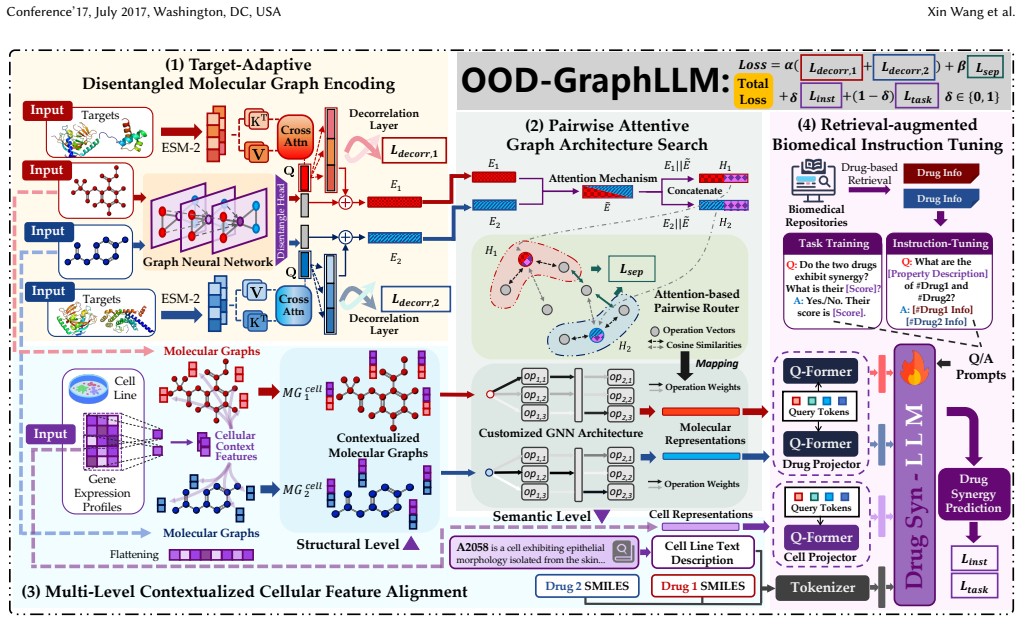
OOD-GraphLLM achieves out-of-distribution generalized drug synergy prediction by jointly optimizing molecular graph representations and biomedical semantic language representations in a unified framework, achieved through finetuning DrugSyn-LLM and applying retrieval-augmented biomedical instruction tuning to align topological and semantic molecular information for language-based reasoning.
What carries the argument
The OOD-GraphLLM framework, which integrates graph neural architectures for molecular topology with retrieval-augmented instruction tuning on a biomedical large language model to align structural and semantic information.
If this is right
- The model identifies structurally relevant and irrelevant molecular features relative to specific cell targets under OOD conditions.
- Optimal graph neural network designs emerge for calculating molecular representations that support OOD generalization.
- Joint use of structural graphs and language semantics enables language-based reasoning about drug combinations not seen in training.
- The released model supports interactive predictions for new drug pairs via a web interface.
Where Pith is reading between the lines
- The same alignment of graph topology with language semantics might transfer to other molecular prediction tasks that face scaffold shifts, such as toxicity forecasting.
- If the alignment holds, it could lower the volume of labeled experimental data required to train reliable models for emerging compounds.
- The approach points toward testing whether similar retrieval mechanisms improve generalization when cell contexts themselves vary beyond the training distribution.
Load-bearing premise
Retrieval-augmented instruction tuning aligns molecular topological information with semantic information well enough to overcome distribution shifts in drug synergy data.
What would settle it
Measure prediction accuracy on a test set of drug pairs whose molecular scaffolds and sizes differ markedly from the training distribution and compare against ground-truth synergy labels obtained from cell assays.
Figures

read the original abstract
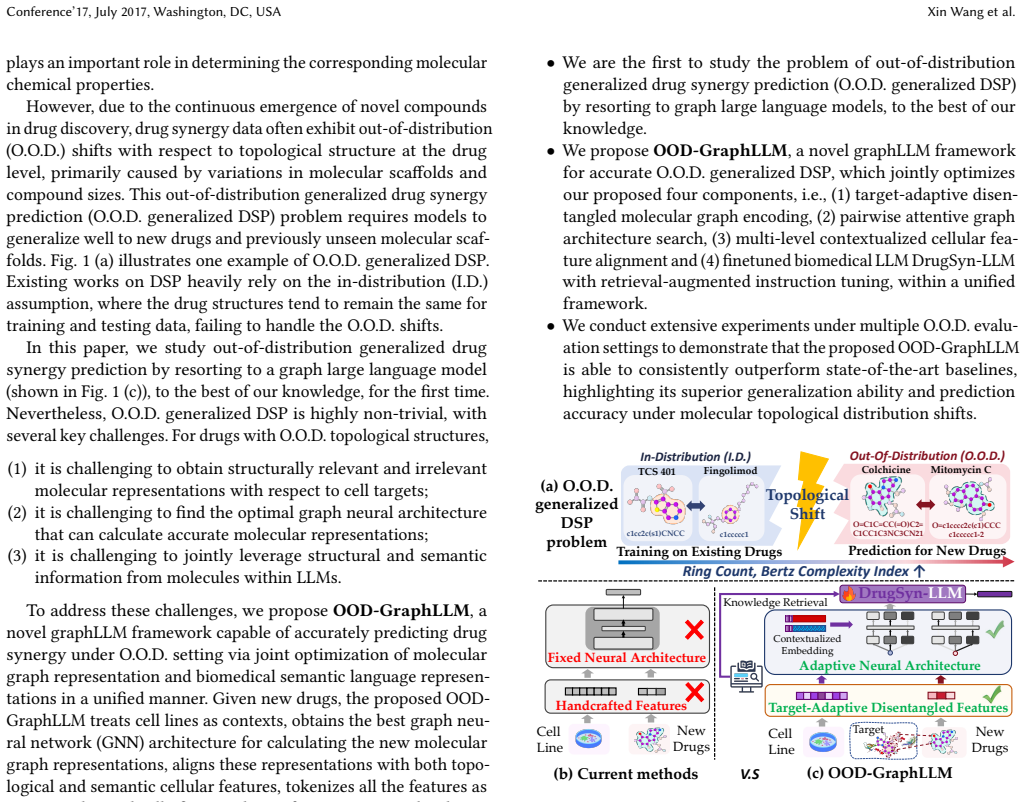
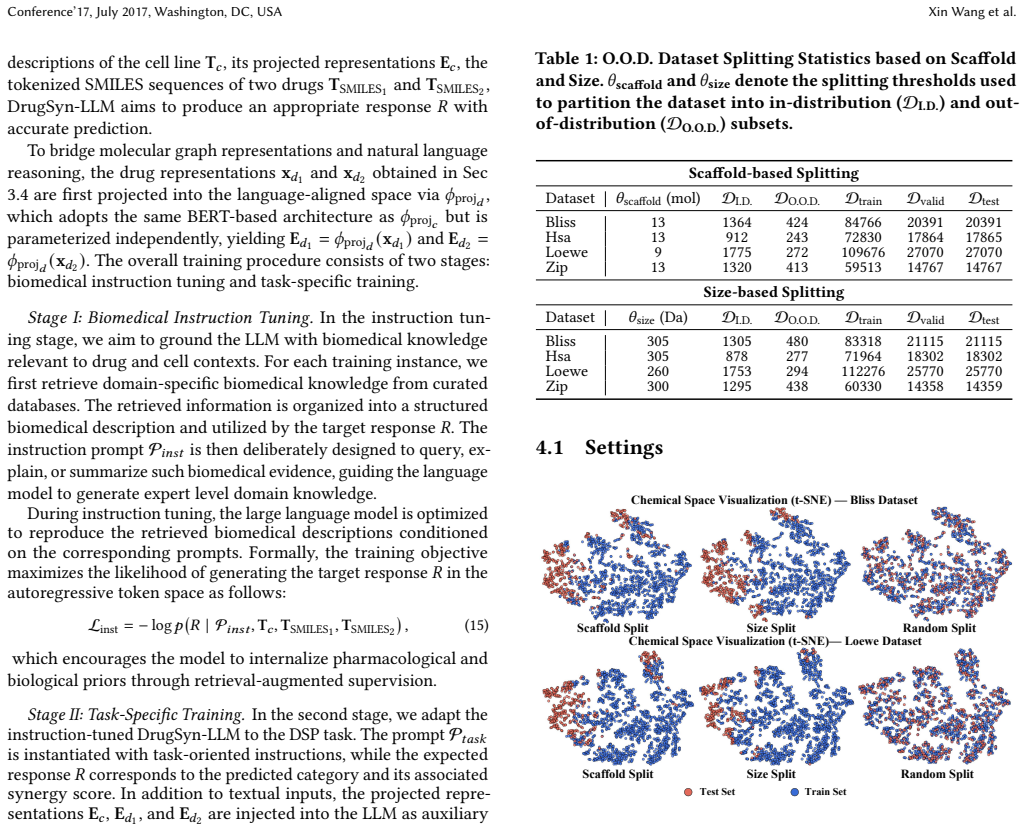
Drug synergy prediction (DSP) aims to identify efficacious drug combinations under various cellular contexts with different targets. However, the continual emergence of novel compounds results in variations in molecular scaffolds and sizes, causing drug synergy data to exhibit out-of-distribution (O.O.D.) shifts with respect to topological structure. Existing works rely on in-distribution (I.D.) assumption, failing to handle the O.O.D. shifts. To solve this problem, we study out-of-distribution generalized drug synergy prediction through a graph large language model for the first time. Nevertheless, O.O.D. generalized DSP is highly non-trivial, posing several challenges: i) how to discover structurally relevant and irrelevant molecular representations with respect to cell targets; ii) how to find the optimal graph neural architectures that accurately calculate molecular representations; and iii) how to jointly leverage molecular structural and semantic information in LLMs. To address these challenges, we propose OOD-GraphLLM, a novel graphLLM framework which is able to accurately predict drug synergy under O.O.D. settings via jointly optimizing molecular graph representation and biomedical semantic language representations in a unified manner. Furthermore, we finetune DrugSyn-LLM, a biomedical LLM, and employ a retrieval-augmented biomedical instruction tuning strategy to align molecular topological information and molecular semantic information with language-based reasoning for O.O.D. generalized DSP. Both the source code (https://github.com/EkkoXiao/Bio-GraphLLM) and released model (https://mn.cs.tsinghua.edu.cn/bio-graphllm/) are publicly available, where users are allowed to download model resources and interactively use the system through a web interface.
Editorial analysis
A structured set of objections, weighed in public.
Referee Report
Summary. The paper introduces OOD-GraphLLM, the first graph large language model framework for out-of-distribution generalized drug synergy prediction (DSP). It addresses OOD shifts arising from novel molecular scaffolds and sizes by jointly optimizing molecular graph representations and biomedical semantic language representations in a unified manner, finetuning DrugSyn-LLM and applying a retrieval-augmented biomedical instruction tuning strategy to align topological and semantic information for OOD generalization.
Significance. If the OOD generalization results hold with proper validation, the work could be significant for advancing DSP under distribution shifts, as the first application of graphLLMs to this problem; the public release of source code and the interactive model at the provided GitHub and web links is a clear strength for reproducibility and community use.
major comments (2)
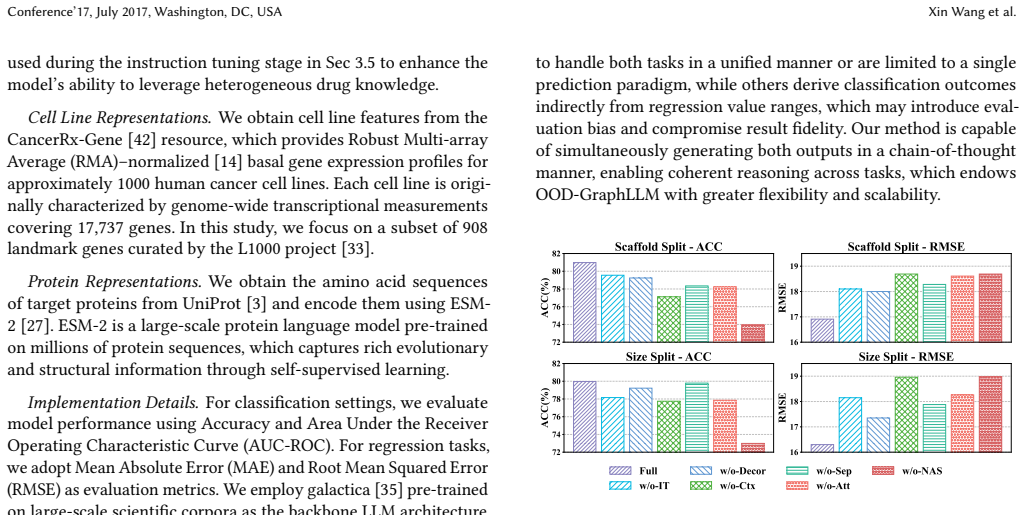
- [Experiments] The central claim that the retrieval-augmented biomedical instruction tuning successfully aligns molecular topological (graph) representations with semantic (language) information to handle OOD shifts is not supported by isolated experimental validation. No ablation isolates the tuning strategy's contribution to OOD metrics versus standard fine-tuning or graph-only baselines (see § on experiments and the description of the tuning strategy).
- [Method] The method section provides no quantitative measure or metric for how alignment between molecular topological information and molecular semantic information is achieved or verified during joint optimization, leaving the mechanism for OOD handling as an untested assumption rather than a demonstrated result.
minor comments (1)
- [Abstract] The abstract states the model 'is able to accurately predict' under OOD settings but contains no experimental results, error metrics, or baseline comparisons to ground this claim.
Simulated Author's Rebuttal
We thank the referee for the constructive feedback and positive assessment of the work's potential significance and reproducibility. We address the major comments point by point below, agreeing that additional validation would strengthen the claims.
read point-by-point responses
-
Referee: [Experiments] The central claim that the retrieval-augmented biomedical instruction tuning successfully aligns molecular topological (graph) representations with semantic (language) information to handle OOD shifts is not supported by isolated experimental validation. No ablation isolates the tuning strategy's contribution to OOD metrics versus standard fine-tuning or graph-only baselines (see § on experiments and the description of the tuning strategy).
Authors: We agree that the current experiments do not include an isolated ablation specifically quantifying the retrieval-augmented biomedical instruction tuning's contribution to OOD performance relative to standard fine-tuning or graph-only baselines. In the revised manuscript we will add these ablations, reporting OOD metrics (e.g., synergy prediction accuracy under scaffold and size shifts) for the full model versus the indicated variants to directly support the alignment claim. revision: yes
-
Referee: [Method] The method section provides no quantitative measure or metric for how alignment between molecular topological information and molecular semantic information is achieved or verified during joint optimization, leaving the mechanism for OOD handling as an untested assumption rather than a demonstrated result.
Authors: We acknowledge that the method section currently lacks an explicit quantitative metric (such as embedding similarity or alignment loss) to verify the degree of alignment between topological graph representations and semantic language representations. In revision we will introduce and report such a metric, computed before and after the joint optimization and retrieval-augmented tuning steps, to demonstrate the alignment mechanism. revision: yes
Circularity Check
No significant circularity; derivation is self-contained architectural proposal
full rationale
The paper proposes OOD-GraphLLM as a graphLLM framework for OOD drug synergy prediction via joint optimization of molecular graph and biomedical semantic representations, plus retrieval-augmented instruction tuning of DrugSyn-LLM. The provided text (abstract and description) contains no equations, parameter-fitting procedures, uniqueness theorems, or derivation chains that could reduce a claimed prediction or result to its own inputs by construction. Claims rest on model architecture and (unshown) empirical results rather than self-definitional mappings, fitted inputs renamed as predictions, or load-bearing self-citations. This is the normal case of a self-contained empirical ML proposal with no inspectable circular steps.
Axiom & Free-Parameter Ledger
Reference graph
Works this paper leans on
- [1]
-
[2]
Ziwei Chai, Tianjie Zhang, Liang Wu, Kaiqiang Han, Xiaohai Hu, Xuanwen Huang, and Yang Yang. 2025. Graphllm: Boosting graph reasoning ability of large language model.IEEE Transactions on Big Data(2025)
2025
-
[3]
UniProt Consortium. 2019. UniProt: a worldwide hub of protein knowledge. Nucleic acids research47, D1 (2019), D506–D515
2019
-
[4]
Jacob Devlin, Ming-Wei Chang, Kenton Lee, and Kristina Toutanova. 2019. Bert: Pre-training of deep bidirectional transformers for language understanding. In Proceedings of the 2019 conference of the North American chapter of the association for computational linguistics: human language technologies, volume 1 (long and short papers). 4171–4186
2019
-
[5]
Yunyun Dong, Yunqing Chang, Yuxiang Wang, Qixuan Han, Xiaoyuan Wen, Ziting Yang, Yan Zhang, Yan Qiang, Kun Wu, Xiaole Fan, et al. 2024. MFSynDCP: multi-source feature collaborative interactive learning for drug combination synergy prediction.BMC bioinformatics25, 1 (2024), 140
2024
-
[6]
Mohamed Reda El Khili, Safyan Aman Memon, and Amin Emad. 2023. MARSY: a multitask deep-learning framework for prediction of drug combination synergy scores.Bioinformatics39, 4 (2023), btad177
2023
- [7]
-
[8]
Yue Guo, Haitao Hu, Wenbo Chen, Hao Yin, Jian Wu, Chang-Yu Hsieh, Qiaojun He, and Ji Cao. 2024. SynergyX: a multi-modality mutual attention network for interpretable drug synergy prediction.Briefings in Bioinformatics25, 2 (2024), bbae015
2024
-
[9]
Betül Güvenç Paltun, Samuel Kaski, and Hiroshi Mamitsuka. 2021. Machine learning approaches for drug combination therapies.Briefings in Bioinfor- matics22, 6 (08 2021), bbab293. arXiv:https://academic.oup.com/bib/article- pdf/22/6/bbab293/41088416/bbab293.pdf doi:10.1093/bib/bbab293
-
[10]
Edward J Hu, Yelong Shen, Phillip Wallis, Zeyuan Allen-Zhu, Yuanzhi Li, Shean Wang, Lu Wang, Weizhu Chen, et al. 2022. Lora: Low-rank adaptation of large language models.ICLR1, 2 (2022), 3
2022
-
[11]
Jing Hu, Jie Gao, Xiaomin Fang, Zijing Liu, Fan Wang, Weili Huang, Hua Wu, and Guodong Zhao. 2022. DTSyn: a dual-transformer-based neural network to predict synergistic drug combinations.Briefings in Bioinformatics23, 5 (2022), bbac302
2022
-
[12]
Chao Huang, Xubin Ren, Jiabin Tang, Dawei Yin, and Nitesh Chawla. 2024. Large language models for graphs: Progresses and directions. InCompanion Proceedings of the ACM Web Conference 2024. 1284–1287
2024
-
[13]
Aleksandr Ianevski, Anil K Giri, and Tero Aittokallio. 2022. SynergyFinder 3.0: an interactive analysis and consensus interpretation of multi-drug synergies across multiple samples.Nucleic acids research50, W1 (2022), W739–W743
2022
-
[14]
Francesco Iorio, Theo A Knijnenburg, Daniel J Vis, Graham R Bignell, Michael P Menden, Michael Schubert, Nanne Aben, Emanuel Gonçalves, Syd Barthorpe, Howard Lightfoot, et al. 2016. A landscape of pharmacogenomic interactions in cancer.Cell166, 3 (2016), 740–754
2016
-
[15]
Joseph D Janizek, Safiye Celik, and Su-In Lee. 2018. Explainable machine learn- ing prediction of synergistic drug combinations for precision cancer medicine. BioRxiv(2018), 331769
2018
-
[16]
Yuanfeng Ji, Lu Zhang, Jiaxiang Wu, Bingzhe Wu, Lanqing Li, Long-Kai Huang, Tingyang Xu, Yu Rong, Jie Ren, Ding Xue, et al . 2023. Drugood: Out-of- distribution dataset curator and benchmark for ai-aided drug discovery–a focus on affinity prediction problems with noise annotations. InProceedings of the AAAI Conference on Artificial Intelligence, Vol. 37. ...
2023
-
[17]
Bowen Jin, Gang Liu, Chi Han, Meng Jiang, Heng Ji, and Jiawei Han. 2024. Large language models on graphs: A comprehensive survey.IEEE Transactions on Knowledge and Data Engineering(2024)
2024
- [18]
-
[19]
Craig Knox, Mike Wilson, Christen M Klinger, Mark Franklin, Eponine Oler, Alex Wilson, Allison Pon, Jordan Cox, Na Eun Chin, Seth A Strawbridge, et al. 2024. DrugBank 6.0: the DrugBank knowledgebase for 2024.Nucleic acids research52, D1 (2024), D1265–D1275
2024
-
[20]
Halil Ibrahim Kuru, Oznur Tastan, and A Ercument Cicek. 2021. MatchMaker: a deep learning framework for drug synergy prediction.IEEE/ACM transactions on computational biology and bioinformatics19, 4 (2021), 2334–2344
2021
-
[21]
Greg Landrum. 2013. Rdkit documentation.Release1, 1-79 (2013), 4
2013
-
[22]
Huijun Li, Lin Zou, Jamal AH Kowah, Dongqiong He, Lisheng Wang, Mingqing Yuan, and Xu Liu. 2023. Predicting drug synergy and discovering new drug combinations based on a graph autoencoder and convolutional neural network. Interdisciplinary Sciences: Computational Life Sciences15, 2 (2023), 316–330
2023
-
[23]
Junnan Li, Dongxu Li, Silvio Savarese, and Steven Hoi. 2023. Blip-2: Bootstrapping language-image pre-training with frozen image encoders and large language models. InInternational conference on machine learning. PMLR, 19730–19742
2023
-
[24]
Lei Li, Hongyu Zhang, Chunhou Zheng, and Yansen Su. 2025. A review of deep learning approaches for drug synergy prediction in cancer.npj Drug Discovery2, 1 (Dec. 2025), 30. doi:10.1038/s44386-025-00034-1
-
[25]
Tianhao Li, Sandesh Shetty, Advaith Kamath, Ajay Jaiswal, Xiaoqian Jiang, Ying Ding, and Yejin Kim. 2024. CancerGPT for few shot drug pair synergy prediction using large pretrained language models.NPJ Digital Medicine7, 1 (2024), 40
2024
-
[26]
Xueliang Li, Bihan Shen, Fangyoumin Feng, Kunshi Li, Zhixuan Tang, Liangxiao Ma, and Hong Li. 2024. Dual-view jointly learning improves personalized drug synergy prediction.Bioinformatics40, 10 (2024), btae604
2024
-
[27]
Zeming Lin, Halil Akin, Roshan Rao, Brian Hie, Zhongkai Zhu, Wenting Lu, Nikita Smetanin, Robert Verkuil, Ori Kabeli, Yaniv Shmueli, Allan dos Santos Costa, Maryam Fazel-Zarandi, Tom Sercu, Salvatore Candido, and Alexander Rives. 2023. Evolutionary-scale prediction of atomic-level pro- tein structure with a language model.Science379, 6637 (2023), 1123–
2023
-
[28]
arXiv:https://www.science.org/doi/pdf/10.1126/science.ade2574 doi:10. 1126/science.ade2574
-
[29]
Qiao Liu and Lei Xie. 2021. TranSynergy: Mechanism-driven interpretable deep neural network for the synergistic prediction and pathway deconvolution of drug combinations.PLoS computational biology17, 2 (2021), e1008653
2021
-
[30]
Tianyu Liu, Tinyi Chu, Xiao Luo, and Hongyu Zhao. 2025. Building a unified model for drug synergy analysis powered by large language models.Nature Communications16, 1 (2025), 4537
2025
-
[31]
Ilya Loshchilov and Frank Hutter. 2017. Decoupled weight decay regularization. arXiv preprint arXiv:1711.05101(2017)
work page internal anchor Pith review Pith/arXiv arXiv 2017
-
[32]
Kristina Preuer, Richard PI Lewis, Sepp Hochreiter, Andreas Bender, Krishna C Bulusu, and Günter Klambauer. 2018. DeepSynergy: predicting anti-cancer drug synergy with deep learning.Bioinformatics34, 9 (2018), 1538–1546
2018
- [33]
-
[34]
Aravind Subramanian, Rajiv Narayan, Steven M Corsello, David D Peck, Ted E Natoli, Xiaodong Lu, Joshua Gould, John F Davis, Andrew A Tubelli, Jacob K Asiedu, et al. 2017. A next generation connectivity map: L1000 platform and the first 1,000,000 profiles.Cell171, 6 (2017), 1437–1452
2017
-
[35]
Jiabin Tang, Yuhao Yang, Wei Wei, Lei Shi, Lixin Su, Suqi Cheng, Dawei Yin, and Chao Huang. 2024. Graphgpt: Graph instruction tuning for large language models. InProceedings of the 47th International ACM SIGIR Conference on Research and Development in Information Retrieval. 491–500
2024
-
[36]
Ross Taylor, Marcin Kardas, Guillem Cucurull, Thomas Scialom, Anthony Hartshorn, Elvis Saravia, Andrew Poulton, Viktor Kerkez, and Robert Sto- jnic. 2022. Galactica: A large language model for science.arXiv preprint arXiv:2211.09085(2022)
work page internal anchor Pith review Pith/arXiv arXiv 2022
-
[37]
Heng Wang, Shangbin Feng, Tianxing He, Zhaoxuan Tan, Xiaochuang Han, and Yulia Tsvetkov. 2023. Can language models solve graph problems in natural language?Advances in Neural Information Processing Systems36 (2023), 30840– 30861
2023
-
[38]
Jinxian Wang, Xuejun Liu, Siyuan Shen, Lei Deng, and Hui Liu. 2022. DeepDDS: deep graph neural network with attention mechanism to predict synergistic drug combinations.Briefings in Bioinformatics23, 1 (2022)
2022
-
[39]
Tianshuo Wang, Ruheng Wang, and Leyi Wei. 2023. AttenSyn: an attention- based deep graph neural network for anticancer synergistic drug combination prediction.Journal of Chemical Information and Modeling64, 7 (2023), 2854–2862
2023
- [40]
-
[41]
Linxin Xiao, Xin Wang, Zeyang Zhang, Yang Yao, and Wenwu Zhu. 2025. DyNAS- DDI: Dynamic Pairwise Architecture Search for Generalizable Drug-Drug Interac- tion LLM. InProceedings of the 33rd ACM International Conference on Multimedia. 2216–2225
2025
-
[42]
Mengdie Xu, Xinwei Zhao, Jingyu Wang, Wei Feng, Naifeng Wen, Chunyu Wang, Junjie Wang, Yun Liu, and Lingling Zhao. 2023. DFFNDDS: prediction of syner- gistic drug combinations with dual feature fusion networks.Journal of Chemin- formatics15, 1 (2023), 33
2023
-
[43]
Wanjuan Yang, Jorge Soares, Patricia Greninger, Elena J Edelman, Howard Light- foot, Simon Forbes, Nidhi Bindal, Dave Beare, James A Smith, I Richard Thompson, et al. 2012. Genomics of Drug Sensitivity in Cancer (GDSC): a resource for thera- peutic biomarker discovery in cancer cells.Nucleic acids research41, D1 (2012), D955–D961
2012
-
[44]
Ruosong Ye, Caiqi Zhang, Runhui Wang, Shuyuan Xu, and Yongfeng Zhang. 2024. Language is all a graph needs. InFindings of the association for computational linguistics: EACL 2024. 1955–1973
2024
-
[45]
Barbara Zdrazil, Eloy Felix, Fiona Hunter, Emma J Manners, James Blackshaw, Sybilla Corbett, Marleen De Veij, Harris Ioannidis, David Mendez Lopez, Juan F Mosquera, et al. 2024. The ChEMBL Database in 2023: a drug discovery platform spanning multiple bioactivity data types and time periods.Nucleic acids research 52, D1 (2024), D1180–D1192
2024
-
[46]
Jianan Zhao, Meng Qu, Chaozhuo Li, Hao Yan, Qian Liu, Rui Li, Xing Xie, and Jian Tang. 2022. Learning on large-scale text-attributed graphs via variational inference.arXiv preprint arXiv:2210.14709(2022). OOD-GraphLLM: Graph Large Language Model for Out-of-Distribution Generalized Drug Synergy Prediction Conference’17, July 2017, Washington, DC, USA
-
[47]
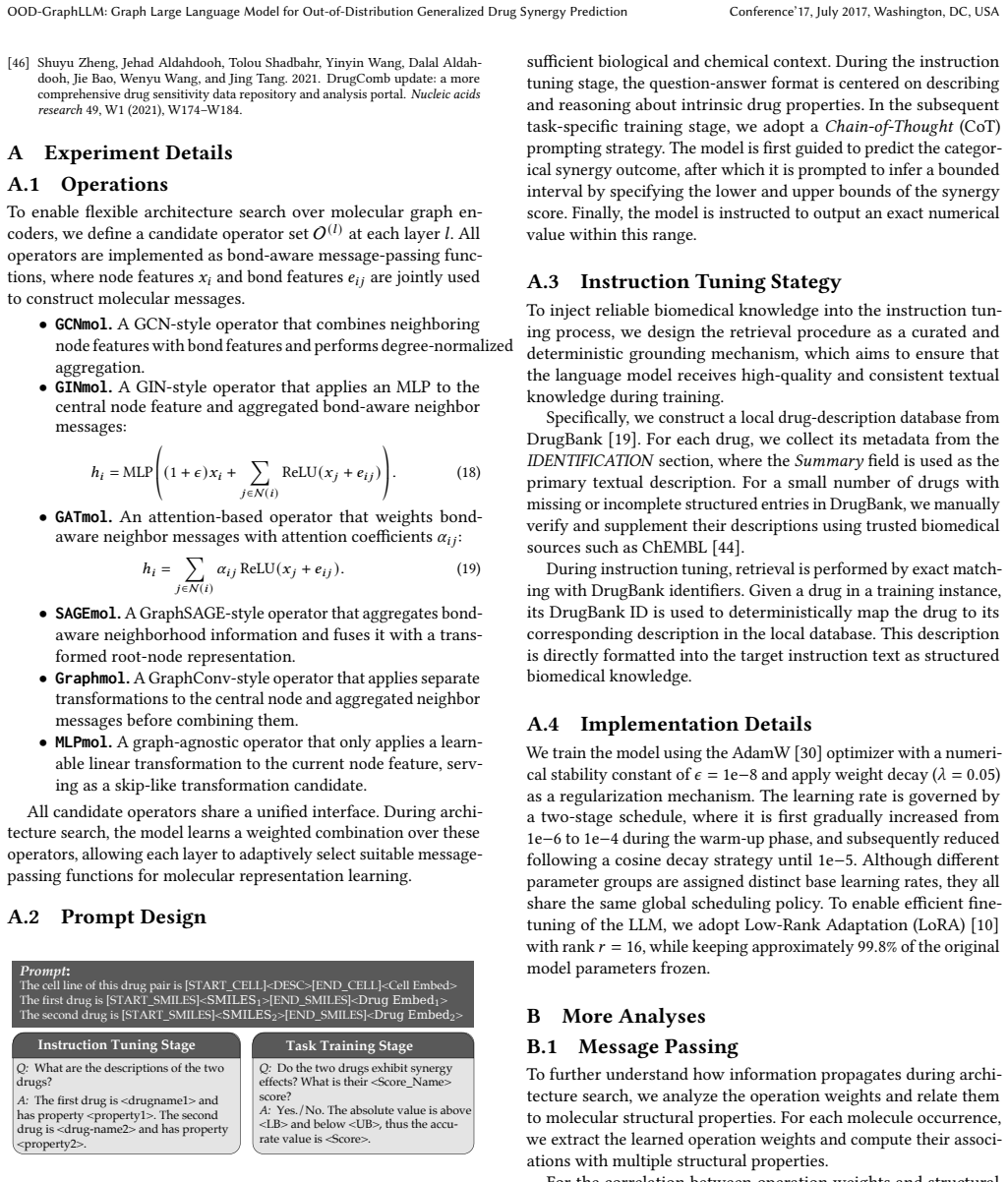
Shuyu Zheng, Jehad Aldahdooh, Tolou Shadbahr, Yinyin Wang, Dalal Aldah- dooh, Jie Bao, Wenyu Wang, and Jing Tang. 2021. DrugComb update: a more comprehensive drug sensitivity data repository and analysis portal.Nucleic acids research49, W1 (2021), W174–W184. A Experiment Details A.1 Operations To enable flexible architecture search over molecular graph en...
2021
discussion (0)
Sign in with ORCID, Apple, or X to comment. Anyone can read and Pith papers without signing in.