REVIEW 4 major objections 6 minor 68 references
Deep Sparse Latent Feature Models for Knowledge Graph Completion
T0 review · 4 major / 6 minor · reviewed 2026-08-12 · deepseek-v4-flash
Pith's one-line read DSLFM-KGC, a deep VAE with Indian Buffet Process community memberships plus BERT text, improves knowledge graph completion on Wikidata5M-Ind (MRR 76.3 vs 71.3 for SimKGC) and yields interpretable communities.
desk verdict Strong empirical results, but the model's central claim about global community discovery via an Indian Buffet Process doesn't hold as written—per-instance stick-breaking weights produce sparse text codes, not shared graph communities. read the letter →
The pith
A machine-rendered reading of the paper's core claim, the machinery that carries it, and where it could break.
The reading
What carries the argument
The load-bearing object is a sparse latent feature relational model with an Indian Buffet Process prior, the LFRM-style construction in which each node (here, each query and each answer entity) carries a binary vector $z$ of community memberships and a continuous vector $w$ of membership strengths; the existence probability of a triple is $p(A_{hr,t}=1) = \sigma(f_{hr}^\top f_t)$ with $f = w \odot z$. To make inference scalable, the paper uses the stick-breaking construction of the IBP with truncation $K=128$, a variational autoencoder whose encoder is two weight-shared BERT encoders plus an MLP producing Bernoulli probabilities, Gaussian means and variances, and Beta parameters, and a decoder that maps $f$ through an MLP and scores with a cosine-similarity contrastive loss with margin and temperature. The ELBO combines KL divergences over the latent variables, reconstruction terms, and the contrastive triple-completion term; reparameterization uses the Concrete/Gumbel-softmax trick for the Bernoulli variables and implicit differentiation for Beta variables.
What would settle it
Train a matched-capacity dense Gaussian VAE with the same BERT/MLP backbone and the same contrastive loss but no IBP-Bernoulli sparsity and compare on Wikidata5M-Ind; if the dense variant matches DSLFM-KGC's 76.3 MRR, the sparse community mechanism is not the driver of the gains.
Extended reading notes
Core claim
The central claim is that a sparse latent feature model for KGC—where each query and each answer entity is represented by a sparse binary community-membership vector $z$ and a continuous feature vector $w$, combined through the Hadamard product $f = w \odot z$ and scored by an MLP-transformed inner product—captures global clustering information that text-only encoders miss, and that optimizing this model through a deep variational autoencoder makes it scalable. Under an Indian Buffet Process prior on the membership matrices, the number of active communities is learned rather than fixed. On Wikidata5M-Ind, the method reports an MRR of 76.3 versus 71.3 for SimKGC and Hit@1 of 67.2 versus 60.7; on WN18RR it reports MRR 70.4 and Hit@10 84.2, surpassing the strongest prior model (GHN) across all metrics. The authors support the community-structure mechanism by showing that a Gaussian VAE and an autoencoder variant perform close to SimKGC and far below DSLFM-KGC, and that the gain is largest on long-range triples in WN18RR while being modest on the low-modularity FB15k-237 graph.
Load-bearing premise
The paper's causal claim depends on the assumption that the latent communities learned from the Indian Buffet Process prior genuinely reflect the graph's real community structure and are the source of the accuracy gains, rather than acting as an uninterpretable increase in model capacity.
Editorial extensions
If this is right
- On knowledge graphs with clear community structure, such as WN18RR and Wikidata5M, community-aware latent features can substantially outperform text-only contrastive baselines (MRR 76.3 vs 71.3 on Wikidata5M-Ind).
- Learned communities are inspectable: the highest-strength entities in a community form coherent semantic groups (e.g., counties, music artists), giving a path from link prediction to explanation.
- The performance gain is concentrated on long-range triples—head and tail more than a few hops apart—where local text evidence is weak, indicating that global structure supplies complementary signal.
- On graphs with low modularity such as FB15k-237, the method's advantage over text-only baselines shrinks, consistent with community structure being the active ingredient rather than model complexity.
- The deep VAE formulation with a fixed truncation level scales to graphs with millions of entities and tens of millions of triples, removing the scalability barrier that has kept SBM-style models out of large-scale KGC.
Reading between the lines
- If the community mechanism is the true driver, then across a family of KGs the MRR gap between DSLFM-KGC and a text-only baseline should be rank-correlated with graph modularity; this is a testable prediction the paper does not run.
- The architecture is a template: any entity encoder (multimodal, multilingual, or LLM-based) could be placed under the same IBP latent layer, so the structural inductive bias may transfer beyond text-only KGC to other link-prediction settings.
- A sharper test of interpretability would quantify community purity by comparing the learned partition against known entity categories; the paper currently shows qualitative examples only.
- Because the triple-completion likelihood is replaced by a contrastive loss, the generative model is partly a scaffold; ablating the cosine-margin scoring against a plain inner product would separate the contribution of the sparse latent structure from the contrastive objective.
Editorial analysis
A structured set of objections, weighed in public.
Referee Report
Summary. The paper proposes DSLFM-KGC, a knowledge graph completion method that combines BERT-encoded textual descriptions of queries and entities with a deep variational autoencoder whose latent variables are intended to be sparse Bernoulli community indicators under an Indian Buffet Process prior. The encoder maps text to the parameters of Beta, Bernoulli, and Gaussian latents; the decoder applies a Hadamard product and an MLP to produce query/answer representations, and the training objective is an ELBO whose triple-completion term is a supervised contrastive loss. Experiments on UMLS, WN18RR, FB15k-237, and Wikidata5M-Ind report state-of-the-art or competitive results, including a 5.0-point MRR improvement over SimKGC on Wikidata5M-Ind. The paper additionally provides ablations to a Gaussian VAE and an autoencoder, robustness tests over stick-breaking prior parameters, geodesic-distance analyses, and latent-structure visualizations.
Significance. If the mechanism were as described, the paper would make a useful contribution: it would show that scalable variational inference of sparse latent community features improves text-based KGC and provides interpretable clusters. The empirical work has genuine strengths, including five-seed averaged results, a 30-setting robustness grid over the stick-breaking priors, and a geodesic-distance analysis that gives a concrete, falsifiable prediction about where gains concentrate. However, the central claimed mechanism, a global IBP prior that integrates graph-community structure with text, is not present in the implemented equations, and the evaluation protocol raises comparability questions. As written, the benchmark gains and interpretability examples cannot be attributed to community modeling; they may reflect a sparse regularization of text-derived features. The significance of the result therefore depends on substantial revision.
major comments (4)
- [§3.1–3.2, Eqs. (8)–(16)] The model does not implement the claimed global IBP/LFRM prior. In the standard IBP stick-breaking construction the Beta weights v_k are shared across rows, whereas Eq. (9) draws v_hr,k and v_t,k separately for each query and entity. The mean-field family in Eqs. (10)–(12) also has per-instance Beta parameters, so Z_qry and Z_ans are not draws from the IBP as defined. Moreover, the encoder in Eqs. (15)–(16) receives only textual descriptions; the graph adjacency matrix A enters only through the contrastive triple-completion term (Eq. 19). The latent "communities" are therefore per-instance sparse text-derived codes, not a global community assignment matrix shared across entities. The abstract's claim that the model "dynamically integrates global clustering information with local textual features" and the interpretability claims in Section 5.2 are not supported by the generative model as written. The authors should either implement a genuine global community assignment (e.g., shared stick-breaking weights and a graph-based encoder) or reframe the contribution as a sparse-latent text-based KGC model and remove the SBM/community causal language.
- [§4.1, Tables 1–2 and Fig. 2] The evaluation protocol for DSLFM-KGC differs from the protocol used to produce most published baseline numbers. Section 4.1 states that for each test triple the paper evaluates both a forward query (h,r,?) and a backward query (?, r^{-1}, t), using the inverse-relation convention from the authors' own KERMIT paper, and averages the two. No statement is made that the baselines in Table 1 and Figure 2 were recomputed under this protocol; the baseline numbers appear to be taken from the original papers, which typically use only the standard filtered forward protocol or a different reciprocal convention. Since the reported gains are often small (e.g., MRR 70.4 vs. 67.8 on WN18RR; 76.3 vs. 71.3 on Wikidata5M-Ind), the headline comparisons are not trustworthy until baselines are evaluated under exactly the same protocol or both protocols are reported.
- [§3.4, Eq. (19)] The generative likelihood and the training objective are inconsistent. Section 3.1 defines p(A_hr,t = 1 | ...) = σ(f_hr^T f_t), a Bernoulli probability (Eq. 7). Section 3.4 then sets log pθ(A_hr,t | ...) equal to a supervised contrastive softmax over positive and negative entities (Eq. 19). This is not the log-likelihood of the Bernoulli model, so the ELBO in Eq. (18) is not being optimized for the generative model described. The paper should either derive the contrastive objective as an approximation to the Bernoulli likelihood (specifying how the normalization over negative entities arises) or describe the objective as a hybrid contrastive+VAE loss rather than a probabilistic KGC model.
- [§4.3, Table 2] The ablation in Section 4.3 does not isolate graph-community modeling. Replacing the sparse Beta-Bernoulli prior with a Gaussian VAE or an autoencoder changes the regularizer, but none of these variants has access to graph structure either; the comparison only tests whether a sparse latent prior helps over a dense Gaussian prior or no probabilistic prior. Moreover, the variants are not matched on hyperparameters such as β, η, and training epochs (Table 2 shows different epoch counts). The conclusion that "the enhancement in KGC performance arises from the sparse community modeling itself" is therefore too strong; the experiment cannot distinguish a sparse-regularization effect from a graph-community effect, especially given that the latent codes are text-derived.
minor comments (6)
- [§4.2] The text says "Table 2 presents the results for the Wikidata5M-Ind dataset," but Figure 2 contains the Wikidata5M-Ind results and Table 2 contains ablations for WN18RR, FB15k-237, and UMLS; the cross-reference should be corrected.
- [§7] The conclusion says the method is evaluated on "three benchmark datasets," but the paper reports results on UMLS, WN18RR, FB15k-237, and Wikidata5M-Ind; the count should be four.
- [§D.2, Fig. 11] The latent-structure visualization uses K = 64 and α_ans = 50, whereas the main results use K = 128 and α_ans = 20 (Appendix C, Table 4); the authors should clarify whether the displayed communities come from the same configuration that produced the reported benchmark numbers.
- [§4.2] The phrase "5.0% increase in MRR" describes a 5.0 percentage-point increase (71.3 to 76.3); the wording should be made precise.
- [§6, Table 1] The same method is referred to as both KBGAT [41] in the related-work section and KGGAT [41] in Table 1; the notation should be unified.
- [Appendix B.1] The reconstruction terms pθ(X_qry | Z_qry, W_qry) and pθ(X_ans | Z_ans, W_ans) are introduced in the ELBO, but the generative model in Section 3.1 does not specify a text-likelihood; the appendix says the reconstruction is computed by cosine similarity between e_hr and g_hr, but this is not derived from the generative story. A precise definition is needed for reproducibility.
Circularity Check
No significant circularity: the reported MRR gains are evaluated against external, held-out benchmarks and published baselines, so the headline results are not defined in terms of fitted parameters or self-citation.
full rationale
The numerical claims that carry the paper's headline—a 5.0% MRR gain on Wikidata5M-Ind over SimKGC and WN18RR gains over GHN—are produced by training on standard train splits and scoring on held-out test sets under the filtered protocol. These results are therefore not defined in terms of any fitted parameter or self-citation. The KL/Beta/Concrete derivations in Appendix B are standard identities and do not encode the target benchmark numbers. The only self-citation, KERMIT [33], is used in Section 4.1 to define the inverse-relation convention for averaging forward/backward metrics; this is an evaluation convention, not a load-bearing model component, so it does not force the outcome. Two caveats are recorded but do not constitute circularity. First, the stick-breaking construction in Eq. 9 uses per-query Beta weights v_hr,k rather than a single column-shared weight sequence, so the global IBP prior asserted in Eq. 8 is not literally implemented; this is an implementation/claim mismatch affecting attribution of the gains to 'global clustering information,' not a circular reduction of the benchmarks. Second, the interpretability demonstration in Section 5.2 uses entity descriptions to interpret communities whose posterior parameters are produced by the same BERT+MLP text encoder (Eqs. 15-16), making the textual interpretability partly definitional; again, this does not enter the benchmark computation. Overall, the central empirical derivation is self-contained and externally checkable.
Assumptions & free parameters
free parameters (7)
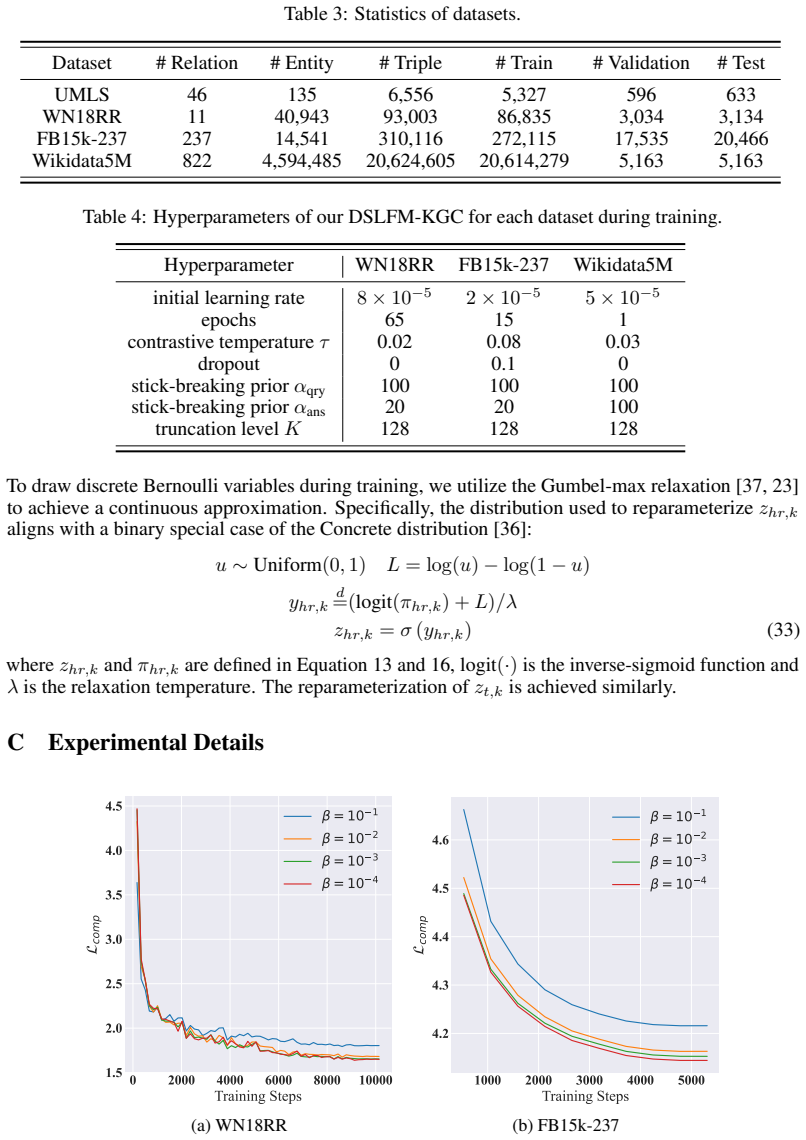
- Indian Buffet Process concentration alpha_qry =
100 for all datasets
- Indian Buffet Process concentration alpha_ans =
20 (WN18RR, FB15k-237), 100 (Wikidata5M)
- Truncation level K =
128
- Contrastive temperature tau =
0.02, 0.08, 0.03
- Additive margin gamma =
not reported
- KL weight beta =
not stated for main experiments
- Reconstruction weight eta =
not reported
assumptions (6)
- domain assumption Triples are conditionally independent given their latent communities.
- domain assumption A knowledge graph can be represented as a bipartite query-answer graph A in {0,1}^{|Q|x|E|}.
- standard math Mean-field factorization of the variational posterior.
- domain assumption IBP stick-breaking prior with fixed truncation K.
- domain assumption BERT text descriptions provide sufficient local features.
- ad hoc to paper Supervised contrastive loss equals the triple log-likelihood.
Cite this review
Pith. "Pith review of Deep Sparse Latent Feature Models for Knowledge Graph Completion." pith.science (2026). https://pith.science/paper/SQQLYZVW
@misc{pith2026241115694,
  author       = {Pith},
  title        = {Pith review of: Deep Sparse Latent Feature Models for Knowledge Graph Completion},
  year         = {2026},
  howpublished = {\url{https://pith.science/paper/SQQLYZVW}},
  note         = {Machine review of arXiv:2411.15694}
}
read the original abstract
Recent advances in knowledge graph completion (KGC) have emphasized text-based approaches to navigate the inherent complexities of large-scale knowledge graphs (KGs). While these methods have achieved notable progress, they frequently struggle to fully incorporate the global structural properties of the graph. Stochastic blockmodels (SBMs), especially the latent feature relational model (LFRM), offer robust probabilistic frameworks for identifying latent community structures and improving link prediction. This paper presents a novel probabilistic KGC framework utilizing sparse latent feature models, optimized via a deep variational autoencoder (VAE). Our proposed method dynamically integrates global clustering information with local textual features to effectively complete missing triples, while also providing enhanced interpretability of the underlying latent structures. Extensive experiments on four benchmark datasets with varying scales demonstrate the significant performance gains achieved by our method.
Figures


Figures from the paper (7 more)




Reference graph
Works this paper leans on
-
[1]
Mixed membership stochastic blockmodels
Edo M Airoldi, David Blei, Stephen Fienberg, and Eric Xing. Mixed membership stochastic blockmodels. Advances in neural information processing systems, 21, 2008
work page 2008
-
[2]
Dbpedia: A nucleus for a web of open data
Sören Auer, Christian Bizer, Georgi Kobilarov, Jens Lehmann, Richard Cyganiak, and Zachary Ives. Dbpedia: A nucleus for a web of open data. In international semantic web conference, pages 722–735. Springer, 2007
work page 2007
-
[3]
Tucker: Tensor factorization for knowledge graph completion
Ivana Balaževi´c, Carl Allen, and Timothy M Hospedales. Tucker: Tensor factorization for knowledge graph completion. arXiv preprint arXiv:1901.09590, 2019
arXiv 1901
-
[4]
Reverse engineering self-supervised learning
Ido Ben-Shaul, Ravid Shwartz-Ziv, Tomer Galanti, Shai Dekel, and Yann LeCun. Reverse engineering self-supervised learning. Advances in Neural Information Processing Systems , 36:58324–58345, 2023
work page 2023
-
[5]
Translating embeddings for modeling multi-relational data
Antoine Bordes, Nicolas Usunier, Alberto Garcia-Duran, Jason Weston, and Oksana Yakhnenko. Translating embeddings for modeling multi-relational data. Advances in neural information processing systems, 26, 2013
2013
-
[6]
Generating sentences from a continuous space
Samuel R Bowman, Luke Vilnis, Oriol Vinyals, Andrew M Dai, Rafal Jozefowicz, and Samy Bengio. Generating sentences from a continuous space. arXiv preprint arXiv:1511.06349, 2015
arXiv 2015
-
[7]
Knowledge is flat: A seq2seq generative framework for various knowledge graph completion
Chen Chen, Yufei Wang, Bing Li, and Kwok-Yan Lam. Knowledge is flat: A seq2seq generative framework for various knowledge graph completion. arXiv preprint arXiv:2209.07299, 2022
arXiv 2022
-
[8]
Chen Chen, Yufei Wang, Aixin Sun, Bing Li, and Kwok-Yan Lam. Dipping plms sauce: Bridging structure and text for effective knowledge graph completion via conditional soft prompting. arXiv preprint arXiv:2307.01709, 2023
arXiv 2023
Show all 68 references
-
[9]
HittER: Hierarchical transformers for knowledge graph embeddings
Sanxing Chen, Xiaodong Liu, Jianfeng Gao, Jian Jiao, Ruofei Zhang, and Yangfeng Ji. HittER: Hierarchical transformers for knowledge graph embeddings. In Marie-Francine Moens, Xuan- jing Huang, Lucia Specia, and Scott Wen-tau Yih, editors, Proceedings of the 2021 Conference on ...
2021
-
[10]
A simple frame- work for contrastive learning of visual representations
Ting Chen, Simon Kornblith, Mohammad Norouzi, and Geoffrey Hinton. A simple frame- work for contrastive learning of visual representations. In Hal Daumé III and Aarti Singh, editors, Proceedings of the 37th International Conference on Machine Learning, volume 119 of Proceeding...
2020
-
[11]
A direct formulation for sparse pca using semidefinite programming
Alexandre d’Aspremont, Laurent Ghaoui, Michael Jordan, and Gert Lanckriet. A direct formulation for sparse pca using semidefinite programming. Advances in neural information processing systems, 17, 2004
2004
-
[12]
Inductive entity representations from text via link prediction
Daniel Daza, Michael Cochez, and Paul Groth. Inductive entity representations from text via link prediction. In Proceedings of the Web Conference 2021, pages 798–808, 2021
2021
-
[13]
Convolutional 2d knowledge graph embeddings
Tim Dettmers, Pasquale Minervini, Pontus Stenetorp, and Sebastian Riedel. Convolutional 2d knowledge graph embeddings. In Proceedings of the AAAI conference on artificial intelligence, volume 32, 2018
2018
-
[14]
BERT: Pre-training of deep bidirectional transformers for language understanding
Jacob Devlin, Ming-Wei Chang, Kenton Lee, and Kristina Toutanova. BERT: Pre-training of deep bidirectional transformers for language understanding. In Proceedings of the 2019 Confer- ence of the North American Chapter of the Association for Computational Linguistics: Human Lan...
2019
-
[15]
Knowledge vault: A web-scale approach to proba- bilistic knowledge fusion
Xin Dong, Evgeniy Gabrilovich, Geremy Heitz, Wilko Horn, Ni Lao, Kevin Murphy, Thomas Strohmann, Shaohua Sun, and Wei Zhang. Knowledge vault: A web-scale approach to proba- bilistic knowledge fusion. In Proceedings of the 20th ACM SIGKDD international conference on Knowledge d...
2014
-
[16]
Implicit reparameterization gradients
Mikhail Figurnov, Shakir Mohamed, and Andriy Mnih. Implicit reparameterization gradients. Advances in neural information processing systems, 31, 2018
2018
-
[17]
Infinite latent feature models and the indian buffet process
Zoubin Ghahramani and Thomas Griffiths. Infinite latent feature models and the indian buffet process. Advances in neural information processing systems, 18, 2005
2005
-
[18]
The indian buffet process: An introduction and review
Thomas L Griffiths and Zoubin Ghahramani. The indian buffet process: An introduction and review. Journal of Machine Learning Research, 12(4), 2011
2011
-
[19]
Noise-contrastive estimation of unnormalized statistical models, with applications to natural image statistics
Michael U Gutmann and Aapo Hyvärinen. Noise-contrastive estimation of unnormalized statistical models, with applications to natural image statistics. Journal of machine learning research, 13(2), 2012
2012
-
[20]
beta-vae: Learning basic visual concepts with a constrained variational framework
Irina Higgins, Loic Matthey, Arka Pal, Christopher P Burgess, Xavier Glorot, Matthew M Botvinick, Shakir Mohamed, and Alexander Lerchner. beta-vae: Learning basic visual concepts with a constrained variational framework. ICLR (Poster), 3, 2017
2017
-
[21]
Learning deep representations by mutual information estimation and maximization
R Devon Hjelm, Alex Fedorov, Samuel Lavoie-Marchildon, Karan Grewal, Phil Bachman, Adam Trischler, and Yoshua Bengio. Learning deep representations by mutual information estimation and maximization. arXiv preprint arXiv:1808.06670, 2018
2018 arXiv
-
[22]
Stochastic blockmodels: First steps
Paul W Holland, Kathryn Blackmond Laskey, and Samuel Leinhardt. Stochastic blockmodels: First steps. Social networks, 5(2):109–137, 1983
1983
-
[23]
Categorical reparameterization with gumbel-softmax
Eric Jang, Shixiang Gu, and Ben Poole. Categorical reparameterization with gumbel-softmax. arXiv preprint arXiv:1611.01144, 2016
2016 arXiv
-
[24]
A modified principal component technique based on the lasso
Ian T Jolliffe, Nickolay T Trendafilov, and Mudassir Uddin. A modified principal component technique based on the lasso. Journal of computational and Graphical Statistics, 12(3):531–547, 2003
2003
-
[25]
Supervised contrastive learning
Prannay Khosla, Piotr Teterwak, Chen Wang, Aaron Sarna, Yonglong Tian, Phillip Isola, Aaron Maschinot, Ce Liu, and Dilip Krishnan. Supervised contrastive learning. Advances in neural information processing systems, 33:18661–18673, 2020
2020
-
[26]
Multi-task learning for knowl- edge graph completion with pre-trained language models
Bosung Kim, Taesuk Hong, Youngjoong Ko, and Jungyun Seo. Multi-task learning for knowl- edge graph completion with pre-trained language models. In Proceedings of the 28th Interna- tional Conference on Computational Linguistics, pages 1737–1743, Barcelona, Spain (Online), Decem...
2020
-
[27]
Auto-encoding variational bayes
Diederik P Kingma and Max Welling. Auto-encoding variational bayes. arXiv preprint arXiv:1312.6114, 2013
2013 arXiv
-
[28]
Semi-supervised classification with graph convolutional networks
Thomas N Kipf and Max Welling. Semi-supervised classification with graph convolutional networks. arXiv preprint arXiv:1609.02907, 2016
2016 arXiv
-
[29]
Statistical predicate invention
Stanley Kok and Pedro Domingos. Statistical predicate invention. In Proceedings of the 24th international conference on Machine learning, pages 433–440, 2007
2007
-
[30]
V on mises-fisher loss for training sequence to sequence models with continuous outputs
Sachin Kumar and Yulia Tsvetkov. V on mises-fisher loss for training sequence to sequence models with continuous outputs. arXiv preprint arXiv:1812.04616, 2018
2018 arXiv
-
[31]
Bayesian methods for graph clustering
Pierre Latouche, Etienne Birmelé, and Christophe Ambroise. Bayesian methods for graph clustering. In Advances in Data Analysis, Data Handling and Business Intelligence: Proceedings of the 32nd Annual Conference of the Gesellschaft für Klassifikation eV , Joint Conference with ...
2008
-
[32]
Overlapping stochastic block models with application to the french political blogosphere
Pierre Latouche, Etienne Birmelé, and Christophe Ambroise. Overlapping stochastic block models with application to the french political blogosphere. 2011
2011
-
[33]
Kermit: Knowledge graph completion of enhanced relation modeling with inverse transformation
Haotian Li, Lingzhi Wang, Yuliang Wei, Richard Yi Da Xu, and Bailing Wang. Kermit: Knowledge graph completion of enhanced relation modeling with inverse transformation. arXiv preprint arXiv:2309.14770, 2023. 11
2023 arXiv
-
[34]
Juanhui Li, Harry Shomer, Jiayuan Ding, Yiqi Wang, Yao Ma, Neil Shah, Jiliang Tang, and Dawei Yin. Are message passing neural networks really helpful for knowledge graph com- pletion? In Proceedings of the 61st Annual Meeting of the Association for Computational Linguistics (V...
2023
-
[35]
Learning entity and relation embeddings for knowledge graph completion
Yankai Lin, Zhiyuan Liu, Maosong Sun, Yang Liu, and Xuan Zhu. Learning entity and relation embeddings for knowledge graph completion. In Proceedings of the AAAI conference on artificial intelligence, volume 29, 2015
2015
-
[36]
The concrete distribution: A continuous relaxation of discrete random variables
Chris J Maddison, Andriy Mnih, and Yee Whye Teh. The concrete distribution: A continuous relaxation of discrete random variables. arXiv preprint arXiv:1611.00712, 2016
2016 arXiv
-
[37]
A* sampling.Advances in neural information processing systems, 27, 2014
Chris J Maddison, Daniel Tarlow, and Tom Minka. A* sampling.Advances in neural information processing systems, 27, 2014
2014
-
[38]
Stochastic blockmodels meet graph neural networks
Nikhil Mehta, Lawrence Carin Duke, and Piyush Rai. Stochastic blockmodels meet graph neural networks. In International Conference on Machine Learning, pages 4466–4474. PMLR, 2019
2019
-
[39]
Nonparametric latent feature models for link prediction
Kurt Miller, Michael Jordan, and Thomas Griffiths. Nonparametric latent feature models for link prediction. Advances in neural information processing systems, 22, 2009
2009
-
[40]
Stick-breaking variational autoencoders
Eric Nalisnick and Padhraic Smyth. Stick-breaking variational autoencoders. arXiv preprint arXiv:1605.06197, 2016
2016 arXiv
-
[41]
Learning attention-based embeddings for relation prediction in knowledge graphs
Deepak Nathani, Jatin Chauhan, Charu Sharma, and Manohar Kaul. Learning attention-based embeddings for relation prediction in knowledge graphs. arXiv preprint arXiv:1906.01195, 2019
1906 arXiv
-
[42]
Communities in networks
Mason Alexander Porter, Jukka-Pekka Onnela, Peter J Mucha, et al. Communities in networks. 2009
2009
-
[43]
Improving knowledge graph completion with generative hard negative mining
Zile Qiao, Wei Ye, Dingyao Yu, Tong Mo, Weiping Li, and Shikun Zhang. Improving knowledge graph completion with generative hard negative mining. In Anna Rogers, Jordan Boyd-Graber, and Naoaki Okazaki, editors, Findings of the Association for Computational Linguistics: ACL 2023...
2023
-
[44]
Variational inference with normalizing flows
Danilo Rezende and Shakir Mohamed. Variational inference with normalizing flows. In International conference on machine learning, pages 1530–1538. PMLR, 2015
2015
-
[45]
Modeling relational data with graph convolutional networks
Michael Schlichtkrull, Thomas N Kipf, Peter Bloem, Rianne Van Den Berg, Ivan Titov, and Max Welling. Modeling relational data with graph convolutional networks. In The semantic web: 15th international conference, ESWC 2018, Heraklion, Crete, Greece, June 3–7, 2018, proceedings...
2018
-
[46]
Reasoning with neural tensor networks for knowledge base completion
Richard Socher, Danqi Chen, Christopher D Manning, and Andrew Ng. Reasoning with neural tensor networks for knowledge base completion. Advances in neural information processing systems, 26, 2013
2013
-
[47]
Stochas- tic block models with multiple continuous attributes
Natalie Stanley, Thomas Bonacci, Roland Kwitt, Marc Niethammer, and Peter J Mucha. Stochas- tic block models with multiple continuous attributes. Applied Network Science, 4:1–22, 2019
2019
-
[48]
Rotate: Knowledge graph em- bedding by relational rotation in complex space
Zhiqing Sun, Zhi-Hong Deng, Jian-Yun Nie, and Jian Tang. Rotate: Knowledge graph em- bedding by relational rotation in complex space. In International Conference on Learning Representations, 2019
2019
-
[49]
Kracl: Contrastive learning with graph context modeling for sparse knowledge graph completion
Zhaoxuan Tan, Zilong Chen, Shangbin Feng, Qingyue Zhang, Qinghua Zheng, Jundong Li, and Minnan Luo. Kracl: Contrastive learning with graph context modeling for sparse knowledge graph completion. In Proceedings of the ACM Web Conference 2023, pages 2548–2559, 2023
2023
-
[50]
Stick-breaking construction for the indian buffet process
Yee Whye Teh, Dilan Grür, and Zoubin Ghahramani. Stick-breaking construction for the indian buffet process. In Artificial intelligence and statistics, pages 556–563. PMLR, 2007. 12
2007
-
[51]
Representing text for joint embedding of text and knowledge bases
Kristina Toutanova, Danqi Chen, Patrick Pantel, Hoifung Poon, Pallavi Choudhury, and Michael Gamon. Representing text for joint embedding of text and knowledge bases. In Proceedings of the 2015 conference on empirical methods in natural language processing, pages 1499–1509, 2015
2015
-
[52]
Composition-based multi-relational graph convolutional networks
Shikhar Vashishth, Soumya Sanyal, Vikram Nitin, and Partha Talukdar. Composition-based multi-relational graph convolutional networks. arXiv preprint arXiv:1911.03082, 2019
1911 arXiv
-
[53]
Wikidata: a free collaborative knowledgebase
Denny Vrandeˇci´c and Markus Krötzsch. Wikidata: a free collaborative knowledgebase. Com- munications of the ACM, 57(10):78–85, 2014
2014
-
[54]
Structure- augmented text representation learning for efficient knowledge graph completion
Bo Wang, Tao Shen, Guodong Long, Tianyi Zhou, Ying Wang, and Yi Chang. Structure- augmented text representation learning for efficient knowledge graph completion. In Proceed- ings of the Web Conference 2021, pages 1737–1748, 2021
2021
-
[55]
Simkgc: Simple contrastive knowledge graph completion with pre-trained language models
Liang Wang, Wei Zhao, Zhuoyu Wei, and Jingming Liu. Simkgc: Simple contrastive knowledge graph completion with pre-trained language models. In Proceedings of the 60th Annual Meeting of the Association for Computational Linguistics (Volume 1: Long Papers), pages 4281–4294, 2022
2022
-
[56]
Kepler: A unified model for knowledge embedding and pre-trained language representation
Xiaozhi Wang, Tianyu Gao, Zhaocheng Zhu, Zhengyan Zhang, Zhiyuan Liu, Juanzi Li, and Jian Tang. Kepler: A unified model for knowledge embedding and pre-trained language representation. Transactions of the Association for Computational Linguistics , 9:176–194, 2021
2021
-
[57]
Kicgpt: Large language model with knowledge in context for knowledge graph completion
Yanbin Wei, Qiushi Huang, James T Kwok, and Yu Zhang. Kicgpt: Large language model with knowledge in context for knowledge graph completion. arXiv preprint arXiv:2402.02389, 2024
2024 arXiv
-
[58]
Representation learning of knowledge graphs with entity descriptions
Ruobing Xie, Zhiyuan Liu, Jia Jia, Huanbo Luan, and Maosong Sun. Representation learning of knowledge graphs with entity descriptions. In Proceedings of the AAAI conference on artificial intelligence, volume 30, 2016
2016
-
[59]
Embedding entities and relations for learning and inference in knowledge bases
Bishan Yang, Wen-tau Yih, Xiaodong He, Jianfeng Gao, and Li Deng. Embedding entities and relations for learning and inference in knowledge bases. arXiv preprint arXiv:1412.6575, 2014
2014 arXiv
-
[60]
Enhancing text-based knowledge graph completion with zero-shot large language models: A focus on semantic enhancement
Rui Yang, Jiahao Zhu, Jianping Man, Li Fang, and Yi Zhou. Enhancing text-based knowledge graph completion with zero-shot large language models: A focus on semantic enhancement. Knowledge-Based Systems, 300:112155, 2024
2024
-
[61]
Knowledge graph embedding and completion based on entity community and local importance
Xu-Hua Yang, Gang-Feng Ma, Xin Jin, Hai-Xia Long, Jie Xiao, and Lei Ye. Knowledge graph embedding and completion based on entity community and local importance. Applied Intelligence, 53(19):22132–22142, 2023
2023
-
[62]
Kg-bert: Bert for knowledge graph completion
Liang Yao, Chengsheng Mao, and Yuan Luo. Kg-bert: Bert for knowledge graph completion. arXiv preprint arXiv:1909.03193, 2019
1909 arXiv
-
[63]
Exploring large language models for knowledge graph completion
Liang Yao, Jiazhen Peng, Chengsheng Mao, and Yuan Luo. Exploring large language models for knowledge graph completion. arXiv preprint arXiv:2308.13916, 2023
2023 arXiv
-
[64]
Native: Multi-modal knowledge graph completion in the wild
Yichi Zhang, Zhuo Chen, Lingbing Guo, Yajing Xu, Binbin Hu, Ziqi Liu, Wen Zhang, and Huajun Chen. Native: Multi-modal knowledge graph completion in the wild. In Proceedings of the 47th International ACM SIGIR Conference on Research and Development in Information Retrieval, pag...
2024
-
[65]
Making large language models perform better in knowledge graph completion
Yichi Zhang, Zhuo Chen, Lingbing Guo, Yajing Xu, Wen Zhang, and Huajun Chen. Making large language models perform better in knowledge graph completion. In Proceedings of the 32nd ACM International Conference on Multimedia, pages 233–242, 2024
2024
-
[66]
Rethinking graph convolutional networks in knowledge graph completion
Zhanqiu Zhang, Jie Wang, Jieping Ye, and Feng Wu. Rethinking graph convolutional networks in knowledge graph completion. In Proceedings of the ACM Web Conference 2022 , pages 798–807, 2022
2022
-
[67]
acquaintance
Jun Zhu, Jiaming Song, and Bei Chen. Max-margin nonparametric latent feature models for link prediction. arXiv preprint arXiv:1602.07428, 2016. 13 A Clustering Benefits for KGC: An Example Michael Jordan Dennis Rodman Scottie Pippen Gregg Popovich Chuck Daly Phil Jackson Horac...
2016 arXiv
-
[68]
location-scale
is computed as: DKL [qϕ(zhr)||pθ(zhr|vhr)] = Eq [log qϕ(zhr) − log pθ(zhr|vhr)] = KX k=1 Eq[log qϕ(zhr,k) − log pθ(zhr,k|vhr)] (29) where we apply the Concrete relaxation to the variational posterior (Equation 13) and the prior (Equation 9): qϕ(zhr,k) ≜ Concrete(zhr,k|πhr,k(G)...
2000
Reviewed August 12, 2026 · model on record in the stance chip above.
Discussion (0). Continue with ORCID to comment.