REVIEW 4 major objections 6 minor 47 references
DynaSubVAE: Adaptive Subgrouping for Scalable and Robust OOD Detection
T0 review · 4 major / 6 minor · reviewed 2026-08-07 · deepseek-v4-flash
Pith's one-line read A variational autoencoder that spawns new latent clusters as new data arrive can detect out-of-distribution samples, including entire missing classes, without retraining its encoder.
desk verdict Novel dynamic-GMM-VAE combination, but a sign error and an undefined regret-to-OOD mapping make the paper unreproducible as written. read the letter →
The pith
A machine-rendered reading of the paper's core claim, the machinery that carries it, and where it could break.
The reading
What carries the argument
The load-bearing mechanism is the dynamic latent cluster structure inside a conditional variational autoencoder, with three interlocking parts. First, a nonparametric GMM-inspired module clusters a low-dimensional embedding $Z_c$ and omits the KL term on $Z_c$ to avoid the anticlustering effect; it adds a cluster when the silhouette score falls below 0.5 (or mean intra-cluster variance exceeds 1.5 early in training), splits an overdominant cluster with KMeans, and merges near-duplicate Gaussians using symmetric KL divergence. Second, an adaptive modulation layer $f^{am}$ injects the cluster assignment into the decoder path as per-cluster scaling $g_{W|C}=\sqrt{\mathrm{softplus}(W_{C_k})}$ plus a subgroup-specific residual $f_C^{\mathrm{inc}}(Z)$, so each new cluster corresponds to a small set of weights that can be updated online while the encoder stays frozen. Third, a regret function measures the loss gap between the assigned cluster and the best alternative, and a weighted combination of the reconstruction-KL lower bound, splitting, entropy, usage, balancing, augmentation, contrastive, and orthogonality losses is optimized jointly. Together these parts let the model turn an anomalous stream of samples into a new represented subgroup rather than only a flag.
What would settle it
Train DynaSubVAE on one domain and stream in an unseen class with low-level features absent from training (for example, grayscale MNIST in-distribution with color or heavily rotated digits as OOD); if the frozen encoder cannot separate the new class, OOD accuracy and regret precision should collapse despite cluster spawning, showing that adaptation is limited to what the pretrained embedding already knows.
Extended reading notes
Core claim
The paper's core claim is that OOD detection and representation learning can be solved by one dynamic, nonparametric clustering process living in the VAE's latent space. The model maintains a Gaussian mixture over low-dimensional embeddings, and on a fixed schedule it checks the silhouette score (or intra-cluster variance early in training) to decide whether to add, split, or merge clusters. Each cluster carries its own scaling and residual weights, and the decoder input is produced by an adaptive modulation $Z_{\mathrm{dec}}=g_{W|C}\odot Z+f_C^{\mathrm{inc}}(Z)$, so the assigned cluster directly shapes the reconstruction. OOD-ness is scored by a regret function $R_c=\max_{c'\ne c}[L(p(y|c))-L(p(y|c'))]+\mathrm{margin}$, which measures how much worse the model would perform if the sample were assigned to a different cluster. On CIFAR-10 as in-distribution data, the paper reports a 29% reduction in FRP@95 and a 21.4% improvement in OOD detection accuracy on SVHN relative to supervised state-of-the-art baselines, competitive near-OOD performance, and better class-OOD accuracy than static GMM or KMeans++ clustering.
Load-bearing premise
The load-bearing premise is that every future subgroup can be represented in the fixed embedding space learned from in-distribution data, because the encoder is never updated during adaptation.
Editorial extensions
If this is right
- When a new class appears, the model can spawn a cluster for it once enough OOD samples accumulate (the paper uses 32), and only the weights tied to that cluster plus the classifier need updating.
- Far-OOD detection on a CIFAR-10 model improves over the fully supervised baselines compared: SVHN OOD accuracy reaches 84.3% with AUROC 96.86 and FPR@95 7.52, while ID accuracy stays at 93.10%.
- Near-OOD detection stays competitive (e.g., CIFAR-100 as OOD gives AUROC 85.45 and FPR@95 55.53), placing the method among the top two or three compared models despite using only a small MLP classifier.
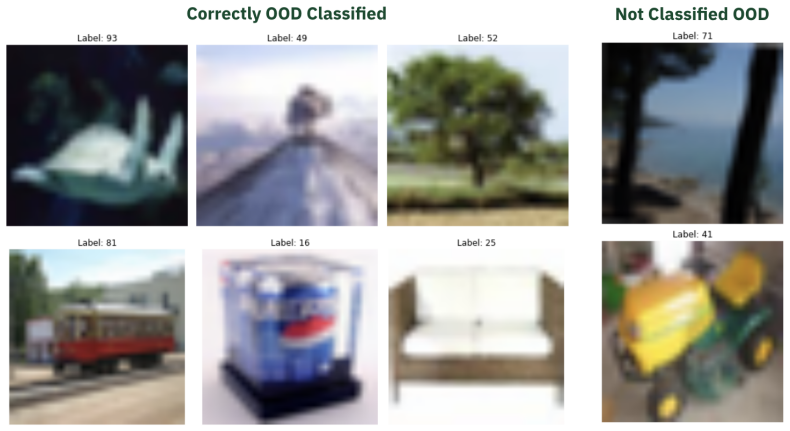
- Class-OOD detection works across simulated and real datasets, with MNIST class-OOD accuracy of 86% and MedMNIST class-OOD accuracy of 97% while ID accuracy remains high.
- Continuous updating after new subgroup initiation improves accuracy by 11%, 17%, and 15% on the simulated Circles, Moons, and Blobs datasets.
Reading between the lines
- Beyond the paper: because the encoder is frozen by design, the method's reach is bounded by the embedding space learned from in-distribution data; the most direct stress test is a domain shift that changes low-level features (e.g., texture or color) rather than semantic class.
- Beyond the paper: the regret-masking rule depends only on cluster posteriors and classifier logits, so it could be ported to other latent-variable generators; showing that the same rule improves OOD detection in a diffusion or GAN would separate the clustering mechanism from the VAE implementation.
- Beyond the paper: the cluster-spawning schedule (silhouette below 0.5, variance above 1.5) could serve as a general open-set trigger in continual learning, where each new cluster is a candidate class; a testable prediction is that the number of spawned clusters tracks the number of genuinely novel categories.
Editorial analysis
A structured set of objections, weighed in public.
Referee Report
Summary. The paper proposes DynaSubVAE, a variational autoencoder with a dynamic Gaussian-mixture-based clustering module that adds and splits clusters online in the latent space, freezes the encoder, and uses adaptive modulation plus several auxiliary losses. It claims to perform adaptive OOD detection through a 'regret-masking' mechanism, reports experiments on synthetic data, MNIST, MedMNIST, and CIFAR-10, and compares against supervised OOD detectors (KNN, DICE, Fdbd, Scale, MSP) as well as against GMM and KMeans++ for the subgrouping module.
Significance. The idea of coupling representation learning with online cluster adaptation for streaming OOD detection is timely, and the paper includes a broad set of experiments, ablations, and an appendix with implementation details. The frozen-encoder design and the augmentation/orthogonality losses are reasonable engineering choices. However, because the operational OOD decision rule is never specified, the entropy loss has a sign error relative to its stated goal, and the MNIST results are confounded by hyperparameter selection on MNIST, the central claims are currently not verifiable. If these issues were corrected, the framework could be a useful contribution to self-supervised streaming OOD detection.
major comments (4)
- [Section 3.1.2, Eq. (11)] The central claim of adaptive OOD detection via a regret-masking mechanism is not evaluable as written. Eq. (11) defines R_c as a max over alternative clusters of a loss difference plus an unspecified margin, but no equation, pseudocode, or threshold in the paper maps R_c (or any other quantity) to an OOD flag. Algorithm 1 uses only the silhouette score and intra-cluster variance to add or split clusters; the 'regret-masking mechanism' named in the abstract and Section 1 never appears again. The pseudo-label classifier, the margin value, and the alternative-cluster selection procedure are also unspecified. Because Table 3's 'Regret Precision' is defined as the percentage of correctly predicted OOD samples among all flagged samples, and the flagging rule is not defined, the reported class-OOD accuracies and the comparisons to GMM/KMeans++ cannot be reproduced or falsified from the manuscript.
- [Section 3.1.1, Eq. (8)] There is a sign error in the entropy loss. The text states that this loss 'encourages low-entropy (i.e., confident) assignments by penalizing uncertain (high-entropy) distributions,' but Eq. (8) defines L_entropy = -E_q q log q, which is the negative entropy; minimizing it maximizes entropy and would encourage diffuse, unconfident cluster assignments. If the intended behavior is confident assignments, the objective should be +E_q q log q (or equivalently the minimization of -H should be replaced by minimization of H). As written, the loss will push against the stated goal.
- [Appendix B.2 and Section 4.1] The hyperparameter selection and the headline MNIST results are entangled. Appendix B.2 states that the loss weights were derived by grid search on MNIST and then kept fixed for other datasets, yet MNIST class-OOD accuracy (86% in Table 1, Table 3, and Table 4) is reported as a headline result. This is a selection-on-test procedure for the MNIST rows: the same data used to pick weights is then used to report performance. The authors should either retune on a held-out set and report MNIST as a test-set result, or explicitly label MNIST as a development-set result and avoid claiming superiority on it.
- [Sections 3.1.2, 3.2, and 4 (Training Schema)] The 'self-supervised' characterization is internally inconsistent. Section 3.1.2 uses a pseudo-label derived from 'current label assignments using a classifier not trained on OOD data'; Section 4 says classifier training uses cross-entropy loss, which requires labels; and ID accuracy, NMI, and ARI are computed by aligning clusters to ground-truth labels. The Limitations appendix also states that the method 'does not rely on labeled data.' The role of labels needs to be clarified: if labels are used for the classifier or for evaluation, the method is not fully self-supervised, and if labels are used only for evaluation, the pseudo-label source and training procedure need explicit specification.
minor comments (6)
- [Section 3.1] The text refers to 'the final OOD flags 3.1.2,' but Section 3.1.2 does not define how OOD flags are computed; this cross-reference is unresolved.
- [Abstract and Conclusion] The term 'FRP@95' is used in the abstract and conclusion, while tables report 'FPR'; this inconsistency should be fixed.
- [Table 3] The header uses 'Kmean++' rather than 'KMeans++'; the spelling should be consistent.
- [Section 4, Evaluation Metrics] The sentence 'DynaSubV AE is resource-friendly, with training requiring only a GPU with 120GB of memory' is confusing, since 120GB is a very large memory footprint; please clarify the actual GPU memory requirement or remove the qualitative claim.
- [Algorithm 1] The control flow in Algorithm 1 is ambiguous: the nesting of the 'if Epoch ≠ 0' branch, the silhouette check, and the variance check is not clear from the indentation, and the 'else if' condition is not consistently indented with its matching 'if'. A rewrite with explicit braces or structured pseudocode would improve readability.
- [Section 3.1.1, Eq. (6)] The text says the summation of L_NLL and L_KL provides a lower bound for the ELBO, but it does not specify whether these terms are per-sample or batched, making the loss expression ambiguous.
Circularity Check
No circular derivation; minor in-sample hyperparameter selection on MNIST.
-
fitted input called prediction
[Appendix B.2 (Eqs. 20-21); results in Tables 1 and 3]
"We performed a grid search on the MNIST dataset to derive suitable weights for the loss components. These weights were kept consistent across different datasets for simplicity."
The loss weights in Eqs. (20)-(21) are selected by grid search on MNIST, and Appendix A.1 similarly selects the cluster-splitting threshold tau=1.5 from {1.2,1.5,1.7,2} without a stated held-out split. Tables 1 and 3 then report Mnist class-OOD accuracy (86%) as a headline result. Reporting performance on the same dataset used for model selection makes the MNIST numbers a re-statement of the selection process rather than an independent OOD-detection prediction. The CIFAR-10 near/far-OOD comparison in Table 2 is a separate, independent evaluation and does not inherit this in-sample bias.
full rationale
The paper's derivation chain does not reduce to its inputs by construction: the VAE objective (Eq. 4), the adaptive clustering rule (Algorithm 1), and the regret function (Eq. 11) are separate components, and no equation makes the reported OOD accuracy equal to a fitted constant or to a self-citation. There are no load-bearing self-citations and no imported uniqueness theorem. Two non-circularity caveats should be recorded: (1) the OOD decision rule is underspecified - the text says clusters 'help define ... the final OOD flags 3.1.2' and introduces R_c in Eq. 11, but no mapping from R_c to an OOD flag or threshold is given, so the central adaptive-OOD claim is hard to evaluate; this is an omitted-proof/correctness issue, not a circular reduction. (2) The 'Regret Precision' metric in Section 4 is defined as precision ('percentage of correctly predicted OOD samples out of all samples flagged as OOD'), so the new name does not change the measured quantity. The only genuine circularity-adjacent step is the MNIST grid search described in Appendix B.2: loss weights and the tau=1.5 variance threshold were selected with MNIST in the loop, and MNIST results are then reported as headline numbers. Because the central SOTA comparison on CIFAR-10 (Table 2) uses a different dataset and was not used to select those constants, the circularity is minor and localized.
Assumptions & free parameters
free parameters (11)
- Initial cluster count Ks =
not specified (Ks << N)
- Silhouette threshold =
0.5
- Variance threshold tau =
1.5
- Cluster addition frequency =
every 100 iterations
- Split fraction =
0.4
- New cluster log-variance and weight init =
log-variance 0.095, pi 0.001
- Regret margin =
unspecified
- Loss weights =
lambda_elbo=1, lambda_ent=3, lambda_usage=0.5, lambda_KLb=2, lambda_split=3, lambda_aug=0.1; beta_recon=1, beta_kl=1…
- Latent dims D1 and D2 =
D1: 80 sim, 128 MNIST/MedMNIST, 256 CIFAR-10; D2=5
- Softmax temperature tau =
unspecified
- OOD flag threshold =
unspecified
assumptions (6)
- standard math Standard VAE reparameterization and ELBO objective.
- domain assumption Frozen encoder can represent all future emerging subgroups.
- domain assumption A classifier trained only on ID data with pseudo-labels yields regret values that separate OOD from ID.
- domain assumption Latent-space clusters correspond to semantically meaningful subgroups.
- ad hoc to paper Silhouette threshold 0.5 and variance threshold 1.5 are appropriate triggers for cluster addition.
- ad hoc to paper Regret with a margin (Eq. 11) is a valid OOD score.
Cite this review
Pith. "Pith review of DynaSubVAE: Adaptive Subgrouping for Scalable and Robust OOD Detection." pith.science (2026). https://pith.science/paper/SQVIIJTQ
@misc{pith2026250610200,
  author       = {Pith},
  title        = {Pith review of: DynaSubVAE: Adaptive Subgrouping for Scalable and Robust OOD Detection},
  year         = {2026},
  howpublished = {\url{https://pith.science/paper/SQVIIJTQ}},
  note         = {Machine review of arXiv:2506.10200}
}
read the original abstract
Real-world observational data often contain existing or emerging heterogeneous subpopulations that deviate from global patterns. The majority of models tend to overlook these underrepresented groups, leading to inaccurate or even harmful predictions. Existing solutions often rely on detecting these samples as Out-of-domain (OOD) rather than adapting the model to new emerging patterns. We introduce DynaSubVAE, a Dynamic Subgrouping Variational Autoencoder framework that jointly performs representation learning and adaptive OOD detection. Unlike conventional approaches, DynaSubVAE evolves with the data by dynamically updating its latent structure to capture new trends. It leverages a novel non-parametric clustering mechanism, inspired by Gaussian Mixture Models, to discover and model latent subgroups based on embedding similarity. Extensive experiments show that DynaSubVAE achieves competitive performance in both near-OOD and far-OOD detection, and excels in class-OOD scenarios where an entire class is missing during training. We further illustrate that our dynamic subgrouping mechanism outperforms standalone clustering methods such as GMM and KMeans++ in terms of both OOD accuracy and regret precision.
Figures


Figures from the paper (4 more)



Reference graph
Works this paper leans on
-
[1]
k-means++: The advantages of careful seeding
David Arthur and Sergei Vassilvitskii. k-means++: The advantages of careful seeding. Technical report, Stanford, 2006
2006
-
[2]
Density-based clustering over an evolving data stream with noise
Feng Cao, Martin Estert, Weining Qian, and Aoying Zhou. Density-based clustering over an evolving data stream with noise. In Proceedings of the 2006 SIAM international conference on data mining, pages 328–339. SIAM, 2006
work page 2006
-
[3]
Unsupervised learning of visual features by contrasting cluster assignments
Mathilde Caron, Ishan Misra, Julien Mairal, Priya Goyal, Piotr Bojanowski, and Armand Joulin. Unsupervised learning of visual features by contrasting cluster assignments. Advances in neural information processing systems, 33:9912–9924, 2020
2020
-
[4]
Probabilistic machine learning for healthcare
Irene Y Chen, Shalmali Joshi, Marzyeh Ghassemi, and Rajesh Ranganath. Probabilistic machine learning for healthcare. Annual review of biomedical data science, 4(1):393–415, 2021
work page 2021
-
[5]
Maximum likelihood from incomplete data via the em algorithm
Arthur P Dempster, Nan M Laird, and Donald B Rubin. Maximum likelihood from incomplete data via the em algorithm. Journal of the royal statistical society: series B (methodological), 39 (1):1–22, 1977
work page 1977
-
[6]
Deep unsupervised clustering with gaussian mixture variational autoencoders
Nat Dilokthanakul, Pedro AM Mediano, Marta Garnelo, Matthew CH Lee, Hugh Salimbeni, Kai Arulkumaran, and Murray Shanahan. Deep unsupervised clustering with gaussian mixture variational autoencoders. arXiv preprint arXiv:1611.02648, 2016
arXiv 2016
-
[7]
Optimal representations for covariate shifts
Yann Dubois, Yangjun Ruan, and Chris J Maddison. Optimal representations for covariate shifts. In NeurIPS 2021 workshop on distribution shifts: connecting methods and applications, 2021
work page 2021
-
[8]
Cadet: Fully self-supervised out-of-distribution detection with contrastive learning
Charles Guille-Escuret, Pau Rodriguez, David Vazquez, Ioannis Mitliagkas, and Joao Monteiro. Cadet: Fully self-supervised out-of-distribution detection with contrastive learning. Advances in Neural Information Processing Systems, 36:7361–7376, 2023
work page 2023
Show all 47 references
-
[9]
Deep residual learning for image recognition
Kaiming He, Xiangyu Zhang, Shaoqing Ren, and Jian Sun. Deep residual learning for image recognition. In Proceedings of the IEEE conference on computer vision and pattern recognition, pages 770–778, 2016
2016
-
[10]
A baseline for detecting misclassified and out-of-distribution examples in neural networks
Dan Hendrycks and Kevin Gimpel. A baseline for detecting misclassified and out-of-distribution examples in neural networks. arXiv preprint arXiv:1610.02136, 2016
2016 arXiv
-
[11]
Approximating the kullback leibler divergence between gaussian mixture models
John R Hershey and Peder A Olsen. Approximating the kullback leibler divergence between gaussian mixture models. In 2007 IEEE International Conference on Acoustics, Speech and Signal Processing-ICASSP’07, volume 4, pages IV–317. IEEE, 2007
2007
-
[12]
Comparing partitions.Journal of classification, 2:193–218, 1985
Lawrence Hubert and Phipps Arabie. Comparing partitions.Journal of classification, 2:193–218, 1985
1985
-
[13]
Variational deep embedding: An unsupervised and generative approach to clustering
Zhuxi Jiang, Yin Zheng, Huachun Tan, Bangsheng Tang, and Hanning Zhou. Variational deep embedding: An unsupervised and generative approach to clustering. arXiv preprint arXiv:1611.05148, 2016
2016 arXiv
-
[14]
An introduc- tion to variational methods for graphical models
Michael I Jordan, Zoubin Ghahramani, Tommi S Jaakkola, and Lawrence K Saul. An introduc- tion to variational methods for graphical models. Machine learning, 37:183–233, 1999
1999
-
[15]
Rodd: A self- supervised approach for robust out-of-distribution detection
Umar Khalid, Ashkan Esmaeili, Nazmul Karim, and Nazanin Rahnavard. Rodd: A self- supervised approach for robust out-of-distribution detection. In 2022 IEEE/CVF Conference on Computer Vision and Pattern Recognition Workshops (CVPRW), pages 163–170. IEEE, 2022
2022
-
[16]
Semi-supervised learning with deep generative models
Durk P Kingma, Shakir Mohamed, Danilo Jimenez Rezende, and Max Welling. Semi-supervised learning with deep generative models. Advances in neural information processing systems, 27, 2014
2014
-
[17]
Learning multiple layers of features from tiny images
Alex Krizhevsky, Geoffrey Hinton, et al. Learning multiple layers of features from tiny images. 2009. 11
2009
-
[18]
Gradient-based learning applied to document recognition
Yann LeCun, Léon Bottou, Yoshua Bengio, and Patrick Haffner. Gradient-based learning applied to document recognition. Proceedings of the IEEE, 86(11):2278–2324, 1998
1998
-
[19]
Fast decision boundary based out-of-distribution detector
Litian Liu and Yao Qin. Fast decision boundary based out-of-distribution detector. In Interna- tional Conference on Machine Learning, pages 31728–31746. PMLR, 2024
2024
-
[20]
Sgdr: Stochastic gradient descent with warm restarts
Ilya Loshchilov and Frank Hutter. Sgdr: Stochastic gradient descent with warm restarts. arXiv preprint arXiv:1608.03983, 2016
2016 arXiv
-
[21]
Representa- tional continuity for unsupervised continual learning
Divyam Madaan, Jaehong Yoon, Yuanchun Li, Yunxin Liu, and Sung Ju Hwang. Representa- tional continuity for unsupervised continual learning. In International Conference on Learning Representations, 2022
2022
-
[22]
A clinician’s guide to understanding bias in critical clinical prediction models
João Matos, Jack Gallifant, Anand Chowdhury, Nicoleta Economou-Zavlanos, Marie-Laure Charpignon, Judy Gichoya, Leo Anthony Celi, Lama Nazer, Heather King, and An-Kwok Ian Wong. A clinician’s guide to understanding bias in critical clinical prediction models. Critical Care Clin...
2024
-
[23]
Accuracy on the line: on the strong correlation between out-of-distribution and in-distribution generalization
John P Miller, Rohan Taori, Aditi Raghunathan, Shiori Sagawa, Pang Wei Koh, Vaishaal Shankar, Percy Liang, Yair Carmon, and Ludwig Schmidt. Accuracy on the line: on the strong correlation between out-of-distribution and in-distribution generalization. In International conferen...
2021
-
[24]
Reading digits in natural images with unsupervised feature learning
Yuval Netzer, Tao Wang, Adam Coates, Alessandro Bissacco, Baolin Wu, Andrew Y Ng, et al. Reading digits in natural images with unsupervised feature learning. In NIPS workshop on deep learning and unsupervised feature learning, volume 2011, page 4. Granada, 2011
2011
-
[25]
Scikit- learn: Machine learning in python
Fabian Pedregosa, Gaël Varoquaux, Alexandre Gramfort, Vincent Michel, Bertrand Thirion, Olivier Grisel, Mathieu Blondel, Peter Prettenhofer, Ron Weiss, Vincent Dubourg, et al. Scikit- learn: Machine learning in python. the Journal of machine Learning research, 12:2825–2830, 2011
2011
-
[26]
Unsupervised representation learning with deep convolutional generative adversarial networks
Alec Radford, Luke Metz, and Soumith Chintala. Unsupervised representation learning with deep convolutional generative adversarial networks. arXiv preprint arXiv:1511.06434, 2015
2015 arXiv
-
[27]
Deep clustering: A comprehensive survey
Yazhou Ren, Jingyu Pu, Zhimeng Yang, Jie Xu, Guofeng Li, Xiaorong Pu, Philip S Yu, and Lifang He. Deep clustering: A comprehensive survey. IEEE transactions on neural networks and learning systems, 2024
2024
-
[28]
Mcluster- vaes: an end-to-end variational deep learning-based clustering method for subtype discovery using multi-omics data
Zhiwei Rong, Zhilin Liu, Jiali Song, Lei Cao, Yipe Yu, Mantang Qiu, and Yan Hou. Mcluster- vaes: an end-to-end variational deep learning-based clustering method for subtype discovery using multi-omics data. Computers in Biology and Medicine, 150:106085, 2022
2022
-
[29]
Silhouettes: a graphical aid to the interpretation and validation of cluster analysis
Peter J Rousseeuw. Silhouettes: a graphical aid to the interpretation and validation of cluster analysis. Journal of computational and applied mathematics, 20:53–65, 1987
1987
-
[30]
Accuracy on the wrong line: On the pitfalls of noisy data for out-of-distribution generalisation
Amartya Sanyal, Yaxi Hu, Yaodong Yu, Yian Ma, Yixin Wang, and Bernhard Schölkopf. Accuracy on the wrong line: On the pitfalls of noisy data for out-of-distribution generalisation. In The 28th International Conference on Artificial Intelligence and Statistics, 2024
2024
-
[31]
Facenet: A unified embedding for face recognition and clustering
Florian Schroff, Dmitry Kalenichenko, and James Philbin. Facenet: A unified embedding for face recognition and clustering. In Proceedings of the IEEE conference on computer vision and pattern recognition, pages 815–823, 2015
2015
-
[32]
Deep residual learning for image recognition: A survey
Muhammad Shafiq and Zhaoquan Gu. Deep residual learning for image recognition: A survey. Applied sciences, 12(18):8972, 2022
2022
-
[33]
How robust is unsupervised representation learning to distribution shift? In The Eleventh International Conference on Learning Representations, 2023
Yuge Shi, Imant Daunhawer, Julia E V ogt, Philip Torr, and Amartya Sanyal. How robust is unsupervised representation learning to distribution shift? In The Eleventh International Conference on Learning Representations, 2023
2023
-
[34]
Modern information retrieval: A brief overview
Amit Singhal et al. Modern information retrieval: A brief overview. IEEE Data Eng. Bull., 24 (4):35–43, 2001. 12
2001
-
[35]
A survey on open-set image recognition
Jiayin Sun and Qiulei Dong. A survey on open-set image recognition. arXiv preprint arXiv:2312.15571, 2023
2023 arXiv
-
[36]
Dice: Leveraging sparsification for out-of-distribution detection
Yiyou Sun and Yixuan Li. Dice: Leveraging sparsification for out-of-distribution detection. In European conference on computer vision, pages 691–708. Springer, 2022
2022
-
[37]
Out-of-distribution detection with deep nearest neighbors
Yiyou Sun, Yifei Ming, Xiaojin Zhu, and Yixuan Li. Out-of-distribution detection with deep nearest neighbors. In International Conference on Machine Learning , pages 20827–20840. PMLR, 2022
2022
-
[38]
Comprehensive analysis of clustering algorithms: exploring limitations and innovative solutions
Aasim Ayaz Wani. Comprehensive analysis of clustering algorithms: exploring limitations and innovative solutions. PeerJ Computer Science, 10:e2286, 2024
2024
-
[39]
Fashion-mnist: a novel image dataset for benchmarking machine learning algorithms
Han Xiao, Kashif Rasul, and Roland V ollgraf. Fashion-mnist: a novel image dataset for benchmarking machine learning algorithms. arXiv preprint arXiv:1708.07747, 2017
2017 arXiv
-
[40]
Machine learning enabled subgroup analysis with real-world data to inform clinical trial eligibility criteria design
Jie Xu, Hao Zhang, Hansi Zhang, Jiang Bian, and Fei Wang. Machine learning enabled subgroup analysis with real-world data to inform clinical trial eligibility criteria design. Scientific Reports, 13(1):613, 2023
2023
-
[41]
Scaling for training time and post-hoc out-of-distribution detection enhancement
Kai Xu, Rongyu Chen, Gianni Franchi, and Angela Yao. Scaling for training time and post-hoc out-of-distribution detection enhancement. In The Twelfth International Conference on Learning Representations, 2023
2023
-
[42]
Medmnist classification decathlon: A lightweight automl benchmark for medical image analysis
Jiancheng Yang, Rui Shi, and Bingbing Ni. Medmnist classification decathlon: A lightweight automl benchmark for medical image analysis. In IEEE 18th International Symposium on Biomedical Imaging (ISBI), pages 191–195, 2021
2021
-
[43]
Medmnist v2-a large-scale lightweight benchmark for 2d and 3d biomedical image classification
Jiancheng Yang, Rui Shi, Donglai Wei, Zequan Liu, Lin Zhao, Bilian Ke, Hanspeter Pfister, and Bingbing Ni. Medmnist v2-a large-scale lightweight benchmark for 2d and 3d biomedical image classification. Scientific Data, 10(1):41, 2023
2023
-
[44]
Generalized out-of-distribution detection: A survey
Jingkang Yang, Kaiyang Zhou, Yixuan Li, and Ziwei Liu. Generalized out-of-distribution detection: A survey. International Journal of Computer Vision, pages 1–28, 2024
2024
-
[45]
Out- of-distribution detection with diversification (provably)
Haiyun Yao, Zongbo Han, Huazhu Fu, Xi Peng, Qinghua Hu, and Changqing Zhang. Out- of-distribution detection with diversification (provably). arXiv preprint arXiv:2411.14049 , 2024
2024 arXiv
-
[46]
Out-of-distribution detection for medical applications: Guidelines for practical evaluation
Karina Zadorozhny, Patrick Thoral, Paul Elbers, and Giovanni Cinà. Out-of-distribution detection for medical applications: Guidelines for practical evaluation. In Multimodal AI in healthcare: A paradigm shift in health intelligence, pages 137–153. Springer, 2022
2022
-
[47]
Openood v1.5: Enhanced benchmark for out-of-distribution detection
Jingyang Zhang, Jingkang Yang, Pengyun Wang, Haoqi Wang, Yueqian Lin, Haoran Zhang, Yiyou Sun, Xuefeng Du, Yixuan Li, Ziwei Liu, Yiran Chen, and Hai Li. Openood v1.5: Enhanced benchmark for out-of-distribution detection. arXiv preprint arXiv:2306.09301, 2023. 13 A Methodology ...
2023 arXiv
Reviewed August 7, 2026 · model on record in the stance chip above.
Discussion (0). Continue with ORCID to comment.