REVIEW 4 major objections 5 minor 72 references
From Spikes to Speech: NeuroVoc -- A Biologically Plausible Vocoder Framework for Auditory Perception and Cochlear Implant Simulation
T0 review · 4 major / 5 minor · reviewed 2026-08-07 · deepseek-v4-flash
Pith's one-line read NeuroVoc reconstructs intelligible speech from simulated auditory nerve spikes using classical signal processing, with electrical-hearing DIN scores clinically equivalent to cochlear-implant data.
desk verdict A clean, modular neurogram-to-speech vocoder with real behavioral data; the missing standard-vocoder baseline and a loosely anchored equivalence test keep it from being a slam dunk, but it deserves serious review. read the letter →
The pith
A machine-rendered reading of the paper's core claim, the machinery that carries it, and where it could break.
The reading
What carries the argument
The load-bearing identity is the analogy between the neurogram and a Mel-band power spectrogram. Spike trains from fibers assigned to Mel-spaced frequency bands are binned at 36 microseconds, smoothed with a Hann window, downsampled, clipped, and mapped linearly to a decibel-to-power scale; a Mel filterbank inversion via non-negative least squares recovers a linear-frequency magnitude spectrum, and the Griffin-Lim algorithm estimates phase from the redundancy of overlapping STFT windows. This stack is what lets any tonotopically mapped auditory nerve model feed the same decoder.
What would settle it
Give actual CI users and normal-hearing listeners the same NeuroVoc EH-vocoded and unprocessed DIN material in one controlled lab session; if the EH-vocoded speech reception threshold differs from the pooled clinical CI mean by more than the 1.51 dB equivalence margin, the claim of clinical equivalence fails.
Extended reading notes
Core claim
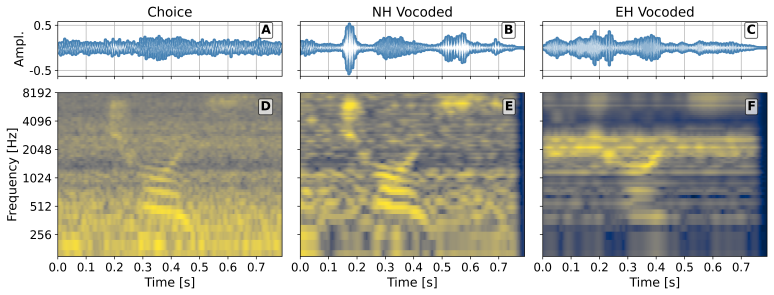
The central claim is that a time-frequency binning of auditory nerve fiber spike trains, called a neurogram, carries enough spectral and temporal information to be inverted into intelligible acoustic speech using only classical signal processing. The authors show this with two very different underlying models: a normal-hearing auditory nerve model and an electrical-hearing pipeline built from a 3D volume-conduction model, a speech coding strategy, and the PHAST+ phenomenological nerve model. The reconstruction preserves model-specific characteristics, with the normal-hearing vocoder retaining harmonic structure while the electrical-hearing vocoder shows spectral smearing and channel interaction. In the DIN experiment, the electrical-hearing vocoder raised speech reception thresholds by 7.1 dB relative to unprocessed speech, and the resulting thresholds were statistically equivalent to pooled clinical data from cochlear implant users.
Load-bearing premise
The reconstruction's fidelity rests on treating binned spike counts as a faithful proxy for acoustic power in each Mel band; anything that breaks that linear correspondence, such as onset bursts, refractoriness, or saturation, degrades the decoded sound.
Editorial extensions
If this is right
- A single NeuroVoc decoder can evaluate any auditory nerve model or cochlear implant coding strategy without building strategy-specific vocoders.
- Differences in reconstruction quality track model characteristics: the normal-hearing vocoder preserves harmonics, while the electrical-hearing vocoder shows spectral smearing and channel interaction, matching known CI perceptual limits.
- Because the electrical-hearing vocoder's DIN thresholds are clinically equivalent to CI users' scores, NeuroVoc could stand in for CI listeners in speech-in-noise experiments.
- Since input and output are both acoustic, information-theoretic or distance measures can compare different hearing models numerically in the same domain.
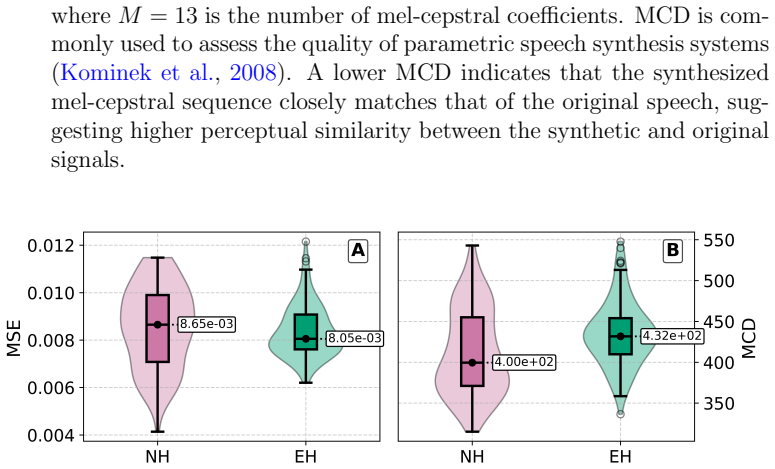
- MSE alone is misleading: the electrical-hearing vocoder had lower waveform error but worse spectral distortion and intelligibility, so spectral and perceptual metrics are needed to judge reconstruction quality.
Reading between the lines
- A natural extension, which the authors flag as future work, is a head-to-head comparison of SpecRes with the ACE strategy inside the same NeuroVoc pipeline; the framework appears ready for this without modification.
- The linear neurogram-to-power assumption implies that reconstructions will degrade for loud stimuli where saturation, onset responses, and refractoriness distort spike counts; adding a compression or nonlinear calibration step is a testable fix.
- The encoder-decoder pattern might transfer to other neural codes, but the frequency-place mapping is the critical ingredient, so applying it to cortical recordings would require solving that mapping first.
- The online equivalence results suggest NeuroVoc could support remote, large-N studies of hearing-impaired perception without recruiting CI users for every experimental condition.
Editorial analysis
A structured set of objections, weighed in public.
Referee Report
Summary. NeuroVoc is a model-agnostic vocoder framework that reconstructs acoustic waveforms from simulated auditory nerve activity. The encoder bins, filters, and rescales spike trains from either a Bruce et al. (2018) normal-hearing model or a PHAST+-based electrical-hearing pipeline into a neurogram; the decoder converts this representation to a Mel-band power estimate, recovers a linear-frequency magnitude spectrum via non-negative least squares, and applies Griffin-Lim phase reconstruction. The authors assess reconstruction quality with MSE and mel-cepstral distortion, and they run an online Dutch Digits-in-Noise test in which 52 self-reported normal-hearing participants completed unprocessed, NH-vocoded, and EH-vocoded conditions. The unprocessed and EH-vocoded SRTs are reported as statistically equivalent to published clinical NH and CI DIN data, with mean SRT elevations of 2.4 dB for the NH vocoder and 7.1 dB for the EH vocoder relative to unprocessed speech.
Significance. The framework is genuinely model-agnostic, open-source, and does not rely on learned reconstruction networks, which makes it a potentially useful, interpretable tool for CI simulation and for comparing normal-hearing and electrical-hearing models. The authors compare against external clinical DIN data rather than fitting the vocoder to those data, and the code release supports reproducibility. If the perceptual results are robust, NeuroVoc would be a lightweight alternative to strategy-specific vocoders. However, the headline equivalence claim rests on a permissive statistical margin applied to a heterogeneous pooled reference, and the absence of a comparison against standard channel vocoders limits the practical claims.
major comments (4)
- [§5.2.1, Table 1] The TOST equivalence for the EH-vocoded group uses a margin of half the pooled SD of the heterogeneous CI reference, i.e., 1.51 dB. Against the de Graaff et al. (2016) subgroup alone (mean -3.6 dB, SD 1.7 dB), the EH-vocoded mean (-1.9 dB) differs by 1.7 dB, which exceeds a half-SD margin of 0.85 dB; the pooled reference also mixes pediatric listeners (Vroegop et al., 2021), values estimated from figures, and discontinuous-noise data. The claim that NeuroVoc 'accurately reflects' CI speech-in-noise performance should be supported by a pre-specified equivalence margin and by sensitivity analyses against well-matched adult studies.
- [§4.3.3] One participant was excluded after the fact because their unprocessed SRT of -5.5 dB was deemed too high an outlier. The exclusion criterion is not pre-specified, and this participant's data would have affected all three conditions; the TOST analysis in §5.2.1 does not report whether the equivalence conclusion survives inclusion of this participant. Please report results with and without this participant or justify the criterion with a pre-registered outlier rule.
- [§3.5.1] The preprocessing step rescales normalized neurogram values linearly to a decibel-like power range, treating spike counts as a faithful proxy for acoustic band power. For the Bruce et al. (2018) model under noise, Figure 8 shows refractoriness-driven 'clumping' that is not present in the input spectrum, and for the EH model onset responses and current spread distort the count-to-power mapping. The reconstruction quality therefore depends on an unvalidated linearity assumption. A calibration experiment, for example reconstructing synthetic tones or stationary noise and comparing band levels, would test this assumption directly.
- [§5.3] The introduction states that NeuroVoc 'eliminates the need for speech-coding-strategy-specific vocoder implementations,' but the manuscript does not compare NeuroVoc with a standard channel vocoder or with a vocoder designed for a specific speech coding strategy. Since the future-work paragraph itself lists this comparison as pending, the practical advantage over existing vocoders is not yet demonstrated.
minor comments (5)
- [Eq. (5)] The Hann window is defined with an unspecified M, while the window length H is introduced only in §3.2; please define M or use H consistently.
- [Figure 6 and §4.1] The Figure 6 caption assigns panel B to the NH vocoder and panel C to the EH vocoder, but the text refers to the EH reconstruction as 'Figure 6B'; one of these is incorrect.
- [§3.4] The text reports 3,200 modeled fibers and then says '1356 virtual electrode channels were modeled,' while the footnote states '215 · 9 = 135'; these numbers do not reconcile and should be clarified.
- [§4.3.3] The sentence 'Two participants did not complete all three lists, and the other scored an SRT of -5.5 dB' should say 'one participant' and should make explicit that three participants were excluded in total.
- [§4.2.1] The MSE and MCD comparisons between NH and EH vocoders use a two-sided Mann-Whitney U test on 120 paired stimuli; a paired test would be more appropriate for these within-corpus comparisons.
Circularity Check
No significant circularity: NeuroVoc is a signal-processing reconstruction pipeline validated against external clinical DIN data; no fitted parameter or self-citation chain forces the claimed result.
full rationale
I walked the claimed derivation chain rather than the framing. The neurogram is produced from spike trains by explicit binning and filtering (Eqs. 3-5), then the decoder maps it to a Mel-band-like power representation using fixed scaling (Eqs. 6-7), inverts a Mel filterbank by NNLS, and applies Griffin-Lim. Every parameter in this chain (64 Mel bands, 36-microsecond bins, 54-millisecond Hann window, 512-point FFT, 320 iterations, 50 dB reference) is a stated modeling choice, not a fit to the DIN outcome or to the clinical reference distribution. The EH model is taken from prior open-source work (PHAST+, de Nobel et al. 2024) and is not refit here; self-citation to that work is not load-bearing because the model is code-reproduced and externally inspectable. The clinical comparison uses published DIN SRT distributions from independent studies; although one of the pooled studies has overlapping authors (Stronks et al. 2025), it is empirical clinical data, not a model output of this paper, so the comparison does not reduce to a self-citation. The treatment of the binned neurogram as a proxy for a Mel-band power spectrogram is an explicit modeling assumption, flagged in the paper, and while it may affect reconstruction fidelity it is not a circular reduction: the intelligibility claim is tested behaviorally against an external benchmark. The wide, data-derived equivalence margin in the TOST analysis is a legitimate statistical-robustness concern, but it is not a case of a prediction reducing to its inputs by construction. No equation in the paper is equivalent to its own input, and no fitted parameter is renamed as a prediction. I therefore find no significant circularity.
Assumptions & free parameters
free parameters (4)
- Spontaneous firing rate in PHAST+ (EH model) =
50 spikes/s
- Stimulus presentation level =
50 dB RMS SPL
- Neurogram temporal smoothing window length =
H = 1500 bins (0.054 s)
- Vocoder reconstruction parameters =
64 mel bands, 512-point FFT, hop 32, 320 Griffin-Lim iterations
assumptions (4)
- domain assumption Neurogram values can be mapped to a Mel-band power spectrogram via linear scaling and NNLS inversion.
- standard math Griffin-Lim converges to a reasonable phase estimate from a magnitude spectrogram.
- domain assumption CI users adapt to a 'learned' tonotopic map that matches electrode operating frequencies rather than the Greenwood place map.
- standard math The STFT with overlapping Hann windows satisfies constant-overlap-add and permits perfect reconstruction.
Cite this review
Pith. "Pith review of From Spikes to Speech: NeuroVoc -- A Biologically Plausible Vocoder Framework for Auditory Perception and Cochlear Implant Simulation." pith.science (2026). https://pith.science/paper/SRXGDLL2
@misc{pith2026250603959,
  author       = {Pith},
  title        = {Pith review of: From Spikes to Speech: NeuroVoc -- A Biologically Plausible Vocoder Framework for Auditory Perception and Cochlear Implant Simulation},
  year         = {2026},
  howpublished = {\url{https://pith.science/paper/SRXGDLL2}},
  note         = {Machine review of arXiv:2506.03959}
}
read the original abstract
We present NeuroVoc, a flexible model-agnostic vocoder framework that reconstructs acoustic waveforms from simulated neural activity patterns using an inverse Fourier transform. The system applies straightforward signal processing to neurogram representations, time-frequency binned outputs from auditory nerve fiber models. Crucially, the model architecture is modular, allowing for easy substitution or modification of the underlying auditory models. This flexibility eliminates the need for speech-coding-strategy-specific vocoder implementations when simulating auditory perception in cochlear implant (CI) users. It also allows direct comparisons between normal hearing (NH) and electrical hearing (EH) models, as demonstrated in this study. The vocoder preserves distinctive features of each model; for example, the NH model retains harmonic structure more faithfully than the EH model. We evaluated perceptual intelligibility in noise using an online Digits-in-Noise (DIN) test, where participants completed three test conditions: one with standard speech, and two with vocoded speech using the NH and EH models. Both the standard DIN test and the EH-vocoded groups were statistically equivalent to clinically reported data for NH and CI listeners. On average, the NH and EH vocoded groups increased SRT compared to the standard test by 2.4 dB and 7.1 dB, respectively. These findings show that, although some degradation occurs, the vocoder can reconstruct intelligible speech under both hearing models and accurately reflects the reduced speech-in-noise performance experienced by CI users.
Figures


Figures from the paper (8 more)





Reference graph
Works this paper leans on
-
[1]
Akbari, H., Khalighinejad, B., Herrero, J. L., Mehta, A. D., and Mesgarani, N. (2019). Towards reconstructing intelligible speech from the human auditory cortex. Scientific reports , 9(1):874
work page 2019
-
[2]
Allen, J. (1977). Short term spectral analysis, synthesis, and modification by discrete fourier transform. IEEE Transactions on Acoustics, Speech, and Signal Processing , 25(3):235--238
work page 1977
-
[3]
B \"a ck, T. H., Kononova, A. V., van Stein, B., Wang, H., Antonov, K. A., Kalkreuth, R. T., de Nobel, J., Vermetten, D., de Winter, R., and Ye, F. (2023). Evolutionary algorithms for parameter optimization—thirty years later. Evolutionary Computation , 31(2):81--122
work page 2023
-
[4]
Berndt, D. J. and Clifford, J. (1994). Using dynamic time warping to find patterns in time series. In KDD workshop , volume 10, pages 359--370. Seattle, WA, USA:
work page 1994
-
[5]
Blamey, P., Artieres, F., Ba s kent, D., Bergeron, F., Beynon, A., Burke, E., Dillier, N., Dowell, R., Fraysse, B., Gall \'e go, S., et al. (2012). Factors affecting auditory performance of postlinguistically deaf adults using cochlear implants: an update with 2251 patients. Audiology and Neurotology , 18(1):36--47
work page 2012
-
[6]
Bonham, B. H. and Litvak, L. M. (2008). Current focusing and steering: modeling, physiology, and psychophysics. Hearing research , 242(1-2):141--153
work page 2008
-
[7]
Briaire, J. J. and Frijns, J. H. M. (2000). 3d mesh generation to solve the electrical volume conduction problem in the implanted inner ear. Simulation Practice and Theory , 8(1):57--73
work page 2000
-
[8]
Briaire, J. J. and Frijns, J. H. M. (2005). Unraveling the electrically evoked compound action potential. Hearing Research , 205(1):143--156
work page 2005
Show all 72 references
-
[9]
B rian M c F ee, C olin R affel, D awen L iang, D aniel P . W . E llis, M att M c V icar, E ric B attenberg, and O riol N ieto (2015). librosa: A udio and M usic S ignal A nalysis in P ython. In K athryn H uff and J ames B ergstra, editors, P roceedings of the 14th P ython in ...
2015
-
[10]
Bruce, I., Buller, A., and Zilany, M. S. A. (2023). Modeling of auditory nerve fiber input/output functions near threshold. In Acoustics 2023 , Sydney, Australia. Conference poster
2023
-
[11]
Bruce, I., Irlicht, L., White, M., O'Leary, S., Dynes, S., Javel, E., and Clark, G. (1999). A stochastic model of the electrically stimulated auditory nerve: pulse-train response. IEEE Transactions on Biomedical Engineering , 46(6):630--637
1999
-
[12]
C., Erfani, Y., and Zilany, M
Bruce, I. C., Erfani, Y., and Zilany, M. S. (2018). A phenomenological model of the synapse between the inner hair cell and auditory nerve: Implications of limited neurotransmitter release sites. Hearing Research , 360:40--54. Computational models of the auditory system
2018
-
[13]
P., Macherey, O., Frijns, J
Carlyon, R. P., Macherey, O., Frijns, J. H., Axon, P. R., Kalkman, R. K., Boyle, P., Baguley, D. M., Briggs, J., Deeks, J. M., Briaire, J. J., et al. (2010). Pitch comparisons between electrical stimulation of a cochlear implant and acoustic stimuli presented to a normal-heari...
2010
-
[14]
Cullington, H. E. and Zeng, F.-G. (2008). Speech recognition with varying numbers and types of competing talkers by normal-hearing, cochlear-implant, and implant simulation subjects. The Journal of the Acoustical Society of America , 123(1):450--461
2008
-
[15]
B., and Goupell, M
Cychosz, M., Winn, M. B., and Goupell, M. J. (2024). How to vocode: Using channel vocoders for cochlear-implant research. The Journal of the Acoustical Society of America , 155(4):2407--2437
2024
-
[16]
Daly, I. (2023). Neural decoding of music from the eeg. Scientific Reports , 13(1):624
2023
-
[17]
de Graaff, F., Huysmans, E., Qazi, O. u. R., Vanpoucke, F. J., Merkus, P., Goverts, S. T., and Smits, C. (2016). The development of remote speech recognition tests for adult cochlear implant users: The effect of presentation mode of the noise and a reliable method to deliver s...
2016
-
[18]
S., Briaire, J
de Nobel , J., Martens, S. S., Briaire, J. J., Bäck, T. H., Kononova, A. V., and Frijns, J. H. (2024). Biophysics-inspired spike rate adaptation for computationally efficient phenomenological nerve modeling. Hearing Research , 447:109011
2024
-
[19]
Dekker, D. M. T., Briaire, J. J., and Frijns, J. H. M. (2014). The impact of internodal segmentation in biophysical nerve fiber models. Journal of Computational Neuroscience , 37(2):307--315
2014
-
[20]
Dudley, H. (1939). Remaking speech. The Journal of the Acoustical Society of America , 11(2):169--177
1939
-
[21]
K., and Dillier, N
El Boghdady , N., Kegel, A., Lai, W. K., and Dillier, N. (2016). A neural-based vocoder implementation for evaluating cochlear implant coding strategies. Hearing Research , 333:136--149
2016
-
[22]
Frijns, J. H. M., Briaire, J. J., and Schoonhoven, R. (2000). Integrated use of volume conduction and neural models to simulate the response to cochlear implants. Simulation Practice and Theory , 8(1):75--97
2000
-
[23]
Frijns, J. H. M., de Snoo , S., and Schoonhoven, R. (1995). Potential distributions and neural excitation patterns in a rotationally symmetric model of the electrically stimulated cochlea. Hearing Research , 87(1):170--186
1995
-
[24]
and Nogueira, W
Gajecki, T. and Nogueira, W. (2022). An end-to-end deep learning speech coding and denoising strategy for cochlear implants. In ICASSP 2022 - 2022 IEEE International Conference on Acoustics, Speech and Signal Processing (ICASSP) , pages 3109--3113
2022
-
[25]
Goossens, T., Vercammen, C., Wouters, J., and van Wieringen , A. (2017). Masked speech perception across the adult lifespan: Impact of age and hearing impairment. Hearing Research , 344:109--124
2017
-
[26]
and Lim, J
Griffin, D. and Lim, J. (1984). Signal estimation from modified short-time fourier transform. IEEE Transactions on Acoustics, Speech, and Signal Processing , 32(2):236--243
1984
-
[27]
and Hanekom, J
Hanekom, T. and Hanekom, J. J. (2016). Three-dimensional models of cochlear implants: A review of their development and how they could support management and maintenance of cochlear implant performance. Network: Computation in Neural Systems , 27(2-3):67--106
2016
-
[28]
and Harte, N
Hines, A. and Harte, N. (2012). Speech intelligibility prediction using a neurogram similarity index measure. Speech Communication , 54(2):306--320
2012
-
[29]
Hodgkin, A. L. and Huxley, A. F. (1952). A quantitative description of membrane current and its application to conduction and excitation in nerve. The Journal of physiology , 117(4):500
1952
-
[30]
Ab-generic-python-toolbox: A toolbox for simulating cochlear implant signal processing and the perception of sound by implant recipients
jabeim (2025). Ab-generic-python-toolbox: A toolbox for simulating cochlear implant signal processing and the perception of sound by implant recipients. https://github.com/jabeim/AB-Generic-Python-Toolbox. Accessed: 2025-04-24
2025
-
[31]
T., Leclère, T., Wijetillake, A., Segovia-Martínez, M., and Lopez-Poveda, E
Johannesen, P. T., Leclère, T., Wijetillake, A., Segovia-Martínez, M., and Lopez-Poveda, E. A. (2022). Modeling temporal information encoding by the population of fibers in the healthy and synaptopathic auditory nerve. Hearing Research , 426:108621
2022
-
[32]
Johnson, K. O. (2000). Neural coding. Neuron , 26(3):563--566
2000
-
[33]
W., Smits, C., Merkus, P., Goverts, S
Kaandorp, M. W., Smits, C., Merkus, P., Goverts, S. T., and Festen, J. M. (2015). Assessing speech recognition abilities with digits in noise in cochlear implant and hearing aid users. International Journal of Audiology , 54(1):48--57
2015
-
[34]
K., Briaire, J
Kalkman, R. K., Briaire, J. J., Dekker, D. M., and Frijns, J. H. (2014). Place pitch versus electrode location in a realistic computational model of the implanted human cochlea. Hearing research , 315:10--24
2014
-
[35]
K., Briaire, J
Kalkman, R. K., Briaire, J. J., Dekker, D. M., and Frijns, J. H. M. (2022). The relation between polarity sensitivity and neural degeneration in a computational model of cochlear implant stimulation. Hearing Research , 415:108413
2022
-
[36]
Kansaku, K. (2021). Neuroprosthetics in systems neuroscience and medicine. Scientific Reports , 11(1):5404
2021
-
[37]
Y.-S., Watanabe, T., Thomas, E
Kiang, N. Y.-S., Watanabe, T., Thomas, E. C., and Clark, L. F. (1966). Discharge Patterns of Single Fibers in the Cat's Auditory Nerve , volume 35 of MIT Research Monograph . MIT Press, Cambridge, MA
1966
-
[38]
Kominek, J., Schultz, T., and Black, A. W. (2008). Synthesizer voice quality of new languages calibrated with mean mel cepstral distortion. In SLTU , pages 63--68
2008
-
[39]
Kwak, C., Seo, J.-H., Oh, Y., and Han, W. (2021). Efficacy of the digit-in-noise test: a systematic review and meta-analysis. Journal of Audiology & Otology , 26(1):10
2021
-
[40]
T., Wijetillake, A., Segovia-Martínez, M., and Lopez-Poveda, E
Leclère, T., Johannesen, P. T., Wijetillake, A., Segovia-Martínez, M., and Lopez-Poveda, E. A. (2023). A computational modelling framework for assessing information transmission with cochlear implants. Hearing Research , 432:108744
2023
-
[41]
Litvak, L., Delgutte, B., and Eddington, D. (2001). Auditory nerve fiber responses to electric stimulation: modulated and unmodulated pulse trains. The Journal of the Acoustical Society of America , 110(1):368--379
2001
-
[42]
Lyon, R. F. et al. (2011). Using a cascade of asymmetric resonators with fast-acting compression as a cochlear model for machine-hearing applications. In Autumn meeting of the acoustical society of japan , pages 509--512
2011
-
[43]
Mertens, G., Van de Heyning, P., Vanderveken, O., Topsakal, V., and Van Rompaey, V. (2022). The smaller the frequency-to-place mismatch the better the hearing outcomes in cochlear implant recipients? European Archives of Oto-Rhino-Laryngology , 279(4):1875--1883
2022
-
[44]
Quick statistics about hearing
National Institute on Deafness and Other Communication Disorders (2024). Quick statistics about hearing. Technical report, National Institutes of Health, Washington, DC. Accessed: 2025-04-14
2024
-
[45]
S., Morini, G., Shroads, E., and Chatterjee, M
Newman, R. S., Morini, G., Shroads, E., and Chatterjee, M. (2020). Toddlers' fast-mapping from noise-vocoded speech. The Journal of the Acoustical Society of America , 147(4):2432--2441
2020
-
[46]
Nogueira, W., Litvak, L., Edler, B., Ostermann, J., and B \"u chner, A. (2009). Signal processing strategies for cochlear implants using current steering. EURASIP Journal on Advances in Signal Processing , 2009:1--20
2009
-
[47]
Oppenheim, A. V. (1999). Discrete-time signal processing . Pearson Education India
1999
-
[48]
Park, J.-Y., Tsukamoto, M., Tanaka, M., and Kamitani, Y. (2023). Sound reconstruction from human brain activity via a generative model with brain-like auditory features
2023
-
[49]
N., David, S
Pasley, B. N., David, S. V., Mesgarani, N., Flinker, A., Shamma, S. A., Crone, N. E., Knight, R. T., and Chang, E. F. (2012). Reconstructing speech from human auditory cortex. PLoS biology , 10(1):e1001251
2012
-
[50]
and Jasper, H
Penfield, W. and Jasper, H. (1954). Epilepsy and the functional anatomy of the human brain. Little, Brown & Co
1954
-
[51]
Perraudin, N., Balazs, P., and Søndergaard, P. L. (2013). A fast griffin-lim algorithm. In 2013 IEEE Workshop on Applications of Signal Processing to Audio and Acoustics , pages 1--4
2013
-
[52]
Polspoel, S. (2024). Global access to digits-in-noise hearing tests: a fully automatic test development procedure . Phd-thesis - research and graduation internal, Vrije Universiteit Amsterdam
2024
-
[53]
Rattay, F. (1986). Analysis of models for external stimulation of axons. IEEE Transactions on Biomedical Engineering , 33(10):974--977
1986
-
[54]
Rattay, F., Lutter, P., and Felix, H. (2001). A model of the electrically excited human cochlear neuron: I. contribution of neural substructures to the generation and propagation of spikes. Hearing research , 153(1-2):43--63
2001
-
[55]
A., Turner, C
Reiss, L. A., Turner, C. W., Erenberg, S. R., and Gantz, B. J. (2007). Changes in pitch with a cochlear implant over time. Journal for the Association for Research in Otolaryngology , 8:241--257
2007
-
[56]
Rosen, S., Faulkner, A., and Wilkinson, L. (1999). Adaptation by normal listeners to upward spectral shifts of speech: Implications for cochlear implants. The Journal of the Acoustical Society of America , 106(6):3629--3636
1999
-
[57]
R., Reid, G., and Bostock, H
Schwarz, J. R., Reid, G., and Bostock, H. (1995). Action potentials and membrane currents in the human node of ranvier. Pflugers Arch , 430(2):283--292
1995
-
[58]
V., Zeng, F.-G., Kamath, V., Wygonski, J., and Ekelid, M
Shannon, R. V., Zeng, F.-G., Kamath, V., Wygonski, J., and Ekelid, M. (1995). Speech recognition with primarily temporal cues. Science , 270(5234):303--304
1995
-
[59]
V., Zeng, F.-G., and Wygonski, J
Shannon, R. V., Zeng, F.-G., and Wygonski, J. (1998). Speech recognition with altered spectral distribution of envelope cues. The Journal of the Acoustical Society of America , 104(4):2467--2476
1998
-
[60]
J., Prendergast, G., Munro, K
Shehabi, A., Plack, C. J., Prendergast, G., Munro, K. J., Stone, M. A., Laycock, J., AlJasser, A., and Guest, H. (2025). Online arabic and english digits-in-noise tests: Effects of test language and at-home testing. Journal of Speech, Language, and Hearing Research , 68(1):388--398
2025
-
[61]
Slaney, M. (1998). A matlab toolbox for auditory modeling work
1998
-
[62]
Smits, C., Theo Goverts, S., and Festen, J. M. (2013). The digits-in-noise test: Assessing auditory speech recognition abilities in noise. The Journal of the Acoustical Society of America , 133(3):1693--1706
2013
-
[63]
S., Kidd, G
Smits, C., Watson, C. S., Kidd, G. R., Moore, D. R., and and, S. T. G. (2016). A comparison between the dutch and american-english digits-in-noise (din) tests in normal-hearing listeners. International Journal of Audiology , 55(6):358--365
2016
-
[64]
S., Volkmann, J., and Newman, E
Stevens, S. S., Volkmann, J., and Newman, E. B. (1937). A scale for the measurement of the psychological magnitude pitch. The Journal of the Acoustical Society of America , 8(3):185--190
1937
-
[65]
C., van Deurzen, R., Jansen, P
Stronks, H. C., van Deurzen, R., Jansen, P. L., Briaire, J. J., and Frijns, J. H. M. (2025). Effect of speech material and scoring method on psychometric curves for cochlear implant users and typical hearing listeners. Ear and Hearing , pages 10--1097
2025
-
[66]
J., Briaire, J
van Gendt, M. J., Briaire, J. J., Kalkman, R. K., and Frijns, J. H. (2016). A fast, stochastic, and adaptive model of auditory nerve responses to cochlear implant stimulation. Hearing research , 341:130--143
2016
-
[67]
and Derksen, H
Verveen, A. and Derksen, H. (1968). Fluctuation phenomena in nerve membrane. Proceedings of the IEEE , 56(6):906--916
1968
-
[68]
Vroegop, J., Rodenburg-Vlot, M., Goedegebure, A., Doorduin, A., Homans, N., and van der Schroeff, M. (2021). The feasibility and reliability of a digits-in-noise test in the clinical follow-up of children with mild to profound hearing loss. Ear and Hearing , 42(4):973--981
2021
-
[69]
K., Reinagel, P., and Meister, M
Warland, D. K., Reinagel, P., and Meister, M. (1997). Decoding visual information from a population of retinal ganglion cells. Journal of Neurophysiology , 78(5):2336--2350. PMID: 9356386
1997
-
[70]
S., Finley, C
Wilson, B. S., Finley, C. C., Lawson, D. T., Wolford, R. D., Eddington, D. K., and Rabinowitz, W. M. (1991). Better speech recognition with cochlear implants. Nature , 352(6332):236--238
1991
-
[71]
Yeomans, J. S. (1979). The absolute refractory periods of self-stimulation neurons. Physiology & Behavior , 22(5):911--919
1979
-
[72]
Zilany, M. S. A. and Bruce, I. C. (2023). Source code for the bruce, erfani and zilany (2018) auditory nerve model (dec 2023 update). https://www.ece.mcmaster.ca/ ibruce/zbcANmodel/zbcANmodel.htm. Accessed: 2025-04-17
2023
Reviewed August 7, 2026 · model on record in the stance chip above.
Discussion (0). Continue with ORCID to comment.