REVIEW 3 major objections 5 minor 53 references
Focus on What Matters: Constraining Spatial-Temporal Attention via Action-Units for Noise-Resilient AQA
T0 review · 3 major / 5 minor · reviewed 2026-08-03 · deepseek-v4-flash
Pith's one-line read This paper argues that a multi-level, pose-guided parsing framework — cropping video frames to the athlete's body and joints and splitting athletic motion from environmental effects like water splash — achieves state-of-the-art action segme
desk verdict The pose-based ROI idea is worth a look, but the empirical case is undercut by test-set tuning and sloppy tables. read the letter →
The pith
A machine-rendered reading of the paper's core claim, the machinery that carries it, and where it could break.
The reading
What carries the argument
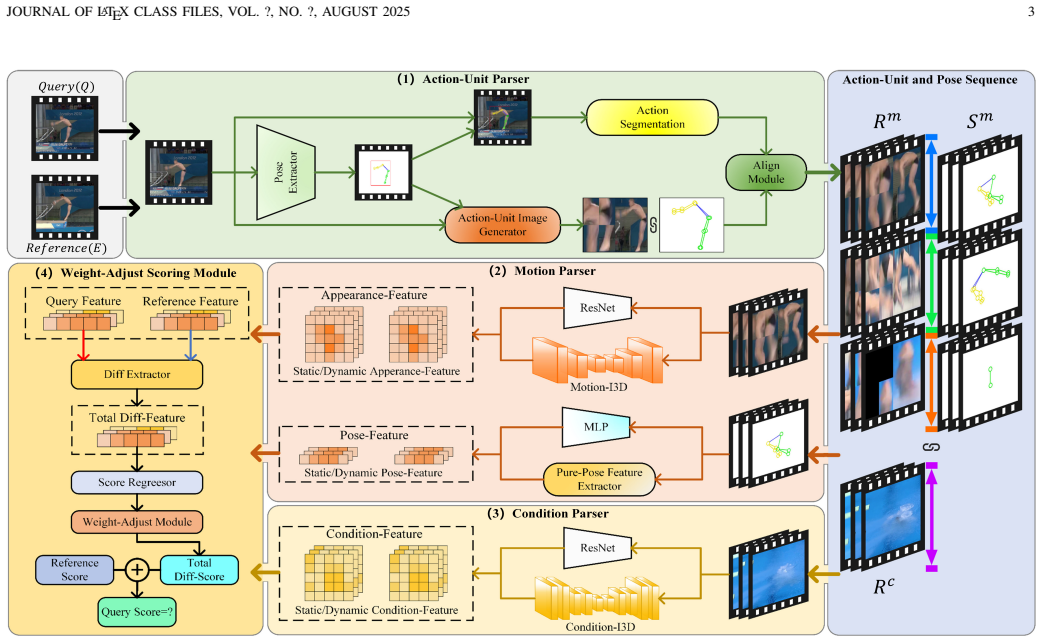
The Action-Unit Parser: a pose extractor supplies joint coordinates, body bending angles, and a bounding box; these drive both an action segmentation module (I3D plus pose features that predicts keyframes dividing the motion into sub-phases) and an action-unit image generator that crops the body and eight specified joint regions. The Motion Parser then uses a dual branch — ResNet/I3D on action-unit sequences for appearance, and a Pure-Pose Feature Extractor (LSTM cascaded into a Nyström-attention Transformer) for skeleton dynamics. The Condition Parser runs a separate I3D/ResNet on condition crops, and the Weight-Adjust Scoring Module fuses the resulting difference scores with hyperparameter
What would settle it
Freeze the motion stream and scoring weights, then edit only the splash region in the test video (e.g., replace the water in post-entry frames with a neutral color) and measure whether the Condition Parser's features and the final score change. If the condition features are insensitive to splash edits while the body crops stay identical, the claimed decoupling is not real; if they change, the mechanism is supported.
Extended reading notes
Core claim
The core discovery is that pose-topology-derived action-unit images act as a spatial hard-attention filter: by cropping each frame around the athlete's bounding box and a preselected set of joints, the model's appearance and pose branches never see background pixels, so they are forced to represent only body-related geometry and appearance. On top of that, splitting input into a motion stream (per-phase body and pose data) and a condition stream (non-body factors such as splash) creates two score dimensions that are then fused with adjustable weights. The paper reports that this framework reaches Spearman's ρ = 0.9465 and Rℓ2 = 0.2243 on FineDiving, 0.9466 and 0.2179 on FineDiving-HM, 0.9612
Load-bearing premise
That the Align Module can actually separate the athlete's motion from non-body factors like water splash and height using only the keyframe set — the paper never defines what the condition ROI contains geometrically, so the claimed motion/condition orthogonality may not hold.
Editorial extensions
If this is right
- Action segmentation accuracy close to human judgment enables stage-wise scoring (take-off, turning, entry, spray) rather than whole-video regression.
- The hard-attention crop from pose topology could transfer to other judged sports where scoring depends on body form and environmental outcome, such as gymnastics landings or figure skating.
- The motion/condition decoupling gives an interpretable two-factor score, and the weights can be tuned to sport-specific rules (e.g., splash contributing 30–40% of the score).
- The multi-instance voting with reference videos improves ranking reliability, with ρ rising from 0.9401 to 0.9465 as the voting sample size goes from 1 to 5.
- Pose-only segmentation without body-appearance features still surpasses the prior state of the art, suggesting pose priors alone are strong for locating action boundaries.
Reading between the lines
- The orthogonality of the motion and condition streams is not proven: since the condition ROI is never defined geometrically, the condition parser may in practice be reading body-cropped pixels that overlap with the motion stream, so the claimed 'two orthogonal dimensions' may be partially shared.
- The paper's fixed set of eight joints for ROI generation could limit performance on actions where key joints are occluded or where scoring-relevant detail lies elsewhere; adaptive or learned joint selection is a natural extension.
- The α and β weights are chosen by grid search; an action-type-conditional weighting mechanism could make the fusion more flexible and is a testable extension beyond the paper.
- The framework's 'condition' idea could generalize beyond splash to other non-body scoring factors (height above the board, landing stability, apparatus rotation), which the paper mentions but does not explore.
Editorial analysis
A structured set of objections, weighed in public.
Referee Report
Summary. The paper proposes a pose-aware multi-level motion parsing framework for action quality assessment (AQA). It extracts pose and bounding-box information, generates action-unit ROIs from selected joints, segments the video into sub-phases, and separates features into motion and condition streams. A contrastive scoring module then computes per-phase feature differences, weights them, and predicts the query score as the reference score plus an estimated difference. The paper reports state-of-the-art AQA and action-segmentation results on FineDiving, FineDiving-HM, and MTL-AQA, with ablations showing that each module contributes.
Significance. If the reported empirical results are valid, the hard-attention ROI approach and the explicit motion/condition decoupling would be a useful contribution to AQA. The idea of using pose topology to remove background at the input stage is simple and potentially transferable, and the paper is transparent about implementation details such as network choices, joint counts, and inference time. The ablations in Table V are organized and suggest that each component has a positive effect when added to the full configuration. However, the central empirical claim is weakened by a table data error and by hyperparameter selection on the test set, as detailed below. The current manuscript therefore does not establish the claimed state-of-the-art performance.
major comments (3)
- [Table I, Section IV.D] The Action Segmentation Task rows for TSA and NS-AQA in Table I exactly duplicate the AQA rows of USDL and MUSDL (0.8913/0.3822 and 0.8978/0.5733). These cannot be correct segmentation metrics, and the prose in Section IV.D claiming improvements over TSA and NS-AQA does not follow from the printed numbers (e.g., the claimed 64.1% improvement over TSA would require a different baseline than 0.3822). This data inconsistency undermines the action-segmentation SOTA claim as printed. Please correct the table and recompute/verify all associated percentages.
- [Section IV.C, Tables VII and IX] The key hyperparameters α, β (motion/condition weights) and L (number of voting reference videos) are selected by their test-set performance on FineDiving: Table VII reports the best test ρ at L=5, and Table IX reports the best test ρ at α=0.7, β=0.3. No validation split, repeated-seed variance, or statistical significance testing is described, and the same test set is then used to report the final numbers and to transfer the chosen values to FineDiving-HM and MTL-AQA. Since the reported SOTA gains are small (e.g., +0.0083 ρ over T2CR on FineDiving, +0.0042 over FineParser on FineDiving-HM, +0.0083 over T2CR on MTL-AQA), the claimed improvements may be selection noise. Please introduce a validation split for hyperparameter selection and report test performance only for the final configuration.
- [Section III.C, Section III.D, Eq. (9)] The condition part Rc is not defined geometrically. The action-unit images R are generated by cropping around the bounding box and joint points (Fig. 3), while water splash and height above ground extend outside the body. The Align Module is described as separating the pose information and action-unit image set into motion and condition parts through the keyframe set K, but no definition is given for what pixels Rc contains or how a network reading body-cropped images can produce a 'non-body-related' condition feature. If Rc is simply a body crop from the final phase, the Condition Parser and Motion Parser read overlapping content, and the claimed decoupling behind Eq. (9) is not realized. Please define Rc explicitly and verify that the condition stream does not largely overlap with the motion stream.
minor comments (5)
- [Title/Abstract] The cover title/abstract ('Focus on What Matters...', 'Pose-Guided Intrinsic Motion Distillation Framework') do not match the manuscript title and abstract ('Pose-Aware Multi-Level Motion Parsing...', 'Human pose serves as a cornerstone...'). Please harmonize all metadata and terminology.
- [Eq. (7)–(8)] The δ_i are introduced as 'proportional hyperparameters' and Eq. (8) only constrains their sum. The actual values of δ_i used in the experiments are not reported. Please state how these weights are set or learned.
- [Eq. (6)] F_{p,i}=PFP(\bar S_{m,i})[-1] suggests that only the last time step of the Pure-Pose Feature Extractor output is used. The meaning of this indexing and whether this is a temporal pooling operation should be clarified.
- [Table V] The column headers 'PE', 'AIG', 'PFP', 'AS' are not self-explanatory. Although the text describes them, adding explicit checkmark labels or a footnote would improve readability.
- [Eqs. (12)–(13)] The BCE loss uses variables y and p_h^t, but the relationship between the ground-truth transition distribution p_h^t and the predicted probabilities \hat p_h^t is inconsistently notated with Eq. (2)–(3). Please align the notation.
Circularity Check
No material circularity; the scoring and segmentation results are empirical, with only a minor non-load-bearing self-citation cluster.
full rationale
The paper's central claims are empirical: pose-guided parsing and contrastive score regression evaluated on public benchmarks (FineDiving, FineDiving-HM, MTL-AQA). The scoring path (Eqs. 9-10) is supervised regression: SD_total is produced by learned Diff Extractor and Score Regressor from feature differences and optimized against query score labels via L_MSE (Eq. 14); no term is defined from the predicted score, so the prediction does not reduce to its inputs by construction. The motion/condition decoupling (Sec. III.C) and action-unit ROI generation are architecturally defined from pose, bounding boxes, and keyframes, rather than from the score targets. Hyperparameters alpha, beta, L, and delta_i are tuning choices ablated in Tables VII and IX; selecting them on the test split is a validation/risk concern, not an equation-level circularity. The only overlapping-author citations ([21]-[23]) are cited as design inspiration for skeleton-based action recognition and are not used as a uniqueness theorem or as evidence for the reported numbers, so they are not load-bearing. No step was found where Eq. X = Eq. Y by construction or where a fitted parameter is renamed as a prediction.
Assumptions & free parameters
free parameters (5)
- α, β (motion vs condition score weights) =
0.7 / 0.3
- δ_i (per-sub-phase weights) =
not reported (sum to 1, Eq. 8)
- L (number of voting reference videos) =
5
- Dynamic/static and appearance/pose fusion ratio =
5:5
- J=12 joints, U=4 angles, Y=8 ROI joints =
12/4/8
assumptions (5)
- domain assumption Kinetics-pretrained I3D features transfer to diving AQA
- domain assumption The unnamed 2D pose estimator supplies reliable joints and bounding boxes on high-speed, self-occluded sports footage
- domain assumption Each dive type has a fixed, known number H of action transitions
- domain assumption Score differences are learnable from feature differences against a same-difficulty reference video
- ad hoc to paper Water splash and height above ground are the scoring-relevant non-body conditions, separable from motion via the keyframe set
Cite this review
Pith. "Pith review of Focus on What Matters: Constraining Spatial-Temporal Attention via Action-Units for Noise-Resilient AQA." pith.science (2026). https://pith.science/paper/SS2WSQT7
@misc{pith2026251105611,
  author       = {Pith},
  title        = {Pith review of: Focus on What Matters: Constraining Spatial-Temporal Attention via Action-Units for Noise-Resilient AQA},
  year         = {2026},
  howpublished = {\url{https://pith.science/paper/SS2WSQT7}},
  note         = {Machine review of arXiv:2511.05611}
}
read the original abstract
The core challenge in Action Quality Assessment (AQA) lies in extracting fine-grained motion features from redundant and complex video backgrounds. Existing global feature learning methods are constrained by extremely low "signal-to-noise ratios", making it difficult to distinguish intrinsic actions from background clutter. To address this, we propose a Pose-Guided Intrinsic Motion Distillation Framework that explicitly enforces physical constraints to focus on motion subjects and decouple motion execution from environmental outcomes. First, we design an Action-Unit Parser that constructs dynamic regions of interest (ROIs) using human pose topology as prior knowledge. This functions as a spatial hard-attention filter that physically removes background noise at the input stage, forcing the model to learn appearance and geometric features only from pure body regions. Second, to resolve factor entanglement, we introduce a dual-stream decoupling mechanism: the Motion Parser focuses on capturing purified joint motion details, while the Condition Parser independently processes non-body-related environmental feedback (e.g., splash in diving) to create two orthogonal evaluation dimensions in feature space. Finally, adaptive weight modules integrate these decoupled features to generate final scores. Experimental results on large-scale datasets including FineDiving, FineDiving-HM, and MTL-AQA demonstrate that this method achieves state-of-the-art (SOTA) performance in both action segmentation and scoring accuracy, validating the effectiveness of "noise suppression focusing" and "motion disentanglement" strategies in fine-grained action evaluation.
Figures

Figures from the paper (4 more)


Reference graph
Works this paper leans on
-
[1]
Sportsmot: A large multi-object tracking dataset in multiple sports scenes,
Y . Cui, C. Zeng et al., “Sportsmot: A large multi-object tracking dataset in multiple sports scenes,” in IEEE International Conference on Computer Vision, 2023, pp. 9921–9931
2023
-
[2]
Multisports: A multi-person video dataset of spatio- temporally localized sports actions,
Y . Li, L. Chen et al., “Multisports: A multi-person video dataset of spatio- temporally localized sports actions,” in IEEE International Conference on Computer Vision, 2021, pp. 13536–13545
2021
-
[3]
Finegym: A hierarchical video dataset for fine- grained action understanding,
D. Shao, Y . Zhao et al., “Finegym: A hierarchical video dataset for fine- grained action understanding,” in IEEE/CVF Conference on Computer Vision and Pattern Recognition, 2020, pp. 2616–2625
2020
-
[4]
Finediving: A fine-grained dataset for procedure- aware action quality assessment,
J. Xu, Y . Rao et al., “Finediving: A fine-grained dataset for procedure- aware action quality assessment,” in IEEE/CVF Conference on Computer Vision and Pattern Recognition, 2022, pp. 2949–2958
2022
-
[5]
Uncertainty-aware score distribution learning for action quality assessment,
Y . Tang, Z. Ni et al., “Uncertainty-aware score distribution learning for action quality assessment,” in IEEE/CVF Conference on Computer Vision and Pattern Recognition, 2020, pp. 9839–9848
2020
-
[6]
Group-aware contrastive regression for action quality assessment,
X. Yu, Y . Rao et al., “Group-aware contrastive regression for action quality assessment,” in IEEE International Conference on Computer Vision, 2021, pp. 7919–7928
2021
-
[7]
Quo vadis, action recognition? a new model and the kinetics dataset,
J. Carreira and A. Zisserman, “Quo vadis, action recognition? a new model and the kinetics dataset,” in IEEE/CVF Conference on Computer Vision and Pattern Recognition, 2017, pp. 4724–4733
2017
-
[8]
Online quality assessment of human movement from skeleton data,
A. Paiement, L. Tao et al., “Online quality assessment of human movement from skeleton data,” in British Machine Vision Conference, 2014, pp. 153– 166
2014
Show all 53 references
-
[9]
Visual and human-interpretable feedback for assisting physical activity,
M. Antunes, R. Baptista et al., “Visual and human-interpretable feedback for assisting physical activity,” in European Conference on Computer Vision, 2016, pp. 115–129
2016
-
[10]
A video-based augmented reality system for human-in-the-loop muscle strength assessment of juvenile dermatomyosi- tis,
K. Zhou, R. Cai et al., “A video-based augmented reality system for human-in-the-loop muscle strength assessment of juvenile dermatomyosi- tis,” IEEE Transactions on Visualization and Computer Graphics, vol. 29, no. 5, pp. 2456–2466, 2023
2023
-
[11]
Who’s better? who’s best? pairwise deep ranking for skill determination,
H. Doughty, D. Damen et al., “Who’s better? who’s best? pairwise deep ranking for skill determination,” in IEEE/CVF Conference on Computer Vision and Pattern Recognition, 2018, pp. 6057–6066
2018
-
[12]
The pros and cons: Rank-aware temporal attention for skill determination in long videos,
H. Doughty, W. Mayol-Cuevas et al., “The pros and cons: Rank-aware temporal attention for skill determination in long videos,” in IEEE/CVF Conference on Computer Vision and Pattern Recognition, 2019, pp. 7862– 7871
2019
-
[13]
Spatio-temporal adaptive network with bidirectional temporal difference for action recognition,
Z. Li, J. Li et al., “Spatio-temporal adaptive network with bidirectional temporal difference for action recognition,” IEEE Transactions on Circuits and Systems for Video Technology, vol. 33, no. 9, pp. 5174–5185, 2023
2023
-
[14]
Agpn: Action granularity pyramid network for video action recognition,
Y . Chen, H. Ge et al., “Agpn: Action granularity pyramid network for video action recognition,” IEEE Transactions on Circuits and Systems for Video Technology, vol. 33, no. 8, pp. 3912–3923, 2023
2023
-
[15]
Question-aware global-local video understand- ing network for audio-visual question answering,
Z. Chen, L. Wang et al., “Question-aware global-local video understand- ing network for audio-visual question answering,” IEEE Transactions on Circuits and Systems for Video Technology, vol. 34, no. 5, pp. 4109–4119, 2023
2023
-
[16]
Learning to score olympic events,
P. Parmar and B. T. Morris, “Learning to score olympic events,” in IEEE/CVF Conference on Computer Vision and Pattern Recognition Workshops, 2017, pp. 76–84. JOURNAL OF LATEX CLASS FILES, VOL. ?, NO. ?, AUGUST 2025 11
2017
-
[17]
Learning to score figure skating sport videos,
C. Xu, Y . Fu et al., “Learning to score figure skating sport videos,” IEEE Transactions on Circuits and Systems for Video Technology, vol. 30, no. 12, pp. 4578–4590, 2019
2019
-
[18]
Attentive spatio-temporal representation learning for diving classification,
G. Kanojia, S. Kumawat et al., “Attentive spatio-temporal representation learning for diving classification,” in IEEE/CVF Conference on Computer Vision and Pattern Recognition Workshops, 2019, pp. 2467–2476
2019
-
[19]
Multi-stage contrastive regression for action quality assessment,
Q. An, M. Qi et al., “Multi-stage contrastive regression for action quality assessment,” 2024, arXiv preprint arXiv:2401.02841
2024 arXiv
-
[20]
Fineparser: A fine-grained spatio-temporal action parser for human-centric action quality assessment,
J. Xu, S. Yin et al., “Fineparser: A fine-grained spatio-temporal action parser for human-centric action quality assessment,” in IEEE/CVF Conference on Computer Vision and Pattern Recognition, 2024, pp. 14628– 14637
2024
-
[21]
Efficient spatio-temporal contrastive learning for skeleton-based 3d action recognition,
X. Gao, Y . Yang et al., “Efficient spatio-temporal contrastive learning for skeleton-based 3d action recognition,” IEEE Transactions on Multimedia, vol. 25, no. 1, pp. 405–417, 2023
2023
-
[22]
Glimpse and focus: Global and local-scale graph convolution network for skeleton-based action recognition,
X. Gao, Y . Yang et al., “Glimpse and focus: Global and local-scale graph convolution network for skeleton-based action recognition,” Neural Networks, vol. 163, pp. 261–271, 2023
2023
-
[23]
Learning heterogeneous spatial-temporal context for skeleton-based action recognition,
X. Gao, Y . Yang et al., “Learning heterogeneous spatial-temporal context for skeleton-based action recognition,” IEEE Transactions on Neural Networks and Learning Systems, vol. 35, no. 3, pp. 12130–12141, 2023
2023
-
[24]
Assessing the quality of actions,
H. Pirsiavash, C. V ondrick et al., “Assessing the quality of actions,” in European Conference on Computer Vision, 2014, pp. 556–571
2014
-
[25]
Support vector regression,
D. Basak, S. Pal et al., “Support vector regression,” 2007
2007
-
[26]
What and how well you performed? a multitask learning approach to action quality assessment,
P. Parmar and B. T. Morris, “What and how well you performed? a multitask learning approach to action quality assessment,” in IEEE/CVF Conference on Computer Vision and Pattern Recognition, 2019, pp. 304– 313
2019
-
[27]
Hierarchical graph convolutional networks for action quality assessment,
K. Zhou, Y . Ma et al., “Hierarchical graph convolutional networks for action quality assessment,” IEEE Transactions on Circuits and Systems for Video Technology, vol. 33, no. 12, pp. 7749–7763, 2023
2023
-
[28]
Hybrid dynamic-static context-aware attention network for action assessment in long videos,
L. A. Zeng, F. T. Hong et al., “Hybrid dynamic-static context-aware attention network for action assessment in long videos,” in ACM International Conference on Multimedia, 2020, pp. 2526–2534
2020
-
[29]
Fine-grained temporal contrastive learning for weakly-supervised temporal action localization,
J. Gao, M. Chen et al., “Fine-grained temporal contrastive learning for weakly-supervised temporal action localization,” in IEEE/CVF Conference on Computer Vision and Pattern Recognition, 2022, pp. 19999–20009
2022
-
[30]
Fineaction: A fine-grained video dataset for temporal action localization,
Y . Liu, L. Wang et al., “Fineaction: A fine-grained video dataset for temporal action localization,” 2021, arXiv preprint arXiv:2105.11107
2021 arXiv
-
[31]
Fine-grained activity recognition in baseball videos,
A. J. Piergiovanni and M. S. Ryoo, “Fine-grained activity recognition in baseball videos,” in IEEE/CVF Conference on Computer Vision and Pattern Recognition Workshops, 2018, pp. 1740–1748
2018
-
[32]
An image is worth 16x16 words: Transformers for image recognition at scale,
A. Dosovitskiy, L. Beyer et al., “An image is worth 16x16 words: Transformers for image recognition at scale,” 2020, arXiv preprint arXiv:2010.11929
2020 arXiv
-
[33]
Alleviating over-segmentation errors by detecting action boundaries,
Y . Ishikawa, S. Kasai et al., “Alleviating over-segmentation errors by detecting action boundaries,” 2020, arXiv preprint arXiv:2007.06866
2020 arXiv
-
[34]
Learning and fusion of multiple hidden sub-phases for action quality assessment,
H.-B. Zhang, Q. Shi et al., “Learning and fusion of multiple hidden sub-phases for action quality assessment,” Knowledge-Based Systems, vol. 225, p. 107388, 2021
2021
-
[35]
Ms-tcn++: Multi-stage temporal convolutional network for action segmentation,
L. Shi-Jie, Y . Abu Farha et al., “Ms-tcn++: Multi-stage temporal convolutional network for action segmentation,” IEEE Transactions on Pattern Analysis and Machine Intelligence, vol. 45, no. 6, pp. 6647–6658, 2023
2023
-
[36]
Mtdan: A lightweight multi-scale temporal difference attention networks for automated video depression detection,
S. Zhang, X. Zhang et al., “Mtdan: A lightweight multi-scale temporal difference attention networks for automated video depression detection,” IEEE Transactions on Affective Computing, vol. 15, no. 3, pp. 1078–1089, 2023
2023
-
[37]
Bidirectional temporal and frame-segment attention for sparse action segmentation of figure skating,
Y . Liu, X. Cheng et al., “Bidirectional temporal and frame-segment attention for sparse action segmentation of figure skating,” Computer Vision and Image Understanding, vol. 104186, 2024
2024
-
[38]
On space-time interest points,
I. Laptev, “On space-time interest points,” International Journal of Computer Vision, vol. 64, no. 2, pp. 107–123, 2005
2005
-
[39]
Dense trajectories and motion boundary descriptors for action recognition,
H. Wang, A. Kl ¨aser et al., “Dense trajectories and motion boundary descriptors for action recognition,” International Journal of Computer Vision, vol. 103, no. 1, pp. 60–79, 2013
2013
-
[40]
Action recognition with improved trajectories,
H. Wang and C. Schmid, “Action recognition with improved trajectories,” in IEEE International Conference on Computer Vision, 2013, pp. 3551– 3558
2013
-
[41]
Beyond short snippets: Deep networks for video classification,
J. Y .-H. Ng, M. Hausknecht et al., “Beyond short snippets: Deep networks for video classification,” in IEEE/CVF Conference on Computer Vision and Pattern Recognition, 2015, pp. 4694–4702
2015
-
[42]
Unsupervised learning of video representations using lstms,
N. Srivastava, E. Mansimov et al., “Unsupervised learning of video representations using lstms,” in International Conference on Machine Learning, 2015, pp. 843–852
2015
-
[43]
Long-term temporal convolutions for action recognition,
G. Varol, I. Laptev et al., “Long-term temporal convolutions for action recognition,” IEEE Transactions on Pattern Analysis and Machine Intelligence, vol. 40, no. 6, pp. 1510–1517, 2017
2017
-
[44]
Action assessment by joint relation graphs,
J.-H. Pan, J. Gao et al., “Action assessment by joint relation graphs,” in IEEE International Conference on Computer Vision, 2019, pp. 6331–6340
2019
-
[45]
Temporal segment networks: Towards good practices for deep action recognition,
L. Wang, Y . Xiong et al., “Temporal segment networks: Towards good practices for deep action recognition,” in European Conference on Computer Vision, 2016, pp. 20–36
2016
-
[46]
Timemil: Advancing multivariate time series classification via a time-aware multiple instance learning,
X. Chen, P. Qiu et al., “Timemil: Advancing multivariate time series classification via a time-aware multiple instance learning,” in International Conference on Machine Learning, 2024, pp. 7190–7206
2024
-
[47]
Likert scoring with grade decoupling for long-term action assessment,
A. Xu, L.-A. Zeng et al., “Likert scoring with grade decoupling for long-term action assessment,” in IEEE/CVF Conference on Computer Vision and Pattern Recognition, 2022, pp. 3232–3241
2022
-
[48]
Pairwise contrastive learning network for action quality assessment,
M. Li, H.-B. Zhang et al., “Pairwise contrastive learning network for action quality assessment,” in European Conference on Computer Vision, 2022, pp. 457–473
2022
-
[49]
Auto-encoding score distribution regression for action quality assessment,
B. Zhang, J. Chen et al., “Auto-encoding score distribution regression for action quality assessment,” Neural Computing and Applications, vol. 36, no. 2, pp. 929–942, 2024
2024
-
[50]
Cofinal: Enhancing action quality assessment with coarse-to-fine instruction alignment,
K. Zhou, J. Li et al., “Cofinal: Enhancing action quality assessment with coarse-to-fine instruction alignment,” in International Joint Conference on Artificial Intelligence, 2024, pp. 1771–1779
2024
-
[51]
Asformer: Transformer for action segmentation,
F. Yi, H. Wen et al., “Asformer: Transformer for action segmentation,” in British Machine Vision Conference, 2021, pp. 1–15
2021
-
[52]
Hierarchical neurosymbolic approach for comprehensive and explainable action quality assessment,
L. Okamoto and P. Parmar, “Hierarchical neurosymbolic approach for comprehensive and explainable action quality assessment,” in IEEE/CVF Conference on Computer Vision and Pattern Recognition, 2024, pp. 3204– 3213
2024
-
[53]
Incorporating nesterov momentum into adam,
T. Dozat, “Incorporating nesterov momentum into adam,” 2016, arXiv preprint arXiv:1502.02410
2016 arXiv
Reviewed August 3, 2026 · model on record in the stance chip above.
Discussion (0). Sign in to comment.