Superfluid fraction in the crystal phase of the inner crust of neutron stars
Pith reviewed 2026-05-25 07:47 UTC · model grok-4.3
The pith
Above 0.03 fm^{-3} density, over 90% of neutrons in the inner crust are superfluid, independent of interaction details.
A machine-rendered reading of the paper's core claim, the machinery that carries it, and where it could break.
Core claim
Within the crystal phase of the inner crust, a relative flow between clusters and the surrounding neutron gas induces a phase in the complex order parameter; the neutron superfluid fraction extracted from the counterflow current exceeds 90% above 0.03 fm^{-3}, is only slightly below the linear-response BCS value, and is nearly independent of the Skyrme parametrization, cluster charge, and lattice geometry.
What carries the argument
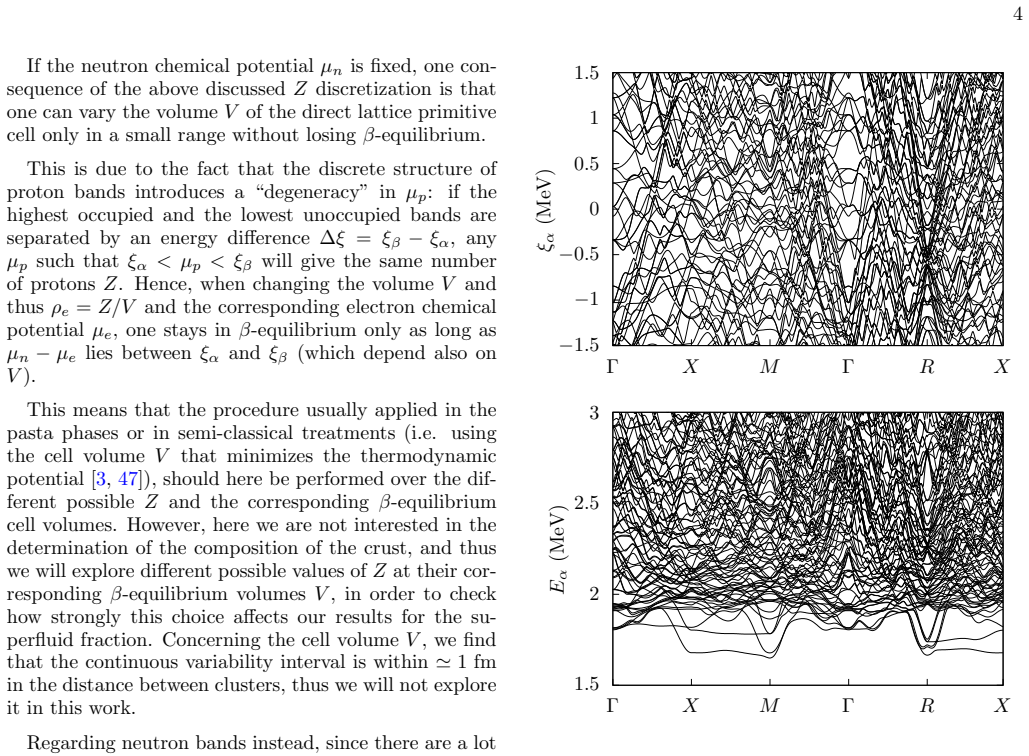
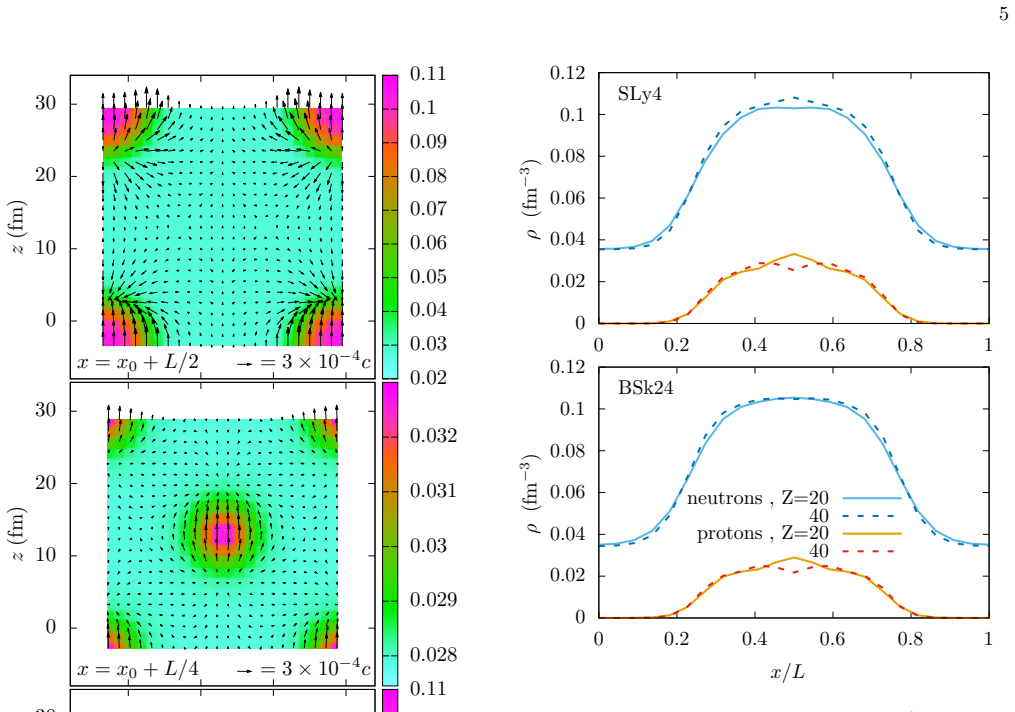
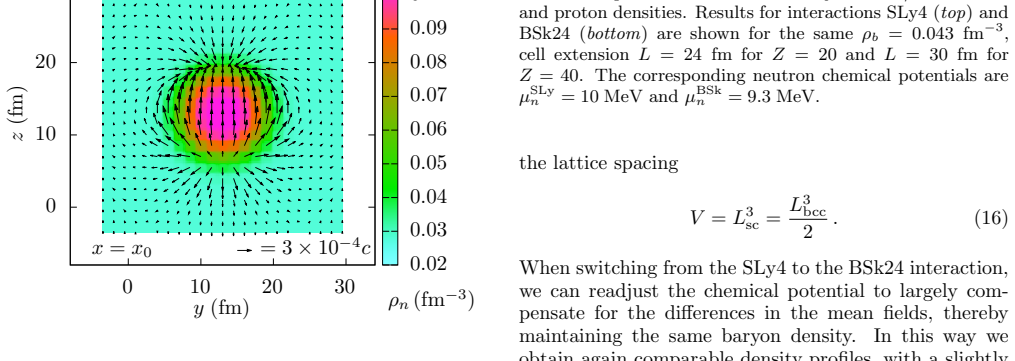
Time-independent relative flow between clusters and neutron gas under Bloch boundary conditions in HFB calculations, which develops a phase in the pairing order parameter whose induced current defines the superfluid fraction.
If this is right
- The inner crust alone can supply the superfluid angular momentum reservoir needed to explain pulsar glitches.
- The superfluid fraction approaches the hydrodynamic limit when pairing is strong.
- The result is robust against variations in Skyrme interaction, cluster charge, and lattice geometry.
- The value lies only slightly below that obtained from linear response on top of BCS theory.
Where Pith is reading between the lines
- Similar Bloch-HFB setups could be applied to the pasta phases at higher densities to check whether the high superfluid fraction persists.
- Glitch rise-time observations might be used to place bounds on the effective pairing strength inside the crust.
- The near-independence from microscopic details suggests that simplified hydrodynamic models of the crust could be calibrated directly to the 90% figure for glitch modeling.
Load-bearing premise
A time-independent relative flow combined with Bloch boundary conditions produces a phase in the order parameter that accurately quantifies the superfluid fraction through the resulting current.
What would settle it
A calculation or simulation at densities above 0.03 fm^{-3} that yields a superfluid fraction below 80% when the relative flow is replaced by a fully time-dependent dynamical treatment would contradict the central result.
Figures
read the original abstract
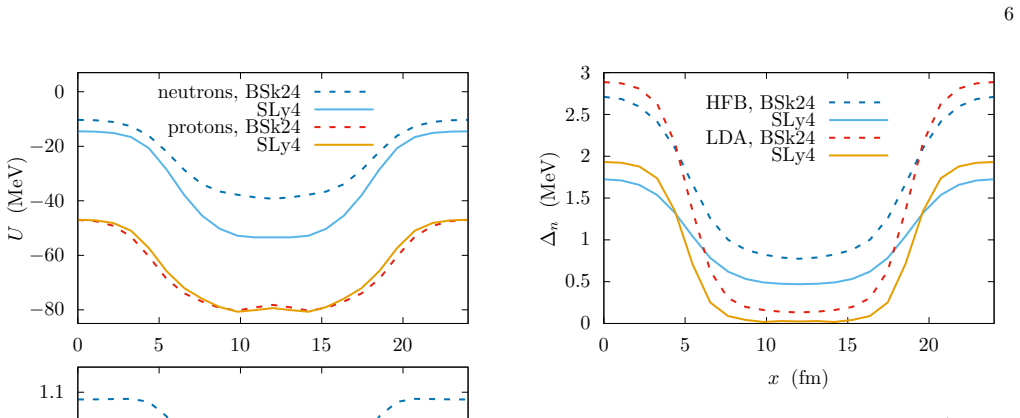
In the most extended layer of the inner crust of neutron stars, nuclear matter is believed to form a crystal of clusters immersed in a superfluid neutron gas. Here we analyze this phase of matter within fully self-consistent Hartree-Fock-Bogoliubov calculations using Skyrme-type energy density functionals for the mean field and a separable interaction in the pairing channel. The periodicity of the lattice is taken into account using Bloch boundary conditions, in order to describe the interplay between band structure and superfluidity. A relative flow between the clusters and the surrounding neutron gas is introduced in a time-independent way. As a consequence, the complex order parameter develops a phase, and in the rest frame of the superfluid one finds a counterflow between neutrons inside and outside the clusters. The neutron superfluid fraction is computed from the resulting current. Our results indicate that at densities above 0.03 fm$^{-3}$, more than 90% of the neutrons are effectively superfluid, independently of the detailed choice of the interaction, cluster charge, and lattice geometry. This fraction is only slightly lower than the one obtained recently within linear response theory on top of the Bardeen-Cooper-Schrieffer approximation, and it approaches the hydrodynamic limit for strong pairing. As a consequence, it is likely that the inner crust alone can provide a sufficient superfluid angular momentum reservoir to explain pulsar glitches.
Editorial analysis
A structured set of objections, weighed in public.
Referee Report
Summary. The manuscript presents fully self-consistent Hartree-Fock-Bogoliubov (HFB) calculations of the inner crust of neutron stars modeled as a crystal of nuclear clusters immersed in a superfluid neutron gas. Skyrme-type energy density functionals are used for the mean field together with a separable pairing interaction. Lattice periodicity is incorporated via Bloch boundary conditions. A time-independent relative flow is imposed between the clusters and the neutron gas, causing the complex order parameter to acquire a phase; the superfluid fraction is then extracted from the resulting neutron current evaluated in the superfluid rest frame. The central claim is that above 0.03 fm^{-3} more than 90% of the neutrons are effectively superfluid, with this fraction independent of the detailed choice of interaction, cluster charge, and lattice geometry. The result lies close to recent linear-response calculations on top of BCS and approaches the hydrodynamic limit for strong pairing, implying that the inner crust alone can supply a sufficient superfluid angular-momentum reservoir to account for pulsar glitches.
Significance. If the numerical result holds, the work is significant for neutron-star astrophysics. It supplies a quantitative, largely model-independent estimate of the superfluid reservoir in the inner crust and thereby strengthens the case that this layer can explain observed glitch sizes without additional contributions from the core. The methodological combination of fully self-consistent HFB with Bloch boundary conditions for the periodic lattice constitutes a clear advance over simpler approximations, and the reported approach to the hydrodynamic limit for strong pairing provides an internal consistency check. The independence from microscopic details is a noteworthy feature of the findings.
major comments (1)
- [Abstract and §3 (computational method)] Abstract and computational-setup description: the extraction of the superfluid fraction from the neutron current that arises after the order parameter acquires a phase under the imposed time-independent relative flow (with Bloch boundary conditions) is load-bearing for both the >90% value and the independence claim. The manuscript should supply an explicit test or derivation (e.g., comparison to the uniform-matter limit or variation of flow velocity) demonstrating that residual entrainment, lattice-induced artifacts, or pairing-channel dependence do not alter the current-to-density ratio across the scanned parameter space.
minor comments (2)
- [Figure captions] Figure captions should explicitly list the Skyrme parametrizations, cluster charges, and lattice geometries corresponding to each curve or symbol so that the independence statement can be verified at a glance.
- [Results discussion] A short reference or one-line derivation of the hydrodynamic-limit expression for the superfluid fraction would help readers confirm that the numerical results indeed approach this limit for strong pairing.
Simulated Author's Rebuttal
We thank the referee for the positive evaluation of our work and the constructive suggestion. We address the major comment below.
read point-by-point responses
-
Referee: [Abstract and §3 (computational method)] Abstract and computational-setup description: the extraction of the superfluid fraction from the neutron current that arises after the order parameter acquires a phase under the imposed time-independent relative flow (with Bloch boundary conditions) is load-bearing for both the >90% value and the independence claim. The manuscript should supply an explicit test or derivation (e.g., comparison to the uniform-matter limit or variation of flow velocity) demonstrating that residual entrainment, lattice-induced artifacts, or pairing-channel dependence do not alter the current-to-density ratio across the scanned parameter space.
Authors: We agree that an explicit validation of the extraction procedure would strengthen the manuscript. While the reported near-independence from the choice of Skyrme functional (which varies both the mean-field and pairing channels), cluster charge, and lattice geometry, together with the close agreement to linear-response BCS results and the approach to the hydrodynamic limit, already indicates that lattice artifacts and residual entrainment do not dominate, we acknowledge the value of a direct test. In the revised version we will add (i) a comparison to the uniform-matter limit obtained by suppressing the lattice modulation and (ii) a short check confirming that the current-to-density ratio remains stable under small variations of the imposed flow velocity within the linear regime. These additions will be placed in §3 or an appendix. revision: yes
Circularity Check
No circularity: superfluid fraction from direct numerical HFB current extraction
full rationale
The paper computes the superfluid fraction by solving the HFB equations with Skyrme functionals and separable pairing under Bloch boundary conditions, imposing a time-independent relative flow, allowing the order parameter to develop a phase, and extracting the fraction from the resulting neutron current in the superfluid rest frame. This is a standard numerical procedure using external functionals; the reported >90% value above 0.03 fm^{-3} (independent of interaction, charge, geometry) emerges from parameter scans rather than reducing by construction to any fitted input or self-citation chain within the paper's own equations. No self-definitional, fitted-input, or uniqueness-imported steps are present in the derivation chain.
Axiom & Free-Parameter Ledger
axioms (1)
- domain assumption Bloch boundary conditions accurately capture the periodicity of the nuclear lattice and the interplay between band structure and superfluidity.
Lean theorems connected to this paper
-
IndisputableMonolith/Foundation/AlexanderDuality.leanalexander_duality_circle_linking unclear?
unclearRelation between the paper passage and the cited Recognition theorem.
We perform fully self-consistent Hartree-Fock-Bogoliubov calculations … using Bloch boundary conditions … The neutron superfluid fraction is computed from the resulting current.
-
IndisputableMonolith/Cost/FunctionalEquation.leanwashburn_uniqueness_aczel unclear?
unclearRelation between the paper passage and the cited Recognition theorem.
Our results indicate that at densities above 0.03 fm^{-3}, more than 90% of the neutrons are effectively superfluid, independently of … interaction, cluster charge, and lattice geometry.
What do these tags mean?
- matches
- The paper's claim is directly supported by a theorem in the formal canon.
- supports
- The theorem supports part of the paper's argument, but the paper may add assumptions or extra steps.
- extends
- The paper goes beyond the formal theorem; the theorem is a base layer rather than the whole result.
- uses
- The paper appears to rely on the theorem as machinery.
- contradicts
- The paper's claim conflicts with a theorem or certificate in the canon.
- unclear
- Pith found a possible connection, but the passage is too broad, indirect, or ambiguous to say the theorem truly supports the claim.
Reference graph
Works this paper leans on
-
[1]
Superfluid fraction in the crystal phase of the inner crust of neutron stars
predicted a very strong entrainment and thus a small superfluid fraction. This presents a tension with glitch ∗ giorgio.almirante@ijclab.in2p3.fr † theodora.kaskitsi@universite-paris-saclay.fr ‡ michael.urban@ijclab.in2p3.fr observations [20], unless one abandons the assumption that glitches originate solely in the crust [21]. This prediction of band theo...
work page internal anchor Pith review Pith/arXiv arXiv 2025
-
[2]
and the scalar superfluid density isρ S =P i ρii S /3. Working in the frame in which the phase of the pair- ing field is periodic, Eq. (12) implies that the superfluid velocity vanishes (vS = 0) and thus Eq. (10) becomes ⟨ρn⟩= (⟨ρ n⟩ −ρ S)vN .(13) The neutron superfluid density can thus be directly in- ferred from Eq. (13), once densities and currents hav...
-
[3]
(9), obtaining quasi-particle energiesE α(pb) and eigenvectors (U ∗ αn(pb),−V ∗ αn(pb))
We diagonalize it according to Eq. (9), obtaining quasi-particle energiesE α(pb) and eigenvectors (U ∗ αn(pb),−V ∗ αn(pb)). In terms of these, the normal and anomalous density matrices are expressed as ρnn′(pb) = X Eα>0 V ∗ n′α(pb)Vnα(pb),(A6) κnn′(pb) = X Eα>0 U ∗ nα(pb)Vn′α(pb),(A7) withE α =E α(pb). Then, one can compute the densities and pairing field...
-
[4]
Neutron star matter at sub-nuclear densities,
J.W. Negele and D. Vautherin, “Neutron star matter at sub-nuclear densities,” Nucl. Phys. A207, 298–320 (1973)
work page 1973
-
[5]
Physics of Neutron Star Crusts,
N. Chamel and P. Haensel, “Physics of Neutron Star Crusts,” Liv. Rev. Relativity11, 10 (2008)
work page 2008
-
[6]
N. Martin and M. Urban, “Liquid-gas coexistence versus energy minimization with respect to the density profile in the inhomogeneous inner crust of neutron stars,” Phys. Rev. C92, 015803 (2015)
work page 2015
-
[7]
Uncertainties in the pasta-phase properties of catalysed neutron stars,
H. Dhin Thi, T. Carreau, A. F. Fantina, and F. Gul- minelli, “Uncertainties in the pasta-phase properties of catalysed neutron stars,” Astron. Astrophys.654, A114 (2021)
work page 2021
-
[8]
Thermal and transport prop- erties of the neutron star inner crust,
D. Page and S. Reddy, “Thermal and transport prop- erties of the neutron star inner crust,” inNeutron star crust, edited by C. A. Bertulani and J. Piekarewicz (Nova Science Publishers, Hauppage, 2012) pp. 281–308
work page 2012
-
[9]
Spectrum of shear modes in the neutron- star crust: Estimating the nuclear-physics uncertainties,
I. Tews, “Spectrum of shear modes in the neutron- star crust: Estimating the nuclear-physics uncertainties,” Phys. Rev. C95, 015803 (2017)
work page 2017
-
[10]
Pulsar Glitches and Rest- lessness as a Hard Superfluidity Phenomenon,
P. W. Anderson and N. Itoh, “Pulsar Glitches and Rest- lessness as a Hard Superfluidity Phenomenon,” Nature 256, 25–27 (1975)
work page 1975
-
[11]
Slowly ro- tating superfluid Newtonian neutron star model with en- trainment,
R. Prix, G. L. Comer, and N. Andersson, “Slowly ro- tating superfluid Newtonian neutron star model with en- trainment,” Astron. Astrophys.381, 178–196 (2002)
work page 2002
-
[12]
Effect of entrainment on stress and pulsar glitches in stratified neutron star crust,
B. Carter and N. Chamel, “Effect of entrainment on stress and pulsar glitches in stratified neutron star crust,” Mon. Not. R. Astron. Soc.368, 796–808 (2006)
work page 2006
-
[13]
In- sights Into the Physics of Neutron Star Interiors from Pulsar Glitches,
M. Antonelli, A. Montoli, and P. M. Pizzochero, “In- sights Into the Physics of Neutron Star Interiors from Pulsar Glitches,” inAstrophysics in the XXI Century with Compact Stars, edited by C. A. Z. Vasconcellos (World Scientific, Singapore, 2022) pp. 219–281
work page 2022
-
[14]
On the Superfluid Fraction of an Arbi- trary Many-Body System at T=0,
A. J. Leggett, “On the Superfluid Fraction of an Arbi- trary Many-Body System at T=0,” J. Stat. Phys.93, 927–941 (1998)
work page 1998
-
[15]
J. R. Schrieffer,Theory of superconductivity(Benjamin, New York, 1964)
work page 1964
-
[16]
Three-velocity hydro- dynamics of superfluid solutions,
A. F. Andreev and E. P. Bashkin, “Three-velocity hydro- dynamics of superfluid solutions,” Sov. J. Exp. Theor. Phys.42, 164 (1975)
work page 1975
-
[17]
N. Chamel, “Neutron conduction in the inner crust of a neutron star in the framework of the band theory of solids,” Phys. Rev. C85, 035801 (2012)
work page 2012
-
[18]
N. W. Ashcroft and N. D. Mermin,Solid state physics (Saunders, Fort Worth, 1976)
work page 1976
-
[19]
Band structure effects for dripped neu- trons in neutron star crust,
N. Chamel, “Band structure effects for dripped neu- trons in neutron star crust,” Nucl. Phys. A747, 109–128 (2005)
work page 2005
-
[20]
Effective mass of free neutrons in neutron star crust,
N. Chamel, “Effective mass of free neutrons in neutron star crust,” Nucl. Phys. A773, 263–278 (2006)
work page 2006
-
[21]
Self-consistent band calculation of the slab phase in the neutron-star crust,
Y. Kashiwaba and T. Nakatsukasa, “Self-consistent band calculation of the slab phase in the neutron-star crust,” Phys. Rev. C100, 035804 (2019)
work page 2019
-
[22]
K. Sekizawa, S. Kobayashi, and M. Matsuo, “Time- dependent extension of the self-consistent band theory for neutron star matter: Anti-entrainment effects in the slab phase,” Phys. Rev. C105, 045807 (2022)
work page 2022
-
[23]
Crustal Entrainment and Pulsar Glitches,
N. Chamel, “Crustal Entrainment and Pulsar Glitches,” Phys. Rev. Lett.110, 011101 (2013)
work page 2013
-
[24]
Pulsar Glitches: The Crust is not Enough,
N. Andersson, K. Glampedakis, W. C. G. Ho, and C. M. Espinoza, “Pulsar Glitches: The Crust is not Enough,” Phys. Rev. Lett.109, 241103 (2012)
work page 2012
-
[25]
Superfluid hydrodynamics in the inner crust of neutron stars,
N. Martin and M. Urban, “Superfluid hydrodynamics in the inner crust of neutron stars,” Phys. Rev. C94, 065801 (2016)
work page 2016
-
[26]
Neutron-phonon interaction in neutron stars: phonon spectrum of Coulomb lattice,
A.D. Sedrakian, “Neutron-phonon interaction in neutron stars: phonon spectrum of Coulomb lattice,” Astrophys. Space Sci.236, 267–276 (1996)
work page 1996
-
[27]
In-medium ion mass renormalization and lattice vibrations in the neutron star crust,
P. Magierski, “In-medium ion mass renormalization and lattice vibrations in the neutron star crust,” Int. J. Mod. Phys. E13, 371–374 (2004)
work page 2004
-
[28]
Nuclear hydrodynamics in the inner crust of neutron stars,
P. Magierski and A. Bulgac, “Nuclear hydrodynamics in the inner crust of neutron stars,” Acta Phys. Pol. B35, 1203–1213 (2004)
work page 2004
-
[29]
Nuclear structure and dy- namics in the inner crust of neutron stars,
P. Magierski and A. Bulgac, “Nuclear structure and dy- namics in the inner crust of neutron stars,” Nucl. Phys. A 738, 143–149 (2004), proceedings of the 8th International Conference on Clustering Aspects of Nuclear Structure and Dynamics
work page 2004
-
[30]
Effect of BCS pairing on entrainment in neutron superfluid current in neutron star crust,
B. Carter, N. Chamel, and P. Haensel, “Effect of BCS pairing on entrainment in neutron superfluid current in neutron star crust,” Nucl. Phys. A759, 441–464 (2005)
work page 2005
-
[31]
Superfluid fraction in the crystalline crust of a neutron star: Role of BCS pairing,
N. Chamel, “Superfluid fraction in the crystalline crust of a neutron star: Role of BCS pairing,” Phys. Rev. C 111, 045803 (2025)
work page 2025
-
[32]
G. Watanabe and C. J. Pethick, “Superfluid Density of Neutrons in the Inner Crust of Neutron Stars: New Life for Pulsar Glitch Models,” Phys. Rev. Lett.119, 062701 (2017)
work page 2017
-
[33]
Superfluid fraction in the rod phase of the inner crust of neutron stars,
G. Almirante and M. Urban, “Superfluid fraction in the rod phase of the inner crust of neutron stars,” Phys. Rev. C110, 065802 (2024)
work page 2024
-
[34]
M. Grasso, E. Khan, and M. Urban, “Temperature dependence and finite-size effects in collective modes of superfluid-trapped Fermi gases,” Phys. Rev. A72, 043617 (2005)
work page 2005
-
[35]
Formation of a vortex lattice in a rotating BCS Fermi gas,
G. Tonini, F. Werner, and Y. Castin, “Formation of a vortex lattice in a rotating BCS Fermi gas,” Eur. Phys. J. D39, 283–294 (2006)
work page 2006
-
[36]
Effects of pairing gap and band gap on superfluid density in the inner crust of neutron stars,
Y. Minami and G. Watanabe, “Effects of pairing gap and band gap on superfluid density in the inner crust of neutron stars,” Phys. Rev. Res.4, 033141 (2022)
work page 2022
-
[37]
Superfluidity and the moments of inertia of nuclei,
A. B. Migdal, “Superfluidity and the moments of inertia of nuclei,” Nucl. Phys.13, 655–674 (1959)
work page 1959
-
[38]
Time-dependent hartree-fock equations and rotational states of nuclei,
D. J. Thouless and J. G. Valatin, “Time-dependent hartree-fock equations and rotational states of nuclei,” Nucl. Phys.31, 211–230 (1962)
work page 1962
-
[39]
Slow rotation of a superfluid trapped Fermi gas,
M. Urban and P. Schuck, “Slow rotation of a superfluid trapped Fermi gas,” Phys. Rev. A67, 033611 (2003)
work page 2003
-
[40]
Giorgio Almirante and Michael Urban, “Superfluid den- sity in linear response theory: Pulsar glitches from the in- ner crust of neutron stars,” Phys. Rev. Lett.135, 132701 (2025)
work page 2025
-
[41]
Superfluidity in topologically nontrivial flat bands,
S. Peotta and P. T¨ orm¨ a, “Superfluidity in topologically nontrivial flat bands,” Nat. Commun.6, 8944 (2015)
work page 2015
-
[42]
Band geometry, Berry curvature, and superfluid weight,
L. Liang, T. I. Vanhala, S. Peotta, T. Siro, A. Harju, and P. T¨ orm¨ a, “Band geometry, Berry curvature, and superfluid weight,” Phys. Rev. B95, 024515 (2017)
work page 2017
-
[43]
M. Iskin, “Cooper pairing, flat-band superconductiv- ity, and quantum geometry in the pyrochlore-hubbard 14 model,” Phys. Rev. B109, 174508 (2024)
work page 2024
-
[44]
Geometric superfluid weight of composite bands in multiorbital superconductors,
G. Jiang and Y. Barlas, “Geometric superfluid weight of composite bands in multiorbital superconductors,” Phys. Rev. B109, 214518 (2024)
work page 2024
-
[45]
Structure factors and quantum geometry in multiband BCS superconductors,
M. Iskin, “Structure factors and quantum geometry in multiband BCS superconductors,” Phys. Rev. B112, 014517 (2025)
work page 2025
-
[46]
Superfluid fraction in the slab phase of the inner crust of neutron stars,
G. Almirante and M. Urban, “Superfluid fraction in the slab phase of the inner crust of neutron stars,” Phys. Rev. C109, 045805 (2024)
work page 2024
-
[47]
On the Superfluid Fraction and the Hy- drodynamics of Supersolids,
W. M. Saslow, “On the Superfluid Fraction and the Hy- drodynamics of Supersolids,” J. Low Temp. Phys.169, 248–263 (2012)
work page 2012
-
[48]
Superfluidity of Periodic Solids,
W. M. Saslow, “Superfluidity of Periodic Solids,” Phys. Rev. Lett.36, 1151–1154 (1976)
work page 1976
-
[49]
Superfluid Fraction of a 2D Bose-Einstein Condensate in a Trian- gular Lattice,
F. Rabec, G. Brochier, S. Wattellier, G. Chauveau, Y. Li, S. Nascimbene, J. Dalibard, and J. Beugnon, “Superfluid Fraction of a 2D Bose-Einstein Condensate in a Trian- gular Lattice,” arXiv e-prints (2025), arXiv:2511.04575 [cond-mat.quant-gas]
-
[50]
K. Yoshimura and K. Sekizawa, “Superfluid extension of the self-consistent time-dependent band theory for neu- tron star matter: Anti-entrainment versus superfluid ef- fects in the slab phase,” Phys. Rev. C109, 065804 (2024)
work page 2024
-
[51]
K. Yoshimura and K. Sekizawa, “Phase transitions in the inner crust of neutron stars within the superfluid band theory: Competition between 1S0 pairing and spin po- larization under finite temperature and magnetic field,” Phys. Rev. C112, 065804 (2025)
work page 2025
-
[52]
A Skyrme parametrization from subnu- clear to neutron star densities,
E. Chabanat, P. Bonche, P. Haensel, J. Meyer, and R. Schaeffer, “A Skyrme parametrization from subnu- clear to neutron star densities,” Nucl. Phys. A627, 710– 746 (1997)
work page 1997
-
[53]
E. Chabanat, P. Bonche, P. Haensel, J. Meyer, and R. Schaeffer, “A Skyrme parametrization from subnu- clear to neutron star densities Part II. Nuclei far from stabilities,” Nucl. Phys. A635, 231–256 (1998)
work page 1998
-
[54]
N. Chamel, S. Goriely, and J. M. Pearson, “Further ex- plorations of Skyrme-Hartree-Fock-Bogoliubov mass for- mulas. XI. Stabilizing neutron stars against a ferromag- netic collapse,” Phys. Rev. C80, 065804 (2009)
work page 2009
-
[55]
S. Goriely, N. Chamel, and J. M. Pearson, “Further ex- plorations of Skyrme-Hartree-Fock-Bogoliubov mass for- mulas. XIII. The 2012 atomic mass evaluation and the symmetry coefficient,” Phys. Rev. C88, 024308 (2013)
work page 2012
-
[56]
N. Chamel and V. Allard, “Entrainment effects in neutron-proton mixtures within the nuclear energy- density functional theory: Low-temperature limit,” Phys. Rev. C100, 065801 (2019)
work page 2019
-
[57]
V. Allard and N. Chamel, “Entrainment effects in neutron-proton mixtures within the nuclear energy- density functional theory. II. Finite temperatures and ar- bitrary currents,” Phys. Rev. C103, 025804 (2021)
work page 2021
-
[58]
Collective modes in a super- fluid neutron gas within the quasiparticle random-phase approximation,
N. Martin and M. Urban, “Collective modes in a super- fluid neutron gas within the quasiparticle random-phase approximation,” Phys. Rev. C90, 065805 (2014)
work page 2014
-
[59]
Superfluid Dynamics in Neutron Star Crusts,
C. J. Pethick, N. Chamel, and S. Reddy, “Superfluid Dynamics in Neutron Star Crusts,” Prog. Theor. Phys. Suppl.186, 9–16 (2010)
work page 2010
-
[60]
B. Carter, N. Chamel, and P. Haensel, “Entrainment coefficient and effective mass for conduction neutrons in neutron star crust. 2. Macroscopic treatment,” Int. J. Mod. Phys. D15, 777–803 (2006)
work page 2006
-
[61]
High-throughput elec- tronic band structure calculations: Challenges and tools,
W. Setyawan and S. Curtarolo, “High-throughput elec- tronic band structure calculations: Challenges and tools,” Comput. Mater. Sci.49, 299–312 (2010)
work page 2010
- [62]
-
[63]
M. Duan and M. Urban, “New Skyrme parametrizations to describe finite nuclei and neutron star matter with realistic effective masses,” Phys. Rev. C110, 065806 (2024)
work page 2024
-
[64]
N. Chamel, S. Goriely, J. M. Pearson, and M. Onsi, “Uni- fied description of neutron superfluidity in the neutron- star crust with analogy to anisotropic multiband BCS superconductors,” Phys. Rev. C81, 045804 (2010)
work page 2010
-
[65]
Pairing in pure neutron matter,
S. Ramanan and M. Urban, “Pairing in pure neutron matter,” Eur. Phys. J. Spec. Top.230, 567 (2021)
work page 2021
-
[66]
Superfluidity and Entrainment in Neutron-star Crusts,
N. Chamel, J. Pearson, and S. Goriely, “Superfluidity and Entrainment in Neutron-star Crusts,” inElectromag- netic Radiation from Pulsars and Magnetars, ASP Conf. Ser., Vol. 466, edited by W. Lewandowski, O. Maron, and J. Kijak (2012) p. 203
work page 2012
-
[67]
Nuclear shapes in the inner crust of a neutron star,
K. Oyamatsu, “Nuclear shapes in the inner crust of a neutron star,” Nucl. Phys. A561, 431–452 (1993)
work page 1993
-
[68]
Shell energies of non- spherical nuclei in the inner crust of a neutron star,
K. Oyamatsu and M. Yamada, “Shell energies of non- spherical nuclei in the inner crust of a neutron star,” Nucl. Phys. A578, 181–203 (1994)
work page 1994
-
[69]
Low-energy collec- tive excitations in the neutron star inner crust,
N. Chamel, D. Page, and S. Reddy, “Low-energy collec- tive excitations in the neutron star inner crust,” Phys. Rev. C87, 035803 (2013)
work page 2013
-
[70]
Long-wavelength phonons in the crystalline and pasta phases of neutron-star crusts,
D. Durel and M. Urban, “Long-wavelength phonons in the crystalline and pasta phases of neutron-star crusts,” Phys. Rev. C97, 065805 (2018)
work page 2018
-
[71]
Broy- den’s method in nuclear structure calculations,
A. Baran, A. Bulgac, M. M. Forbes, G. Hagen, W. Nazarewicz, N. Schunck, and M. V. Stoitsov, “Broy- den’s method in nuclear structure calculations,” Phys. Rev. C78, 014318 (2008)
work page 2008
discussion (0)
Sign in with ORCID, Apple, or X to comment. Anyone can read and Pith papers without signing in.