REVIEW 4 major objections 4 minor 77 references
Local magnetic correlations and light-sensitive centers in the Cr2AlC MAX phase
T0 review · 4 major / 4 minor · reviewed 2026-08-02 · deepseek-v4-flash
Pith's one-line read Cr2AlC is a weak metallic paramagnet whose only light-sensitive magnetic response lives in a dilute population of Cr centers, not in the bulk.
desk verdict Solid SQUID work and an honest decomposition, but the ESR light-effect needs a heating control before it can carry the optomagnetism claim. read the letter →
The pith
A machine-rendered reading of the paper's core claim, the machinery that carries it, and where it could break.
The reading
What carries the argument
The load-bearing analysis tools are three. The Bleaney-Bowers model, an exchange-coupled dimer Hamiltonian H = -2J S1·S2, converts the non-monotonic susceptibility into a dimer fraction and exchange energy, identifying a ~15% population of antiferromagnetically coupled Cr-Cr pairs. The differential Brillouin-function analysis isolates the dilute S = 3/2 Curie component by subtracting isotherms at nearby temperatures, pinning down its spin and ~0.02% concentration. The ab initio Bethe-Salpeter equation calculation, combined with maximally localized Wannier-function projections of the spin bands, defines a ΔM indicator that says, for each optical transition, whether electron-hole excitation tr
What would settle it
Measure the ESR cavity or sample temperature during illumination; if the temperature jumps from 4 K toward ~17 K, the observed ~77% intensity drop would be thermal, not optoelectronic. Alternatively, compare the light-on spectrum with a dark ESR spectrum recorded at the temperature that light actually produces, and repeat the illumination with monochromatic light tuned to the BSE-predicted wavelengths (THz in-plane, ~1200 nm c-axis) and away from them: an electronic spin-transfer mechanism should show a wavelength-specific reduction, while heating would be broadband.
Extended reading notes
Core claim
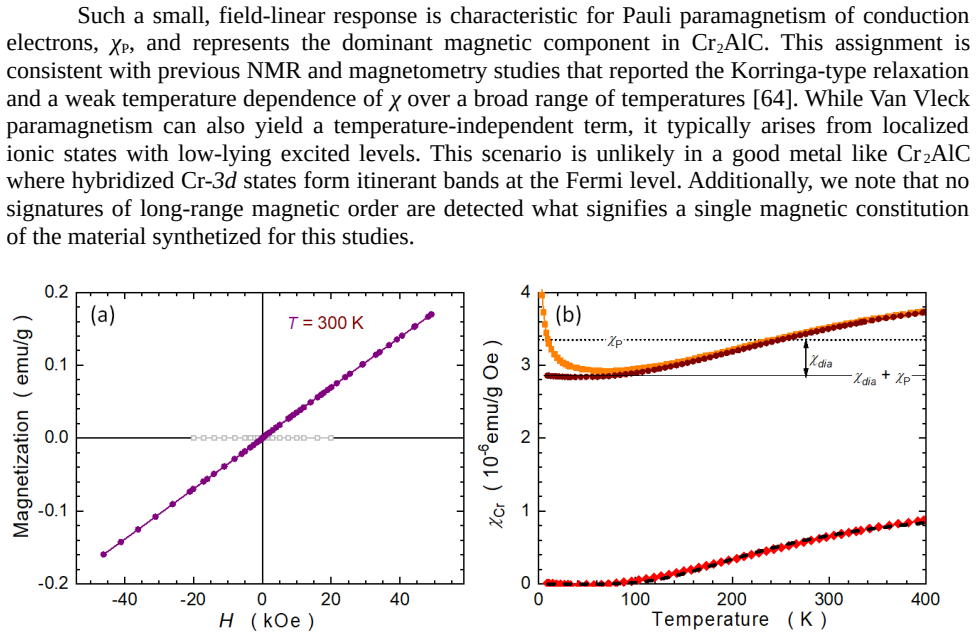
The central claim is a hierarchy of magnetic contributions in Cr2AlC. The material is a weak metallic paramagnet whose dominant response is Pauli-like susceptibility from itinerant Cr states; its non-monotonic temperature dependence is described by the Bleaney-Bowers model of antiferromagnetically coupled Cr-Cr dimers (about 15% of Cr ions, J/kB ≈ 760 K); and a Curie-like upturn at low temperature comes from about 0.02% of Cr sites carrying S = 3/2. SQUID magnetometry under red light finds no bulk optomagnetic effect, only reversible heating of about 0.3 K. ESR at 4 K finds a reversible light-induced reduction of a local signal that involves tens of ppm of the Cr sublattice, explained by opt
Load-bearing premise
The load-bearing premise is that the light-induced drop in the 4 K ESR signal is an electronic redistribution of spin among Cr-related centers, not sample heating by the lamp or a non-chromium defect resonance; the ESR run reports no in-situ temperature or heating budget to rule those out.
Editorial extensions
If this is right
- If the hierarchy is right, bulk Cr2AlC cannot serve as a macroscopically switchable optomagnet; any light-driven magnetic function would have to exploit dilute centers, defects, or surface states.
- The ~15% dimer fraction with J/kB ≈ 760 K explains the nonzero temperature-dependent susceptibility and reconciles earlier conflicting reports of weak magnetism in Cr2AlC without invoking long-range order.
- Because the optically modified spin population is only tens of ppm, ESR is the appropriate probe; integral magnetometry is expected to miss the effect, as observed.
- The BSE calculations make specific spectral predictions: the most magnetization-reducing transitions are at low-energy THz frequencies for in-plane polarization and near 1200 nm for c-axis polarization, giving testable wavelengths for future experiments.
- The reversibility of the ESR signal under dark recovery indicates a metastable local spin rearrangement rather than permanent damage, so repeated optical cycling should be possible at low temperature.
Reading between the lines
- The absence of an in-situ temperature reading in the ESR illumination run leaves open a thermal explanation: at 4 K the ESR intensity follows a 1/T Curie-like law, so a rise from 4 K toward ~17 K would mimic the observed ~77% intensity drop; the g-factor shift and line broadening partially argue against pure heating but do not eliminate it.
- The dark-state g-factor of 2.0038 sits close to the free-electron value typical of carbon-based defect radicals, and the sample was synthesized in a graphite crucible; an ESR control on a sample prepared with a different carbon source would test whether the light-sensitive centers are Cr-related at all.
- Since DFT finds the paramagnetic, antiferromagnetic, and ferromagnetic configurations nearly degenerate, chemical pressure, strain, or off-stoichiometry may be able to enlarge the dimer fraction or the trace-center population, turning a ppm-level effect into a macroscopic one—an extension the paper's design rationale implies but does not demonstrate.
- A direct experimental check of the proposed spin-transfer mechanism would be time-resolved or pulsed ESR: if optical excitation transiently populates triplet states of the Cr-Cr dimers, a photo-induced triplet ESR spectrum distinct from the dark singlet signal should appear on the microsecond timescale.
Signed reviews
Editorial analysis
A structured set of objections, weighed in public.
Referee Report
Summary. The paper reports synthesis of the Cr2AlC MAX phase by high-pressure solid-state annealing and characterizes its magnetic and optomagnetic response by SQUID magnetometry, ESR, and DFT/BSE calculations. The authors identify Cr2AlC as a weak, field-linear metallic paramagnet with a dominant Pauli-like susceptibility, a non-monotonic contribution fitted with an antiferromagnetic Cr–Cr dimer model (J/kB = 760 K, about 15% of Cr sites), and a low-temperature Curie upturn from about 0.02% of S = 3/2 localized centers. SQUID magnetometry under red-light illumination shows no intrinsic macroscopic optomagnetic response beyond a small reversible heating effect. ESR at 4 K shows a reversible reduction of a dilute spin signal under AM1.5G illumination, which the authors attribute to light-induced spin redistribution between neighboring Cr sites with opposite local moments, supported by ai-BSE calculations and an MLWF-based ΔM analysis. The paper concludes that Cr2AlC is a weakly magnetic metal with an extremely dilute population of light-sensitive local centers.
Significance. If established, this hierarchy — Pauli-dominated bulk response, a sizeable AF dimer-like component, a trace Curie term, and a dilute optically responsive ESR population — would provide a useful reference for optomagnetic MAX/MXene design. The SQUID work is carefully executed: the compensating holder, differential Brillouin-function analysis, and the SI S1 heating calibration are clear strengths, and the red-light SQUID null result is well controlled. The ai-BSE calculations are detailed, with exciton lists and oscillator strengths supplied in the SI. However, the central optomagnetic claim rests on a single ESR illumination experiment in which heating and the chemical identity of the ESR centers are not sufficiently controlled, and the theoretical ΔM metric is an ad hoc proxy rather than a computed magnetization change. These issues prevent the current version from supporting the strong conclusion that the ESR response originates from light-induced spin redistribution on Cr centers.
major comments (4)
- [§3.3, Fig. 5 and §2.4] The ESR light-effect is not separated from illumination-induced heating. The paper reports no in-situ sample temperature during AM1.5G irradiation in the ESR setup; the only heating calibration (SI S1) applies to the SQUID red-LED geometry, not to the 100 mW cm−2 solar illumination of a 1 mg powder in He gas. Since the dark ESR intensity is consistent with a near-Curie 1/T law, the observed reduction of Nspin from 3.80×10^17 to 8.58×10^16 spins/g (ratio 0.226) corresponds to an effective temperature rise from 4 K to about 17.7 K. The g-factor shift (2.0038→2.0051) and line broadening (0.92→1.32 mT) are cited as evidence against pure heating, but no dark-state g(T) or ΔHpp(T) calibration is provided, so this evidence is not decisive. Please add an in-situ temperature monitor, measure dark ESR spectra over a temperature range covering at least 4–20 K, or provide a quantitative thermal mode
- [§3.3, Fig. 5 and §2.1] The assignment of the ESR centers to Cr is not sufficiently supported. The observed g = 2.0038 is close to the free-electron value and is typical of carbon/defect radicals; the sample is synthesized in a graphite crucible with graphite spacers, and XRD shows small amounts of Al2O3 or Cr7C3 impurities. The ESR signal corresponds to only ~0.0045% of Cr sites, so a trace carbonaceous or impurity phase could dominate. No control ESR measurements on the empty holder, graphite, or a similarly prepared sample are reported. Since the proposed mechanism (Eq. 2) is specifically Cr-based, the centers need to be identified by complementary methods — for example, variable-frequency ESR, spin concentration vs. Cr fraction, hyperfine studies, or chemical analysis — before the conclusion 'light-sensitive Cr centers' is drawn.
- [§3.2, Eq. (1)] The dimer analysis is a two-parameter fit, not an independent measurement. The values J/kB = 760(10) K and ξ = 0.15(1) (i.e., about 15% of Cr in AF dimers) are extracted by fitting the residual susceptibility after subtracting the Pauli and Curie terms; the same model is then used to interpret the non-monotonic contribution it was fitted to. A gently non-monotonic χ(T) can be parameterized by several models, so the specific claim that 15% of Cr sites form AF-coupled S = 1/2 dimers needs cross-validation (e.g., magnetic specific heat, neutron scattering, or an independent estimate of dimer density from sample disorder). Without this, the statement should be framed as an effective model rather than an established microscopic component of the magnetic hierarchy.
- [§3.3, Eq. (2)] The ΔM measure defined in Eq. (2) is a weighted sum of differences of MLWF projections onto Cr-centered Wannier functions; it is not the actual change of local magnetization in the optically excited state. The paper's transition from 'suggest' in §3.3 to 'can be ascribed' in the Conclusion relies on this proxy. Moreover, the BSE/MLWF calculation is performed for an AF-like Cr configuration, while DFT (Table S1) shows that the magnetic ground state is functional- and pseudopotential-dependent, with AF not robustly the ground state. Please either compute the spin-density change of the excited state directly, or explicitly label ΔM as a qualitative orbital-weight indicator and discuss the sensitivity of the mechanism to the assumed magnetic state.
minor comments (4)
- [§3.2] The display equation for Eq. (1) appears missing in the text between 'fitted with the expression:' and the following sentence; please ensure the Bleaney–Bowers dimer formula is shown and numbered correctly.
- [Table 1] The units in Table 1 are garbled: 'states·eV⁻¹·f.u.⁻¹' and 'states·eV⁻¹·Cr⁻¹' should be typeset with proper superscripts; the current rendering with double negative signs is confusing.
- [SI] The SI contains two sections numbered S4 ('Band structure calculated with the DFT' and 'Absorption spectra obtained with the ai-BSE'); renumber to S4 and S5 respectively.
- [Throughout] Minor typos: 'synthetized' should be 'synthesized' (e.g., Fig. 4 caption); reference [60] 'Scirpta Materialia' should be 'Scripta Materialia'; the model attributed to Bleaney and Bowers is usually called the Bleaney–Bowers dimer model, not 'Bleaney-Bleaney'.
Circularity Check
No significant circularity: the SQUID decomposition is an openly labeled fit, and the ESR/BSE comparison is an independent measurement-theory pairing.
full rationale
The derivation chain is self-contained and no load-bearing step reduces to its inputs. The SQUID susceptibility decomposition is an explicitly labeled fitting exercise: the paper states that the residual χCr(T) is 'fitted with the expression' (Eq. 1) and reports that 'The least-squares fit ... yields an exchange energy of J/kB = 760(10) K and the Curie constant ...'. The dimer fraction ξ = 0.15(1) is therefore a fit output, not a disguised prediction; the paper never calls it a prediction. The low-T Curie component is quantified independently in SI S3 by differential Brillouin-function analysis of M(H) at 2, 5, and 8 K, so it is not defined via the dimer model. The ESR light response is an independent measurement (Nspin dark 3.80×10^17 vs 8.58×10^16 spins/g at 4 K), and the ai-BSE/MLWF ΔM calculation is not adjusted to any ESR datum; the paper presents it as a 'plausible microscopic mechanism' and says the calculations 'suggest' a redistribution, not that they reproduce the ESR number. Self-citations are methodological (SQUID protocols, ESR calibration procedures, prior calculation methods) and are not load-bearing for the physical conclusions; no uniqueness theorem or prior-work ansatz is invoked to force the interpretation. The absence of an in-situ temperature reading during the ESR illumination is an experimental-design/correctness concern (a 4→17 K heating would mimic the 77% intensity drop), but that is not circularity under the definition used here.
Assumptions & free parameters
free parameters (4)
- Dimer exchange coupling J/kB =
760(10) K
- Dimer Curie constant C (≡ Nd·g²·μB²/kB) =
1.60(2)×10⁻³ emu·K/g/Oe
- Concentration of S=3/2 localized centers nS =
1.5×10¹⁸ spins/g (~0.02% of Cr)
- Pauli susceptibility χP =
3.3×10⁻⁶ emu/g/Oe
assumptions (6)
- domain assumption The residual χCr(T) is governed by an isotropic-exchange dimer Hamiltonian H = -2J S1·S2 with two S=1/2 Cr ions
- domain assumption The dimer-forming Cr ions carry S=1/2 (local moment ≈ 1 μB as in the DFT AF solution)
- domain assumption Non-paramagnetic magnetic background is temperature-independent between 2 and 8 K
- domain assumption The DFT-PBE AF solution is a valid reference for computing the optical transitions relevant to the light-sensitive centers
- ad hoc to paper The ΔM measure of Eq. (2), built from MLWF weight differences, represents the actual change of local Cr magnetization under an optical transition
- domain assumption An e-h space of 8 bands with the Tamm-Dancoff approximation and a 12×12×4 k-grid captures the relevant optical response
invented entities (2)
-
Antiferromagnetically coupled Cr–Cr dimers (≈15% of Cr sublattice)
-
Reversibly light-sensitive ESR centers (≈35 ppm of Cr)
independent evidence
Cite this review
Pith. "Pith review of Local magnetic correlations and light-sensitive centers in the Cr2AlC MAX phase." pith.science (2026). https://pith.science/paper/SSGV7GOD
@misc{pith2026260715110,
  author       = {Pith},
  title        = {Pith review of: Local magnetic correlations and light-sensitive centers in the Cr2AlC MAX phase},
  year         = {2026},
  howpublished = {\url{https://pith.science/paper/SSGV7GOD}},
  note         = {Machine review of arXiv:2607.15110}
}
read the original abstract
Cr2AlC MAX phase is synthesized by high-pressure solid-state annealing and investigated as a candidate platform for optically responsive magnetism. Structural characterization confirms the formation of the Cr2AlC phase, while magnetic and optical-magnetic properties are examined by superconducting quantum interference device (SQUID) magnetometry, electron spin resonance (ESR), and first principles calculations. SQUID magnetometry identifies Cr 2AlC as a weak, field-linear metallic paramagnet dominated by Pauli-like susceptibility of itinerant Cr-derived states. Its non-monotonic temperature dependence is described by an additional contribution from antiferromagnetically coupled Cr-Cr dimers, whereas the low-temperature Curie-like upturn originates from only a trace population of localized Cr centers. Under red-light illumination, SQUID magnetometry does not reveal an intrinsic macroscopic optomagnetic response. In contrast, ESR at 4 K shows a reversible light-induced reduction of a local magnetic signal, but the optically modified spin population corresponds only to several tens of ppm of the Cr sublattice. Ab initio Bethe-Salpeter equation (ai-BSE) calculations combined with the maximally localized Wannier function analysis suggest that optical excitation can redistribute spin polarization between neighboring Cr sites with the opposite local moments. The combined experiment-theory approach therefore establishes the hierarchy of magnetic contributions in Cr 2AlC and identifies the microscopic origin of its local optical sensitivity. This provides a reference for designing MAX phases and related MXenes in which defects, surface terminations or reduced dimensionality may enhance optically active magnetic states.
Figures


Figures from the paper (7 more)




Reference graph
Works this paper leans on
-
[1]
N. Fang, C. Wu, Y . Zhang, Z. Li, Z. Zhou, Perspectives: Light Control of Magnetism and Device Development, ACS Nano 18 (2024) 8600‒8625, https://doi/10.1021/acsnano.3c13002
-
[2]
E. Beaurepaire, J.-C. Merle, A. Daunois, J.-Y . Bigot, Ultrafast Spin Dynamics in Ferromagnetic Nickel, Phys. Rev. Lett. 76 (1996) 4250‒4253, https://doi.org/10.1103/PhysRevLett.76.4250
-
[3]
A. Kirilyuk, A.V . Kimel, T. Rasing, Ultrafast optical manipulation of magnetic order, Rev. Mod. Phys. 82 (2010) 2731‒2784, https://doi.org/10.1103/RevModPhys.82.2731
-
[4]
K. Carva, M. Battiato, P.M. Oppeneer, Ab Initio Investigation of the Elliott-Yafet Electron- Phonon Mechanism in Laser-Induced Ultrafast Demagnetization, Phys. Rev. Lett. 107 (2011) 207201, https://doi.org/10.1103/PhysRevLett.107.207201
-
[5]
S.R. Tauchert, M. V olkov, D. Ehberger, D. Kazenwadel, M. Evers, H. Lange, A. Donges, A. Book, W. Kreuzpaintner, U. Nowak, P. Baum, Polarized phonons carry angular momentum in ultrafast demagnetization, Nature 602 (2022) 73‒77, https://doi.org/10.1038/s41586-021-04306-4
-
[6]
V . Unikandanunni, R. Medapalli, E.E. Fullerton, K. Carva, P.M. Oppeneer, S. Bonetti, Anisotropic ultrafast spin dynamics in epitaxial cobalt, Applied Physics Letters 118 (2021) 232404, https://doi.org/10.1063/5.0049692
-
[7]
M. Haag, C. Illg, M. Fähnle, Role of electron-magnon scatterings in ultrafast demagnetization, Phys. Rev. B 90 (2014) 014417, https://doi.org/10.1103/PhysRevB.90.014417
-
[8]
M. Weißenhofer, P. M. Oppeneer, Ultrafast Demagnetization Through Femtosecond Generation of Non-Thermal Magnons, Adv. Phys. Res. (2024) 2300103, https://doi.org/10.1002/apxr.202300103
Show all 77 references
-
[9]
Battiato, K
M. Battiato, K. Carva, P. M. Oppeneer, Superdiffusive Spin Transport as a Mechanism of Ultrafast Demagnetization, Phys. Rev. Lett. 105 (2010) 027203, https://doi.org/10.1103/PhysRevLett.105.027203
2010 doi
-
[10]
Hofherr et al., Ultrafast optically induced spin transfer in ferromagnetic alloys, Sci
M. Hofherr et al., Ultrafast optically induced spin transfer in ferromagnetic alloys, Sci. Adv. 6 (2020) eaay8717, https://doi.org/10.1126/sciadv.aay8717
2020 doi
-
[11]
Carva, P
K. Carva, P. Baláž, and I. Radu, in Handbook of Magnetic Materials , V ol. 26, edited by E. Brück (Elsevier, 2017), pp. 291–463
2017
-
[12]
Dewhurst, S
J.K. Dewhurst, S. Shallcross, P. Elliott, S. Eisebitt, C. v. Korff Schmising, C. v. Korff, S. Sharma, Angular momentum redistribution in laser-induced demagnetization, Phys. Rev. B 104 (2021) 054438, https://doi.org/10.1103/PhysRevB.104.054438
2021 doi
-
[13]
von Korff Schmising, S
C. von Korff Schmising, S. Jana, O. Zülich, D. Sommer, S. Eisebitt, Direct versus indirect excitation of ultrafast magnetization dynamics in FeNi alloys, Physical Review Research 6 (2024) 013270, https://doi.org/10.1103/PhysRevResearch.6.013270
2024 doi
-
[14]
M. S. Mrudul, P. M. Oppeneer, Ab initio investigation of laser-induced ultrafast demagnetization of FePt: Intensity dependence and importance of electron coherence, Phys. Rev. B 109 (2024) 144418, https://doi.org/10.1103/PhysRevB.109.144418
2024 doi
-
[15]
Jungwirth, X
T. Jungwirth, X. Marti, P. Wadley, J. Wunderlich, Antiferromagnetic spintronics. Nature Nanotech 11 (2016) 231–241, https://doi.org/10.1038/nnano.2016.18
2016 doi
-
[16]
J. H. Mentink, J. Hellsvik, D.V . Afanasiev, B.A. Ivanov, A. Kirilyuk, A.V . Kimel, O. Eriksson, M.I. Katsnelson, Th. Rasing, Ultrafast Spin Dynamics in Multisublattice Magnets, Phys. Rev. Lett. 108 (2012) 057202, https://doi.org/10.1103/PhysRevLett.108.057202
2012 doi
-
[17]
S.-E. Lee, Y . W. Windsor, A. Fedorov, K. Kliemt, C. Krellner, C. Schüßler-Langeheine, N. Pontius, M. Wolf, U. Atxitia, D. V . Vyalikh, L. Rettig, Robust Magnetic Order Upon Ultrafast Excitation of an Antiferromagnet, Advanced Materials Interfaces 9 (2022) 2201340, https://doi...
2022 doi
-
[18]
Y . W. Windsor, A. Ernst, K. Kummer, K. Kliemt, Ch. Schüßler-Langeheine, N. Pontius, U. Staub, E. V . Chulkov, C. Krellner, D. V . Vyalikh, L. Rettig, Deterministic control of an antiferromagnetic spin arrangement using ultrafast optical excitation, Communications Physics 3 (2...
2020 doi
-
[19]
Hamara, M
D. Hamara, M. Strungaru, J.R. Massey, et al. Ultra-high spin emission from antiferromagnetic FeRh, Nature Communications 15 (2024) 4958, https://doi.org/10.1038/s41467-024-48795-z
2024 doi
-
[20]
Kašpar, M
Z. Kašpar, M. Surýnek, J. Zubáč, F. Krizek, V . Novák, R.P. Campion, M.S. Wörnle, P. Gambardella, X. Marti, P. Němec, K.W. Edmonds, S. Reimers, O.J. Amin, F. Maccherozzi, S.S. Dhesi, P. Wadley, J. Wunderlich, K. Olejník, T. Jungwirth, Quenching of an antiferromagnet into high ...
2021 doi
-
[21]
Freimuth, S
F. Freimuth, S. Blügel, and Y . Mokrousov, Laser-induced torques in metallic antiferromagnets, Phys. Rev. B 103 (2021) 174429, https://doi.org/10.1103/PhysRevB.103.174429
2021 doi
-
[22]
Dannegger, M
T. Dannegger, M. Berritta, K. Carva, S. Selzer, U. Ritzmann, P.M. Oppeneer, U. Nowak, Ultrafast coherent all-optical switching of an antiferromagnet with the inverse Faraday effect, Physical Review B 104 (2021) L060413, https://doi.org/10.1103/PhysRevB.104.L060413
2021 doi
-
[23]
Kubitza, C
N. Kubitza, C. Büchner, J. Sinclair, R. M. Snyder, and C. S. Birkel, Extending the Chemistry of Layered Solids and Nanosheets: Chemistry and Structure of MAX Phases, MAB Phases and Mxenes, ChemPlusChem 88 (2023) e202300214, https://doi.org/10.1002/cplu.202300214
2023 doi
-
[24]
Fu, N.Wang, D
Z. Fu, N.Wang, D. Legut, C. Si, Q. Zhang, S. Du, T.C. Germann, J.S. Francisco, R. Zhang, Rational Design of Flexible Two-Dimensional MXenes with Multiple Functionalities, Chem Rev. 119 (2019) 11980‒12031, https://doi.org/10.1021/acs.chemrev.9b00348
2019 doi
-
[25]
Khazaei, A
M. Khazaei, A. Ranjbar, M. Arai, T. Sasaki, S. Yunoki, Electronic properties and applications of MXenes: a theoretical review, Journal of Materials Chemistry C 5 (2017) 2488, https://doi.org/10.1039/C7TC00140A
2017 doi
-
[26]
X. Lin, W. Yang, K. L. Wang, and W. Zhao, Two-dimensional spintronics for low-power electronics, Nature Electronics 2 (2019) 274‒283, https://doi.org/10.1038/s41928-019-0273-7
2019 doi
-
[27]
Hirohata, K
A. Hirohata, K. Yamadab, Y . Nakatanic, I.-L. Prejbeanud, B. Diényd, P. Pirroe, B. Hillebrands, Review on spintronics: Principles and device applications, Journal of Magnetism and Magnetic Materials 509 (2020) 166711, https://doi.org/10.1016/j.jmmm.2020.166711
2020
-
[28]
Gibertini, M
M. Gibertini, M. Koperski, A.F. Morpurgo, K.S. Novoselov, Magnetic 2D materials and heterostructures, Nat. Nanotechnol. 14 (2019) 408 ‒419, https://doi.org/10.1038/s41565-019-0438- 6
2019 doi
-
[29]
Hantanasirisakul, B
K. Hantanasirisakul, B. Anasori, S. Nemsak, J.L. Hart, J. Wu, Y . Yang, R.V . Chopdekar, P. Shafer, A.F. May, E.J. Moon, J. Zhou, Q. Zhang, M.L. Taheri, S.J. May, Y . Gogotsi, Evidence of a magnetic transition in atomically thin Cr2TiC2Tx Mxene, Nanoscale Horizons 5 (2020) 155...
2020 doi
-
[30]
Iqbal, J
M. Iqbal, J. Fatheema, Q. Noor, M. Rani, M. Mumtaz, R.-K. Zheng, S.A. Khan, S. Rizwan, Co-existence of magnetic phases in two-dimensional Mxene, Materials Today Chemistry 16 (2020) 100271, https://doi.org/10.1016/j.mtchem.2020.100271
2020
-
[31]
Jaouen, P
M. Jaouen, P. Chartier, T. Cabioc'h, V . Mauchamp, G. André, M. Viret, Invar Like Behavior of the Cr2AlC MAX Phase at Low Temperature, J. Am. Ceram. Soc., 96: 3872 ‒3876, https://doi.org/10.1111/jace.12635
-
[32]
Dahlqvist, B
M. Dahlqvist, B. Alling, I. A. Abrikosov, J. Rosen, Phys. Rev. B 84 (2011) 220403, https://doi.org/10.1103/PhysRevB.84.220403
2011 doi
-
[33]
Sobolev, K.K
K.V . Sobolev, K.K. Kolincio, A. Emelyanov, A. Mielewczyk-Gryń, M. Gazda, M. Roman, A. Pazniak, V . Rodionov, Evolution of magnetic and transport properties in (Cr 1−xMnx)2AlC MAX- phase synthesized by arc melting technique, Journal of Magnetism and Magnetic Materials 493 (202...
2020
-
[34]
Sobolev, H
K. Sobolev, H. Pazniak, M. Farle, V . Rodionova, and U. Wiedwald, Synthesis, phase purification and magnetic characterization of the (Cr 1-x,Mnx)2AlC MAX-phase, Journal of Materials Chemistry C 9 (2021) 16516, https://doi.org/ 10.1039/d1tc03092b
2021 doi
-
[35]
Gonzalez-Julian, S
J. Gonzalez-Julian, S. Onrubia, M. Bram, O. Guillon, Effect of sintering method on the microstructure of pure Cr 2AlC MAX phase ceramics, J. Ceram. Soc. Jap. 124 (2016) 415–420, https://doi.org/10.2109/jcersj2.15263
2016 doi
-
[36]
Azina, M
C. Azina, M. Poll, D.M. Holzapfel, E. Tailleur, A. Zuber, S. Dubois, P. Eklund, J. Gonzalez- Julian, Microstructural and compositional design of Cr 2AlC MAX phases and their impact on oxidation resistance, J. Eur. Ceram. Soc. 44 (2024) 4895–4904, https://doi.org/10.1016/j.jeur...
2024 doi
-
[37]
Sierakowski, R
K. Sierakowski, R. Jakiela, B. Lucznik, P. Kwiatkowski, M. Iwinska, M. Turek, H. Sakurai, T. Kachi, M Bockowski, High Pressure Processing of Ion Implanted GaN, Electronics 9 (2020) 1380, https://doi.org/10.3390/electronics9091380
2020 doi
-
[39]
Gas and M
K. Gas and M. Sawicki, In Situ Compensation Method for Precise Integral SQUID Magnetometry of Miniscule Biological, Chemical, and Powder Specimens Requiring the Use of Capsules, Materials 15, 2 (2022)
2022
-
[44]
Reciprocating Sample Option (RSO) – Theory of Operation and Measurement Modes,
Quantum Design Application Note 1014-201 , “Reciprocating Sample Option (RSO) – Theory of Operation and Measurement Modes,” Quantum Design Inc., San Diego, CA
-
[45]
Marumoto, T
K. Marumoto, T. Fujimori, M. Ito, T. Mori, Advanced Energy Materials 2 (2012) 591 ‒597, https://doi.org/10.1002/aenm.201100774
2012 doi
-
[46]
Nagamori, K
T. Nagamori, K. Marumoto, Direct Observation of Hole Accumulation in Polymer Solar Cells During Device Operation using Light-Induced Electron Spin Resonance, Advanced Materials 25 (2013) 2362-2367, https://doi.org/10.1002/adma.201204015
2013 doi
-
[47]
Hohenberg, W
P. Hohenberg, W. Kohn, Inhomogeneous Electron Gas, Phys. Rev. B 136 (1964) B864-B871, https://doi.org/10.1103/PhysRev.136.B864
1964 doi
-
[48]
Kohn, L.J
W. Kohn, L.J. Sham, Self-Consistent Equations Including Exchange and Correlation Effects, Phys. Rev. B 140 (1965) A1133‒A1138, https://doi.org/10.1103/PhysRev.140.A1133
1965 doi
-
[49]
Giannozzi, S
P. Giannozzi, S. Baroni, N. Bonini, M. Calandra, R. Car, C. Cavazzoni, D. Ceresoli, G.L. Chiarotti, M. Cococcioni, I. Dabo, et al., Quantum espresso: a modular and open-source software project for quantum simulations of materials, J. Phys.: Condens. Matter. 21 (2009) 395502, h...
2009 doi
-
[50]
Perdew, K
J.P. Perdew, K. Burke, M. Ernzerhof, Generalized gradient approximation made simple, Phys. Rev. Lett. 77 (1996) 3865–3868, https://doi.org/10.1103/PhysRevLett.77.3865
1996 doi
-
[51]
Monkhorst, J.D
H.J. Monkhorst, J.D. Pack, Special Points for Brillouin-Zone Integrations, Physical Review B, 13 (1976) 5188-5192, http://dx.doi.org/10.1103/PhysRevB.13.5188
1976 doi
-
[52]
Salpeter , H.A
E.E. Salpeter , H.A. Bethe , A relativistic equation for bound-state problems. Phys. Rev. 84 (1951) 1232–1242, https://doi.org/10.1103/PhysRev.84.1232
1951 doi
-
[53]
Marini, C
A. Marini, C. Hogan, M. Grüning, D. Varsano, Yambo: an ab initio tool for excited state calculations, Comput. Phys. Commun. 180 (2009) 1392−1403, https://doi.org/10.1016/j.cpc.2009.02.003
2009 doi
-
[54]
Sangalli, A
D. Sangalli, A. Ferretti, H. Miranda, C. Attaccalite, I. Marri, E. Cannuccia, P. Melo, M. Marsili, F. Paleari, A. Marrazzo, Many-body perturbation theory calculations using the yambo code, J. Phys. Cond. Matter. 31 (2019) 325902, https://doi.org/10.1088/1361-648X/ab15d0
2019 doi
-
[55]
Taylor, Tamm-Dancoff Method, Phys
J.C. Taylor, Tamm-Dancoff Method, Phys. Rev. 95 (1954) 1313−1317, https://doi.org/10.1103/PhysRev.95.1313
1954 doi
-
[56]
Souza, N
I. Souza, N. Marzari, D. Vanderbilt, Maximally localized Wannier functions for entangled energy bands, Phys. Rev. B 65 (2001) 035109, https://doi.org/10.1103/PhysRevB.65.035109
2001 doi
-
[57]
Marzari, A.A
N. Marzari, A.A. Mostofi, J.R. Yates, I. Souza, D. Vanderbilt, Maximally localized Wannier functions: Theory and applications, Rev. Mod. Phys. 84 (2012) 1419, https://doi.org/10.1103/RevModPhys.84.1419
2012 doi
-
[58]
Pizzi, et al
G. Pizzi, et al. Wannier90 as a community code: new features and applications. J. Phys. Cond. Mater. 32 (2020) 165902, https://doi.org/10.1088/1361-648X/ab51ff
2020 doi
-
[59]
Jeitschko, H
W. Jeitschko, H. Nowotny, Die Kristallstruktur von Ti 3SiC2—ein neuer Komplexcarbid-Typ , Monatsh. Chem. 98 (1967) 329, https://doi.org/10.1007/BF00899949
1967 doi
-
[60]
J. Yuan, S. Zhou, H. Wu, Z. Wang, Y . Zhang, G. Zhou, G. Ma, P. Ke, A. Wang, Ultrahigh strength-ductility of nanocrystalline Cr2AlC coating under micropillar compression, Scipta Materialia, 235 (2023) 115594, https://doi.org/10.1016/j.scriptamat.2023.115594
2023
-
[61]
Z. Wang, G. Ma, L. Liu, L. Wang, P. Ke, Q. Xue, A. Wang, High-performance Cr 2AlC MAX phase coatings: Oxidation mechanisms in the 900–1100°C temperature range, Corrosion Science, 167 (2020) 108492, https://doi.org/10.1016/j.corsci.2020.108492
2020
-
[62]
Sharma, O.P
P. Sharma, O.P. Pandey, Thermal kinetics involved during the solid-state synthesis of Cr 2AlC MAX phase. J Therm Anal Calorim,143 (2021) 3997–4008, https://doi.org/10.1007/s10973-020- 09390-8
2021 doi
-
[63]
Bain and John F
Gordon A. Bain and John F. Berry, Diamagnetic Corrections and Pascal’ s Constants, Journal of Chemical Education, 85 (2008) 532
2008
-
[64]
Phys.: Conf
Zhongsheng Liu, Kenta Takao, Takeshi Waki, Yoshikazu Tabata and Hiroyuki Nakamura, Electron correlation in Pauli paramagnetic Cr2AlC, Cr2GaC and Cr2GeC, 2017 J. Phys.: Conf. Ser. 868 012016; DOI 10.1088/1742-6596/868/1/012016
2017 doi
-
[65]
Pacuski, P
W. Pacuski, P. Kossacki, D. Ferrand, A. Golnik, J. Cibert, M. Wegscheider, A. Navarro- Quezada, A. Bonanni, M. Kiecana, M. Sawicki, and T. Dietl, Observation of Strong-Coupling Effects in a Diluted Magnetic Semiconductor Ga1-xFexN, Phys. Rev. Lett. 100, 037204 (2008)
2008
-
[66]
Z. Liu, T. Waki, Y . Tabata, and H. Nakamura, Mn-doping-induced itinerant-electron ferromagnetism in Cr2GeC, Phys. Rev. B 89 (2014) 054435
2014
-
[67]
Hamm, Joshua D
Christin M. Hamm, Joshua D. Bocarsly, Gareth Seward, Ulrike I. Kramm and Christina S. Birkel, Non-conventional synthesis and magnetic properties of MAX phases (Cr/Mn)2AlC and (Cr/Fe)2AlC, J. Mater. Chem. C, 2017, 5, 5700; DOI: 10.1039/c7tc00112f
2017 doi
-
[71]
Gas and M
K. Gas and M. Sawicki, Reliable Magnetometry for Antiferromagnets and Thin Films: Correcting Substrate Artifacts in Mn3Sn/MgO Systems, Phys. Rev. Appl., 25, 014012 (2026). Supporting information Local magnetic correlations and light-sensitive centers in the Cr2AlC MAX phase Ma...
2026
-
[72]
Anomalous paramagnetism of copper acetate
Bleaney, B.; Bowers, K.D. Anomalous paramagnetism of copper acetate . Proc. R. Soc. Lond. Ser. A 1952, 214, 451–465
1952
-
[73]
C. J. O’Connor, Magnetochemistry-Advances in Theory and Experimentation , Progress in Inorganic Chemistry; Vol 29, Edited by Stephen J. Lippard, John Wiley & Sons, Inc. (1982)
1982
-
[74]
Frenking, Heretical thoughts about the present understanding and description of the chemical bond
G. Frenking, Heretical thoughts about the present understanding and description of the chemical bond. Molecular Physics, 121 (9–10) (2022) https://doi.org/10.1080/00268976.2022 . 2110168 References in Supporting Information
2022
-
[75]
Available online: https://www.cmr-direct.com/en/cmr-gevar-25ml?filter_name=ge %20varnis (accessed on 12 October 2022)., (n.d.)
The GE/IMI 7031 Varnish Is Obtained from Cambridge Magnetic Refrigeration, Cambridge, CB5 8HR, UK. Available online: https://www.cmr-direct.com/en/cmr-gevar-25ml?filter_name=ge %20varnis (accessed on 12 October 2022)., (n.d.)
2022
-
[76]
Sawicki, W
M. Sawicki, W. Stefanowicz, and A. Ney, Sensitive SQUID magnetometry for studying nanomagnetism, Semicond. Sci. Technol. 26, 064006 (2011)
2011
-
[77]
Nur Amanina Juniasari Tun Nur Iskandar, Yeap Guan Yeow, Nobuyuki Maeta, Masato M. Ito, Yoshiyuki Nakamura, Katarzyna Gas and Maciej Sawicki, Anisotropic and magnetic properties in non-metal and non-radical organic aggregates of tri-substituted phenyl derivatives , New J. Chem....
2020 doi
-
[78]
Świątkowski, S
M. Świątkowski, S. Lanka, A. Czylkowska, K. Gas, M. Sawicki, Structural, Spectroscopic, Thermal, and Magnetic Properties of a New Dinuclear Copper Coordination Compound with Tiglic Acid, Materials, 14, 2148 (2021). https://doi.org/10.3390/ma14092148
2021 doi
-
[79]
Rogalewicz, A
B. Rogalewicz, A. Climova, E. Pivovarova, J. Sukiennik, K. Czarnecka, P. Szymański, M. Szczesio, K. Gas, M. Sawicki, M. Pitucha, and A. Czylkowska, Antitumor Activity and Physicochemical Properties of New Thiosemicarbazide Derivative and Its Co(II), Ni(II), Cu(II), Zn(II) and ...
2022 doi
-
[80]
Reciprocating Sample Option (RSO) – Theory of Operation and Measurement Modes,
Quantum Design Application Note 1014-201, “Reciprocating Sample Option (RSO) – Theory of Operation and Measurement Modes,” Quantum Design Inc., San Diego, CA. S2. Magnetic phases obtained from the DFT and their relative total energies Definitions of magnetic moments via the sp...
-
[81]
Pacuski, P
W. Pacuski, P. Kossacki, D. Ferrand, A. Golnik, J. Cibert, M. Wegscheider, A. Navarro-Quezada, A. Bonanni, M. Kiecana, M. Sawicki, and T. Dietl, Observation of Strong-Coupling Effects in a Diluted Magnetic Semiconductor Ga1-xFexN, Phys. Rev. Lett. 100, 037204 (2008)
2008
-
[82]
Navarro-Quezada, K
A. Navarro-Quezada, K. Gas, T. Truglas, V . Bauernfeind, M. Matzer, D. Kreil, A. Ney, H. Groiss, M. Sawicki, and A. Bonanni, Out-of-Plane Magnetic Anisotropy in Ordered Ensembles of FeyN Nanocrystals Embedded in GaN, Materials 13, 3294 (2020)
2020
-
[83]
K. Gas, A. Królicka, K. Dybko, P. Nowicki, Z. Khosravizadeh, T. Story, and M. Sawicki, Magnetic constitution of topologically trivial thermoelectric PbTe:Cr, Journal of Magnetism and Magnetic Materials 537, 168154 (2021)
2021
-
[84]
K. Gas, J. Sadowski, and M. Sawicki, Magnetic properties of wurtzite (Ga,Mn)As, Journal of Magnetism and Magnetic Materials 533, 168012 (2021)
2021
-
[85]
U” and/or down denoted “D
K. Gas and M. Sawicki, Reliable Magnetometry for Antiferromagnets and Thin Films: Correcting Substrate Artifacts in Mn3Sn/MgO Systems, Phys. Rev. Appl., 25, 014012 (2026). S4. Band structure calculated with the DFT Table S2. List of the high symmetry points in the Brillouin zo...
2026
Reviewed August 2, 2026 · model on record in the stance chip above.
Discussion (0). Continue with ORCID to comment.