REVIEW 3 major objections 4 minor 96 references
Universality at next-to-leading power for jet associated processes
T0 review · 3 major / 4 minor · reviewed 2026-08-16 · deepseek-v4-flash
Pith's one-line read For any colourless particle produced with a jet, the leading logarithmic corrections at next-to-leading power have a universal coefficient set by mass factorization.
desk verdict The universal relation C_LL = -C_-1 is a clean, plausible conjecture, but the paper asserts the key angular integration rather than showing it, and the spin-1 W/Z results are explicitly deferred; the abstract overstates what is demonstrated. read the letter →
The pith
A machine-rendered reading of the paper's core claim, the machinery that carries it, and where it could break.
The reading
What carries the argument
The central object is the identity $C_{LL} = -C_{-1}$ (eq. (18)), with $C_{-1}$ fixed by mass factorization through eq. (15) and the helicity-dependent Altarelli-Parisi splitting kernels. What makes the argument run is the colour-ordered helicity-amplitude formalism: next-to-soft gluon emission is handled by the subleading soft theorem, while soft quark emission is handled by operators that merge the soft quark with the adjacent hard coloured particle. Because the Eikonal factor multiplies the squared NLP amplitudes, the angular integrals reduce to terms of the form $1/s_{i5}$ and $s_{i5}/(s_{i+1,5}s_{i+2,5})$ with coefficients independent of $s_{i5}$; the paper states that performing those angular integrals and multiplying by the phase-space factor yields the relation.
What would settle it
Compute the full NLP leading-logarithmic coefficient for $W^+$+jet (or $Z$+jet) by explicit phase-space integration of the colour-ordered helicity amplitudes for a fixed helicity configuration, and compare the coefficient of $\log(s_{45}/\bar\mu^2)$ with $-C_{-1}$ obtained from the mass-factorization expression in eq. (15) using helicity-dependent splitting functions. Any mismatch would falsify the universal relation.
Extended reading notes
Core claim
The central claim is that for production of an arbitrary colourless particle in association with a jet, the coefficient $C_{LL}$ of the leading logarithm at NLP equals $-C_{-1}$, where $C_{-1}$ is the coefficient of the $1/\epsilon$ pole that mass factorization must cancel. In the paper's setup, $C_{-1}$ is computed from the helicity-dependent Altarelli-Parisi splitting kernels $\Gamma_{i\to jk}$. The relation is claimed to hold for both diagonal ($q\bar q$, $gg$) and off-diagonal ($qg$, $\bar q g$) partonic channels, for next-to-soft gluon emission and soft quark emission alike, and for colourless particles of arbitrary spin, provided the helicity configurations are handled correctly: soft quarks are clubbed with the neighbouring hard parton in colour-ordered amplitudes, and sums over gluon helicities and massive-particle polarisations are taken.
Load-bearing premise
The load-bearing step is the claim that the angular integration of the Eikonal-structured squared amplitudes produces exactly $C_{LL} = -C_{-1}$ with no extra finite terms; if that integration were to generate additional leading-logarithmic contributions, the universality formula would not hold.
Editorial extensions
If this is right
- The NLP leading-logarithmic coefficients for $W$+jet and $Z$+jet can be obtained directly from mass factorization and helicity-dependent splitting functions, without performing the full NLP phase-space integrals.
- The same universal structure covers diagonal $q\bar q$ and $gg$ channels as well as off-diagonal $qg$ channels, so no separate resummation machinery is needed for each partonic channel.
- Because the identity holds for both next-to-soft gluon and soft quark radiation, the two sources can be combined into a single NLP formula for each helicity configuration.
- This sets a practical foundation for resumming NLP leading logarithms in jet-associated colour-singlet production at the LHC.
Reading between the lines
- Read as a general statement, the paper's colourless set includes the massless photon, so the same $C_{LL}=-C_{-1}$ formula should also apply to prompt-photon-plus-jet production; this extension is not demonstrated explicitly.
- The identity at leading logarithm raises the question of whether the same mass-factorization relation also determines the next-to-leading logarithms at NLP; the paper does not claim this.
- An independent calculation of the $W$+jet or $Z$+jet NLP coefficients, for instance through a subtraction scheme, would provide a direct test of the universal formula.
Signed reviews
Editorial analysis
A structured set of objections, weighed in public.
Referee Report
Summary. The paper proposes that the next-to-leading-power (NLP) leading logarithms for the production of an arbitrary massive colourless particle in association with a jet have a universal analytic form. The authors argue that the coefficient of the NLP leading logarithm, C_LL, is equal to minus the mass-factorization pole coefficient C_{-1}, so that the NLP logarithms can be obtained from helicity-dependent Altarelli-Parisi splitting functions alone. They illustrate this with explicit Higgs+jet results from their previous work and then give 'anticipated' formulas for W+jet production, while explicitly stating that a complete W/Z calculation is beyond the scope of the paper.
Significance. If the central relation C_LL = -C_{-1} is correct, the result would be practically valuable: it would reduce the computation of NLP leading logarithms for jet-associated colour-singlet processes to mass factorization and helicity-dependent splitting kernels, avoiding the difficult phase-space integrals that have prevented complete V+jet NLP calculations. The paper also makes concrete, checkable predictions in Eqs. (19)-(22) and draws on the authors' earlier Higgs+jet calculations. However, the generalization to arbitrary massive colourless particles is not derived: the W/Z formulas are stated as expectations, and the key angular-integration step behind Eq. (18) is asserted rather than shown. As it stands, the manuscript is better described as a research proposal than as a demonstration of universality.
major comments (3)
- [Section IV, Eq. (18)] The central relation C_LL = -C_{-1} is stated to follow 'straightforwardly' from the angular integration of the Eikonal-structured squared amplitudes, but the integration over theta1 and theta2 in Eq. (13) is not shown. No integrals for the six term types are displayed, and no argument is given that finite pieces from the angular integrals cannot contribute to the coefficient of log(s45/bar_mu^2). Because Eq. (18) is the load-bearing step for the claimed universality, this omission is substantive rather than a presentation issue.
- [Section IV, Eq. (15)] Mass factorization defines C_{-1} through convolutions over x1 and x2 of Gamma with the Born cross-section, but Eq. (14) assumes that the result is a local coefficient multiplying (A^{h1h2h3h4})^2. The reduction of the convolutions to this local form is not demonstrated, and the treatment of final-state collinear or soft-virtual contributions to C_{-1} is not discussed. Without this step, the equality C_LL = -C_{-1} cannot be verified from the mass-factorization expression alone.
- [Section IV, Eqs. (21)-(22)] The W/Z coefficients are introduced as 'expected' and 'anticipated', and the text explicitly states that 'a complete and explicit calculation of the NLP contributions for W^+- and Z-boson production in association with a jet is beyond the scope of this article'. The abstract nonetheless claims demonstration of universality for arbitrary massive colourless particles. This exceeds what is actually derived; the authors should either provide the explicit spin-1 derivation or substantially weaken the universality claim to a conjecture supported by the Higgs+jet case.
minor comments (4)
- [Section IV] The text contains a typo: 'Altareli-Parisi' should be 'Altarelli-Parisi'.
- [Section III, Eq. (14)] The notation 'C45 1/(s45)+' is not defined; if this is a plus distribution, it should be written explicitly, and the relation of this term to the log term should be clarified.
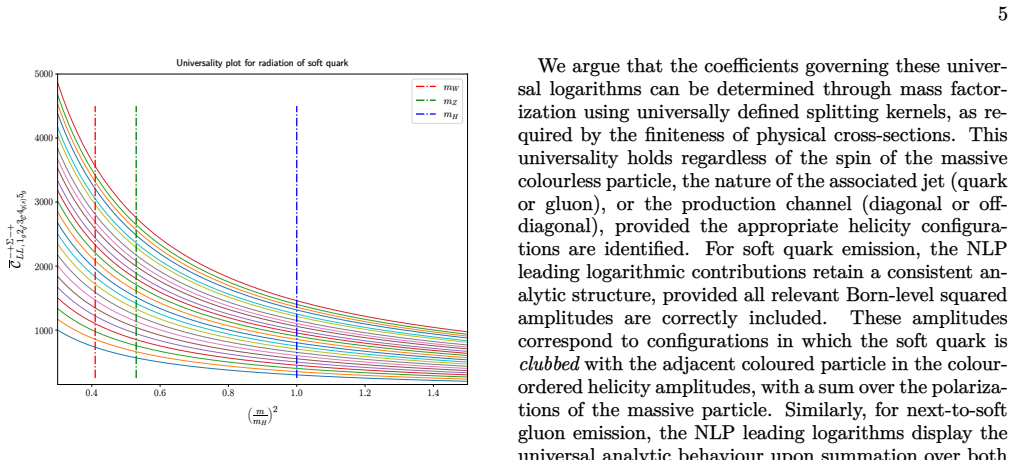
- [Figures 1 and 2] The captions say that F and |A|^2 are excluded, and the vertical axis is labelled as CLL rather than the barred quantity mentioned in the text; please make this notation consistent.
- [Introduction, references [90,91]] The paper says earlier vector-boson-plus-jet studies did not provide complete NLP logarithms, but it does not explain why the results of those references are insufficient or how the present proposal differs from them; a brief comparison would help the reader.
Circularity Check
No circularity: C_LL = -C_-1 is a claimed identity between independently defined coefficients, and the W/Z extensions are explicit conjectures rather than fitted or definitionally forced outputs.
full rationale
The derivation chain is not circular. C_-1 in Eq. (15) is defined through mass-factorization counterterms involving helicity-dependent Altarelli-Parisi kernels and Born cross-sections, while C_LL in Eq. (14) is the coefficient of log(s45/\bar{\mu}^2) arising from the real-emission phase-space integral in Eq. (13); Eq. (18) asserts their equality after angular integration, but neither coefficient is defined in terms of the other, so the relation is a substantive identity rather than a tautology. No parameter is fitted to a subset of data and renamed as a prediction, no uniqueness theorem is imported from the authors' prior work, and no ansatz is smuggled in through a citation: the soft-quark operators and helicity formalism of refs. [92,96] are prior parameter-free calculations that support the method without themselves forcing the spin-1 results. The genuine weaknesses are evidential rather than circular: the angular integration leading to Eq. (18) is not exhibited (the text says it "follows straightforwardly"), and the W/Z coefficients in Eqs. (21)-(22) are explicitly "anticipated" and "expected," with the paper stating that a complete calculation "is beyond the scope of this article and will be presented in forthcoming studies." These are omitted proofs and deferred verifications, which affect the support for the universality claim, but they do not amount to a reduction of the output to the input by construction.
Assumptions & free parameters
assumptions (4)
- standard math Soft theorems of gauge theory [93-95] correctly describe the next-to-soft gluon emission amplitude at NLP (eq. (2)).
- ad hoc to paper The soft quark operators defined in the authors' previous paper [96] (eqs. (3)-(4)) correctly capture soft quark emission at NLP.
- ad hoc to paper The phase-space parametrization (eq. (10)) and the angular integration result lead to the cross-section form of eq. (14) and the relation C_LL = -C_{-1} (eq. (18)).
- domain assumption The infrared pole coefficient C_{-1} is entirely determined by mass factorization (eqs. (15)-(17)) and no other soft/collinear contributions affect the NLP leading logarithm.
Cite this review
Pith. "Pith review of Universality at next-to-leading power for jet associated processes." pith.science (2026). https://pith.science/paper/STEM45F4
@misc{pith2026250501340,
  author       = {Pith},
  title        = {Pith review of: Universality at next-to-leading power for jet associated processes},
  year         = {2026},
  howpublished = {\url{https://pith.science/paper/STEM45F4}},
  note         = {Machine review of arXiv:2505.01340}
}
read the original abstract
The study of cross-sections in the threshold limit at next-to-leading power has been a subject of sustained interest for many years. We demonstrate the universality of leading logarithms at next-to-leading power for the production of arbitrary massive colourless particles in association with a jet, contingent upon the identification of appropriate combination of helicity configurations.
Figures

Reference graph
Works this paper leans on
-
[1]
Parisi, Summing large perturbative corrections in QCD, Phys
G. Parisi, Summing large perturbative corrections in QCD, Phys. Lett. B90 (1980) 295
1980
-
[2]
Curci and M
G. Curci and M. Greco, Large Infrared Corrections in QCD Processes, Phys. Lett. B92 (1980) 175
1980
-
[3]
Sterman, Summation of large corrections to short distance hadronic cross-sections, Nucl
G. Sterman, Summation of large corrections to short distance hadronic cross-sections, Nucl. Phys. B281 (1987) 310
1987
-
[4]
Catani and L
S. Catani and L. Trentadue, Resummation of the QCD Perturbative Series for Hard Processes , Nucl. Phys. B327 (1989) 323
1989
-
[5]
Catani and L
S. Catani and L. Trentadue, Comment on qcd exponentiation at large x , Nucl. Phys. B353 (1991) 183
1991
-
[6]
J. G. M. Gatheral, Exponentiation of eikonal cross-sections in nonabelian gauge theories , Phys. Lett. B133 (1983) 90
1983
-
[7]
Frenkel and J
J. Frenkel and J. C. Taylor, Nonabelian eikonal exponentiation, Nucl. Phys. B246 (1984) 231
1984
-
[8]
Sterman, Infrared divergences in perturbative QCD,
G. Sterman, Infrared divergences in perturbative QCD,
Show all 96 references
-
[9]
G. P. Korchemsky and G. Marchesini, Structure function for large x and renormalization of wilson loop , Nucl. Phys. B406 (1993) 225 [ hep-ph/9210281]
1993 arXiv
-
[10]
G. P. Korchemsky and G. Marchesini, Resummation of large infrared corrections using Wilson loops, Phys. Lett. B313 (1993) 433
1993
-
[11]
Forte and G
S. Forte and G. Ridolfi, Renormalization group approach to soft gluon resummation , Nucl. Phys. B650 (2003) 229 [ hep-ph/0209154]
2003 arXiv
-
[12]
Becher and M
T. Becher and M. Neubert, Threshold resummation in 6 momentum space from effective field theory , Phys. Rev. Lett. 97 (2006) 082001 [ hep-ph/0605050]
2006 arXiv
-
[13]
M. D. Schwartz, Resummation and NLO matching of event shapes with effective field theory , Phys.Rev. D77 (2008) 014026 [ 0709.2709]
2008 arXiv
-
[14]
C. W. Bauer, S. P. Fleming, C. Lee and G. F. Sterman, Factorization of e+e- Event Shape Distributions with Hadronic Final States in Soft Collinear Effective Theory, Phys.Rev. D78 (2008) 034027 [ 0801.4569]
2008 arXiv
-
[15]
J.-y. Chiu, A. Fuhrer, R. Kelley and A. V. Manohar, Factorization Structure of Gauge Theory Amplitudes and Application to Hard Scattering Processes at the LHC, Phys.Rev. D80 (2009) 094013 [ 0909.0012]
2009 arXiv
-
[16]
Luisoni and S
G. Luisoni and S. Marzani, QCD resummation for hadronic final states , J. Phys. G42 (2015) 103101 [1505.04084]
2015 arXiv
-
[17]
Becher, A
T. Becher, A. Broggio and A. Ferroglia, Introduction to Soft-Collinear Effective Theory , Lect. Notes Phys. 896 (2015) pp.1 [ 1410.1892]
2015 arXiv
-
[18]
Campbell, J
J. Campbell, J. Huston and F. Krauss, The Black Book of Quantum Chromodynamics. Oxford University Press, 2017
2017
-
[19]
F. E. Low, Bremsstrahlung of very low-energy quanta in elementary particle collisions , Phys. Rev. 110 (1958) 974
1958
-
[20]
T. H. Burnett and N. M. Kroll, Extension of the low soft photon theorem, Phys. Rev. Lett. 20 (1968) 86
1968
-
[21]
Del Duca, High-energy bremsstrahlung theorems for soft photons, Nucl
V. Del Duca, High-energy bremsstrahlung theorems for soft photons, Nucl. Phys. B345 (1990) 369
1990
-
[22]
Kramer, E
M. Kramer, E. Laenen and M. Spira, Soft gluon radiation in Higgs boson production at the LHC , Nucl. Phys. B511 (1998) 523 [ hep-ph/9611272]
1998 arXiv
-
[23]
R. D. Ball, M. Bonvini, S. Forte, S. Marzani and G. Ridolfi, Higgs production in gluon fusion beyond NNLO, Nucl.Phys. B874 (2013) 746 [ 1303.3590]
2013 arXiv
-
[24]
Bonvini, S
M. Bonvini, S. Forte, G. Ridolfi and L. Rottoli, Resummation prescriptions and ambiguities in SCET vs. direct QCD: Higgs production as a case study , JHEP 01 (2015) 046 [ 1409.0864]
2015 arXiv
-
[25]
Anastasiou, C
C. Anastasiou, C. Duhr, F. Dulat, F. Herzog and B. Mistlberger, Higgs Boson Gluon-Fusion Production in QCD at Three Loops , Phys. Rev. Lett. 114 (2015) 212001 [1503.06056]
2015 arXiv
-
[26]
Anastasiou, C
C. Anastasiou, C. Duhr, F. Dulat, E. Furlan, T. Gehrmann, F. Herzog et al., High precision determination of the gluon fusion Higgs boson cross-section at the LHC , JHEP 05 (2016) 058 [1602.00695]
2016 arXiv
-
[27]
van Beekveld, W
M. van Beekveld, W. Beenakker, R. Basu, E. Laenen, A. Misra and P. Motylinski, Next-to-leading power threshold effects for resummed prompt photon production, Phys. Rev. D100 (2019) 056009 [1905.11771]
2019 arXiv
-
[28]
van Beekveld, E
M. van Beekveld, E. Laenen, J. Sinninghe Damst´ e and L. Vernazza, Next-to-leading power threshold corrections for finite order and resummed colour-singlet cross sections, JHEP 05 (2021) 114 [ 2101.07270]
2021 arXiv
-
[29]
A. H. Ajjath, P. Mukherjee, V. Ravindran, A. Sankar and S. Tiwari, Next-to SV resummed Drell-Yan cross section beyond leading-logarithm, 2107.09717
-
[30]
Grunberg and V
G. Grunberg and V. Ravindran, On threshold resummation beyond leading 1-x order , JHEP 10 (2009) 055 [0902.2702]
2009 arXiv
-
[31]
G. Soar, S. Moch, J. Vermaseren and A. Vogt, On Higgs-exchange DIS, physical evolution kernels and fourth-order splitting functions at large x , Nucl.Phys. B832 (2010) 152 [ 0912.0369]
2010 arXiv
-
[32]
Moch and A
S. Moch and A. Vogt, On non-singlet physical evolution kernels and large-x coefficient functions in perturbative QCD, JHEP 11 (2009) 099 [ 0909.2124]
2009 arXiv
-
[33]
Moch and A
S. Moch and A. Vogt, Threshold Resummation of the Structure Function F(L), JHEP 04 (2009) 081 [0902.2342]
2009 arXiv
-
[34]
Laenen, L
E. Laenen, L. Magnea, G. Stavenga and C. D. White, Next-to-eikonal corrections to soft gluon radiation: a diagrammatic approach, JHEP 1101 (2011) 141 [1010.1860]
2011 arXiv
-
[35]
Laenen, G
E. Laenen, G. Stavenga and C. D. White, Path integral approach to eikonal and next-to-eikonal exponentiation , JHEP 03 (2009) 054 [ 0811.2067]
2009 arXiv
-
[36]
de Florian, J
D. de Florian, J. Mazzitelli, S. Moch and A. Vogt, Approximate N3LO Higgs-boson production cross section using physical-kernel constraints, JHEP 10 (2014) 176 [ 1408.6277]
2014 arXiv
-
[37]
Lo Presti, A
N. Lo Presti, A. Almasy and A. Vogt, Leading large-x logarithms of the quark & gluon contributions to inclusive Higgs-boson and lepton-pair production , Phys. Lett. B737 (2014) 120 [ 1407.1553]
2014 arXiv
-
[38]
Bonocore, E
D. Bonocore, E. Laenen, L. Magnea, S. Melville, L. Vernazza and C. D. White, A factorization approach to next-to-leading-power threshold logarithms, JHEP 06 (2015) 008 [ 1503.05156]
2015 arXiv
-
[39]
Bonocore, E
D. Bonocore, E. Laenen, L. Magnea, L. Vernazza and C. D. White, Non-abelian factorisation for next-to-leading-power threshold logarithms, JHEP 12 (2016) 121 [ 1610.06842]
2016 arXiv
-
[40]
Bonocore, Asymptotic dynamics on the worldline for spinning particles, JHEP 02 (2021) 007 [ 2009.07863]
D. Bonocore, Asymptotic dynamics on the worldline for spinning particles, JHEP 02 (2021) 007 [ 2009.07863]
2021 arXiv
-
[41]
Gervais, Soft Photon Theorem for High Energy Amplitudes in Yukawa and Scalar Theories , Phys
H. Gervais, Soft Photon Theorem for High Energy Amplitudes in Yukawa and Scalar Theories , Phys. Rev. D95 (2017) 125009 [ 1704.00806]
2017 arXiv
-
[42]
Gervais, Soft Graviton Emission at High and Low Energies in Yukawa and Scalar Theories , Phys
H. Gervais, Soft Graviton Emission at High and Low Energies in Yukawa and Scalar Theories , Phys. Rev. D96 (2017) 065007 [ 1706.03453]
2017 arXiv
-
[43]
Gervais, Soft Radiation Theorems at All Loop Order in Quantum Field Theory , Ph.D
H. Gervais, Soft Radiation Theorems at All Loop Order in Quantum Field Theory , Ph.D. thesis, SUNY, Stony Brook, 2017-08-04
2017
-
[44]
Laenen, J
E. Laenen, J. Sinninghe Damst´ e, L. Vernazza, W. Waalewijn and L. Zoppi, Towards all-order factorization of QED amplitudes at next-to-leading power, Phys. Rev. D103 (2021) 034022 [ 2008.01736]
2021 arXiv
-
[45]
Del Duca, E
V. Del Duca, E. Laenen, L. Magnea, L. Vernazza and C. D. White, Universality of next-to-leading power threshold effects for colourless final states in hadronic collisions, JHEP 11 (2017) 057 [ 1706.04018]
2017 arXiv
-
[46]
van Beekveld, W
M. van Beekveld, W. Beenakker, E. Laenen and C. D. White, Next-to-leading power threshold effects for inclusive and exclusive processes with final state jets , JHEP 03 (2020) 106 [ 1905.08741]
2020 arXiv
-
[47]
Bonocore, E
D. Bonocore, E. Laenen, L. Magnea, L. Vernazza and C. D. White, The method of regions and next-to-soft corrections in Drell-Yan production, Phys. Lett. B742 (2015) 375 [ 1410.6406]
2015 arXiv
-
[48]
Bahjat-Abbas, J
N. Bahjat-Abbas, J. Sinninghe Damst´ e, L. Vernazza and C. D. White, On next-to-leading power threshold corrections in Drell-Yan production at N 3LO, JHEP 10 (2018) 144 [ 1807.09246]
2018 arXiv
-
[49]
M. A. Ebert, I. Moult, I. W. Stewart, F. J. Tackmann, 7 G. Vita and H. X. Zhu, Power Corrections for N-Jettiness Subtractions at O(αs), JHEP 12 (2018) 084 [1807.10764]
2018 arXiv
-
[50]
Boughezal, A
R. Boughezal, A. Isgr` o and F. Petriello, Next-to-leading-logarithmic power corrections for N-jettiness subtraction in color-singlet production , Phys. Rev. D97 (2018) 076006 [ 1802.00456]
2018 arXiv
-
[51]
Boughezal, A
R. Boughezal, A. Isgr` o and F. Petriello,Next-to-leading power corrections to V + 1 jet production in N-jettiness subtraction, Phys. Rev. D101 (2020) 016005 [1907.12213]
2020 arXiv
-
[52]
Bahjat-Abbas, D
N. Bahjat-Abbas, D. Bonocore, J. Sinninghe Damst´ e, E. Laenen, L. Magnea, L. Vernazza et al., Diagrammatic resummation of leading-logarithmic threshold effects at next-to-leading power , JHEP 11 (2019) 002 [ 1905.13710]
2019 arXiv
-
[53]
A. H. Ajjath, P. Mukherjee and V. Ravindran, On next to soft corrections to Drell-Yan and Higgs Boson productions, 2006.06726
2006 arXiv
-
[54]
A. H. Ajjath, P. Mukherjee, V. Ravindran, A. Sankar and S. Tiwari, On next to soft threshold corrections to DIS and SIA processes , JHEP 04 (2021) 131 [2007.12214]
2021 arXiv
-
[55]
A. H. Ajjath, P. Mukherjee, V. Ravindran, A. Sankar and S. Tiwari, On next to soft corrections for Drell-Yan and Higgs boson rapidity distributions beyond N 3LO, Phys. Rev. D103 (2021) L111502 [ 2010.00079]
2021 arXiv
-
[56]
Ahmed, A
T. Ahmed, A. A. H., P. Mukherjee, V. Ravindran and A. Sankar, Soft-virtual correction and threshold resummation for n-colorless particles to fourth order in QCD: Part II , 2010.02980
2010 arXiv
-
[57]
Ahmed, A
T. Ahmed, A. H. Ajjath, G. Das, P. Mukherjee, V. Ravindran and S. Tiwari, Soft-virtual correction and threshold resummation for n-colorless particles to fourth order in QCD: Part I , 2010.02979
2010 arXiv
-
[58]
D. W. Kolodrubetz, I. Moult and I. W. Stewart, Building Blocks for Subleading Helicity Operators , JHEP 05 (2016) 139 [ 1601.02607]
2016 arXiv
-
[59]
Moult, L
I. Moult, L. Rothen, I. W. Stewart, F. J. Tackmann and H. X. Zhu, Subleading Power Corrections for N-Jettiness Subtractions, Phys. Rev. D95 (2017) 074023 [1612.00450]
2017 arXiv
-
[60]
Feige, D
I. Feige, D. W. Kolodrubetz, I. Moult and I. W. Stewart, A Complete Basis of Helicity Operators for Subleading Factorization, JHEP 11 (2017) 142 [1703.03411]
2017 arXiv
-
[61]
Beneke, M
M. Beneke, M. Garny, R. Szafron and J. Wang, Anomalous dimension of subleading-power N-jet operators, JHEP 03 (2018) 001 [ 1712.04416]
2018 arXiv
-
[62]
Beneke, M
M. Beneke, M. Garny, R. Szafron and J. Wang, Anomalous dimension of subleading-power N-jet operators. Part II, JHEP 11 (2018) 112 [ 1808.04742]
2018 arXiv
-
[63]
Bhattacharya, I
A. Bhattacharya, I. Moult, I. W. Stewart and G. Vita, Helicity Methods for High Multiplicity Subleading Soft and Collinear Limits , JHEP 05 (2019) 192 [1812.06950]
2019 arXiv
-
[64]
Beneke, M
M. Beneke, M. Garny, R. Szafron and J. Wang, Violation of the Kluberg-Stern-Zuber theorem in SCET , JHEP 09 (2019) 101 [ 1907.05463]
2019 arXiv
-
[65]
G. T. Bodwin, J.-H. Ee, J. Lee and X.-P. Wang, Renormalization of the radiative jet function , 2107.07941
-
[66]
Moult, I
I. Moult, I. W. Stewart and G. Vita, Subleading Power Factorization with Radiative Functions, JHEP 11 (2019) 153 [ 1905.07411]
2019 arXiv
-
[67]
Beneke, A
M. Beneke, A. Broggio, S. Jaskiewicz and L. Vernazza, Threshold factorization of the Drell-Yan process at next-to-leading power, JHEP 07 (2020) 078 [1912.01585]
2020 arXiv
-
[68]
Z. L. Liu and M. Neubert, Factorization at subleading power and endpoint-divergent convolutions in h →γγ decay, JHEP 04 (2020) 033 [ 1912.08818]
2020 arXiv
-
[69]
Z. L. Liu, B. Mecaj, M. Neubert and X. Wang, Factorization at subleading power, Sudakov resummation, and endpoint divergences in soft-collinear effective theory, Phys. Rev. D104 (2021) 014004 [2009.04456]
2021 arXiv
-
[70]
Boughezal, X
R. Boughezal, X. Liu and F. Petriello, Power Corrections in the N-jettiness Subtraction Scheme , JHEP 03 (2017) 160 [ 1612.02911]
2017 arXiv
-
[71]
Moult, I
I. Moult, I. W. Stewart and G. Vita, A subleading operator basis and matching for gg → H, JHEP 07 (2017) 067 [ 1703.03408]
2017 arXiv
-
[72]
Chang, I
C.-H. Chang, I. W. Stewart and G. Vita, A Subleading Power Operator Basis for the Scalar Quark Current , JHEP 04 (2018) 041 [ 1712.04343]
2018 arXiv
-
[73]
Moult, I
I. Moult, I. W. Stewart, G. Vita and H. X. Zhu, First Subleading Power Resummation for Event Shapes , JHEP 08 (2018) 013 [ 1804.04665]
2018 arXiv
-
[74]
Beneke, A
M. Beneke, A. Broggio, M. Garny, S. Jaskiewicz, R. Szafron, L. Vernazza et al., Leading-logarithmic threshold resummation of the Drell-Yan process at next-to-leading power, JHEP 03 (2019) 043 [1809.10631]
2019 arXiv
-
[75]
M. A. Ebert, I. Moult, I. W. Stewart, F. J. Tackmann, G. Vita and H. X. Zhu, Subleading power rapidity divergences and power corrections for q T , JHEP 04 (2019) 123 [ 1812.08189]
2019 arXiv
-
[76]
Beneke, M
M. Beneke, M. Garny, S. Jaskiewicz, R. Szafron, L. Vernazza and J. Wang, Leading-logarithmic threshold resummation of Higgs production in gluon fusion at next-to-leading power, JHEP 01 (2020) 094 [1910.12685]
2020 arXiv
-
[77]
Moult, I
I. Moult, I. W. Stewart, G. Vita and H. X. Zhu, The Soft Quark Sudakov , JHEP 05 (2020) 089 [ 1910.14038]
2020 arXiv
-
[78]
Z. L. Liu and M. Neubert, Two-Loop Radiative Jet Function for Exclusive B-Meson and Higgs Decays , JHEP 06 (2020) 060 [ 2003.03393]
2020 arXiv
-
[79]
Z. L. Liu, B. Mecaj, M. Neubert, X. Wang and S. Fleming, Renormalization and Scale Evolution of the Soft-Quark Soft Function, JHEP 07 (2020) 104 [2005.03013]
2020 arXiv
-
[80]
Wang, Resummation of double logarithms in loop-induced processes with effective field theory, 1912.09920
J. Wang, Resummation of double logarithms in loop-induced processes with effective field theory, 1912.09920
1912 arXiv
-
[81]
Beneke, M
M. Beneke, M. Garny, S. Jaskiewicz, R. Szafron, L. Vernazza and J. Wang, Large-x resummation of off-diagonal deep-inelastic parton scattering from d-dimensional refactorization, JHEP 10 (2020) 196 [2008.04943]
2020 arXiv
-
[82]
van Beekveld, L
M. van Beekveld, L. Vernazza and C. D. White, Threshold resummation of new partonic channels at next-to-leading power, JHEP 12 (2021) 087 [2109.09752]
2021 arXiv
-
[83]
Das and A
G. Das and A. Sankar, Next-to-soft threshold effects on Higgs boson production via bottom quark annihilation , Phys. Rev. D 111 (2025) 076008 [ 2409.01553]
2025 arXiv
-
[84]
G. Das, C. Dey, M. C. Kumar and K. Samanta, Soft 8 gluon resummation for gluon fusion ZH production, 2501.10330
-
[85]
Bhattacharya, C
A. Bhattacharya, C. Dey, M. C. Kumar and V. Pandey, Next to Soft Threshold Resummation for VH Production, 2502.20331
-
[86]
van Bijleveld, E
R. van Bijleveld, E. Laenen, C. Marinissen, L. Vernazza and G. Wang, Next-to-leading power jet functions in the small-mass limit in QED , 2503.10810
-
[87]
Czakon, F
M. Czakon, F. Eschment and T. Schellenberger, Subleading Effects in Soft-Gluon Emission at One-Loop in Massless QCD , 2307.02286
-
[88]
Agarwal, K
P. Agarwal, K. Melnikov, I. Pedron and P. Pfohl, Power corrections to the production of a color-singlet final state in hadron collisions in the N-jettiness slicing scheme at NLO QCD , 2502.09327
-
[89]
J.-Y. Hou, J. Wang and D.-J. Zhang, Region analysis of H →γγ via a bottom quark loop , 2501.11824
-
[90]
Sterman and W
G. Sterman and W. Vogelsang, Power corrections to electroweak boson production from threshold resummation, Phys. Rev. D 107 (2023) 014009 [2208.00937]
2023 arXiv
-
[91]
van Beekveld, A
M. van Beekveld, A. Danish, E. Laenen, S. Pal, A. Tripathi and C. D. White, Next-to-soft radiation from a different angle , 2308.12850
-
[92]
Pal and S
S. Pal and S. Seth, On Higgs+jet production at next-to-leading power accuracy, Phys. Rev. D 109 (2024) 114018 [ 2309.08343]
2024 arXiv
-
[93]
Strominger, On BMS Invariance of Gravitational Scattering, JHEP 07 (2014) 152 [ 1312.2229]
A. Strominger, On BMS Invariance of Gravitational Scattering, JHEP 07 (2014) 152 [ 1312.2229]
2014 arXiv
-
[94]
Casali, Soft sub-leading divergences in Yang-Mills amplitudes, JHEP 08 (2014) 077 [ 1404.5551]
E. Casali, Soft sub-leading divergences in Yang-Mills amplitudes, JHEP 08 (2014) 077 [ 1404.5551]
2014 arXiv
-
[95]
H. Luo, P. Mastrolia and W. J. T. Bobadilla, On the Subleading-Soft Behaviour of QCD Amplitudes , 1411.1669
-
[96]
Pal and S
S. Pal and S. Seth, Soft quark effects on H+jet production at NLP accuracy, Phys. Lett. B 860 (2025) 139179 [2405.06444]
2025 arXiv
Reviewed August 16, 2026 · model on record in the stance chip above.
Discussion (0). Continue with ORCID to comment.