REVIEW 3 major objections 6 minor 15 references
Learning to Imitate with Less: Efficient Individual Behavior Modeling in Chess
T0 review · 3 major / 6 minor · reviewed 2026-08-06 · deepseek-v4-flash
Pith's one-line read Maia4All claims to model an individual chess player's decisions from about 20 games—250 times less data than prior methods—by matching the player to prototypes and fine-tuning from their embedding.
desk verdict Real held-out gains at 800 positions, but the '250x' headline is a cross-protocol comparison the paper never directly tests. read the letter →
The pith
A machine-rendered reading of the paper's core claim, the machinery that carries it, and where it could break.
The reading
What carries the argument
The load-bearing machinery is Prototype-Enriched Maia-2 plus a Prototype Matching Network (PMN). Maia-2's skill embeddings, one per rating bin, are expanded into one embedding per prototype player, so the shared transformer parameters learn to distinguish individuals rather than populations. The PMN is a transformer meta-network trained with cross-entropy to identify which prototype produced a short history of moves; at inference, its softmax over prototypes yields a weighted average of the top-k prototype embeddings that initializes the unseen player's 128-dimensional embedding. Only that embedding is then optimized with the next-move prediction loss, with shared parameters frozen.
What would settle it
Select a group of unseen players whose playing style is deliberately far from every prototype (for example, players who consistently choose rare or unorthodox openings) and give each only 800 recorded positions. If Maia4All-Prototype's accuracy gain over the population baseline shrinks to near zero for this group while remaining around 1.8 percentage points for typical players, the claim that twenty games suffice would hold only for styles covered by the prototype set, not generally.
Extended reading notes
Core claim
The central discovery is that a difficult generative task—predicting the next move a specific person will play—can be bootstrapped by first solving an easier discriminative task: identifying which of a set of prototype players the person most resembles. After fine-tuning Maia-2 on prototype players selected uniformly across skill levels, the shared parameters become responsive to individual embeddings. For an unseen player, a Prototype Matching Network maps their available moves to a weighted average of the top-k prototype embeddings, and the player-specific embedding is fine-tuned while shared parameters stay frozen. The paper reports that this prototype-informed initialization is what carries the gain: with 800 positions it reaches 53.2% accuracy versus 51.4% for the population baseline, outperforming strength-only initialization and direct fine-tuning, which shows almost no progress at this data scale.
Load-bearing premise
A short history of moves from an unfamiliar player can be mapped by a classifier trained only to identify prototype players into a weighted average of prototype embeddings that lies close enough to the player's true embedding for a twenty-game fine-tune to succeed.
Editorial extensions
If this is right
- Individual-level move prediction in chess drops from roughly 5,000 games per player to about 20 games, for players whose style lies within the prototype distribution.
- Prototype matching doubles as behavioral stylometry: with 800 positions the model identifies a player among 1,100 candidates with 89% accuracy.
- Freezing shared parameters during adaptation keeps gains in low-data settings and makes personalization computationally cheap, in line with parameter-efficient tuning approaches.
- The two-stage recipe transfers to language: prototype-enriched token embedding initialization improves language-modeling loss for low-resource authors with 1,000–3,000 tokens.
Reading between the lines
- If the embedding space is as smooth as the t-SNE visualization suggests, interpolating between prototype embeddings could generate synthetic players with adjustable style and strength, a capability the paper does not claim.
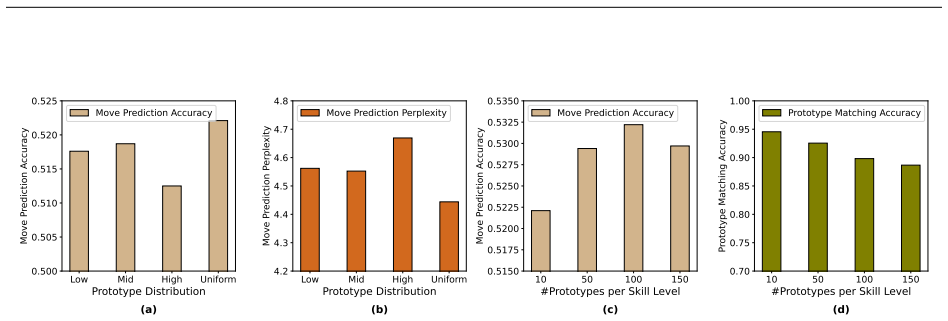
- The 250-fold data-efficiency gain likely depends on prototype coverage; adding more prototypes per style region should improve accuracy until the matching task itself becomes too hard, suggesting a coverage-versus-discriminability trade-off worth measuring.
- Using the same mechanism to attribute 20-game histories to known players would make anonymized chess databases harder to keep private, an unintended consequence of high-fidelity stylometry.
- A direct test of the framework's generality would be applying the enrichment-democratization design to other population models with latent user embeddings, such as recommendation or tutoring systems, where the hard task is also next-item prediction.
Editorial analysis
A structured set of objections, weighed in public.
Referee Report
Summary. The paper proposes Maia4All, a two-stage framework for data-efficient individual-level move prediction in chess. Starting from the population model Maia-2, the method first enriches the model by fine-tuning it on a set of prototype players with rich histories, extending population embeddings to individual embeddings. In a second democratization step, an unseen low-resource player is assigned an embedding initialized either by strength bin or by a Prototype Matching Network (PMN) that identifies similar prototypes; only this embedding is then fine-tuned while shared parameters are frozen. Experiments on Lichess blitz data report move-prediction accuracy and perplexity gains over Maia and Maia-2 at training sizes from 800 to 100,000 positions, including a headline result of 53.2% accuracy at 800 positions (~20 games) versus a 51.4% population baseline. A case study extends the two-stage idea to idiosyncratic LLM style adaptation with LLaMA-3.1-8B.
Significance. If the results hold, the contribution is practically valuable: it would reduce the data required for individual chess modeling from thousands of games to tens of games, and the prototype-matching idea is a plausible general mechanism for low-resource personalization. The paper has notable strengths: unseen players are held out from prototype training; the Maia-2-Strength ablation isolates the value of the enrichment step; Table 4 compares frozen versus optimized universal parameters; and the PMN is also evaluated as behavioral stylometry. The hyperparameter study of prototype distribution and count is a useful robustness check. However, as the authors acknowledge in Section 6, the method depends on a rich prototype set, and the LLM case study is only a limited proof of concept. More importantly, the headline comparative-efficiency claim against prior individual modeling is not directly tested in this paper, which materially weakens the stated contribution until that comparison is supplied or the claim is reframed.
major comments (3)
- [§1, §4.1] The central claim that Maia4All achieves in 20 games what previous work required 5,000 games to achieve is an indirect comparison to published Maia-Individual results. In Section 4.1 the paper excludes Maia-Individual because it 'does not apply to the sparser settings we consider,' but that is exactly the premise the headline asserts. The prior 5,000-game threshold was obtained with a different base model (Maia v1), different data splits, different test positions, and likely different fine-tuning choices. The paper's own direct fine-tuning control, Maia-2-Strength, already gains 0.43 percentage points over Maia-2 at 800 positions, so a nonzero direct-fine-tuning gain is possible in this protocol. To support the '250x more data-efficient' claim, the authors should run Maia-Individual (or a faithful adaptation) at 800 and 20,000 positions under the same evaluation protocol, or substantially qualify the abstract and introduction so that the comparison is not stated as a direct efficiency ratio.
- [§3.3, Table 6] The Prototype Matching Network is load-bearing for the main result: Table 3 shows that prototype-informed initialization outperforms strength-informed initialization by roughly 1.6 percentage points before any fine-tuning. Yet the paper gives no architecture or training hyperparameters for the chess PMN: the number of transformer layers, hidden dimension, number of training positions per prototype, top-k value, and softmax temperature for the chess experiments are not reported. Table 6 lists only Maia-2 training hyperparameters, and the LLM appendix gives different PMN settings. Without these details the key initialization component cannot be reproduced. Please add a dedicated PMN implementation table or appendix section for the chess experiments.
- [§4.1, evaluation protocol] The experimental protocol restricts training to the first M positions of each unseen player's 2023 history and evaluates on the last 2048 positions, but no exact-position deduplication is reported. For players whose total 2023 position count is less than M + 2048, some positions (or positions from the same game, including the same opening line) can appear in both the training and test sets. This would inflate the absolute accuracy of all fine-tuned variants, including Maia4All, and could also affect the relative comparison if the overlap rate differs across methods. The paper should report whether exact duplicate positions were removed between the training and test portions and quantify the overlap statistics.
minor comments (6)
- [§1] The statement that 'less than 1% of players on Lichess have played at least 5,000 games' is given without a source or date; please add a citation or compute it directly from the used Lichess snapshot.
- [§1, Table 1] The sentence 'Maia-2 shows virtually no progress when given 20 games of data' is ambiguous and, if it refers to direct fine-tuning, inconsistent with the Maia-2-Strength row in Table 1, which improves from 0.5146 to 0.5189 at 800 positions. If it refers to the unfine-tuned base Maia-2, that comparison is trivial and should be stated as such.
- [§4.2, Table 2] The claim that Maia-Individual 'barely shows any improvement at this amount of data' is not backed by a number in this paper; since Maia-Individual is not run, either report the exact published gain or soften the sentence to avoid implying a direct measurement.
- [§4.2, §5] No confidence intervals or statistical significance tests are reported for the accuracy differences in Tables 1 and 2. With roughly 225,000 test positions the differences may be significant, but reporting standard errors or bootstrap intervals would clarify which gains are robust.
- [Table 3] The entries in Table 3 correspond to initialization without the subsequent embedding-only fine-tuning, but this is not stated in the table caption; please clarify to prevent readers from comparing these numbers directly with the full Maia4All rows in Table 1.
- [§6, Appendix B] The LLM case study is presented as evidence of generalization, but it uses only 30 test authors, reports no variance or significance measures, and evaluates only language modeling loss as a proxy for style. The authors appropriately hedge in Section 6, but the main-text wording should make the proof-of-concept status of this case study explicit.
Circularity Check
No significant circularity: the central result is an empirical held-out evaluation, with the only mild concern being a self-cited prior baseline that is not re-run under the same protocol.
full rationale
The paper's central claim is an empirical result: Maia4All-Prototype is fine-tuned on 800 positions from unseen players and evaluated on held-out positions (the last 2048 positions recorded in 2023). This is a transfer/meta-learning pipeline, not a derivation that reduces to its inputs. The Prototype Matching Network is trained to classify prototype identities from histories and then used only to initialize an unseen player's embedding; the final accuracy numbers in Tables 1 and 2 come from a separate next-move prediction evaluation on held-out positions. No equation in the paper defines the target accuracy in terms of the prototype matching output or the training loss; the improvement is not forced by construction. The only load-bearing appeal to prior work is the '5,000 games required previously' claim, taken from McIlroy-Young et al. (2022), whose authors overlap with this paper. That prior result is a published, peer-reviewed, externally falsifiable empirical finding, and the decision not to include Maia-Individual as a baseline is a comparison-protocol choice rather than a circular argument. A separate concern is that no position deduplication between the first 800 training positions and the last 2048 test positions is reported, which could inflate absolute accuracy gains, but that is a data-leakage risk, not circularity. Overall, the paper's core contribution is an independent empirical evaluation against held-out data, so the circularity score is 0.
Assumptions & free parameters
free parameters (3)
- N (number of prototypes per strength level) =
100
- top-k prototypes for matching =
2
- Temperature for prototype matching softmax =
0.5
assumptions (4)
- domain assumption Chess positions can be treated as a Markov decision process; the current position alone suffices to predict a human's next move.
- domain assumption A set of prototypes balanced across strength levels covers the space of individual playing styles.
- domain assumption Prototype matching (a discriminative task) provides a good initialization for next-move prediction (a generative task).
- ad hoc to paper The player embedding space is smooth enough that weighted averages of prototype embeddings are meaningful starting points for unseen players.
Cite this review
Pith. "Pith review of Learning to Imitate with Less: Efficient Individual Behavior Modeling in Chess." pith.science (2026). https://pith.science/paper/STIS6DEF
@misc{pith2026250721488,
  author       = {Pith},
  title        = {Pith review of: Learning to Imitate with Less: Efficient Individual Behavior Modeling in Chess},
  year         = {2026},
  howpublished = {\url{https://pith.science/paper/STIS6DEF}},
  note         = {Machine review of arXiv:2507.21488}
}
read the original abstract
As humans seek to collaborate with, learn from, and better understand artificial intelligence systems, developing AIs that can accurately emulate individual decision-making becomes increasingly important. Chess, a long-standing AI benchmark with precise skill measurement, offers an ideal testbed for human-AI alignment. However, existing approaches to modeling human behavior require prohibitively large amounts of data from each individual, making them impractical for new or sparsely represented users. In this work, we introduce Maia4All, a framework designed to learn and adapt to individual decision-making styles efficiently, even with limited data. Maia4All achieves this through a two-stage optimization process: (1) an enrichment step, which bridges population and individual-level human behavior modeling with a prototype-enriched model, and (2) a democratization step, which leverages ability levels or user prototypes to initialize and refine individual embeddings with minimal data. Our experimental results show that Maia4All can accurately predict individual moves and profile behavioral patterns with high fidelity, establishing a new standard for personalized human-like AI behavior modeling in chess. Maia4All achieves individual human behavior modeling in chess with only 20 games, compared to the 5,000 games required previously, representing a significant improvement in data efficiency. Our work provides an example of how population AI systems can flexibly adapt to individual users using a prototype-enriched model as a bridge. This approach extends beyond chess, as shown in our case study on idiosyncratic LLMs, highlighting its potential for broader applications in personalized AI adaptation.
Figures


Figures from the paper (5 more)



Reference graph
Works this paper leans on
-
[4]
Markov games as a framework for multi-agent reinforcement learning
Michael L Littman. Markov games as a framework for multi-agent reinforcement learning. InMachine learning proceedings 1994, pp. 157–163. Elsevier,
work page 1994
-
[6]
The training process exhibits smooth optimization trajectory suggests that our enrichment step successfully adapts the base model parameters to capture individual-level behavior patterns. 16 0 50000 100000 150000 200000 Training Steps 0.50 0.52 0.54Validation Accuracy Val Acc Train Loss 1.35 1.40 1.45 1.50 1.55 Training Loss Figure 6: Training dynamics of...
-
[7]
The LoRA adaptation strategically targets key attention modules and feed-forward layers, allowing the model to learn author-specific transformations while maintaining its general language understanding capabilities. The training dynamics shown in Figure 7 demonstrate steady convergence, which suggests effective learning of author-specific styles while mai...
work page 2000
-
[8]
Oriol Vinyals, Charles Blundell, Timothy Lillicrap, Daan Wierstra, et al
URL https://arxiv.org/abs/2409.20553. Oriol Vinyals, Charles Blundell, Timothy Lillicrap, Daan Wierstra, et al. Matching networks for one shot learning. In NeurIPS, pp. 3630–3638,
-
[9]
Pin Wang, Dapeng Liu, Jiayu Chen, Hanhan Li, and Ching-Yao Chan. Human-like decision making for autonomous driving via adversarial inverse reinforcement learning.arXiv, pp. arXiv–1911,
work page 1911
-
[11]
Human-aligned chess with a bit of search.arXiv preprint arXiv:2410.03893,
Yiming Zhang, Athul Paul Jacob, Vivian Lai, Daniel Fried, and Daphne Ippolito. Human-aligned chess with a bit of search.arXiv preprint arXiv:2410.03893,
-
[12]
We follow the notations from Maia-2 (Tang et al., 2024)
15 A Maia4All Reproductibility Table 6: Hyperparameter Settings. We follow the notations from Maia-2 (Tang et al., 2024). Initial learning rate 1e−4 Weight decay 1e−5 Batch size (positions) 8192 Minimum move ply 10 Maximum move ply 300 Remaining seconds threshold 30 #Backbone blocksKConv 12 #Attention blockKAtt 2 #Input channelsCinput 18 #Intermediate cha...
work page 2024
-
[1999]
Lisa Schut, Nenad Tomasev, Tom McGrath, Demis Hassabis, Ulrich Paquet, and Been Kim. Bridging the human-ai knowledge gap: Concept discovery and transfer in alphazero.arXiv preprint arXiv:2310.16410,
Show all 15 references
-
[2000]
On first-order meta-learning algorithms.arXiv preprint arXiv:1803.02999,
Alex Nichol, Joshua Achiam, and John Schulman. On first-order meta-learning algorithms.arXiv preprint arXiv:1803.02999,
-
[2015]
The power of scale for parameter-efficient prompt tuning
Brian Lester, Rami Al-Rfou, and Noah Constant. The power of scale for parameter-efficient prompt tuning. arXiv preprint arXiv:2104.08691,
-
[2016]
Lora: Low-rank adaptation of large language models.arXiv preprint arXiv:2106.09685,
Edward J Hu, Yelong Shen, Phillip Wallis, Zeyuan Allen-Zhu, Yuanzhi Li, Shean Wang, Lu Wang, and Weizhu Chen. Lora: Low-rank adaptation of large language models.arXiv preprint arXiv:2106.09685,
-
[2017]
A cell is marked 1 to denote the presence of a piece in the corresponding location, and 0 otherwise
to represent chess positions as multi-channel8× 8 matrices, including: • Piece Representation: The first 12 channels categorize the board’s pieces by type and color, with one channel each for white and black Pawns, Knights, Bishops, Rooks, Queens, and Kings. A cell is marked 1...
1994
-
[2020]
Smarter, better, faster, longer: A modern bidirectional encoder for fast, memory efficient, and long context finetuning and inference.arXiv preprint arXiv:2412.13663,
14 Benjamin Warner, Antoine Chaffin, Benjamin Clavié, Orion Weller, Oskar Hallström, Said Taghadouini, Alexis Gallagher, Raja Biswas, Faisal Ladhak, Tom Aarsen, et al. Smarter, better, faster, longer: A modern bidirectional encoder for fast, memory efficient, and long context ...
-
[2021]
Prefix-tuning: Optimizing continuous prompts for generation.arXiv preprint arXiv:2101.00190,
Xiang Lisa Li and Percy Liang. Prefix-tuning: Optimizing continuous prompts for generation.arXiv preprint arXiv:2101.00190,
-
[2024]
Rapid learning or feature reuse? towards understanding the effectiveness of maml.arXiv preprint arXiv:1909.09157,
Aniruddh Raghu, Maithra Raghu, Samy Bengio, and Oriol Vinyals. Rapid learning or feature reuse? towards understanding the effectiveness of maml.arXiv preprint arXiv:1909.09157,
1909 arXiv
Reviewed August 6, 2026 · model on record in the stance chip above.
Discussion (0). Continue with ORCID to comment.