REVIEW 4 major objections 5 minor 53 references
Probing the Ginzburg-Landau Potential for Lasers Using Higher-order Photon Correlations
T0 review · 4 major / 5 minor · reviewed 2026-08-14 · deepseek-v4-flash
Pith's one-line read Low-$\beta$ lasers follow Ginzburg-Landau photon statistics exactly when carrier decay is at least as fast as photon decay.
desk verdict Plausible numerical observation and a useful g(q) diagnostic, but the claimed sharp γ∥/γc=1 boundary is not supported by the paper's own eigenvalue analysis. read the letter →
The pith
A machine-rendered reading of the paper's core claim, the machinery that carries it, and where it could break.
The reading
What carries the argument
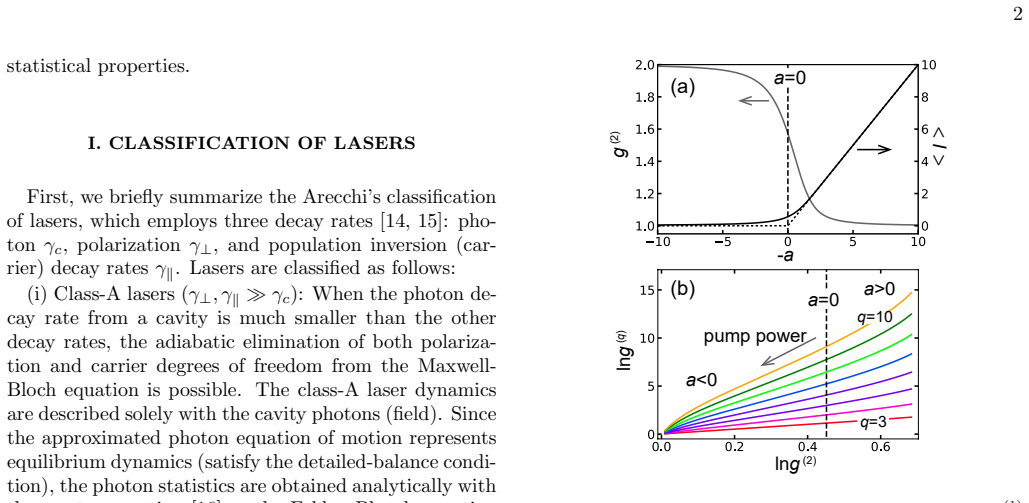
The load-bearing machinery is the pair of tools: the parabolic-cylinder formula for $g^{(q)}$ derived from the GL steady state $P(\alpha)\propto\exp(-(a|\alpha|^2+b|\alpha|^4))$, which produces universal, efficiency-independent $\ln g^{(q)}$ versus $\ln g^{(2)}$ curves, and the center-manifold reduction of the Statz-de Mars rate equations with the pump parameter suspended as a slow variable. The reduction yields the normal form $\dot I=\gamma_c\epsilon I-\beta\gamma_c I^2$; its validity is controlled by whether the Jacobian's eigenvalues are real or complex. When they are real ($\gamma_\parallel/\gamma_c\ge1$) the one-dimensional photon equation survives as an attractor and the GL steady state follows; when they are complex ($\gamma_\parallel/\gamma_c<1$) the oscillatory mixing of photon and carrier variables destroys the reduction.
What would settle it
Integrate the stochastic rate equations (19)–(21) at $\gamma_\parallel/\gamma_c=1$ with carrier noise strength $\Gamma$ much larger than field noise $Q$, keeping $\beta=10^{-4}$ and pump $P/P_{th}=10^{0.04}$. If $\ln g^{(3)}$ versus $\ln g^{(2)}$ moves off the GL curve, the claim that multiplicative carrier noise is negligible—and with it the boundary at $\gamma_\parallel/\gamma_c=1$—collapses.
Extended reading notes
Core claim
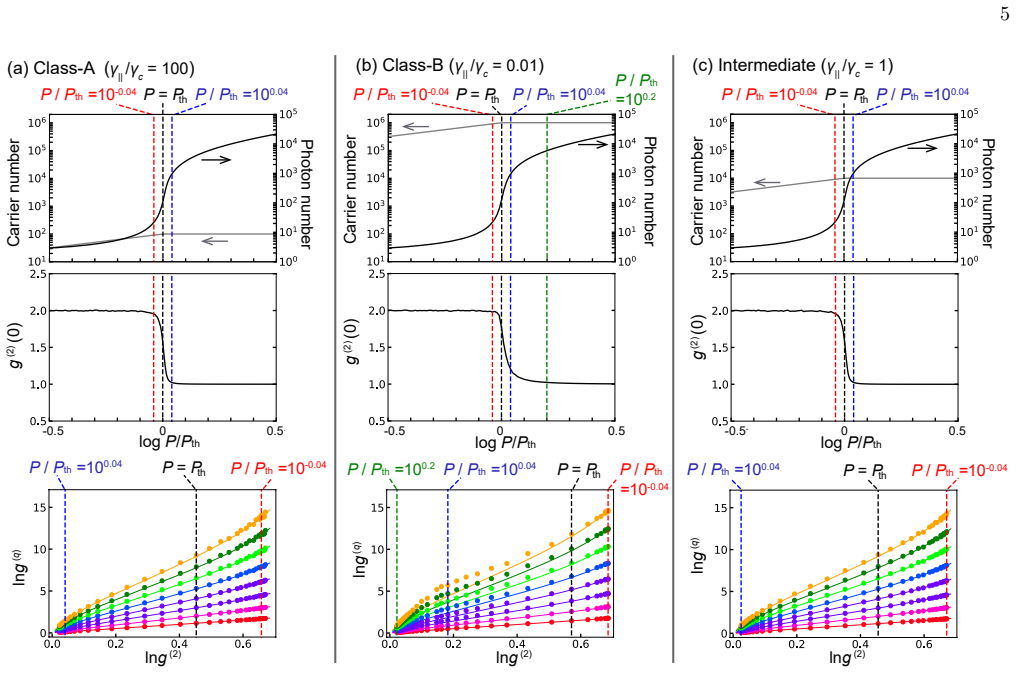
The paper's core claim is a sharp boundary for low-$\beta$ lasers: the normalized higher-order photon correlations $g^{(q)}$ produced by the stochastic rate equations fall on the universal GL curves $\ln g^{(q)}$ versus $\ln g^{(2)}$ whenever $\gamma_\parallel/\gamma_c\ge1$, and depart from them whenever $\gamma_\parallel/\gamma_c<1$. The departure is caused by photon-carrier relaxation oscillation, which appears exactly when the linearized Jacobian eigenvalues become complex; this prevents the center-manifold reduction from collapsing the two-variable dynamics into the single field equation whose steady state is the GL potential. At $\gamma_\parallel/\gamma_c=1$, the stochastic simulations match the GL prediction even though the conventional adiabatic-elimination condition is not satisfied.
Load-bearing premise
The argument depends on the stochastic center-manifold reduction being valid, so that the full noisy two-variable system is faithfully represented by a reduced single photon equation in which the carrier noise contributes only a tiny multiplicative term that can be neglected.
Editorial extensions
If this is right
- For low-$\beta$ lasers with $\gamma_\parallel/\gamma_c\ge1$, the threshold transition in $g^{(2)}$ from 2 to 1 is sharp, so a laser with photon lifetime comparable to carrier lifetime can emit near-Poissonian light just above threshold.
- The boundary $\gamma_\parallel/\gamma_c=1$ places class-B lasers on the non-GL side, where bunched light ($g^{(2)}>1$) persists well above threshold and can serve as a bright two-photon source.
- A measurement of the pump-light-output curve and $g^{(2)}$ alone is enough to test whether a given laser obeys GL theory, because the efficiency-independent $\ln g^{(q)}$ versus $\ln g^{(2)}$ curves are fixed by the GL potential.
- The conventional class-A condition $\gamma_c\ll\gamma_\parallel$ is not necessary for GL-like photon statistics; a photon lifetime comparable to the carrier lifetime is sufficient.
Reading between the lines
- An untested corollary is that the same $\ln g^{(q)}$ versus $\ln g^{(2)}$ diagnostic could be applied to measured photon-counting histograms from existing nanolaser experiments, mapping the GL/non-GL boundary without requiring absolute detection efficiencies.
- If the stochastic center-manifold reduction were pushed to next order, the multiplicative carrier-noise term $\beta\,\delta I f_N$ could be quantified directly by constructing the effective Langevin equation and comparing its steady state; the paper treats this term as negligible but does not compute its influence in detail.
- Because the boundary is set by relaxation oscillation rather than by the lifetime ratio per se, other nonlinear oscillators described by coupled amplitude-inversion equations—such as polariton or optomechanical systems—may show the same GL/non-GL transition at their own effective decay-rate balance.
- A stronger, testable version of the paper's claim is that the collapse onto GL curves is not special to $\beta=10^{-4}$; for larger $\beta$, the multiplicative noise term may shift the boundary, and a sweep over $\beta$ would separate the lifetime-ratio effect from the small-$\beta$ assumption.
Signed reviews
Editorial analysis
A structured set of objections, weighed in public.
Referee Report
Summary. The paper asks when the photon statistics of low-β lasers are described by a Ginzburg-Landau (GL) potential. The authors use stochastic rate equations for the field and carrier, propose a comparison of normalized higher-order photon correlations g(q) with the parameter-free GL curve of Eq. (8), and simulate three representative cases: class-A (γ∥/γc = 100), intermediate (γ∥/γc = 1), and class-B (γ∥/γc = 0.01). They report that the class-A and intermediate cases follow the GL curve, while the class-B case does not, and they interpret this via a deterministic center-manifold reduction that yields the transcritical normal form for the photon intensity. They further claim that the boundary between GL and non-GL statistics lies at γ∥/γc = 1, with relaxation oscillations responsible for the breakdown, and they add a stochastic center-manifold argument to neglect carrier noise. The paper closes with an experimental protocol using only the input-output curve and g(2).
Significance. The proposed diagnostic—plotting ln g(q) against ln g(2) and comparing with the universal curve Eq. (8)—is clean, quantum-efficiency independent, and potentially useful experimentally. The deterministic center-manifold calculation in Sec. IV B is a coherent extension of adiabatic elimination and gives a concrete interpretation of the numerical results. If the central claim that GL theory applies for low-β lasers with γ∥/γc ≳ 1 were fully established, it would revise the conventional class-A/class-B dichotomy and would have concrete design implications for high-Q nanophotonic lasers. However, the manuscript currently contains a mathematically incorrect eigenvalue threshold, an unfinished stochastic reduction, and numerical comparisons without statistical uncertainties; these issues affect the load-bearing claim.
major comments (4)
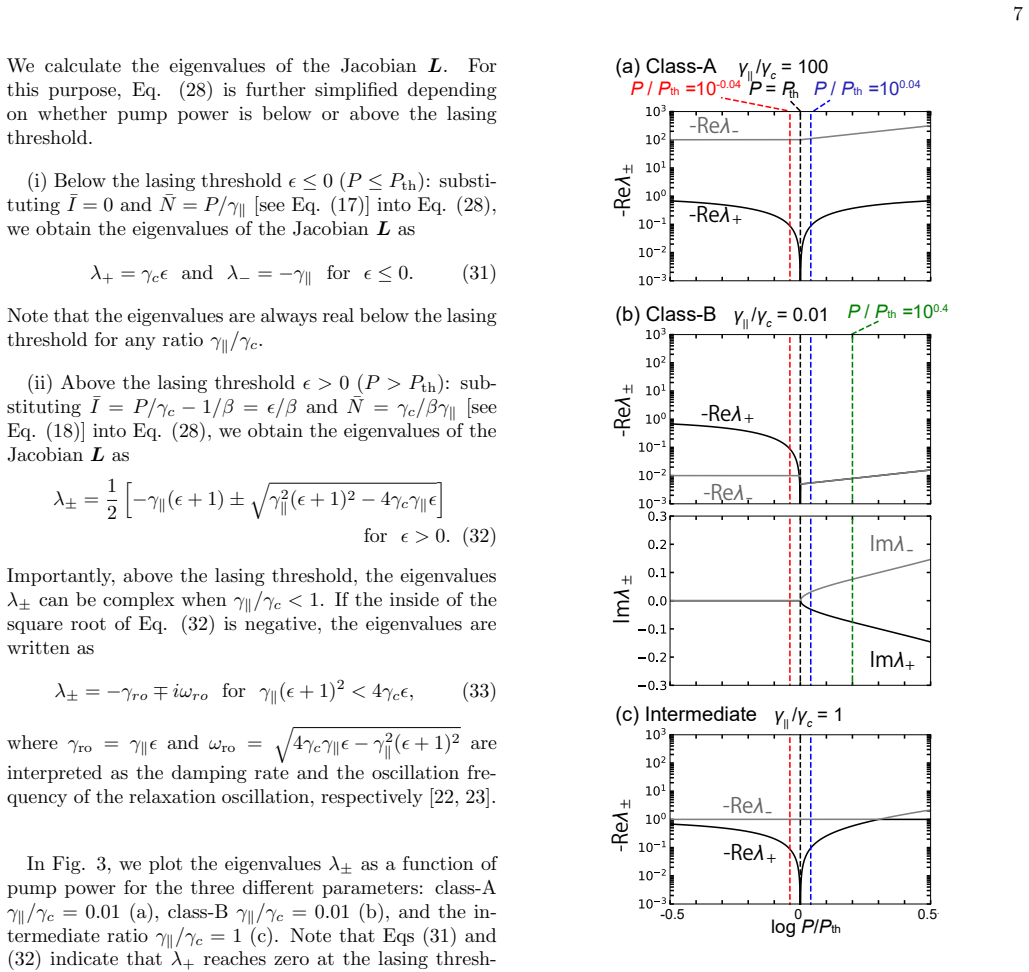
- [Section IV D, Eq. (32)] The eigenvalue criterion used to define the boundary is stated incorrectly. Eq. (32) gives a negative discriminant when γ∥²(1+ε)² < 4γcγ∥ε, i.e. γ∥/γc < 4ε/(1+ε)², not when γ∥/γc > 1 as written in Section IV D. For any fixed r = γ∥/γc < 1 this condition holds only on a finite pump interval; for example, at r = 0.9 it holds for roughly 0.52 < ε < 1.93, while the pump used in Fig. 5(b), ε ≈ 0.096, lies outside that interval. At that pump the complex-eigenvalue threshold is r ≈ 0.32, not r = 1. Thus the eigenvalue analysis does not establish a universal GL/non-GL boundary at r = 1, and the causal claim that relaxation oscillations are responsible for the non-GL statistics at this pump is not supported by Eq. (32). The authors should correct the inequality, state the pump-dependent condition explicitly, and either revise the boundary claim to account for the ε-dependence or present simulations over a range of ε that justify an r = 1 boundary.
- [Section IV E, Eq. (47)] The stochastic center-manifold reduction is not actually carried out in the manuscript. Eq. (47) is asserted with a placeholder citation ('[xxx]') and refers to 'Eq. (??)'; the claimed result that the lowest-order carrier-noise contribution is βδI f_N and that all higher-order noise terms are O(β^q) is therefore not verifiable. This is a load-bearing step because it is what turns the deterministic center-manifold result into the statement that the full Langevin system has the GL steady state with only additive field noise. Moreover, the simulations fix Q = Γ = γc in Eq. (26), so the generality of neglecting multiplicative carrier noise when Q/Γ differs is not tested. A derivation, or at least a detailed numerical verification of the stochastic reduction over a range of Q/Γ, is needed before the GL steady-state claim can be accepted.
- [Section III B, Figs. 2 and 5(b)] The central quantitative comparison rests on visual agreement between simulated points and the GL curves, but the manuscript provides no simulation details (Euler step size, trajectory length, number of realizations, or time-averaging procedure) and no error bars or confidence intervals. In Fig. 5(b), the deviation is defined as ln g(q)_sim / ln g(q)_GL without stating how the signs of the logarithms are handled, and the plotted deviation has no statistical uncertainty. As a result, the statement that deviations 'start to appear when γ∥/γc becomes smaller than unity' is not quantitatively established. Please add numerical parameters, error bars, and a statistical criterion for when simulated correlations are inconsistent with the GL prediction.
- [Section III B, Eq. (26)] The noise-strength choice Q = Γ = γc is an assumption whose consequences are not examined. Since the GL mapping in Sec. II B uses Q to set the potential coefficients a and b, and since the stochastic reduction in Sec. IV E concerns the relative size of field and carrier noise, a single choice of Q/Γ cannot establish that the GL description is valid independently of this ratio. The authors should either justify this choice from a microscopic model or test how the results depend on Q/Γ.
minor comments (5)
- [Fig. 3 caption] The caption lists '(a) Class-A γ∥/γc = 0.01', which is the same value as the class-B panel; class-A should be γ∥/γc = 100.
- [Section IV C] The sentence 'as we discussed in Section 4C' should refer to the center-manifold discussion in Section IV B, and the accompanying text refers to 'Fig. 4(a) and (b)' when the intermediate case is actually Fig. 4(c).
- [Eq. (12)] There is a typographical double minus sign in the exponent ('exp(--1/2µ|α|²...'); this should be corrected.
- [Eq. (13)] The intensity equation does not follow from Eq. (10): from ˙α = µα − λ|α|²α one obtains ˙I = 2µI − 2λI² for the deterministic part, whereas Eq. (13) has negative signs and different coefficients. Please correct the signs and coefficients or explain the intended scaling.
- [Appendix C and Section IV D] Appendix C contains a broken cross-reference to 'Eq. (eq:fitting)', and Section IV D alternates between P/Pth = 10^0.1 and P/Pth = 10^0.04 when describing the deviation plot; these should be made consistent.
Circularity Check
No significant circularity: the GL comparison curves are parameter-free and the stochastic simulations are independent; the central boundary claim contains a mathematical error, but that is a correctness issue, not circularity.
full rationale
The derivation chain is self-contained. The GL predictions used for comparison are Eq. (8), derived directly from the assumed GL steady-state distribution P(alpha) = exp(-F_GL)/Z with no fitted parameters; the paper then compares these parameter-free curves with Langevin simulations of Eqs. (19)-(21) using fixed physical parameters beta = 10^-4 and Q = Gamma = gamma_c (Eq. 26). The simulated g(q) values are not fitted to the GL curves, so there is no fitted-input-called-prediction structure. The center-manifold analysis in Section IV B derives the reduced photon equation (45) from the same deterministic rate equations (14)-(15); it is an interpretation of the simulation results rather than an input that forces them. The stochastic extension in Section IV E cites external references [44,45] and a placeholder numerical calculation '[xxx]' for the claim that the lowest-order carrier-noise contribution is beta*delta I*f_N; this is a missing-evidence gap, not a circular reduction, because the multiplicative-noise term is argued to be negligible by the explicit beta << 1 estimate rather than by assuming the target result. The claimed gamma_parallel/gamma_c = 1 boundary is not circularly derived, but it is mathematically unsupported: the text states that Eq. (32) gives imaginary eigenvalues when gamma_parallel/gamma_c > 1, whereas the discriminant of Eq. (32) gives complex eigenvalues only for gamma_parallel/gamma_c < 4 epsilon/(1+epsilon)^2, a pump-dependent condition. That is a correctness problem, not a circularity. The paper's self-citations [22,39] are used as experimental corroboration of class-B bunching and are not load-bearing for the theoretical reduction. No step in the paper reduces by construction to a fitted parameter, a self-citation chain, or a renamed input, so the circularity score is 0.
Assumptions & free parameters
free parameters (2)
- Noise strength ratio Q/Gamma =
Q = Gamma = gamma_c (Eq. 26)
- Spontaneous emission coupling beta =
beta = 10^-4 in all simulations
assumptions (6)
- domain assumption Polarization degree of freedom is adiabatically eliminated (gamma_perp >> gamma_c, gamma_parallel), reducing Maxwell-Bloch to Statz-deMars rate equations.
- domain assumption For beta << 1, carrier transparency (N0=0) and the spontaneous emission term beta*gamma_parallel*N can be neglected in the rate equations.
- domain assumption The white-noise Langevin description with field noise Q and carrier noise Gamma (Eqs. 19-22) accurately models the photon statistics.
- standard math The integral identity integral_0^inf x^q exp(-ax-bx^2) dx = Gamma(q+1)(2b)^(-(q+1)/2) exp(a^2/8b) D_-q-1(a/sqrt(2b)) is correct and used to derive Eq. (8).
- standard math Center manifold theorem applies to the suspended three-variable system at threshold (eigenvalues 0, 0, -gamma_parallel).
- ad hoc to paper Stochastic center manifold reduction of Refs. [44,45] extends the deterministic reduction to the noisy system and gives Eq. (47) with negligible multiplicative noise.
Cite this review
Pith. "Pith review of Probing the Ginzburg-Landau Potential for Lasers Using Higher-order Photon Correlations." pith.science (2026). https://pith.science/paper/STVJR3D7
@misc{pith2026190808679,
  author       = {Pith},
  title        = {Pith review of: Probing the Ginzburg-Landau Potential for Lasers Using Higher-order Photon Correlations},
  year         = {2026},
  howpublished = {\url{https://pith.science/paper/STVJR3D7}},
  note         = {Machine review of arXiv:1908.08679}
}
abstract
Lasing transition is known to be analogous to the second-order phase transition. Furthermore, for some cases, it is possible to define the Ginzburg-Landau (GL) potential, and the GL theory predicts the photon statistical properties of lasers. However, the GL potential for lasers is surprising, because lasers are operating far from equilibrium. In this paper, we theoretically examine the validity of the GL theory for lasers in terms of various parameters, particularly, the ratio between photon and carrier lifetimes. For this purpose, we use stochastic rate equations and higher-order photon correlation functions. With higher-order photon correlation measurements, we can check whether or not laser dynamics are described by the GL theory. We demonstrate that, for low-$\beta$ lasers, the GL theory is applicable even when the photon lifetime is comparable to the carrier lifetime and that photon-carrier relaxation oscillation is the fundamental origin of the breakdown of the GL theory, which can be understood in the framework of center manifold reduction.
Figures
Figures from the paper (3 more)


Reference graph
Works this paper leans on
-
[1]
are calculated as [25] pη n = ∫ ∞ 0 dIP (I) (ηI)n n! e−ηI. (4) For the conversion of the coordinate, the polar coordinate α = reiθ and the relation d2α = rdrdθ with I = r2 are used. Importantly, the generalized quantum efficiency η(≤ 1) includes various quantum efficiencies such as the quantum efficiency of detectors, optical losses, and de- tection time [26]. ...
-
[2]
Haken, Laser theory (Springer Science & Business Me- dia, 2012)
H. Haken, Laser theory (Springer Science & Business Me- dia, 2012)
work page 2012
- [3]
-
[4]
Louisell, Quantum statistical properties of radiation , Vol. 7 (Wiley New York, 1973)
work page 1973
- [5]
- [6]
-
[7]
H. F. Hofmann and O. Hess, Phys. Rev. A 62, 063807 (2000)
work page 2000
-
[8]
H. F. Hofmann and O. Hess, J. Opt. Soc. Am. B 17, 1926 (2000)
work page 2000
Show all 53 references
-
[9]
Y. Lien, S. M. de Vries, N. J. van Druten, M. P. van Exter, and J. P. Woerdman, Phys. Rev. Lett. 86, 2786 (2001)
2001
-
[10]
Nontriv- ial photon statistics in small scale lasers,
T. Wang, D. Aktas, O. Alibart, ´E. Picholle, G. P. Puccioni, S. Tanzilli, and G. L. Lippi, “Nontriv- ial photon statistics in small scale lasers,” (2017), 14 arXiv:1710.02052
2017 arXiv
-
[11]
Young, Y
M. Young, Y. Qu, S. Singh, and R. C. Hwa, Optics Communications 105, 325 (1994)
1994
-
[12]
R. C. Hwa and M. T. Nazirov, Phys. Rev. Lett. 69, 741 (1992)
1992
-
[13]
R. C. Hwa, Phys. Rev. D 47, 2773 (1993)
1993
-
[14]
Haken, Synergetics (Springer, 1977)
H. Haken, Synergetics (Springer, 1977)
1977
-
[15]
Arecchi, G
F. Arecchi, G. Lippi, G. Puccioni, and J. Tredicce, Op- tics communications 51, 308 (1984)
1984
-
[16]
F. T. Arecchi and R. G. Harrison, Instabilities and chaos in quantum optics , Vol. 34 (Springer Science & Business Media, 2012)
2012
-
[17]
M. O. Scully and W. E. Lamb, Phys. Rev. 159, 208 (1967)
1967
-
[18]
Lax and W
M. Lax and W. Louisell, IEEE Journal of Quantum Elec- tronics 3, 47 (1967)
1967
-
[19]
Risken, in The Fokker-Planck Equation (Springer,
H. Risken, in The Fokker-Planck Equation (Springer,
-
[20]
Graham and H
R. Graham and H. Haken, Zeitschrift f¨ ur Physik237, 31 (1970)
1970
-
[21]
DeGiorgio and M
V. DeGiorgio and M. O. Scully, Phys. Rev. A 2, 1170 (1970)
1970
-
[22]
P. R. Rice and H. J. Carmichael, Phys. Rev. A 50, 4318 (1994)
1994
-
[23]
Takemura, J
N. Takemura, J. Omachi, and M. Kuwata-Gonokami, Phys. Rev. A 85, 053811 (2012)
2012
-
[24]
T. Wang, G. Puccioni, and G. Lippi, Sci. Rep. 5, 15858 (2015)
2015
-
[25]
Gartner, Phys
P. Gartner, Phys. Rev. B 99, 115313 (2019)
2019
-
[26]
D. F. Walls and G. J. Milburn, Quantum optics (Springer Science & Business Media, 2007)
2007
-
[27]
M. O. Scully and W. E. Lamb, Phys. Rev. 179, 368 (1969)
1969
-
[28]
Avenhaus, K
M. Avenhaus, K. Laiho, M. V. Chekhova, and C. Silber- horn, Phys. Rev. Lett. 104, 063602 (2010)
2010
-
[29]
M. J. Stevens, B. Baek, E. A. Dauler, A. J. Kerman, R. J. Molnar, S. A. Hamilton, K. K. Berggren, R. P. Mirin, and S. W. Nam, Opt. Express 18, 1430 (2010)
2010
-
[30]
Elvira, X
D. Elvira, X. Hachair, V. B. Verma, R. Braive, G. Beau- doin, I. Robert-Philip, I. Sagnes, B. Baek, S. W. Nam, E. A. Dauler, I. Abram, M. J. Stevens, and A. Beveratos, Phys. Rev. A 84, 061802 (2011)
2011
-
[31]
Wiersig, C
J. Wiersig, C. Gies, F. Jahnke, M. Aßmann, T. Berster- mann, M. Bayer, C. Kistner, S. Reitzenstein, C. Schnei- der, S. H¨ ofling,et al. , Nature 460, 245 (2009)
2009
-
[32]
Schlottmann, M
E. Schlottmann, M. von Helversen, H. A. M. Ley- mann, T. Lettau, F. Kr¨ uger, M. Schmidt, C. Schneider, M. Kamp, S. H¨ ofling, J. Beyer, J. Wiersig, and S. Re- itzenstein, Phys. Rev. Applied 9, 064030 (2018)
2018
-
[33]
Z. Cao, Y. Gao, and R. C. Hwa, Zeitschrift f¨ ur Physik C: Particles and Fields 72, 661 (1996)
1996
-
[34]
Guckenheimer and P
J. Guckenheimer and P. Holmes, J. Appl. Mech 51, 947 (1984)
1984
-
[35]
Kuramoto, Chemical oscillations, waves, and turbu- lence (Courier Corporation, 2003)
Y. Kuramoto, Chemical oscillations, waves, and turbu- lence (Courier Corporation, 2003)
2003
-
[36]
Yamamoto, IEEE Journal of Quantum Electronics 19, 34 (1983)
Y. Yamamoto, IEEE Journal of Quantum Electronics 19, 34 (1983)
1983
-
[37]
E. G. Lariontsev, Phys. Rev. A 83, 063803 (2011)
2011
-
[38]
Risken and H
H. Risken and H. D. Vollmer, Zeitschrift f¨ ur Physik201, 323 (1967)
1967
-
[39]
N. J. van Druten, Y. Lien, C. Serrat, S. S. R. Oem- rawsingh, M. P. van Exter, and J. P. Woerdman, Phys. Rev. A 62, 053808 (2000)
2000
-
[40]
Takemura, M
N. Takemura, M. Takiguchi, E. Kuramochi, A. Shinya, T. Sato, K. Takeda, S. Matsuo, and M. Notomi, Phys. Rev. A 99, 053820 (2019)
2019
-
[41]
Carr, Applications of centre manifold theory , Vol
J. Carr, Applications of centre manifold theory , Vol. 35 (Springer Science & Business Media, 2012)
2012
-
[42]
Wunderlin and H
A. Wunderlin and H. Haken, Zeitschrift f¨ ur Physik B Condensed Matter 44, 135 (1981)
1981
-
[43]
G. L. Oppo and A. Politi, Europhysics Letters (EPL) 1, 549 (1986)
1986
-
[44]
Haken, Advanced synergetics: Instability hierarchies of self-organizing systems and devices , Vol
H. Haken, Advanced synergetics: Instability hierarchies of self-organizing systems and devices , Vol. 20 (Springer Science & Business Media, 2012)
2012
-
[45]
Xu and A
C. Xu and A. Roberts, Physica A: Statistical Mechanics and its Applications 225, 62 (1996)
1996
-
[46]
Roberts, Physica A: Statistical Mechanics and its Ap- plications 387, 12 (2008)
A. Roberts, Physica A: Statistical Mechanics and its Ap- plications 387, 12 (2008)
2008
-
[47]
R. L. Stratonovich, Topics in the theory of random noise , Vol. 2 (CRC Press, 1967)
1967
-
[48]
M. R. Young and S. Singh, Phys. Rev. A 38, 238 (1988)
1988
-
[49]
R. F. Fox and R. Roy, Phys. Rev. A 35, 1838 (1987)
1987
-
[50]
Jechow, M
A. Jechow, M. Seefeldt, H. Kurzke, A. Heuer, and R. Menzel, Nature Photonics 7, 973 EP (2013)
2013
-
[51]
Baili, M
G. Baili, M. Alouini, T. Malherbe, D. Dolfi, I. Sagnes, and F. Bretenaker, EPL (Europhysics Letters) 87, 44005 (2009)
2009
-
[52]
J. R. Klauder and E. C. G. Sudarshan, Fundamentals of quantum optics (Courier Corporation, 2006)
2006
-
[53]
Gulyak, B
B. Gulyak, B. Melcher, and J. Wiersig, Phys. Rev. A 98, 053857 (2018)
2018
Reviewed August 14, 2026 · model on record in the stance chip above.
Discussion (0). Continue with ORCID to comment.