UrbanCDNet: Appearance-Robust and Boundary-Aware Bitemporal Change Detection for Korean Urban Building Monitoring
Pith reviewed 2026-06-30 06:26 UTC · model grok-4.3
The pith
UrbanCDNet raises F1 to 0.7511 on Korean urban building change detection by using appearance-robust comparison and boundary supervision.
A machine-rendered reading of the paper's core claim, the machinery that carries it, and where it could break.
Core claim
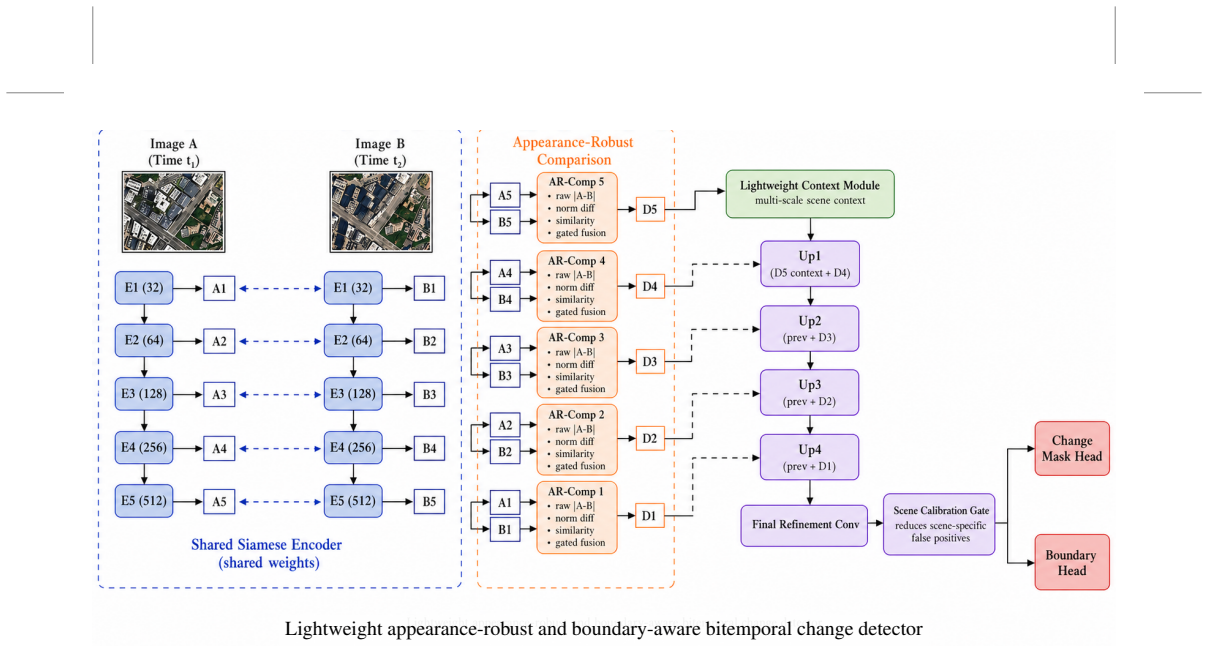
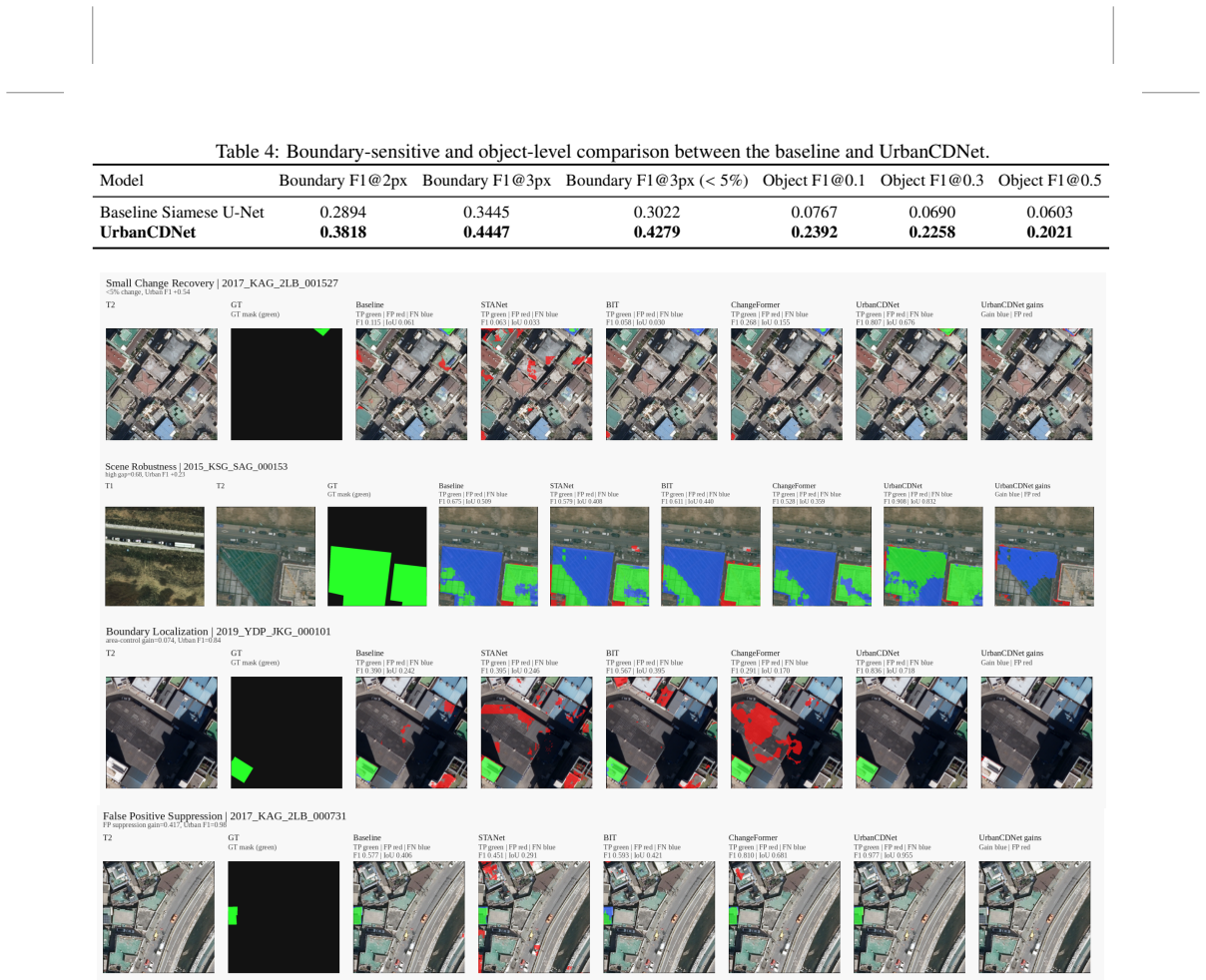
UrbanCDNet is a Siamese CNN that integrates appearance-robust multi-cue comparison, alignment-aware middle-scale differencing, lightweight context refinement, scene calibration, and auxiliary boundary supervision. On the corrected AIHub Korean benchmark (3,998 train, 503 val, 499 test pairs), it records 0.7335 precision, 0.7696 recall, 0.7511 F1, and 0.6014 IoU. These figures exceed a strong Siamese U-Net baseline (0.7108 F1, 0.5514 IoU) and ChangeFormer-MIT-B0 (0.7107 F1, 0.5512 IoU). Gains concentrate on the sparse-change subset (F1 0.6175 vs 0.4765) and high-photometric-gap subset (F1 0.7285 vs 0.6349), with boundary F1 at 3-pixel tolerance rising to 0.4447 and object F1 at IoU 0.3 rising
What carries the argument
UrbanCDNet, a Siamese CNN that performs appearance-robust multi-cue comparison, alignment-aware middle-scale differencing, and auxiliary boundary supervision to produce footprint-aligned change maps in bi-temporal aerial imagery.
If this is right
- F1 on subsets with under 5 percent changed area rises from 0.4765 to 0.6175.
- F1 on high photometric-gap pairs rises from 0.6349 to 0.7285.
- Boundary F1 measured at three-pixel tolerance increases from 0.3445 to 0.4447.
- Object-level F1 at IoU threshold 0.3 increases from 0.0690 to 0.2258.
- Task-specific temporal and boundary components produce larger gains than generic increases in model capacity on this benchmark.
Where Pith is reading between the lines
- The same combination of multi-cue comparison and boundary loss could be tested on change-detection benchmarks from other dense Asian cities to check transfer.
- Boundary supervision outputs may integrate more directly with vector GIS layers used in municipal planning systems.
- The reported emphasis on alignment-aware differencing suggests similar middle-scale modules might help other remote-sensing tasks that suffer from registration errors.
- The need to correct the public AIHub benchmark implies that data-cleaning steps are a practical first requirement before architectural comparisons in urban remote sensing.
Load-bearing premise
The performance gains are produced by the listed architectural components rather than by any unreported differences in training schedule, data augmentation, or hyper-parameter choices.
What would settle it
Re-train the Siamese U-Net baseline and ChangeFormer using the identical optimizer, learning-rate schedule, and augmentations reported for UrbanCDNet, then measure whether the F1 gap of 0.0403 on the locked test set remains.
Figures
read the original abstract
Urban building change detection from bi-temporal aerial imagery is important for redevelopment monitoring, infrastructure management, and unauthorized-construction screening, but Korean urban scenes remain difficult because changed regions are often sparse, appearance varies strongly between acquisition dates, and useful outputs must follow building footprints rather than coarse blobs. This paper presents UrbanCDNet, a task specific Siamese CNN that combines appearance-robust multi-cue comparison, alignment-aware middle-scale differencing, lightweight context refinement, scene calibration, and auxiliary boundary supervision. Experiments use a corrected AIHub-based Korean benchmark with 3,998 training, 503 validation, and 499 test pairs, and report changed-class precision, recall, F1, and IoU. On the locked test split, UrbanCDNet achieves 0.7335 precision, 0.7696 recall, 0.7511 F1, and 0.6014 IoU, outperforming a strong Siamese U-Net baseline (0.7108 F1, 0.5514 IoU) and the strongest external competitor, ChangeFormer-MIT-B0 (0.7107 F1, 0.5512 IoU). Additional diagnostic slicing shows that the gain is concentrated in the operating regimes that motivated the design: on the sparse-change subset with less than 5% changed area, F1 improves from 0.4765 to 0.6175, and on the high photometric-gap subset it improves from 0.6349 to 0.7285. Boundary F1 at 3-pixel tolerance rises from 0.3445 to 0.4447, while object F1 at IoU 0.3 rises from 0.0690 to 0.2258. These results indicate that, on this Korean benchmark, task-shaped temporal comparison and boundary-aware supervision matter more than generic model scale alone
Editorial analysis
A structured set of objections, weighed in public.
Referee Report
Summary. The manuscript introduces UrbanCDNet, a task-specific Siamese CNN for bitemporal change detection in Korean urban scenes. It combines appearance-robust multi-cue comparison, alignment-aware middle-scale differencing, lightweight context refinement, scene calibration, and auxiliary boundary supervision. On a corrected AIHub Korean benchmark (3,998 train / 503 val / 499 test pairs), UrbanCDNet reports 0.7335 precision, 0.7696 recall, 0.7511 F1, and 0.6014 IoU on the locked test split, outperforming a Siamese U-Net baseline (0.7108 F1, 0.5514 IoU) and ChangeFormer-MIT-B0 (0.7107 F1, 0.5512 IoU). Gains are concentrated on sparse-change (<5% area) and high-photometric-gap subsets, with additional improvements in boundary F1 (0.4447 vs. 0.3445) and object F1 at IoU 0.3 (0.2258 vs. 0.0690). The paper concludes that task-shaped temporal comparison and boundary-aware supervision outperform generic model scaling.
Significance. If the performance deltas are verifiably attributable to the proposed components, the work would offer useful empirical support for domain-specific design choices in remote-sensing change detection under sparse changes and strong appearance variation. The locked test split and diagnostic subset analysis are positive elements that strengthen reproducibility and targeted evaluation.
major comments (2)
- [Experimental Results] Experimental Results section: The central claim attributes the F1/IoU lift (0.7511/0.6014 vs. 0.7108/0.5514) and subset gains specifically to appearance-robust multi-cue comparison, alignment-aware middle-scale differencing, and auxiliary boundary supervision. No ablation tables, component-removal experiments, or explicit confirmation of matched training schedules, data augmentations, and hyper-parameters across baselines are described, so the attribution cannot be verified from the reported evidence.
- [Methods] Methods section: The description of the multi-cue comparison module and alignment-aware middle-scale differencing lacks equations for the loss terms or the precise formulation of the alignment and differencing operations, which are load-bearing for reproducing and validating the claimed robustness properties.
minor comments (1)
- The abstract and methods would benefit from an architecture diagram and explicit loss equations to improve clarity of the proposed components.
Simulated Author's Rebuttal
We thank the referee for the constructive feedback and for recognizing the value of the locked test split and diagnostic subset analysis. We address each major comment below. Both comments correctly identify gaps in the current manuscript that we will resolve through revision.
read point-by-point responses
-
Referee: [Experimental Results] Experimental Results section: The central claim attributes the F1/IoU lift (0.7511/0.6014 vs. 0.7108/0.5514) and subset gains specifically to appearance-robust multi-cue comparison, alignment-aware middle-scale differencing, and auxiliary boundary supervision. No ablation tables, component-removal experiments, or explicit confirmation of matched training schedules, data augmentations, and hyper-parameters across baselines are described, so the attribution cannot be verified from the reported evidence.
Authors: We agree that the manuscript does not currently contain ablation studies or explicit confirmation of matched training configurations. In the revised version we will add a dedicated ablation table that removes or replaces each proposed component (multi-cue comparison, alignment-aware differencing, boundary supervision) while holding training schedules, data augmentations, and hyperparameters fixed. We will also document the exact baseline configurations used for the Siamese U-Net and ChangeFormer comparisons. These additions will make the attribution of performance gains verifiable. revision: yes
-
Referee: [Methods] Methods section: The description of the multi-cue comparison module and alignment-aware middle-scale differencing lacks equations for the loss terms or the precise formulation of the alignment and differencing operations, which are load-bearing for reproducing and validating the claimed robustness properties.
Authors: We acknowledge that the Methods section would benefit from explicit mathematical formulations. The revised manuscript will include the precise equations for the multi-cue comparison loss terms, the alignment operation, and the middle-scale differencing process. These additions will support reproducibility and validation of the robustness properties. revision: yes
Circularity Check
No derivation chain; purely empirical benchmark comparison
full rationale
The paper introduces UrbanCDNet as a Siamese CNN with listed components (appearance-robust multi-cue comparison, alignment-aware middle-scale differencing, auxiliary boundary supervision) and evaluates it on a held-out test split of an external Korean benchmark (AIHub-based, 499 test pairs). Reported metrics (F1 0.7511, IoU 0.6014) are direct outputs of standard training and inference against baselines; no equations, first-principles derivations, fitted parameters renamed as predictions, or load-bearing self-citations reduce these quantities to the paper's own inputs. The central claim rests on external data comparison and is therefore self-contained with no circularity.
Axiom & Free-Parameter Ledger
free parameters (1)
- model weights and hyperparameters
axioms (1)
- domain assumption Siamese CNNs with the listed modules can learn appearance-robust features for building change detection
Reference graph
Works this paper leans on
-
[1]
Deep learning-based detection of urban forest cover change along with overall urban changes using very-high- resolution satellite images.Remote Sensing, 2023
Aisha Javed, Taeheon Kim, Chang woo Lee, Jaeho Oh, and Youkyung Han. Deep learning-based detection of urban forest cover change along with overall urban changes using very-high- resolution satellite images.Remote Sensing, 2023
2023
-
[2]
Jungeun Cha, Seunghyeok Lee, and H. Kim. Deep learning-based detection and assessment of road damage caused by disaster with satellite imagery.Applied Sciences, 2025
2025
-
[3]
Sadhana, and K
Kamalakar Ramineni, Billakanti Srinivasa Rao, Gulab Singh Chauhan, Sallauddin Mohmmad, U. Sadhana, and K. Sridhar. Satellite-based infrastructure change detection using deep learn- ing.Proc. 5th Int. Conf. Soft Comput. Security Appl. (ICSCSA), 2025
2025
-
[4]
Seda Camalan, Kangning Cui, V . P. Pauca, Sarra M. Alqahtani, Miles Silman, Raymond Chan, R. Plemmons, E. N. Dethier, Luis E. Fernandez, and D. Lutz. Change detection of amazonian alluvial gold mining using deep learning and sentinel-2 imagery. Remote Sensing, 2022
2022
-
[5]
The change detection of mangrove forests using deep learning with medium-resolution satellite im- agery: A case study of wunbaik mangrove forest in myanmar
Kyaw Win and Jun Sasaki. The change detection of mangrove forests using deep learning with medium-resolution satellite im- agery: A case study of wunbaik mangrove forest in myanmar. Remote Sensing, 2024
2024
-
[6]
R. S. Priya and K. Vani. Vegetation change detection and recov- ery assessment based on post-fire satellite imagery using deep learning.Scientific Reports, 2024
2024
-
[7]
Zainoolabadien Karim and Terence L van Zyl. Deep learning and transfer learning applied to sentinel-1 dinsar and sentinel-2 optical satellite imagery for change detection.2020 International SAUPEC/RobMech/PRASA Conference, 2020
2020
-
[8]
Siamese net- works for change detection in remote sensing: A comprehensive review.2025 International Conference on Artificial Intelligence and Machine Vision (AIMV), 2025
Devansh Patel, Rashmi Bhattad, and Vibha Patel. Siamese net- works for change detection in remote sensing: A comprehensive review.2025 International Conference on Artificial Intelligence and Machine Vision (AIMV), 2025
2025
-
[9]
Transformers in remote sensing: A survey
Abdulaziz Amer Aleissaee, Amandeep Kumar, Rao Muhammad Anwer, Salman Khan, Hisham Cholakkal, Gui-Song Xia, and Fahad Shahbaz Khan. Transformers in remote sensing: A survey. Remote Sensing, 2023
2023
-
[10]
Deep learning in remote sensing applications: A meta-analysis and review.ISPRS Journal of Photogrammetry and Remote Sensing, 152:166–177, 2019
Lei Ma, Yu Liu, Xueliang Zhang, Yuanxin Ye, Gaofei Yin, and Brian Alan Johnson. Deep learning in remote sensing applications: A meta-analysis and review.ISPRS Journal of Photogrammetry and Remote Sensing, 152:166–177, 2019
2019
-
[11]
Ball, Derek T
John E. Ball, Derek T. Anderson, and Chee Seng Chan. Com- prehensive survey of deep learning in remote sensing: Theories, tools, and challenges for the community.Journal of Applied Remote Sensing, 11(4):042609, 2017
2017
-
[12]
Atkinson, Jón Atli Benediktsson, Behnood Rasti, Naoto Yokoya, Qunming Wang, Bernhard Höfle, Lorenzo Bruzzone, Francesca Bovolo, Mingmin Chi, and Katharina Anders
Pedram Ghamisi, Richard Gloaguen, Peter M. Atkinson, Jón Atli Benediktsson, Behnood Rasti, Naoto Yokoya, Qunming Wang, Bernhard Höfle, Lorenzo Bruzzone, Francesca Bovolo, Mingmin Chi, and Katharina Anders. Multisource and multitemporal data fusion in remote sensing: A comprehensive review of the state of the art.IEEE Geoscience and Remote Sensing Magazine...
2019
-
[13]
Class imbalance in the automatic interpretation of remote sensing im- ages: A review.IEEE Journal of Selected Topics in Applied Earth Observations and Remote Sensing, 2025
Pengdi Chen, Yuanrui Ren, Baoan Zhang, and Yuan Zhao. Class imbalance in the automatic interpretation of remote sensing im- ages: A review.IEEE Journal of Selected Topics in Applied Earth Observations and Remote Sensing, 2025
2025
-
[14]
U-Net: Convolutional networks for biomedical image segmentation
Olaf Ronneberger, Philipp Fischer, and Thomas Brox. U-Net: Convolutional networks for biomedical image segmentation. In Medical Image Computing and Computer-Assisted Intervention (MICCAI), pages 234–241, 2015
2015
-
[15]
Fully convolutional siamese networks for change detection
Rodrigo Caye Daudt, Bertrand Le Saux, and Alexandre Boulch. Fully convolutional siamese networks for change detection. In 2018 25th IEEE International Conference on Image Processing (ICIP), pages 4063–4067, 2018
2018
-
[16]
Deep siamese multi-scale convolutional network for change detection in multi-temporal vhr images.International Workshop on the Analysis of Multitemporal Remote Sensing Images, 2019
Hongruixuan Chen, Chen Wu, Bo Du, and Liangpei Zhang. Deep siamese multi-scale convolutional network for change detection in multi-temporal vhr images.International Workshop on the Analysis of Multitemporal Remote Sensing Images, 2019
2019
-
[17]
Snunet-cd: A densely connected siamese network for change detection of VHR images.IEEE Geoscience and Remote Sensing Letters, pages 1–5, 2021
Sheng Fang, Kaiyu Li, Jinyuan Shao, and Zhe Li. Snunet-cd: A densely connected siamese network for change detection of VHR images.IEEE Geoscience and Remote Sensing Letters, pages 1–5, 2021
2021
-
[18]
Chenxiao Zhang, Peng Yue, Deodato Tapete, Liangcun Jiang, Boyi Shangguan, Li Huang, and Guangchao Liu. A deeply su- pervised image fusion network for change detection in high res- olution bi-temporal remote sensing images.ISPRS Journal of Photogrammetry and Remote Sensing, 166:183–200, 2020
2020
-
[19]
TINYCD: A (not so) deep learning model for change detection
Andrea Codegoni, Gabriele Lombardi, and Alessandro Ferrari. TINYCD: A (not so) deep learning model for change detection. arXiv preprint arXiv:2207.13159, 2022
-
[20]
Lightcdnet: Lightweight change detection network based on vhr images.IEEE Geoscience and Remote Sensing Letters, 20:1–5, 2023
Yuanjun Xing, Jiawei Jiang, Jun Xiang, Enping Yan, Yabin Song, and Dengkui Mo. Lightcdnet: Lightweight change detection network based on vhr images.IEEE Geoscience and Remote Sensing Letters, 20:1–5, 2023
2023
-
[21]
Jie Chen, Ziyang Yuan, Jian Peng, Li Chen, Haozhe Huang, Jiawei Zhu, Yu Liu, and Haifeng Li. Dasnet: Dual attentive fully convolutional siamese networks for change detection in high- resolution satellite images.IEEE Journal of Selected Topics in Applied Earth Observations and Remote Sensing, 2020
2020
-
[22]
Pelillo, and Liangpei Zhang
Kunping Yang, Gui-Song Xia, Zicheng Liu, Bo Du, Wen Yang, M. Pelillo, and Liangpei Zhang. Asymmetric siamese networks for semantic change detection in aerial images.IEEE Transactions on Geoscience and Remote Sensing, 2022
2022
-
[23]
Adaptive differentiation siamese fusion network for remote sensing change detection.IEEE Geoscience and Remote Sensing Letters, 2025
Yunzuo Zhang, Jiawen Zhen, Ting Liu, Yuehui Yang, and Yu Cheng. Adaptive differentiation siamese fusion network for remote sensing change detection.IEEE Geoscience and Remote Sensing Letters, 2025. 6
2025
-
[24]
Xibing Zuo, Fei Jin, Lei Ding, Shuxiang Wang, Yuzhun Lin, Bing Liu, and Yao Ding. Multitask siamese network guided by enhanced change information for semantic change detection in bitemporal remote sensing images.IEEE Journal of Selected Topics in Applied Earth Observations and Remote Sensing, 2025
2025
-
[25]
A spatial-temporal attention method and dataset for remote sensing change detection.Remote Sensing, 12(10):1662, 2020
Hao Chen and Zhenwei Shi. A spatial-temporal attention method and dataset for remote sensing change detection.Remote Sensing, 12(10):1662, 2020
2020
-
[26]
Chengxi Han, Chen Wu, Haonan Guo, Meiqi Hu, and Hongruix- uan Chen. Hanet: A hierarchical attention network for change detection with bitemporal very-high-resolution remote sensing images.IEEE Journal of Selected Topics in Applied Earth Obser- vations and Remote Sensing, 16:3867–3878, 2023
2023
-
[27]
Change guiding network: Incorporating change prior to guide change detection in remote sensing imagery
Chengxi Han, Chen Wu, Haonan Guo, Meiqi Hu, Jiepan Li, and Hongruixuan Chen. Change guiding network: Incorporating change prior to guide change detection in remote sensing imagery. IEEE Journal of Selected Topics in Applied Earth Observations and Remote Sensing, 16:8395–8407, 2023
2023
-
[28]
Chengzhen Sun, Jiangjiang Wu, Hao Chen, and C. Du. Semisanet: A semi-supervised high-resolution remote sensing image change detection model using siamese networks with graph attention. Remote Sensing, 2022
2022
-
[29]
Holail, T
S. Holail, T. Saleh, Xiongwu Xiao, and Deren Li. Afde-net: Building change detection using attention-based feature differ- ential enhancement for satellite imagery.IEEE Geoscience and Remote Sensing Letters, 2023
2023
-
[30]
Addednet: Remote sensing image change detection algorithm based on multiple attention mechanisms.International Conference Civil Engineering and Architecture, 2025
Junheng Wei and Yuanyuan Dang. Addednet: Remote sensing image change detection algorithm based on multiple attention mechanisms.International Conference Civil Engineering and Architecture, 2025
2025
-
[31]
Weng, Min Xia, Kai Hu, and Haifeng Lin
Yan Li, L. Weng, Min Xia, Kai Hu, and Haifeng Lin. Multi- scale fusion siamese network based on three-branch attention mechanism for high-resolution remote sensing image change detection.Remote Sensing, 2024
2024
-
[32]
Weng, and Min Xia
Shanshan Jiang, Haifeng Lin, Hongjin Ren, Ziwei Hu, L. Weng, and Min Xia. Mdanet: A high-resolution city change detection network based on difference and attention mechanisms under multi-scale feature fusion.Remote Sensing, 2024
2024
-
[33]
M2f2net: Multi-stage mixed feature fusion network for remote sensing change detection.Proc
Binhao Gu, Lei Song, Youyong Kong, and Binjie Gu. M2f2net: Multi-stage mixed feature fusion network for remote sensing change detection.Proc. IEEE ICASSP, 2025
2025
-
[34]
K. S. Basavaraju, N. Sravya, Vibha Damodara Kevala, S. Suresh, and Shyam Lal. Sfscdnet: A deep learning model with spatial flow-based semantic change detection from bi-temporal satellite images.IEEE Access, 2024
2024
-
[35]
Remote sensing image change detection with transformers.IEEE Trans
Hao Chen, Zipeng Qi, and Zhenwei Shi. Remote sensing image change detection with transformers.IEEE Trans. Geosci. Remote Sens., 60:1–14, 2022
2022
-
[36]
Wele Gedara Chaminda Bandara and Vishal M. Patel. A transformer-based siamese network for change detection. In2022 IEEE International Geoscience and Remote Sensing Symposium (IGARSS), 2022
2022
-
[37]
Stransunet: A siamese transunet-based remote sensing image change detection network.IEEE Journal of Selected Topics in Applied Earth Ob- servations and Remote Sensing, 2022
Jianghua Yuan, Liejun Wang, and Shuli Cheng. Stransunet: A siamese transunet-based remote sensing image change detection network.IEEE Journal of Selected Topics in Applied Earth Ob- servations and Remote Sensing, 2022
2022
-
[38]
A multitask cnn-transformer network for semantic change detection from bitemporal remote sensing images.IEEE Transactions on Geoscience and Remote Sensing, 2024
Wei Liu, Ziwen Kang, Jiawei Liu, Yiyuan Lin, Yongtao Yu, and Jonathan Li. A multitask cnn-transformer network for semantic change detection from bitemporal remote sensing images.IEEE Transactions on Geoscience and Remote Sensing, 2024
2024
-
[39]
Du, and Wei Zhang
Xiaowen Ma, Zhenkai Wu, Meng-Yao Ma, Mengjiao Zhao, Fan Yang, Z. Du, and Wei Zhang. Steinformer: Spatial-temporal interaction transformer architecture for remote sensing change detection.arXiv.org, 2024
2024
-
[40]
Sheng Fang, Kaiyu Li, and Zhe Li. Changer: Feature inter- action is what you need for change detection.arXiv preprint arXiv:2209.08290, 2022
-
[41]
Keyan Chen, Chengyang Liu, Wenyuan Li, Zili Liu, Hao Chen, Haotian Zhang, Zhengxia Zou, and Zhenwei Shi. Time trav- elling pixels: Bitemporal features integration with foundation model for remote sensing image change detection.arXiv preprint arXiv:2312.16202, 2023
-
[42]
A new learning paradigm for foundation model-based remote sensing change detection.IEEE Transactions on Geoscience and Remote Sensing, pages 1–1, 2024
Kaiyu Li, Xiangyong Cao, and Deyu Meng. A new learning paradigm for foundation model-based remote sensing change detection.IEEE Transactions on Geoscience and Remote Sensing, pages 1–1, 2024
2024
-
[43]
Ziyuan Liu, Ruifei Zhu, Long Gao, Yuanxiu Zhou, Jingyu Ma, and Yuantao Gu. Jl1-cd: A new benchmark for remote sensing change detection and a robust multi-teacher knowledge distillation framework.arXiv preprint arXiv:2502.13407, 2025
-
[44]
Open-CD: A comprehensive toolbox for change detection.arXiv preprint arXiv:2407.15317, 2024
Kaiyu Li et al. Open-CD: A comprehensive toolbox for change detection.arXiv preprint arXiv:2407.15317, 2024. v2 last revised Apr. 2025
-
[45]
S2Looking: A satel- lite side-looking dataset for building change detection.Remote Sensing, 13(24):5094, 2021
Lan Shen, Yang Lu, Hao Chen, Hao Wei, Dehui Xie, Jian Yue, Rong Chen, Shibing Lv, and Bin Jiang. S2Looking: A satel- lite side-looking dataset for building change detection.Remote Sensing, 13(24):5094, 2021
2021
-
[46]
AERNet: An attention-guided edge refinement network and a dataset for remote sensing building change detection.IEEE Transactions on Geoscience and Remote Sensing, 2023
Jindou Zhang, Zhenfeng Shao, Qing Ding, Xiao Huang, Yu Wang, Xuechao Zhou, and Deren Li. AERNet: An attention-guided edge refinement network and a dataset for remote sensing building change detection.IEEE Transactions on Geoscience and Remote Sensing, 2023
2023
-
[47]
CASENet: Deep category-aware semantic edge detection
Zhiding Yu, Chen Feng, Ming-Yu Liu, and Srikumar Ramalingam. CASENet: Deep category-aware semantic edge detection. In2017 IEEE Conference on Computer Vision and Pattern Recognition (CVPR), pages 1761–1770, 2017
2017
-
[48]
Sudre, Wenqi Li, Tom Vercauteren, Sebastien Ourselin, and M
Carole H. Sudre, Wenqi Li, Tom Vercauteren, Sebastien Ourselin, and M. Jorge Cardoso. Generalised dice overlap as a deep learning loss function for highly unbalanced segmentations. InDeep Learning in Medical Image Analysis and Multimodal Learning for Clinical Decision Support, pages 240–248, 2017
2017
-
[49]
Urban building change detection dataset
National Information Society Agency. Urban building change detection dataset. AI Hub, 2022. https://www.aihub.or.kr/ aihubdata/data/view.do?dataSetSn=491. 7
2022
discussion (0)
Sign in with ORCID, Apple, or X to comment. Anyone can read and Pith papers without signing in.