REVIEW 4 major objections 4 minor 18 references
Signature of lepton flavor universality violation in $B_s \to D_s \tau \nu$ semileptonic decays
T0 review · 4 major / 4 minor · reviewed 2026-08-14 · deepseek-v4-flash
Pith's one-line read If scalar new-physics couplings are ruled out by the $B_c \to \tau \nu$ bound, the $\tau$ polarization in $B_s \to D_s \tau \nu$ decays becomes the observable that separates the two surviving vector scenarios.
desk verdict Useful complementary predictions for B_s→D_s τν, but the scalar-operator exclusion is overclaimed because the parameter scan ignores complex phases. read the letter →
The pith
A machine-rendered reading of the paper's core claim, the machinery that carries it, and where it could break.
The reading
What carries the argument
The machinery is an effective Lagrangian for the $b \to c \tau \nu$ transition that adds to the standard-model operator eight new-physics Wilson coefficients: vector couplings $V_L$, $V_R$, $\tilde{V}_L$, $\tilde{V}_R$ and scalar couplings $S_L$, $S_R$, $\tilde{S}_L$, $\tilde{S}_R$. The argument is driven by two constraints: the measured $R_D$ and $R_{D^*}$ restrict the allowed coupling planes, and the $\mathcal{B}(B_c \to \tau \nu) \le 30\%$ bound eliminates the scalar planes. The $B_s \to D_s$ form factors enter from lattice QCD, and from the resulting amplitudes the paper computes $q^2$-dependent observables including the $\tau$ polarization that distinguishes the surviving vector scenarios.
What would settle it
Compute $\mathcal{B}(B_c \to \tau \nu)$ as a function of a complex phase for a scalar coupling, say $S_L = |S_L| e^{i\phi}$, using points that fit $R_D$ and $R_{D^*}$ at $1\sigma$; if any such point predicts $\mathcal{B}(B_c \to \tau \nu)$ below $30\%$, the paper's central exclusion of scalar new physics is falsified.
Extended reading notes
Core claim
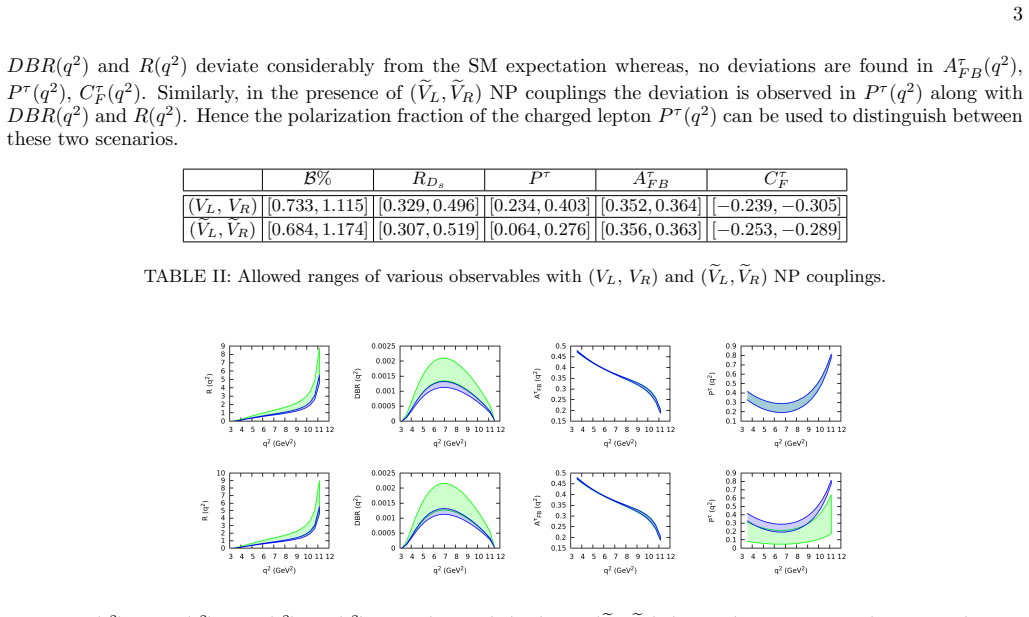
The central claim is that after imposing the $1\sigma$ $R_D$ and $R_{D^*}$ measurements along with the LEP constraint $\mathcal{B}(B_c \to \tau \nu) \le 30\%$, only the vector new-physics couplings $(V_L, V_R)$ and $(\tilde{V}_L, \tilde{V}_R)$ are allowed; the scalar couplings $(S_L, S_R)$ and $(\tilde{S}_L, \tilde{S}_R)$ are ruled out. Within the surviving vector scenarios, the differential branching fraction and $R_{D_s}(q^2)$ deviate noticeably from the standard model, and the $\tau$ polarization fraction $P_\tau(q^2)$ takes different ranges in the two scenarios, making it the discriminating observable.
Load-bearing premise
The paper assumes the new-physics couplings are real, so its conclusion that scalar couplings are ruled out could fail if complex phases let those couplings interfere with the standard model differently in $B_c \to \tau \nu$.
Editorial extensions
If this is right
- Scalar new-physics explanations of the $R_D$ and $R_{D^*}$ anomalies are excluded unless they also satisfy the $B_c \to \tau \nu$ bound, redirecting model building toward vector couplings.
- A measurement of the $B_s \to D_s \tau \nu$ branching ratio and $R_{D_s}$ in the quoted ranges would signal new physics at a level distinguishable from the standard model.
- The $\tau$ polarization $P_\tau(q^2)$, predicted in $[0.234, 0.403]$ for $(V_L, V_R)$ and $[0.064, 0.276]$ for $(\tilde{V}_L, \tilde{V}_R)$, offers a way to tell the two vector scenarios apart.
- The $q^2$-dependent shapes of $R_{D_s}$ and the differential branching ratio provide additional handles that do not rely only on total branching fractions.
Reading between the lines
- The exclusion of scalar couplings is derived on real coupling planes; allowing complex phases could change the interference with the standard model in $B_c \to \tau \nu$ and possibly reopen the scalar window.
- The same effective-Lagrangian observables could be adapted to other $b \to c \tau \nu$ modes, such as $B_c \to J/\psi \, \tau \nu$ or $\Lambda_b \to \Lambda_c \tau \nu$, where polarization measurements might sharpen the same discrimination.
- If the $\mathcal{B}(B_c \to \tau \nu)$ bound is later strengthened, the surviving vector parameter space will shrink; if it relaxes, the scalar scenarios deserve another look.
- A dedicated experimental extraction of $P_\tau(q^2)$ in $B_s \to D_s \tau \nu$, rather than an integrated rate alone, would be the most direct test of the paper's proposed separation.
Signed reviews
Editorial analysis
A structured set of objections, weighed in public.
Referee Report
Summary. The paper studies the semileptonic decay B_s -> D_s tau nu as a probe of the b -> c tau nu transitions that underlie the R_D and R_D* anomalies. Using an effective Lagrangian with vector and scalar new-physics Wilson coefficients, the authors impose 1 sigma constraints from the measured R_D and R_D* ratios and from B(B_c -> tau nu) <= 30%, then scan four two-coupling scenarios: (V_L,V_R), (V~_L,V~_R), (S_L,S_R), and (S~_L,S~_R). They predict the differential branching ratio, R(q^2), the forward-backward asymmetry, the tau polarization fraction, and the convexity parameter for B_s -> D_s tau nu, and they conclude that only vector-type couplings survive the B_c -> tau nu constraint while scalar-type couplings are ruled out. They also propose P_tau(q^2) as a discriminator between the (V_L,V_R) and (V~_L,V~_R) scenarios.
Significance. If the central claim holds, the paper strengthens vector-type new-physics explanations of the R_D and R_D* anomalies and identifies an observable that can distinguish left- and right-handed neutrino scenarios. A notable strength is that the B_s -> D_s tau nu observables are predictions, not inputs to the fit, so the exercise is a genuine forward test and not circular. The use of lattice QCD form factors from Ref. [14] and the consistent extension of the companion formalism [17] are also positive features. The significance is, however, conditional: the main exclusion statement depends on an unstated assumption that the Wilson coefficients are real, and the paper provides little of the underlying decay-rate machinery, so the robustness of the conclusion cannot be fully assessed from the manuscript alone.
major comments (4)
- [Section IV and Fig. 1] The conclusion that scalar NP couplings are ruled out relies on the scans in Fig. 1, whose axes are the real two-dimensional planes (S_L,S_R) and (S~_L,S~_R). Equation (1) does not restrict the Wilson coefficients to be real, and the text nowhere states such a restriction. For complex coefficients, the scalar contributions to B_c -> tau nu can interfere with the SM amplitude and with each other with independent phases, so destructive interference can reduce the branching ratio below the 30% bound even for large |S_L| and |S_R|. The real-plane scan therefore does not cover the EFT parameter space relevant to the bound, and the unqualified statement that scalar couplings are ruled out is stronger than the shown calculation supports. The authors should either state and justify the real-coefficient assumption or extend the scan to complex phases, or provide an analytic argument that phases cannot relax the bound.
- [Sections II and III] The paper does not display the explicit expressions for dGamma/dq^2, the angular observables, or the B_c -> tau nu branching ratio in terms of the Wilson coefficients; all of these are imported from Refs. [17,18]. Since the central claim of Section IV is that the B_c -> tau nu constraint excludes scalar couplings, at least the B_c -> tau nu decay-rate formula and the definition of the 30% bound should be shown, so that the exclusion and the allowed ranges in Table II can be checked from the material in this paper alone.
- [Section II, Eq. (2)] Equation (2) defines R(q^2) as B(B_s -> D_s tau nu)/B(B_s -> D_s l nu), which is a q^2-independent ratio of total branching fractions, yet the text and Fig. 2 treat R(q^2) as a q^2-dependent observable. The intended quantity is presumably the differential ratio [dGamma_tau/dq^2]/[dGamma_l/dq^2], with the total ratio obtained by integrating numerator and denominator separately. This definition should be corrected, since R(q^2) is one of the main predicted quantities.
- [Section IV] The statement that 'only vector type NP couplings satisfy the B(B_c -> tau nu) constraint' is broader than the scenarios actually scanned. Only four isolated two-coupling pairs are considered at a time; simultaneous vector and scalar couplings, or mixtures of left- and right-handed neutrino operators, are not examined. The conclusion should be qualified to the pair scenarios studied unless a general argument is provided that no mixed scenario can satisfy all constraints.
minor comments (4)
- [Abstract and Section I] The abstract states that the R_J/psi measurement is 'more than 2 sigma' away from the standard model, while Section I reports '1.3 sigma'. These numbers should be harmonized, since the R_J/psi anomaly is cited as motivation.
- [Fig. 1 caption] The caption does not indicate which sub-panels correspond to which NP scenario or what the shaded regions and contours represent; the figure should be self-explanatory with labeled panels and a legend.
- [Table II] The first column is labeled 'B%' without a subscript; for clarity it should read B(B_s -> D_s tau nu) in percent or otherwise identify the mode explicitly.
- [Section II, Eq. (2)] The convexity parameter C_F(q^2) is written as a second derivative with respect to cos theta but the evaluation point is not specified; the standard definition evaluates at cos theta = 0, and this should be stated.
Circularity Check
No significant circularity: the Bs→Dsτν observables are forward predictions from couplings fitted to RD/RD* and an external Bc→τν bound.
full rationale
The derivation chain is linear: external inputs (lattice form factors [14], |Vcb|, the effective Lagrangian from [15,16], measured RD/RD*, and the LEP-derived B(Bc→τν)≤30% bound [18]) are used to constrain the NP Wilson coefficients; those constrained coefficients are then inserted into the Bs→Dsτν decay formulas to produce the observables in Table II and Figs. 1–2. None of the predicted Bs→Dsτν quantities (R_Ds, DBR, A_FB^τ, P_τ, C_F^τ) appears among the fitted inputs, so the Bs predictions are not statistically forced by the RD/RD* fit. The scalar exclusion in Section IV is a direct consequence of imposing the external Bc→τν bound, not a consequence of the Bs→Dsτν calculation itself. The only self-citations, to Ref. [17], are used for 'details' of the observable definitions and SM inputs; they are formalism references, not load-bearing appeals to an unverified prior result by the same authors. The real-coefficient scan in Fig. 1 is a genuine limitation—complex phases could change the scalar exclusion—but that is a correctness risk, not a circularity. No equation in the paper reduces by construction to another equation or to a fitted parameter renamed as a prediction, so no circular step can be exhibited.
Assumptions & free parameters
free parameters (3)
- NP Wilson coefficients V_L, V_R =
No central values quoted; allowed 1 sigma regions shown in Fig. 1
- NP Wilson coefficients ~V_L, ~V_R =
No central values quoted; allowed 1 sigma regions shown in Fig. 1
- NP Wilson coefficients S_L, S_R, ~S_L, ~S_R =
Excluded by the B_c to tau nu bound
assumptions (5)
- domain assumption The b to c l nu transition is fully described by the vector and scalar operators in Eq. (1); tensor operators are ignored.
- ad hoc to paper NP Wilson coefficients are real-valued.
- domain assumption Lattice QCD form factors from Ref. [14] are valid for both SM and NP operator matrix elements over the full q2 range.
- domain assumption The B_c to tau nu branching fraction upper bound of 30 percent from LEP data (Ref. [18]) is applicable and correctly constrains scalar NP.
- domain assumption The R_D and R_D* measurements are the relevant 1 sigma constraints for the allowed NP parameter space.
Cite this review
Pith. "Pith review of Signature of lepton flavor universality violation in $B_s \to D_s \tau \nu$ semileptonic decays." pith.science (2026). https://pith.science/paper/SUTUBDYB
@misc{pith2026190806243,
  author       = {Pith},
  title        = {Pith review of: Signature of lepton flavor universality violation in $B_s \to D_s \tau \nu$ semileptonic decays},
  year         = {2026},
  howpublished = {\url{https://pith.science/paper/SUTUBDYB}},
  note         = {Machine review of arXiv:1908.06243}
}
abstract
Deviation from the standard model prediction is observed in many semileptonic $B$ decays mediated via $b \to c$ charged current interactions. In particular, current experimental measurements of the ratio of branching ratio $R_D$ and $R_{D^{\ast}}$ in $B \rightarrow D^{(*)}l \nu$ decays disagree with standard model expectations at the level of about $4.1\sigma$. Moreover, recent measurement of the ratio of branching ratio $R_{J/\Psi}$ by LHCb, where $R_{J/\Psi} = \mathcal B(B_c \to J/\Psi\,\tau\nu)/\mathcal B(B_c \to J/\Psi\,\mu\nu)$, is more than $2\sigma$ away from the standard model prediction. In this context, we consider an effective Lagrangian in the presence of vector and scalar new physics couplings to study the implications of $R_D$ and $R_{D^{\ast}}$ anomalies in $B_s \to D_s\,\tau\nu$ decays. We give prediction of several observables such as branching ratio, ratio of branching ratio, forward backward asymmetry parameter, $\tau$ polarization fraction, and the convexity parameter for the $B_s \to D_s\,\tau\nu$ decays within the standard model and within various new physics scenarios.
Figures

Reference graph
Works this paper leans on
- [17]
-
[14]
C. J. Monahan, H. Na, C. M. Bouchard, G. P. Lepage and J. Shigemitsu, Phys. Rev. D 95, no. 11, 114506 (2017)
work page 2017
-
[1]
J. A. Bailey et al. [MILC Collaboration], Phys. Rev. D 92, no. 3, 034506 (2015)
work page 2015
- [2]
- [3]
- [4]
-
[5]
Fajfer, J
S. Fajfer, J. F. Kamenik and I. Nisandzic, Phys. Rev. D 85, 094025 (2012)
2012
-
[6]
D. Bigi, P. Gambino and S. Schacht, JHEP 1711, 061 (2017)
work page 2017
Show all 18 references
-
[7]
J. P. Lees et al. [BaBar Collaboration], Phys. Rev. D 88, no. 7, 072012 (2013)
2013
-
[8]
Huschle et al
M. Huschle et al. [Belle Collaboration], Phys. Rev. D 92, no. 7, 072014 (2015)
2015
-
[9]
Sato et al
Y. Sato et al. [Belle Collaboration], Phys. Rev. D 94, no. 7, 072007 (2016)
2016
-
[10]
Hirose et al
S. Hirose et al. [Belle Collaboration], Phys. Rev. Lett. 118, no. 21, 211801 (2017)
2017
-
[11]
Aaij et al
R. Aaij et al. [LHCb Collaboration], Phys. Rev. Lett. 115, no. 11, 111803 (2015)
2015
-
[12]
Amhis et al
Y. Amhis et al. [HFLAV Collaboration], Eur. Phys. J. C 77, no. 12, 895 (2017)
2017
- [13]
-
[15]
Cirigliano, J
V. Cirigliano, J. Jenkins and M. Gonzalez-Alonso, Nucl. Phys. B 830, 95 (2010)
2010
-
[16]
Bhattacharya, V
T. Bhattacharya, V. Cirigliano, S. D. Cohen, A. Filipuzzi, M. Gonzalez-Alonso, M. L. Graesser, R. Gupta and H. W. Lin, Phys. Rev. D 85, 054512 (2012)
2012
-
[18]
A. G. Akeroyd and C. H. Chen, Phys. Rev. D 96, no. 7, 075011 (2017)
2017
Reviewed August 14, 2026 · model on record in the stance chip above.
Discussion (0). Continue with ORCID to comment.