REVIEW 3 major objections 6 minor 70 references
Continuous-variable state moments from randomized homodyne and heterodyne measurements
T0 review · 3 major / 6 minor · reviewed 2026-08-16 · deepseek-v4-flash
Pith's one-line read Randomized homodyne and heterodyne measurements can estimate continuous-variable state moments directly, without reconstructing the state.
desk verdict Useful homodyne MGF shadow idea, but the written estimator is biased by a missing 1/π normalization and the (-1)^k signs; the simulations contradict the equations. read the letter →
The pith
A machine-rendered reading of the paper's core claim, the machinery that carries it, and where it could break.
The reading
What carries the argument
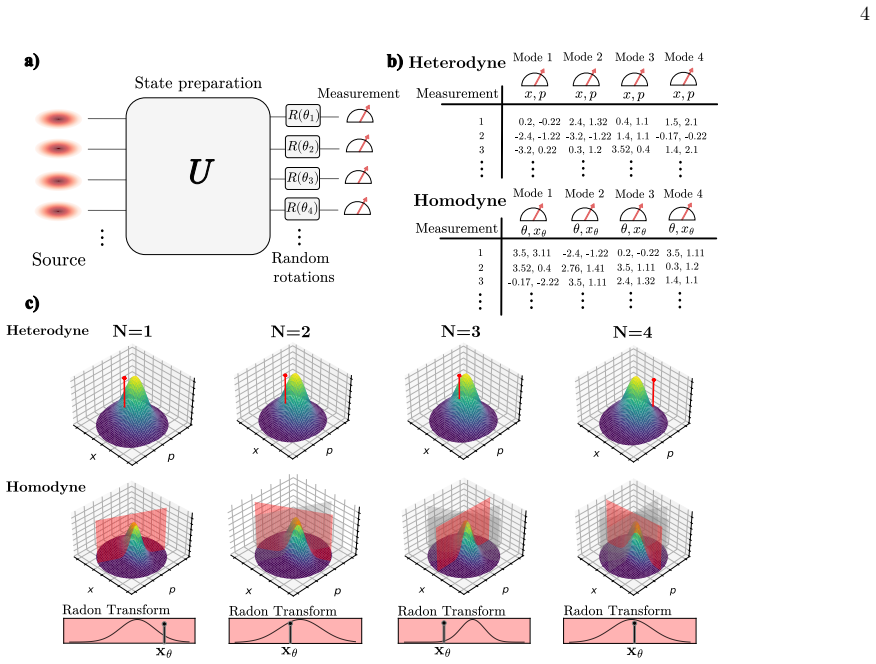
The load-bearing object is the single-shot MGF estimator $M_l^{(i)}(\mu) = \sum_{k=0}^{L} \frac{\mu^k}{k!} C_{k,l} H_{2k+l}(x_\theta^{(i)}) e^{-il\theta^{(i)}}$, where $H_n$ is a Hermite polynomial, $C_{k,l}$ is a closed-form constant, and $(x_\theta, \theta)$ is a single homodyne sample. It replaces the pattern-function-based sampling function $S_M(x_\theta,\mu,l)$ with an infinite series that can be truncated at the highest desired moment, making postprocessing nearly free and avoiding the singularity at $\mu=0$. Judiciously, in multimode settings it works with the factorized representation $\prod_m M_{l_m}^{(i)}(\mu_m)$, whose memory footprint grows linearly in the number of modes.
What would settle it
Prepare a coherent state with known displacement $\alpha$ and known moments, run the proposed homodyne protocol with a detector whose quadrature normalization is independently calibrated, and compare the estimated $\langle \hat a^{\dagger k+l}\hat a^k\rangle$ against the analytic values for several orders; any systematic multiplicative bias, visible already at $k+l\le 2$, would falsify the estimator's unbiasedness.
Extended reading notes
Core claim
The central claim is that the full moment structure of a CV state can be recovered from randomized phase-space measurements without reconstructing the state. For heterodyne measurements the usual characteristic-function shadow suffices; for homodyne measurements, whose samples lie on one-dimensional slices and whose characteristic function would be a distribution, the paper introduces a new MGF $M_l(\mu)$ that is regular everywhere and whose single-shot estimator is a sum of Hermite polynomials with explicit coefficients. From this MGF, normally-ordered moments $\langle \hat a^{\dagger k+l}\hat a^k\rangle$ are obtained by taking derivatives at $\mu=0$, and a multimode moment is an average of products of single-mode snapshots. The complexity analysis shows the estimator's variance grows as $O(D^{2k+l})$ with Fock truncation $D$ and moment order $2k+l$, so that low-order moments remain estimable even at high energy, and the two demonstrations show that a few thousand randomized measurements suffice to detect entanglement and to map single-mode loss.
Load-bearing premise
The homodyne estimator is unbiased only if the quadrature distribution $P_\theta(x_\theta)$ sampled by the device is normalized exactly as in the Radon-transform identity used to derive the kernel; the paper does not fix that normalization, and a constant prefactor error would shift every estimated moment.
Editorial extensions
If this is right
- Many moments of a multimode CV state can be estimated concurrently from a single batch of randomized measurements, with per-sample postprocessing that is essentially free.
- The sample complexity grows exponentially in moment order, so low-order moments stay accessible for high-energy states.
- Entanglement of Gaussian and non-Gaussian states can be certified with a few thousand randomized homodyne or heterodyne measurements using the SV submatrix determinants.
- Optical loss on a specific mode of a photonic chip can be detected from the exponential decay pattern of the covariance matrix estimated via the protocol.
- The factorized form of the shadow keeps memory linear in the number of modes, allowing the protocol to scale to many-mode systems.
Reading between the lines
- If the normalization issue is benign, the same estimator can be adapted to any rotated quadrature sampling, including noisy or miscalibrated homodyne, by folding the detector's known response into the kernel.
- The paper's own note about testing multiple SV submatrices suggests that applying the protocol to unknown states should be paired with a multiple-testing correction or a fixed pre-chosen submatrix; without it, apparent violations may occur by chance.
- The exponential-in-order variance suggests a natural extension: importance-sampling the quadrature angle or the phase-space point to flatten the estimator variance, which could extend the reachable moment order at fixed sample count.
- Because the moments are estimated without state reconstruction, the same shadows could feed moment-based Hamiltonian simulation or variational algorithms, bypassing the density-matrix reconstruction entirely.
Signed reviews
Editorial analysis
A structured set of objections, weighed in public.
Referee Report
Summary. This paper proposes a shadow-tomography protocol for estimating continuous-variable state moments from randomized homodyne and heterodyne measurements. For homodyne detection it defines a moment-generating function built from Hermite polynomials and derives single-shot estimators; for heterodyne detection it uses the characteristic function and a polynomial kernel. It gives Bernstein-based sample-complexity bounds, claims a variance that grows as a power of the Fock cutoff and exponentially in the moment order, and demonstrates entanglement detection via the Shchukin-Vogel criterion and optical-loss characterization with a few thousand simulated randomized measurements. The central claim is that the resulting shadows allow efficient concurrent estimation of many multimode moments.
Significance. The problem addressed is timely, and the idea of estimating normally ordered moments directly from randomized homodyne samples through a moment-generating function is natural and potentially useful; a correct version would be a worthwhile contribution to CV shadow tomography. The paper also deserves credit for connecting the framework to concrete applications, namely the Shchukin-Vogel entanglement criterion and optical-loss characterization, and for reporting simulation studies on non-Gaussian states. However, the estimator definitions in the homodyne section contain internal prefactor and sign inconsistencies, and the complexity argument relies on an unjustified support truncation. These issues affect the core unbiasedness claims and the sample-complexity guarantees, so the manuscript cannot be accepted in its current form; because the problems are local and potentially correctable, a careful revision could repair them.
major comments (3)
- [Section III.B, Eqs. (18), (20), (23), (24)] The homodyne estimator as written is not unbiased. Eq. (18) expresses the moment as C times the double integral over theta in [0,pi) and x, with C = [pi sqrt(2^(2k+l) binom(2k+l,k+l))]^(-1). If theta is sampled uniformly from [0,pi), the expectation of a per-sample function f(theta,x) is (1/pi) times that integral, so the unbiased per-sample kernel must contain an explicit factor pi in the numerator. The k-th derivative of Eq. (20) has coefficient [(-1)^k pi sqrt(...)]^(-1) = (-1)^k / (pi sqrt(...)), which is too small by a factor pi and carries an extra (-1)^k relative to Eq. (18). Eq. (23) and Eq. (24) then take derivatives without the (-1)^k prefactor required by Eq. (15), so the final estimator is off by both a factor pi and a sign (-1)^k. For a Fock state |1> with k=1, l=0, the estimator converges to -1/pi instead of +1. The supplementary text is also internally inconsistent: Eq. (A25) uses C without the missing pi and without (-1)^k, while the variance calculation immediately after it inserts a factor pi. A single Fock-state calibration run would expose this error, and the claimed agreement of the simulations with analytic values cannot be checked without the exact estimator used in the code.
- [Section III.C, Eqs. (26)-(27), (37), (39)] The Bernstein-based sample-complexity bound is not justified as stated. Bernstein's inequality requires the random variable Z to be almost surely bounded, with R a bound on |Z - E[Z]|. The kernels in Eqs. (20) and (30) are Hermite polynomials or polynomials in alpha, which are unbounded on the infinite phase space that homodyne and heterodyne measurements actually sample. The paper introduces a phase-space truncation Omega in Eqs. (37) and (39) and sets R = 2|C H(Omega)|, but it never states that outcomes outside [-Omega, Omega] have zero probability, nor does it provide a tail bound on P_theta or Q that would make the truncation valid. If such outcomes occur, R underestimates the true range and the confidence statement in Eq. (25) does not follow. As written, the required-measurement formula Eq. (27) is therefore an upper bound only under an additional support assumption that is neither stated nor controlled.
- [Section III.A, Eqs. (12), (29), and the numerical-differentiation discussion] The actual heterodyne estimator is left ambiguous. Eq. (12) defines moments as derivatives of chi_1 at alpha=0, and the text says these derivatives are obtained by numerical differentiation of stored characteristic-function values around the phase-space point alpha=0. The kernel estimator in Eqs. (29)-(30) and the variance bound in Eq. (36), however, do not involve any finite-difference step; they are direct expectation estimators over the Husimi-Q distribution. The finite-difference route introduces a systematic bias and a step-size-dependent variance that are not analyzed, and it is not connected to the complexity bound. Because the heterodyne numerical demonstrations and the few-thousand-measurements claim depend on which of these two estimators was actually used, the manuscript needs to state the estimator explicitly, give the step-size selection, and provide the associated bias-variance or complexity analysis.
minor comments (6)
- [Section II.A, Eq. (5)] The normalization of P_theta is not specified consistently with Eq. (18); the 1/2 prefactor in Eq. (5) should be reconciled with the quadrature distribution used in the Radon identity.
- [Section IV.A] The multiple-testing issue for searching over many SV submatrices is mentioned but not addressed; the protocol-level claim that many submatrices can be evaluated without correction is not supported, even though the fixed-submatrix demonstrations are valid as illustrative examples.
- [Section III.C and abstract] The statement that the required number of measurements grows exponentially in the moment order should be qualified by the fixed Fock truncation D and by the state-dependence of the variance bounds; the abstract's phrasing is too strong without this qualification.
- [Eq. (22)] The notation for the multimode MGF shadow is inconsistent: the text uses both M with a tilde and a typeset 'fM' for the same object; please standardize the notation.
- [Figure 6] The missing heterodyne data point for the photon-subtracted state is attributed to a limitation of Strawberry Fields; either explain why no alternative simulation method was used or provide a result from another simulator so the heterodyne comparison is complete.
- [Reproducibility] No code or data repository is provided; given the estimator inconsistencies described above, the numerical agreement with analytic values cannot be independently audited, and the authors should make the simulation code available or at least state the exact estimator implemented.
Circularity Check
No circular reduction: the moment estimators are constructed from standard Radon-transform and characteristic-function identities and validated against independent analytic values in simulation.
full rationale
I walked the claimed derivation chain. For heterodyne measurements, the estimator derives from the standard characteristic-function identities of Cahill-Glauber and Serafini (Eqs. (11)-(12)); for homodyne measurements, the single-shot MGF estimator in Eq. (20) is built explicitly from Wunsche's Radon-transform moment formula, Eq. (18), and Richter's MGF relation, Eq. (15). These are published external identities, not assumptions containing the target moments. No parameter is fitted to the moments being estimated, and no target value is used to define the kernels. The sample-complexity statement is a Bernstein-type upper bound, not a disguised fit. The numerical demonstrations use Strawberry Fields simulations and compare the estimated moments and SV determinants with analytically computed true values, so the results are externally benchmarked rather than derived from the protocol's own inputs. The only self-citation, Ref. [41], is contextual and not load-bearing in the derivation. The skeptic's concerns about a possible missing factor of pi in Eq. (20) and missing (-1)^k signs in Eq. (23) are internal correctness risks; if valid, they would make the estimator biased, but they would not make the claim circular because the estimator is not defined in terms of the quantity it estimates. Under the evidence rule requiring an explicit reduction of a prediction to its input, no circular step is present.
Assumptions & free parameters
free parameters (3)
- Fock truncation D =
D = 10 in simulations
- Phase-space truncation Omega =
not specified
- Number of measurements N =
N = 5000
assumptions (4)
- domain assumption Normally-ordered moments equal derivatives of the s-ordered characteristic functions (Eq. (12), from Serafini/Cahill-Glauber).
- domain assumption Wunsche's Radon transform formula (Eq. (18)) expresses moments as integrals of Hermite polynomials against quadrature distributions.
- domain assumption Richter's moment-generating function definition and derivative relation (Eqs. (14)-(15)).
- domain assumption Heterodyne samples are drawn from the Husimi-Q function, and the characteristic function estimator in Eq. (7) is unbiased.
Cite this review
Pith. "Pith review of Continuous-variable state moments from randomized homodyne and heterodyne measurements." pith.science (2026). https://pith.science/paper/SV2RHQYN
@misc{pith2026260811811,
  author       = {Pith},
  title        = {Pith review of: Continuous-variable state moments from randomized homodyne and heterodyne measurements},
  year         = {2026},
  howpublished = {\url{https://pith.science/paper/SV2RHQYN}},
  note         = {Machine review of arXiv:2608.11811}
}
read the original abstract
Continuous-variable (CV) quantum states are naturally characterized by their moments, defined as expectation values of products of single- or multimode ladder operators. Many CV Hamiltonians and quantum algorithms are formulated directly in terms of these moments, and therefore an efficient procedure to estimate moments with limited state measurements is necessary. In this paper, we present a protocol for shadow tomography of moment-generating functions (MGFs) of CV states based on randomized homodyne and heterodyne measurements. The resulting shadows enable an efficient and concurrent estimation of many multimode moments. Our complexity analysis shows that the number of measurements required to estimate a certain moment to a given precision grows exponentially in the order of the moments. Finally, we assess the precision of these moment estimators by applying them to two tasks: detecting entanglement in both Gaussian and non-Gaussian states via the Shchukin-Vogel protocol, and characterizing optical loss in a photonic chip. We demonstrate that both tasks can be accomplished with only a few thousand randomized measurements. The small number of required measurements, combined with efficient sample processing, makes our protocol applicable to a wide range of CV simulation tasks.
Figures


Figures from the paper (9 more)


Reference graph
Works this paper leans on
-
[1]
Heterodyne measurements In the case of heterodyne measurements, using Eqs. (4) and (12), we can describe the single-mode characteristic functionχ 1 in terms of the Husimi-Q function as χ1(β) = Z C d2αe (αβ∗−α∗β)Q(α)e|β|2 .(28) The normally-ordered operators for a single mode are then obtained from the derivatives ofχ 1(β) ⟨ˆa†k+lˆak⟩= ∂ ∂β k+l − ∂ ∂β∗ k χ...
-
[2]
The Glauber-Sudarshan representation is difficult to sample from experimentally and therefore is not written as an expectation value the same way the Wigner or the Husimi-Q distribution are. The Glauber-Sudarshan rep- resentation is however necessary to find the final form of the normally-ordered moment estimators of our state. All three representations a...
-
[3]
Squeezed Gaussian state The easiest test of entanglement is for Gaussian entan- gled states, which are fully described by their first- and second-order moments. More specifically, we consider a family of single-mode squeezed light, coupled to a second mode via a tunable beamsplitter. The adjustment of the transmittivity of the beamsplitter changes the amo...
-
[4]
Product states Finally, we show as an example that a specific SV submatrix which confirmed entanglement for the photon- subtracted and squeezed Gaussian states rejects the hy- pothesis of entanglement for a product state of two sub- systems such that|ψ AB⟩=|ψ A⟩⊗|ψ B⟩. The violation of the SV criterion is a sufficient condition for entangle- ment detectio...
-
[5]
The leading order of the hypergeometric func- tion asn→∞isO(n 2k+l)
Homodyne measurements The variance of the samplesZ i obtained from MGF snapshots using homodyne measurements is bounded by Var(hom)[Z]≤ (k!)2((k+l)!) 2 (2k+l)! DX n=1 ρn,n3F2 1 2,−n,−(2k+l); 1,1; 4 , (38) where we usepFq to denote a generalized hypergeometric function. The leading order of the hypergeometric func- tion asn→∞isO(n 2k+l). If we setρ D,D = 1...
-
[6]
Photon-subtracted twin-beam A straightforward non-Gaussian state to realize exper- imentally is the photon-subtracted twin-beam. Photon- subtracted states are probabilistic non-Gaussian states used in universal quantum computation on CV systems [45–47]. Fig. 3 schematically depicts the generation of a photon-subtracted twin beam. A two-mode squeezed vacuu...
work page 2000
-
[7]
Cat states are built from superpositions of coherent states |α⟩
Cat states Cat states form an important family of non-Gaussian states with interesting applications such as quantum er- ror correction and logical qubit encoding [8, 48]. Cat states are built from superpositions of coherent states |α⟩. When interacting a cat state with a vacuum mode at a beam splitter, the resulting state is an entangled non-Gaussian stat...
-
[8]
Analytically, we expect an increase in the SV value det(D){0,3,6} for small photon losses. Also, the initial mixing transmittivityT 1 plays an important role in keep- ing the entanglement alive, as expected. Indeed, if there 13 T1 0.00 0.25 0.50 0.75 1.00a b T2 = 0.0 T2 = 0.1 T2 = 0.2 T1 0.75 1.00 1.25 1.50 1.75 2.00b b /4 5 /16 3 /8 7 /16 /2 T1 0.00 0.25...
Show all 70 references
-
[9]
Leonhardt and H
U. Leonhardt and H. Paul, Measuring the quantum state of light, Prog. Quantum Electron.19, 89 (1995)
1995
-
[10]
Barbieri, N
M. Barbieri, N. Spagnolo, M. G. Genoni, F. Ferreyrol, R. Blandino, M. G. A. Paris, P. Grangier, and R. Tualle- 14 Brouri, Non-Gaussianity of quantum states: an experi- mental test on single-photon added coherent states, Phys- ical Review A82, 063833 (2010), arXiv:1012.0466 [quant- ph]
2010 arXiv
-
[11]
F. A. Mele, A. A. Mele, L. Bittel, J. Eisert, V. Giovan- netti, L. Lami, L. Leone, and S. F. E. Oliviero, Learning quantum states of continuous variable systems (2024), arXiv:2405.01431 [quant-ph]
2024
-
[12]
Y.-S. Ra, A. Dufour, M. Walschaers, C. Jacquard, T. Michel, C. Fabre, and N. Treps, Non-Gaussian quan- tum states of a multimode light field, Nature Physics16, 144 (2020)
2020
-
[13]
Adesso, S
G. Adesso, S. Ragy, and A. R. Lee, Continuous vari- able quantum information: Gaussian states and beyond, Open Systems & Information Dynamics21, 1440001 (2014), arXiv:1401.4679 [quant-ph]
2014 arXiv
-
[14]
S. L. Braunstein and P. v. Loock, Quantum information with continuous variables, Reviews of Modern Physics 77, 513 (2005), arXiv:quant-ph/0410100
2005 arXiv
-
[15]
R. M. Gomes, A. Salles, F. Toscano, P. H. Souto Ribeiro, and S. P. Walborn, Quantum entanglement beyond Gaus- sian criteria, Proceedings of the National Academy of Sciences106, 21517 (2009)
2009
-
[16]
already proposed an estimator for the reconstructed characteristic function ˜χas an average overNsingle- measurement heterodyne snapshots. After heterodyning anM-mode state, they obtain a set of measurements {x(i)}N i=1, wherex (i) = (x 0,p 0,...,x M,pM)∈R 2M is the result of ...
-
[17]
Gottesman, A
D. Gottesman, A. Kitaev, and J. Preskill, Encoding a qubit in an oscillator, Physical Review A64, 012310 (2001), arXiv:quant-ph/0008040
2001 arXiv
-
[18]
provides an equivalent representation of the single- mode state in continuous phase space, where the state can be described, for example, over a complete basis of displacement operatorsD α. These displacement oper- ators displace a single-mode vacuum state|vac⟩into a coherent ...
-
[19]
Mari and J
A. Mari and J. Eisert, Positive Wigner Functions Render Classical Simulation of Quantum Computation Efficient, Physical Review Letters109, 230503 (2012)
2012
-
[20]
T. C. Ralph, A. Gilchrist, G. J. Milburn, W. J. Munro, and S. Glancy, Quantum computation with optical co- herent states, Physical Review A68, 042319 (2003)
2003
-
[21]
Mølmer, Non-Gaussian states from continuous-wave Gaussian light sources, Physical Review A73, 063804 (2006)
K. Mølmer, Non-Gaussian states from continuous-wave Gaussian light sources, Physical Review A73, 063804 (2006)
2006
-
[22]
Brydges, A
T. Brydges, A. Elben, P. Jurcevic, B. Vermersch, C. Maier, B. P. Lanyon, P. Zoller, R. Blatt, and C. F. Roos, Probing R´ enyi entanglement entropy via random- ized measurements, Science364, 260 (2019)
2019
-
[23]
Cie´ sli´ nski, S
P. Cie´ sli´ nski, S. Imai, J. Dziewior, O. G¨ uhne, L. Knips, W. Laskowski, J. Meinecke, T. Paterek, and T. V´ ertesi, Analysing quantum systems with randomised measure- ments, Physics Reports1095, 1 (2024)
2024
-
[24]
Elben, S
A. Elben, S. T. Flammia, H.-Y. Huang, R. Kueng, J. Preskill, B. Vermersch, and P. Zoller, The random- ized measurement toolbox, Nature Reviews Physics5, 9 (2022), arXiv:2203.11374 [quant-ph]
2022 arXiv
-
[25]
Elben, R
A. Elben, R. Kueng, H.-Y. Huang, R. v. Bijnen, C. Kokail, M. Dalmonte, P. Calabrese, B. Kraus, J. Preskill, P. Zoller, and B. Vermersch, Mixed-state en- tanglement from local randomized measurements, Physi- cal Review Letters125, 200501 (2020), arXiv:2007.06305 [quant-ph]
2020 arXiv
-
[26]
Becker, N
S. Becker, N. Datta, L. Lami, and C. Rouz´ e, Classical shadow tomography for continuous variables quantum systems, IEEE Transactions on Information Theory70, 3427 (2024), arXiv:2211.07578 [quant-ph]
2024 arXiv
-
[27]
Gandhari, V
S. Gandhari, V. V. Albert, T. Gerrits, J. M. Taylor, and M. J. Gullans, Precision Bounds on Continuous- Variable State Tomography using Classical Shadows (2023), arXiv:2211.05149 [quant-ph]
2023 arXiv
-
[28]
Serafini,Quantum continuous variables(CRC Press, London, England, 2021)
A. Serafini,Quantum continuous variables(CRC Press, London, England, 2021)
2021
-
[29]
Shchukin and W
E. Shchukin and W. Vogel, Inseparability Criteria for Continuous Bipartite Quantum States, Physical Review Letters95, 230502 (2005)
2005
-
[30]
Leonhardt and H
U. Leonhardt and H. Paul, Realistic optical homodyne measurements and quasiprobability distributions, Physi- cal Review A48, 4598 (1993)
1993
-
[31]
W¨ unsche, Ordered moments and relation to Radon transform of Wigner quasiprobability, Journal of Modern Optics47, 33 (2000)
A. W¨ unsche, Ordered moments and relation to Radon transform of Wigner quasiprobability, Journal of Modern Optics47, 33 (2000)
2000
-
[32]
L. A. Kanari-Naish, J. Clarke, S. Qvarfort, and M. R. Vanner, Two-mode schr¨ odinger-cat states with nonlin- ear optomechanics: generation and verification of non- gaussian mechanical entanglement, Quantum Science and Technology7, 035012 (2022)
2022
-
[33]
W. Chen, J. Gan, J.-N. Zhang, D. Matuskevich, and K. Kim, Quantum computation and simulation with vi- brational modes of trapped ions, Chinese Physics B30, 060311 (2021), arXiv:2103.14299 [quant-ph]
2021 arXiv
-
[34]
D. E. Koh and S. Grewal, Classical Shadows With Noise, Quantum6, 776 (2022), arXiv:2011.11580 [quant-ph]
2022 arXiv
-
[35]
S. Chen, W. Yu, P. Zeng, and S. T. Flammia, Robust Shadow Estimation, PRX Quantum2, 030348 (2021)
2021
-
[36]
K. E. Cahill and R. J. Glauber, Density Operators and Quasiprobability Distributions, Physical Review177, 1882 (1969)
1969
-
[37]
K. E. Cahill and R. J. Glauber, Ordered Expansions in Boson Amplitude Operators, Physical Review177, 1857 (1969)
1969
-
[38]
Fornberg, Finite difference formulas in the complex plane, Numerical Algorithms90, 1305 (2022)
B. Fornberg, Finite difference formulas in the complex plane, Numerical Algorithms90, 1305 (2022)
2022
-
[39]
Richter, Realistic pattern functions for optical homo- dyne tomography and determination of specific expecta- tion values, Physical Review A61, 063819 (2000)
T. Richter, Realistic pattern functions for optical homo- dyne tomography and determination of specific expecta- tion values, Physical Review A61, 063819 (2000)
2000
-
[40]
R. J. Glauber, Optical coherence and photon statistics, inQuantum Optics and Electronics, edited by C. De- Witt, A. Blandin, and C. Cohen-Tannoudji (Gordon and Breach, New York, 1965) reprinted inQuantum Theory of Coherence(Wiley-VCH, Weinheim, 2007)
1965
-
[41]
S. M. Barnett, G. Ferenczi, C. R. Gilson, and F. C. Speirits, Statistics of photon-subtracted and photon- added states, Physical Review A98, 013809 (2018), arXiv:1806.09475 [quant-ph]
2018 arXiv
-
[42]
A sinogram is a description of the state as Radon trans- formations of the state over a continuous angleθ∈[0,π)
-
[43]
Rebeschini, Bernstein’s Concentration Inequalities
P. Rebeschini, Bernstein’s Concentration Inequalities. Fast Rates, Lecture notes, University of Oxford (2021)
2021
-
[44]
M. A. Jones, H. J. Vallury, C. D. Hill, and L. C. L. Hol- lenberg, Chemistry beyond the Hartree–Fock energy via quantum computed moments, Scientific Reports12, 8985 (2022)
2022
-
[45]
Dutta, D
R. Dutta, D. G. A. Cabral, N. Lyu, N. P. Vu, Y. Wang, B. Allen, X. Dan, R. G. Corti˜ nas, P. Khazaei, M. Sch¨ afer, A. C. C. d. Albornoz, S. E. Smart, S. Nie, M. H. De- voret, D. A. Mazziotti, P. Narang, C. Wang, J. D. Whit- field, A. K. Wilson, H. P. Hendrickson, D. A. Lidar,...
2024
-
[46]
H. R. Grimsley, S. E. Economou, E. Barnes, and N. J. Mayhall, An adaptive variational algorithm for exact molecular simulations on a quantum computer, Nature Communications10, 3007 (2019)
2019
-
[47]
Simon, Peres-Horodecki Separability Criterion for Continuous Variable Systems, Physical Review Letters 84, 2726 (2000)
R. Simon, Peres-Horodecki Separability Criterion for Continuous Variable Systems, Physical Review Letters 84, 2726 (2000)
2000
-
[48]
L.-M. Duan, G. Giedke, J. I. Cirac, and P. Zoller, In- separability criterion for continuous variable systems, Physical Review Letters84, 2722 (2000), arXiv:quant- ph/9908056
2000
-
[49]
Walschaers, Non-Gaussian Quantum States and Where to Find Them, PRX Quantum2, 030204 (2021), arXiv:2104.12596 [quant-ph]
M. Walschaers, Non-Gaussian Quantum States and Where to Find Them, PRX Quantum2, 030204 (2021), arXiv:2104.12596 [quant-ph]
2021 arXiv
-
[50]
Gessner, L
M. Gessner, L. Pezz` e, and A. Smerzi, Entanglement and squeezing in continuous-variable systems (2017), arXiv:1702.08413 [quant-ph]
2017 arXiv
-
[51]
Straeter, M
M. Straeter, M. Tsesmelis, and L.-C. Kwek, Detect- ing entanglement of non-Gaussian continuous-variable states from single-copy homodyne measurements (2026), arXiv:2606.28698 [quant-ph]
2026 arXiv
-
[52]
Finke, P
A. Finke, P. Jain, and S. Weinfurtner, On the observation of nonclassical excitations in Bose–Einstein condensates, New J. Phys.18, 113017 (2016)
2016
-
[53]
D. Miki, A. Matsumura, and K. Yamamoto, Non- Gaussian entanglement in gravitating masses: The role of cumulants, Physical Review D105, 026011 (2022)
2022
-
[54]
Kogias, P
I. Kogias, P. Skrzypczyk, D. Cavalcanti, A. Ac´ ın, and G. Adesso, Hierarchy of Steering Criteria Based on Mo- ments for All Bipartite Quantum Systems, Physical Re- view Letters115, 210401 (2015)
2015
-
[55]
K. K. Sabapathy, H. Qi, J. Izaac, and C. Weedbrook, Pro- duction of photonic universal quantum gates enhanced by machine learning, Physical Review A100, 012326 (2019). 15
2019
-
[56]
D. Su, C. R. Myers, and K. K. Sabapathy, Conver- sion of Gaussian states to non-Gaussian states using photon-number-resolving detectors, Physical Review A 100, 052301 (2019)
2019
-
[57]
S. Abel, M. Spannowsky, and S. Williams, Simulating quantum field theories on continuous-variable quantum computers, Physical Review A110, 012607 (2024)
2024
-
[58]
Mirrahimi, Z
M. Mirrahimi, Z. Leghtas, V. V. Albert, S. Touzard, R. J. Schoelkopf, L. Jiang, and M. H. Devoret, Dynamically protected cat-qubits: a new paradigm for universal quan- tum computation, New Journal of Physics16, 045014 (2014), arXiv:1312.2017 [quant-ph]
2014 arXiv
-
[59]
Killoran, J
N. Killoran, J. Izaac, N. Quesada, V. Bergholm, M. Amy, and C. Weedbrook, Strawberry Fields: A Software Plat- form for Photonic Quantum Computing, Quantum3, 129 (2019), arXiv:1804.03159 [quant-ph]
2019 arXiv
-
[60]
Ferraro, S
A. Ferraro, S. Olivares, and M. G. A. Paris, Gaus- sian states in continuous variable quantum information (2005), arXiv:quant-ph/0503237
2005 arXiv
-
[61]
Gaidash, A
A. Gaidash, A. D. Kiselev, A. Kozubov, and G. Mirosh- nichenko, Lindblad dynamics of open multimode bosonic systems: Algebra of quadratic superoperators, excep- tional points, and speed of evolution, Physical Review A111, 062211 (2025)
2025
-
[62]
P. Du, J. Zhang, T. Zhang, R. Yang, and J. Gao, A complete continuous-variable quantum computation ar- chitecture based on the 2D spatiotemporal cluster state, Scientific Reports15, 18199 (2025)
2025
-
[63]
Lenzini, J
F. Lenzini, J. Janousek, O. Thearle, M. Villa, B. Haylock, S. Kasture, L. Cui, H.-P. Phan, D. V. Dao, H. Yonezawa, P. K. Lam, E. H. Huntington, and M. Lobino, Integrated photonic platform for quantum information with contin- uous variables, Science Advances4, eaat9331 (2018)
2018
-
[64]
Alexander, A
PsiQuantum team, K. Alexander, A. Benyamini, D. Black, D. Bonneau, S. Burgos, B. Burridge, H. Cable, G. Campbell, G. Catalano, A. Ceballos, C.-M. Chang, S. S. Choudhury, C. J. Chung, F. Danesh, T. Dauer, M. Davis, E. Dudley, P. Er-Xuan, J. Fargas, A. Farsi, C. Fenrich, J. Fraz...
2025
-
[65]
K. Koor, Y. Qiu, L. C. Kwek, and P. Rebentrost, A short tutorial on Wirtinger Calculus with applications in quan- tum information (2023), arXiv:2312.04858 [quant-ph]
2023 arXiv
-
[66]
Richter, Determination ofs-ordered moments and moment generating function from quadrature distribu- tions, Journal of Modern Optics46, 2123 (1999)
T. Richter, Determination ofs-ordered moments and moment generating function from quadrature distribu- tions, Journal of Modern Optics46, 2123 (1999)
1999
-
[67]
E. Feldheim, Equations int´ egrales pour les polynomes d’hermite ` a une et plusieurs variables, pour les polynomes de laguerre, et pour les fonctions hyperg´ eom´ etriques les plus g´ en´ erales, Annali della Scuola Normale Superiore di Pisa, Classe di Scienze9, 225 (1940)
1940
-
[68]
G. N. Watson, A note on the polynomials of hermite and laguerre, Journal of the London Mathematical Society s1-13, 204 (1938)
1938
-
[69]
I. S. Gradshteyn and I. M. Ryzhik,Table of Integrals, Series, and Products, 7th ed., edited by D. Zwillinger and A. Jeffrey (Academic Press, 2007)
2007
-
[70]
W¨ unsche, Tomographic reconstruction of the density operator from its normally ordered moments, Physical Review A54, 5291 (1996)
A. W¨ unsche, Tomographic reconstruction of the density operator from its normally ordered moments, Physical Review A54, 5291 (1996). SUPPLEMENTARY INFORMATION: CONTINUOUS-VARIABLE STATE MOMENTS FROM RANDOMIZED HOMODYNE AND HETERODYNE MEASUREMENTS. SUPP. 1: COHERENT STATES Coh...
1996
Reviewed August 16, 2026 · model on record in the stance chip above.
Discussion (0). Continue with ORCID to comment.