REVIEW 4 major objections 6 minor 1 cited by
Study of large extra dimension and neutrino decay at P2SO experiment
T0 review · 4 major / 6 minor · reviewed 2026-08-12 · deepseek-v4-flash
Pith's one-line read Combining the proposed P2SO, DUNE, and T2HK long-baseline neutrino experiments would, according to this simulation study, set the extra-dimension radius below 0.320 micrometers and give P2SO a competitive invisible-decay limit.
desk verdict Solid, useful P2SO sensitivity study, but the headline LED bounds rest on an unvalidated two-mode KK truncation and a perturbative expansion that is strained at the quoted limits. read the letter →
The pith
A machine-rendered reading of the paper's core claim, the machinery that carries it, and where it could break.
The reading
What carries the argument
The analysis uses a modified long-baseline simulation engine implementing two new-physics extensions: for LED, an infinite Kaluza-Klein tower from a 5-D singlet neutrino field compactified on a circle of radius RED, with Dirac mass m0 and the perturbative regime m_D RED << 1; for invisible decay, a non-Hermitian Hamiltonian that depletes the nu3 state with the decay parameter tau3/m3. The LED distortion is carried by the fast-oscillating factor L/(2 E $R_ED^{2}$), while the decay depletion enters through exponential damping factors. Sensitivities are evaluated with a Poisson log-likelihood including pull-based systematic uncertainties and marginalization over the oscillation parameters.
What would settle it
Run the same sensitivity analysis with the P2SO experiment's own official simulation configuration; if the resulting 90% C.L. exclusion on RED or the 3-sigma bound on tau3/m3 deviates from the values quoted here, the projections are not robust. A direct experimental check is the shape of the nu_e appearance spectrum, which should show fast oscillation wiggles growing with RED in P2SO's first data.
Extended reading notes
Core claim
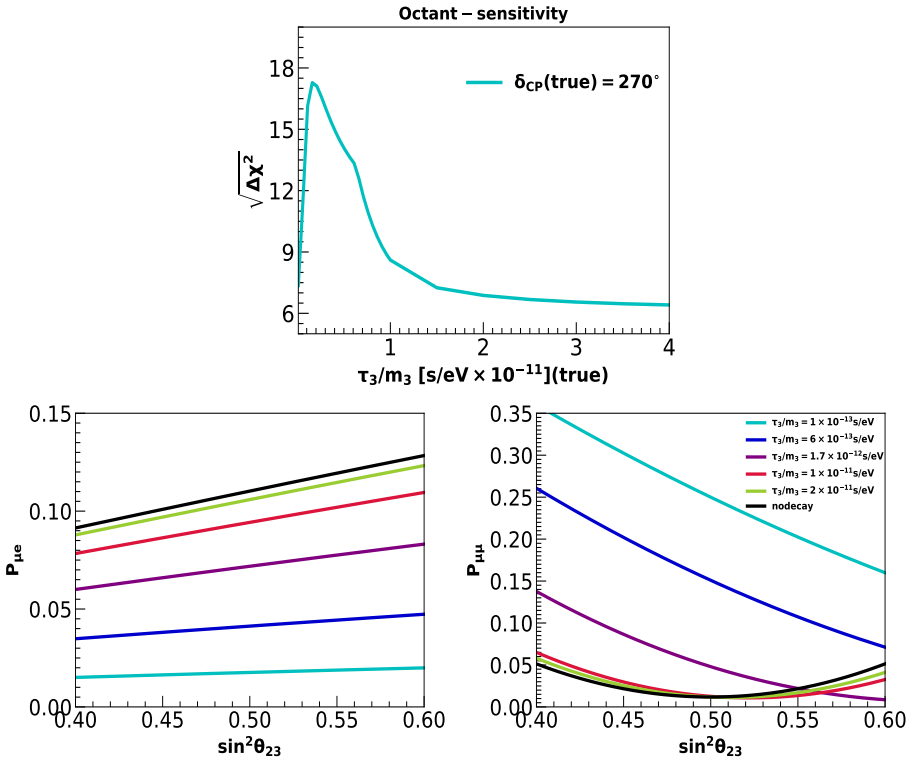
The central claim is that the 2,595-km P2SO beam and its few-megaton Cherenkov detector can serve as a competitive probe of both large extra dimensions and invisible neutrino decay. For extra dimensions, the signature is a fast-oscillating distortion of the neutrino appearance and disappearance probabilities, so P2SO alone can set a 90% C.L. bound RED < 0.361 micrometers once all oscillation parameters are marginalized and systematics are included; combining with DUNE and T2HK gives RED < 0.320 micrometers, and the ideal case with fixed parameters and no systematics improves the bound to 0.175 micrometers. For invisible decay, P2SO would exclude tau3/m3 below 2.11 x $10^{-11}$ s/eV at 3 $\sigma$. The paper further claims that LED has only a mild effect on CP-violation, mass-ordering, and octant sensitivities, whereas decay degrades CP-violation sensitivity and produces a non-monotonic octant sensitivity because of a degeneracy between theta23 and the decay parameter.
Load-bearing premise
The projected bounds rest on the assumption that the simulation, including its detector response, backgrounds, energy bins, and systematic uncertainties, faithfully represents the P2SO experiment as it would actually run.
Editorial extensions
If this is right
- If the LED scenario is right, DUNE+T2HK+P2SO would already surpass the current combined MINOS/MINOS+, Daya Bay, and KATRIN limit (RED < 0.250 micrometers) even with all oscillation parameters free.
- P2SO alone would produce a stronger LED bound than DUNE+T2HK combined, making it a standalone probe of extra dimensions without waiting for the other two experiments.
- Marginalizing over delta m^2_31 weakens the LED bound more than any other single parameter, so improving the precision of the atmospheric mass-squared difference is the key lever for future LED searches.
- P2SO's 3-sigma exclusion of tau3/m3 below 2.11 x 10^-11 s/eV would place it between MOMENT and ESSnuSB on one side and DUNE and T2HK on the other among projected decay limits.
- If decay affects CP violation and octant as described, P2SO data analyses that ignore decay could mis-reconstruct delta_CP and the theta23 octant.
Reading between the lines
- A natural step the paper does not take is to run the invisible-decay analysis for the DUNE+T2HK+P2SO combination; the synergy shown for LED suggests the combined decay bound would improve on any single experiment.
- P2SO's long baseline is a plausible reason it beats the shorter-baseline DUNE+T2HK combination on LED, since the LED distortion scales with L/E; this makes baseline choice as important as detector size for such searches.
- The non-monotonic octant sensitivity implies that searches for neutrino decay and for the theta23 octant in P2SO data cannot be separated cleanly, and a joint two-dimensional fit would be needed to avoid misattributing one effect to the other.
- The quoted bounds assume 200 MeV energy bins; because the LED signature is fast oscillatory wiggles, testing how the bounds vary with bin width and energy resolution would show whether the projections are conservative or optimistic.
Editorial analysis
A structured set of objections, weighed in public.
Referee Report
Summary. This paper performs sensitivity projections for two BSM scenarios at the proposed P2SO long-baseline experiment, with DUNE and T2HK included for comparison in the LED part. For LED, the authors use a Kaluza-Klein-tower neutrino-mass model with parameters m0 and R_ED, simulate P2SO, DUNE, and T2HK with GLoBES using a modified probability engine, and report 90% C.L. bounds under different marginalization and systematics assumptions. The headline results are that P2SO alone excludes R_ED > 0.361 μm and the DUNE+T2HK+P2SO combination excludes R_ED > 0.320 μm when all oscillation parameters are marginalized and systematics are included (Table II). For invisible decay of nu_3, the paper finds that P2SO can exclude tau3/m3 below 2.11e-11 s/eV at 3 sigma (Table IV). The paper also studies the impact of the two new-physics scenarios on CP-violation, mass-ordering, and octant sensitivities, accounting for the results with analytical expressions in Eqs. (16) and (22)-(23).
Significance. If the numerical engine is reliable, these are useful and previously unavailable P2SO-specific projections for LED and invisible neutrino decay. The analysis includes a full GLoBES simulation with Poisson statistics, pull-based systematics, and marginalization over oscillation parameters, and it compares the P2SO results with existing constraints and with DUNE/T2HK projections. The analytical expressions in Section 4.2 and Section 5.2 provide useful context for the numerical behavior. However, the LED part does not currently validate its two main approximations: the perturbative expansion in m_D^i R_ED and the restriction to two KK modes. Since the headline bounds in Table II are extracted from small spectral distortions, these approximations are load-bearing and need numerical justification before the projections can be relied upon.
major comments (4)
- [Section 4.1, Eqs. (9)-(12), footnote 1] The analysis explicitly adopts the expansion m_D^i R_ED << 1 'throughout', but the scanned parameter space in Fig. 3 includes points with m0 R_ED of order unity or larger (for example, m0 = 1 eV and R_ED = 0.5 μm gives m0 R_ED roughly 2.5 in natural units), and even at the headline m0 = 0 row of Table II (R_ED = 0.361 μm) the product m_3^D R_ED is about 0.09. Because the 90% C.L. bounds are obtained from small differences between spectra with and without LED, the perturbative probability engine should be benchmarked against the exact diagonalization of Eq. (7) over the full reported scan region, or the scan should be restricted to the region where the expansion is under control.
- [Section 4.1, final paragraph] The statement that including more than two KK modes has 'minimal effect' is not supported by any numerical comparison shown in the paper. In the small-mass limit, the retained n = 1, 2 modes contribute sum_{n=1,2} 1/n^2 = 1.25 of the sterile-KK normalization while the full tower gives pi^2/6 roughly equal to 1.64, so modes n >= 3 represent roughly 24% of the KK admixture. Since the LED correction to the standard spectra is itself small, omitting this fraction can shift chi^2 by O(1) near the Table II boundaries. The authors should provide a direct comparison of the R_ED bounds with 2, 3, 5, and 10 KK modes (or an all-mode treatment) before the quoted limits can be considered robust.
- [Section 4.2, Eqs. (16)-(17)] The coefficients A, B, and C in Eq. (17) are quoted to three significant figures without derivation and with unspecified dimensions, and they appear to be numerical fits to a particular realization of the oscillation probability. The paper should state how these coefficients were obtained, over which parameter range they are valid, and how they depend on theta_23 and Delta m^2_31; without this information, Eq. (16) cannot serve as an independent cross-check of the numerical engine or as the basis for the qualitative claim that the LED term is always negative.
- [Section 3] The P2SO, DUNE, and T2HK simulation configuration files and the modified probability engine are not provided, and the detector response and systematics are taken from Refs. [57, 58, 62, 64] and prior group papers. Since every projected bound in Tables II and IV depends on this implementation, the manuscript should include at least benchmark event-rate tables for the standard no-new-physics spectra (or a repository link) so that the detector response, binning, and systematic pulls can be checked by independent readers.
minor comments (6)
- [Section 5.3.1 and Table IV] The phrase 'exclude tau3/m3 below 2.11e-11 s/eV' is ambiguous about the inequality direction; the authors should state explicitly that short lifetimes (small tau3/m3) are excluded, i.e., tau3/m3 > 2.11e-11 s/eV at 3 sigma, and align the table headings with this convention.
- [Table III] The column header 'Sensitivity |Delta sqrt(Delta chi^2)|' is confusing; it should state that the entries are the absolute change in significance in sigma when R_ED is varied from 0 to 0.5 μm.
- [Sections 2.2-2.3 and Eq. (15)] The matter density profile used for each baseline is not specified even though Eq. (15) is solved with constant matter density; the values used for P2SO, DUNE, and T2HK should be given explicitly.
- [Eq. (16)] The sentence specifying units ('RED, L and E_nu are in eV^-1, eV^-1 and eV respectively') should also specify the units of A, B, and C, which appear to carry eV^2 dimensions; as written the dimensional analysis is not transparent.
- [Throughout] The phrase '3 sigma C.L.' is imprecise because a confidence level requires specifying the number of degrees of freedom; please use '3 sigma' or state the corresponding C.L. explicitly.
- [Section 5.3.1] Several words are run together in the text (for example, 'ThecapabilityoftheP2SOexperiment' and 'dottedorangerepresent'), which should be corrected in production.
Circularity Check
No circularity found: the LED and neutrino-decay bounds are projected sensitivities from a GLoBES simulation anchored to external TDRs and NuFit oscillation parameters, not quantities defined in terms of the fitted inputs.
full rationale
The derivation chain is self-contained against external benchmarks. The LED probability engine uses the standard infinite KK-tower mass matrix and L0n closure from Refs. [1–4,70]; Eq. (16) with coefficients in (17) is explicitly offered only as an explanation of the numerical probability plots ("this equation is sufficient to explain the main features of Fig. 1"), and the bounds in Table II are obtained from the full GLoBES event-rate simulation, not from this fitted-style analytic expression. For the bounds, the true spectrum is always standard (RED=0 or stable neutrino) and the test spectrum varies the new-physics parameters, with oscillation parameters marginalized using NuFit values from Table I; no bound is defined as the parameter that reproduces the input. The P2SO configuration rests on the external TDR Refs. [57,58] plus the authors' earlier simulation papers [59–61], but the projected bounds are new outputs of a modified GLoBES calculation, so the self-citation is methodological rather than load-bearing. The stated assumptions m_D RED << 1 and the two-KK-mode truncation (Sec. 4.1, footnote 1) are accuracy limitations with possible numerical impact, not circular definitions; no equation in the paper reduces by construction to a fitted input.
Assumptions & free parameters
free parameters (3)
- m0 (lightest Dirac neutrino mass in LED) =
scanned up to ~1 eV; set to 0 eV for sensitivity figures
- RED (extra dimension radius) =
scanned 0 to 0.5 micrometers; bound values extracted
- tau3/m3 (nu3 lifetime over mass) =
bound at 2.11e-11 s/eV (3 sigma) for P2SO
assumptions (6)
- standard math Three-neutrino PMNS mixing and standard matter oscillation Hamiltonian
- domain assumption LED model with 5D singlet fermions, compactification radius RED, KK tower mixing, and m_D RED << 1
- ad hoc to paper Truncation to two KK modes is sufficient
- domain assumption Constant matter density along baseline with equal electron and neutron densities
- domain assumption Normal neutrino mass ordering and NuFit best-fit oscillation parameters
- domain assumption Invisible decay of nu3 to sterile neutrino and Majoron, with sterile basis aligned to mass basis
Cite this review
Pith. "Pith review of Study of large extra dimension and neutrino decay at P2SO experiment." pith.science (2026). https://pith.science/paper/SVW4PMZS
@misc{pith2026241109628,
  author       = {Pith},
  title        = {Pith review of: Study of large extra dimension and neutrino decay at P2SO experiment},
  year         = {2026},
  howpublished = {\url{https://pith.science/paper/SVW4PMZS}},
  note         = {Machine review of arXiv:2411.09628}
}
read the original abstract
In this study, we explore two intriguing new physics scenarios: the theory of Large Extra Dimensions (LED) and the theory of neutrino decay. We analyze the impact of LED on neutrino oscillations in the contexts of Protvino to Super-ORCA (P2SO), DUNE, and T2HK, with a particular emphasis on P2SO. In contrast, the effects of neutrino decay are examined exclusively in the context of P2SO. For the LED scenario, we find that combining data from P2SO, DUNE, and T2HK can yield tighter constraints than current bounds, but only if all oscillation parameters are measured with high precision. In the case of neutrino decay, P2SO can achieve slightly better bounds compared to ESSnuSB and MOMENT, although its bounds remain weaker than those provided by DUNE and T2HK. Regarding sensitivities to unresolved oscillation parameters, the existence of LED has a minimal impact on the determination of CP violation, mass ordering and octant. However, neutrino decay can significantly influence the sensitivities related to CP violation and octant in a non-trivial manner.
Figures


Figures from the paper (8 more)


Forward citations
Cited by 1 Pith paper
-
Dark Dimension Right-handed Neutrinos Confronted with Long-Baseline Oscillation Experiments
T2K and NOvA data exclude dark-dimension neutrino models with bulk mass |c| < ~0.1 eV for a 10 µm extra dimension.
Reference graph
Works this paper leans on
-
[1]
Introduction The existence of neutrino mass has been conclusively established through the observation of neutrino flavor oscillations. The flavor and mass eigenstates of neutrinos are not identical; instead, they are related by the unitary Pontecorvo-Maki-Nakagawa-Sakata (PMNS) matrix (U), which is characterized by three mixing angles and one CP-violating...
-
[2]
Experimental details In this section, we outline the key details of three experiments considered in the analysis for the LED and neutrino decay. 2.1. P2SO In the case of the P2SO experiment, which is a future long-baseline neutrino experiment with a baseline of 2595 km, we formulate our simulation details using the technical design report from Refs. [57, ...
-
[3]
We have modified the probability engine to incorporate the effects of the large extra dimension scenario and neutrino decay
Statistical method and simulation details To simulate P2SO, DUNE and T2HK experiments, we use the General Long-Baseline Ex- periment Simulator (GLoBES) software [65, 66]. We have modified the probability engine to incorporate the effects of the large extra dimension scenario and neutrino decay. This engine calculates the exact neutrino oscillation probabi...
-
[4]
Large Extra dimension In this section, we discuss the framework of LED, and in the subsequent section, we examine neutrino decay. We begin with a brief overview of the theoretical framework of LED in the context of neutrino oscillations, followed by an exploration of its impact on neutrino oscillation probabilities and the expected event rates. Next, we e...
-
[5]
, (2) where mD is the Dirac mass matrix
Using this notation, the mass term of the Lagrangian [70] can be expressed as Lmass = mD αβ ¯να(0) R νβ L + √ 2 ∞X n=1 ¯να(n) R νβ L + ∞X n=1 n RED ¯να(n) R να(n) L + h.c. , (2) where mD is the Dirac mass matrix. The diagonalization of the mass matrix is carried out in two steps. We first introduce two3 × 3 matrices U and r that diagonalize mD i.e. mD dia...
-
[6]
Concluding remarks Future long-baseline experiments will play a pivotal role in exploring physics beyond the standardthree-neutrinoparadigm. Inthispaper, wefocusontwosuchnewphysicsscenarios, 23 namely LED and neutrino decay, in the context of long-baseline neutrino experiments, with a special emphasis on the P2SO detector. The LED model offers an elegant ...
-
[7]
Following a structure similar to the discussion of LED, we begin by outlining the theoretical framework for invisible decay of ν3 state
Invisible Decay This section explores the propagation of neutrinos in the context of invisible neutrino decay. Following a structure similar to the discussion of LED, we begin by outlining the theoretical framework for invisible decay of ν3 state. We then analyze its influence on oscillation probabilities and event rates. Subsequently, we estimate bounds ...
-
[8]
It is evident that marginalizing only over∆m2 31 and δCP yields a similar effect on the bound curve; however, the inclusion ofθ23 significantly decreases sensitivity
The purple curve results from marginalizing simultaneously over θ23, ∆m2 31, and δCP. It is evident that marginalizing only over∆m2 31 and δCP yields a similar effect on the bound curve; however, the inclusion ofθ23 significantly decreases sensitivity. For a comprehensive comparison of theτ3/m3 parameter values obtained in this study with those from other...
Show all 94 references
-
[9]
The left panel of Fig
CPV sensitivity: In this section, we examine the impact of invisible neutrino decay on the sensitivity measurements of CPV at P2SO experiment. The left panel of Fig. 9 depicts the sen- sitivity to CPV as a function ofτ3/m3 (true). The parameter τ3/m3 is kept same in both true ...
-
[10]
Octant sensitivity The capability of the P2SO experiment to exclude the wrong octant is shown in the top panel of Fig. 10 which presents the combined p ∆χ2 from both disappearance and 21 1 2 3 4 3/m3 [s/eV × 10 11](true) 6 9 12 15 18 2 Octant sensitivity CP(true) = 270 0.40 0....
-
[11]
Z. G. Berezhiani, G. Fiorentini, M. Moretti, and A. Rossi, Z. Phys. C54, 581 (1992)
1992
-
[12]
SR is supported by the NPDF grant (PDF/2023/001262) from SERB, 24 Government of India
Acknowledgement PP and PM want to thank Prime Minister’s Research Fellows (PMRF) scheme for its financial support. SR is supported by the NPDF grant (PDF/2023/001262) from SERB, 24 Government of India. The work of MG has been in part funded by Ministry of Science and Education...
2023
-
[13]
Arkani-Hamed, S
N. Arkani-Hamed, S. Dimopoulos, G. R. Dvali, and J. March-Russell, Phys. Rev. D65, 024032 (2001), arXiv:hep-ph/9811448
2001 arXiv
-
[14]
K. R. Dienes, E. Dudas, and T. Gherghetta, Nucl. Phys. B 557, 25 (1999), arXiv:hep- ph/9811428
1999
-
[15]
G. R. Dvali and A. Y. Smirnov, Nucl. Phys. B563, 63 (1999), arXiv:hep-ph/9904211
1999 arXiv
-
[16]
Barbieri, P
R. Barbieri, P. Creminelli, and A. Strumia, Nucl. Phys. B 585, 28 (2000), arXiv:hep- ph/0002199
2000
-
[17]
Nortier, Acta Phys
F. Nortier, Acta Phys. Polon. B54, 6 (2023), arXiv:2112.15592 [hep-th]
2023 arXiv
-
[18]
G. B. Gelmini and M. Roncadelli, Phys. Lett. B99, 411 (1981)
1981
-
[19]
D’Ambrosio and G
G. D’Ambrosio and G. B. Gelmini, Z. Phys. C35, 461 (1987)
1987
-
[20]
Oberauer, F
L. Oberauer, F. Von Feilitzsch, and R. L. Mossbauer, Phys. Lett. B198, 113 (1987)
1987
-
[21]
R. S. Raghavan, X.-G. He, and S. Pakvasa, Phys. Rev. D38, 1317 (1988)
1988
-
[22]
M. C. Gonzalez-Garcia and J. W. F. Valle, Phys. Lett. B216, 360 (1989)
1989
-
[23]
A. N. Khan, JHEP01, 052 (2023), arXiv:2208.09584 [hep-ph]
2023 arXiv
-
[24]
Arkani-Hamed, S
N. Arkani-Hamed, S. Dimopoulos, and G. R. Dvali, Phys. Lett. B429, 263 (1998), arXiv:hep- ph/9803315
1998
-
[25]
Antoniadis, N
I. Antoniadis, N. Arkani-Hamed, S. Dimopoulos, and G. R. Dvali, Phys. Lett. B436, 257 (1998), arXiv:hep-ph/9804398
1998 arXiv
-
[26]
P. A. N. Machado, H. Nunokawa, and R. Zukanovich Funchal, Phys. Rev. D84, 013003 (2011), arXiv:1101.0003 [hep-ph]
2011 arXiv
-
[27]
Adamson et al
P. Adamson et al. (MINOS), Phys. Rev. D94, 111101 (2016), arXiv:1608.06964 [hep-ex]
2016 arXiv
-
[28]
D. V. Forero, C. Giunti, C. A. Ternes, and O. Tyagi, Phys. Rev. D 106, 035027 (2022), arXiv:2207.02790 [hep-ph]
2022 arXiv
-
[29]
Esmaili, O
A. Esmaili, O. L. G. Peres, and Z. Tabrizi, JCAP12, 002 (2014), arXiv:1409.3502 [hep-ph]
2014 arXiv
-
[30]
V. S. Basto-Gonzalez, A. Esmaili, and O. L. G. Peres, Phys. Lett. B 718, 1020 (2013), arXiv:1205.6212 [hep-ph]
2013 arXiv
-
[31]
As a result, the oscillation probability depends on the two extra parameters,mD 1 (≡ m0) and RED
mass squared differences. As a result, the oscillation probability depends on the two extra parameters,mD 1 (≡ m0) and RED. Matter modifies the vacuum neutrino oscillation probability which in the presence of LED is governed by the following equation [71]: i d dt ν′ iL = " 1 2...
-
[32]
V. S. Basto-Gonzalez, D. V. Forero, C. Giunti, A. A. Quiroga, and C. A. Ternes, Phys. Rev. D 105, 075023 (2022), arXiv:2112.00379 [hep-ph]. 25
2022 arXiv
-
[33]
Rodejohann and H
W. Rodejohann and H. Zhang, Phys. Lett. B737, 81 (2014), arXiv:1407.2739 [hep-ph]
2014 arXiv
-
[34]
Carena, Y.-Y
M. Carena, Y.-Y. Li, C. S. Machado, P. A. N. Machado, and C. E. M. Wagner, Phys. Rev. D 96, 095014 (2017), arXiv:1708.09548 [hep-ph]
2017 arXiv
-
[35]
G. V. Stenico, D. V. Forero, and O. L. G. Peres, JHEP11, 155 (2018), arXiv:1808.05450 [hep-ph]
2018 arXiv
- [36]
- [37]
-
[38]
Giarnetti, S
A. Giarnetti, S. Marciano, and D. Meloni, Universe10, 357 (2024), arXiv:2407.17247 [hep-ph]
2024 arXiv
-
[39]
Calatayud-Cadenillas, A
A. Calatayud-Cadenillas, A. Pérez-G, and A. M. Gago, (2024), arXiv:2408.04234 [hep-ph]
2024 arXiv
-
[40]
Abdullahi and P
A. Abdullahi and P. B. Denton, Phys. Rev. D102, 023018 (2020), arXiv:2005.07200 [hep-ph]
2020 arXiv
-
[41]
Eguchi et al
K. Eguchi et al. (KamLAND), Phys. Rev. Lett.92, 071301 (2004), arXiv:hep-ex/0310047
2004 arXiv
-
[42]
Pagliaroli, A
G. Pagliaroli, A. Palladino, F. L. Villante, and F. Vissani, Phys. Rev. D92, 113008 (2015), arXiv:1506.02624 [hep-ph]
2015 arXiv
-
[43]
A. M. Gago, R. A. Gomes, A. L. G. Gomes, J. Jones-Perez, and O. L. G. Peres, JHEP11, 022 (2017), arXiv:1705.03074 [hep-ph]
2017 arXiv
-
[44]
Z. Moss, M. H. Moulai, C. A. Argüelles, and J. M. Conrad, Phys. Rev. D97, 055017 (2018), arXiv:1711.05921 [hep-ph]
2018 arXiv
- [45]
-
[46]
M. V. Ascencio-Sosa, A. M. Calatayud-Cadenillas, A. M. Gago, and J. Jones-Pérez, Eur. Phys. J. C78, 809 (2018), arXiv:1805.03279 [hep-ph]
2018 arXiv
-
[47]
MacDonald, P
M. MacDonald, P. Martínez-Miravé, and I. Tamborra, (2024), arXiv:2409.16367 [astro- ph.HE]
2024 arXiv
-
[48]
Denton andI.Tamborra, Phys
P.B. Denton andI.Tamborra, Phys. Rev.Lett.121,121802 (2018), arXiv:1805.05950 [hep-ph]
2018 arXiv
-
[49]
Martínez-Miravé, I
P. Martínez-Miravé, I. Tamborra, and M. Tórtola, JCAP05, 002 (2024), arXiv:2402.00116 [astro-ph.HE]
2024 arXiv
-
[50]
Acker, S
A. Acker, S. Pakvasa, and J. T. Pantaleone, Phys. Rev. D45, 1 (1992)
1992
-
[51]
Acker, A
A. Acker, A. Joshipura, and S. Pakvasa, Phys. Lett. B285, 371 (1992)
1992
-
[52]
Chikashige, R
Y. Chikashige, R. N. Mohapatra, and R. D. Peccei, Phys. Lett. B98, 265 (1981)
1981
-
[53]
Schechter and J
J. Schechter and J. W. F. Valle, Phys. Rev. D25, 774 (1982)
1982
-
[54]
G. B. Gelmini and J. W. F. Valle, Phys. Lett. B142, 181 (1984)
1984
-
[55]
J. N. Bahcall, N. Cabibbo, and A. Yahil, Phys. Rev. Lett.28, 316 (1972)
1972
-
[56]
J. M. Berryman, A. de Gouvea, and D. Hernandez, Phys. Rev. D 92, 073003 (2015), arXiv:1411.0308 [hep-ph]
2015 arXiv
-
[57]
Picoreti, M
R. Picoreti, M. M. Guzzo, P. C. de Holanda, and O. L. G. Peres, Phys. Lett. B761, 70 (2016), arXiv:1506.08158 [hep-ph]
2016 arXiv
- [58]
-
[59]
Bandyopadhyay, S
A. Bandyopadhyay, S. Choubey, and S. Goswami, Phys. Lett. B555, 33 (2003), arXiv:hep- ph/0204173
2003
-
[60]
J. A. Frieman, H. E. Haber, and K. Freese, Phys. Lett. B200, 115 (1988)
1988
-
[61]
R. A. Gomes, A. L. G. Gomes, and O. L. G. Peres, Phys. Lett. B 740, 345 (2015), arXiv:1407.5640 [hep-ph]
2015 arXiv
-
[62]
Choubey, D
S. Choubey, D. Dutta, and D. Pramanik, JHEP08, 141 (2018), arXiv:1805.01848 [hep-ph]
2018 arXiv
-
[63]
C. A. Ternes and G. Pagliaroli, Phys. Rev. D109, L071701 (2024), arXiv:2401.14316 [hep-ph]
2024 arXiv
-
[64]
Choubey, S
S. Choubey, S. Goswami, and D. Pramanik, JHEP02, 055 (2018), arXiv:1705.05820 [hep-ph]
2018 arXiv
-
[65]
Ghoshal, A
A. Ghoshal, A. Giarnetti, and D. Meloni, J. Phys. G 48, 055004 (2021), arXiv:2003.09012 [hep-ph]
2021 arXiv
-
[66]
Choubey, M
S. Choubey, M. Ghosh, D. Kempe, and T. Ohlsson, JHEP05, 133 (2021), arXiv:2010.16334 [hep-ph]
2021 arXiv
-
[67]
Chakraborty, D
K. Chakraborty, D. Dutta, S. Goswami, and D. Pramanik, JHEP 08, 136 (2021), arXiv:2012.04958 [hep-ph]
2021 arXiv
-
[68]
Z. F. Dey and D. Dutta, (2024), arXiv:2402.13235 [hep-ph]
2024 arXiv
-
[69]
A. V. Akindinovet al., Eur. Phys. J. C79, 758 (2019), arXiv:1902.06083 [physics.ins-det]
2019 arXiv
-
[70]
Hofestädt, M
J. Hofestädt, M. Bruchner, and T. Eberl, PoS ICRC2019, 911 (2020), arXiv:1907.12983 [hep-ex]
2020 arXiv
-
[71]
D. K. Singha, M. Ghosh, R. Majhi, and R. Mohanta, Phys. Rev. D 107, 075039 (2023), arXiv:2211.01816 [hep-ph]
2023 arXiv
-
[72]
Majhi, D
R. Majhi, D. K. Singha, M. Ghosh, and R. Mohanta, Phys. Rev. D 107, 075036 (2023), arXiv:2212.07244 [hep-ph]
2023 arXiv
-
[73]
D. K. Singha, R. Majhi, L. Panda, M. Ghosh, and R. Mohanta, Phys. Rev. D109, 095038 (2024), arXiv:2308.10789 [hep-ph]
2024 arXiv
-
[74]
Abi et al
B. Abi et al. (DUNE), (2021), arXiv:2103.04797 [hep-ex]
2021
-
[75]
Abi et al
B. Abi et al. (DUNE), Eur. Phys. J. C80, 978 (2020), arXiv:2006.16043 [hep-ex]
2020
-
[76]
Abe et al
K. Abe et al. (Hyper-Kamiokande), PTEP 2018, 063C01 (2018), arXiv:1611.06118 [hep-ex]
2018 arXiv
-
[77]
Huber, M
P. Huber, M. Lindner, and W. Winter, Comput. Phys. Commun.167, 195 (2005), arXiv:hep- ph/0407333
2005
-
[78]
Huber, J
P. Huber, J. Kopp, M. Lindner, M. Rolinec, and W. Winter, Comput. Phys. Commun.177, 432 (2007), arXiv:hep-ph/0701187
2007 arXiv
-
[79]
M. C. Gonzalez-Garcia and M. Maltoni, Phys. Rev. D 70, 033010 (2004), arXiv:hep- ph/0404085
2004
-
[80]
G. L. Fogli, E. Lisi, A. Marrone, D. Montanino, and A. Palazzo, Phys. Rev. D66, 053010 (2002), arXiv:hep-ph/0206162
2002 arXiv
-
[81]
Esteban, M
I. Esteban, M. C. Gonzalez-Garcia, M. Maltoni, T. Schwetz, and A. Zhou, JHEP09, 178 (2020), arXiv:2007.14792 [hep-ph]. 27
2020 arXiv
-
[82]
Davoudiasl, P
H. Davoudiasl, P. Langacker, and M. Perelstein, Phys. Rev. D65, 105015 (2002), arXiv:hep- ph/0201128
2002
-
[83]
J. M. Berryman, A. de Gouvêa, K. J. Kelly, O. L. G. Peres, and Z. Tabrizi, Phys. Rev. D94, 033006 (2016), arXiv:1603.00018 [hep-ph]
2016 arXiv
-
[84]
Choubey and P
S. Choubey and P. Roy, Phys. Rev. Lett.93, 021803 (2004), arXiv:hep-ph/0310316
2004 arXiv
-
[85]
Z. G. Berezhiani, M. Moretti, and A. Rossi, Z. Phys. C58, 423 (1993)
1993
-
[86]
V. D. Barger, J. G. Learned, P. Lipari, M. Lusignoli, S. Pakvasa, and T. J. Weiler, Phys. Lett. B 462, 109 (1999), arXiv:hep-ph/9907421
1999 arXiv
-
[87]
Lindner, T
M. Lindner, T. Ohlsson, and W. Winter, Nucl. Phys. B 607, 326 (2001), arXiv:hep- ph/0103170
2001
-
[88]
J. F. Beacom and N. F. Bell, Phys. Rev. D65, 113009 (2002), arXiv:hep-ph/0204111
2002 arXiv
-
[89]
D. S. Chattopadhyay, K. Chakraborty, A. Dighe, S. Goswami, and S. M. Lakshmi, Phys. Rev. Lett. 129, 011802 (2022), arXiv:2111.13128 [hep-ph]
2022 arXiv
-
[90]
Abrahão, H
T. Abrahão, H. Minakata, H. Nunokawa, and A. A. Quiroga, JHEP 11, 001 (2015), arXiv:1506.02314 [hep-ph]
2015 arXiv
-
[91]
D. S. Chattopadhyay, K. Chakraborty, A. Dighe, and S. Goswami, JHEP01, 051 (2023), arXiv:2204.05803 [hep-ph]
2023 arXiv
-
[92]
Banerjee, K
R. Banerjee, K. Sharma, S. Patra, and P. K. Panigrahi, (2023), arXiv:2312.08178 [hep-ph]
2023 arXiv
-
[93]
Grönroos, T
J. Grönroos, T. Ohlsson, and S. Vihonen, Phys. Rev. D111, 035003 (2025), arXiv:2401.16864 [hep-ph]
2025 arXiv
-
[94]
Tang, T.-C
J. Tang, T.-C. Wang, and Y. Zhang, JHEP04, 004 (2019), arXiv:1811.05623 [hep-ph]. 28
2019 arXiv
Reviewed August 12, 2026 · model on record in the stance chip above.
Discussion (0). Continue with ORCID to comment.