No Cloning of Quantum Ensembles
Pith reviewed 2026-06-29 04:56 UTC · model grok-4.3
The pith
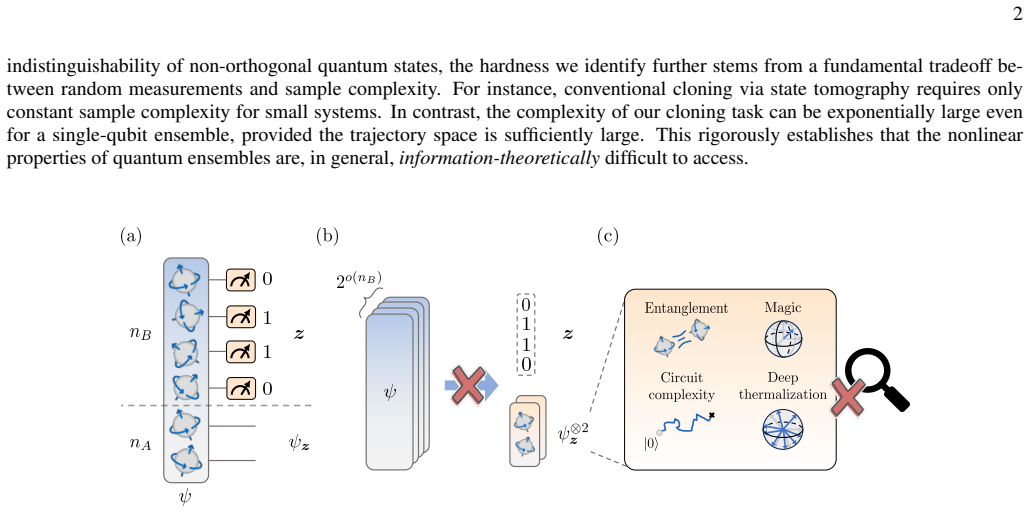
A general no-cloning theorem holds for arbitrary quantum ensembles even with multiple purified copies available, yet physical ensembles from finite-time evolutions can be cloned in principle while remaining computationally intractable.
A machine-rendered reading of the paper's core claim, the machinery that carries it, and where it could break.
Core claim
A general no-cloning theorem for arbitrary ensembles is established from an information-theoretic perspective, even assuming multiple copies of the ensemble's purification. It is then shown that this barrier can be unexpectedly circumvented for physical ensembles generated by finite-time evolutions. Nevertheless, these tasks are proven to remain computationally intractable, even when the full circuit description of state preparation is known.
What carries the argument
Information-theoretic no-cloning theorem for quantum ensembles, which blocks fine-grained cloning regardless of access to purified copies.
If this is right
- Nonlinear properties of quantum states can be accessed only through fine-grained ensemble cloning.
- Finite-time evolution ensembles evade the general no-cloning barrier.
- Cloning remains hard even with full knowledge of the preparation circuit.
- Standard no-cloning (unknown state) and ensemble no-cloning differ in their computational character.
Where Pith is reading between the lines
- Sample, computational, and measurement costs are intrinsically traded off when probing measurement-induced phenomena.
- Problem-specific rather than universal cloning methods will be required for practical characterization tasks.
Load-bearing premise
Characterizing nonlinear properties of quantum states is equivalent to fine-grained cloning of the ensemble, and the information-theoretic prohibition applies directly to ensembles produced by finite-time evolutions.
What would settle it
An efficient algorithm that clones an ensemble generated by a known finite-time evolution circuit to arbitrary precision would falsify the computational intractability result.
Figures
read the original abstract
Modern quantum physics now enables control of quantum systems at the level of individual trajectories, opening a new frontier that links quantum information theory, quantum many-body physics, and quantum thermodynamics, and uncovers novel non-equilibrium phenomena such as deep thermalization and measurement-induced entanglement. However, a central challenge remains: their characterization relies on measuring nonlinear properties of individual quantum states, a task tantamount to fine-grained cloning of a quantum ensemble. Here, the fundamental laws governing the cloning of quantum ensembles are investigated. First, a general no-cloning theorem for arbitrary ensembles is established from an information-theoretic perspective, even assuming multiple copies of the ensemble's purification. It is then shown that this barrier can be unexpectedly circumvented for physical ensembles generated by finite-time evolutions. Nevertheless, these tasks are proven to remain computationally intractable, even when the full circuit description of state preparation is known. This stands in sharp contrast to the conventional no-cloning theorem, which relies on the state being unknown. Together, these results establish new fundamental principles of quantum mechanics, reveal intrinsic trade-offs among sample complexity, computational complexity, and quantum measurements, and highlight the necessity of problem-specific strategies for probing measurement-induced quantum phenomena.
Editorial analysis
A structured set of objections, weighed in public.
Referee Report
Summary. The manuscript claims to prove a general no-cloning theorem for arbitrary quantum ensembles from an information-theoretic perspective (even given multiple copies of the ensemble purification), then shows that this barrier is circumvented for ensembles generated by finite-time evolutions while proving that the associated tasks remain computationally intractable even when the full state-preparation circuit is known. The work contrasts this with the standard no-cloning theorem and links the results to characterization of nonlinear properties in many-body systems.
Significance. If the central claims hold, the information-theoretic framing of ensemble cloning and the explicit separation between in-principle possibility (via finite-time structure) and computational hardness constitute a substantive contribution. The paper would establish new trade-offs among sample complexity, computational complexity, and measurement resources for probing measurement-induced phenomena.
major comments (2)
- [General no-cloning theorem] The section presenting the general no-cloning theorem: the information-theoretic argument must be shown to apply directly to finite-time-generated ensembles; otherwise the subsequent circumvention claim requires an explicit statement of which assumption (e.g., lack of known evolution structure or purification access) is relaxed, as the abstract provides no such clarification and the computational-intractability result presupposes that cloning is possible in principle.
- [Circumvention for finite-time ensembles] The section equating nonlinear-property characterization to fine-grained cloning: the premise that measuring nonlinear functions of individual states is tantamount to ensemble cloning must be derived rigorously rather than asserted, because this equivalence is load-bearing for applying the general theorem to physical ensembles generated by finite-time evolutions.
minor comments (1)
- The abstract states that the conventional no-cloning theorem 'relies on the state being unknown'; the manuscript should clarify whether the new ensemble result reduces to this case or introduces genuinely distinct assumptions.
Simulated Author's Rebuttal
Thank you for the careful review and constructive feedback. We address the major comments point-by-point below. We will revise the manuscript to add the requested clarifications and strengthen the derivations.
read point-by-point responses
-
Referee: [General no-cloning theorem] The section presenting the general no-cloning theorem: the information-theoretic argument must be shown to apply directly to finite-time-generated ensembles; otherwise the subsequent circumvention claim requires an explicit statement of which assumption (e.g., lack of known evolution structure or purification access) is relaxed, as the abstract provides no such clarification and the computational-intractability result presupposes that cloning is possible in principle.
Authors: The general no-cloning theorem is proven for arbitrary ensembles in the information-theoretic setting (including multiple purification copies). Finite-time-generated ensembles form a structured subclass where the known evolution provides additional information absent from the arbitrary case; this structure enables in-principle circumvention while the computational intractability result (even with the full circuit) remains. We agree the abstract and connecting text require an explicit statement of the relaxed assumption (known finite-time structure) and will revise to clarify the logical flow. revision: yes
-
Referee: [Circumvention for finite-time ensembles] The section equating nonlinear-property characterization to fine-grained cloning: the premise that measuring nonlinear functions of individual states is tantamount to ensemble cloning must be derived rigorously rather than asserted, because this equivalence is load-bearing for applying the general theorem to physical ensembles generated by finite-time evolutions.
Authors: The manuscript links the tasks by showing that nonlinear characterization requires distinguishing or reproducing individual states at a granularity equivalent to fine-grained cloning, which is used to apply the general bound. To address the concern, we will expand this section with a more explicit, step-by-step derivation of the equivalence, including formal definitions tying nonlinear measurements to the cloning task. revision: yes
Circularity Check
No circularity: information-theoretic derivation is independent of specific results
full rationale
The paper establishes a general no-cloning theorem for arbitrary ensembles from an information-theoretic perspective (even with multiple purifications), then separately shows circumvention for finite-time evolution ensembles and proves computational intractability. No quoted steps reduce by construction to fitted inputs, self-definitions, or load-bearing self-citations; the general theorem is framed as applying to arbitrary cases while the circumvention is presented as an unexpected exception for structured physical ensembles. The derivation chain remains self-contained against external benchmarks with no reductions to the paper's own inputs.
Axiom & Free-Parameter Ledger
axioms (1)
- domain assumption Characterization of nonlinear properties of quantum states is equivalent to cloning a quantum ensemble
Reference graph
Works this paper leans on
-
[1]
L. D. Landau and E. M. Lifshitz,Statistical Physics, Part 1, 3rd ed. (Pergamon, 1980)
1980
-
[2]
Holevo, The capacity of the quantum channel with general signal states, IEEE Transactions on Information Theory44, 269 (1998)
A. Holevo, The capacity of the quantum channel with general signal states, IEEE Transactions on Information Theory44, 269 (1998)
1998
-
[3]
E. T. Jaynes, Information theory and statistical mechanics, Phys. Rev.106, 620 (1957)
1957
-
[4]
J. M. Deutsch, Quantum statistical mechanics in a closed system, Phys. Rev. A43, 2046 (1991)
2046
-
[5]
Srednicki, Chaos and quantum thermalization, Phys
M. Srednicki, Chaos and quantum thermalization, Phys. Rev. E50, 888 (1994)
1994
-
[6]
Rigol, V
M. Rigol, V . Dunjko, and M. Olshanii, Thermalization and its mechanism for generic isolated quantum systems, Nature452, 854 (2008)
2008
-
[7]
Nandkishore and D
R. Nandkishore and D. A. Huse, Many-body localization and thermalization in quantum statistical mechanics, Annual Review of Con- densed Matter Physics6, 15 (2015)
2015
-
[8]
Bluvstein, S
D. Bluvstein, S. J. Evered, A. A. Geim, S. H. Li, H. Zhou, T. Manovitz, S. Ebadi, M. Cain, M. Kalinowski, D. Hangleiter,et al., Logical quantum processor based on reconfigurable atom arrays, Nature626, 58 (2024)
2024
-
[9]
M. A. Norcia, W. B. Cairncross, K. Barnes, P. Battaglino, A. Brown, M. O. Brown, K. Cassella, C.-A. Chen, R. Coxe, D. Crow, J. Epstein, C. Griger,et al., Midcircuit qubit measurement and rearrangement in a 171Ybatomic array, Phys. Rev. X13, 041034 (2023)
2023
-
[10]
J. W. Lis, A. Senoo, W. F. McGrew, F. R ¨onchen, A. Jenkins, and A. M. Kaufman, Midcircuit operations using the omg architecture in neutral atom arrays, Phys. Rev. X13, 041035 (2023)
2023
-
[11]
T. M. Graham, L. Phuttitarn, R. Chinnarasu, Y . Song, C. Poole, K. Jooya, J. Scott, A. Scott, P. Eichler, and M. Saffman, Midcircuit measurements on a single-species neutral alkali atom quantum processor, Phys. Rev. X13, 041051 (2023)
2023
-
[12]
D. K. Mark, F. Surace, A. Elben, A. L. Shaw, J. Choi, G. Refael, M. Endres, and S. Choi, Maximum entropy principle in deep thermal- ization and in hilbert-space ergodicity, Phys. Rev. X14, 041051 (2024)
2024
-
[13]
J. S. Cotler, D. K. Mark, H.-Y . Huang, F. Hern´andez, J. Choi, A. L. Shaw, M. Endres, and S. Choi, Emergent quantum state designs from individual many-body wave functions, PRX Quantum4, 010311 (2023)
2023
-
[14]
W. W. Ho and S. Choi, Exact emergent quantum state designs from quantum chaotic dynamics, Physical Review Letters128(2022)
2022
-
[15]
Ippoliti and W
M. Ippoliti and W. W. Ho, Solvable model of deep thermalization with distinct design times, Quantum6, 886 (2022)
2022
-
[16]
Ippoliti and W
M. Ippoliti and W. W. Ho, Dynamical purification and the emergence of quantum state designs from the projected ensemble, PRX Quantum4, 030322 (2023)
2023
-
[17]
P. W. Claeys and A. Lamacraft, Emergent quantum state designs and biunitarity in dual-unitary circuit dynamics, Quantum6, 738 (2022)
2022
-
[18]
J. Choi, A. L. Shaw, I. S. Madjarov, X. Xie, R. Finkelstein, J. P. Covey, J. S. Cotler, D. K. Mark, H.-Y . Huang, A. Kale, H. Pichler, F. G. S. L. Brand ˜ao, S. Choi, and M. Endres, Preparing random states and benchmarking with many-body quantum chaos, Nature613, 468–473 (2023)
2023
-
[19]
Bhore, J.-Y
T. Bhore, J.-Y . Desaules, and Z. Papi´c, Deep thermalization in constrained quantum systems, Phys. Rev. B108, 104317 (2023)
2023
-
[20]
Chang, H
R.-A. Chang, H. Shrotriya, W. W. Ho, and M. Ippoliti, Deep thermalization under charge-conserving quantum dynamics, PRX Quantum 6, 020343 (2025). 8
2025
-
[21]
C. Liu, Q. C. Huang, and W. W. Ho, Deep thermalization in gaussian continuous-variable quantum systems, Phys. Rev. Lett.133, 260401 (2024)
2024
-
[22]
W.-K. Mok, T. Haug, A. L. Shaw, M. Endres, and J. Preskill, Optimal conversion from classical to quantum randomness via quantum chaos, Phys. Rev. Lett.134, 180403 (2025)
2025
-
[23]
Cheng, E
Z. Cheng, E. Huang, V . Khemani, M. J. Gullans, and M. Ippoliti, Emergent unitary designs for encoded qubits from coherent errors and syndrome measurements, PRX Quantum6, 030333 (2025)
2025
-
[24]
S. Chakraborty, S. Choi, S. Ghosh, and T. Giurgic˘a-Tiron, Fast computational deep thermalization (2025), arXiv:2507.13670 [quant-ph]
-
[25]
Shrotriya and W
H. Shrotriya and W. W. Ho, Nonlocality of deep thermalization, SciPost Physics18(2025)
2025
- [26]
- [27]
-
[28]
Zhang, P
B. Zhang, P. Xu, X. Chen, and Q. Zhuang, Holographic deep thermalization for secure and efficient quantum random state generation, Nature Communications16(2025)
2025
-
[29]
Bejan, B
M. Bejan, B. B ´eri, and M. McGinley, Matchgate circuits deeply thermalize, Phys. Rev. Lett.135, 020401 (2025)
2025
-
[30]
Y . Li, X. Chen, and M. P. A. Fisher, Quantum zeno effect and the many-body entanglement transition, Phys. Rev. B98, 205136 (2018)
2018
-
[31]
Y . Li, X. Chen, and M. P. A. Fisher, Measurement-driven entanglement transition in hybrid quantum circuits, Phys. Rev. B100, 134306 (2019)
2019
-
[32]
Skinner, J
B. Skinner, J. Ruhman, and A. Nahum, Measurement-induced phase transitions in the dynamics of entanglement, Phys. Rev. X9, 031009 (2019)
2019
-
[33]
X. Cao, A. Tilloy, and A. D. Luca, Entanglement in a fermion chain under continuous monitoring, SciPost Phys.7, 024 (2019)
2019
-
[34]
A. Chan, R. M. Nandkishore, M. Pretko, and G. Smith, Unitary-projective entanglement dynamics, Phys. Rev. B99, 224307 (2019)
2019
-
[35]
Y . Bao, S. Choi, and E. Altman, Theory of the phase transition in random unitary circuits with measurements, Phys. Rev. B101, 104301 (2020)
2020
-
[36]
S. Choi, Y . Bao, X.-L. Qi, and E. Altman, Quantum error correction in scrambling dynamics and measurement-induced phase transition, Phys. Rev. Lett.125, 030505 (2020)
2020
-
[37]
Jian, Y .-Z
C.-M. Jian, Y .-Z. You, R. Vasseur, and A. W. W. Ludwig, Measurement-induced criticality in random quantum circuits, Phys. Rev. B101, 104302 (2020)
2020
-
[38]
M. J. Gullans and D. A. Huse, Dynamical purification phase transition induced by quantum measurements, Phys. Rev. X10, 041020 (2020)
2020
-
[39]
Zabalo, M
A. Zabalo, M. J. Gullans, J. H. Wilson, S. Gopalakrishnan, D. A. Huse, and J. H. Pixley, Critical properties of the measurement-induced transition in random quantum circuits, Phys. Rev. B101, 060301 (2020)
2020
-
[40]
Y . Li, X. Chen, A. W. W. Ludwig, and M. P. A. Fisher, Conformal invariance and quantum nonlocality in critical hybrid circuits, Phys. Rev. B104, 104305 (2021)
2021
-
[41]
Ippoliti, M
M. Ippoliti, M. J. Gullans, S. Gopalakrishnan, D. A. Huse, and V . Khemani, Entanglement phase transitions in measurement-only dy- namics, Phys. Rev. X11, 011030 (2021)
2021
-
[42]
Alberton, M
O. Alberton, M. Buchhold, and S. Diehl, Entanglement transition in a monitored free-fermion chain: From extended criticality to area law, Phys. Rev. Lett.126, 170602 (2021)
2021
-
[43]
R. Fan, S. Vijay, A. Vishwanath, and Y .-Z. You, Self-organized error correction in random unitary circuits with measurement, Phys. Rev. B103, 174309 (2021)
2021
-
[44]
Agrawal, A
U. Agrawal, A. Zabalo, K. Chen, J. H. Wilson, A. C. Potter, J. H. Pixley, S. Gopalakrishnan, and R. Vasseur, Entanglement and charge- sharpening transitions in u(1) symmetric monitored quantum circuits, Phys. Rev. X12, 041002 (2022)
2022
-
[45]
C. Noel, P. Niroula, D. Zhu, A. Risinger, L. Egan, D. Biswas, M. Cetina, A. V . Gorshkov, M. J. Gullans, D. A. Huse, and C. Monroe, Measurement-induced quantum phases realized in a trapped-ion quantum computer, Nature Physics18, 760–764 (2022)
2022
-
[46]
J. M. Koh, S.-N. Sun, M. Motta, and A. J. Minnich, Measurement-induced entanglement phase transition on a superconducting quantum processor with mid-circuit readout, Nature Physics19, 1314 (2023)
2023
-
[47]
J. C. Hoke, M. Ippoliti, E. Rosenberg, D. Abanin, R. Acharya, T. I. Andersen, M. Ansmann, F. Arute, K. Arya, A. Asfaw, J. Atalaya, et al., Measurement-induced entanglement and teleportation on a noisy quantum processor, Nature622, 481 (2023)
2023
-
[48]
Kawabata, T
K. Kawabata, T. Numasawa, and S. Ryu, Entanglement phase transition induced by the non-hermitian skin effect, Phys. Rev. X13, 021007 (2023)
2023
-
[49]
Fuji and Y
Y . Fuji and Y . Ashida, Measurement-induced quantum criticality under continuous monitoring, Phys. Rev. B102, 054302 (2020)
2020
-
[50]
Ippoliti and V
M. Ippoliti and V . Khemani, Learnability transitions in monitored quantum dynamics via eavesdropper’s classical shadows, PRX Quantum 5, 020304 (2024)
2024
-
[51]
Kamakari, J
H. Kamakari, J. Sun, Y . Li, J. J. Thio, T. P. Gujarati, M. P. A. Fisher, M. Motta, and A. J. Minnich, Experimental demonstration of scalable cross-entropy benchmarking to detect measurement-induced phase transitions on a superconducting quantum processor, Phys. Rev. Lett. 134, 120401 (2025)
2025
-
[52]
Niroula, C
P. Niroula, C. D. White, Q. Wang, S. Johri, D. Zhu, C. Monroe, C. Noel, and M. J. Gullans, Phase transition in magic with random quantum circuits, Nature Physics20, 1786–1792 (2024)
2024
-
[53]
Quantum magic dynamics in random circuits
Y . Zhang and Y . Gu, Quantum magic dynamics in random circuits (2024), arXiv:2410.21128 [quant-ph]
work page internal anchor Pith review Pith/arXiv arXiv 2024
- [54]
-
[55]
Z. Du, J. Liu, E. X. Huber, Z.-W. Liu, and X. Ma, Certifying localizable quantum properties with constant sample complexity (2025), arXiv:2509.17580 [quant-ph]
work page internal anchor Pith review Pith/arXiv arXiv 2025
- [56]
-
[57]
McGinley, W
M. McGinley, W. W. Ho, and D. Malz, Measurement-induced entanglement and complexity in random constant-depth 2d quantum circuits, Phys. Rev. X15, 021059 (2025)
2025
-
[58]
Suzuki, J
R. Suzuki, J. Haferkamp, J. Eisert, and P. Faist, Quantum complexity phase transitions in monitored random circuits, Quantum9, 1627 (2025)
2025
-
[59]
Bravyi and A
S. Bravyi and A. Kitaev, Universal quantum computation with ideal clifford gates and noisy ancillas, Phys. Rev. A71, 022316 (2005)
2005
-
[60]
W. K. Wootters and W. H. Zurek, A single quantum cannot be cloned, Nature299, 802 (1982)
1982
-
[61]
Poulin, A
D. Poulin, A. Qarry, R. Somma, and F. Verstraete, Quantum simulation of time-dependent hamiltonians and the convenient illusion of hilbert space, Phys. Rev. Lett.106, 170501 (2011)
2011
-
[62]
P. S. Turner and D. Markham, Derandomizing quantum circuits with measurement-based unitary designs, Phys. Rev. Lett.116, 200501 (2016)
2016
-
[63]
M. C. Tran, D. K. Mark, W. W. Ho, and S. Choi, Measuring arbitrary physical properties in analog quantum simulation, Phys. Rev. X13, 011049 (2023)
2023
-
[64]
J. Emerson, Y . S. Weinstein, M. Saraceno, S. Lloyd, and D. G. Cory, Pseudo-random unitary operators for quantum information process- ing, Science302, 2098 (2003), https://www.science.org/doi/pdf/10.1126/science.1090790
-
[65]
S. F. E. Oliviero, L. Leone, A. Hamma, and S. Lloyd, Measuring magic on a quantum processor, npj Quantum Information8, 10.1038/s41534-022-00666-5 (2022)
-
[66]
J. Haah, A. W. Harrow, Z. Ji, X. Wu, and N. Yu, Sample-optimal tomography of quantum states, inProceedings of the Forty-Eighth Annual ACM Symposium on Theory of Computing, STOC ’16 (Association for Computing Machinery, New York, NY , USA, 2016) p. 913–925
2016
-
[67]
McGinley, Postselection-free learning of measurement-induced quantum dynamics, PRX Quantum5, 020347 (2024)
M. McGinley, Postselection-free learning of measurement-induced quantum dynamics, PRX Quantum5, 020347 (2024)
2024
-
[68]
S. Chen, J. Cotler, H.-Y . Huang, and J. Li, Exponential separations between learning with and without quantum memory, inProceedings of 2021 IEEE 62nd Annual Symposium on Foundations of Computer Science (FOCS)(2022) pp. 574–585
2021
-
[69]
Huang, M
H.-Y . Huang, M. Broughton, J. Cotler, S. Chen, J. Li, M. Mohseni, H. Neven, R. Babbush, R. Kueng, J. Preskill, and J. R. McClean, Quantum advantage in learning from experiments, Science376, 1182–1186 (2022)
2022
- [70]
-
[71]
T. Giurgica-Tiron and A. Bouland, Pseudorandomness from subset states (2023), arXiv:2312.09206 [quant-ph]
- [72]
-
[73]
Zyczkowski and H.-J
K. Zyczkowski and H.-J. Sommers, Induced measures in the space of mixed quantum states, Journal of Physics A: Mathematical and General34, 7111 (2001)
2001
-
[74]
Popescu, A
S. Popescu, A. J. Short, and A. Winter, Entanglement and the foundations of statistical mechanics, Nature Physics2, 754–758 (2006)
2006
-
[75]
Brydges, A
T. Brydges, A. Elben, P. Jurcevic, B. Vermersch, C. Maier, B. P. Lanyon, P. Zoller, R. Blatt, and C. F. Roos, Probing R´enyi entanglement entropy via randomized measurements, Science364, 260 (2019)
2019
- [76]
-
[77]
Nakata, Y
Y . Nakata, Y . Takeuchi, M. Kliesch, and A. Darmawan, Computational complexity of unitary and state design properties, PRX Quantum 6, 030345 (2025)
2025
-
[78]
H. Zhao, L. Lewis, I. Kannan, Y . Quek, H.-Y . Huang, and M. C. Caro, Learning quantum states and unitaries of bounded gate complexity, PRX Quantum5, 040306 (2024)
2024
-
[79]
M. J. Gullans and D. A. Huse, Scalable probes of measurement-induced criticality, Phys. Rev. Lett.125, 070606 (2020)
2020
-
[80]
Y . Li, Y . Zou, P. Glorioso, E. Altman, and M. P. A. Fisher, Cross entropy benchmark for measurement-induced phase transitions, Phys. Rev. Lett.130, 220404 (2023)
2023
discussion (0)
Sign in with ORCID, Apple, or X to comment. Anyone can read and Pith papers without signing in.