REVIEW 5 major objections 6 minor 196 references
Advancing Wheat Crop Analysis: A Survey of Deep Learning Approaches Using Hyperspectral Imaging
T0 review · 5 major / 6 minor · reviewed 2026-08-16 · deepseek-v4-flash
Pith's one-line read This survey claims to be the first comprehensive review of deep learning methods on hyperspectral imaging for wheat crop analysis, organizing 193 studies into a structured taxonomy.
desk verdict A useful wheat-specific dataset collection buried under an irreproducible screening process and a corpus of generic HSI papers. read the letter →
The pith
A machine-rendered reading of the paper's core claim, the machinery that carries it, and where it could break.
The reading
What carries the argument
The organizing device is a three-level taxonomy built from learning paradigm, model family, and application. Supervised learning covers CNNs, RNNs, DBNs, SAEs, Transformers, and Mamba; semi-supervised learning covers pseudo-labeling and generative adversarial networks; unsupervised learning covers DBNs, SAEs, and diffusion models. The taxonomy is cross-referenced to four wheat applications—classification, disease detection, nutrient estimation, yield estimation—and anchored by a dataset inventory that includes Indian Pines, GHISA, DRUM, and several Fusarium and yellow-rust collections. The taxonomy does the paper's main work: it turns a scattered literature into a structured map, and it is the basis for the claim that this intersection is a coherent field with identifiable trends and gaps.
What would settle it
Re-run the stated database searches (ScienceDirect, IEEE Xplore, SpringerLink, MDPI; 2015–2024; 'Hyperspectral Imaging' OR 'HSI' AND 'Deep Learning' AND 'Wheat Crops') and count how many of the 193 retained articles actually apply their method to wheat data. A decisive test: check the Section 5 method entries—for example the Mamba papers [80]–[85] and transformer papers [77]–[79]—and see whether wheat appears anywhere beyond a single class in the Indian Pines benchmark; if most never address wheat, the survey's wheat-specific claim would collapse.
Extended reading notes
Core claim
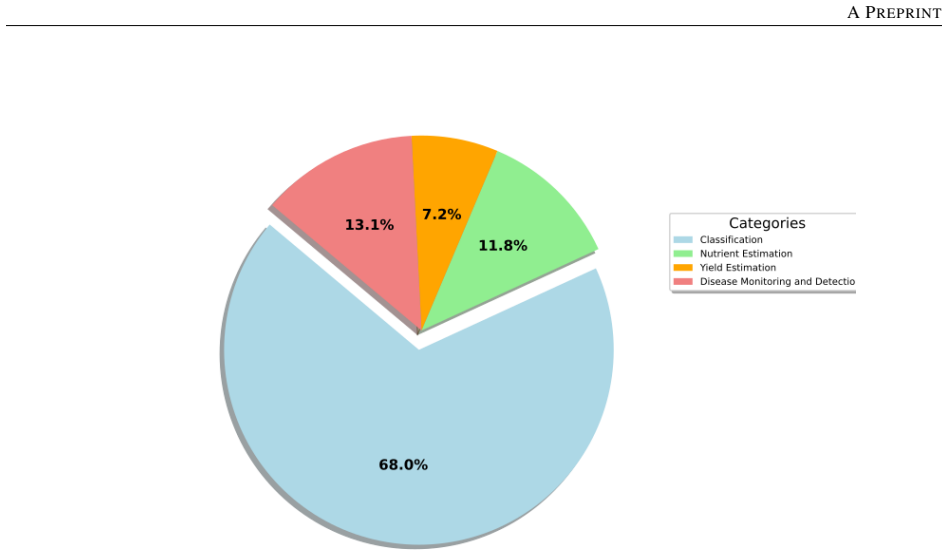
On its own terms, the paper's central claim is that it provides the first comprehensive review of deep learning methods applied to hyperspectral imaging data for wheat crop analysis. To support that claim, it assembles and categorizes 193 papers from four literature databases, groups the methods by learning paradigm and architecture, and summarizes the benchmark datasets—six public and a set of private collections focused mainly on Fusarium head blight and yellow rust. The survey finds that classification dominates the literature at 68% of the retained work, with disease detection at 13.1%, nutrient estimation at 11.8%, and yield estimation at 7.2%, and it argues that the field's main bottlenecks are scarce labeled data and the computational cost of high-dimensional HSI processing.
Load-bearing premise
The load-bearing premise is that the screening process genuinely captured wheat-specific hyperspectral deep-learning studies and that the 193 retained papers were summarized faithfully; if many included papers only use a generic HSI benchmark containing a wheat class, or if the per-paper summaries misrepresent their methods, the survey's map is distorted.
Editorial extensions
If this is right
- Practitioners get a single reference map of deep-learning models and datasets for hyperspectral wheat analysis, organized by learning paradigm and application.
- The survey's statistics make the field's imbalance explicit: classification accounts for 68% of published work, while yield estimation is under-served at 7.2%.
- Because most wheat-disease datasets are private, the paper's call for large, open, region-diverse datasets is a concrete agenda item for the community.
- The review identifies Mamba and transformer architectures as the current state of the art and points to lightweight models and self-supervised learning as priority research directions.
Reading between the lines
- The survey treats general HSI benchmarks such as Indian Pines as wheat-relevant because they contain a wheat class; a stricter reading of 'wheat crop analysis' would exclude many of the cited architecture papers, so the claimed 193-article corpus likely overcounts wheat-specific studies.
- If the field really is at the maturity the survey describes, a natural next step would be a shared benchmark with standardized splits and evaluation metrics for wheat-specific tasks, allowing reported accuracy numbers to be compared fairly across architectures.
- The maintained companion repository could evolve into a living index; its usefulness is testable by whether it continues to be updated with post-2024 papers.
Signed reviews
Editorial analysis
A structured set of objections, weighed in public.
Referee Report
Summary. This manuscript is a survey of deep learning (DL) methods applied to hyperspectral imaging (HSI) for wheat crop analysis. It claims to be the first review focusing specifically on the intersection of HSI and DL for wheat crops, and it organizes the literature into supervised, semi-supervised, and unsupervised learning paradigms. The paper reviews hyperspectral sensors and platforms, public and private wheat datasets, DL architectures (CNNs, RNNs, Transformers, Mamba models, DBNs, SAEs, GANs, diffusion models), and applications such as wheat classification, disease detection, nutrient estimation, and yield estimation. It also discusses challenges and future directions and points to a GitHub repository for tracking state-of-the-art papers.
Significance. If the survey were accurate and comprehensive, it would be a valuable reference for the precision-agriculture and remote-sensing communities, bringing together datasets, a broad taxonomy of DL architectures, and application areas in a single place. The manuscript deserves credit for attempting a structured taxonomy, for compiling sensor and dataset tables, and for providing a public GitHub repository. However, the central claim of being the 'first review' on wheat-specific HSI+DL is not supported by the actual content: the methodology section gives irreproducible screening counts, and many retained papers are generic HSI classification studies evaluated on non-wheat benchmark scenes. These problems undermine the reliability of the survey as a reference and directly affect its core claim.
major comments (5)
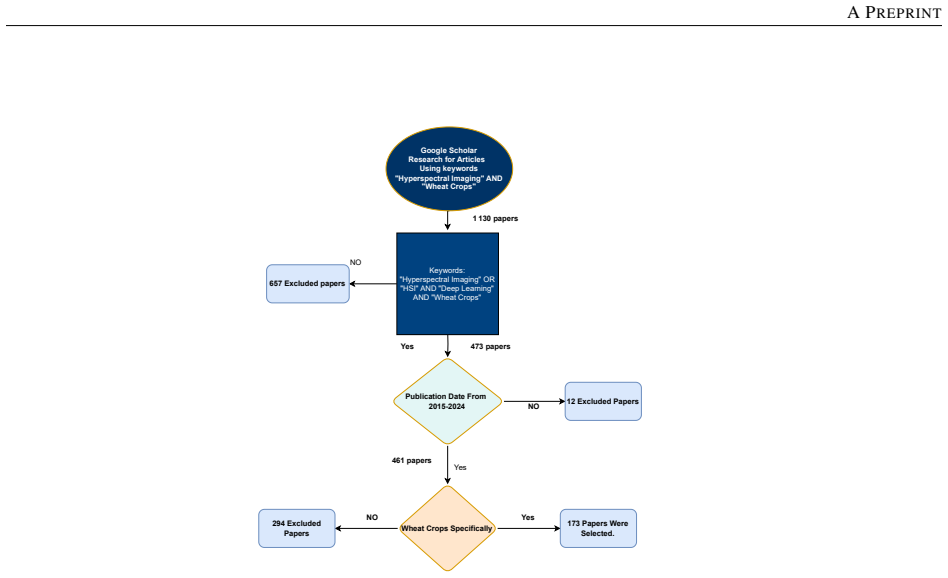
- [2 / Figure 2] The screening counts are inconsistent: Section 2 states that 268 articles were discarded and 193 retained, whereas Figure 2 reports 294 excluded and 173 selected, and Figure 2 labels the source as 'Google Scholar' rather than the four databases named in the text. Because the size and provenance of the corpus are central to the survey's comprehensiveness claim, this discrepancy makes the methodology irreproducible and needs to be resolved with a single consistent PRISMA-style accounting.
- [5.1-5.3 / Tables 6-7] Many entries in the 51-item taxonomy correspond to generic HSI classification papers evaluated on benchmark scenes such as Indian Pines, Pavia, Salinas, Botswana, and KSC, with no wheat-crop experiment; examples include references [66, 67, 68, 70, 72, 75, 76, 77, 78, 79, 80, 81, 82, 84, 85, 86, 87, 88, 89, 90, 91, 92, 93, 95, 96, 98, 99, 101, 102, 103, 104, 105, 107, 108, 111, 112, 113]. The 'wheat crop class acc' column in Tables 6-7 reports per-class accuracy for the wheat class inside Indian Pines, which is a land-cover benchmark, not a wheat-crop analysis. This directly contradicts the inclusion criteria stated in Section 2 and undermines the claim that the survey is wheat-specific.
- [4.1 / Table 3] Table 3 is presented as a summary of public wheat-crop analysis datasets, but it includes Indian Pines and GHISA, which are general agricultural datasets where wheat is only one class among many. The text says the table includes 'six specifically related to wheat crop analysis,' yet only four entries (Soilborne Wheat Mosaic Virus, Wheat HyperSpectral, Early Detection of Crown Rot, DRUM) are wheat-focused. This mismatch further weakens the wheat-specific scope and makes the dataset inventory misleading.
- [5.4 / Table 6] Table 6 contains numerical errors that undermine its reliability as a reference, such as 'OA:IP=96.2.6%' for reference [86] and several rows reporting wheat per-class accuracy of 100% (e.g., references [68] and [79]). Combined with the inclusion of non-wheat benchmark papers, this suggests the summary tables were assembled without careful verification of the original studies.
- [1 / reference [147]] The introduction claims that this is the first review focused specifically on HSI and DL for wheat crop analysis, but reference [147] is a 2024 review by the same research group on deep learning for hyperspectral image analysis in agriculture. The manuscript does not explain how the present survey differs from that prior review, so the novelty and firstness claims are not properly supported.
minor comments (6)
- [Abstract] The phrase 'extract and analysis complex structures' should be corrected to 'extract and analyze complex structures.'
- [Figure 11] The caption of Figure 11 reads 'Number of Published Articles by Year on DL with Hyperspectral Data in Wheat Crops,' but the figure itself is a pie chart showing the percentage distribution of application categories; these do not match.
- [Throughout] There are numerous typographical and formatting errors, including 'have have' in Section 5.2.2, 'Univerity' in the affiliations, inconsistent 'UA V' versus 'UAV' spacing, and 'lLSTMs' in Section 7.
- [Tables 1-2 / text] The sensor name is written inconsistently as 'A VIRIS' and 'AVIRIS'; the standard spelling is AVIRIS.
- [Table 3] The abbreviation 'VNI' is defined as 'Very Near Infrared'; the standard abbreviation is VNIR.
- [Abstract / Repository] The GitHub repository URL appears only in the abstract; it would be helpful to include it in the conclusion or a dedicated data-availability statement.
Circularity Check
No circularity: this survey contains no derived equations or fitted quantities, and its firstness claim is an external scoping assertion rather than an output of the screened corpus.
full rationale
This is a literature survey, not a derivation. There are no fitted parameters, no predictive equations, and no formal model whose output is built from its own input. The central novelty claim, 'To the best of our knowledge, this is the first review to focus specifically on the intersection of HSI data and DL techniques for wheat crop analysis' (Section 1), is a scoping statement about the literature, not a mathematical consequence of the survey's own contents. The screening methodology in Section 2 is a selection procedure, and the retained papers are summarized rather than used as inputs to a calculation whose outcome is then reported as a prediction. The only overlapping-author citation is reference [147], a prior review by Guerri, Distante, Spagnolo, Bougourzi, and Taleb-Ahmed. It appears once, in Section 5.3.1, to support the uncontroversial statement that stacked autoencoders 'excel in reducing dimensionality while preserving critical spectral-spatial details.' This citation is not load-bearing: the survey's organization, taxonomy, and application summaries do not depend on that reference, and the firstness claim does not rest on it. A reviewer could remove [147] without changing any conclusion of the survey. The skeptical concerns about wheat-specificity (e.g., inclusion of Indian Pines benchmark results and reporting 'wheat crop class acc' as per-class accuracy within Indian Pines) are substantive correctness or scoping criticisms, but they are not circularity. They concern whether the survey's corpus matches its stated scope, not whether a claim is equivalent to its own premises by construction. Similarly, discrepancies between the text (268 discarded, 193 retained) and Figure 2 (294 excluded, 173 selected) are internal-consistency and reproducibility issues, not circular reasoning. Accordingly, the paper is best described as containing no significant circularity: its claims are literature-based, externally checkable, and not reduced to self-citation or definitional equivalence.
Assumptions & free parameters
assumptions (2)
- domain assumption The 193 retained articles are relevant to analyzing wheat crops from HSI data and are accurately summarized.
- ad hoc to paper No prior survey focuses specifically on HSI plus deep learning for wheat crops.
Cite this review
Pith. "Pith review of Advancing Wheat Crop Analysis: A Survey of Deep Learning Approaches Using Hyperspectral Imaging." pith.science (2026). https://pith.science/paper/SWSYMCSG
@misc{pith2026250500805,
  author       = {Pith},
  title        = {Pith review of: Advancing Wheat Crop Analysis: A Survey of Deep Learning Approaches Using Hyperspectral Imaging},
  year         = {2026},
  howpublished = {\url{https://pith.science/paper/SWSYMCSG}},
  note         = {Machine review of arXiv:2505.00805}
}
read the original abstract
As one of the most widely cultivated and consumed crops, wheat is essential to global food security. However, wheat production is increasingly challenged by pests, diseases, climate change, and water scarcity, threatening yields. Traditional crop monitoring methods are labor-intensive and often ineffective for early issue detection. Hyperspectral imaging (HSI) has emerged as a non-destructive and efficient technology for remote crop health assessment. However, the high dimensionality of HSI data and limited availability of labeled samples present notable challenges. In recent years, deep learning has shown great promise in addressing these challenges due to its ability to extract and analysis complex structures. Despite advancements in applying deep learning methods to HSI data for wheat crop analysis, no comprehensive survey currently exists in this field. This review addresses this gap by summarizing benchmark datasets, tracking advancements in deep learning methods, and analyzing key applications such as variety classification, disease detection, and yield estimation. It also highlights the strengths, limitations, and future opportunities in leveraging deep learning methods for HSI-based wheat crop analysis. We have listed the current state-of-the-art papers and will continue tracking updating them in the following https://github.com/fadi-07/Awesome-Wheat-HSI-DeepLearning.
Figures


Figures from the paper (8 more)





Reference graph
Works this paper leans on
-
[147]
Deep learning techniques for hyperspectral image analysis in agriculture: A review,
M. F. Guerri, C. Distante, P. Spagnolo, F. Bougourzi, and A. Taleb-Ahmed, “Deep learning techniques for hyperspectral image analysis in agriculture: A review,”ISPRS Open Journal of Photogrammetry and Remote Sensing, p. 100062, 2024
work page 2024
-
[86]
Deep belief network for spectral–spatial classification of hyperspectral remote sensor data,
C. Li, Y . Wang, X. Zhang, H. Gao, Y . Yang, and J. Wang, “Deep belief network for spectral–spatial classification of hyperspectral remote sensor data,”Sensors, vol. 19, no. 1, p. 204, 2019
2019
-
[68]
Hyperspectral image classification with deep learning models,
X. Yang, Y . Ye, X. Li, R. Y . Lau, X. Zhang, and X. Huang, “Hyperspectral image classification with deep learning models,”IEEE Transactions on Geoscience and Remote Sensing, vol. 56, no. 9, pp. 5408–5423, 2018
2018
-
[79]
Hypersformer: A transformer- based end-to-end hyperspectral image classification method for crop classification,
J. Xie, J. Hua, S. Chen, P. Wu, P. Gao, D. Sun, Z. Lyu, S. Lyu, X. Xue, and J. Lu, “Hypersformer: A transformer- based end-to-end hyperspectral image classification method for crop classification,”Remote Sensing, vol. 15, no. 14, p. 3491, 2023
2023
-
[1]
Crops that feed the world 10. past successes and future challenges to the role played by wheat in global food security,
B. Shiferaw, M. Smale, H.-J. Braun, E. Duveiller, M. Reynolds, and G. Muricho, “Crops that feed the world 10. past successes and future challenges to the role played by wheat in global food security,”Food Security, vol. 5, pp. 291–317, 2013. 28 A PREPRINT
-
[2]
The role of wheat in global food security,
M. Acevedo, J. D. Zurn, G. Molero, P. Singh, X. He, M. Aoun, P. Juliana, H. Bockleman, M. Bonman, M. El-Sohl et al., “The role of wheat in global food security,” inAgricultural development and sustainable intensification. Routledge, 2018, pp. 81–110
2018
-
[4]
Hyperspectral versus multispectral crop-productivity modeling and type discrimination for the hyspiri mission,
I. Mariotto, P. S. Thenkabail, A. Huete, E. T. Slonecker, and A. Platonov, “Hyperspectral versus multispectral crop-productivity modeling and type discrimination for the hyspiri mission,”Remote Sensing of Environment, vol. 139, pp. 291–305, 2013
2013
-
[5]
Advantage of hyperspectral eo-1 hyperion over multispectral ikonos, geoeye- 1, worldview-2, landsat etm+, and modis vegetation indices in crop biomass estimation,
M. Marshall and P. Thenkabail, “Advantage of hyperspectral eo-1 hyperion over multispectral ikonos, geoeye- 1, worldview-2, landsat etm+, and modis vegetation indices in crop biomass estimation,”ISPRS Journal of Photogrammetry and Remote Sensing, vol. 108, pp. 205–218, 2015
2015
Show all 196 references
-
[6]
Hyperspectral imaging system: Development aspects and recent trends,
V . Lodhi, D. Chakravarty, and P. Mitra, “Hyperspectral imaging system: Development aspects and recent trends,” Sensing and Imaging, vol. 20, pp. 1–24, 2019
2019
-
[7]
Big data and machine learning with hyperspectral information in agriculture,
K. L.-M. Ang and J. K. P. Seng, “Big data and machine learning with hyperspectral information in agriculture,” IEEE Access, vol. 9, pp. 36 699–36 718, 2021
2021
-
[9]
Uav-based hyperspectral and ensemble machine learning for predicting yield in winter wheat,
Z. Li, Z. Chen, Q. Cheng, F. Duan, R. Sui, X. Huang, and H. Xu, “Uav-based hyperspectral and ensemble machine learning for predicting yield in winter wheat,”Agronomy, vol. 12, no. 1, p. 202, 2022
2022
-
[10]
An extensive review of hyperspectral image classification and prediction: techniques and challenges,
G. Tejasree and L. Agilandeeswari, “An extensive review of hyperspectral image classification and prediction: techniques and challenges,”Multimedia Tools and Applications, pp. 1–98, 2024
2024
-
[11]
A review of deep learning used in the hyperspectral image analysis for agriculture,
C. Wang, B. Liu, L. Liu, Y . Zhu, J. Hou, P. Liu, and X. Li, “A review of deep learning used in the hyperspectral image analysis for agriculture,”Artificial Intelligence Review, vol. 54, no. 7, pp. 5205–5253, 2021
2021
-
[12]
A systematic review on hyperspectral imaging technology with a machine and deep learning methodology for agricultural applications,
A. Khan, A. D. Vibhute, S. Mali, and C. Patil, “A systematic review on hyperspectral imaging technology with a machine and deep learning methodology for agricultural applications,”Ecological Informatics, vol. 69, p. 101678, 2022
2022
-
[13]
Plant disease diagnosis using deep learning based on aerial hyperspectral images: A review,
L. W. Kuswidiyanto, H.-H. Noh, and X. Han, “Plant disease diagnosis using deep learning based on aerial hyperspectral images: A review,”Remote Sensing, vol. 14, no. 23, p. 6031, 2022
2022
-
[14]
Hyperspectral imaging using deep learning in wheat diseases,
O. Abdelkrimet al., “Hyperspectral imaging using deep learning in wheat diseases,” in2024 8th International Conference on Image and Signal Processing and their Applications (ISPA). IEEE, 2024, pp. 1–8
2024
-
[15]
Hyperspectral imaging combined with machine learning for high-throughput phenotyping in winter wheat,
S. Kaur, V . G. Kakani, B. Carver, D. Jarquin, and A. Singh, “Hyperspectral imaging combined with machine learning for high-throughput phenotyping in winter wheat,”The Plant Phenome Journal, vol. 7, no. 1, p. e20111, 2024
2024
-
[16]
Nondestructive identification of wheat seed variety and geographical origin using near-infrared hyperspectral imagery and deep learning,
A. Sharma, T. Singh, and N. M. Garg, “Nondestructive identification of wheat seed variety and geographical origin using near-infrared hyperspectral imagery and deep learning,”Journal of Chemometrics, p. e3585, 2024
2024
-
[17]
Hyperspectral imaging in crop fields: precision agriculture,
D. Caballero, R. Calvini, and J. M. Amigo, “Hyperspectral imaging in crop fields: precision agriculture,” inData handling in science and technology. Elsevier, 2019, vol. 32, pp. 453–473
2019
-
[18]
Hyperspectral imaging,
“Hyperspectral imaging,” https://www.eoportal.org/other-space-activities/hyperspectral-imaging#ghost, 2023, accessed on January 30, 2024
2023
-
[19]
Detection of soil-borne wheat mosaic virus using hyperspectral imaging: from lab to field scans and from hyperspectral to multispectral data,
D. R. K. Marja Haagsma, Christina H. Hagerty and J. S. Selker, “Detection of soil-borne wheat mosaic virus using hyperspectral imaging: from lab to field scans and from hyperspectral to multispectral data,”SpringerLink, vol. 24, 2023
2023
-
[20]
Aviris data - aviris moffett field image cube,
nasa.gov, “Aviris data - aviris moffett field image cube,” https://aviris.jpl.nasa.gov/data/image_cube.html, 2022
2022
-
[21]
Hyperspectral imaging: A review on uav-based sensors, data processing and applications for agriculture and forestry,
T. Adão, J. Hruška, L. Pádua, J. Bessa, E. Peres, R. Morais, and J. J. Sousa, “Hyperspectral imaging: A review on uav-based sensors, data processing and applications for agriculture and forestry,”Remote sensing, vol. 9, no. 11, p. 1110, 2017
2017
-
[22]
Recent advances of hyperspectral imaging technology and applications in agriculture,
B. Lu, P. D. Dao, J. Liu, Y . He, and J. Shang, “Recent advances of hyperspectral imaging technology and applications in agriculture,”Remote Sensing, vol. 12, no. 16, p. 2659, 2020
2020
-
[23]
Hyperspectral imaging for earth observation: Platforms and instruments,
V . Lodhi, D. Chakravarty, and P. Mitra, “Hyperspectral imaging for earth observation: Platforms and instruments,” Journal of the Indian Institute of Science, vol. 98, pp. 429–443, 2018. 29 A PREPRINT
2018
-
[24]
The hyperspectral sensors used in satellite and aerial remote sensing,
I. V orovencii, “The hyperspectral sensors used in satellite and aerial remote sensing,”Bulletin of the Transilvania University of Brasov. Series II: Forestry• Wood Industry• Agricultural Food Engineering, pp. 51–56, 2010
2010
-
[25]
Improving orthorectification of uav-based push-broom scanner imagery using derived orthophotos from frame cameras,
A. Habib, W. Xiong, F. He, H. L. Yang, and M. Crawford, “Improving orthorectification of uav-based push-broom scanner imagery using derived orthophotos from frame cameras,”IEEE Journal of Selected Topics in Applied Earth Observations and Remote Sensing, vol. 10, no. 1, pp. 262...
2016
-
[26]
Survey of hyperspectral earth observation applica- tions from space in the sentinel-2 context,
J. Transon, R. d’Andrimont, A. Maugnard, and P. Defourny, “Survey of hyperspectral earth observation applica- tions from space in the sentinel-2 context,”Remote Sensing, vol. 10, no. 2, p. 157, 2018
2018
-
[27]
Hyperspectral imaging for earth observation: Platforms and instruments,
V . Lodhi, D. Chakravarty, and P. Mitra, “Hyperspectral imaging for earth observation: Platforms and instruments,” Journal of the Indian Institute of Science, vol. 98, pp. 429–443, 2018
2018
-
[28]
Overview of spaceborne hyperspectral imagers and the research progress in bathymetric maps,
X. Jia, S. Li, S. Ke, and B. Hu, “Overview of spaceborne hyperspectral imagers and the research progress in bathymetric maps,” inSecond Target Recognition and Artificial Intelligence Summit Forum, vol. 11427. SPIE, 2020, pp. 118–124
2020
-
[29]
Assessment of plant nitrogen stress in wheat (triticum aestivum l.) through hyperspectral indices,
R. Ranjan, U. K. Chopra, R. N. Sahoo, A. K. Singh, and S. Pradhan, “Assessment of plant nitrogen stress in wheat (triticum aestivum l.) through hyperspectral indices,”International Journal of Remote Sensing, vol. 33, no. 20, pp. 6342–6360, 2012
2012
-
[30]
Estimation of the yield and plant height of winter wheat using uav-based hyperspectral images,
H. Tao, H. Feng, L. Xu, M. Miao, G. Yang, X. Yang, and L. Fan, “Estimation of the yield and plant height of winter wheat using uav-based hyperspectral images,”Sensors, vol. 20, no. 4, p. 1231, 2020
2020
-
[31]
Using high-resolution hyperspectral and thermal airborne imagery to assess physiological condition in the context of wheat phenotyping,
V . Gonzalez-Dugo, P. Hernandez, I. Solis, and P. J. Zarco-Tejada, “Using high-resolution hyperspectral and thermal airborne imagery to assess physiological condition in the context of wheat phenotyping,”Remote Sensing, vol. 7, no. 10, pp. 13 586–13 605, 2015
2015
-
[32]
Predicting grain yield using canopy hyperspectral reflectance in wheat breeding data,
O. A. Montesinos-López, A. Montesinos-López, J. Crossa, G. de Los Campos, G. Alvarado, M. Suchismita, J. Rutkoski, L. González-Pérez, and J. Burgueño, “Predicting grain yield using canopy hyperspectral reflectance in wheat breeding data,”Plant methods, vol. 13, pp. 1–23, 2017
2017
-
[33]
Chang,Hyperspectral data processing: algorithm design and analysis
C.-I. Chang,Hyperspectral data processing: algorithm design and analysis. John Wiley & Sons, 2013
2013
-
[34]
Spassa: Superpixelwise adaptive ssa for unsupervised spatial–spectral feature extraction in hyperspectral image,
G. Sun, H. Fu, J. Ren, A. Zhang, J. Zabalza, X. Jia, and H. Zhao, “Spassa: Superpixelwise adaptive ssa for unsupervised spatial–spectral feature extraction in hyperspectral image,”IEEE Transactions on Cybernetics, vol. 52, no. 7, pp. 6158–6169, 2021
2021
-
[35]
Hyperspectral image processing techniques,
M. O. Ngadi and L. Liu, “Hyperspectral image processing techniques,” inHyperspectral imaging for food quality analysis and control. Elsevier, 2010, pp. 99–127
2010
-
[36]
hyperspectral-image-processing,
“hyperspectral-image-processing,” https://www.sciencedirect.com/topics/computer-science/ hyperspectral-image-processing, 2023
2023
-
[37]
Basic hyperspectral analysis tutorial,
“Basic hyperspectral analysis tutorial,” https://www.nv5geospatialsoftware.com/docs/ HyperspectralAnalysisTutorial.html, 2023
2023
-
[38]
Featureexplorer: Interactive feature selection and exploration of regression models for hyperspectral images,
J. Zhao, M. Karimzadeh, A. Masjedi, T. Wang, X. Zhang, M. M. Crawford, and D. S. Ebert, “Featureexplorer: Interactive feature selection and exploration of regression models for hyperspectral images,” in2019 IEEE Visualization Conference (VIS). IEEE, 2019, pp. 161–165
2019
-
[39]
Superpixel-based spatial-spectral dimension reduction for hyperspectral imagery classification,
H. Xu, H. Zhang, W. He, and L. Zhang, “Superpixel-based spatial-spectral dimension reduction for hyperspectral imagery classification,”Neurocomputing, vol. 360, pp. 138–150, 2019
2019
-
[40]
Prasad and J
S. Prasad and J. Chanussot,Hyperspectral image analysis: advances in machine learning and signal processing. Springer Nature, 2020
2020
-
[41]
The application of hyperspectral imaging technologies for the prediction and measurement of the moisture content of various agricultural crops during the drying process,
E. Taghinezhad, A. Szumny, and A. Figiel, “The application of hyperspectral imaging technologies for the prediction and measurement of the moisture content of various agricultural crops during the drying process,” Molecules, vol. 28, no. 7, p. 2930, 2023
2023
-
[42]
Hyperspectral remote sensing scenes,
B. A. M Graña, MA Veganzons, “Hyperspectral remote sensing scenes,” https://www.ehu.eus/ccwintco/index. php/Hyperspectral_Remote_Sensing_Scenes#Indian_Pines., 1992/1998
1992
-
[43]
Global hyperspectral imaging spectral-library of agricultural crops for conterminous united states v001,
“Global hyperspectral imaging spectral-library of agricultural crops for conterminous united states v001,” https://catalog.data.gov/dataset/ global-hyperspectral-imaging-spectral-library-of-agricultural-crops-for-conterminous-unite, December 7, 2023
2023
-
[44]
Hyperspectral reflectance data of wheat in situ and lab scans infected with soilborne wheat mosaic virus,
E. R. Haagsma Marja Hagerty, Christina H. Kroese Duncan R. Jachens, “Hyperspectral reflectance data of wheat in situ and lab scans infected with soilborne wheat mosaic virus,” https://ir.library.oregonstate.edu/concern/ datasets/z316q855z, 2019. 30 A PREPRINT
2019
-
[45]
The promise of hyperspectral imaging for the early detection of crown rot in wheat,
H. Liu, “The promise of hyperspectral imaging for the early detection of crown rot in wheat,” https://adelaide.figshare.com/articles/dataset/The_Promise_of_Hyperspectral_Imaging_for_the_Early_ Detection_of_Crown_Rot_in_Wheat/17075138, 2021
2021
-
[46]
Wheathyperspectral,
K. Dhakal, “Wheathyperspectral,” https://github.com/LiLabAtVT/WheatHyperSpectral, 2021
2021
-
[47]
Hyperspectral image dataset for salt stress phenotyping of wheat,
C. Moghimi, Ali Yang, “Hyperspectral image dataset for salt stress phenotyping of wheat,” https://conservancy. umn.edu/handle/11299/195720, April 13, 2018
2018
-
[48]
Early detection of fusarium infection in wheat using hyper-spectral imaging,
E. Bauriegel, A. Giebel, M. Geyer, U. Schmidt, and W. Herppich, “Early detection of fusarium infection in wheat using hyper-spectral imaging,”Computers and electronics in agriculture, vol. 75, no. 2, pp. 304–312, 2011
2011
-
[49]
Identification of fusarium head blight in winter wheat ears using continuous wavelet analysis,
H. Ma, W. Huang, Y . Jing, S. Pignatti, G. Laneve, Y . Dong, H. Ye, L. Liu, A. Guo, and J. Jiang, “Identification of fusarium head blight in winter wheat ears using continuous wavelet analysis,”Sensors, vol. 20, no. 1, p. 20, 2019
2019
-
[50]
Identification of wheat yellow rust using optimal three-band spectral indices in different growth stages,
Q. Zheng, W. Huang, X. Cui, Y . Dong, Y . Shi, H. Ma, and L. Liu, “Identification of wheat yellow rust using optimal three-band spectral indices in different growth stages,”Sensors, vol. 19, no. 1, p. 35, 2018
2018
-
[51]
In-field detection of yellow rust in wheat on the ground canopy and uav scale,
D. Bohnenkamp, J. Behmann, and A.-K. Mahlein, “In-field detection of yellow rust in wheat on the ground canopy and uav scale,”Remote Sensing, vol. 11, no. 21, p. 2495, 2019
2019
-
[52]
A deep learning-based approach for automated yellow rust disease detection from high-resolution hyperspectral uav images,
X. Zhang, L. Han, Y . Dong, Y . Shi, W. Huang, L. Han, P. González-Moreno, H. Ma, H. Ye, and T. Sobeih, “A deep learning-based approach for automated yellow rust disease detection from high-resolution hyperspectral uav images,”Remote Sensing, vol. 11, no. 13, p. 1554, 2019
2019
-
[53]
A review of wheat diseases—a field perspective,
M. Figueroa, K. E. Hammond-Kosack, and P. S. Solomon, “A review of wheat diseases—a field perspective,” Molecular plant pathology, vol. 19, no. 6, pp. 1523–1536, 2018
2018
-
[54]
Detecting fusarium head blight in wheat kernels using hyperspectral imaging,
J. G. Barbedo, C. S. Tibola, and J. M. Fernandes, “Detecting fusarium head blight in wheat kernels using hyperspectral imaging,”Biosystems Engineering, vol. 131, pp. 65–76, 2015
2015
-
[55]
Hyperspectral measurements of yellow rust and fusarium head blight in cereal crops: Part 1: Laboratory study,
R. L. Whetton, K. L. Hassall, T. W. Waine, and A. M. Mouazen, “Hyperspectral measurements of yellow rust and fusarium head blight in cereal crops: Part 1: Laboratory study,”Biosystems Engineering, vol. 166, pp. 101–115, 2018
2018
-
[56]
Development of fusarium head blight classification index using hyperspectral microscopy images of winter wheat spikelets,
N. Zhang, Y . Pan, H. Feng, X. Zhao, X. Yang, C. Ding, and G. Yang, “Development of fusarium head blight classification index using hyperspectral microscopy images of winter wheat spikelets,”Biosystems Engineering, vol. 186, pp. 83–99, 2019
2019
-
[57]
Development and evaluation of a new spectral disease index to detect wheat fusarium head blight using hyperspectral imaging,
D. Zhang, Q. Wang, F. Lin, X. Yin, C. Gu, and H. Qiao, “Development and evaluation of a new spectral disease index to detect wheat fusarium head blight using hyperspectral imaging,”Sensors, vol. 20, no. 8, p. 2260, 2020
2020
-
[58]
Detection of scab in wheat ears using in situ hyperspectral data and support vector machine optimized by genetic algorithm,
L. Huang, H. Zhang, C. Ruan, W. Huang, T. Hu, and J. Zhao, “Detection of scab in wheat ears using in situ hyperspectral data and support vector machine optimized by genetic algorithm,”International Journal of Agricultural and Biological Engineering, vol. 13, no. 2, pp. 182–188, 2020
2020
-
[59]
Identification of yellow rust in wheat using in-situ spectral reflectance measurements and airborne hyperspectral imaging,
W. Huang, D. W. Lamb, Z. Niu, Y . Zhang, L. Liu, and J. Wang, “Identification of yellow rust in wheat using in-situ spectral reflectance measurements and airborne hyperspectral imaging,”Precision Agriculture, vol. 8, pp. 187–197, 2007
2007
-
[60]
Assessing wheat yellow rust disease through hyperspectral remote sensing,
G. Krishna, R. Sahoo, S. Pargal, V . Gupta, P. Sinha, S. Bhagat, M. Saharan, R. Singh, and C. Chattopadhyay, “Assessing wheat yellow rust disease through hyperspectral remote sensing,”The international archives of the photogrammetry, remote sensing and spatial information scie...
2014
-
[61]
Identification of wheat yellow rust using spectral and texture features of hyperspectral images,
A. Guo, W. Huang, H. Ye, Y . Dong, H. Ma, Y . Ren, and C. Ruan, “Identification of wheat yellow rust using spectral and texture features of hyperspectral images,”Remote Sensing, vol. 12, no. 9, p. 1419, 2020
2020
-
[62]
Deep learning classifiers for hyperspectral imaging: A review,
M. Paoletti, J. Haut, J. Plaza, and A. Plaza, “Deep learning classifiers for hyperspectral imaging: A review,” ISPRS Journal of Photogrammetry and Remote Sensing, vol. 158, pp. 279–317, 2019
2019
-
[63]
Deep learning meets hyperspectral image analysis: A multidisciplinary review,
A. Signoroni, M. Savardi, A. Baronio, and S. Benini, “Deep learning meets hyperspectral image analysis: A multidisciplinary review,”Journal of Imaging, vol. 5, no. 5, p. 52, 2019
2019
-
[64]
A neural network method for classification of sunlit and shaded components of wheat canopies in the field using high-resolution hyperspectral imagery,
P. Sadeghi-Tehran, N. Virlet, and M. J. Hawkesford, “A neural network method for classification of sunlit and shaded components of wheat canopies in the field using high-resolution hyperspectral imagery,”Remote Sensing, vol. 13, no. 5, p. 898, 2021
2021
-
[65]
Machine learning analysis of hyperspectral images of damaged wheat kernels,
K. Dhakal, U. Sivaramakrishnan, X. Zhang, K. Belay, J. Oakes, X. Wei, and S. Li, “Machine learning analysis of hyperspectral images of damaged wheat kernels,”Sensors, vol. 23, no. 7, p. 3523, 2023
2023
-
[66]
Spectral–spatial residual network for hyperspectral image classifica- tion: A 3-d deep learning framework,
Z. Zhong, J. Li, Z. Luo, and M. Chapman, “Spectral–spatial residual network for hyperspectral image classifica- tion: A 3-d deep learning framework,”IEEE Transactions on Geoscience and Remote Sensing, vol. 56, no. 2, pp. 847–858, 2017. 31 A PREPRINT
2017
-
[67]
Deep feature extraction and classification of hyperspectral images based on convolutional neural networks,
Y . Chen, H. Jiang, C. Li, X. Jia, and P. Ghamisi, “Deep feature extraction and classification of hyperspectral images based on convolutional neural networks,”IEEE transactions on geoscience and remote sensing, vol. 54, no. 10, pp. 6232–6251, 2016
2016
-
[69]
Deep 3d convolutional network combined with spatial-spectral features for hyperspectral image classification,
L. Bing, Y . Xuchu, Z. Pengqiang, and T. Xiong, “Deep 3d convolutional network combined with spatial-spectral features for hyperspectral image classification,”Acta Geodaetica et Cartographica Sinica, vol. 48, no. 1, p. 53, 2019
2019
-
[70]
Hybridsn: Exploring 3-d–2-d cnn feature hierarchy for hyperspectral image classification,
S. K. Roy, G. Krishna, S. R. Dubey, and B. B. Chaudhuri, “Hybridsn: Exploring 3-d–2-d cnn feature hierarchy for hyperspectral image classification,”IEEE Geoscience and Remote Sensing Letters, vol. 17, no. 2, pp. 277–281, 2019
2019
-
[71]
Crop yield prediction of wheat using cnn and remote sensing multispectral imagery, a hybrid approach,
M. Ashfaq and I. Khan, “Crop yield prediction of wheat using cnn and remote sensing multispectral imagery, a hybrid approach,” 2023
2023
-
[72]
Hyperspectral image classification with deep feature fusion network,
W. Song, S. Li, L. Fang, and T. Lu, “Hyperspectral image classification with deep feature fusion network,”IEEE Transactions on Geoscience and Remote Sensing, vol. 56, no. 6, pp. 3173–3184, 2018
2018
-
[73]
Deep recurrent neural network for crop classification task based on sentinel-1 and sentinel-2 imagery,
N. Kussul, M. Lavreniuk, and L. Shumilo, “Deep recurrent neural network for crop classification task based on sentinel-1 and sentinel-2 imagery,” inIGARSS 2020-2020 IEEE International Geoscience and Remote Sensing Symposium. IEEE, 2020, pp. 6914–6917
2020
-
[74]
Hyperspectral image features classification using deep learning recurrent neural networks,
R. Venkatesan and S. Prabu, “Hyperspectral image features classification using deep learning recurrent neural networks,”Journal of medical systems, vol. 43, no. 7, p. 216, 2019
2019
-
[75]
Shorten spatial-spectral rnn with parallel-gru for hyperspectral image classification,
H. Luo, “Shorten spatial-spectral rnn with parallel-gru for hyperspectral image classification,”arXiv preprint arXiv:1810.12563, 2018
2018 arXiv
-
[76]
Double-branch feature fusion transformer for hyperspectral image classification,
L. Dang, L. Weng, Y . Hou, X. Zuo, and Y . Liu, “Double-branch feature fusion transformer for hyperspectral image classification,”Scientific Reports, vol. 13, no. 1, p. 272, 2023
2023
-
[77]
Unveiling the potential of diffusion model- based framework with transformer for hyperspectral image classification,
N. Sigger, Q.-T. Vien, S. V . Nguyen, G. Tozzi, and T. T. Nguyen, “Unveiling the potential of diffusion model- based framework with transformer for hyperspectral image classification,”Scientific Reports, vol. 14, no. 1, p. 8438, 2024
2024
-
[78]
Cesa-mcformer: An efficient transformer network for hyperspectral image classification by eliminating redundant information,
S. Liu, C. Yin, and H. Zhang, “Cesa-mcformer: An efficient transformer network for hyperspectral image classification by eliminating redundant information,”Sensors, vol. 24, no. 4, p. 1187, 2024
2024
-
[80]
Dualmamba: A lightweight spectral-spatial mamba-convolution network for hyperspectral image classification,
J. Sheng, J. Zhou, J. Wang, P. Ye, and J. Fan, “Dualmamba: A lightweight spectral-spatial mamba-convolution network for hyperspectral image classification,”arXiv preprint arXiv:2406.07050, 2024
2024 arXiv
-
[81]
Hsimamba: Hyperpsectral imaging efficient feature learning with bidirectional state space for classification,
J. X. Yang, J. Zhou, J. Wang, H. Tian, and A. W. C. Liew, “Hsimamba: Hyperpsectral imaging efficient feature learning with bidirectional state space for classification,”arXiv preprint arXiv:2404.00272, 2024
2024 arXiv
-
[82]
Mamba-in-mamba: Centralized mamba-cross-scan in tokenized mamba model for hyperspectral image classification,
W. Zhou, S.-I. Kamata, H. Wang, M.-S. Wonget al., “Mamba-in-mamba: Centralized mamba-cross-scan in tokenized mamba model for hyperspectral image classification,”arXiv preprint arXiv:2405.12003, 2024
2024 arXiv
-
[83]
Spectral-spatial mamba for hyperspectral image classification,
L. Huang, Y . Chen, and X. He, “Spectral-spatial mamba for hyperspectral image classification,”arXiv preprint arXiv:2404.18401, 2024
2024 arXiv
-
[84]
3dss-mamba: 3d-spectral-spatial mamba for hyperspectral image classification,
Y . He, B. Tu, B. Liu, J. Li, and A. Plaza, “3dss-mamba: 3d-spectral-spatial mamba for hyperspectral image classification,”arXiv preprint arXiv:2405.12487, 2024
2024 arXiv
-
[85]
Graphmamba: An efficient graph structure learning vision mamba for hyperspectral image classification,
A. Yang, M. Li, Y . Ding, L. Fang, Y . Cai, and Y . He, “Graphmamba: An efficient graph structure learning vision mamba for hyperspectral image classification,”arXiv preprint arXiv:2407.08255, 2024
2024 arXiv
-
[87]
Spectra-spatial graph-based deep restricted boltzmann networks for hyperspectral image classification,
A. Sellami and I. Farah, “Spectra-spatial graph-based deep restricted boltzmann networks for hyperspectral image classification,” in2019 PhotonIcs & Electromagnetics Research Symposium-Spring (PIERS-Spring). IEEE, 2019, pp. 1055–1062
2019
-
[88]
Multiple deep-belief-network-based spectral-spatial classification of hyperspectral images,
A. Mughees and L. Tao, “Multiple deep-belief-network-based spectral-spatial classification of hyperspectral images,”Tsinghua Science and Technology, vol. 24, no. 2, pp. 183–194, 2018. 32 A PREPRINT
2018
-
[89]
Learning to diversify deep belief networks for hyperspectral image classification,
P. Zhong, Z. Gong, S. Li, and C.-B. Schönlieb, “Learning to diversify deep belief networks for hyperspectral image classification,”IEEE Transactions on Geoscience and Remote Sensing, vol. 55, no. 6, pp. 3516–3530, 2017
2017
-
[90]
Stacked denoise autoencoder based feature extraction and classification for hyperspectral images,
C. Xing, L. Ma, and X. Yang, “Stacked denoise autoencoder based feature extraction and classification for hyperspectral images,”Journal of Sensors, vol. 2016, no. 1, p. 3632943, 2016
2016
-
[91]
Two-stage multi-dimensional convolutional stacked autoencoder network model for hyperspectral images classification,
Y . Bai, X. Sun, Y . Ji, W. Fu, and J. Zhang, “Two-stage multi-dimensional convolutional stacked autoencoder network model for hyperspectral images classification,”Multimedia Tools and Applications, vol. 83, no. 8, pp. 23 489–23 508, 2024
2024
-
[92]
Enhancing semi-supervised few-shot hyperspectral image classifica- tion via progressive sample selection,
J. Zhao, J. Zhang, H. Huang, and J. Zhang, “Enhancing semi-supervised few-shot hyperspectral image classifica- tion via progressive sample selection,”Remote Sensing, vol. 16, no. 10, p. 1747, 2024
2024
-
[93]
Improved active deep learning for semi-supervised classification of hyperspectral image,
Q. Wang, M. Chen, J. Zhang, S. Kang, and Y . Wang, “Improved active deep learning for semi-supervised classification of hyperspectral image,”Remote Sensing, vol. 14, no. 1, p. 171, 2021
2021
-
[94]
Semi-supervised deep learning using pseudo labels for hyperspectral image classification,
H. Wu and S. Prasad, “Semi-supervised deep learning using pseudo labels for hyperspectral image classification,” IEEE Transactions on Image Processing, vol. 27, no. 3, pp. 1259–1270, 2017
2017
-
[95]
Semi-supervised deep learning classification for hyperspectral image based on dual-strategy sample selection,
B. Fang, Y . Li, H. Zhang, and J. C.-W. Chan, “Semi-supervised deep learning classification for hyperspectral image based on dual-strategy sample selection,”Remote Sensing, vol. 10, no. 4, p. 574, 2018
2018
-
[96]
Semi-supervised hyperspectral image classification algorithm based on graph embedding and discriminative spatial information,
Z. Zhang, “Semi-supervised hyperspectral image classification algorithm based on graph embedding and discriminative spatial information,”Microprocessors and Microsystems, vol. 75, p. 103070, 2020
2020
-
[97]
Gacnet: Generate adversarial-driven cross- aware network for hyperspectral wheat variety identification,
W. Zhang, Z. Li, G. Li, P. Zhuang, G. Hou, Q. Zhang, and C. Li, “Gacnet: Generate adversarial-driven cross- aware network for hyperspectral wheat variety identification,”IEEE Transactions on Geoscience and Remote Sensing, 2023
2023
-
[98]
Generative adversarial networks-based semi-supervised learning for hyperspectral image classification,
Z. He, H. Liu, Y . Wang, and J. Hu, “Generative adversarial networks-based semi-supervised learning for hyperspectral image classification,”Remote Sensing, vol. 9, no. 10, p. 1042, 2017
2017
-
[99]
Semisupervised hyperspectral image classification based on generative adversarial networks and spectral angle distance,
Y . Zhan, Y . Wang, and X. Yu, “Semisupervised hyperspectral image classification based on generative adversarial networks and spectral angle distance,”Scientific Reports, vol. 13, no. 1, p. 22019, 2023
2023
-
[100]
Generative adversarial networks,
I. Goodfellow, J. Pouget-Abadie, M. Mirza, B. Xu, D. Warde-Farley, S. Ozair, A. Courville, and Y . Bengio, “Generative adversarial networks,”Communications of the ACM, vol. 63, no. 11, pp. 139–144, 2020
2020
-
[101]
Hyperspectral image classification based on generative adversarial networks,
F. Chen, J. Li, and D. Yang, “Hyperspectral image classification based on generative adversarial networks,” Comput Eng Appl, vol. 55, no. 22, pp. 172–179, 2019
2019
-
[102]
Generative adversarial networks for hyperspectral image classification,
L. Zhu, Y . Chen, P. Ghamisi, and J. A. Benediktsson, “Generative adversarial networks for hyperspectral image classification,”IEEE Transactions on Geoscience and Remote Sensing, vol. 56, no. 9, pp. 5046–5063, 2018
2018
-
[103]
Cascade conditional generative adversarial nets for spatial-spectral hyperspectral sample generation,
X. Liu, Y . Qiao, Y . Xiong, Z. Cai, and P. Liu, “Cascade conditional generative adversarial nets for spatial-spectral hyperspectral sample generation,”Science China Information Sciences, vol. 63, pp. 1–16, 2020
2020
-
[104]
Feature extraction of hyperspectral images based on deep boltzmann machine,
J. Yang, Y . Guo, and X. Wang, “Feature extraction of hyperspectral images based on deep boltzmann machine,” IEEE Geoscience and Remote Sensing Letters, vol. 17, no. 6, pp. 1077–1081, 2019
2019
-
[105]
Manifold-based multi-deep belief network for feature extraction of hyperspectral image,
Z. Li, H. Huang, Z. Zhang, and G. Shi, “Manifold-based multi-deep belief network for feature extraction of hyperspectral image,”Remote Sensing, vol. 14, no. 6, p. 1484, 2022
2022
-
[106]
Comparison of vis-nir and swir hyperspectral imaging for the non-destructive detection of don levels in fusarium head blight wheat kernels and wheat flour,
K. Liang, J. Huang, R. He, Q. Wang, Y . Chai, and M. Shen, “Comparison of vis-nir and swir hyperspectral imaging for the non-destructive detection of don levels in fusarium head blight wheat kernels and wheat flour,” Infrared Physics & Technology, vol. 106, p. 103281, 2020
2020
-
[107]
Efficient deep auto-encoder learning for the classification of hyperspectral images,
A. Mughees and L. Tao, “Efficient deep auto-encoder learning for the classification of hyperspectral images,” in 2016 international conference on virtual reality and visualization (ICVRV). IEEE, 2016, pp. 44–51
2016
-
[108]
Enhancing hyperspectral image compression through stacked autoencoder approach,
A. Afrin, M. R. Haque, and M. Al Mamun, “Enhancing hyperspectral image compression through stacked autoencoder approach,” in2024 6th International Conference on Electrical Engineering and Information & Communication Technology (ICEEICT). IEEE, 2024, pp. 1372–1377
2024
-
[109]
A noise estimation method for hyperspectral image based on stacked autoencoder,
L. Deng, B. Zhou, J. Ying, and R. Zhao, “A noise estimation method for hyperspectral image based on stacked autoencoder,”IEEE Access, 2023
2023
-
[110]
A two-stream stacked autoencoder with inter-class separability for bilinear hyperspectral unmixing,
C. Cao, W. Song, H. Xiang, H. Yi, F. Xiao, and X. Gao, “A two-stream stacked autoencoder with inter-class separability for bilinear hyperspectral unmixing,”IEEE Transactions on Computational Imaging, 2024
2024
-
[111]
Hir-diff: Unsupervised hyperspectral image restoration via improved diffusion models,
L. Pang, X. Rui, L. Cui, H. Wang, D. Meng, and X. Cao, “Hir-diff: Unsupervised hyperspectral image restoration via improved diffusion models,” inProceedings of the IEEE/CVF Conference on Computer Vision and Pattern Recognition, 2024, pp. 3005–3014. 33 A PREPRINT
2024
-
[112]
Diffucd: Unsupervised hyperspectral image change detection with semantic correlation diffusion model,
X. Zhang, S. Tian, G. Wang, H. Zhou, and L. Jiao, “Diffucd: Unsupervised hyperspectral image change detection with semantic correlation diffusion model,”arXiv preprint arXiv:2305.12410, 2023
2023 arXiv
-
[113]
Unsupervised diffusion and volume maximization-based clustering of hyperspectral images,
S. L. Polk, K. Cui, A. H. Chan, D. A. Coomes, R. J. Plemmons, and J. M. Murphy, “Unsupervised diffusion and volume maximization-based clustering of hyperspectral images,”Remote Sensing, vol. 15, no. 4, p. 1053, 2023
2023
-
[114]
Supervised contrastive learning for open-set hyperspectral image classification,
Z. Li, K. Bi, Y . Wang, Z. Fang, and J. Zhang, “Supervised contrastive learning for open-set hyperspectral image classification,”IEEE Geoscience and Remote Sensing Letters, vol. 20, pp. 1–5, 2023
2023
-
[115]
Advances in hyperspectral image classification based on convolutional neural networks: A review,
V . K. S. Somenath Bera and S. C. Satapathy, “Advances in hyperspectral image classification based on convolutional neural networks: A review,”Tech Science Press (TSP), 2022. [Online]. Available: https://www.techscience.com/CMES/v133n2/48965/html
2022
-
[116]
Spectral–spatial classification of hyperspectral imagery with 3d convolutional neural network,
Y . Li, H. Zhang, and Q. Shen, “Spectral–spatial classification of hyperspectral imagery with 3d convolutional neural network,”Remote Sensing, vol. 9, no. 1, p. 67, 2017
2017
-
[117]
Deep hashing neural networks for hyperspectral image feature extraction,
L. Fang, Z. Liu, and W. Song, “Deep hashing neural networks for hyperspectral image feature extraction,”IEEE Geoscience and Remote Sensing Letters, vol. 16, no. 9, pp. 1412–1416, 2019
2019
-
[118]
Going deeper with contextual cnn for hyperspectral image classification,
H. Lee and H. Kwon, “Going deeper with contextual cnn for hyperspectral image classification,”IEEE Transac- tions on Image Processing, vol. 26, no. 10, pp. 4843–4855, 2017
2017
-
[119]
Empirical evaluation of gated recurrent neural networks on sequence modeling,
J. Chung, C. Gulcehre, K. Cho, and Y . Bengio, “Empirical evaluation of gated recurrent neural networks on sequence modeling,”arXiv preprint arXiv:1412.3555, 2014
2014 arXiv
-
[120]
Long short-term memory,
A. Graves and A. Graves, “Long short-term memory,”Supervised sequence labelling with recurrent neural networks, pp. 37–45, 2012
2012
-
[121]
Deep recurrent neural networks for hyperspectral image classification,
L. Mou, P. Ghamisi, and X. X. Zhu, “Deep recurrent neural networks for hyperspectral image classification,” IEEE transactions on geoscience and remote sensing, vol. 55, no. 7, pp. 3639–3655, 2017
2017
-
[122]
Deep recurrent neural network for agricultural classification using multitemporal sar sentinel-1 for camargue, france,
E. Ndikumana, D. Ho Tong Minh, N. Baghdadi, D. Courault, and L. Hossard, “Deep recurrent neural network for agricultural classification using multitemporal sar sentinel-1 for camargue, france,”Remote Sensing, vol. 10, no. 8, p. 1217, 2018
2018
-
[123]
Predicting ultrafast nonlinear dynamics in fibre optics with a recurrent neural network,
L. Salmela, N. Tsipinakis, A. Foi, C. Billet, J. M. Dudley, and G. Genty, “Predicting ultrafast nonlinear dynamics in fibre optics with a recurrent neural network,”Nature machine intelligence, vol. 3, no. 4, pp. 344–354, 2021
2021
-
[124]
A fast learning algorithm for deep belief nets,
G. Hinton, “A fast learning algorithm for deep belief nets,”Neural Computation, 2006
2006
-
[125]
Stacked sparse autoencoder in hyperspectral data classification using spectral-spatial, higher order statistics and multifractal spectrum features,
X. Wan, C. Zhao, Y . Wang, and W. Liu, “Stacked sparse autoencoder in hyperspectral data classification using spectral-spatial, higher order statistics and multifractal spectrum features,”Infrared Physics & Technology, vol. 86, pp. 77–89, 2017
2017
-
[126]
Unsupervised feature-learning for hyperspectral data with autoencoders,
L. Windrim, R. Ramakrishnan, A. Melkumyan, R. J. Murphy, and A. Chlingaryan, “Unsupervised feature-learning for hyperspectral data with autoencoders,”Remote Sensing, vol. 11, no. 7, p. 864, 2019
2019
-
[127]
Enhanced classification of remotely sensed hyperspectral images through efficient band selection using autoencoders and genetic algorithm,
P. S. Singh and S. Karthikeyan, “Enhanced classification of remotely sensed hyperspectral images through efficient band selection using autoencoders and genetic algorithm,”Neural Computing and Applications, vol. 34, no. 24, pp. 21 539–21 550, 2022
2022
-
[128]
Attention is all you need,
A. Vaswani, N. Shazeer, N. Parmar, J. Uszkoreit, L. Jones, A. N. Gomez, Ł. Kaiser, and I. Polosukhin, “Attention is all you need,”Advances in neural information processing systems, vol. 30, 2017
2017
-
[129]
Spatial-spectral transformer for hyperspectral image classification,
X. He, Y . Chen, and Z. Lin, “Spatial-spectral transformer for hyperspectral image classification,”Remote Sensing, vol. 13, no. 3, p. 498, 2021
2021
-
[130]
Efficiently modeling long sequences with structured state spaces,
A. Gu, K. Goel, and C. Ré, “Efficiently modeling long sequences with structured state spaces,”arXiv preprint arXiv:2111.00396, 2021
2021 arXiv
-
[131]
Mamba: Linear-time sequence modeling with selective state spaces,
A. Gu and T. Dao, “Mamba: Linear-time sequence modeling with selective state spaces,”arXiv preprint arXiv:2312.00752, 2023
2023 arXiv
-
[132]
Semi-supervised superpixel-based multi-feature graph learning for hyperspectral image data,
M. S. Kotzagiannidis and C.-B. Schönlieb, “Semi-supervised superpixel-based multi-feature graph learning for hyperspectral image data,”IEEE Transactions on Geoscience and Remote Sensing, vol. 60, pp. 1–12, 2021
2021
-
[133]
Prototype-based pseudo-label refinement for semi-supervised hyperspectral image classification,
R. Chen, H. Yao, W. Chen, H. Sun, W. Xie, L. Dong, and X. Lu, “Prototype-based pseudo-label refinement for semi-supervised hyperspectral image classification,”IEEE Geoscience and Remote Sensing Letters, 2024
2024
-
[134]
Semisupervised variational generative adversarial networks for hyperspectral image classification,
C. Tao, H. Wang, J. Qi, and H. Li, “Semisupervised variational generative adversarial networks for hyperspectral image classification,”IEEE Journal of Selected Topics in Applied Earth Observations and Remote Sensing, vol. 13, pp. 914–927, 2020. 34 A PREPRINT
2020
-
[135]
Data-efficient domain adaptation for semantic segmentation of aerial imagery using generative adversarial networks,
B. Benjdira, A. Ammar, A. Koubaa, and K. Ouni, “Data-efficient domain adaptation for semantic segmentation of aerial imagery using generative adversarial networks,”Applied Sciences, vol. 10, no. 3, p. 1092, 2020
2020
-
[136]
A general generative adversarial capsule network for hyperspectral image spectral-spatial classification,
Z. Xue, “A general generative adversarial capsule network for hyperspectral image spectral-spatial classification,” Remote Sensing Letters, vol. 11, no. 1, pp. 19–28, 2020
2020
-
[137]
A hyperspectral image classification method based on multi-discriminator generative adversarial networks,
H. Gao, D. Yao, M. Wang, C. Li, H. Liu, Z. Hua, and J. Wang, “A hyperspectral image classification method based on multi-discriminator generative adversarial networks,”Sensors, vol. 19, no. 15, p. 3269, 2019
2019
-
[138]
Discrimination of unsound wheat kernels based on deep convolutional generative adversarial network and near-infrared hyperspectral imaging technology,
H. Li, L. Zhang, H. Sun, Z. Rao, and H. Ji, “Discrimination of unsound wheat kernels based on deep convolutional generative adversarial network and near-infrared hyperspectral imaging technology,”Spectrochimica Acta Part A: Molecular and Biomolecular Spectroscopy, vol. 268, p....
2022
-
[139]
Adaptive dropblock-enhanced generative adversarial networks for hyperspectral image classification,
J. Wang, F. Gao, J. Dong, and Q. Du, “Adaptive dropblock-enhanced generative adversarial networks for hyperspectral image classification,”IEEE Transactions on Geoscience and Remote Sensing, vol. 59, no. 6, pp. 5040–5053, 2020
2020
-
[140]
Dimensionality reduction of hyperspectral imagery based on spatial–spectral manifold learning,
H. Huang, G. Shi, H. He, Y . Duan, and F. Luo, “Dimensionality reduction of hyperspectral imagery based on spatial–spectral manifold learning,”IEEE transactions on cybernetics, vol. 50, no. 6, pp. 2604–2616, 2019
2019
-
[141]
Classification of hyperspectral image based on deep belief networks,
T. Li, J. Zhang, and Y . Zhang, “Classification of hyperspectral image based on deep belief networks,” in2014 IEEE international conference on image processing (ICIP). IEEE, 2014, pp. 5132–5136
2014
-
[142]
Change vector analysis: A technique for the multispectral monitoring of land cover and condition,
R. D. Johnson and E. Kasischke, “Change vector analysis: A technique for the multispectral monitoring of land cover and condition,”International journal of remote sensing, vol. 19, no. 3, pp. 411–426, 1998
1998
-
[143]
Unsupervised hyperspectral image change detection via deep learning self-generated credible labels,
Q. Li, H. Gong, H. Dai, C. Li, Z. He, W. Wang, Y . Feng, F. Han, A. Tuniyazi, H. Liet al., “Unsupervised hyperspectral image change detection via deep learning self-generated credible labels,”IEEE Journal of Selected Topics in Applied Earth Observations and Remote Sensing, vol...
2021
-
[144]
Unsupervised multitemporal spectral unmixing for detecting multiple changes in hyperspectral images,
S. Liu, L. Bruzzone, F. Bovolo, and P. Du, “Unsupervised multitemporal spectral unmixing for detecting multiple changes in hyperspectral images,”IEEE Transactions on Geoscience and Remote Sensing, vol. 54, no. 5, pp. 2733–2748, 2016
2016
-
[145]
Current state of hyperspectral remote sensing for early plant disease detection: A review,
A. Terentev, V . Dolzhenko, A. Fedotov, and D. Eremenko, “Current state of hyperspectral remote sensing for early plant disease detection: A review,”Sensors, vol. 22, no. 3, p. 757, 2022
2022
-
[146]
Unsupervised spectral–spatial feature learning via deep residual conv– deconv network for hyperspectral image classification,
L. Mou, P. Ghamisi, and X. X. Zhu, “Unsupervised spectral–spatial feature learning via deep residual conv– deconv network for hyperspectral image classification,”IEEE Transactions on Geoscience and Remote Sensing, vol. 56, no. 1, pp. 391–406, 2017
2017
-
[148]
Binary change guided hyperspectral multiclass change detection,
M. Hu, C. Wu, B. Du, and L. Zhang, “Binary change guided hyperspectral multiclass change detection,”IEEE Transactions on Image Processing, vol. 32, pp. 791–806, 2023
2023
-
[149]
Unsupervised deep slow feature analysis for change detection in multi- temporal remote sensing images,
B. Du, L. Ru, C. Wu, and L. Zhang, “Unsupervised deep slow feature analysis for change detection in multi- temporal remote sensing images,”IEEE Transactions on Geoscience and Remote Sensing, vol. 57, no. 12, pp. 9976–9992, 2019
2019
-
[150]
Hypernet: Self-supervised hyperspectral spatial–spectral feature understanding network for hyperspectral change detection,
M. Hu, C. Wu, and L. Zhang, “Hypernet: Self-supervised hyperspectral spatial–spectral feature understanding network for hyperspectral change detection,”IEEE Transactions on Geoscience and Remote Sensing, vol. 60, pp. 1–17, 2022
2022
-
[151]
Convolutional neural networks for agricultural land use classification from sentinel-2 image time series,
A.-M. Simón Sánchez, J. González-Piqueras, L. de la Ossa, and A. Calera, “Convolutional neural networks for agricultural land use classification from sentinel-2 image time series,”Remote Sensing, vol. 14, no. 21, p. 5373, 2022
2022
-
[152]
A novel statistical metric learning for hyperspectral image classification,
Z. Gong, P. Zhong, W. Hu, Z. Xiao, and X. Yin, “A novel statistical metric learning for hyperspectral image classification,”arXiv preprint arXiv:1905.05087, 2019
1905 arXiv
-
[153]
Semisupervised hyperspectral image classification based on generative adversarial networks,
Y . Zhan, D. Hu, Y . Wang, and X. Yu, “Semisupervised hyperspectral image classification based on generative adversarial networks,”IEEE Geoscience and Remote Sensing Letters, vol. 15, no. 2, pp. 212–216, 2017
2017
-
[154]
Wheat seed classification using neural network pattern recognizer,
J. Madhavan, M. Salim, U. Durairaj, and R. Kotteeswaran, “Wheat seed classification using neural network pattern recognizer,”Materials Today: Proceedings, vol. 81, pp. 341–345, 2023
2023
-
[155]
Identification of wheat tiller based on alexnet-feature fusion,
P. K. Sethy, “Identification of wheat tiller based on alexnet-feature fusion,”Multimedia Tools and Applications, vol. 81, no. 6, pp. 8309–8316, 2022
2022
-
[156]
Wheat kernels,
“Wheat kernels,” https://archive.ics.uci.edu/datasets?search=wheat+, 2023. 35 A PREPRINT
2023
-
[157]
Hyperspectral imaging for classification of bulk grain samples with deep convolutional neural networks,
E. S. Dreier, K. M. Sorensen, T. Lund-Hansen, B. M. Jespersen, and K. S. Pedersen, “Hyperspectral imaging for classification of bulk grain samples with deep convolutional neural networks,”Journal of Near Infrared Spectroscopy, vol. 30, no. 3, pp. 107–121, 2022
2022
-
[158]
Image-based wheat grain classification using convolutional neural network,
S. Lingwal, K. K. Bhatia, and M. S. Tomer, “Image-based wheat grain classification using convolutional neural network,”Multimedia Tools and Applications, pp. 1–25, 2021
2021
-
[159]
Computer vision-based method for classification of wheat grains using artificial neural network,
K. Sabanci, A. Kayabasi, and A. Toktas, “Computer vision-based method for classification of wheat grains using artificial neural network,”Journal of the Science of Food and Agriculture, vol. 97, no. 8, pp. 2588–2593, 2017
2017
-
[160]
Deep convolutional neural networks for hyperspectral image classification,
W. Hu, Y . Huang, L. Wei, F. Zhang, and H. Li, “Deep convolutional neural networks for hyperspectral image classification,”Journal of Sensors, vol. 2015, no. 1, p. 258619, 2015
2015
-
[161]
Hyperspectral image classification with convolutional neural networks,
V . Slavkovikj, S. Verstockt, W. De Neve, S. Van Hoecke, and R. Van de Walle, “Hyperspectral image classification with convolutional neural networks,” inProceedings of the 23rd ACM international conference on Multimedia, 2015, pp. 1159–1162
2015
-
[162]
Global wheat head detection (gwhd) dataset: a large and diverse dataset of high-resolution rgb-labelled images to develop and benchmark wheat head detection methods,
E. David, S. Madec, P. Sadeghi-Tehran, H. Aasen, B. Zheng, S. Liu, N. Kirchgessner, G. Ishikawa, K. Nagasawa, M. A. Badhonet al., “Global wheat head detection (gwhd) dataset: a large and diverse dataset of high-resolution rgb-labelled images to develop and benchmark wheat head...
2020
-
[163]
Near-infrared spectroscopy and hyperspectral imaging for non-destructive quality assessment of cereal grains,
N. Caporaso, M. B. Whitworth, and I. D. Fisk, “Near-infrared spectroscopy and hyperspectral imaging for non-destructive quality assessment of cereal grains,”Applied spectroscopy reviews, vol. 53, no. 8, pp. 667–687, 2018
2018
-
[164]
Rapid classification of wheat grain varieties using hyperspectral imaging and chemometrics,
Y . Bao, C. Mi, N. Wu, F. Liu, and Y . He, “Rapid classification of wheat grain varieties using hyperspectral imaging and chemometrics,”Applied Sciences, vol. 9, no. 19, p. 4119, 2019
2019
-
[165]
Wheat kernels classification using visible-near infrared camera based on deep learning,
K. Özkan, S. Erol, and I. ¸ Sahin, “Wheat kernels classification using visible-near infrared camera based on deep learning,”Pamukkale Üniversitesi Mühendislik Bilimleri Dergisi, vol. 27, no. 5, pp. 618–626, 2021
2021
-
[166]
Yipeng, L
L. Yipeng, L. Wenbing, H. Kaixuan, T. Wentao, Z. Ling, W. Shizhuang, and H. Linsheng, “Determination of wheat kernels damaged by fusarium head blight using monochromatic images of effective wavelengths from hyperspectral imaging coupled with an architecture self-search deep ne...
2022
-
[167]
Identification of slightly sprouted wheat kernels using hyperspectral imaging technology and different deep convolutional neural networks,
J. Zhu, H. Li, Z. Rao, and H. Ji, “Identification of slightly sprouted wheat kernels using hyperspectral imaging technology and different deep convolutional neural networks,”Food Control, vol. 143, p. 109291, 2023
2023
-
[168]
Identification of wheat kernel varieties based on hyperspectral imaging technology and grouped convolutional neural network with feature intervals,
H. Que, X. Zhao, X. Sun, Q. Zhu, and M. Huang, “Identification of wheat kernel varieties based on hyperspectral imaging technology and grouped convolutional neural network with feature intervals,”Infrared Physics & Technology, vol. 131, p. 104653, 2023
2023
-
[169]
Hyperspectral sensing of plant diseases: Principle and methods,
L. Wan, H. Li, C. Li, A. Wang, Y . Yang, and P. Wang, “Hyperspectral sensing of plant diseases: Principle and methods,”Agronomy, vol. 12, no. 6, p. 1451, 2022
2022
-
[170]
Hyperspectral remote sensing for early detection of wheat leaf rust caused by puccinia triticina,
A. Terentev, V . Badenko, E. Shaydayuk, D. Emelyanov, D. Eremenko, D. Klabukov, A. Fedotov, and V . Dolzhenko, “Hyperspectral remote sensing for early detection of wheat leaf rust caused by puccinia triticina,” Agriculture, vol. 13, no. 6, p. 1186, 2023
2023
-
[171]
Wheat fusarium head blight automatic non-destructive detection based on multi-scale imaging: A technical perspective,
G. Feng, Y . Gu, C. Wang, Y . Zhou, S. Huang, and B. Luo, “Wheat fusarium head blight automatic non-destructive detection based on multi-scale imaging: A technical perspective,”Plants, vol. 13, no. 13, p. 1722, 2024
2024
-
[172]
Classifying wheat hyperspectral pixels of healthy heads and fusarium head blight disease using a deep neural network in the wild field,
X. Jin, L. Jie, S. Wang, H. J. Qi, and S. W. Li, “Classifying wheat hyperspectral pixels of healthy heads and fusarium head blight disease using a deep neural network in the wild field,”Remote Sensing, vol. 10, no. 3, p. 395, 2018
2018
-
[173]
Mce-st: Classifying crop stress using hyperspectral data with a multiscale conformer encoder and spectral-based tokens,
W. N. Khotimah, M. Bennamoun, F. Boussaid, L. Xu, D. Edwards, and F. Sohel, “Mce-st: Classifying crop stress using hyperspectral data with a multiscale conformer encoder and spectral-based tokens,”International Journal of Applied Earth Observation and Geoinformation, vol. 118,...
2023
-
[174]
Early detection of powdery mildew disease and accurate quantification of its severity using hyperspectral images in wheat,
I. H. Khan, H. Liu, W. Li, A. Cao, X. Wang, H. Liu, T. Cheng, Y . Tian, Y . Zhu, W. Caoet al., “Early detection of powdery mildew disease and accurate quantification of its severity using hyperspectral images in wheat,”Remote Sensing, vol. 13, no. 18, p. 3612, 2021
2021
-
[175]
Detection of fusarium head blight in wheat under field conditions using a hyperspectral camera and machine learning,
M. B. Almoujahed, A. K. Rangarajan, R. L. Whetton, D. Vincke, D. Eylenbosch, P. Vermeulen, and A. M. Mouazen, “Detection of fusarium head blight in wheat under field conditions using a hyperspectral camera and machine learning,”Computers and Electronics in Agriculture, vol. 20...
2022
-
[176]
Detection of fusarium head blight in wheat using hyperspectral data and deep learning,
A. K. Rangarajan, R. L. Whetton, and A. M. Mouazen, “Detection of fusarium head blight in wheat using hyperspectral data and deep learning,”Expert Systems with Applications, vol. 208, p. 118240, 2022. 36 A PREPRINT
2022
-
[177]
Hyperspectral monitoring of powdery mildew disease severity in wheat based on machine learning,
Z.-H. Feng, L.-Y . Wang, Z.-Q. Yang, Y .-Y . Zhang, X. Li, L. Song, L. He, J.-Z. Duan, and W. Feng, “Hyperspectral monitoring of powdery mildew disease severity in wheat based on machine learning,”Frontiers in Plant Science, vol. 13, p. 828454, 2022
2022
-
[178]
Wheat leaf disease identification based on deep learning algorithms,
L. Xu, B. Cao, F. Zhao, S. Ning, P. Xu, W. Zhang, and X. Hou, “Wheat leaf disease identification based on deep learning algorithms,”Physiological and Molecular Plant Pathology, vol. 123, p. 101940, 2023
2023
-
[179]
Development of methods for remote monitoring of leaf diseases in wheat agrocenoses,
I. Sereda, R. Danilov, O. Kremneva, M. Zimin, and Y . Podushin, “Development of methods for remote monitoring of leaf diseases in wheat agrocenoses,”Plants, vol. 12, no. 18, p. 3223, 2023
2023
-
[180]
The potential of uav and very high-resolution satellite imagery for yellow and stem rust detection and phenotyping in ethiopia,
G. Blasch, T. Anberbir, T. Negash, L. Tilahun, F. Y . Belayineh, Y . Alemayehu, G. Mamo, D. P. Hodson, and F. A. Rodrigues Jr, “The potential of uav and very high-resolution satellite imagery for yellow and stem rust detection and phenotyping in ethiopia,”Scientific Reports, v...
2023
-
[181]
Recognition of wheat rusts in a field environment based on improved densenet,
S. Chang, G. Yang, J. Cheng, Z. Feng, Z. Fan, X. Ma, Y . Li, X. Yang, and C. Zhao, “Recognition of wheat rusts in a field environment based on improved densenet,”Biosystems Engineering, vol. 238, pp. 10–21, 2024
2024
-
[182]
Applications of a hyperspectral imaging system used to estimate wheat grain protein: A review,
J. Ma, B. Zheng, and Y . He, “Applications of a hyperspectral imaging system used to estimate wheat grain protein: A review,”Frontiers in Plant Science, vol. 13, p. 837200, 2022
2022
-
[183]
A review on the combination of deep learning techniques with proximal hyperspectral images in agriculture,
J. G. A. Barbedo, “A review on the combination of deep learning techniques with proximal hyperspectral images in agriculture,”Computers and Electronics in Agriculture, vol. 210, p. 107920, 2023
2023
-
[184]
Predicting micronutrients of wheat using hyperspectral imaging,
N. Hu, W. Li, C. Du, Z. Zhang, Y . Gao, Z. Sun, L. Yang, K. Yu, Y . Zhang, and Z. Wang, “Predicting micronutrients of wheat using hyperspectral imaging,”Food Chemistry, vol. 343, p. 128473, 2021
2021
-
[185]
Assessment of wheat chlorophyll content by the multiple linear regression of leaf image features,
Y . Song, G. Teng, Y . Yuan, T. Liu, and Z. Sun, “Assessment of wheat chlorophyll content by the multiple linear regression of leaf image features,”Information processing in Agriculture, vol. 8, no. 2, pp. 232–243, 2021
2021
-
[186]
Estimation of leaf nitrogen content in wheat based on fusion of spectral features and deep features from near infrared hyperspectral imagery,
B. Yang, J. Ma, X. Yao, W. Cao, and Y . Zhu, “Estimation of leaf nitrogen content in wheat based on fusion of spectral features and deep features from near infrared hyperspectral imagery,”Sensors, vol. 21, no. 2, p. 613, 2021
2021
-
[187]
Astaoui, J
G. Astaoui, J. E. Dadaiss, I. Sebari, S. Benmansour, and E. Mohamed, “Mapping wheat dry matter and nitrogen content dynamics and estimation of wheat yield using uav multispectral imagery machine learning and a variety-based approach: Case study of morocco,”AgriEngineering, vol...
2021
-
[188]
An assessment of multi-view spectral information from uav-based color-infrared images for improved estimation of nitrogen nutrition status in winter wheat,
N. Lu, Y . Wu, H. Zheng, X. Yao, Y . Zhu, W. Cao, and T. Cheng, “An assessment of multi-view spectral information from uav-based color-infrared images for improved estimation of nitrogen nutrition status in winter wheat,”Precision Agriculture, vol. 23, no. 5, pp. 1653–1674, 2022
2022
-
[189]
Incremental learning for crop growth parameters estimation and nitrogen diagnosis from hyperspectral data,
R. Du, J. Chen, Y . Xiang, Z. Zhang, N. Yang, X. Yang, Z. Tang, H. Wang, X. Wang, H. Shiet al., “Incremental learning for crop growth parameters estimation and nitrogen diagnosis from hyperspectral data,”Computers and Electronics in Agriculture, vol. 215, p. 108356, 2023
2023
-
[190]
Wheat yield estimation using remote sensing data based on machine learning approaches,
E. Cheng, B. Zhang, D. Peng, L. Zhong, L. Yu, Y . Liu, C. Xiao, C. Li, X. Li, Y . Chenet al., “Wheat yield estimation using remote sensing data based on machine learning approaches,”Frontiers in Plant Science, vol. 13, p. 1090970, 2022
2022
-
[191]
Aerial hyperspectral imagery and deep neural networks for high- throughput yield phenotyping in wheat,
A. Moghimi, C. Yang, and J. A. Anderson, “Aerial hyperspectral imagery and deep neural networks for high- throughput yield phenotyping in wheat,”Computers and Electronics in Agriculture, vol. 172, p. 105299, 2020
2020
-
[192]
Estimation of winter wheat yield using multiple temporal vegetation indices derived from uav-based multispectral and hyperspectral imagery,
Y . Liu, L. Sun, B. Liu, Y . Wu, J. Ma, W. Zhang, B. Wang, and Z. Chen, “Estimation of winter wheat yield using multiple temporal vegetation indices derived from uav-based multispectral and hyperspectral imagery,”Remote Sensing, vol. 15, no. 19, p. 4800, 2023
2023
-
[193]
Toward automated machine learning-based hyperspectral image analysis in crop yield and biomass estimation,
K.-Y . Li, R. Sampaio de Lima, N. G. Burnside, E. Vahtmäe, T. Kutser, K. Sepp, V . H. Cabral Pinheiro, M.-D. Yang, A. Vain, and K. Sepp, “Toward automated machine learning-based hyperspectral image analysis in crop yield and biomass estimation,”Remote Sensing, vol. 14, no. 5, ...
2022
-
[194]
Application of multi-layer neural network and hyperspectral reflectance in genome-wide association study for grain yield in bread wheat,
S. Fei, M. A. Hassan, Y . Xiao, A. Rasheed, X. Xia, Y . Ma, L. Fu, Z. Chen, and Z. He, “Application of multi-layer neural network and hyperspectral reflectance in genome-wide association study for grain yield in bread wheat,” Field Crops Research, vol. 289, p. 108730, 2022
2022
-
[195]
Rapid and nondestructive evaluation of wheat chlorophyll under drought stress using hyperspectral imaging,
Y . Yang, R. Nan, T. Mi, Y . Song, F. Shi, X. Liu, Y . Wang, F. Sun, Y . Xi, and C. Zhang, “Rapid and nondestructive evaluation of wheat chlorophyll under drought stress using hyperspectral imaging,”International Journal of Molecular Sciences, vol. 24, no. 6, p. 5825, 2023
2023
-
[196]
Comparison of attention mechanism- based deep learning and transfer strategies for wheat yield estimation using multisource temporal drone imagery,
S. Zhang, X. Qi, J. Duan, X. Yuan, H. Zhang, W. Feng, T. Guo, and L. He, “Comparison of attention mechanism- based deep learning and transfer strategies for wheat yield estimation using multisource temporal drone imagery,” IEEE Transactions on Geoscience and Remote Sensing, vo...
2024
-
[197]
Spatial-spectral feature extraction for in-field chlorophyll content estimation using hyperspectral imaging,
R. Zhao, W. Tang, M. Liu, N. Wang, H. Sun, M. Li, and Y . Ma, “Spatial-spectral feature extraction for in-field chlorophyll content estimation using hyperspectral imaging,”Biosystems Engineering, vol. 246, pp. 263–276, 2024
2024
-
[198]
Estimation of wheat biomass based on phenological identification and spectral response,
T. Liu, T. Yang, S. Zhu, N. Mou, W. Zhang, W. Wu, Y . Zhao, Z. Yao, J. Sun, C. Chenet al., “Estimation of wheat biomass based on phenological identification and spectral response,”Computers and Electronics in Agriculture, vol. 222, p. 109076, 2024. 38
2024
Reviewed August 16, 2026 · model on record in the stance chip above.
Discussion (0). Continue with ORCID to comment.