REVIEW 4 major objections 6 minor 1 cited by
Prompt-Driven Simulation with Feature Perturbation for Cross-Domain Few-Shot Object Detection
T0 review · 4 major / 6 minor · reviewed 2026-08-06 · deepseek-v4-flash
Pith's one-line read Prompt-driven VLM generation plus feature perturbation improves cross-domain few-shot object detection on six target domains.
desk verdict A well-ablated empirical win for VLM-generated training data in CD-FSOD, but the central augmentation runs through an undisclosed prompt and a closed API; referee it, then ask for the prompt and error bars. read the letter →
The pith
A machine-rendered reading of the paper's core claim, the machinery that carries it, and where it could break.
The reading
What carries the argument
The central mechanism is prompt-driven domain simulation (PDS), built on a structured prompt $P(y, d) = \{P_{\mathrm{sem}}, P_{\mathrm{fg}}, P_{\mathrm{bg}}, P_{\mathrm{loc}}, P_{\mathrm{ann}}\}$ that separately constrains semantic identity, foreground adaptation, background adaptation, object placement, and annotation output. A grounding-aware generation scheme uses a visible red box as an intermediate cue to preserve spatial correspondence, then removes it from the final image. The complementary mechanism is noise-induced feature perturbation (NFP), which injects Gaussian noise $X^{\mathrm{noisy}}_i = X^{\mathrm{clean}}_i + \sigma_i \epsilon_i$ with $\sigma_1 = 0.15$ for low-level features
What would settle it
Replace Gemini with an open-weight grounded VLM using the same five-part prompt and measure average mAP on the CD-ViTO benchmark; if performance falls back to the Domain-RAG or baseline level, the claim depends on the specific closed model. Alternatively, run the generation protocol on a sample of support images and have human annotators check whether the returned bounding box actually contains the intended object; a high rate of category or bounding-box misalignment would directly undermine the claimed semantic-spatial consistency.
Extended reading notes
Core claim
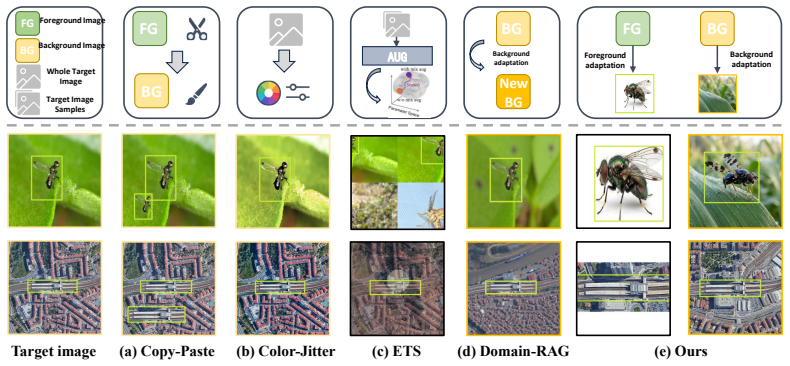
The paper's central claim is that the bottleneck in CD-FSOD is not only lack of target data but the type of augmentation used to fake target-domain data: background-only adaptation such as Domain-RAG leaves foreground representations fixed, while naive copy-paste and low-level transforms fail to model complex shifts. PSP-FSOD therefore uses a VLM, Gemini, as a training-free generator. Each support image and bounding box are fed with a five-part structured prompt $P(y, d)$ that (1) constrains semantic category, (2) adapts foreground, (3) adapts background, (4) fixes object placement, and (5) asks for the image plus bounding box, producing $(\hat{I}, \hat{B})$. Generated samples are added to t
Load-bearing premise
The entire gain rests on the closed VLM reliably following the five-part prompt so that generated images preserve the object's category, structure, and location while returning usable bounding boxes; the specific prompt text and generation protocol are not disclosed, so this cannot be independently verified.
Editorial extensions
If this is right
- Joint prompt-driven foreground–background generation is the dominant source of gains, adding +6.4 mAP at 1-shot over the fine-tuned GroundingDINO baseline, while feature perturbation adds +1.1 mAP.
- The full PSP-FSOD outperforms Domain-RAG by 2.8, 2.3, and 1.7 mAP at 1-, 5-, and 10-shot settings, and outperforms the fine-tuned GroundingDINO baseline by 10.1, 4.6, and 3.2 points.
- Gains are largest on domains with strong foreground variation and foreground–background coupling, such as ArTaxOr, DeepFish, UODD, and NEU-DET, and smaller on simpler domains like Clipart1k and DIOR.
- The method needs only one or two generated images per support image, fewer than Domain-RAG's five, indicating that alignment and semantic consistency matter more than raw generation volume.
- Because the generation stage is training-free and the noise injection is inserted between the backbone and feature enhancer, the authors argue the framework extends to other few-shot learning tasks and detectors built on multi-scale features.
Reading between the lines
- If the gains come from VLM grounding rather than mere image diversity, the five-part prompt structure is a transferable recipe: the same decomposition into semantic constraints, foreground/background adaptation, location, and annotation output could be packaged as a reusable augmentation protocol for other detection domains.
- The success with one generated image per support sample hints that quality and alignment matter more than volume; a testable extension is to vary the number of generated samples and measure whether performance saturates, which would reveal a 'sufficient synthetic coverage' regime.
- Because the noise injection uses only mean-variance correction, it can likely be ported to other dense prediction tasks such as segmentation or keypoint detection under few-shot domain shift, though the paper does not test this.
- The dependency on a closed VLM means reproducibility hinges on whether any grounded VLM can follow the same prompt; reimplementing the generation with an open-weight model would test whether the mechanism transfers or is model-specific.
Editorial analysis
A structured set of objections, weighed in public.
Referee Report
Summary. The paper proposes PSP-FSOD, a method for cross-domain few-shot object detection (CD-FSOD) that combines two components: (a) prompt-driven domain simulation (PDS), which uses the Gemini vision-language model to synthesize domain-diverse support images with joint foreground-background adaptation and grounding-aware bounding-box generation; and (b) noise-induced feature perturbation (NFP), which injects Gaussian noise into multi-scale features of GroundingDINO with a distribution-correction step during fine-tuning. On the CD-ViTO benchmark, the method reports average mAP of 36.4/45.0/47.1 for 1/5/10-shot, surpassing the Domain-RAG baseline by 2.8/2.3/1.7 points. The paper includes ablations of PDS and NFP, prompt-strategy comparisons, noise-strength analysis, and qualitative visualizations.
Significance. If the reported results are reproducible and statistically reliable, the paper would make a useful empirical contribution to CD-FSOD: it is simple, builds on standard GroundingDINO, and addresses both foreground and background variation with a VLM, while adding a lightweight feature-level regularizer. The evaluation uses the established CD-ViTO benchmark and compares against several independent data-augmentation baselines (ETS, Domain-RAG). The ablations are reasonably designed, including prompt-strategy variants and noise-level sensitivity. The paper's main limitations are also acknowledged in the checklist (no error bars) and in the appendix (manual prompt/noise tuning). However, the core PDS component relies on an undisclosed closed-source generation protocol, which currently prevents independent verification of the central claim.
major comments (4)
- [§3.1, Eq. (1), Fig. 4, Table 2] The central causal claim—that PDS contributes +6.4/+3.2/+2.1 mAP (Table 2)—flows entirely through an unverifiable black box. The exact structured prompt P(y,d) is never written out; the five components are described only at a high level. The conversion from the intermediate 'red box' to the final annotation B̂ is described informally. Gemini is a closed API whose behavior can change. Fig. 4 itself shows that when the prompt does not enforce foreground-background consistency, the VLM can produce semantically/spatially wrong compositions. The paper must release the exact prompt template, the generation parameters, the post-processing code, and either the generated dataset or a substantial reproducible subset with human-rated semantic/spatial correctness. Without this, the reported attribution of gains to PDS is not independently testable.
- [Checklist item 7, Table 1, Table 2] The paper reports single-run results with no error bars, confidence intervals, or significance tests; the checklist explicitly answers 'No' to this item. This is load-bearing because several headline gains over Domain-RAG are modest (2.8, 2.3, and 1.7 mAP on average), and per-dataset differences are often small—e.g., 5-shot DeepFish is 43.9 vs. 43.8 in Table 1. Single runs cannot distinguish real improvements from seed/initialization noise. At minimum, multi-seed mean±std should be reported for the main results and for the core ablations (Table 2), or the paper should justify why single runs are sufficient under this protocol.
- [Table 2 (NFP rows), §4.3] The text claims that 'both modules consistently improve performance,' but the NFP-only ablation does not consistently improve: on DeepFish 1-shot, NFP reduces mAP from 42.2 to 36.7 (−5.5 points); on DIOR 5-shot it is 26.9 vs. 27.9; on UODD 5-shot it is 26.7 vs. 27.7. Even in the combined model, 10-shot NEU-DET drops from 28.3 (PDS alone) to 27.8 (Ours). The NFP contribution is therefore positive mainly when combined with PDS. The paper should report per-domain NFP effects honestly and avoid the 'consistently improves' wording, or provide a mechanism explaining these negative cases.
- [§4.1, Table 5, Table 6, Appendix C] The selection of NFP hyperparameters is under-specified. Table 5 tunes noise strengths only on UODD, yet the method section fixes σ1=0.15 and σ2=0.10. The implementation details say 'Dataset-specific settings, including noise strengths... are provided in the Appendix,' but Table 6 lists only epochs, batch sizes, and LR decay milestones; no dataset-specific noise-strength table is given. This is an internal inconsistency and a reproducibility gap. Please report the noise strengths actually used per dataset, and add a sensitivity analysis beyond UODD if the claim is that the same fixed values transfer.
minor comments (6)
- [Eq. (1), §3.1] Define all notation: G, I, B, d are used without a formal description of their spaces. The phrase 'visible red box' appears only in text; clarify how B̂ is computed from the red box and whether the generated image is post-processed before training.
- [Table 1] The Distill-CDFSOD row contains 'nan' for DeepFish and NEU-DET without explanation. Also, 'best results highlighted in pink' is not accessible in monochrome printing; use bold or a table note.
- [Tables 2 and 3] The 'Baseline+' of Table 2 and the 'GroundingDINO' row of Table 3 differ (e.g., ArTaxOr 26.8 vs. 26.3), but the difference is not explained. Define both baselines explicitly so readers can interpret the ablations.
- [§3.2 vs. Table 5] The terminology is inconsistent: the method section says 'distribution correction,' while Table 5's caption says 'distribution rectification.' Use one term throughout.
- [Checklist item 5, §4.1] The checklist states that an anonymized code repository is provided, but no URL or repository identifier appears in the manuscript. Either include the URL or state that code will be released upon publication.
- [Throughout] Minor typos and phrasing: 'aprompt-driven' should be 'aprompt-driven' (Sec. 1); 'generated figures bring larger gains' likely means 'generated samples/images' (Sec. 4.3); 'L20X GPUs' should be specified with memory and total compute if possible.
Circularity Check
No circularity: gains are measured against external benchmarks and held-out test labels; PDS is a training-time augmentation pipeline, not a fit to the target result.
full rationale
The paper's central claims are empirical: it reports mAP on the CD-ViTO benchmark under 1/5/10-shot protocols and compares against external baselines (GroundingDINO, ETS, Domain-RAG). The PDS module uses support images, their bounding boxes, and a category label to synthesize additional training samples (Eq. 1), which are then used to fine-tune GroundingDINO. Evaluation is performed on a disjoint query set with human-annotated labels, so the reported improvements are not forced by the generation process by construction. The NFP module injects Gaussian noise and then rescales perturbed features to match the clean feature statistics; that matching is definitional, but it is a design property of the regularizer, not a derived result that is then 'predicted'. The paper's limitations—manually designed prompts, manually selected noise strengths, no error bars, and an undisclosed prompt template—are reproducibility and robustness concerns, not evidence of circularity. There is co-author overlap with Domain-RAG (Tianwen Qian), but Domain-RAG is treated as a competitor baseline rather than as load-bearing justification for the method, so this does not raise the circularity score. No step in the derivation chain reduces to its own input or to a self-citation chain.
Assumptions & free parameters
free parameters (5)
- Noise strengths σ1, σ2 =
σ1=0.15, σ2=0.10
- Number of generated images per support image =
2 for ArTaxOr, 1 for others
- Training schedule (epochs, batch size, LR milestones) =
e.g., epochs 30-80, batch 3-4, milestones per dataset
- Injection probability =
1
- Prompt template P(y,d) =
manual
assumptions (4)
- domain assumption Gemini-generated images preserve semantic category and annotation alignment
- domain assumption Gaussian noise with mean-variance correction yields domain-invariant features
- domain assumption Target-domain description d can be obtained by an LLM from dataset papers
- domain assumption Standard supervised fine-tuning objectives of GroundingDINO transfer to augmented samples
Cite this review
Pith. "Pith review of Prompt-Driven Simulation with Feature Perturbation for Cross-Domain Few-Shot Object Detection." pith.science (2026). https://pith.science/paper/SWW4WH6D
@misc{pith2026260801348,
  author       = {Pith},
  title        = {Pith review of: Prompt-Driven Simulation with Feature Perturbation for Cross-Domain Few-Shot Object Detection},
  year         = {2026},
  howpublished = {\url{https://pith.science/paper/SWW4WH6D}},
  note         = {Machine review of arXiv:2608.01348}
}
read the original abstract
Data augmentation, which simulates diverse visual variations to expand the source distribution and induce synthetic domain shifts, is a simple yet effective strategy for mitigating severe domain shifts and limited labeled target data in cross-domain few-shot object detection (CD-FSOD). Existing approaches rely on conventional data augmentation, such as Color-Jitter, Mosaic, and background-centric adaptation (e.g., Domain-RAG), which are limited in modeling complex domain shifts and often lead to suboptimal performance. In this paper, we propose PSP-FSOD, a principled framework that integrates prompt-driven domain simulation with feature perturbation regularization to improve generalization in CD-FSOD. To enable controllable domain synthesis, we design a prompt-driven strategy that leverages the visual grounding capability of large VLMs to jointly model foreground and background variations, generating semantically consistent yet domain-diverse training samples. Moreover, we adopt a grounding-aware generation scheme that guides object placement and alleviates semantic-spatial misalignment, thereby improving foreground adaptation. To ensure training stability and robustness, we further introduce a noise-induced feature perturbation mechanism that injects Gaussian noise into multi-scale intermediate features with distribution correction, encouraging consistent predictions under perturbations and reducing reliance on domain-specific cues. Extensive experiments demonstrate that PSP-FSOD produces high-quality domain-diverse supervision and learns domain-invariant representations, consistently improving performance across CD-FSOD benchmarks.
Figures


Figures from the paper (5 more)


Forward citations
Cited by 1 Pith paper
-
The First EgoCross Challenge at EgoVis 2026: Cross-Domain Egocentric Video Question Answering
At CVPR 2026, the EgoCross Challenge evaluated cross-domain egocentric video QA across four specialist domains, with the best system reaching 66.98% accuracy.
Reference graph
Works this paper leans on
-
[2]
Qwen3 technical report.arXiv preprint arXiv:2505.09388,
An Yang, Anfeng Li, Baosong Yang, Beichen Zhang, Binyuan Hui, Bo Zheng, Bowen Yu, Chang Gao, Chengen Huang, Chenxu Lv, et al. Qwen3 technical report.arXiv preprint arXiv:2505.09388,
-
[3]
Gemini: a family of highly capable multimodal models.arXiv preprint arXiv:2312.11805,
Gemini Team, Rohan Anil, Sebastian Borgeaud, Jean-Baptiste Alayrac, Jiahui Yu, Radu Soricut, Johan Schalk- wyk, Andrew M Dai, Anja Hauth, Katie Millican, et al. Gemini: a family of highly capable multimodal models.arXiv preprint arXiv:2312.11805,
-
[6]
mixup: Beyond empirical risk minimization.arXiv preprint arXiv:1710.09412,
Hongyi Zhang, Moustapha Cisse, Yann N Dauphin, and David Lopez-Paz. mixup: Beyond empirical risk minimization.arXiv preprint arXiv:1710.09412,
-
[8]
Lei Qi, Hongpeng Yang, Yinghuan Shi, and Xin Geng
doi: 10.1109/ TCSVT.2022.3152615. Lei Qi, Hongpeng Yang, Yinghuan Shi, and Xin Geng. Normaug: Normalization-guided augmentation for domain generalization.IEEE Transactions on Image Processing,
-
[9]
Yuqian Fu, Yu Xie, Yanwei Fu, Jingjing Chen, and Yu-Gang Jiang
doi: 10.1109/TIP.2024.3364516. Yuqian Fu, Yu Xie, Yanwei Fu, Jingjing Chen, and Yu-Gang Jiang. Wave-san: Wavelet based style augmentation network for cross-domain few-shot learning.arXiv preprint arXiv:2203.07656,
-
[11]
Ze Liu, Yutong Lin, Yue Cao, Han Hu, Yixuan Wei, Zheng Zhang, Stephen Lin, and Baining Guo
doi: 10.1109/CVPR52733.2024.01682. Ze Liu, Yutong Lin, Yue Cao, Han Hu, Yixuan Wei, Zheng Zhang, Stephen Lin, and Baining Guo. Swin transformer: Hierarchical vision transformer using shifted windows. InProceedings of the IEEE/CVF International Conference on Computer Vision, pages 10012–10022,
arXiv 2024
-
[14]
DeFRCN: Decoupled Faster R-CNN for Few-Shot Object Detection
Limeng Qiao, Yuxuan Zhao, Zhiyuan Li, Xi Qiu, Jianan Wu, and Chi Zhang. Defrcn: Decoupled faster r-cnn for few-shot object detection.arXiv preprint arXiv:2108.09017,
-
[15]
Detect everything with few examples.arXiv preprint arXiv:2309.12969,
Xinyu Zhang, Yuhan Liu, Yuting Wang, and Abdeslam Boularias. Detect everything with few examples.arXiv preprint arXiv:2309.12969,
Show all 16 references
-
[16]
A.1 More Implementation Details Additional implementation details are summarized in Table 6, including dataset-specific epochs, batch sizes, and learning rate decay milestones
A More Implementation Details and Analysis This section presents additional implementation details of the proposed CD-FSOD method and comparison of the number of the generated samples. A.1 More Implementation Details Additional implementation details are summarized in Table 6,...
2019
-
[2019]
Frustratingly simple few-shot object detection.arXiv preprint arXiv:2003.06957,
Xin Wang, Thomas E Huang, Trevor Darrell, Joseph E Gonzalez, and Fisher Yu. Frustratingly simple few-shot object detection.arXiv preprint arXiv:2003.06957,
2003 arXiv
-
[2020]
Raphael Gontijo Lopes, Dong Yin, Ben Poole, Justin Gilmer, and Ekin D
doi: 10.1109/W ACV45572.2020.9093467. Raphael Gontijo Lopes, Dong Yin, Ben Poole, Justin Gilmer, and Ekin D. Cubuk. Improving robustness without sacrificing accuracy with patch gaussian augmentation.arXiv preprint arXiv:1906.02611,
2020
-
[2021]
Arthropod taxonomy orders object detection dataset
Geir Drange. Arthropod taxonomy orders object detection dataset. https://doi.org/10.34740/kaggle/ dsv/1240192,
-
[2022]
Cd-fsod: A benchmark for cross-domain few-shot object detection
Wuti Xiong. Cd-fsod: A benchmark for cross-domain few-shot object detection. InICASSP 2023-2023 IEEE International Conference on Acoustics, Speech and Signal Processing (ICASSP), pages 1–5. IEEE,
2023
-
[2023]
Gpt-4 technical report.arXiv preprint arXiv:2303.08774,
Josh Achiam, Steven Adler, Sandhini Agarwal, Lama Ahmad, Ilge Akkaya, Florencia Leoni Aleman, Diogo Almeida, Janko Altenschmidt, Sam Altman, Shyamal Anadkat, et al. Gpt-4 technical report.arXiv preprint arXiv:2303.08774,
-
[2024]
Andreas Bär, Neil Houlsby, Mostafa Dehghani, and Manoj Kumar
doi: 10.1145/3696409.3700174. Andreas Bär, Neil Houlsby, Mostafa Dehghani, and Manoj Kumar. Frozen feature augmentation for few- shot image classification. InProceedings of the IEEE/CVF Conference on Computer Vision and Pattern Recognition, pages 16067–16077,
-
[2025]
Sdxl: Improving latent diffusion models for high-resolution image synthesis.arXiv preprint arXiv:2307.01952,
Dustin Podell, Zion English, Kyle Lacey, Andreas Blattmann, Tim Dockhorn, Jonas Müller, Joe Penna, and Robin Rombach. Sdxl: Improving latent diffusion models for high-resolution image synthesis.arXiv preprint arXiv:2307.01952,
Reviewed August 6, 2026 · model on record in the stance chip above.
Discussion (0). Sign in to comment.