REVIEW 3 major objections 4 minor 22 references
Artificially Evolved Chunks for Morphosyntactic Analysis
T0 review · 3 major / 4 minor · reviewed 2026-08-14 · deepseek-v4-flash
Pith's one-line read An evolutionary search over chunk rules from dependency treebanks improves POS tagging, morphological tagging, and dependency parsing.
desk verdict Novel evolutionary chunk-rule induction with a real attribution problem: no control ruleset, so the paper can't show the evolution (rather than chunk features per se) helps; still worth refereeing. read the letter →
The pith
A machine-rendered reading of the paper's core claim, the machinery that carries it, and where it could break.
The reading
What carries the argument
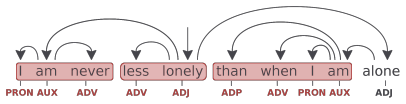
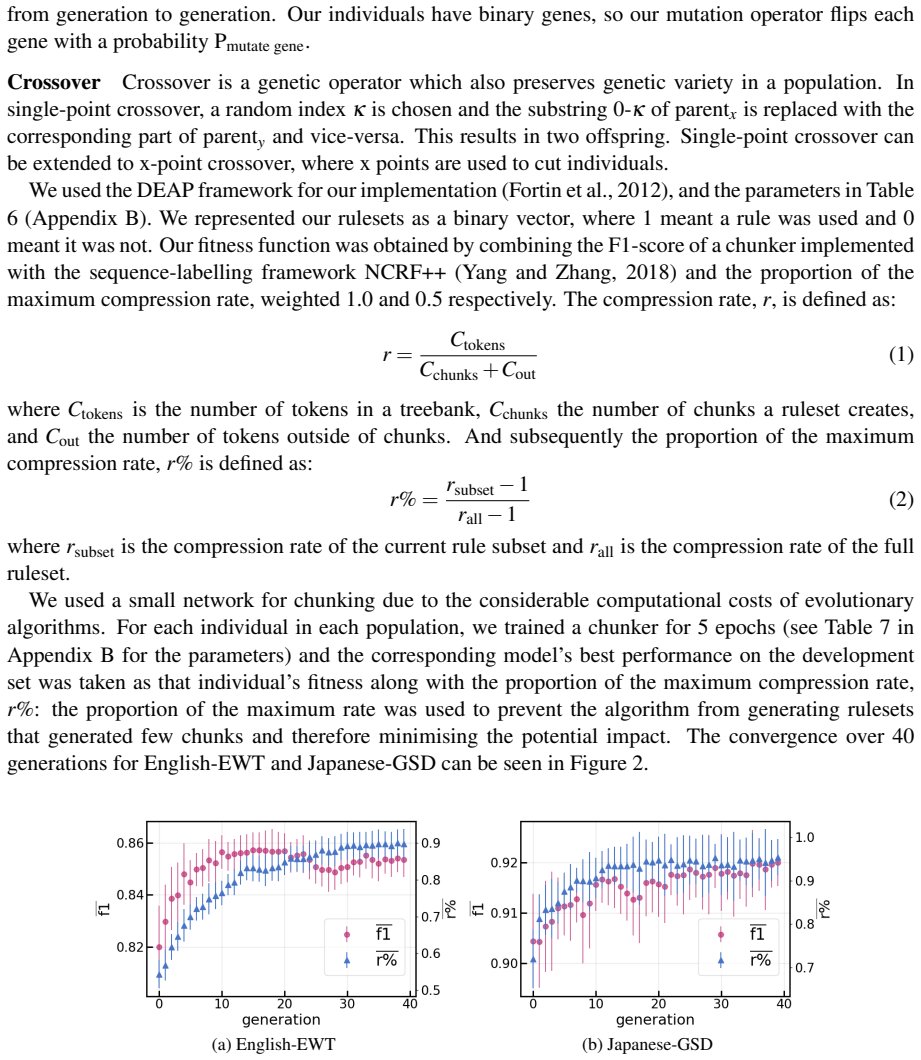
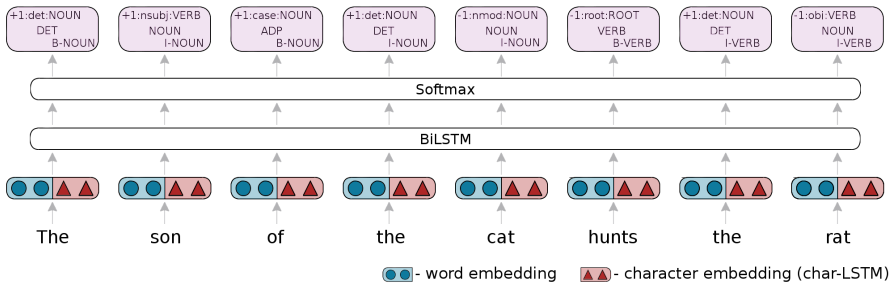
The load-bearing mechanism is the combination of a relaxed chunk definition with an evolutionary rule-subset search. A chunk is any continuous base-level subtree: one head, its dependents, and no internal dependent escaping the chunk. Each candidate chunk type is the POS-tag sequence of such a subtree, and an individual in the search is a binary vector over the candidate rule set, scored by the F1 of a chunker trained on that subset plus 0.5 times the proportion of the maximum compression rate. The resulting rulesets are applied to treebanks to produce IOB chunk labels, which are then used either as an auxiliary task in a hard-sharing BiLSTM multi-task network or as extra features for a sequence-labelling dependency parser that encodes heads by relative position.
What would settle it
On a held-out UD treebank, compare the evolved ruleset against several random subsets of the full candidate ruleset matched for number of rules and chunk coverage, using downstream parsing accuracy as the only score. If the random subsets match or beat the evolved ruleset, the fitness proxy is not selecting for what matters.
Extended reading notes
Core claim
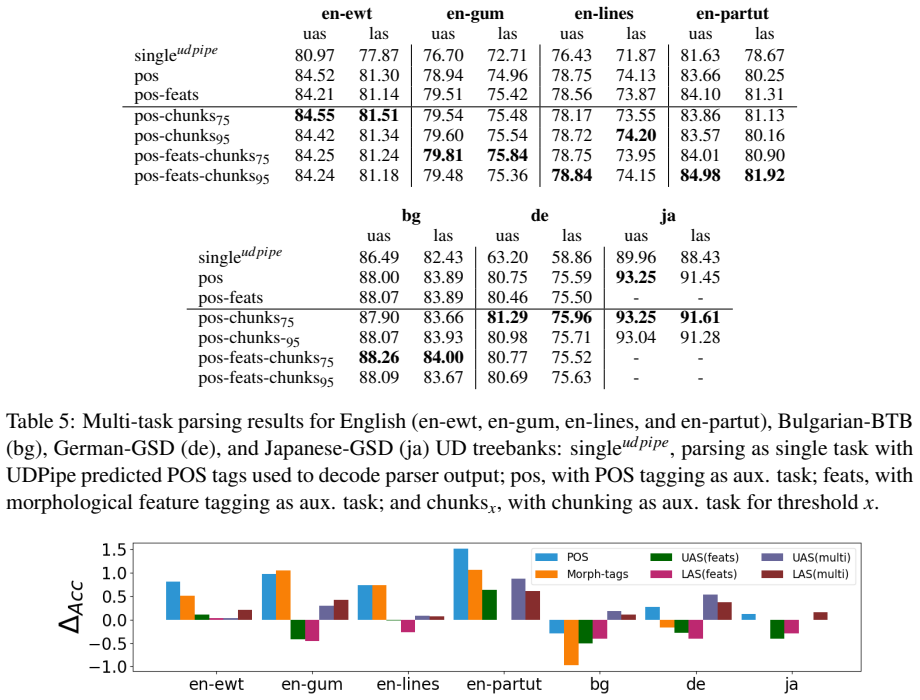
The central claim is that automatically evolved chunks are useful at multiple levels of syntactic abstraction. Starting only from UD-annotated sentences, the method collects all continuous one-head subtrees, converts each to its POS-tag sequence, and treats the resulting rules as binary genes in an evolutionary search. The fitness function is the F1 of a small chunker trained on the ruleset plus half the proportion of maximum compression rate, so selected rulesets must be both learnable and informative. The authors show that adding these chunks as an auxiliary task improves POS and morphological tagging on all English treebanks and POS tagging on German and Japanese, while Bulgarian is not helped; as input features for a sequence-labelling dependency parser, chunks explicitly help the largest and smallest English treebanks, and in a multi-task parsing setup chunking consistently improves parsing across every tested treebank. The conclusion is that shallow chunks derived without linguistic rules carry information that downstream morphosyntactic models can exploit.
Load-bearing premise
The search assumes that a ruleset which scores well on chunker F1 and compression will also improve downstream POS tagging, morphological tagging, and parsing; if that proxy is wrong, the evolved rulesets are not the ones that best help those tasks.
Editorial extensions
If this is right
- A dependency treebank alone is enough to derive chunk supervision for any language covered by UD; no hand-written phrase-structure rules or language-specific resources are needed.
- Chunking can be treated as an auxiliary task alongside POS and morphological tagging without hurting the main tasks; it improves both tagging tasks on all four English treebanks.
- Chunk predictions can serve as parser features and improve dependency parsing on some treebanks, and using chunks as a multi-task auxiliary improves parsing on every treebank tested.
- The gap between oracle and predicted chunk performance suggests that better chunk prediction would widen the observed parsing gains, pointing to a direct direction for future work.
Reading between the lines
- The compression-rate term in the fitness function acts as a built-in regularizer: it rewards rulesets that cover many tokens in few, learnable chunks, so the search implicitly trades coverage against predictability rather than maximizing raw chunk count.
- Because the chunk definitions rely only on POS sequences and dependency structure, the same pipeline could be applied to low-resource UD treebanks to generate cheap auxiliary supervision, a setting the paper does not test.
- The negative Bulgarian result is a testable hypothesis: chunk information may matter less for morphologically rich languages where inflection already encodes much of the dependency structure, so applying the method to a broader sample of UD languages could reveal a typological boundary.
Signed reviews
Editorial analysis
A structured set of objections, weighed in public.
Referee Report
Summary. The paper introduces an evolutionary search over candidate chunk patterns extracted from UD dependency treebanks, using a fitness function that combines a small chunker's F1 score with a compression-rate term. The selected rules are aggregated into consensus rulesets at two thresholds, and the resulting chunk labels are used as auxiliary tasks and input features in a BiLSTM sequence-labelling framework for POS tagging, morphological feature tagging, and dependency parsing. Experiments cover English (EWT, GUM, LinES, ParTUT), Bulgarian, German, and Japanese treebanks, with comparisons between systems with and without chunking information. The reported effects are mixed: POS/features improve on English and partly on German/Japanese, but Bulgarian degrades; parsing gains are small and only two English treebanks show consistent explicit chunk-feature improvements.
Significance. The proposed idea is potentially useful: deriving chunk supervision automatically from dependency annotations is language-agnostic, and evaluating chunks across three sequence-labelling tasks is a reasonable way to test their utility. The paper is transparent about its methodology and hyperparameters, and it honestly reports that the evolutionary search itself produced low-scoring single rulesets. If the selection mechanism could be shown to be effective against proper baselines, this would be a solid contribution. Currently, however, the central claim that the evolutionary selection process—rather than the presence of any chunking information—is responsible for the gains is unsupported, and several cross-linguistic conclusions are based on differences that may be within noise.
major comments (3)
- [Section 3, eqs. (1)-(2), Tables 2, 4, 5] The experiments never compare the evolved or consensus rulesets against the full candidate ruleset or an equally sized randomly sampled subset of rules. Every comparison in the paper contrasts systems with chunks against systems without chunks, so the observed gains could be due to chunking information in general rather than to the evolutionary selection that is the paper's central contribution. Please add control experiments using the full ruleset and random subsets of the same size, ideally repeated over multiple seeds, and report the resulting performance distributions.
- [Section 3, Table 6] The paper states that the evolutionary algorithm 'only managed to find a single set with a fairly low performance' and therefore reports the consensus of the top 100 rulesets at 75% and 95% thresholds. This post-hoc aggregation is not compared against simple alternatives such as selecting the most frequent rules from the full candidate set. Without such a comparison, it is unclear whether the evolutionary search, as opposed to the consensus step, contributes anything. In addition, the text mentions convergence over 40 generations while Table 6 lists the number of generations as 4; this inconsistency should be resolved.
- [Section 6, Tables 2, 4, and 5] The cross-linguistic claim is stronger than the results support. Table 2 shows that chunking hurts Bulgarian POS and morphological feature tagging (pos+feats+chunks75 achieves 97.49/94.58 vs. 97.69/94.84 for pos+feats), and in the feature-ablation parsing experiments of Table 4, predicted chunks improve both UAS and LAS only for en-ewt and en-partut. Several differences in Tables 4 and 5 are below 0.3 points. Since no significance tests are reported, these differences are hard to distinguish from noise. Please add significance testing (e.g., bootstrap over sentences) or moderate the conclusions to the configurations that are reliable.
minor comments (4)
- [Abstract, Section 6] The phrase 'a small, diverse subset of non-English UD treebanks' should be qualified: Bulgarian actually degrades on tagging with chunks, and Japanese lacks morphological features, so the non-English evidence is substantially weaker than the abstract suggests.
- [Section 5, Table 1] The use of the English-EWT evolved ruleset for the other English treebanks should be stated more prominently in the experimental design, since it means the method was not re-run per treebank and affects how Table 1's chunk statistics are interpreted.
- [Appendix B] The number of generations is inconsistent between the main text (40) and Table 6 (4); please correct this and also state the number of rules and chunks per sentence for each treebank and threshold in a single table.
- [General] No public code, data, or ruleset release is mentioned; given the complexity of the evolutionary pipeline and the many hyperparameters, releasing the rulesets and evaluation scripts would materially help reproducibility.
Circularity Check
No significant circularity: the evolutionary ruleset selection is dev-based model selection, downstream evaluations use predicted chunks against external UDPipe baselines, and no fitted parameter is renamed as a prediction.
full rationale
The paper's derivation chain is not circular. Candidate chunk rules are extracted from training-subtree POS patterns (Sec. 2) and the evolutionary search (Sec. 3) optimizes a chunker F1 plus compression-rate fitness on the development set; this is standard model selection, not a fitted input disguised as a prediction. The downstream experiments then train separate models and use chunker predictions at runtime on test sets, comparing against single-task and UDPipe baselines (Tables 2-5), so the reported gains are empirical outcomes rather than consequences of an equation. The only same-author citations (Strzyz et al. 2019; Vilares et al. 2019) provide the sequence-labelling scheme and hyperparameters as reusable tools, not as a load-bearing uniqueness or equivalence argument. The absence of a full/random ruleset control is an attribution and experimental-design concern, not a circularity, because nothing in the formalism forces the observed improvements. No self-definitional reduction, fitted-input-as-prediction, or imported uniqueness was found.
Assumptions & free parameters
free parameters (4)
- Fitness weights =
1.0 for F1, 0.5 for compression proportion
- Frequency cutoff for candidate rules =
5
- Consensus thresholds =
75% and 95%
- Evolutionary algorithm hyperparameters =
population size 100, generations 4/40, k-best 5, mutation/crossover probabilities
assumptions (4)
- domain assumption Base-level dependency subtrees (one head plus immediate dependents) are a valid and useful definition of chunks.
- ad hoc to paper The fitness function is a reasonable proxy for downstream task utility.
- domain assumption POS tag sequences are sufficient to identify useful chunks across languages.
- domain assumption The evolutionary search and the subsequent consensus extraction produce stable and representative rulesets.
invented entities (1)
-
Evolved chunk rulesets
Cite this review
Pith. "Pith review of Artificially Evolved Chunks for Morphosyntactic Analysis." pith.science (2026). https://pith.science/paper/SX2PN5AW
@misc{pith2026190803480,
  author       = {Pith},
  title        = {Pith review of: Artificially Evolved Chunks for Morphosyntactic Analysis},
  year         = {2026},
  howpublished = {\url{https://pith.science/paper/SX2PN5AW}},
  note         = {Machine review of arXiv:1908.03480}
}
read the original abstract
We introduce a language-agnostic evolutionary technique for automatically extracting chunks from dependency treebanks. We evaluate these chunks on a number of morphosyntactic tasks, namely POS tagging, morphological feature tagging, and dependency parsing. We test the utility of these chunks in a host of different ways. We first learn chunking as one task in a shared multi-task framework together with POS and morphological feature tagging. The predictions from this network are then used as input to augment sequence-labelling dependency parsing. Finally, we investigate the impact chunks have on dependency parsing in a multi-task framework. Our results from these analyses show that these chunks improve performance at different levels of syntactic abstraction on English UD treebanks and a small, diverse subset of non-English UD treebanks.
Figures
Figures from the paper (1 more)
Reference graph
Works this paper leans on
-
[1]
write newline
" write newline "" before.all 'output.state := FUNCTION fin.entry add.period write newline FUNCTION new.block output.state before.all = 'skip after.block 'output.state := if FUNCTION new.sentence output.state after.block = 'skip output.state before.all = 'skip after.sentence 'output.state := if if FUNCTION not #0 #1 if FUNCTION and 'skip pop #0 if FUNCTIO...
-
[2]
S. Abney, 1997. Part-of-Speech Tagging and Partial Parsing , pages 118--136. Springer Netherlands, Dordrecht
work page 1997
-
[3]
Gluseppe Attardi and Felice Dell’Orletta. 2008. Chunking and dependency parsing. In Proceedings of LREC Workshop on Partial Parsing: Between Chunking and Deep Parsing
work page 2008
-
[4]
Thomas Back. 1996. Evolutionary algorithms in theory and practice: evolution strategies, evolutionary programming, genetic algorithms . Oxford university press
work page 1996
-
[5]
Fabio Ciravegna and Alberto Lavelli. 1999. Full text parsing using cascades of rules: an information extraction perspective. In Ninth Conference of the E uropean Chapter of the Association for Computational Linguistics
work page 1999
-
[6]
F\'elix-Antoine Fortin, Fran c ois-Michel De Rainville , Marc-Andr\'e Gardner, Marc Parizeau, and Christian Gagn\'e. 2012. DEAP: Evolutionary Algorithms Made Easy . Journal of Machine Learning Research , 13:2171--2175, jul
work page 2012
-
[7]
Sepp Hochreiter and J \"u rgen Schmidhuber. 1997. Long short-term memory. Neural computation , 9(8):1735--1780
1997
-
[8]
Mucahit Kutlu and Ilyas Cicekli. 2016. Noun phrase chunking for turkish using a dependency parser. In Information Sciences and Systems 2015 , pages 381--391. Springer
work page 2016
Show all 22 references
-
[9]
Oph \'e lie Lacroix. 2018. Investigating NP-Chunking with Universal Dependencies for English . In Proceedings of the Second Workshop on Universal Dependencies (UDW 2018) , pages 85--90
2018
-
[10]
Dat Quoc Nguyen and Karin Verspoor. 2018. An improved neural network model for joint POS tagging and dependency parsing. In Proceedings of the C o NLL 2018 Shared Task: Multilingual Parsing from Raw Text to Universal Dependencies , pages 81--91, Brussels, Belgium, October. Ass...
2018
-
[11]
Joakim Nivre, Z eljko Agi \'c , Lars Ahrenberg, et al. 2017. Universal Dependencies 2.1 . LINDAT / CLARIN digital library at the Institute of Formal and Applied Linguistics ( \'U FAL ), Faculty of Mathematics and Physics, Charles University
2017
-
[12]
Joakim Nivre, Mitchell Abrams, Z eljko Agi \'c , Lars Ahrenberg, et al. 2018. Universal Dependencies 2.3 . LINDAT / CLARIN digital library at the Institute of Formal and Applied Linguistics ( \'U FAL ), Faculty of Mathematics and Physics, Charles University
2018
-
[13]
Jeffrey Pennington, Richard Socher, and Christopher D. Manning. 2014. Glove: Global vectors for word representation. In Empirical Methods in Natural Language Processing (EMNLP) , pages 1532--1543
2014
-
[14]
Lance A Ramshaw and Mitchell P Marcus. 1999. Text chunking using transformation-based learning. In Natural language processing using very large corpora , pages 157--176. Springer
1999
-
[15]
Mike Schuster and Kuldip K Paliwal. 1997. Bidirectional recurrent neural networks. IEEE Transactions on Signal Processing , 45(11):2673--2681
1997
-
[16]
Anders S gaard and Yoav Goldberg. 2016. Deep multi-task learning with low level tasks supervised at lower layers. In Proceedings of the 54th Annual Meeting of the Association for Computational Linguistics (Volume 2: Short Papers) , pages 231--235, Berlin, Germany, August. Asso...
2016
-
[17]
Milan Straka and Jana Strakov \'a . 2019. Universal dependencies 2.4 models for UDPipe (2019-05-31). LINDAT / CLARIN digital library at the Institute of Formal and Applied Linguistics ( \'U FAL ), Faculty of Mathematics and Physics, Charles University
2019
-
[18]
Michalina Strzyz, David Vilares, and Carlos G \'o mez-Rodr \' guez. 2019. Viable dependency parsing as sequence labeling. In Proceedings of the 2019 Conference of the North A merican Chapter of the Association for Computational Linguistics: Human Language Technologies, Volume ...
2019
-
[19]
Aniruddha Tammewar, Karan Singla, Bhasha Agrawal, Riyaz Bhat, and Dipti Misra Sharma. 2015. Can distributed word embeddings be an alternative to costly linguistic features: A study on parsing hindi. In Proceedings of the 6th Workshop on Statistical Parsing of Morphologically R...
2015
-
[20]
Yoshimasa Tsuruoka and Jun ' ichi Tsujii. 2005. Chunk parsing revisited. In Proceedings of the Ninth International Workshop on Parsing Technology , pages 133--140, Vancouver, British Columbia, October. Association for Computational Linguistics
2005
-
[21]
David Vilares, Mostafa Abdou, and Anders S gaard. 2019. Better, faster, stronger sequence tagging constituent parsers. In Proceedings of the 2019 Conference of the North A merican Chapter of the Association for Computational Linguistics: Human Language Technologies, Volume 1 (...
2019
-
[22]
Jie Yang and Yue Zhang. 2018. NCRF++: An Open-source Neural Sequence Labeling Toolkit . In Proceedings of the 56th Annual Meeting of the Association for Computational Linguistics
2018
Reviewed August 14, 2026 · model on record in the stance chip above.
Discussion (0). Continue with ORCID to comment.