Hunting New Animalcula with Flavour Changing Processes
Pith reviewed 2026-06-29 16:26 UTC · model grok-4.3
The pith
Correlations among branching ratios of flavour-changing decays reveal specific new physics particles.
A machine-rendered reading of the paper's core claim, the machinery that carries it, and where it could break.
Core claim
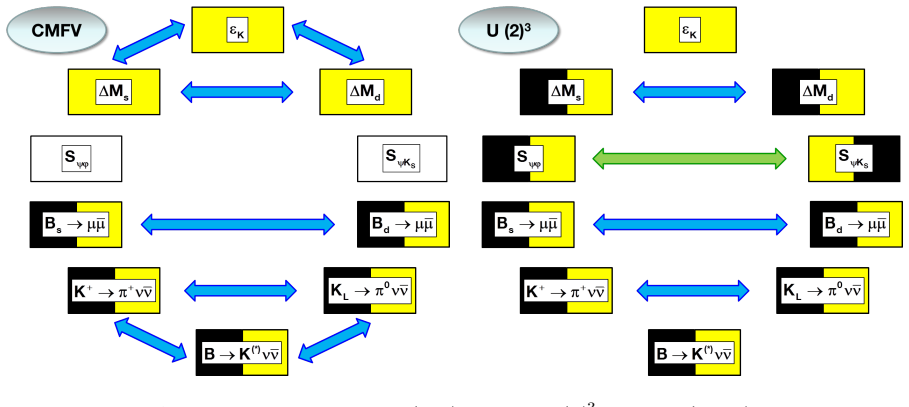
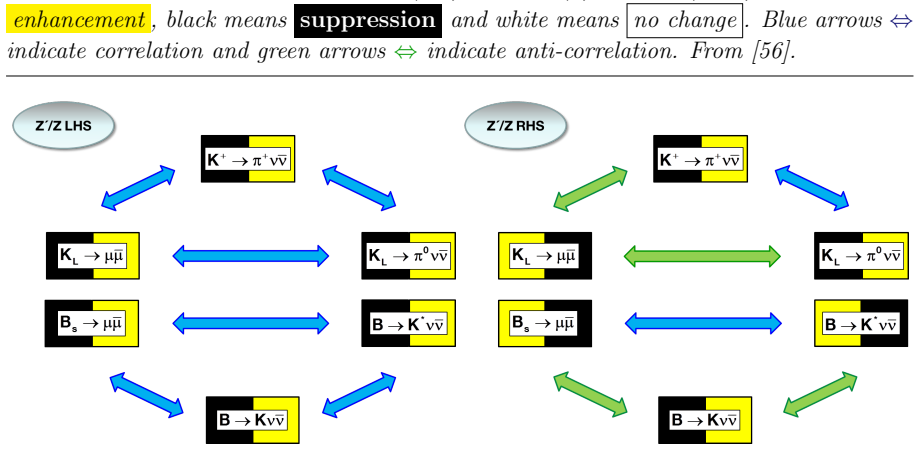
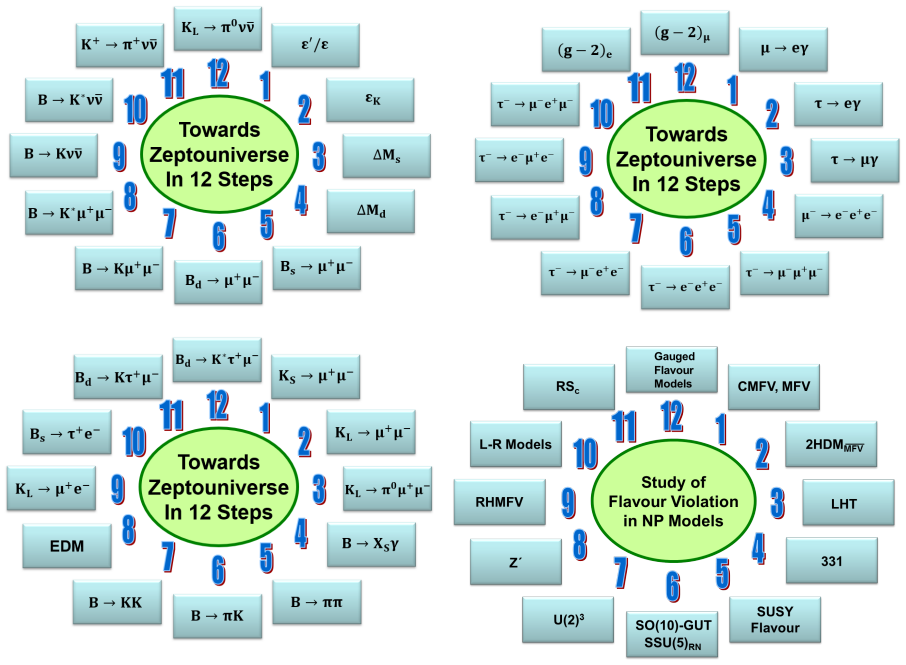
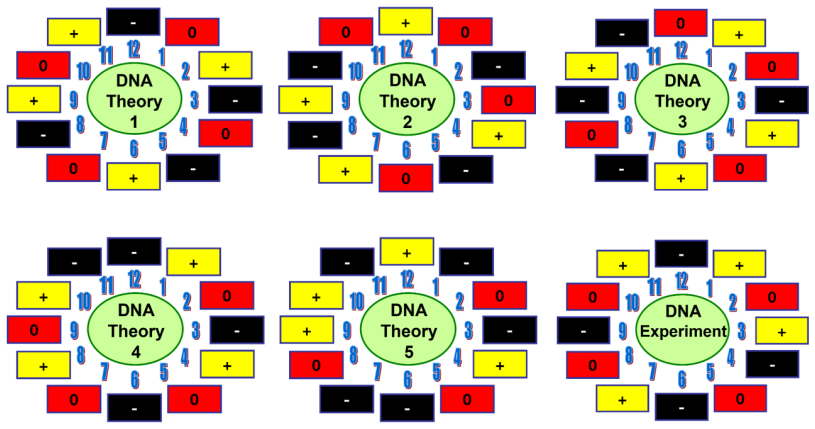
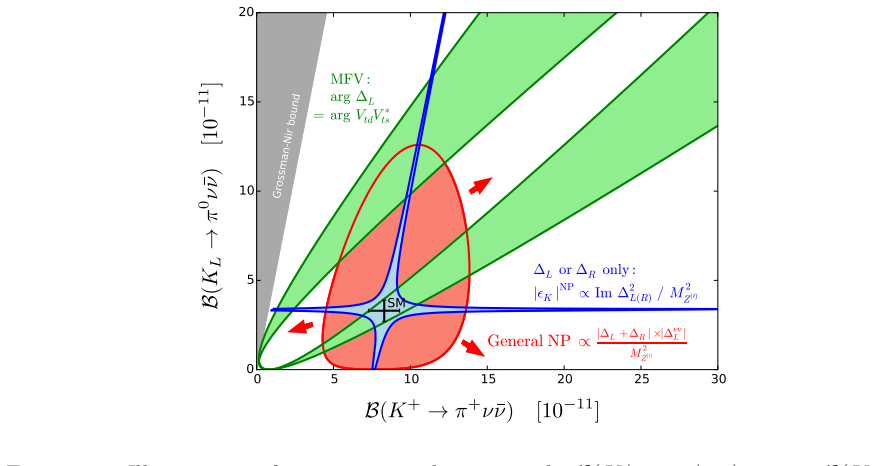
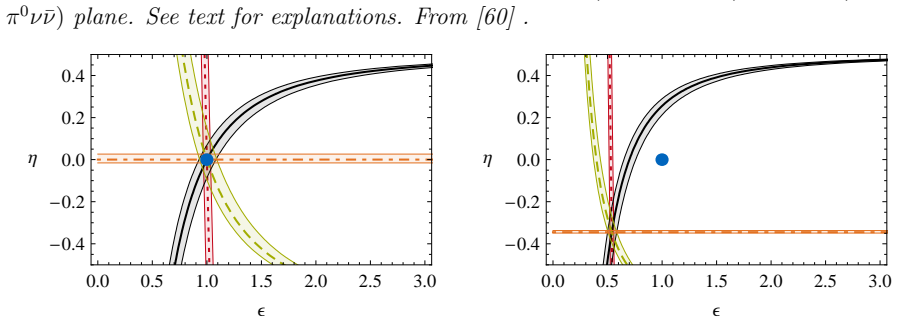
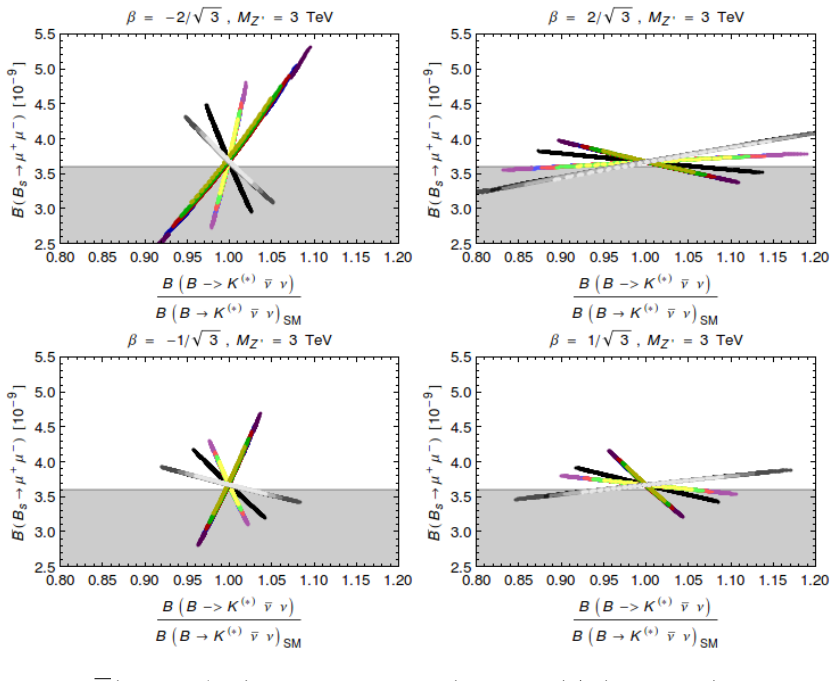
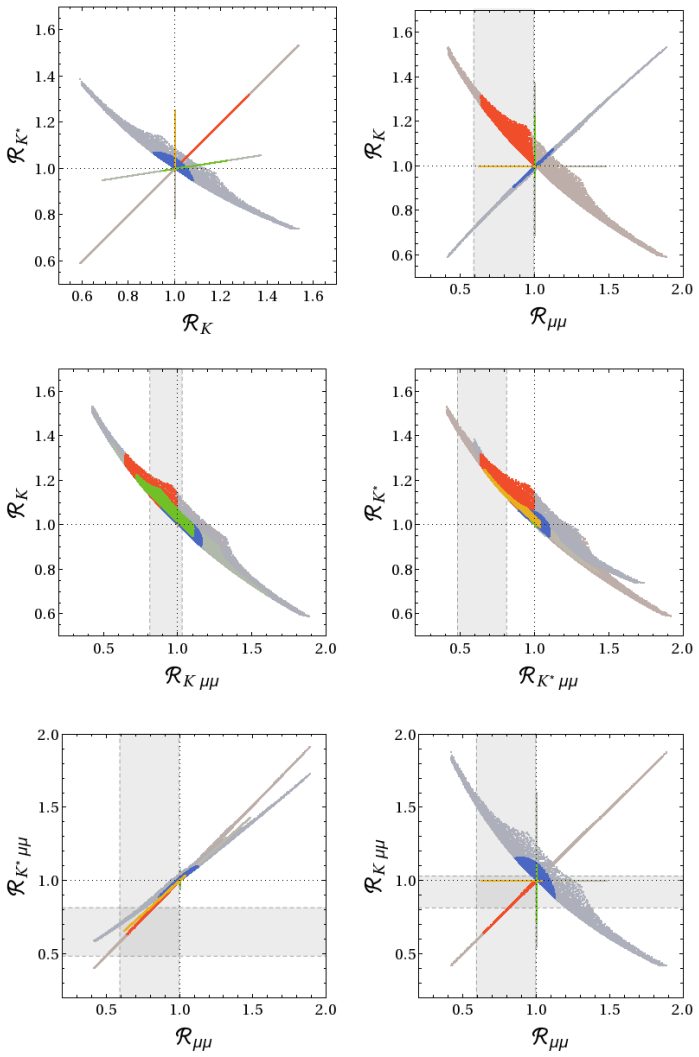
The most direct tests of the SM and its extensions are correlations among different observables, like branching ratios of numerous decays, that are characteristic of particular new animalcula at work. While effective field theories such as WET and SMEFT are formulated in terms of Wilson coefficients, with correlations characteristic of the SM and of specific NP scenarios, the emphasis is on observable correlations for hunting new physics.
What carries the argument
Correlations among different observables like branching ratios of flavour-changing decays that are characteristic of particular new physics scenarios.
If this is right
- These correlations can distinguish specific new physics models from each other and from the Standard Model.
- This approach allows tests at distance scales shorter than those accessible at the LHC.
- Precise measurements of a wide variety of observables are required alongside theoretical calculations.
- It goes beyond global fits to Wilson coefficients as the primary search strategy.
Where Pith is reading between the lines
- Experimenters could prioritize measuring combinations of decays that best discriminate between different correlation patterns.
- This method might help interpret anomalies in flavour data by matching them to specific scenarios.
- It suggests that theoretical efforts should focus on predicting these multi-observable correlations accurately.
Load-bearing premise
That the characteristic correlations for specific new physics scenarios can be cleanly distinguished from Standard Model predictions and from each other given uncertainties in hadronic matrix elements.
What would settle it
Finding a set of measured branching ratios whose correlation pattern does not match predictions from the Standard Model or from any commonly considered new physics model.
Figures
read the original abstract
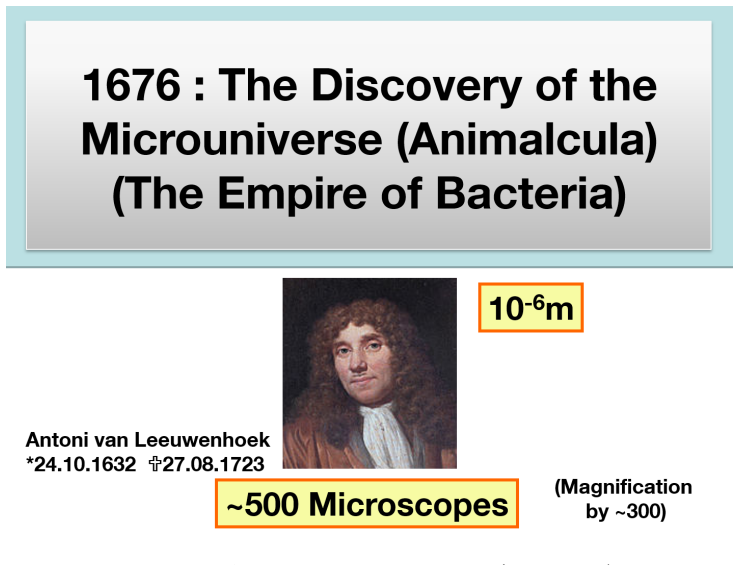
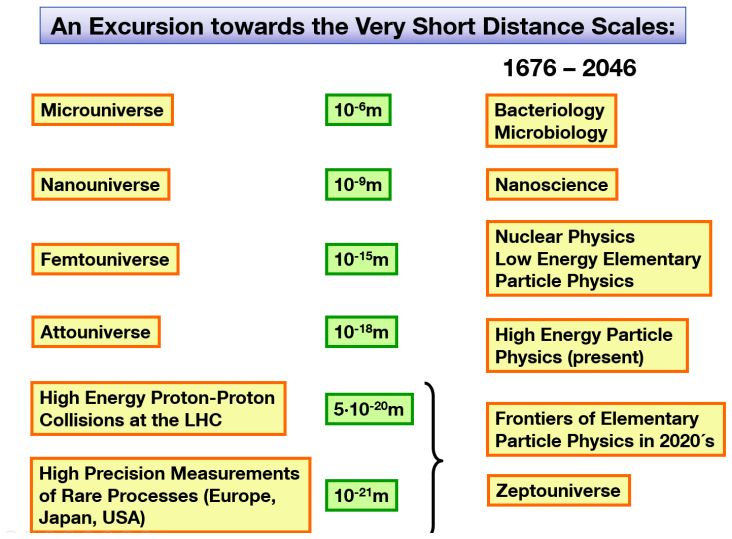
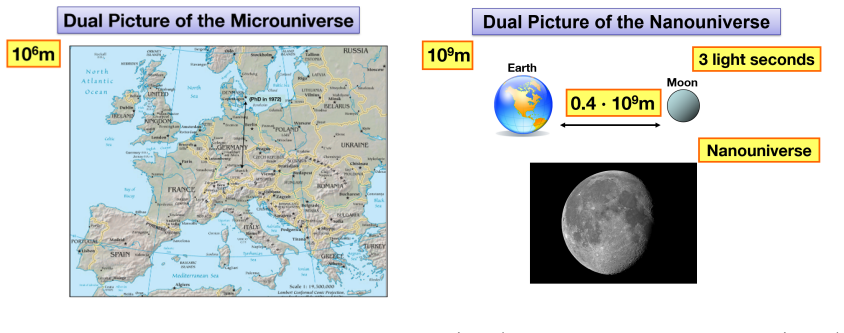
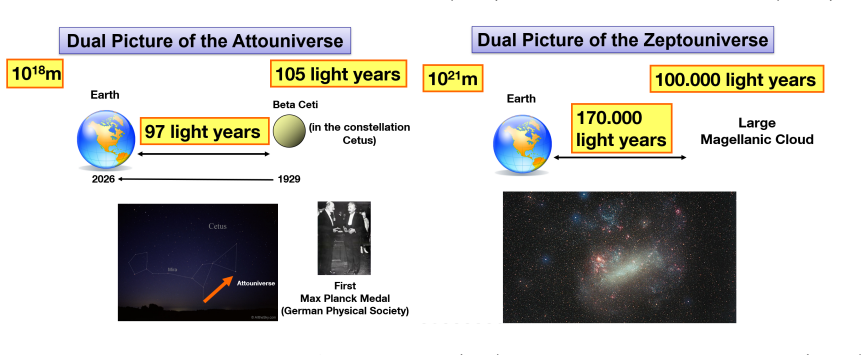
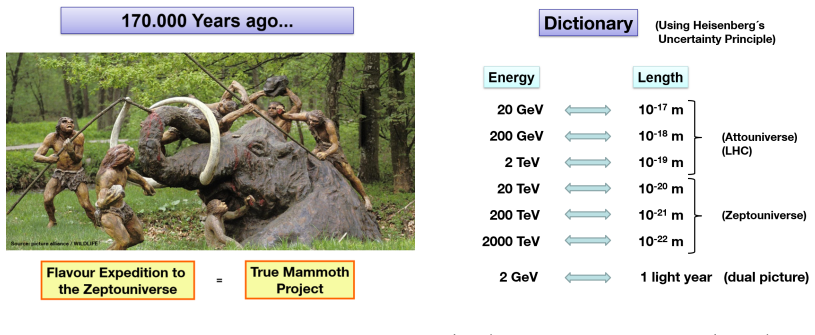
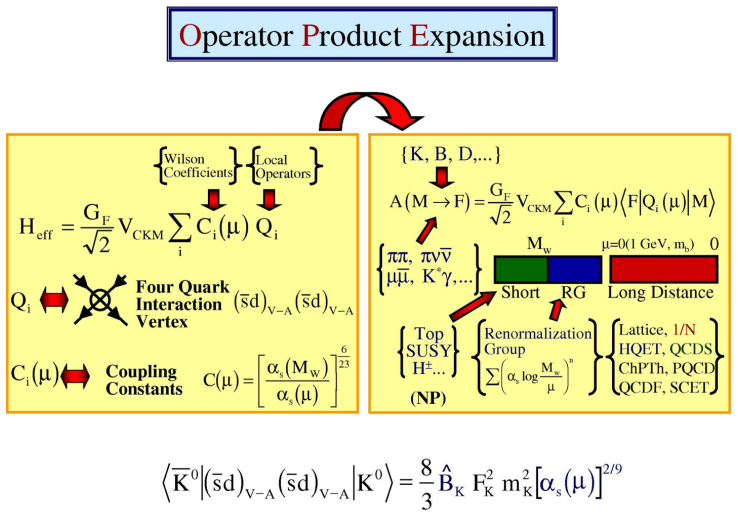
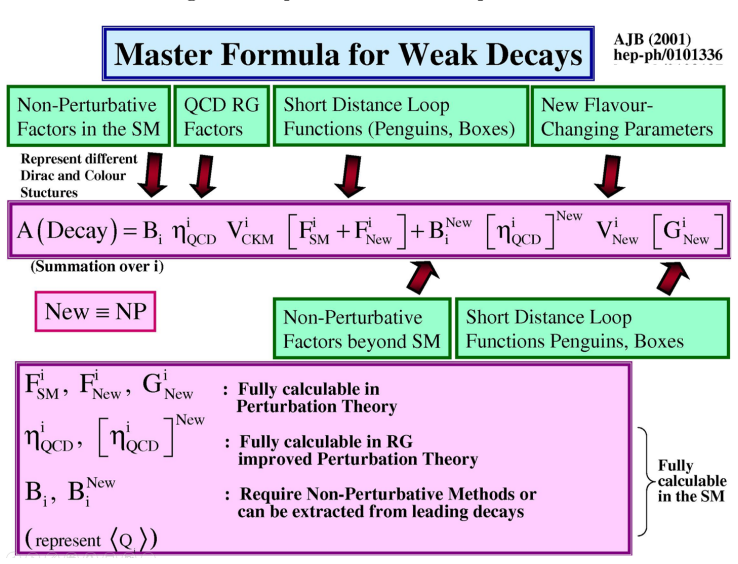
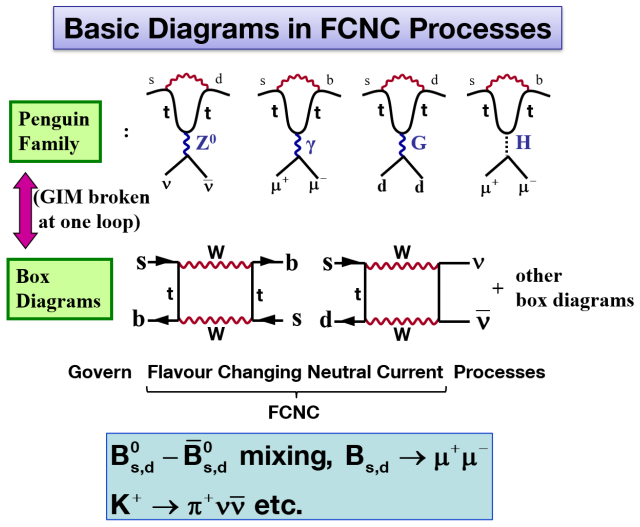
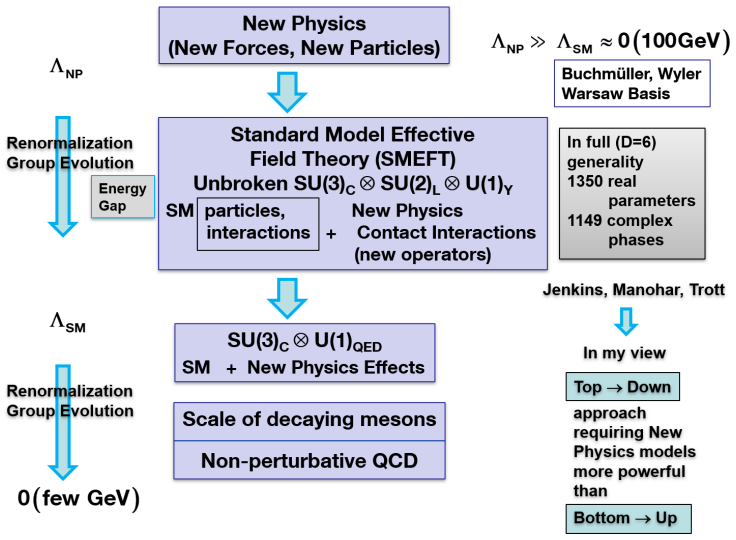
This year marks the 350th anniversary of the discovery of the first animalcula (little animals) by van Leeuvanhoek in 1676.Flavour physics makes it possible to search for new animalcula at distance scales far shorter than those resolved by van Leeuwenhoek in 1676 and even shorter than those directly accessible at the Large Hadron Collider and the planned colliders in this century. I summarize various strategies for achieving this goal. While precise measurements of a wide variety of observables and their precise theoretical calculations, both within the Standard Model (SM) and beyond it, are indispensable in this context, in my view it is crucial to develop strategies for the search for New Physics (NP) that go beyond the global fits that are very popular today. While effective field theories such as WET and SMEFT are formulated in terms of Wilson coefficients of the relevant operators, with correlations characteristic of the SM and of specific NP scenarios, the most direct tests of the SM and its extensions are, in my opinion, correlations among different observables, like branching ratios of numerous decays, that are characteristic of particular new animalcula at work
Editorial analysis
A structured set of objections, weighed in public.
Referee Report
Summary. The manuscript summarizes strategies for searching new physics (NP) in flavour-changing processes at short distance scales inaccessible to colliders. It argues that, while precise SM and beyond-SM calculations of observables are essential, the most direct tests of the SM and specific NP scenarios are provided by characteristic correlations among multiple observables (e.g., branching ratios of numerous decays) rather than global fits to Wilson coefficients in EFTs such as WET and SMEFT.
Significance. If the proposed emphasis on observable correlations can be shown to remain identifiable under realistic uncertainties, the perspective could usefully complement existing global-fit approaches in flavour physics. As presented, however, the manuscript offers an opinion without quantitative support, limiting its significance to stimulating discussion on search strategies.
major comments (1)
- [Abstract] Abstract: the central claim that correlations among observables 'are, in my opinion, the most direct tests' rests on the untested premise that NP-specific patterns remain distinguishable from SM predictions and from each other after inclusion of hadronic matrix-element uncertainties; no example calculation, error propagation, or comparison at current/projected precision is supplied to substantiate this.
Simulated Author's Rebuttal
We thank the referee for the constructive feedback. Our manuscript is a perspective piece intended to stimulate discussion on search strategies in flavour physics. We address the single major comment below.
read point-by-point responses
-
Referee: [Abstract] Abstract: the central claim that correlations among observables 'are, in my opinion, the most direct tests' rests on the untested premise that NP-specific patterns remain distinguishable from SM predictions and from each other after inclusion of hadronic matrix-element uncertainties; no example calculation, error propagation, or comparison at current/projected precision is supplied to substantiate this.
Authors: We agree that the manuscript is an opinion/perspective article, as signalled by repeated use of 'in my opinion' and 'in my view'. Its goal is to argue that characteristic correlations among observables provide the most direct tests of specific NP scenarios, complementing global fits to Wilson coefficients. We do not claim to have performed the quantitative error-propagation studies needed to demonstrate distinguishability under hadronic uncertainties; such calculations lie outside the scope of this short perspective and would constitute a separate research project. The referee's observation correctly identifies an open question that this manuscript hopes to encourage others to address. revision: no
Circularity Check
No circularity: opinion-based discussion paper with no derivation chain or quantitative predictions
full rationale
The manuscript is a strategic discussion of flavour physics search strategies rather than a derivation or model with equations, fits, or predictions. The central statement is explicitly presented as an opinion ('in my opinion it is crucial... the most direct tests... are, in my opinion, correlations among different observables') with no load-bearing mathematical steps, self-citations invoked as uniqueness theorems, fitted parameters renamed as predictions, or ansatze smuggled via prior work. No equations or quantitative claims appear that could reduce to inputs by construction. The paper is therefore self-contained as a viewpoint piece; the distinguishability assumption noted by the skeptic is a matter of empirical testability, not circularity.
Axiom & Free-Parameter Ledger
Reference graph
Works this paper leans on
- [1]
-
[2]
A. J. Buras,Flavour Theory: 2009,PoSEPS-HEP2009(2009) 024, [arXiv:0910.1032]
work page internal anchor Pith review Pith/arXiv arXiv 2009
-
[3]
K. G. Wilson,Nonlagrangian models of current algebra,Phys. Rev.179(1969) 1499–1512
1969
-
[4]
Zimmermann,Normal products and the short distance expansion in the perturbation theory of renormalizable interactions,Annals Phys.77(1973) 570–601
W. Zimmermann,Normal products and the short distance expansion in the perturbation theory of renormalizable interactions,Annals Phys.77(1973) 570–601
1973
-
[5]
K. G. Wilson and W. Zimmermann,Operator product expansions and composite field operators in the general framework of quantum field theory,Commun. Math. Phys.24(1972) 87–106
1972
-
[6]
A. J. Buras,Gauge Theory of Weak Decays. Cambridge University Press, 6, 2020
2020
-
[7]
A. J. Buras,Weak Hamiltonian, CP violation and rare decays, inLes Houches Summer School in Theoretical Physics, Session 68: Probing the Standard Model of Particle Interactions, 6, 1998.hep-ph/9806471
work page internal anchor Pith review Pith/arXiv arXiv 1998
- [8]
-
[9]
Kaon Decays in the Standard Model
V. Cirigliano, G. Ecker, H. Neufeld, A. Pich, and J. Portoles,Kaon Decays in the Standard Model,Rev. Mod. Phys.84(2012) 399, [arXiv:1107.6001]. [11]HPQCDCollaboration, W. G. Parrott, C. Bouchard, and C. T. H. Davies,B→K and D→K form factors from fully relativistic lattice QCD,Phys. Rev. D107 (2023), no. 1 014510, [arXiv:2207.12468]. [12]HPQCDCollaboration...
work page internal anchor Pith review Pith/arXiv arXiv 2012
-
[10]
W. Parrott, C. Bouchard, and C. Davies,The search for new physics in B→Kℓ +ℓ− andB→Kν¯νusing precise lattice QCD form factors,PoS LATTICE2022(2023) 421, [arXiv:2210.10898]
-
[11]
A. Khodjamirian, B. Meli´ c, and Y.-M. Wang,A guide to the QCD light-cone sum rules forb-quark decays,Eur. Phys. J. ST233(2024), no. 2 271–298, [arXiv:2311.08700]. 37
-
[12]
On B -> V l l at small dilepton invariant mass, power corrections, and new physics
S. J¨ ager and J. Martin Camalich,OnB→V ℓℓat small dilepton invariant mass, power corrections, and new physics,JHEP05(2013) 043, [arXiv:1212.2263]
work page internal anchor Pith review Pith/arXiv arXiv 2013
-
[13]
S. J¨ ager and J. Martin Camalich,Reassessing the discovery potential of the B→K ∗ℓ+ℓ− decays in the large-recoil region: SM challenges and BSM opportunities,Phys. Rev. D93(2016), no. 1 014028, [arXiv:1412.3183]
work page internal anchor Pith review Pith/arXiv arXiv 2016
-
[14]
N. Gubernari, D. van Dyk, and J. Virto,Non-local matrix elements in B(s) → {K (∗), ϕ}ℓ+ℓ−,JHEP02(2021) 088, [arXiv:2011.09813]
-
[15]
M. Ciuchini, M. Fedele, E. Franco, A. Paul, L. Silvestrini, and M. Valli, Constraints on lepton universality violation from rare B decays,Phys. Rev. D107 (2023), no. 5 055036, [arXiv:2212.10516]
-
[16]
N. Gubernari, M. Reboud, D. van Dyk, and J. Virto,Improved theory predictions and global analysis of exclusiveb→sµ +µ− processes,JHEP09(2022) 133, [arXiv:2206.03797]
-
[17]
N. Gubernari, M. Reboud, D. van Dyk, and J. Virto,Dispersive analysis of B→K (∗) andB s →ϕform factors,JHEP12(2023) 153, [arXiv:2305.06301]. [Erratum: JHEP 01, 125 (2025)]
-
[18]
G. Isidori, Z. Polonsky, and A. Tinari,Explicit estimate of charm rescattering in ¯Bs →ℓ +ℓ−,Phys. Rev. D111(2025), no. 9 093007, [arXiv:2405.17551]
-
[19]
R. Frezzotti, N. Tantalo, G. Gagliardi, V. Lubicz, G. Martinelli, C. T. Sachrajda, F. Sanfilippo, S. Simula, and L. Silvestrini,Theoretical framework for lattice QCD computations ofB→Kℓ +ℓ− and ¯Bs →ℓ +ℓ−γdecays rates, including contributions from ”Charming Penguins”,Phys. Rev. D113(2026), no. 3 034509, [arXiv:2508.03655]
-
[20]
Buchmuller and D
W. Buchmuller and D. Wyler,Effective Lagrangian Analysis of New Interactions and Flavor Conservation,Nucl. Phys. B268(1986) 621–653
1986
-
[21]
Dimension-Six Terms in the Standard Model Lagrangian
B. Grzadkowski, M. Iskrzynski, M. Misiak, and J. Rosiek,Dimension-Six Terms in the Standard Model Lagrangian,JHEP10(2010) 085, [arXiv:1008.4884]
work page internal anchor Pith review Pith/arXiv arXiv 2010
-
[22]
The Standard Model as an Effective Field Theory
I. Brivio and M. Trott,The Standard Model as an Effective Field Theory,Phys. Rept.793(2019) 1–98, [arXiv:1706.08945]
work page internal anchor Pith review Pith/arXiv arXiv 2019
-
[23]
G. Isidori, F. Wilsch, and D. Wyler,The standard model effective field theory at work,Rev. Mod. Phys.96(2024), no. 1 015006, [arXiv:2303.16922]
-
[24]
J. Aebischer, A. J. Buras, and J. Kumar,SMEFT ATLAS: The Landscape Beyond the Standard Model,arXiv:2507.05926
- [25]
- [26]
- [27]
- [28]
-
[29]
G. Finauri and P. Gambino,The q 2 moments in inclusive semileptonic B decays, JHEP02(2024) 206, [arXiv:2310.20324]
-
[30]
Emerging $\Delta M_{d}$-Anomaly from Tree-Level Determinations of $|V_{cb}|$ and the Angle $\gamma$
M. Blanke and A. J. Buras,Emerging∆M d -anomaly from tree-level determinations of|V cb|and the angleγ,Eur. Phys. J. C79(2019), no. 2 159, [arXiv:1812.06963]
work page internal anchor Pith review Pith/arXiv arXiv 2019
- [31]
-
[32]
A. J. Buras,Relations between∆M s,d and andB s,d →µ +µ− in models with minimal flavor violation,Phys. Lett. B566(2003) 115–119, [hep-ph/0303060]. [36]Particle Data GroupCollaboration, P. A. Zyla et al.,Review of Particle Physics,PTEP2020(2020), no. 8 083C01. [37]Heavy Flavor Averaging Group (HFLAV)Collaboration, S. Banerjee et al., Averages of b-hadron, c...
work page internal anchor Pith review Pith/arXiv arXiv 2003
-
[33]
M. Gorbahn, S. J¨ ager, and S. Kvedarait˙ e,RI-(S)MOM toMS conversion for B K at two-loop order,JHEP09(2025) 011, [arXiv:2411.19861]
-
[34]
Aoki et al.,FLAG Review 2021,arXiv:2111.09849
Y. Aoki et al.,FLAG Review 2021,arXiv:2111.09849
-
[35]
R. J. Dowdall, C. T. H. Davies, R. R. Horgan, G. P. Lepage, C. J. Monahan, J. Shigemitsu, and M. Wingate,Neutral B-meson mixing from full lattice QCD at the physical point,Phys. Rev. D100(2019), no. 9 094508, [arXiv:1907.01025]. [42]Heavy Flavor Averaging Group (HFAG)Collaboration, Y. Amhis et al., Averages ofb-hadron,c-hadron, andτ-lepton properties as o...
-
[36]
C. Bobeth and A. J. Buras,Searching for New Physics with ¯B(Bs,d →µ¯µ)/∆Ms,d, Acta Phys. Polon. B52(2021), no. 10 1189, [arXiv:2104.09521]
- [37]
- [38]
- [39]
- [40]
-
[41]
A. J. Buras,Kaon Theory: 50 Years Later, 7, 2023.arXiv:2307.15737. [49]Fermilab Lattice, MILCCollaboration, A. Bazavov et al.,B 0 (s)-mixing matrix elements from lattice QCD for the Standard Model and beyond,Phys. Rev.D93 (2016), no. 11 113016, [arXiv:1602.03560]. [50]HFLAVCollaboration, Y. Amhis et al.,Averages ofb-hadron,c-hadron, and τ-lepton propertie...
-
[42]
A. J. Buras and J. Girrbach,Towards the Identification of New Physics through Quark Flavour Violating Processes,Rept. Prog. Phys.77(2014) 086201, [arXiv:1306.3775]
work page internal anchor Pith review Pith/arXiv arXiv 2014
- [43]
-
[44]
A. J. Buras, F. De Fazio, and J. Girrbach,The Anatomy of Z’ and Z with Flavour Changing Neutral Currents in the Flavour Precision Era,JHEP02(2013) 116, [arXiv:1211.1896]
work page internal anchor Pith review Pith/arXiv arXiv 2013
-
[45]
Flavour Expedition to the Zeptouniverse
A. Buras,Flavour Expedition to the Zeptouniverse,PoSFWNP(2015) 003, [arXiv:1505.00618]
work page internal anchor Pith review Pith/arXiv arXiv 2015
-
[46]
A. J. Buras, D. Buttazzo, and R. Knegjens,K→πν νandε ′/εin simplified new physics models,JHEP11(2015) 166, [arXiv:1507.08672]
work page internal anchor Pith review Pith/arXiv arXiv 2015
-
[47]
Albertus et al.,WISPedia – the WISPs Encyclopedia,arXiv:2602.09089
C. Albertus et al.,WISPedia – the WISPs Encyclopedia,arXiv:2602.09089
-
[48]
W. Altmannshofer, A. J. Buras, D. M. Straub, and M. Wick,New strategies for New Physics search inB→K ∗ν¯ν,B→Kν¯νandB→X sν¯νdecays,JHEP04 (2009) 022, [arXiv:0902.0160]
work page internal anchor Pith review Pith/arXiv arXiv 2009
-
[49]
First limit on inclusive $B \to X_s \nu \bar\nu$ decay and constraints on new physics
Y. Grossman, Z. Ligeti, and E. Nardi,New limit on inclusiveB→X sν¯νdecay and constraints on new physics,Nucl. Phys. B465(1996) 369–398, [hep-ph/9510378]. [Erratum: Nucl.Phys.B 480, 753–754 (1996)]
work page internal anchor Pith review Pith/arXiv arXiv 1996
-
[50]
Right-handed currents in rare exclusive B -> (K, K*) nu bar{nu} decays
D. Melikhov, N. Nikitin, and S. Simula,Right-handed currents in rare exclusive B→K(K ∗)ν¯νdecays,Phys. Lett. B428(1998) 171–178, [hep-ph/9803269]
work page internal anchor Pith review Pith/arXiv arXiv 1998
-
[51]
A. J. Buras, J. Girrbach-Noe, C. Niehoff, and D. M. Straub,B→K (∗)ννdecays in the Standard Model and beyond,JHEP02(2015) 184, [arXiv:1409.4557]
work page internal anchor Pith review Pith/arXiv arXiv 2015
- [52]
-
[53]
A. J. Buras, F. De Fazio, and J. Girrbach-Noe,Z-Z ′ mixing andZ-mediated FCNCs inSU(3) C ×SU(3) L ×U(1) X models,JHEP08(2014) 039, [arXiv:1405.3850]
work page internal anchor Pith review Pith/arXiv arXiv 2014
- [54]
-
[55]
$K_L \to \pi^0 \nu \bar \nu$ Beyond the Standard Model
Y. Grossman and Y. Nir,K L →π 0ν¯νbeyond the standard model,Phys. Lett. B 398(1997) 163–168, [hep-ph/9701313]
work page internal anchor Pith review Pith/arXiv arXiv 1997
-
[56]
A. J. Buras, D. Buttazzo, J. Girrbach-Noe, and R. Knegjens,Can we reach the Zeptouniverse with rareKandB s,d decays?,JHEP11(2014) 121, [arXiv:1408.0728]
work page internal anchor Pith review Pith/arXiv arXiv 2014
-
[57]
J. Aebischer, A. J. Buras, and J. Kumar,Kaon physics without new physics inε K, Eur. Phys. J. C83(2023), no. 5 368, [arXiv:2302.00013]
-
[58]
E. Venturini and A. J. Buras,Standard Model Predictions for Rare K and B Decays without|V cb|and|V ub|Uncertainties*,PoSCKM2021(2023) 094, [arXiv:2203.10099]. 41
-
[59]
Yukawa enhancement of $Z$-mediated New Physics in $\Delta S = 2$ and $\Delta B = 2$ Processes
C. Bobeth, A. J. Buras, A. Celis, and M. Jung,Yukawa enhancement of Z-mediated new physics in∆S= 2and∆B= 2processes,JHEP07(2017) 124, [arXiv:1703.04753]
work page internal anchor Pith review Pith/arXiv arXiv 2017
-
[60]
A. J. Buras, P. Gambino, M. Gorbahn, S. J¨ ager, and L. Silvestrini,Universal unitarity triangle and physics beyond the standard model,Phys. Lett. B500(2001) 161–167, [hep-ph/0007085]
work page internal anchor Pith review Pith/arXiv arXiv 2001
-
[61]
A. J. Buras,Minimal flavor violation,Acta Phys. Polon. B34(2003) 5615–5668, [hep-ph/0310208]
work page internal anchor Pith review Pith/arXiv arXiv 2003
-
[62]
M. Blanke, A. J. Buras, D. Guadagnoli, and C. Tarantino,Minimal Flavour Violation Waiting for Precise Measurements of∆M s,S ψϕ,A s SL,|V ub|,γand B0 s,d →µ +µ−,JHEP10(2006) 003, [hep-ph/0604057]
work page internal anchor Pith review Pith/arXiv arXiv 2006
-
[63]
A. J. Buras and J. Girrbach,On the Correlations between Flavour Observables in MinimalU(2) 3 Models,JHEP01(2013) 007, [arXiv:1206.3878]
work page internal anchor Pith review Pith/arXiv arXiv 2013
-
[64]
A. J. Buras, M. V. Carlucci, S. Gori, and G. Isidori,Higgs-mediated FCNCs: Natural Flavour Conservation vs. Minimal Flavour Violation,JHEP10(2010) 009, [arXiv:1005.5310]
work page internal anchor Pith review Pith/arXiv arXiv 2010
-
[65]
A. J. Buras, G. Isidori, and P. Paradisi,EDMs vs. CPV inB s,d mixing in two Higgs doublet models with MFV,Phys. Lett. B694(2011) 402–409, [arXiv:1007.5291]
work page internal anchor Pith review Pith/arXiv arXiv 2011
-
[66]
A. J. Buras, M. Spranger, and A. Weiler,The Impact of universal extra dimensions on the unitarity triangle and rare K and B decays,Nucl. Phys. B660 (2003) 225–268, [hep-ph/0212143]
work page internal anchor Pith review Pith/arXiv arXiv 2003
-
[67]
A. J. Buras, A. Poschenrieder, M. Spranger, and A. Weiler,The Impact of universal extra dimensions onB→X sγ,B→X sg,B→X sµ+µ−,K L →π 0e+e− andε ′/ε,Nucl. Phys. B678(2004) 455–490, [hep-ph/0306158]
work page internal anchor Pith review Pith/arXiv arXiv 2004
-
[68]
A. J. Buras, A. Poschenrieder, and S. Uhlig,Particle-antiparticle mixing,ε K and the unitarity triangle in the littlest Higgs model,Nucl. Phys. B716(2005) 173–198, [hep-ph/0410309]
work page internal anchor Pith review Pith/arXiv arXiv 2005
-
[69]
A. J. Buras, A. Poschenrieder, S. Uhlig, and W. A. Bardeen,RareKandB Decays in the Littlest Higgs Model without T- Parity,JHEP11(2006) 062, [hep-ph/0607189]
work page internal anchor Pith review Pith/arXiv arXiv 2006
-
[70]
FCNC Processes in the Littlest Higgs Model with T-Parity: an Update
M. Blanke, A. J. Buras, B. Duling, S. Recksiegel, and C. Tarantino,FCNC Processes in the Littlest Higgs Model with T-Parity: a 2009 Look,Acta Phys. Polon. B41(2010) 657–683, [arXiv:0906.5454]
work page internal anchor Pith review Pith/arXiv arXiv 2009
-
[71]
I. I. Bigi, M. Blanke, A. J. Buras, and S. Recksiegel,CP Violation inD 0 − ¯D0 Oscillations: General Considerations and Applications to the Littlest Higgs Model with T-Parity,JHEP07(2009) 097, [arXiv:0904.1545]. 42
work page internal anchor Pith review Pith/arXiv arXiv 2009
-
[72]
Quark flavour observables in the Littlest Higgs model with T-parity after LHC Run 1
M. Blanke, A. J. Buras, and S. Recksiegel,Quark flavour observables in the Littlest Higgs model with T-parity after LHC Run 1,Eur. Phys. J. C76(2016), no. 4 182, [arXiv:1507.06316]
work page internal anchor Pith review Pith/arXiv arXiv 2016
-
[73]
A. J. Buras, B. Duling, T. Feldmann, T. Heidsieck, C. Promberger, and S. Recksiegel,Patterns of Flavour Violation in the Presence of a Fourth Generation of Quarks and Leptons,JHEP09(2010) 106, [arXiv:1002.2126]
work page internal anchor Pith review Pith/arXiv arXiv 2010
-
[74]
A. J. Buras, B. Duling, T. Feldmann, T. Heidsieck, C. Promberger, and S. Recksiegel,The Impact of a 4th Generation on Mixing and CP Violation in the Charm System,JHEP07(2010) 094, [arXiv:1004.4565]
work page internal anchor Pith review Pith/arXiv arXiv 2010
-
[75]
A. J. Buras, B. Duling, T. Feldmann, T. Heidsieck, and C. Promberger,Lepton Flavour Violation in the Presence of a Fourth Generation of Quarks and Leptons, JHEP09(2010) 104, [arXiv:1006.5356]
work page internal anchor Pith review Pith/arXiv arXiv 2010
-
[76]
Anatomy and Phenomenology of FCNC and CPV Effects in SUSY Theories
W. Altmannshofer, A. J. Buras, S. Gori, P. Paradisi, and D. M. Straub,Anatomy and Phenomenology of FCNC and CPV Effects in SUSY Theories,Nucl. Phys. B 830(2010) 17–94, [arXiv:0909.1333]
work page internal anchor Pith review Pith/arXiv arXiv 2010
-
[77]
A Lower Bound on hadronic EDMs from CP Violation in D0-D0bar mixing in SUSY Alignment Models
W. Altmannshofer, A. J. Buras, and P. Paradisi,A Lower Bound on hadronic EDMs from CP Violation inD 0 − ¯D0 mixing in SUSY Alignment Models,Phys. Lett. B688(2010) 202–207, [arXiv:1001.3835]
work page internal anchor Pith review Pith/arXiv arXiv 2010
-
[78]
A. J. Buras, M. Nagai, and P. Paradisi,Footprints of SUSY GUTs in Flavour Physics,JHEP05(2011) 005, [arXiv:1011.4853]
work page internal anchor Pith review Pith/arXiv arXiv 2011
-
[79]
Low Energy Probes of CP Violation in a Flavor Blind MSSM
W. Altmannshofer, A. J. Buras, and P. Paradisi,Low Energy Probes of CP Violation in a Flavor Blind MSSM,Phys. Lett. B669(2008) 239–245, [arXiv:0808.0707]
work page internal anchor Pith review Pith/arXiv arXiv 2008
-
[80]
A. J. Buras, K. Gemmler, and G. Isidori,Quark flavour mixing with right-handed currents: an effective theory approach,Nucl. Phys. B843(2011) 107–142, [arXiv:1007.1993]
work page internal anchor Pith review Pith/arXiv arXiv 2011
discussion (0)
Sign in with ORCID, Apple, or X to comment. Anyone can read and Pith papers without signing in.