REVIEW 4 major objections 5 minor 27 references
Preserving Information: How does Topological Data Analysis improve Neural Network performance?
T0 review · 4 major / 5 minor · reviewed 2026-08-12 · deepseek-v4-flash
Pith's one-line read By stitching raw MNIST images with persistence images from topological data analysis, small CNNs reach 70-90% accuracy on noisy test sets where raw-image models stay near 17-26%.
desk verdict A plausible and clearly reported MNIST result, but the TDA-specific claim is confounded by binarization and missing control channels. read the letter →
The pith
A machine-rendered reading of the paper's core claim, the machinery that carries it, and where it could break.
The reading
What carries the argument
The load-bearing object is the persistence image: a finite-dimensional rasterization of a persistence diagram in which each birth-death point is replaced by a Gaussian blob, weighted, and discretized onto a pixel grid. The paper computes these images from cubical complexes over binarized MNIST digits, using 17 filtrations (8 height directions and 9 radial centers), and takes both H0 and H1 features, producing a 34-layer tensor. Vector Stitching concatenates this tensor with the raw image, so the network sees pixel detail and global shape persistence in the same input. The mechanism proposed is that conditioning the network on more of the data's structure cannot reduce the information available for inference; in practice it gives small models a large accuracy boost.
What would settle it
Re-run the Vector Stitching experiment with the persistence-image tensor replaced by a random or constant tensor of the same shape, and with a binarized-only raw channel as a second control; if accuracy remains near 80-90% on the 1000-image clean training set, the gain is not specifically topological.
Extended reading notes
Core claim
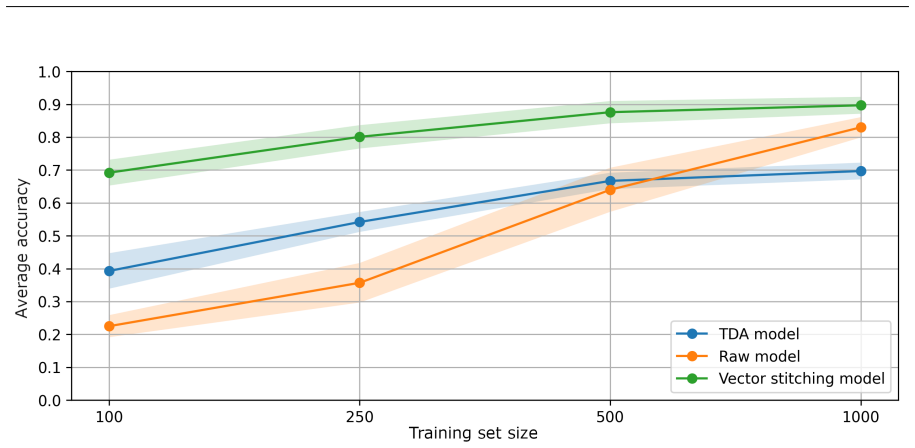
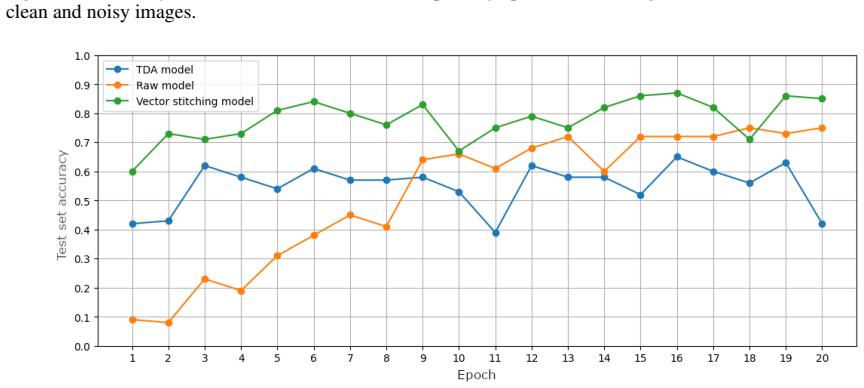
The central discovery is that adding a topological channel to a CNN's input improves classification far beyond what either channel achieves alone. A CNN shown only persistence images reaches about 30% on the hardest protocol; a CNN shown only raw pixels collapses to between 17% and 26%; the stitched model reaches 70-82% on clean-trained sets and 90% when trained on a 90/10 clean/noisy mixture. The topological models also reach high accuracy within the first epochs, suggesting the extra channel accelerates learning rather than merely enlarging the model.
Load-bearing premise
The comparison assumes the three networks are matched closely enough in architecture and training that any accuracy gap comes from the topological information, rather than from the larger stitched input or from the binarization step that filters noise.
Editorial extensions
If this is right
- If the central claim holds, hybrid TDA-plus-pixels inputs are a practical way to keep small CNNs accurate on noisy images when labeled data are scarce.
- Topological features alone are not enough: the TDA-only model saturates well below the stitched model, so the benefit comes from combining topology with raw pixels rather than replacing them.
- The early-epoch advantage suggests topological channels act as a strong prior for low-data training, reducing the number of gradient steps needed to reach a given accuracy.
- The authors' own limitation note implies the gain may shrink as networks grow or as datasets carry more information; the method's advantage is most clearly demonstrated in the small-data, high-noise regime.
Reading between the lines
- The reported gap may partly come from the binarization step removing salt-and-pepper noise before topology is computed; the paper does not isolate that effect from the topological summary itself.
- A direct causal test would replace the persistence-image tensor with a random or constant tensor of identical shape in the stitched model; equal accuracy would indicate the advantage is not specifically topological.
- If the information-theoretic reading is right, the method should transfer to other low-signal domains, such as medical imaging or time series, where objects are characterized more by shape and connectivity than by texture.
- The 17-filtration, 34-layer choice is heuristic, so a natural extension is to ablate the number and type of filtrations and measure accuracy against persistence-image resolution.
Editorial analysis
A structured set of objections, weighed in public.
Referee Report
Summary. The paper proposes 'Vector Stitching' (V-S), a method that concatenates raw grayscale MNIST images with persistence images computed by a topological data analysis (TDA) pipeline, and compares three CNNs: a raw-image model, a TDA-only model, and the V-S model. Experiments are run on small clean or 90/10 clean/noisy training sets (100 to 1000 images) with noisy test sets, repeated 10 times. The reported results in Tables 1 and 2 show that V-S substantially outperforms the other two models, and the paper interprets this through an information-theoretic discussion in Section 5.
Significance. If the reported empirical advantage is robust, the paper provides a useful demonstration that TDA-derived features can improve CNN classification in low-data, noisy regimes. The authors report means, standard deviations, and confidence intervals over 10 repetitions, and they include an honest limitations subsection. However, the current evidence is a single dataset with one noise setting, the architectures and hyperparameters are not specified, and no control isolates the topological contribution from the binarization/denoising preprocessing. The significance is therefore promising but not yet established at the level claimed in the abstract and introduction.
major comments (4)
- [§2.1 and Table 1] The comparison does not isolate the topological contribution from the binarization step. The persistence images are computed exclusively from the binarized image B defined by the fixed threshold 0.4, so the V-S model receives the raw noisy image together with summaries of a thresholded/denoised image. A binarized-image-only control, or a raw-plus-binarized control, is necessary; without it, the large V-S advantage (e.g., 0.693 vs 0.260 at 100 clean training images in Table 1) could be caused by threshold denoising rather than by persistent homology. Please add such control models and report their accuracies.
- [§3.2] The three models are not specified beyond having 'as similar a total number of parameters as possible.' Without layer counts, kernel sizes, padding, optimizers, learning rates, batch sizes, epochs, and any regularization or augmentation, the reader cannot assess capacity matching or reproduce the experiments. The RAW model's accuracy in Table 1 decreases from 0.260 at 100 images to 0.167 at 1000 images, which is suspicious and suggests training instability or unmatched hyperparameters rather than a matched comparison. Please provide complete model definitions and training details for all three networks.
- [§3.1 and §4] The experimental evidence is restricted to MNIST under one unspecified noise setting. The paper's general claims that TDA improves neural network performance, and that the information-theoretic interpretation explains this improvement, are not supported beyond this single benchmark. The authors should either substantially restrict the scope of the claims or add at least one additional dataset and a small ablation over noise levels (white-noise variance and salt-and-pepper density are not reported anywhere).
- [§5.1 and §5.3] The information-theoretic discussion is not a valid derivation of the empirical gain. The 'conditioning theorem' is invoked as 'adding information cannot hurt model performance,' but conditioning reduces entropy in expectation and does not guarantee that a computed summary improves finite-sample classifier accuracy. Since Section 5.3 acknowledges the Data Processing Inequality, Section 5 should be presented explicitly as qualitative interpretation rather than as an explanation of the V-S advantage.
minor comments (5)
- [§1.1] In the definition of an abstract simplicial complex, 'all of its subsets belong to V' should read 'belong to F'; the vertices are V, while the subsets of a simplex are faces in the family F.
- [§1.3] The text says that the interval [a, a+1] 'corresponds to a 1-dimensional standard simplex'; this is an elementary interval/cube, not a simplex. Please correct the wording.
- [Figure 8 caption] Item 2 in the caption is called a 'Persistence diagram,' but the pipeline in Section 2.1 produces a persistence image after vectorization; the caption should use the correct term.
- [§3.1] The noise generation is not reproducible: the text does not specify the white-noise distribution/variance or the salt-and-pepper density, nor how the 10 pseudorandom training/test selections were seeded.
- [§2.1] The statement that the pipeline generates a persistence image consisting of 34 layers would be easier to verify if the authors stated how the H0 and H1 channels are ordered and combined for the 17 filtrations.
Circularity Check
No circularity: the accuracy comparison is an independent empirical benchmark, and no prediction reduces to a fitted input or to a self-citation chain.
full rationale
The paper's central claim is an empirical comparison between three CNN input regimes on a noisy MNIST benchmark, with accuracies averaged over 10 independent train/test splits. No parameter is fitted to the test set and then renamed as a prediction; no quantity is defined in terms of another quantity that it is supposed to predict. The V-S input is defined in Section 2.2 as a concatenation of raw pixels and persistence images, and persistence images are a deterministic transform of the same raw image through the Section 2.1 pipeline; but a deterministic feature transformation is a standard input construction, not a circular derivation of the observed accuracy gain. There is also no load-bearing self-citation: the external references that justify the ingredients (Adams et al. for persistence images, Garin and Tauzin for the filtrations, McGuire et al. for the claim that raw-trained networks underuse topology) are independent prior work, and none of the paper's premises is justified solely by the present authors' own prior results. The information-theoretic discussion in Section 5 is qualitative interpretation rather than a derivation, and Section 5.3 explicitly acknowledges the Data Processing Inequality, so the authors do not claim the method manufactures information beyond its input; they also concede the effect may shrink with larger networks. Those limitations weaken causal isolation of topology from the accompanying binarization and from input tensor size, but that is an experimental-control concern, not circularity. No specific circular step can be exhibited, so the honest finding is a score of 0.
Assumptions & free parameters
free parameters (5)
- Binarization threshold =
0.4
- Height filtration directions =
8
- Radial filtration centers =
9
- Persistence image resolution and bandwidth =
not stated
- Noise levels =
not stated
assumptions (4)
- domain assumption A CNN trained on raw pixel data has limited ability to capture topological properties of images.
- domain assumption Adding relevant information cannot hurt performance because conditioning reduces entropy (the conditioning theorem).
- domain assumption Matching total parameter counts is sufficient to make raw, TDA, and stitched models comparable.
- standard math Persistence homology and persistence image definitions are correct as given.
Cite this review
Pith. "Pith review of Preserving Information: How does Topological Data Analysis improve Neural Network performance?." pith.science (2026). https://pith.science/paper/SYOYYGBX
@misc{pith2026241118410,
  author       = {Pith},
  title        = {Pith review of: Preserving Information: How does Topological Data Analysis improve Neural Network performance?},
  year         = {2026},
  howpublished = {\url{https://pith.science/paper/SYOYYGBX}},
  note         = {Machine review of arXiv:2411.18410}
}
read the original abstract
Artificial Neural Networks (ANNs) require significant amounts of data and computational resources to achieve high effectiveness in performing the tasks for which they are trained. To reduce resource demands, various techniques, such as Neuron Pruning, are applied. Due to the complex structure of ANNs, interpreting the behavior of hidden layers and the features they recognize in the data is challenging. A lack of comprehensive understanding of which information is utilized during inference can lead to inefficient use of available data, thereby lowering the overall performance of the models. In this paper, we introduce a method for integrating Topological Data Analysis (TDA) with Convolutional Neural Networks (CNN) in the context of image recognition. This method significantly enhances the performance of neural networks by leveraging a broader range of information present in the data, enabling the model to make more informed and accurate predictions. Our approach, further referred to as Vector Stitching, involves combining raw image data with additional topological information derived through TDA methods. This approach enables the neural network to train on an enriched dataset, incorporating topological features that might otherwise remain unexploited or not captured by the network's inherent mechanisms. The results of our experiments highlight the potential of incorporating results of additional data analysis into the network's inference process, resulting in enhanced performance in pattern recognition tasks in digital images, particularly when using limited datasets. This work contributes to the development of methods for integrating TDA with deep learning and explores how concepts from Information Theory can explain the performance of such hybrid methods in practical implementation environments.
Figures


Figures from the paper (11 more)




Reference graph
Works this paper leans on
- [1]
-
[2]
G. Carlsson. Topology and Data. Bulletin of The American Mathematical Society - BULL AMER MATH SOC, vol. 46, pp. 255–308, Apr. 2009. DOI: 10.1090/S0273-0979-09-01249-X
- [3]
-
[4]
V . Bhanumathi, R. Sangeetha. CNN Based Training and Classification of MRI Brain Images . 2019 5th International Conference on Advanced Computing & Communication Systems (ICACCS), pp. 129–133, 2019. DOI: 10.1109/ICACCS.2019.8728447
-
[5]
S. McGuire, S. Jackson, T. Emerson, H. Kvinge. Do neural networks trained with topological features learn different internal representations? Proceedings of the 1st NeurIPS Workshop on Symmetry and Geometry in Neural Representations, vol. 197, pp. 122–136, Mar. 2023
work page 2023
- [6]
-
[7]
P. Bubenik, P. Dłotko. A persistence landscapes toolbox for topological statistics . Journal of Symbolic Computation, vol. 78, pp. 91–114, 2017. DOI: 10.1016/j.jsc.2016.03.009
- [8]
Show all 27 references
-
[9]
P. O. de Mendez. Geometric Realization of Simplicial Complexes . Graph Drawing. Berlin, Heidelberg: Springer Berlin Heidelberg, pp. 323–332, 1999. ISBN: 978-3-540-46648-2
1999
-
[10]
de Silva, R
V . de Silva, R. Ghrist. Coordinate-free coverage in sensor networks with controlled boundaries via ho- mology. The International Journal of Robotics Research, vol. 25, no. 12, pp. 1205–1222, 2006. DOI: 10.1177/0278364906072252
2006 doi
-
[11]
Muhammad, A
A. Muhammad, A. Jadbabaie. Dynamic Coverage Verification in Mobile Sensor Networks Via Switched Higher Order Laplacians. June 2007. DOI: 10.15607/RSS.2007.III.039
2007 doi
-
[12]
Kaczynski, K
T. Kaczynski, K. Mischaikow, M. Mrozek. Computational Homology. Springer New York, NY , 2004
2004
-
[13]
Zomorodian, G
A. Zomorodian, G. Carlsson. Computing Persistent Homology. Discrete & Computational Geometry, vol. 33, no. 2, pp. 249–274, Feb. 2005. DOI: 10.1007/s00454-004-1146-y
2005 doi
-
[14]
E. H. Spanier. The Mayer Homology Theory, 1949
1949
-
[15]
C. Park, P. Pranav, P. Chingangbam, R. van de Weygaert, B. Jones, G. Vegter, I. Kim, J. Hidding, W. A. Hellwing. Betti numbers of Gaussian fields. Journal of Korean Astronomical Society, vol. 46, July 2013. DOI: 10.5303/JKAS.2013.46.3.125
2013 doi
-
[16]
Di Fabio, M
B. Di Fabio, M. Ferri. Comparing Persistence Diagrams Through Complex Vectors. Image Analysis and Processing — ICIAP 2015. Cham: Springer International Publishing, pp. 294–305, 2015. ISBN: 978-3-319- 23231-7
2015
-
[17]
Bubenik.Statistical Topological Data Analysis using Persistence Landscapes
P. Bubenik.Statistical Topological Data Analysis using Persistence Landscapes. Journal of Machine Learning Research, vol. 16, no. 3, pp. 77–102, 2015
2015
-
[18]
D. Ali, A. Asaad, M. Jimenez, V . Nanda, E. Paluzo-Hidalgo, M. Soriano-Trigueros.A Survey of Vectorization Methods in Topological Data Analysis. IEEE Transactions on Pattern Analysis & Machine Intelligence, vol. 45, no. 12, pp. 14069–14080, Dec. 2023. DOI: 10.1109/TPAMI.2023.3308391
2023
-
[19]
L. Deng. The mnist database of handwritten digit images for machine learning research . IEEE Signal Processing Magazine, vol. 29, no. 6, pp. 141–142, 2012
2012
-
[20]
https://github.com/giotto-ai, access date: 07.05.2024
Giotto-AI project. https://github.com/giotto-ai, access date: 07.05.2024. 16
2024
-
[21]
Tauzin, U
G. Tauzin, U. Lupo, L. Tunstall, J. Burella Pérez, M. Caorsi, A. Medina-Mardones, A. Dassatti, K. Hess. giotto-tda: A Topological Data Analysis Toolkit for Machine Learning and Data Exploration. 2020. arXiv:2004.02551 [cs.CG]
2020 arXiv
-
[22]
GUDHI User and Reference Manual
The GUDHI Project. GUDHI User and Reference Manual . 3.9.0. GUDHI Editorial Board, 2023. URL: https://gudhi.inria.fr/doc/3.9.0/. access date: 15.06.2024
2023
-
[23]
Garin, G
A. Garin, G. Tauzin. A Topological "Reading" Lesson: Classification of MNIST using TDA. 2019 18th IEEE International Conference On Machine Learning And Applications (ICMLA), pp. 1551–1556, 2019. DOI: 10.1109/ICMLA.2019.00256
2019
-
[24]
Singh, C
Y . Singh, C. M. Farrelly, Q. A. Hathaway, et al.Topological Data Analysis in Medical Imaging: Current State of the Art. Insights Imaging, vol. 14, no. 1, p. 58, 2023. DOI: 10.1186/s13244-023-01413-w
2023 doi
-
[25]
Bresten, J
C. Bresten, J. H. Jung. Detection of Gravitational Waves Using Topological Data Analysis and Convolutional Neural Network: An Improved Approach. arXiv:1910.08245, Oct. 2019
1910 arXiv
-
[26]
J. A. Thomas, T. M. Cover. Elements of Information Theory. John Wiley Sons, Inc., 2005
2005
-
[27]
Vaswani, N
A. Vaswani, N. Shazeer, N. Parmar, J. Uszkoreit, L. Jones, A. N. Gomez, Ł. Kaiser, I. Polosukhin.Attention is All You Need. Advances in Neural Information Processing Systems, vol. 30, 2017. 17
2017
Reviewed August 12, 2026 · model on record in the stance chip above.
Discussion (0). Continue with ORCID to comment.