REVIEW 4 major objections 5 minor 15 references
Signs for the onset of gluon saturation in exclusive photo-production of vector mesons
T0 review · 4 major / 5 minor · reviewed 2026-08-14 · deepseek-v4-flash
Pith's one-line read Exclusive J/psi photoproduction at the LHC shows the onset of gluon saturation.
desk verdict A suggestive but non-quantitative proceedings reprint: the central saturation claim is already in the authors' PLB paper, and the one new piece—the r-dependent scale comparison—leaves the LHC-region scale ambiguity unquantified. read the letter →
The pith
A machine-rendered reading of the paper's core claim, the machinery that carries it, and where it could break.
The reading
What carries the argument
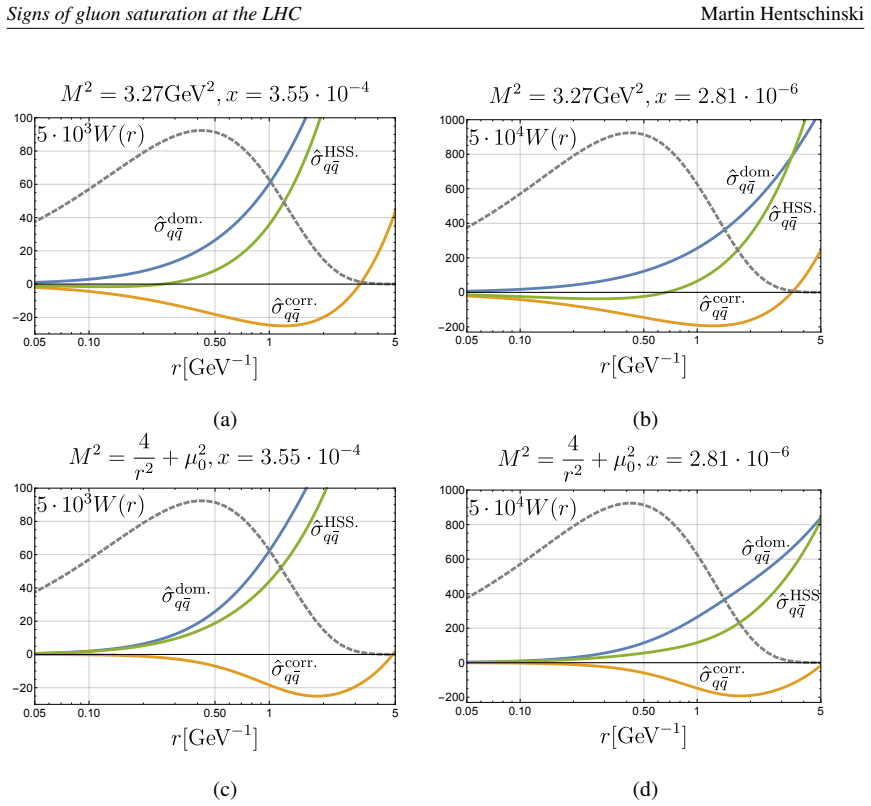
The central object is the unintegrated gluon distribution and its dipole cross-section transform, used to compute exclusive vector-meson photoproduction. For the HSS gluon the dipole cross-section factorizes as a formally leading BFKL term plus a next-to-leading-logarithmic correction $\propto \bar\alpha_s^2 \beta_0 \chi_0(\gamma)\log(1/x)$; that correction is the mechanism that breaks the fixed-scale linear expansion at small $x$ and motivates an $r$-dependent renormalization scale. For the KS gluon the machinery is the nonlinear BK evolution equation, whose damping of the gluon growth at high density tames the cross-section rise. The comparison of these two computations against the $J/\Psi$ and $\Upsilon$ photoproduction data is what carries the argument.
What would settle it
Compute the stabilized linear prediction for $J/\Psi$ photoproduction across the full LHC energy range with that internal scale varied over the same range that reproduces the HERA-region variation; if the linear prediction can be made to match the LHC data within that band, the conclusion that nonlinear effects are required is not established.
Extended reading notes
Core claim
On the paper's own terms, the central discovery is that non-linear corrections to low-$x$ QCD evolution are essential to describe the energy dependence of exclusive $J/\Psi$ photoproduction in the LHC region, and that this necessity is a sign of the onset of gluon saturation. The authors construct this by taking two fits of the unintegrated gluon distribution: the HSS gluon, from linear NLO BFKL evolution, and the KS gluon, a solution to nonlinear BK evolution fitted to combined HERA data. With the renormalization scale fixed at a heavy-quark scale, the formally sub-leading perturbative correction in the HSS dipole cross-section grows toward small $x$ and eventually dominates, so an $r$-dependent scale is used to stabilize the linear prediction. The stabilized linear HSS prediction agrees with the HERA-region data within typical scale variation but overshoots the LHC $J/\Psi$ data, and the linearized KS gluon overshoots as well; the full nonlinear KS gluon describes the data. The paper reads this pattern as evidence that a high-density, saturating gluon configuration is being probed.
Load-bearing premise
The argument assumes that the linear benchmark calculation is still trustworthy after its internal energy scale is adjusted; if its overshoot at LHC energies is just a leftover of that adjustment, the claimed saturation signal disappears.
Editorial extensions
If this is right
- A successful nonlinear BK-based gluon fit to inclusive HERA data transfers to exclusive $J/\Psi$ photoproduction in the LHC region, while the linear BFKL benchmark fails; the low-$x$ gluon growth implied by the data is damped.
- The $\Upsilon$ channel stays in the perturbative regime and should remain describable by linear evolution, providing a scale-dependent cross-check of the saturation interpretation.
- Further exclusive $J/\Psi$ photoproduction measurements at smaller $x$ should show a flatter-than-linear rise if saturation is setting in.
- Linear frameworks that want to describe the LHC $J/\Psi$ data must invoke unnaturally large perturbative corrections, which the paper treats as a symptom rather than a viable alternative.
- The conclusion depends on the stabilized linear calculation, so improving the theoretical accuracy of the linear low-$x$ framework directly sharpens the saturation signal.
Reading between the lines
- An extension the authors do not make: apply the same two gluons to other exclusive processes at comparable and smaller $x$; the same pattern should appear if the interpretation is right and disappear if the $J/\Psi$ result is peculiar to that channel.
- The comparison's power rests on quantifying the scale-variation band of the linear prediction in the LHC region; an explicit envelope would turn the claimed overshoot from an interpretation into a metrologically testable statement.
- A quantitative measure of the onset could be formed from the ratio of nonlinear to linear cross-sections at each LHC energy and compared with saturation-scale estimates from other low-$x$ processes.
- If the interpretation is right, the fixed-scale perturbative expansion in $\log(1/x)$ should break down exactly where the $J/\Psi$ data deviate, so repeating the analysis at higher resummation order predicts where linear evolution regains validity.
Signed reviews
Editorial analysis
A structured set of objections, weighed in public.
Referee Report
Summary. The paper compares two unintegrated gluon densities in exclusive J/psi and Upsilon photoproduction: the nonlinear BK-based Kutak-Sapeta (KS) gluon and the linear NLO BFKL-based Hentschinski-Sabio Vera-Salas (HSS) gluon. After adopting an r-dependent renormalization scale for the HSS gluon, the authors report that the linear HSS prediction overshoots LHC-region J/psi data, whereas the nonlinear KS gluon describes the energy dependence; switching off nonlinearities in the KS gluon also leads to an overshoot. The paper interprets this difference as a sign of the onset of gluon saturation.
Significance. If established, this would be a valuable phenomenological indication of nonlinear small-x QCD dynamics in an otherwise standard exclusive process, and the choice of a linear BFKL baseline rather than a DGLAP fit is well motivated. The comparison is not directly circular because the KS and HSS gluon parameters are determined from inclusive HERA data, not from the LHC photoproduction points used for the test. The main strengths are the clear falsification logic and the explicit use of two different evolution frameworks. However, the evidence presented is qualitative: no theory uncertainty bands, no goodness-of-fit measures, and no explicit definition of the 'linear KS' limit. The central claim therefore currently rests on the visual size of the LHC-region overshoot relative to an unquantified renormalization-scale variation.
major comments (4)
- [Sec. 3, discussion of Fig. 2] The central discriminator is whether the LHC-region overshoot of the HSS prediction exceeds the theoretical uncertainty of the linear benchmark. The paper states that the difference between the fixed-scale and r-dependent-scale HSS solutions is 'of the order of a typical variation of the renormalization scale' only for the HERA region; no analogous scale-variation envelope is given in the LHC region, where the overshoot is claimed. Without this envelope, the plotted dashed-green overshoot cannot be distinguished from a scale-setting artifact, and the conclusion that linear evolution fails at LHC energies is not quantitatively supported.
- [Sec. 3, dashed black curve in Fig. 1] The 'KS-gluon with non-linearities turned off' is presented as the controlled linear limit that demonstrates the need for nonlinear terms, but the manuscript does not define which terms are removed (for example, whether the BK kernel is set to its linear part or the evolution is stopped after the initial condition) and does not provide uncertainty estimates for this limit. Since this curve is part of the key falsification test, its precise definition and reasonable uncertainty band are required before the comparison can be interpreted.
- [Sec. 3 and Fig. 1] No uncertainty bands on any of the theory curves and no chi-squared or other goodness-of-fit values are reported. In the LHC J/psi region the data have appreciable scatter, and the visual difference between the HSS overshoot and the data is comparable in size to that scatter. Reporting the deviation of each theory prediction from the data in units of the experimental uncertainty would turn the claimed failure of HSS and success of KS into a quantitative statement.
- [Abstract and Sec. 3] The abstract claims that linear NLO BFKL evolution can describe the highest-energy data only if perturbative corrections are increased to 'unnaturally large values', but the manuscript never quantifies 'unnaturally large'. The text gives the fixed scale M^2 = 3.27 GeV^2 and the r-dependent scale, and Fig. 2 shows the correction becoming large, but no explicit numerical comparison of the correction to the leading term is given for the LHC kinematics. A concrete ratio or scale value would substantiate this claim.
minor comments (5)
- [Abstract] The phrase 'in low x the proton' should read 'in the low-x proton' or 'in the proton at low x'.
- [Sec. 3, text near Eq. (3.2)] The sentence 'the corrections supersedes the formally leading term' contains a subject-verb disagreement; 'supersede' is the correct form with the plural subject 'corrections'.
- [Fig. 1] The figure has no legend and the caption does not identify which line corresponds to which gluon or scale setting; the text description of colors is not usable in monochrome print.
- [Eqs. (3.1)-(3.2)] The notation for the arguments of the dipole cross-section and the ratio \bar{\alpha}_s(M\cdot Q_0)/\bar{\alpha}_s(M^2) should be defined explicitly, since the scale choices are central to the argument.
- [Sec. 2] The statement that collinear PDFs provide no perturbative evolution for J/psi photoproduction would benefit from a quantitative illustration or a reference to a collinear-fit analysis of the same observable, so that the reader can assess the claimed disadvantage relative to the BFKL benchmark.
Circularity Check
No significant circularity: the linear-versus-nonlinear comparison is anchored by HERA fits and extrapolated to LHC data not used in those fits.
full rationale
The paper's central claim is that a nonlinear BK-based gluon (KS) describes the LHC-region energy rise of exclusive J/psi photoproduction while two linear benchmarks (HSS NLO BFKL and the linear limit of KS) do not. The HSS and KS gluon distributions are published fits to combined HERA inclusive data ([3], [8]), and the LHC J/psi and Upsilon points used for comparison are not part of those fits; the LHC comparison is therefore a genuine extrapolation rather than a re-description of the fitted inputs. The 'linear KS' is obtained by switching off nonlinearities in the KS solution, and its overshoot is a diagnostic of the nonlinear term, not a fitted prediction. The HSS baseline's r-dependent renormalization scale is introduced to stabilize the perturbative correction (Sec. 3: 'choosing an r-dependent renormalization scale. This removes the r-dependent logarithm in the correction term'), and the resulting overshoot is presented as a failure of linear evolution, not as a parameter fitted to LHC data. No equation in the paper defines the output in terms of the input, and no fitted parameter is renamed as a prediction. The main weaknesses are quantitative rather than circular: the paper does not provide the renormalization-scale variation envelope in the LHC region (it only states the HERA-region deviation is 'of the order of a typical variation of the renormalization scale'), and the 'linear KS' limit is not precisely specified. These are robustness and uncertainty issues, not circular reductions. The authors also cite their own prior work ([3], [6], [7], [8]) for the gluon fits and scale setting, but those fits are data-anchored and externally published, so the self-citations are not the load-bearing source of the conclusion.
Assumptions & free parameters
free parameters (4)
- HSS gluon fit parameters =
Not given here (fitted in [3])
- KS gluon fit parameters =
Not given here (fitted in [8])
- HSS renormalization scale setting =
Fixed M^2 = 3.27 GeV^2 or r-dependent
- Vector meson wave function and production model inputs =
Not specified in this paper
assumptions (5)
- domain assumption Exclusive vector meson photoproduction can be computed via dipole factorization using the unintegrated gluon distribution.
- domain assumption The HSS and KS gluon distributions fitted to inclusive HERA data can be extrapolated to the lower x values probed at the LHC.
- ad hoc to paper Turning off nonlinearities in the KS gluon produces a valid linear limit of the same fit.
- ad hoc to paper The r-dependent renormalization scale choice for the HSS gluon provides a trustworthy linear benchmark.
- domain assumption The heavy quark mass provides a hard scale that justifies perturbative QCD for J/Ψ and Upsilon production.
Cite this review
Pith. "Pith review of Signs for the onset of gluon saturation in exclusive photo-production of vector mesons." pith.science (2026). https://pith.science/paper/SYVHI3WP
@misc{pith2026190803494,
  author       = {Pith},
  title        = {Pith review of: Signs for the onset of gluon saturation in exclusive photo-production of vector mesons},
  year         = {2026},
  howpublished = {\url{https://pith.science/paper/SYVHI3WP}},
  note         = {Machine review of arXiv:1908.03494}
}
abstract
We investigate the energy dependence of the photo-production cross-section of vector mesons $J/\Psi$ and $\Upsilon$, measured by both HERA experiments H1 and ZEUS in electron-proton collisions and by LHC experiments ALICE, CMS and LHCb in ultra-peripheral proton-proton and ultra-peripheral proton-lead collisions. Our study uses 2 particular fits of inclusive unintegrated gluon distribution, based on non-linear Balitsky-Kovchegov evolution (Kutak-Sapeta gluon; KS) and next-to-leading order Balitsky-Fadin-Kuraev-Lipatov evolution (Hentschinski-Sabio Vera-Salas gluon; HSS). We find that linear next-to-leading order BFKL evolution can only describe production at highest energies, if perturbative corrections are increased to unnaturally large values; rendering this corrections small, the growth with energy is too strong in the LHC region and the description of $J/\Psi$ data fails. For the KS gluon we find that an accurate description of $J/\Psi$ data is possible if non-linear corrections to low x QCD evolution are taken into account; without such correction a description of data fails. We interpret this observation as a clear signal for the presence of high gluon densities in low x the proton, characteristic for the onset of gluon saturation.
Figures

Reference graph
Works this paper leans on
-
[1]
H. Abramowicz et al. [H1 and ZEUS Collaborations], Eur. Phys. J. C 75, no. 12, 580 (2015) doi:10.1140/epjc/s10052-015-3710-4 [arXiv:1506.06042 [hep-ex]]
arXiv 2015
-
[2]
L. N. Lipatov, Sov. J. Nucl. Phys. 23 (1976) 338, E. A. Kuraev, L. N. Lipatov, V . S. Fadin, Phys. Lett. B 60 (1975) 50, Sov. Phys. JETP 44 (1976) 443, Sov. Phys. JETP 45 (1977) 199. I. I. Balitsky, L. N. Lipatov, Sov. J. Nucl. Phys.28 (1978) 822
work page 1976
-
[3]
The hard to soft Pomeron transition in small x DIS data using optimal renormalization
M. Hentschinski, A. Sabio Vera and C. Salas, Phys. Rev. Lett. 110 (2013) no.4, 041601 [arXiv:1209.1353 [hep-ph]]
work page Pith review arXiv 2013
-
[4]
L. V . Gribov, E. M. Levin and M. G. Ryskin, Phys. Rept.100 (1983) 1. doi:10.1016/0370-1573(83)90022-4
-
[5]
I. Balitsky, Nucl. Phys. B 463 (1996) 99 doi:10.1016/0550-3213(95)00638-9 [hep-ph/9509348]; Y . V . Kovchegov, Phys. Rev. D60 (1999) 034008 doi:10.1103/PhysRevD.60.034008 [hep-ph/9901281]
arXiv 1996
-
[6]
A. Arroyo Garcia, M. Hentschinski and K. Kutak, Phys. Lett. B 795, 569 (2019) doi:10.1016/j.physletb.2019.06.061 [arXiv:1904.04394 [hep-ph]]
arXiv 2019
-
[7]
I. Bautista, A. Fernandez Tellez and M. Hentschinski, Phys. Rev. D 94, no. 5, 054002 (2016) doi:10.1103/PhysRevD.94.054002 [arXiv:1607.05203 [hep-ph]]
arXiv 2016
-
[8]
K. Kutak and S. Sapeta, Phys. Rev. D 86 (2012) 094043 doi:10.1103/PhysRevD.86.094043 [arXiv:1205.5035 [hep-ph]]
arXiv 2012
Show all 15 references
-
[9]
Chekanov et al
S. Chekanov et al. [ZEUS Collaboration], Eur. Phys. J. C 24, 345 (2002) [hep-ex/0201043]; S. Chekanov et al. [ZEUS Collaboration], Nucl. Phys. B 695, 3 (2004) [hep-ex/0404008]; C. Alexa et al. [H1 Collaboration], Eur. Phys. J. C 73, no. 6, 2466 (2013) [arXiv:1304.5162 [hep-ex]...
2002 arXiv
-
[10]
B. B. Abelev et al. [ALICE Collaboration], Phys. Rev. Lett. 113, no. 23, 232504 (2014) [arXiv:1406.7819 [nucl-ex]]; S. Acharya et al. [ALICE Collaboration], Eur. Phys. J. C 79, no. 5, 402 (2019) doi:10.1140/epjc/s10052-019-6816-2 [arXiv:1809.03235 [nucl-ex]]; R. Aaij et al. [L...
2014 arXiv
-
[11]
Adloff et al
C. Adloff et al. [H1 Collaboration], Phys. Lett. B 483, 23 (2000) [hep-ex/0003020]; J. Breitweg et al. [ZEUS Collaboration], Phys. Lett. B 437 (1998) 432 [hep-ex/9807020]; S. Chekanov et al. [ZEUS Collaboration], Phys. Lett. B 680, 4 (2009) [arXiv:0903.4205 [hep-ex]]
2000 arXiv
-
[12]
Measurement of exclusive Y photoproduction in pPb collisions at√sNN = 5.02 TeV,
R. Aaij et al. [LHCb Collaboration], JHEP 1509, 084 (2015) [arXiv:1505.08139 [hep-ex]]; CMS Collaboration [CMS Collaboration], “Measurement of exclusive Y photoproduction in pPb collisions at√sNN = 5.02 TeV,” CMS-PAS-FSQ-13-009; A. M. Sirunyanet al. [CMS Collaboration], Eur. P...
2015 arXiv
-
[13]
van Hameren, P
A. van Hameren, P. Kotko, K. Kutak and S. Sapeta, arXiv:1903.01361 [hep-ph]. 5 Signs of gluon saturation at the LHC Martin Hentschinski
1903 arXiv
-
[14]
Hentschinski, A
M. Hentschinski, A. Kusina, K. Kutak and M. Serino, Eur. Phys. J. C 78 (2018) no.3, 174 doi:10.1140/epjc/s10052-018-5634-2 [arXiv:1711.04587 [hep-ph]]. M. Hentschinski, A. Kusina and K. Kutak, Phys. Rev. D 94 (2016) no.11, 114013 doi:10.1103/PhysRevD.94.114013 [arXiv:1607.0150...
2018 arXiv
-
[15]
Hentschinski, Phys
M. Hentschinski, Phys. Rev. D 97 (2018) no.11, 114027 doi:10.1103/PhysRevD.97.114027 [arXiv:1802.06755 [hep-ph]]. M. Hentschinski and A. Sabio Vera, Phys. Rev. D85 (2012) 056006 [arXiv:1110.6741 [hep-ph]]; M. Hentschinski, Nucl. Phys. B 859 (2012) 129 [arXiv:1112.4509 [hep-ph]...
2018 arXiv
Reviewed August 14, 2026 · model on record in the stance chip above.
Discussion (0). Continue with ORCID to comment.