Coherent and Incoherent Emission from the Ordered Magnetospheres of Low-Mass Stars, UCDs, and Massive Stars
Pith reviewed 2026-07-01 01:24 UTC · model grok-4.3
The pith
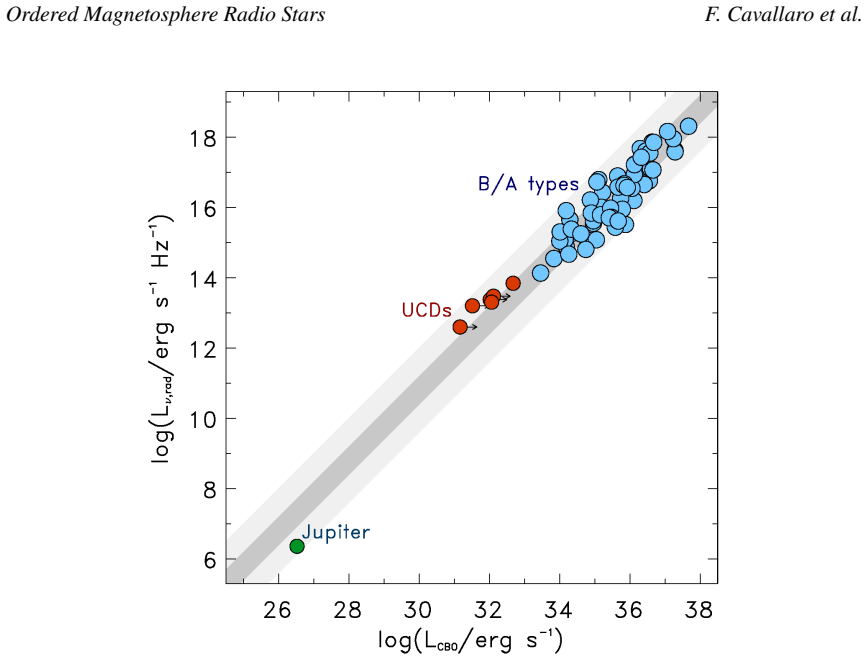
Radio luminosity trends in ultracool dwarfs match those of massive magnetic stars, indicating a centrifugal breakout process may operate in both.
A machine-rendered reading of the paper's core claim, the machinery that carries it, and where it could break.
Core claim
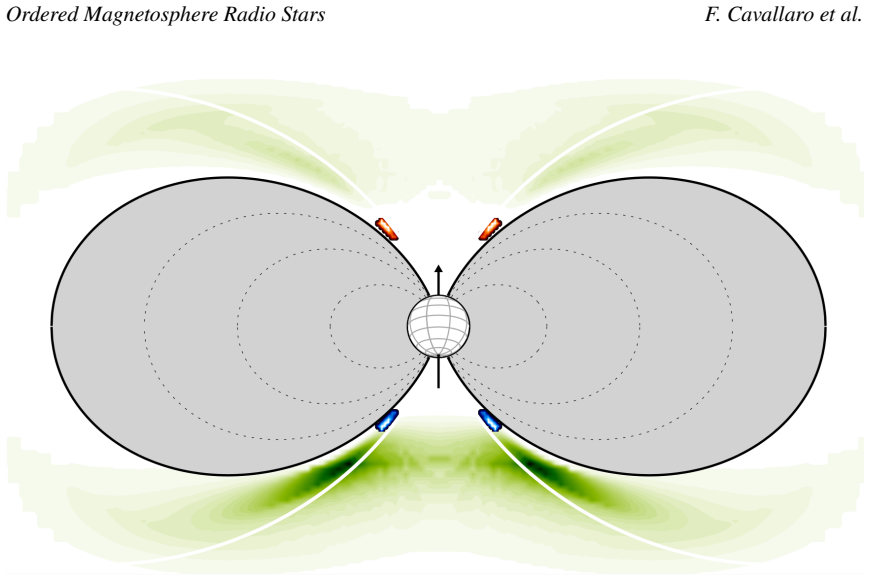
In massive stars the centrifugal breakout mechanism confines plasma until centrifugal forces exceed magnetic tension, triggering reconnection events that generate the non-thermal electrons responsible for the observed incoherent radio emission; the radio luminosity correlates directly with the power released by these events. The same luminosity–rotation–confinement trends appear in ultracool dwarfs, suggesting that a centrifugal-breakout-like process also operates in their fully convective magnetospheres even though the plasma source remains unidentified.
What carries the argument
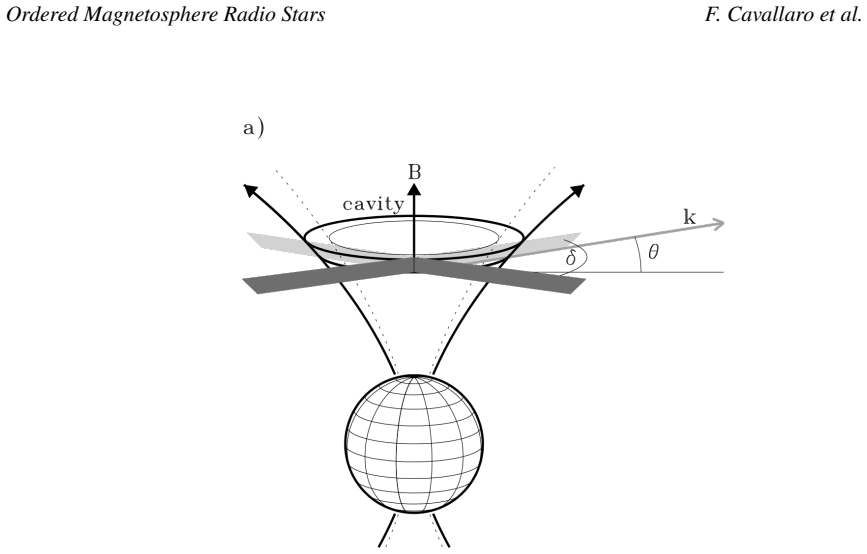
The centrifugal breakout (CBO) mechanism, in which plasma trapped inside the co-rotation radius accumulates until centrifugal forces drive magnetic reconnection and particle acceleration.
If this is right
- Radio output in both stellar classes is directly tied to the product of rotation rate and magnetic confinement efficiency.
- Coherent electron cyclotron maser emission occurs in both regimes and exhibits similar polarization and modulation properties.
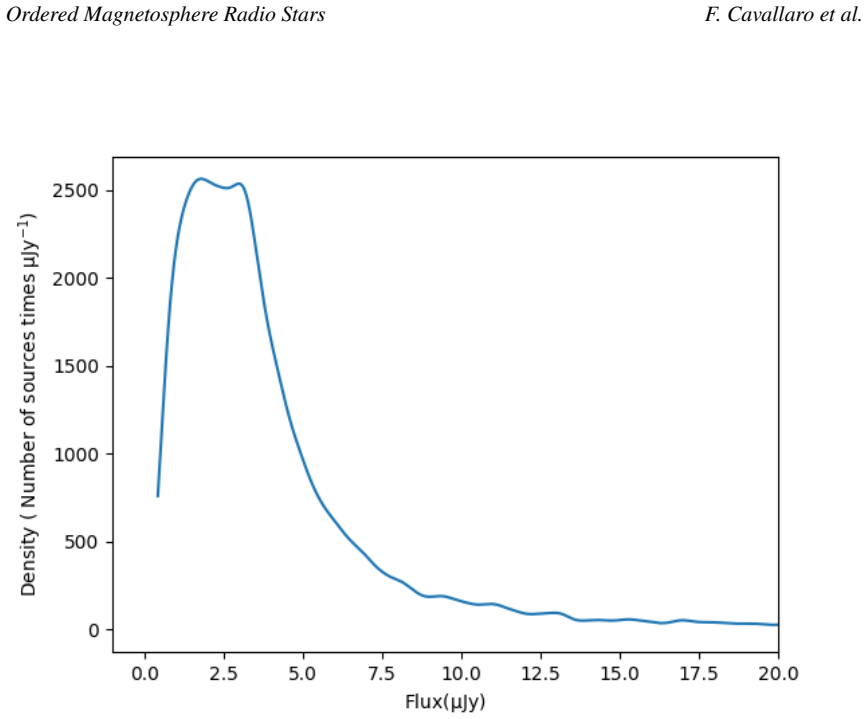
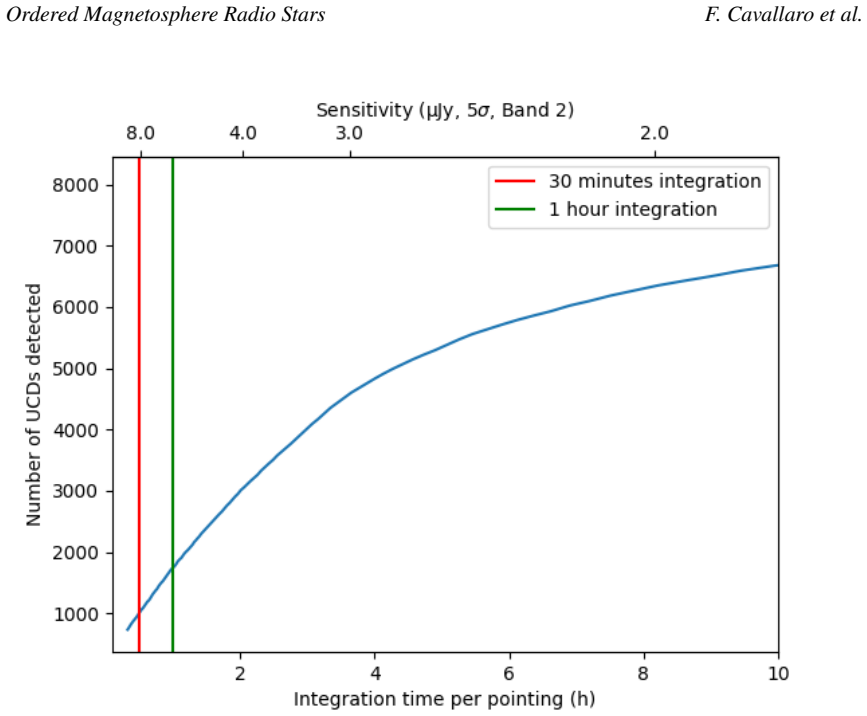
- Statistical tests of the centrifugal breakout hypothesis become feasible once the Square Kilometre Array surveys hundreds of ultracool dwarfs.
Where Pith is reading between the lines
- If the same breakout scaling applies to ultracool dwarfs, radio surveys could map their internal magnetic field strengths without relying on optical or X-ray data.
- The shared presence of coherent emission raises the possibility that the same magnetospheric current systems operate from planets to low-mass stars.
- Extending the comparison to intermediate-mass stars with fossil fields could test whether the breakout process depends on the presence of a convective dynamo.
Load-bearing premise
The assumption that matching radio luminosity trends between massive stars and ultracool dwarfs indicate the same physical mechanism is operating, even though the sources of plasma differ and ultracool dwarfs lack strong stellar winds.
What would settle it
A large sample of ultracool dwarfs in which radio luminosity shows no correlation with the expected centrifugal breakout power calculated from rotation rate and magnetic field strength.
Figures
read the original abstract
Massive early-type (B/A) stars and ultracool dwarfs (UCDs) represent two distinct regimes in which ordered, large-scale magnetospheres are observed. In rapidly rotating massive stars, incoherent radio emission is explained by the centrifugal breakout (CBO) mechanism: plasma confined within the rigidly rotating magnetosphere accumulates beyond the co-rotation radius, where centrifugal forces trigger breakout events and magnetic reconnection, generating non-thermal electrons that produce incoherent gyro-synchrotron emission. Empirically, the radio luminosity correlates with the power released by CBO events, establishing a clear link between stellar rotation, magnetic confinement, and radio output. In UCDs, persistent non-thermal radio emission exhibits similar luminosity trends to those of massive magnetic stars, despite the absence of strong stellar winds. This similarity suggests that a CBO-like process may also operate in these fully convective, low-mass objects, though the plasma source and acceleration mechanisms remain uncertain. In both classes, coherent electron cyclotron maser emission (ECME), characterized by strong polarization and rotational modulation, is observed, indicating common magnetospheric processes analogous to planetary auroral emission. The Square Kilometre Array (SKA) will be able to deeply observe about 70\% of the sky. We expect to observe $\sim 1000$ UCDs, enabling better statistical analysis of their emission and a test of the CBO hypothesis.
Editorial analysis
A structured set of objections, weighed in public.
Referee Report
Summary. The manuscript reviews ordered magnetospheres in massive early-type stars and ultracool dwarfs (UCDs). For massive stars it summarizes the centrifugal breakout (CBO) mechanism for incoherent gyro-synchrotron emission, noting an empirical correlation between radio luminosity and CBO power. It then argues that similar radio-luminosity trends in UCDs, despite the absence of strong stellar winds, suggest a CBO-like process may operate in these objects, while acknowledging that the plasma source and acceleration mechanisms remain uncertain. The paper also discusses coherent electron-cyclotron-maser emission (ECME) in both classes and states that SKA observations of ~1000 UCDs will enable a statistical test of the CBO hypothesis.
Significance. If the proposed analogy holds, the work would help unify the interpretation of non-thermal radio emission across stellar regimes with large-scale ordered fields. A clear strength is the explicit, falsifiable prediction that SKA will detect ~1000 UCDs, providing a concrete observational test of the CBO-like hypothesis.
major comments (1)
- [Abstract] Abstract: the central suggestion that 'a CBO-like process may also operate in these fully convective, low-mass objects' rests on the observed similarity of radio-luminosity trends to those in massive stars. However, the same paragraph explicitly flags the absence of strong stellar winds and leaves the plasma source and acceleration mechanisms uncertain, without referencing an adapted CBO scaling relation or quantitative model for UCDs that would make the trend diagnostic of centrifugal breakout rather than alternative reconnection or acceleration processes.
Simulated Author's Rebuttal
We thank the referee for their constructive review and for highlighting the potential unifying value of the work. We respond to the single major comment on the abstract below.
read point-by-point responses
-
Referee: [Abstract] Abstract: the central suggestion that 'a CBO-like process may also operate in these fully convective, low-mass objects' rests on the observed similarity of radio-luminosity trends to those in massive stars. However, the same paragraph explicitly flags the absence of strong stellar winds and leaves the plasma source and acceleration mechanisms uncertain, without referencing an adapted CBO scaling relation or quantitative model for UCDs that would make the trend diagnostic of centrifugal breakout rather than alternative reconnection or acceleration processes.
Authors: We agree that the abstract presents an empirical analogy based on similar radio-luminosity trends while explicitly noting the absence of strong winds and uncertainties in plasma source and acceleration. As a review manuscript, we do not develop or reference a quantitative adapted CBO scaling relation for UCDs; the intent is to highlight the observed parallel as motivation for considering a CBO-like process and to propose that SKA observations can statistically test the hypothesis. We will revise the abstract to state more explicitly that the suggestion is a tentative hypothesis motivated by the trends rather than a claim that the trends are uniquely diagnostic of centrifugal breakout. revision: yes
Circularity Check
No significant circularity in derivation chain
full rationale
The paper states an empirical correlation for massive stars (radio luminosity correlates with CBO power) and notes similar trends in UCDs to suggest a possible CBO-like process, while explicitly acknowledging uncertain plasma sources. No equations, fitted parameters renamed as predictions, or self-citation chains are present that reduce any claim to its inputs by construction. The SKA count estimate is a direct observational projection, not a derived result. The text contains no load-bearing self-definitional steps, ansatzes, or uniqueness theorems.
Axiom & Free-Parameter Ledger
Reference graph
Works this paper leans on
-
[1]
doi: 10.1007/s11214-014-0042-x. E. Berger. ApJ, 572(1):503–513, June
-
[2]
doi: 10.1086/340301. W. M. J. Best et al. ApJ, 967(2):115, June
-
[3]
doi: 10.3847/1538-4357/ad39ef. A. Biswas et al. ApJ, 980(2):260, Feb
-
[4]
doi: 10.3847/1538-4357/adae02. A. J. Burgasser and M. E. Putman. ApJ, 626(1):486–497, June
-
[5]
doi: 10.1086/429788. P . Chandra et al. MNRAS, 452(2):1245–1253, Sep
-
[6]
doi: 10.1093/mnras/stv1378. J. B. Climent et al. Science, 381(6662):1120–1124, Sept
-
[7]
doi: 10.1126/science.adg6635. K. L. Cruz et al. AJ, 133(2):439–467, Feb
-
[8]
doi: 10.1086/510132. S. Curiel et al. In Advancing Astrophysics with the SKA – II (AASKAII)
-
[9]
16 Ordered Magnetosphere Radio Stars F
doi: 10.3847/1538-4357/ac1075. 16 Ordered Magnetosphere Radio Stars F . Cavallaro et al. B. Das, P . Chandra, and G. A. Wade. MNRAS, 474(1):L61–L65, Feb
-
[10]
doi: 10.1093/mnrasl/ slx193. B. Das, P . Chandra, M. E. Shultz, and G. A. Wade. ApJ, 877(2):123, Jun 2019a. doi: 10.3847/ 1538-4357/ab1b12. B. Das, P . Chandra, M. E. Shultz, and G. A. Wade. MNRAS, 489(1):L102–L107, Oct. 2019b. doi: 10.1093/mnrasl/slz137. B. Das, S. Mondal, and P . Chandra. ApJ, 900(2):156, Sept
-
[11]
doi: 10.3847/1538-4357/aba8fd. B. Das, P . Chandra, and V . Petit. MNRAS, 515(2):2008–2014, Sept. 2022a. doi: 10.1093/mnras/ stac1894. B. Das et al. MNRAS, 517(4):5756–5769, Dec. 2022b. doi: 10.1093/mnras/stac3123. B. Das et al. ApJ, 925(2):125, Feb. 2022c. doi: 10.3847/1538-4357/ac2576. B. Das, P . Chandra, and V . Petit.ApJ, 974(2):267, Oct
-
[12]
doi: 10.3847/1538-4357/ad71c5. B. Das, P . Chandra, W. Cotton, and V . Petit.arXiv e-prints, art. arXiv:2507.03882, July 2025a. doi: 10.48550/arXiv.2507.03882. B. Das et al. PASA, 42:e110, July 2025b. doi: 10.1017/pasa.2025.10036. I. de Pater and D. E. Dunn. Icarus, 163(2):449–455, June
-
[13]
doi: 10.1016/S0019-1035(03) 00068-X. J.-F. Donati et al. Science, 311(5761):633–635, Feb
-
[14]
doi: 10.1126/science.1121102. L. N. Driessen et al. In Advancing Astrophysics with the SKA – II (AASKAII)
-
[15]
doi: 10.1146/annurev.aa.23.090185.001125. J. Forbrich and E. Berger. ApJL, 706(2):L205–L209, Dec
-
[16]
doi: 10.1088/0004-637X/706/2/ L205. J. H. Grunhut, G. A. Wade, and MiMeS Collaboration. In L. Drissen, C. Robert, N. St-Louis, and A. F. J. Moffat, editors, Proceedings of a Scientific Meeting in Honor of Anthony F . J. Moffat , volume 465 of Astronomical Society of the Pacific Conference Series, page 42, Dec
-
[17]
doi: 10.3847/1538-4357/add5f3. G. Hallinan et al. ApJL, 663(1):L25–L28, July
-
[18]
doi: 10.1086/519790. G. Hallinan et al. ApJ, 684(1):644–653, Sept
-
[19]
doi: 10.1086/590360. M. Hoshino, T. Mukai, T. Terasawa, and I. Shinohara. J. Geophys. Res. , 106(A11):25979–25998, Nov
-
[20]
doi: 10.1029/2001JA900052. M. M. Kao and E. L. Shkolnik. MNRAS, 527(3):6835–6866, Jan
-
[21]
doi: 10.1093/mnras/ stad2272. M. M. Kao et al. ApJ, 818(1):24, Feb
-
[22]
doi: 10.3847/0004-637X/818/1/24. M. M. Kao, A. J. Mioduszewski, J. Villadsen, and E. L. Shkolnik. Nature, 619(7969):272–275, July
-
[23]
doi: 10.1038/s41586-023-06138-w. E. Lenc et al. MNRAS, 478(2):2835–2849, Aug
-
[24]
doi: 10.1093/mnras/sty1304. F. Leone and G. Umana. A&A, 268:667–670, Feb
-
[25]
doi: 10.1051/0004-6361:20054511. P . Leto et al. MNRAS, 423(2):1766–1774, June
-
[26]
doi: 10.1111/j.1365-2966.2012.20997.x. P . Leto et al. MNRAS, 459(2):1159–1169, June
-
[27]
doi: 10.1093/mnras/stw639. P . Leto et al. MNRAS, 467(3):2820–2833, May
-
[28]
doi: 10.1093/mnras/stx267. P . Leto et al. MNRAS, 482(1):L4–L8, Jan
-
[29]
17 Ordered Magnetosphere Radio Stars F
doi: 10.1093/mnrasl/sly179. 17 Ordered Magnetosphere Radio Stars F . Cavallaro et al. P . Leto et al. MNRAS, 499(1):L72–L76, Sept. 2020a. doi: 10.1093/mnrasl/slaa157. P . Leto et al. MNRAS, 493(4):4657–4676, Apr. 2020b. doi: 10.1093/mnras/staa587. P . Leto et al. MNRAS, 507(2):1979–1998, Oct
-
[30]
doi: 10.1093/mnras/stab2168. P . Leto et al. A&A, 706:A241, Feb
-
[31]
doi: 10.1051/0004-6361/202557214. J. Llama et al. ApJ, 854(1):7, Feb
-
[32]
doi: 10.3847/1538-4357/aaa59f. C. Lynch, R. L. Mutel, and M. Güdel. ApJ, 802(2):106, Apr
-
[33]
doi: 10.1088/0004-637X/802/ 2/106. C. Lynch et al. MNRAS, 457(2):1224–1232, Apr
-
[34]
doi: 10.1093/mnras/stw050. L. D. Matthews. arXiv e-prints , art. arXiv:2509.21467, Sept
-
[35]
doi: 10.48550/arXiv.2509. 21467. M. McLean et al. ApJ, 741(1):27, Nov
-
[36]
doi: 10.1088/0004-637X/741/1/27. M. McLean, E. Berger, and A. Reiners. ApJ, 746(1):23, Feb
-
[37]
doi: 10.1088/0004-637X/746/ 1/23. D. B. Melrose and G. A. Dulk. ApJ, 259:844–858, Aug
-
[38]
doi: 10.1086/160219. Y . T. Metodieva et al. MNRAS, 465(2):1995–2009, Feb
-
[39]
doi: 10.1093/mnras/stw2597. J. Morin et al. MNRAS, 407(4):2269–2286, Oct
-
[40]
doi: 10.1111/j.1365-2966.2010.17101.x. S. P . Owocki et al. MNRAS, 513(1):1449–1458, June
-
[41]
doi: 10.1093/mnras/stac341. J. Pritchard et al. MNRAS, 502(4):5438–5454, Apr
-
[42]
doi: 10.1093/mnras/stab299. A. Reiners and G. Basri. ApJ, 656(2):1121–1135, Feb
-
[43]
doi: 10.1086/510304. P . Renson and J. Manfroid.A&A, 498(3):961–966, May
-
[44]
doi: 10.1051/0004-6361/200810788. M. Route and A. Wolszczan. ApJ, 830(2):85, Oct
-
[45]
doi: 10.3847/0004-637X/830/2/85. M. E. Shultz et al. MNRAS, 475(4):5144–5178, Apr
-
[46]
doi: 10.1093/mnras/sty103. M. E. Shultz et al. MNRAS, 490(1):274–295, Nov. 2019a. doi: 10.1093/mnras/stz2551. M. E. Shultz et al. MNRAS, 485(2):1508–1527, May 2019b. doi: 10.1093/mnras/stz416. M. E. Shultz et al. MNRAS, Apr
-
[47]
doi: 10.1093/mnras/stac136. J. Sikora, G. A. Wade, J. Power, and C. Neiner. MNRAS, 483(2):2300–2324, Feb
-
[48]
doi: 10.1093/mnras/sty3105. D. W. N. Stibbs. MNRAS, 110:395, Jan
-
[49]
doi: 10.1093/mnras/110.4.395. R. H. D. Townsend and S. P . Owocki. MNRAS, 357(1):251–264, Feb
-
[50]
doi: 10.1111/j. 1365-2966.2005.08642.x. A. Traficante et al. In Advancing Astrophysics with the SKA – II (AASKAII)
work page doi:10.1111/j 2005
-
[51]
doi: 10.1007/s00159-006-0001-y. C. Trigilio et al. A&A, 362:281–288, Oct
-
[52]
doi: 10.48550/arXiv.astro-ph/0007097. C. Trigilio et al. A&A, 418:593–605, May
work page internal anchor Pith review Pith/arXiv arXiv doi:10.48550/arxiv.astro-ph/0007097
-
[53]
doi: 10.1051/0004-6361:20040060. C. Trigilio et al. ApJL, 739(1):L10, Sept
-
[54]
doi: 10.1088/2041-8205/739/1/L10. A. ud-Doula, R. H. D. Townsend, and S. P . Owocki. ApJL, 640(2):L191–L194, Apr
-
[55]
doi: 10.1086/503382. G. A. Wade et al. MNRAS, 456(1):2–22, Feb
-
[56]
doi: 10.1093/mnras/stv2568. P . K. G. Williams, B. A. Cook, and E. Berger. ApJ, 785(1):9, Apr
-
[57]
doi: 10.1088/0004-637X/ 785/1/9. R. K. Y adav et al. ApJL, 813(2):L31, Nov
-
[58]
doi: 10.1088/2041-8205/813/2/L31. P . Zarka. J. Geophys. Res., 103(E9):20159–20194, Sept
-
[59]
18 Ordered Magnetosphere Radio Stars F
doi: 10.1029/98JE01323. 18 Ordered Magnetosphere Radio Stars F . Cavallaro et al. P . Zarka. Advances in Space Research , 33(11):2045–2060, Jan
-
[60]
doi: 10.1016/j.asr.2003.07
-
[61]
doi: 10.1016/j.pss.2006.05.045. E. G. Zweibel and M. Y amada. ARA&A, 47(1):291–332, Sept
discussion (0)
Sign in with ORCID, Apple, or X to comment. Anyone can read and Pith papers without signing in.