REVIEW 3 major objections 7 minor 31 references
Precision measurement of the Z boson to electron neutrino coupling at the future circular colliders
T0 review · 3 major / 7 minor · reviewed 2026-08-14 · deepseek-v4-flash
Pith's one-line read This paper shows that the Z boson's coupling to the electron neutrino can be measured at FCC-ee with about 1% statistical error using the skewness of the radiative-return photon spectrum.
desk verdict A serious, honest feasibility study for measuring the Z-nu_e coupling at FCC-ee via radiative-return photon skewness; the statistical reach looks real, but the unquantified Wt virtual-correction approximation keeps the 1% claim at the level of a projection. read the letter →
The pith
A machine-rendered reading of the paper's core claim, the machinery that carries it, and where it could break.
The reading
What carries the argument
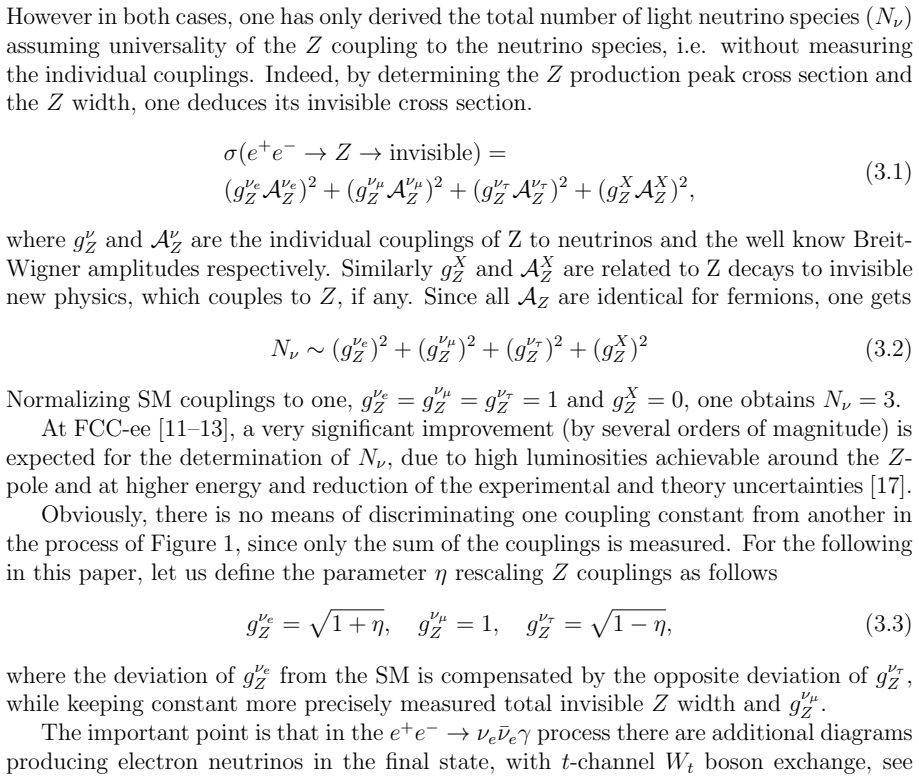
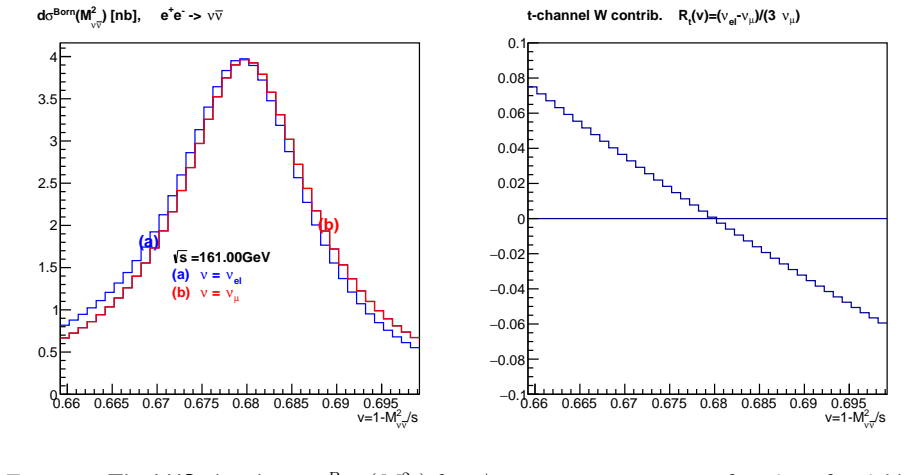
The load-bearing object is the skewness parameter $S$ (Eq. 5.1), a left-right asymmetry of the photon-energy spectrum around $v_Z=1-M_Z^2/s$. This single number isolates the asymmetric deformation of the $Z$ line shape caused by the $Z_s\otimes W_t$ interference; the $W$-exchange diagram exists only for the electron-neutrino final state, so comparing the $\nu_e$ and $\nu_{\mu/\tau}$ spectra identifies the effect of the $Z\nu_e$ coupling. The computation is carried out with the KKMC event generator, a multiphoton Monte Carlo for fermion-pair production in $e^+e^-$ collisions, whose matrix element for $e^+e^-\to\nu\bar\nu+n\gamma$ includes the $t$-channel $W$ exchange. The coupling-scaling parameter $\eta$ of Eq. (3.3) is what converts the measured $S$ into a direct determination of $g_{\nu_e Z}$ while leaving the total invisible width untouched.
What would settle it
Complete the missing one-loop virtual corrections for the $t$-channel $W$ exchange and the $O(\alpha^2)$ electroweak corrections in the $e^+e^- \to \nu_e \bar\nu_e \gamma$ matrix element, and recompute the reference skewness $S(0)$; if it moves from $-0.15274$ by more than about $10^{-4}$, the claimed 1% statistical extraction is biased beyond its quoted error. A cheaper test at FCC-ee is to measure the same skewness in the $\nu_\mu$ channel, where the $W$-exchange diagram is absent, and require agreement with the Standard Model prediction at the $10^{-4}$ level; any larger discrepancy would show the QED subtraction is not under control.
Extended reading notes
Core claim
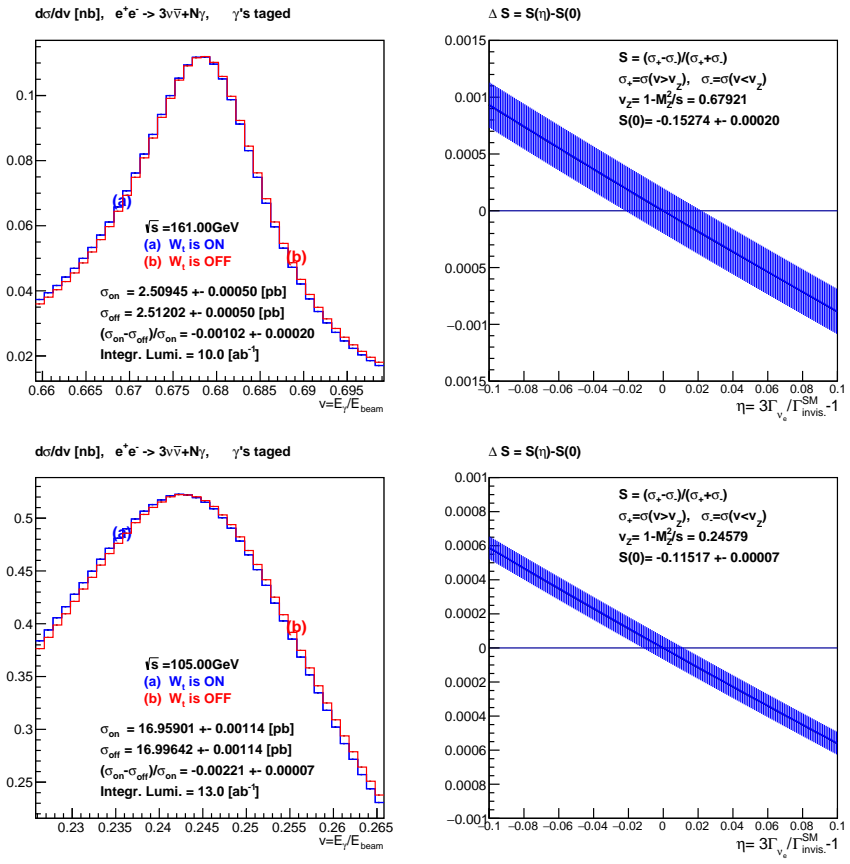
The central claim is that $g_{\nu_e Z}$ can be extracted from the interference between the $s$-channel $Z$ exchange and the $t$-channel $W$ exchange in $e^+e^- \to \nu_e \bar\nu_e \gamma$, rather than from the total invisible $Z$ width. The paper defines the skewness of the radiative-return photon spectrum near the $Z$ peak, $S = [\sigma(v>v_Z)-\sigma(v<v_Z)]/[\sigma(v>v_Z)+\sigma(v<v_Z)]$ with $v=E_\gamma/E_{\mathrm{beam}}$, and shows that the Standard Model value is $S(0)=-0.15274\pm 0.00020$. Rescaling $g_{\nu_e Z}$ to $\sqrt{1+\eta}$ and $g_{\nu_\tau Z}$ to $\sqrt{1-\eta}$, keeping the well-measured total invisible width fixed, makes $S$ move linearly with $\eta$; the Monte Carlo sensitivity at 10 $\mathrm{ab}^{-1}$ (161 GeV) and 13 $\mathrm{ab}^{-1}$ (105 GeV) therefore translates directly into $\delta g_{\nu_e Z}/g \approx 1\%$ and $\approx 0.5\%$, respectively. With a realistic calorimeter resolution the 161 GeV result degrades to 1.4%, and the authors stress that subtracting the much larger QED skewness with a high-quality multiphoton Monte Carlo is the main condition for this to work.
Load-bearing premise
The extraction assumes that the Monte Carlo's Standard Model prediction for the photon-spectrum skewness, $S(0)=-0.15274$, is accurate to about one part in ten thousand; this requires the $t$-channel $W$-exchange virtual corrections (currently only in a low-energy approximation) and the uncomputed $O(\alpha^2)$ electroweak corrections to be that small, and if they are not, the extracted coupling is biased by more than the quoted 1%.
Editorial extensions
If this is right
- At FCC-ee with 10 $\mathrm{ab}^{-1}$ at 161 GeV (or 13 $\mathrm{ab}^{-1}$ at 105 GeV), the statistical error on $g_{\nu_e Z}$ would be about 1% (0.5% at the lower energy), roughly twenty times smaller than the current error.
- With a homogeneous calorimeter of resolution $\sigma(E_\gamma)/E_\gamma = 0.05/\sqrt{E_\gamma} \oplus 0.002$, the 161 GeV sensitivity is 1.4%; even with a sampling calorimeter twice as poor, it degrades only to 2.4%.
- Combined with an essentially negligible error on $N_\nu$ at FCC-ee and no new invisible particles coupling to $Z$, the same measurement yields $g_{\nu_\tau Z}$ with about 4.8% error, turning the tau-neutrino coupling into a test of lepton-flavor universality.
- The linear dependence of $S$ on $\eta$ means the measured skewness can be mapped one-to-one onto $g_{\nu_e Z}$ without relying on the absolute $Z$ width measurement.
- The precision is conditional on upgrading the Monte Carlo: complete $W_t$ virtual corrections, a cross-check of the QED lineshape deformation, $O(\alpha^2)$ electroweak corrections, and $O(\alpha^3)$ non-soft QED corrections all remain to be done.
Reading between the lines
- A full maximum-likelihood fit of the $v=E_\gamma/E_{\mathrm{beam}}$ spectrum, rather than the single asymmetry $S$, would likely improve the sensitivity beyond 1%; the paper mentions such a fit only as a future option.
- Because the $\nu_\mu$ and $\nu_\tau$ channels lack the $W$-exchange diagram, their measured skewness can serve as a data-driven control for the QED subtraction; agreement with the Standard Model prediction at the $10^{-4}$ level would validate the extraction in the $\nu_e$ channel.
- The same technique should transfer to CEPC, which is designed for similar $Z$-pole and 161 GeV operation, with the same systematic caveats.
- At low $v$ (high $M_{\nu\bar\nu}$), the $W$ exchange diagram dominates over the $Z$-resonant diagram rather than merely interfering with it; the paper notes this region needs quantitative study, so it is a plausible cross-check for the coupling.
Signed reviews
Editorial analysis
A structured set of objections, weighed in public.
Referee Report
Summary. The paper proposes a method to measure the Z boson coupling to the electron neutrino, g_nu_e_Z, at the future e+e- circular colliders FCC-ee and CEPC. The idea is to use the process e+e- -> nu_e anti-nu_e gamma, exploiting the interference between the s-channel Z exchange and the t-channel W exchange, which is sensitive to g_nu_e_Z. The observable is the skewness S of the radiative-return photon spectrum around the Z peak, defined in Eq. (5.1). Using KKMC Monte Carlo runs with about 4e9 weighted events at sqrt(s) = 105 GeV and 161 GeV, the authors find that S changes approximately linearly with the coupling rescaling parameter eta defined in Eq. (3.3), and they claim a statistical precision on g_nu_e_Z of about 1% at 161 GeV (with 10 ab^-1) and about 0.5% at 105 GeV (with 13 ab^-1), which would improve the current PDG error by about a factor of 20. A detector resolution study shows a degradation of the sensitivity to about 1.4% at 161 GeV for a homogeneous calorimeter. The paper explicitly lists unresolved theoretical issues, including incomplete virtual corrections to the Wt amplitude, the absence of an independent cross-check of the QED-deformed Z lineshape, and the need for complete O(alpha^2) electroweak corrections.
Significance. If the theoretical uncertainties can be brought under control, the proposed method is a novel and potentially powerful way to probe lepton-flavor universality in the neutrino sector, improving the knowledge of g_nu_e_Z by an order of magnitude. The paper benefits from very large, dedicated Monte Carlo statistics from the publicly available KKMC program, and it includes a cross-check of the Born-level implementation against ZFITTER. However, the claim of a ~1% measurement is currently a statistical-sensitivity projection: the theory errors on the SM reference value S(0) and on the slope dS/deta are not yet quantified to the required level, as acknowledged by the authors themselves. The significance of the result therefore hinges on completing or bounding the missing electroweak corrections.
major comments (3)
- [Section 4 and Section 5, Eq. (5.1)] The paper states in Section 4 that the one-loop virtual corrections to the t-channel W contribution are implemented in KKMC only in a certain low-energy approximation and must be improved in the future, and Section 5 reiterates that DIZET virtual corrections are applied to the s-channel Zs exchange but not to the Wt contribution. Since the sensitivity to g_nu_e_Z in Eq. (5.1) and in Fig. 7 is driven by the Zs⊗Wt interference, an unquantified error in the Wt amplitude enters directly into the SM reference S(0) and into the slope dS/deta used for the extraction. If this error is at the few-percent level, as the historical 2-3% precision of earlier nu-nu-gamma calculations suggests, the resulting bias in g_nu_e_Z would exceed the quoted ~1% statistical error. The authors should either complete the Wt virtual corrections or provide a quantitative estimate of the induced shift in S(0) and in the extracted coupling.
- [Section 5] The claim that unaccounted O(alpha^2) non-QED corrections to S(0) are below the 1e-4 level is an expectation, not a demonstrated bound. The only numerical test reported, switching off all O(alpha1) EW+QCD corrections in KKMC, produces a shift of S(0) by 0.0007, which is about seven times the stated statistical precision of S(0) and therefore does not by itself support the 1e-4 estimate. The authors should provide a more rigorous argument, for example an explicit two-loop estimate or a comparison with an independent electroweak library, to establish that the SM reference value S(0) is known to the accuracy required for the proposed measurement.
- [Section 5] The reference value S(0) = -0.15274 ± 0.00020 is obtained from a single program, KKMC, and the paper lists as a future task a cross-check with an independent calculation. Because S(0) is the point against which the measured skewness is compared, an independent validation of the QED-deformed Z lineshape, including the multiphoton treatment and the treatment of the Wt interference, is necessary before a precision claim can be made. The agreement with ZFITTER for the Born cross sections reported in Section 3 is a useful but insufficient check for the full S(0) prediction.
minor comments (7)
- [Abstract] There are several typos: "it will possible" should be "it will be possible"; "inverse atobarn" should be "inverse attobarn"; "neutrina" should be "neutrinos".
- [Section 4] "a version on KKMC" should read "a version of KKMC", and "twoKKMC runs" in Section 5 should read "two KKMC runs".
- [Figure 7] The RHS axis label "SMinvis. Γ/eνΓ= 3η0.1" is garbled; please clarify the labeling of Delta S = S(eta) - S(0) and the horizontal axis.
- [Section 5, Eq. (5.1)] The integration interval over v used for sigma(v > v_Z) and sigma(v < v_Z) is not explicitly defined in the text; please specify whether the v_Z ± 0.02 window is used throughout, as suggested by the surrounding discussion.
- [Section 3] "with t-channel Wt boson exchange" should read "with t-channel W boson exchange" or "with W_t exchange" for consistency.
- [Summary] In the sentence "comparison of experimental data with high quality Monte Carlo even generator", "even generator" should be "event generator".
- [Figure 4] The RHS caption "log of photon angle" should specify log(sin(theta_gamma)) to be precise.
Circularity Check
No circularity: the sensitivity estimate is computed from an externally benchmarked Monte Carlo, with no fitted quantity renamed as a prediction.
full rationale
The paper does not fit any parameter to data and then rename the fit as a prediction. The observable S (Eq. 5.1) is a cross-section skewness, and the quoted values S(0) and S(eta) are Monte Carlo predictions obtained from KKMC, including the Zs-Wt interference. The eta dependence is introduced explicitly through Eq. (3.3) and implemented in the MC by rescaling the nu_e versus nu_mu distributions (footnote 9); this is a sensitivity calculation, not an input-output tautology. The central matrix element is taken from Ref. [18], whose authors overlap with the present paper, but the paper states that the Born cross sections and forward-backward asymmetries were checked against the benchmark Table 1 of Ref. [18], which itself was validated against ZFITTER; this external benchmark makes the cited support independent rather than load-bearing. The paper's explicit caveat that one-loop corrections to the Wt contribution in KKMC are incomplete is a systematic-theory limitation, not a circular step: it concerns the accuracy of S(0) and of the slope dS/deta, not whether the prediction reduces to the input by construction. No self-definitional, fitted-input, self-citation-chain, ansatz-smuggling, or renaming pattern is present in the derivation chain.
Assumptions & free parameters
assumptions (3)
- domain assumption The Standard Model matrix element for e+e- to nu nu-bar gamma as implemented in KKMC 4.19, including the t-channel W exchange and its interference with the s-channel Z, is accurate for the radiative-return kinematics used here.
- domain assumption Uncomputed higher-order QED and electroweak corrections to the skewness S(0) are below about 1e-4, the estimated experimental precision.
- ad hoc to paper The rescaling in Eq. (3.3), with g_nu_e = sqrt(1+eta), g_nu_mu = 1, g_nu_tau = sqrt(1-eta), keeps the total invisible Z width fixed so that N_nu stays equal to 3.
Cite this review
Pith. "Pith review of Precision measurement of the Z boson to electron neutrino coupling at the future circular colliders." pith.science (2026). https://pith.science/paper/SZOY3AZ7
@misc{pith2026190806338,
  author       = {Pith},
  title        = {Pith review of: Precision measurement of the Z boson to electron neutrino coupling at the future circular colliders},
  year         = {2026},
  howpublished = {\url{https://pith.science/paper/SZOY3AZ7}},
  note         = {Machine review of arXiv:1908.06338}
}
abstract
At the high luminosity electron-positron circular colliders like FCC-ee in CERN and CEPC in China it will possible to measure very precisely $e^+e^-\to Z\gamma$ process with subsequent Z decay into particles invisible in the detector, that is into three neutrina of the Standard Model and possibly into other weakly coupled neutral particles. Apart from the measurement of the total invisible width (which is not the main subject of this work) this process may be used as a source of $Z$ coupling to electron neutrino -- known very poorly. This is possible due to the presence of the $t$-channel $W$ exchange in the $e^+e^-\to \nu_e \bar\nu_e \gamma$ channel which deforms slightly spectrum of the photon. We are going to show experimental investigation of this effect, for $\sim 10$ inverse atobarn accumulated luminosity, which can provide measurement of the $Z-\nu_e$ coupling with statistical error of order 1\%. The estimation of the systematic experimental error will require more work, but most likely it will be of similar size.
Figures


Figures from the paper (6 more)



Reference graph
Works this paper leans on
-
[18]
Predictions for ${\bar \nu} \nu \gamma$ Production at LEP
D. Bardin, S. Jadach, T. Riemann, Z. Was, Predictions for anti-nu nu gamma pro- duction at LEP, Eur. Phys. J. C24 (2002) 373–383 (2002). arXiv:hep-ph/0110371, doi:10.1007/s100520200948
work page Pith review arXiv 2002
-
[1]
Lees, et al., [BaBar Collaboration], Phys
J. Lees, et al., [BaBar Collaboration], Phys. Rev. D88 (2013). arXiv:1303.0571, doi:1103/PhysRevD.88.072012
arXiv 2013
-
[2]
Measurement of the B^0 -> D^*- pi^+ pi^- pi^+ branching fraction
J. Lees, et al., [BaBar Collaboration], Phys. Rev. D94 (2016). arXiv:1609.06802, doi:10.1103/PhysRevD.94.091101
work page Pith review arXiv 2016
-
[3]
Huschle, et al., [Belle Collaboration], Phys
M. Huschle, et al., [Belle Collaboration], Phys. Rev. D92 (2015). doi:10.1103/ PhysRevD.92.072014
work page 2015
-
[4]
Aaij, et al., [LHCb Collaboration], Phys
R. Aaij, et al., [LHCb Collaboration], Phys. Rev. Lett. 115 (2015). doi:10.1103/ PhysRevLett.115.111803
work page 2015
-
[5]
Aaij, et al., [LHCb Collaboration], Phys
R. Aaij, et al., [LHCb Collaboration], Phys. Rev. D97 (2018). arXiv:1711.02505, doi:10.1103/PhysRevD.97.072013
arXiv 2018
-
[6]
Wei, et al., [Belle Collaboration], Phys
J.-T. Wei, et al., [Belle Collaboration], Phys. Rev. Lett. 103 (2009). arXiv:0904. 0770, doi:10.1103/PhysRevLett.103.171801
-
[7]
Lees, et al., [BaBar Collaboration], Phys
J. Lees, et al., [BaBar Collaboration], Phys. Rev. D86 (2012). arXiv:1204.3933, doi:10.1103/PhysRevD.86.032012
arXiv 2012
Show all 31 references
-
[8]
Aaij, et al., [LHCb Collaboration], Phys
R. Aaij, et al., [LHCb Collaboration], Phys. Rev. Lett. 13 (2014). arXiv:1406.6482, doi:10.1103/PhysRevLett.113.151601
2014 arXiv
-
[9]
Tanabashi, et al., [Particle Data Group], Phys
M. Tanabashi, et al., [Particle Data Group], Phys. Rev. D98 030001 (2018)
2018
-
[10]
Voutsinas, E
G. Voutsinas, E. Perez, M. Dam, P. Janot, Beam-beam effects on the lu- minosity measurement at LEP and the number of light neutrino species, Physics Letters B 800 (2020) 135068 (2020). arXiv:1908.01704, doi:https: //doi.org/10.1016/j.physletb.2019.135068. URL http://www.science...
2020 arXiv
-
[11]
Bicer, et al., First Look at the Physics Case of TLEP, JHEP 01 (2014) 164 (2014)
M. Bicer, et al., First Look at the Physics Case of TLEP, JHEP 01 (2014) 164 (2014). arXiv:1308.6176, doi:10.1007/JHEP01(2014)164
2014 arXiv
-
[12]
Mangano, et al., Future Circular Collider, Vol
M. Mangano, et al., Future Circular Collider, Vol. 1: Physics opportunitiesSubmitted for publication to Eur.Phys.J.C. http://cds.cern.ch/record/2651294 (2018)
2018
-
[13]
Benedikt, et al., Future Circular Collider, Vol
M. Benedikt, et al., Future Circular Collider, Vol. 2: The Lepton Collider (FCC- ee)Submitted for publication to Eur.Phys.J.C. http://cds.cern.ch/record/2651299 (2019)
2019
-
[14]
Aharmim, et al., [SNO Collaboration], Phys
B. Aharmim, et al., [SNO Collaboration], Phys. Rev. C72 (2005). arXiv:0502021, doi:10.1103/PhysRevC.72.055502. 13
2005 doi
-
[15]
Schael, et al., Precision electroweak measurements on theZ resonance, Phys
S. Schael, et al., Precision electroweak measurements on theZ resonance, Phys. Rept. 427 (2006) 257–454 (2006). arXiv:hep-ex/0509008, doi:10.1016/j.physrep. 2005.12.006
2006 arXiv
-
[16]
Abbiendi, et al., Photonic events with missing energy ine+e− collisions at S**(1/2) = 189-GeV, Eur
G. Abbiendi, et al., Photonic events with missing energy ine+e− collisions at S**(1/2) = 189-GeV, Eur. Phys. J. C18 (2000) 253–272 (2000). arXiv:hep-ex/0005002, doi:10.1007/s100520000522
2000 arXiv
-
[17]
Jadach, M
S. Jadach, M. Skrzypek, QED challenges at FCC-ee precision measurements (2019). arXiv:1903.09895
2019 arXiv
-
[19]
Jadach, B
S. Jadach, B. F. L. Ward, Z. Was, The Precision Monte Carlo event generator KK for two fermion final states in e+e− collisions, Comput. Phys. Commun. 130 (2000) 260–325 (2000). arXiv:hep-ph/9912214, doi:10.1016/S0010-4655(00)00048-5
2000 arXiv
-
[20]
Carena, A
M. Carena, A. de Gouvea, A. Freitas, M. Schmitt, Invisible Z boson decays at e+ e- colliders, Phys. Rev. D68 (2003) 113007 (2003). arXiv:hep-ph/0308053, doi: 10.1103/PhysRevD.68.113007
2003 arXiv
-
[21]
Ellis, S.-F
J. Ellis, S.-F. Ge, H.-J. He, R.-Q. Xiao, Probing the Scale of New Physics in the ZZγ Coupling at e+e− Colliders (2019). arXiv:1902.06631
2019 arXiv
-
[22]
M. Kobel, et al., Two-Fermion Production in Electron-Positron Collisions, in: Pro- ceedings, Monte Carlo Workshop: Report of the working groups on precision cal- culation for LEP-2 physics: CERN, Geneva, Switzerland, March 12-13, June 25- 26, October 12-13 Oct 1999, 2000 (2000...
2000 arXiv
-
[23]
Jadach, B
S. Jadach, B. F. L. Ward, Z. Was, The Monte Carlo program KORALZ, version 4.0, for the lepton or quark pair production at LEP / SLC energies, Comput. Phys. Commun. 79 (1994) 503–522 (1994). doi:10.1016/0010-4655(94)90190-2
1994 doi
-
[24]
Montagna, O
G. Montagna, O. Nicrosini, F. Piccinini, NUNUGPV: A Monte Carlo event generator for e+ e- to nu anti-nu gamma (gamma) events at LEP, Comput. Phys. Commun. 98 (1996) 206–214 (1996). doi:10.1016/0010-4655(96)00081-1
1996 doi
-
[25]
Montagna, M
G. Montagna, M. Moretti, O. Nicrosini, F. Piccinini, Single photon and multiphoton final states with missing energy at e+ e- colliders, Nucl. Phys. B541 (1999) 31–49 (1999). arXiv:hep-ph/9807465, doi:10.1016/S0550-3213(98)00795-0. 14
1999 arXiv
-
[26]
Fujimoto, T
J. Fujimoto, T. Ishikawa, T. Kaneko, K. Kato, S. Kawabata, Y. Kurihara, T. Mune- hisa, D. Perret-Gallix, Y. Shimizu, H. Tanaka, Grc4f v1.1: A Four fermion event generator for e+ e- collisions, Comput. Phys. Commun. 100 (1997) 128–156 (1997). arXiv:hep-ph/9605312, doi:10.1016/S...
1997 arXiv
-
[27]
Kurihara, J
Y. Kurihara, J. Fujimoto, T. Ishikawa, Y. Shimizu, T. Munehisa, (grc neutrino neu- trino gamma) Event generator for the single photon and double photon emission associated with neutrino pair production, Comput. Phys. Commun. 136 (2001) 250– 268 (2001). arXiv:hep-ph/9908422, do...
2001 arXiv
-
[28]
Colas, R
P. Colas, R. Miquel, Z. Was, The Neutrino Anti-neutrinoγ Cross-section and Invisible Width Measurement at LEP, Phys. Lett. B246 (1990) 541–545 (1990).doi:10.1016/ 0370-2693(90)90646-N
1990
-
[29]
Igarashi, N
M. Igarashi, N. Nakazawa, QED radiative corrections to the neutrino counting reac- tion e+e, Nucl. Phys. B288 (1987) 301–331, [Erratum: Nucl. Phys.B294,1180(1987)] (1987). doi:10.1016/0550-3213(87)90217-3
1987 doi
-
[30]
D. Yu. Bardin, P. Christova, M. Jack, L. Kalinovskaya, A. Olchevski, S. Riemann, T. Riemann, ZFITTER v.6.21: A Semianalytical program for fermion pair production in e+e− annihilation, Comput. Phys. Commun. 133 (2001) 229–395 (2001). arXiv: hep-ph/9908433, doi:10.1016/S0010-465...
2001 arXiv
-
[31]
Was, Gauge invariance, infrared / collinear singularities and tree level matrix element for e+ e- → nu(e) anti-nu(e) gamma gamma, Eur
Z. Was, Gauge invariance, infrared / collinear singularities and tree level matrix element for e+ e- → nu(e) anti-nu(e) gamma gamma, Eur. Phys. J. C44 (2005) 489–503 (2005). arXiv:hep-ph/0406045, doi:10.1140/epjc/s2005-02381-y. 15
2005 arXiv
Reviewed August 14, 2026 · model on record in the stance chip above.
Discussion (0). Continue with ORCID to comment.