REVIEW 4 major objections 4 minor 57 references
Effectiveness of Stacks in the Stacked Hilbert-Huang Transform
T0 review · 4 major / 4 minor · reviewed 2026-08-07 · deepseek-v4-flash
Pith's one-line read The stacked Hilbert-Huang transform traces abrupt frequency jumps more clearly than conventional HHT, at the price of a hand-tuned added-noise level.
desk verdict Useful demonstrations, but the analytic bias formula is wrong and the central advantage rests on hand-tuned noise levels and visual comparisons. read the letter →
The pith
A machine-rendered reading of the paper's core claim, the machinery that carries it, and where it could break.
The reading
What carries the argument
The central object is the stacked Hilbert spectrum $H = \frac{1}{N_t N_m}\sum_{k=1}^{N_m}\sum_{j=1}^{N_t} I_{k,j}$, where $I_{k,j}$ is the Hilbert spectrum of the $k$-th intrinsic mode function of the $j$-th noise-added trial; the key is that each trial's spectrum is formed before any averaging. The argument's engine is the perturbation expansion of the instantaneous-frequency ratio $B_{k,j}/A_{k,j}$ in terms of the added white noise, leading to the approximate deviation ratio $D_k \approx 1 + 1.26\,\sigma_k^2/B_k$, with the numerical constant $\lambda \approx 0.63 \pm 0.03$ obtained by simulating the discretized Hilbert-transform noise correlations. This formula does the work of quantifying how the extra noise broadens the measured frequency and how stacking many trials pulls the true frequency out of the noise.
What would settle it
Take a synthetic signal with a known abrupt frequency jump and known SNR, sweep the added-noise level over 0.01 to 10, and compare the sHHT instantaneous-frequency trace against conventional EEMD-HHT on a quantitative error metric such as mean absolute deviation from the true frequency; if no noise level yields a clear sHHT advantage, the central claim fails. The analytic claim can be tested separately by measuring the frequency-dispersion ratio as a function of added-noise variance $\sigma_k^2$ for fixed $B_k$ and checking whether the slope is approximately $1.26$.
Extended reading notes
Core claim
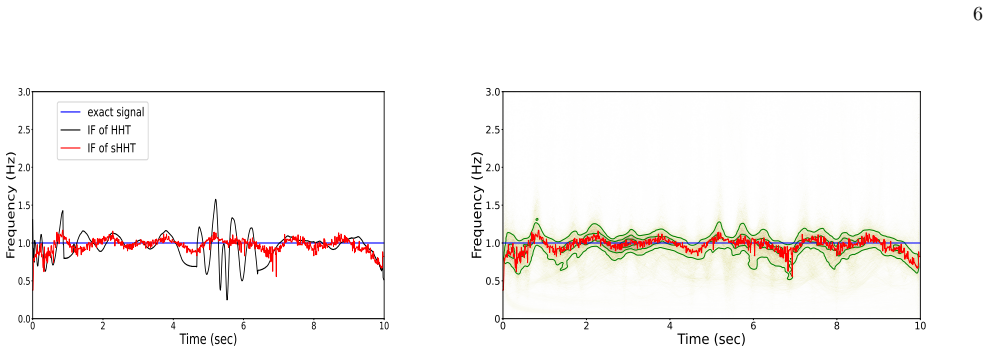
The paper's discovery claim is that the stacked Hilbert-Huang transform is more effective than the conventional HHT for tracing nonlinear, transient signals, particularly when their frequency changes abruptly. The mechanism is the order of operations: conventional ensemble EMD averages the noise-added decompositions into mean IMFs before computing instantaneous frequencies, while sHHT computes the Hilbert spectrum for each trial and stacks the spectra, so the true instantaneous frequency accumulates energy on the time-frequency map while mode-mixing artifacts are suppressed. The paper derives, under Gaussian noise assumptions, the deviation ratio $D_k = E[(1+\beta_{k,j}/B_k)/(1+\alpha_{k,j}/A_k)] \approx 1 + 1.26\,\sigma_k^2/B_k$ between sHHT and ensemble-free HHT for each IMF, establishing consistency with the HHT result when the imposed noise variance is negligible. Numerical experiments show sHHT tracking the exact frequency more closely than HHT for stable, linear-chirp, and exponential-chirp signals, and the real-data demonstrations show superorbital modulation in SMC X-1 and chirp tracks in GW200129 and GW190814, including excess power near the expected $(3,3)$ higher-multipole slice of GW190814. The practical significance is a template-free, adaptive time-frequency tool that needs no prior basis and works on short, nonlinear, non-stationary stretches of data.
Load-bearing premise
The whole improvement depends on choosing the right amplitude for the added noise, and the paper gives no independent rule for real data: with the true SNR unknown, the level is picked by eye from a blind 0.01-to-10 scan, and different levels produce very different stacked spectra, with too little or too much noise making sHHT worse than HHT.
Editorial extensions
If this is right
- On signals with a sudden frequency jump, sHHT produces flatter, clearer instantaneous-frequency tracks than conventional HHT at the same added-noise level.
- Accumulating many stacked spectra (10,000 to 50,000 trials) sharpens the time-frequency map, and in the chirp comparison sHHT shows comparable frequency resolution and better time resolution than the Q-transform.
- The recommended added-noise level of 0.5 to 1 times the signal's standard deviation works across the paper's simulated and real examples; too little noise leaves mode-mixing artifacts, while too much smears the true signal.
- For gravitational-wave data, sHHT reveals chirp tracks for GW200129 and GW190814 from whitened strain data without templates, and shows excess power near the $(3,3)$ multipole slice for GW190814 before merger.
- Because sHHT is template-free and adaptive, it is positioned as a tool for transient and nonlinear features in multi-messenger astronomy data beyond gravitational waves.
Reading between the lines
- The deviation formula implies sHHT's frequency error is controlled by the ratio $\sigma_k^2/B_k$; if $B_k$ could be estimated online, the added-noise variance could be tuned by minimizing that ratio, turning the paper's blind 0.01-to-10 scan into an automatic procedure.
- The stacking-before-averaging principle is not tied to EMD; the same idea could be applied to other dither-and-estimate time-frequency methods, where averaging spectra after estimation may generically beat averaging the estimates before transformation.
- The paper's anomalous dispersion drop for input noise below 1 at low SNR suggests there is an optimal finite dither amplitude; probing whether this optimum coincides with the noise level that best separates signal and mode-mixing scales would be a direct test of the method.
- A natural next step, consistent with the paper's own caveat, is implementing a zero-crossing instantaneous-frequency estimator inside sHHT to remove the intra- and inter-wave modulation oscillations seen on the stacked spectra.
Editorial analysis
A structured set of objections, weighed in public.
Referee Report
Summary. The paper proposes a 'stacked Hilbert-Huang Transform' (sHHT) that computes the Hilbert spectrum for each noise-added trial and averages the spectra after time-frequency realization, rather than averaging IMFs before the Hilbert transform as in conventional EEMD-based HHT. It derives an expression for the deviation ratio D_k between sHHT and HHT instantaneous frequencies, simulates stationary, linear-chirp, and exponential-chirp signals to map frequency dispersion as a function of SNR and input noise level, compares sHHT with the Q-transform, and demonstrates the method on SMC X-1 superorbital modulation and the GW events GW200129 and GW190814.
Significance. If the claims held, sHHT would be a useful addition to the time-frequency toolbox for gravitational-wave and X-ray variability analysis. The manuscript provides a public code repository, uses open GW data, and the applications to SMC X-1 and to the higher-multipole structure of GW190814 are interesting and potentially valuable. However, the central analytic derivation contains a first-order error, the key coefficient is calibrated from the authors' own simulation rather than derived, and the method requires a user-selected input noise level with no independent selection rule. The paper therefore does not currently establish the claimed advantage over conventional HHT.
major comments (4)
- [Section II, Eq. (25)] The expansion of D_k = E[(1+β/B)/(1+α/A)] omits the first-order term -E[α/A] = -2σ²/A, which was already computed in Eq. (22). The correct first-order expansion is 1 + E[β/B] - E[α/A] + ... . For a monochromatic signal with A=a² and B=2π f a², the omitted term is 2σ²/a² while the retained term is ≈1.26σ²/(2π f a²); at f=1 Hz the omitted term is about ten times larger and has the opposite sign. Consequently D_k ≈ 1 + 1.26σ²/B is not a valid small-noise approximation, and the claim that D_k approaches 1 and thus demonstrates consistency between HHT and sHHT is not established by this derivation.
- [Section II, Eqs. (23)-(24) and Table I] The coefficient 1.26 in Eq. (25) is not an analytic prediction: λ ≈ 0.63 is estimated from the authors' own Gaussian-noise simulation (Table I). Because this constant is fitted from the same kind of random process that the dispersion formula is intended to describe, and because the numerical dispersion maps in Section III are produced by the sHHT procedure itself rather than tested against Eq. (25) as an independent predictive check, the agreement reported in Section III cannot serve as a verification of the analytic result.
- [Sections II and III] The analytic derivation compares sHHT against a noiseless HHT baseline (Eq. (15)), whereas the conventional HHT used in all numerical comparisons and applications is EEMD-based, i.e., it also involves added white noise and ensemble averaging of IMFs. The derivation therefore does not model the difference between the two methods as implemented; it only describes the effect of noise on a single trial relative to a clean signal. This mismatch undermines the statement in Section III that the numerical examples 'verify our derivation in the previous section.'
- [Section IV and Appendix A] The input noise level is a free parameter chosen by visual inspection in the range 0.01–10, and the left panels of Figs. 3, 5, and 7 show that the frequency dispersion ratio depends strongly on both SNR and noise level, while Appendix A shows that different noise levels produce qualitatively different stacked spectra. Since the SNR of real data is unknown and no independent rule fixes the noise level, the claimed superiority of sHHT for real data is conditional on a hand-tuned knob, and the recommendation of 0.5–1 in the Conclusion is not supported by a quantitative selection criterion.
minor comments (4)
- [Section III] The left panels of Figs. 3, 5, and 7 are labeled 'frequency dispersion ratio,' but the precise definition (e.g., RMS deviation of the instantaneous frequency divided by the true frequency, or some other statistic) is never stated; please define the quantity plotted.
- [Section II] The assumption that the real and imaginary parts of each IMF, c^R_k,j and c^I_k,j, are Gaussian with zero mean and unit variance and are orthogonal is introduced without justification. For an arbitrary signal plus noise, the IMFs are nonlinear functions of the data, and this distributional assumption is not generally valid; it is used in computing λ and the expectations in Eqs. (22)–(23), so it should be tested or derived.
- [Section II, Eq. (24)] The factor λ is described as counting amplification over discretization, but its dependence on the sampling interval Δt is not analyzed; the manuscript uses Δt=1 throughout, so the generality of Eq. (24) for other sampling rates is unclear.
- [Abstract and Section I] The claim that sHHT is 'more sensitive to detecting/tracing' transient features than HHT is not quantified; no detection statistic, false-alarm probability, or signal-to-noise threshold is provided for this claim.
Circularity Check
No significant circularity: the sHHT advantage is demonstrated on known-truth synthetic signals and new public LIGO events, independent of the analytic derivation; minor self-citations are present but not load-bearing.
full rationale
The paper is self-contained against external benchmarks, so the honest finding is no significant circularity (score 1). The central empirical claim that sHHT traces abrupt frequency changes more clearly than HHT is established by Section III simulations with analytically known ground truth (stable sinusoid, linear and exponential chirps, exact frequency known) and by Section IV applications to O3 events GW200129 065458 and GW190814 (Figs. 10-11) that were not analyzed in the authors' prior paper. These are direct measurements of the sHHT algorithm's output, produced without using the Section II formula, so they do not reduce to the analytic inputs by construction. The constant lambda ~ 0.63 (Table I) is calibrated on a pure Gaussian-noise simulation and is not fitted to the signal-dispersion maps; moreover the paper never quantitatively compares the D_k formula to the dispersion maps, which is a verification weakness but not a fitted-input-called-prediction. Self-citations exist and are frequent: the stacking algorithm originates in the authors' Hu et al. (2022, ref [22]), and the SMC X-1 discussion references the authors' own refs [32] and [4]; however, these are supporting references, not the sole justification, since this paper adds new independent simulations and new GW events drawn from public O3 data. One correctness risk is outside the circularity pass but should be flagged: Eq. (25) writes the expansion of D_k = E[(1+beta/B)/(1+alpha/A)] yet drops the first-order term -E[alpha/A] = -2 sigma^2/A that Eq. (22) itself computed, so D_k ~ 1 + 1.26 sigma^2/B is not a valid small-noise expansion, and Section III.A's wording 'thus verifying our derivation in the previous section' never actually tests the formula quantitatively. That is a mathematical-support failure, not a definitional circularity; per the review rules, such non-consensus or error concerns belong to correctness risk rather than to the circularity score.
Assumptions & free parameters
free parameters (3)
- lambda =
0.63 +/- 0.03
- external noise level for real data =
0.6, 0.8, 0.9 (per event/detector)
- number of trials Nt =
1000, 10000, 50000
assumptions (4)
- ad hoc to paper The IMF components c^R and c^I for noise-added trials are zero-mean Gaussian with variance 1 and are orthogonal.
- standard math The first-order expansion in Eq. (25) is valid because alpha/A and beta/B are small.
- domain assumption The external noise added in sHHT is white Gaussian and independent of the signal.
- domain assumption Instantaneous frequency defined via the analytic signal is meaningful for each IMF.
Cite this review
Pith. "Pith review of Effectiveness of Stacks in the Stacked Hilbert-Huang Transform." pith.science (2026). https://pith.science/paper/T22KPAKI
@misc{pith2026250603349,
  author       = {Pith},
  title        = {Pith review of: Effectiveness of Stacks in the Stacked Hilbert-Huang Transform},
  year         = {2026},
  howpublished = {\url{https://pith.science/paper/T22KPAKI}},
  note         = {Machine review of arXiv:2506.03349}
}
read the original abstract
The Hilbert-Huang transform (HHT) consists of empirical mode decomposition (EMD), which is a template-free method that represents the combination of different intrinsic modes on a time-frequency map (i.e., the Hilbert spectrum). The application of HHT involves introducing trials by imposing white noise on the signal and then calculating the ensemble mean process of the corresponding EMD to demonstrate its significance on the Hilbert spectrum. In this study, we develop a stacked Hilbert-Huang Transform (sHHT) method that generates the Hilbert spectrum for each trial and compiles all results to enhance the strength of the real instantaneous frequency of the main signal on the time-frequency map. This new approach is more sensitive to detecting/tracing the nonlinear and transient features of a signal embedded in astronomical databases than the conventional HHT, particularly when the signal experiences dramatic frequency changes in a short time. We analytically investigate the consistency of HHT and sHHT and perform numerical simulations to examine the dispersion of the instantaneous frequency obtained through sHHT and compare its advantages and effectiveness with those of conventional HHT. To confirm the feasibility of the sHHT, we demonstrate its application in verifying the signal of superorbital modulation in X-ray and binary black hole mergers in gravitational waves.
Figures


Figures from the paper (10 more)


Reference graph
Works this paper leans on
-
[1]
S. Chatterji, L. Blackburn, G. Martin, and E. Kat- savounidis, Multiresolution techniques for the detection of gravitational-wave bursts, Classical and Quantum Gravity 21, S1809 (2004), arXiv:gr-qc/0412119 [gr-qc]
arXiv 2004
-
[2]
The EEMD, which is a dyadic filter, can decompose the superorbital modulation signal into a single IMF that facilitates the calculation of the instantaneous frequency. However, the modulation period has evolved to a shorter regime, which challenges the tracking of the superorbital frequency during the latest “excursion” event, identified by a reduction in...
-
[3]
L. C.-C. Lin, C.-P. Hu, A. K. H. Kong, D. C.-C. Yen, J. Takata, and Y. Chou, Long-term X-ray variability of ultraluminous X-ray sources, MNRAS 454, 1644 (2015), arXiv:1509.00547 [astro-ph.HE]
work page Pith review arXiv 2015
-
[4]
K. Yanagisawa, D. Jia, S. Hirobayashi, N. Uchikata, T. Narikawa, K. Ueno, H. Takahashi, and H. Tagoshi, A time-frequency analysis of gravitational wave signals with non-harmonic analysis, Progress of Theoretical and Experimental Physics 2019, 063F01 (2019)
work page 2019
-
[5]
C.-P. Hu, K. C. Dage, W. I. Clarkson, M. Brumback, P. A. Charles, D. Haggard, R. C. Hickox, T. Mihara, A. Bahramian, R. Karam, W. Athukoralalage, D. Al- tamirano, J. Neilsen, and J. Kennea, Monitoring observa- tions of SMC X-1’s excursions (MOOSE) - II. A new ex- cursion accompanies spin-up acceleration, MNRAS 520, 3436 (2023), arXiv:2302.00260 [astro-ph.HE]
work page Pith review arXiv 2023
-
[6]
J. C. Brown, Calculation of a constant Q spectral trans- form, Acoustical Society of America Journal 89, 425 (1991)
work page 1991
-
[7]
F. Robinet, N. Arnaud, N. Leroy, A. Lundgren, D. Macleod, and J. McIver, Omicron: A tool to char- acterize transient noise in gravitational-wave detectors, SoftwareX 12, 100620 (2020)
work page 2020
- [8]
Show all 57 references
-
[9]
D. J. Pines and L. W. Salvino, Health monitoring of one- dimensional structures using empirical mode decomposi- tion and the Hilbert-Huang transform, in Smart Struc- tures and Materials 2002: Smart Structures and In- tegrated Systems, Society of Photo-Optical Instrumen- tation...
2002
-
[10]
Jan and R
J. Jan and R. B. Pachori, Discrimination between ictal and seizure-free eeg signals using empirical mode decom- position, Research Letters in Signal Processing 2008, 293056 (2008)
2008
-
[11]
N. E. Huang, M.-L. Wu, W. Qu, S. R. Long, and S. S. P. Shen, Applications of hilbert–huang transform to non- stationary financial time series analysis, Applied Stochas- tic Models in Business and Industry 19, 245 (2003), https://onlinelibrary.wiley.com/doi/pdf/10.1002/asmb.501
2003 doi
-
[12]
R. R. Zhang, S. Ma, E. Safak, and S. Hartzell, Hilbert- huang transform analysis of dynamic and earthquake mo- tion recordings, Journal of Engineering Mechanics 129, 861 (2003)
2003
-
[13]
X. Li, Z. Li, E. Wang, J. Feng, X. Kong, L. Chen, B. Li, and N. Li, Analysis of natural mineral earthquake and blast based on hilbert–huang transform (hht), Journal of Applied Geophysics 128, 79 (2016)
2016
-
[14]
T. Schlurmann, Spectral Analysis of Nonlin- ear Water Waves Based on the Hilbert-Huang Transformation , Journal of Offshore Mechan- ics and Arctic Engineering 124, 22 (2001), https://asmedigitalcollection.asme.org/offshoremechanics/article- pdf/124/1/22/5719251/22 1.pdf
2001
-
[15]
A. D. Veltcheva, Wave and group transformation by a hilbert spectrum, Coastal Engineering Journal 44, 283 (2002), https://doi.org/10.1142/S057856340200055X
2002 doi
-
[16]
C.-P. Hu, Y. Chou, T.-C. Yang, and Y.-H. Su, Track- ing the Evolution of Quasi-periodic Oscillation in RE J1034+396 Using the Hilbert-Huang Transform, Astro- phys. J. 788, 31 (2014), arXiv:1404.5108 [astro-ph.HE]
2014 arXiv
-
[17]
L. C.-C. Lin, C.-P. Hu, K.-L. Li, J. Takata, D. C.-C. Yen, K. Kwak, Y.-M. Kim, and A. K. H. Kong, Investigation of X-ray timing and spectral properties of ESO 243-49 HLX-1 with long-term Swift monitoring, MNRAS 491, 5682 (2020), arXiv:1911.13107 [astro-ph.HE]
2020 arXiv
-
[18]
J. B. Camp, J. K. Cannizzo, and K. Numata, Application of the Hilbert-Huang transform to the search for gravita- tional waves, Phys. Rev. D 75, 061101 (2007), arXiv:gr- qc/0701148 [gr-qc]
2007
-
[19]
Kaneyama, K.-i
M. Kaneyama, K.-i. Oohara, H. Takahashi, Y. Sekiguchi, H. Tagoshi, and M. Shibata, Analysis of gravitational waves from binary neutron star merger by Hilbert-Huang transform, Phys. Rev. D 93, 123010 (2016)
2016
-
[20]
Sakai, K.-i
K. Sakai, K.-i. Oohara, H. Nakano, M. Kaneyama, and H. Takahashi, Estimation of starting times of quasi- normal modes in ringdown gravitational waves with the hilbert-huang transform, Phys. Rev. D 96, 044047 (2017)
2017
-
[21]
Akhshi, H
A. Akhshi, H. Alimohammadi, S. Baghram, S. Rahvar, M. R. R. Tabar, and H. Arfaei, A template-free approach for waveform extraction of gravitational wave events, Scientific Reports 11, 20507 (2021), arXiv:2005.11352 [astro-ph.IM]
2021 arXiv
-
[22]
Takeda, Y
M. Takeda, Y. Hiranuma, N. Kanda, K. Kotake, T. Kuroda, R. Negishi, K. Oohara, K. Sakai, Y. Sakai, T. Sawada, H. Takahashi, S. Tsuchida, Y. Watanabe, and T. Yokozawa, Application of the Hilbert-Huang trans- form for analyzing standing-accretion-shock-instability induced gravit...
2021 arXiv
-
[23]
C.-P. Hu, L. C.-C. Lin, K.-C. Pan, K.-L. Li, C.-C. Yen, A. K. H. Kong, and C. Y. Hui, A Comprehensive Anal- ysis of the Gravitational Wave Events with the Stacked Hilbert-Huang Transform: From Compact Binary Coa- lescence to Supernova, Astrophys. J. 935, 127 (2022), arXiv:2207...
2022 arXiv
-
[24]
E. J. Son, W. Kim, Y.-M. Kim, J. McIver, J. J. Oh, and S. H. Oh, Generating Event Triggers Based on Hilbert- Huang Transform and Its Application to Gravitational- Wave Data, arXiv e-prints , arXiv:1810.07555 (2018), arXiv:1810.07555 [astro-ph.IM]
2018 arXiv
-
[25]
Wu and N
Z. Wu and N. E. Huang, Ensemble empirical mode decomposition: A noise-assisted data analysis method, AADA 1, 1 (2009)
2009
-
[26]
N. E. Huang, Z. Shen, S. R. Long, M. C. Wu, H. H. Shih, Q. Zheng, N.-C. Yen, C. C. Tung, and H. H. Liu, The em- pirical mode decomposition and the Hilbert spectrum for nonlinear and non-stationary time series analysis, Royal Society of London Proceedings Series A 454, 903 (1998)
1998
-
[27]
N. E. Huang and Z. Wu, A review on Hilbert-Huang transform: Method and its applications to geophysical studies, Reviews of Geophysics 46, RG2006 (2008)
2008
-
[28]
Huang and S
N. Huang and S. Shen, Hilbert-Huang Transform and Its Applications, EBSCO ebook academic collection (World Scientific, 2014)
2014
-
[29]
Mohapatra, Z
S. Mohapatra, Z. Nemtzow, ´E. Chassande-Mottin, and L. Cadonati, Performance of a Chirplet-based analy- sis for gravitational-waves from binary black-hole merg- ers, in Journal of Physics Conference Series, Journal of Physics Conference Series, Vol. 363 (2012) p. 012031, arXiv...
2012 arXiv
-
[30]
Bernardino and J
A. Bernardino and J. Santos-Victor, A real-time gabor primal sketch for visual attention, in Iberian Conference on Pattern Recognition and Image Analysis (Springer,
-
[31]
C. M. Biwer, C. D. Capano, S. De, M. Cabero, D. A. Brown, A. H. Nitz, and V. Raymond, PyCBC Inference: A Python-based Parameter Estimation Toolkit for Com- pact Binary Coalescence Signal, Publ. Astron. Soc. Pac. 131, 024503 (2019), arXiv:1807.10312 [astro-ph.IM]
2019 arXiv
-
[32]
C.-P. Hu, Y. Chou, M.-C. Wu, T.-C. Yang, and Y.- H. Su, Time-frequency Analysis of the Superorbital Modulation of the X-Ray Binary SMC X-1 Using the Hilbert-Huang Transform, Astrophys. J. 740, 67 (2011), arXiv:1107.5143 [astro-ph.HE]
2011 arXiv
-
[33]
Cannon, R
K. Cannon, R. Cariou, A. Chapman, M. Crispin-Ortuzar, N. Fotopoulos, M. Frei, C. Hanna, E. Kara, D. Keppel, L. Liao, S. Privitera, A. Searle, L. Singer, and A. We- instein, Toward early-warning detection of gravitational waves from compact binary coalescence, The Astrophys- ic...
2012
-
[34]
H. A. Krimm, S. T. Holland, R. H. D. Corbet, A. B. Pearlman, P. Romano, J. A. Kennea, J. S. Bloom, S. D. Barthelmy, W. H. Baumgartner, J. R. Cummings, N. Gehrels, A. Y. Lien, C. B. Markwardt, D. M. Palmer, T. Sakamoto, M. Stamatikos, and T. N. Ukwatta, The Swift/BAT Hard X-Ray...
2013 arXiv
-
[35]
Abbott, H
R. Abbott, H. Abe, F. Acernese, et al., LIGO Scien- tific Collaboration, and Virgo Collaboration, Open Data from the Third Observing Run of LIGO, Virgo, KA- GRA, and GEO, Astrophys. J. Suppl. 267, 29 (2023), arXiv:2302.03676 [gr-qc]
2023 arXiv
-
[36]
Https://gwosc.org/eventapi/html/
-
[37]
B. P. Abbott, R. Abbott, T. D. Abbott, M. R. Aber- nathy, F. Acernese, et al., LIGO Scientific Collabora- tion, and Virgo Collaboration, Observation of Gravita- tional Waves from a Binary Black Hole Merger, Phys. Rev. Lett. 116, 061102 (2016), arXiv:1602.03837 [gr-qc]
2016 arXiv
-
[39]
Https://gwpy.github.io/docs/stable/
-
[40]
D. M. Macleod, J. S. Areeda, S. B. Coughlin, T. J. Massinger, and A. L. Urban, GWpy: A Python pack- age for gravitational-wave astrophysics, SoftwareX 13, 100657 (2021)
2021
-
[41]
Abbott, T
R. Abbott, T. D. Abbott, S. Abraham, F. Acernese, K. Ackley, et al., LIGO Scientific Collaboration, and Virgo Collaboration, GW190814: Gravitational Waves from the Coalescence of a 23 Solar Mass Black Hole with a 2.6 Solar Mass Compact Object, Astrophys. J. Lett. 896, L44 (202...
2020 arXiv
-
[42]
Pratten, C
G. Pratten, C. Garc ´ ıa-Quir´ os, M. Colleoni, A. Ramos- Buades, H. Estell´ es, M. Mateu-Lucena, R. Jaume, M. Haney, D. Keitel, J. E. Thompson, and S. Husa, Computationally efficient models for the dominant and subdominant harmonic modes of precessing bi- nary black holes, Ph...
2021 arXiv
-
[43]
Abbott, T
R. Abbott, T. D. Abbott, F. Acernese, K. Ack- ley, C. Adams, et al., LIGO Scientific Collabora- tion, VIRGO Collaboration, and Kagra Collaboration, GWTC-3: Compact Binary Coalescences Observed by LIGO and Virgo during the Second Part of the Third Observing Run, Physical Review...
2023 arXiv
-
[44]
Ossokine, A
S. Ossokine, A. Buonanno, S. Marsat, R. Cotesta, S. Babak, T. Dietrich, R. Haas, I. Hinder, H. P. Pfeif- fer, M. P¨ urrer, C. J. Woodford, M. Boyle, L. E. Kid- der, M. A. Scheel, and B. Szil´ agyi, Multipolar effective- one-body waveforms for precessing binary black holes: Con...
2020 arXiv
-
[45]
Messick, K
C. Messick, K. Blackburn, P. Brady, P. Brockill, K. Can- non, R. Cariou, S. Caudill, S. J. Chamberlin, J. D. E. Creighton, R. Everett, C. Hanna, D. Keppel, R. N. Lang, T. G. F. Li, D. Meacher, A. Nielsen, C. Pankow, S. Privitera, H. Qi, S. Sachdev, L. Sadeghian, L. Singer, E. ...
2017 arXiv
-
[46]
C. D. Bailyn, R. K. Jain, P. Coppi, and J. A. Orosz, The Mass Distribution of Stellar Black Holes, Astrophys. J. 499, 367 (1998), arXiv:astro-ph/9708032 [astro-ph]
1998 arXiv
-
[47]
¨Ozel, D
F. ¨Ozel, D. Psaltis, R. Narayan, and A. Santos Villar- real, On the Mass Distribution and Birth Masses of Neu- tron Stars, Astrophys. J. 757, 55 (2012), arXiv:1201.1006 [astro-ph.HE]
2012 arXiv
-
[48]
Abbott, T
R. Abbott, T. D. Abbott, F. Acernese, K. Ackley, C. Adams, et al., LIGO Scientific Collaboration, and the Virgo Collaboration, GWTC-2.1: Deep extended catalog 17 of compact binary coalescences observed by LIGO and Virgo during the first half of the third observing run, Phys. R...
2024
-
[49]
B. P. Abbott, R. Abbott, T. D. Abbott, F. Acernese, K. Ackley, et al., LIGO Scientific Collaboration, and Virgo Collaboration, GW170817: Observation of Grav- itational Waves from a Binary Neutron Star Inspiral, Phys. Rev. Lett. 119, 161101 (2017), arXiv:1710.05832 [gr-qc]
2017 arXiv
-
[50]
Https://emd.readthedocs.io/en/stable/index.html
-
[51]
A. J. Quinn, V. Lopes-dos Santos, D. Dupret, A. C. No- bre, and M. W. Woolrich, Emd: Empirical mode decom- position and hilbert-huang spectral analyses in python, Journal of Open Source Software 6, 2977 (2021)
2021
-
[52]
Klimenko, I
S. Klimenko, I. Yakushin, A. Mercer, and G. Mitsel- makher, A coherent method for detection of gravitational wave bursts, Classical and Quantum Gravity 25, 114029 (2008), arXiv:0802.3232 [gr-qc]
2008 arXiv
-
[53]
Klimenko, G
S. Klimenko, G. Vedovato, M. Drago, F. Salemi, V. Ti- wari, G. A. Prodi, C. Lazzaro, K. Ackley, S. Tiwari, C. F. Da Silva, and G. Mitselmakher, Method for detection and reconstruction of gravitational wave transients with net- works of advanced detectors, Phys. Rev. D 93, 0420...
2016 arXiv
-
[54]
Vedovato, E
G. Vedovato, E. Milotti, G. A. Prodi, S. Bini, M. Drago, V. Gayathri, O. Halim, C. Lazzaro, D. Lopez, A. Mi- ani, B. O’Brien, F. Salemi, M. Szczepanczyk, S. Tiwari, A. Virtuoso, and S. Klimenko, Minimally-modeled search of higher multipole gravitational-wave radiation in com- ...
2022 arXiv
-
[55]
London, S
L. London, S. Khan, E. Fauchon-Jones, C. Garc ´ ıa, M. Hannam, S. Husa, X. Jim´ enez-Forteza, C. Kalaghatgi, F. Ohme, and F. Pannarale, First Higher-Multipole Model of Gravitational Waves from Spinning and Coa- lescing Black-Hole Binaries, Phys. Rev. Lett.120, 161102 (2018), a...
2018 arXiv
-
[56]
S. Roy, A. S. Sengupta, and K. G. Arun, Unveiling the spectrum of inspiralling binary black holes, Phys. Rev. D 103, 064012 (2021)
2021
-
[57]
Necula, S
V. Necula, S. Klimenko, and G. Mitselmakher, Transient analysis with fast Wilson-Daubechies time-frequency transform, in Journal of Physics Conference Series, Jour- nal of Physics Conference Series, Vol. 363 (IOP, 2012) p. 012032
2012
-
[58]
Https://github.com/linlupin/sHHT
Reviewed August 7, 2026 · model on record in the stance chip above.
Discussion (0). Sign in to comment.