REVIEW 6 major objections 6 minor 36 references
FaGeL: Fabric LLMs Agent empowered Embodied Intelligence Evolution with Autonomous Human-Machine Collaboration
T0 review · 6 major / 6 minor · reviewed 2026-08-10 · deepseek-v4-flash
Pith's one-line read An embodied LLM agent improves cooperative play by 11.3% using only its own textual reflections as feedback.
desk verdict A plausible token-level alignment extension (DualCUT) wrapped in an embodied-agent story, but the headline 11.3% result is not auditable and the 'human feedback' loop is actually self-feedback. read the letter →
The pith
A machine-rendered reading of the paper's core claim, the machinery that carries it, and where it could break.
The reading
What carries the argument
The central mechanism is DualCUT, a token-level alignment loss built on Contrastive Unlikelihood Training. It uses two contrastive criteria, one for erroneous tokens and one for satisfactory tokens, based on differences in token probabilities under negative feedback, positive feedback, and no feedback. Dynamic sigmoid weights scale penalties and rewards, and a token-level saliency map shows which tokens are reinforced or suppressed during fine-tuning.
What would settle it
Rerun the Overcooked evolution loop with feedback annotations whose polarity is inverted, praising errors and criticizing successes; if the agent still improves by about 11%, the improvement cannot be from aligning with feedback content, and the central claim is falsified.
Extended reading notes
Core claim
The central claim is that the DualCUT algorithm lets an LLM-driven embodied agent align its behavior with human preferences by exploiting both positive and negative textual feedback at the token level. DualCUT extends Contrastive Unlikelihood Training with explicit criteria and dynamic weights for identifying good and bad tokens, and a token-level saliency map visualizes the fine-tuning. In the Cramped Room Overcooked-AI setup, the FaGeL evolution algorithm, starting from ProAgent, achieved an 11.3% improvement over 10 games purely from observation and self-generated annotations, with no human guidance.
Load-bearing premise
The load-bearing assumption is that the annotator's self-generated textual reflections are a valid proxy for genuine human feedback; in the Overcooked experiments the 'human feedback' is produced by the agent's own annotator component, not by a person.
Editorial extensions
If this is right
- Embodied agents can improve collaborative performance from observation alone, without explicit user ratings.
- Token-level saliency maps give developers a concrete view of which words in an instruction or feedback drive alignment.
- Smart fabric sensing provides a non-intrusive way to collect the contextual data that feeds implicit feedback.
- The DualCUT approach could transfer to other cooperative or instruction-following tasks with textual feedback.
- The result suggests that a zero-shot planner like ProAgent can be refined online through self-reflection.
Reading between the lines
- The reported gain likely conflates self-reflection with human alignment, since the feedback is generated by the same model being trained; a human-in-the-loop version may show a smaller or different effect.
- Token-level saliency visualization could be used to compare other alignment methods, such as DPO or RLHF, and expose which tokens they reinforce.
- A testable extension is to replace the annotator with real human-written feedback and measure whether the 11.3% gain persists.
- The single Cramped Room layout leaves open whether the improvement generalizes to other Overcooked layouts or longer horizons.
Editorial analysis
A structured set of objections, weighed in public.
Referee Report
Summary. This paper proposes FaGeL, an embodied agent combining smart-fabric sensing with an LLM-based controller. The agent is intended to autonomously mine user needs from multimodal sensor data, generate tasks, and align its behavior through textual feedback processed by a new DualCUT algorithm that extends Contrastive Unlikelihood Training with separate positive and negative token-level signals. The paper reports a case study of a sleep-disorder scenario, a t-SNE visualization of generated tasks, and simulated Overcooked-AI experiments in which FaGeL-evolution is claimed to improve ProAgent's score by 11.3% over 10 games. A token-level saliency map is proposed as an interpretability tool.
Significance. If the findings were reliably established, the paper would advance the underexplored problem of aligning embodied agents through implicit, non-intrusive feedback, and the DualCUT algorithm could be a useful token-level alternative to response-level alignment methods. The paper has several genuine strengths: it clearly formulates the problem of textual feedback for alignment, provides a concrete extension of CUT with positive and negative token identification, and describes a full system vision from fabric sensing to task execution. However, the current validation does not establish the core claims: the headline performance number is not auditable, the feedback in the simulated experiments is generated by the agent's own annotator rather than by humans, and no ablation isolates the contribution of DualCUT. These limitations are not presentation details; they concern the validity and interpretability of the central results.
major comments (6)
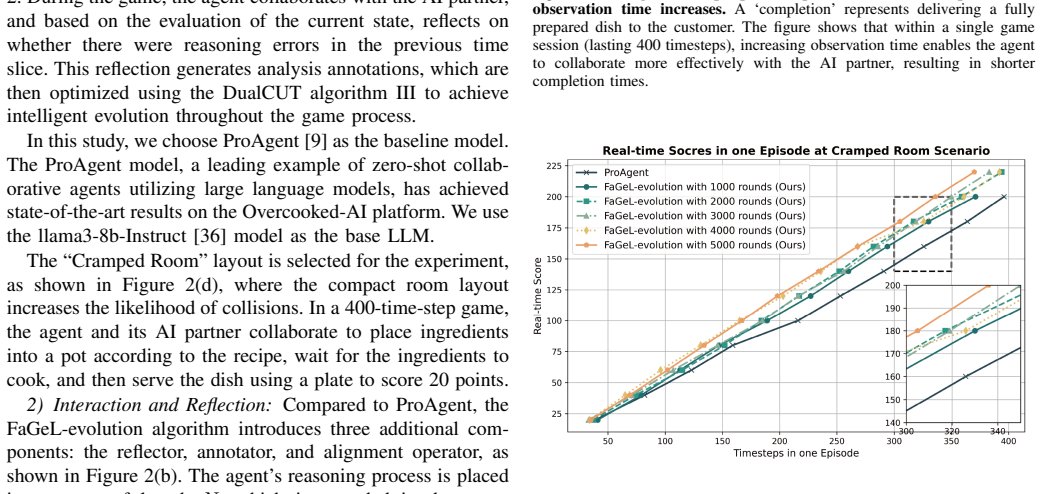
- [§V-A (Contribution 5, p. 3)] The headline claim that FaGeL achieves an 11.3% scoring performance improvement in 10 games is not backed by any reproducible measurement. No table lists per-game scores, means, standard deviations, seeds, or the formula defining the 11.3% figure. Figure 5 is a single-episode score trace, and Figure 4 reports average timesteps per completion, which is not the claimed scoring improvement. Without this information, the central quantitative result cannot be verified or compared with future work.
- [§IV-D and §III-A] The feedback used in the Overcooked-AI experiments is generated by the agent's own annotator rather than by a human user. Section IV-D states that the agent 'reflects on whether there were reasoning errors in the previous time slice' and that 'this reflection generates analysis annotations'; Section III-A explicitly permits feedback to be 'drafted by the LLM based on the analysis of the current state.' Consequently, the experiments do not demonstrate alignment with human preferences; they demonstrate self-training on the model's own judgments. The claim of 'implicit human feedback' is therefore circular with respect to the model's internal estimates.
- [§V-A vs. §III-C] The evaluation does not isolate the DualCUT mechanism from generic self-training. The baseline ProAgent is frozen, while the FaGeL variant receives additional parameter updates every 1000 timesteps on self-generated annotations. Any improvement could be due to the extra in-distribution gradient steps, the MLE term in Eq. (9) that reinforces non-U tokens, or the contrastive/unlikelihood losses. Without an ablation that applies, for example, standard fine-tuning or the original CUT to the same self-annotated data, the specific contribution of DualCUT to the reported improvement is not established.
- [§III-C, Eqs. (5) to (9)] The algorithm depends on eight hyperparameters (λ1, λ2, λ3, λ4, α, β, σ1, σ2), but the manuscript does not report their values or a sensitivity analysis. Since the token-selection criteria and the dynamic scaling terms in Eqs. (7) and (8) are highly sensitive to these thresholds, the reader cannot judge whether the reported behavior is robust or an artifact of particular settings.
- [§V-B, Fig. 6] The token-level saliency map is presented as the first such visualization during LLM training, but it appears to display the model's own next-token probabilities under different feedback conditions. As such, it is a visualization of the model's internal probability assignments, not an independent explanation of why certain tokens are selected. The paper does not compare this saliency map with established interpretability tools (e.g., gradient-based or attention-based attributions), nor does it validate that the visualized saliency corresponds to human-interpretable causes.
- [§IV-C and §V] The validation of task mining is limited to a t-SNE plot of 1000 generated tasks without any quantitative metric (e.g., diversity, relevance, or user agreement), and the DPO-based user preference initialization is described without reporting the rating dataset size, training details, or evaluation. The case study in Table I is anecdotal and does not demonstrate that the system's outputs improve over time in a measurable way.
minor comments (6)
- [Section II heading] The section heading appears as 'R ALATED WORK' in the provided manuscript; this should be corrected to 'RELATED WORK.'
- [Eq. (3)] The indicator function uses the notation x → y without a definition; the meaning of the arrow in the indicator is unclear and should be specified.
- [Footnote to Contribution 5] The footnote states that ProAgent surpasses its previous SOTA by 0.51% in the Cramped Room scenario, but no source or experimental basis is provided for this number.
- [References] Several references are incomplete (e.g., [1], [9], [35] lack full bibliographic details such as venue, volume, or page numbers), which hinders reproducibility.
- [Figure 2] The caption of Figure 2 lists multiple subfigures (a) through (d) but does not explain the content of each subfigure; a legend or detailed caption would improve clarity.
- [§III (general)] The term 'intelligence evolution' is used repeatedly without a formal definition; the paper would benefit from a precise problem statement defining the evolution objective and its success criteria.
Circularity Check
The 'human feedback' that drives DualCUT in Overcooked is the agent's own LLM-generated annotation, so the alignment loop is self-referential; the saliency-map evidence is likewise a visualization of the model's own probabilities.
-
self definitional
[Section III-A (Problem Transformation) and Section IV-D.1 (Setups on Overcooked-AI)]
"Human feedback contains a detailed analysis of the strengths and weaknesses of the output, which is either directly provided by the user or drafted by the LLM based on the analysis of the current state. ... During the game, the agent collaborates with the AI partner, and based on the evaluation of the current state, reflects on whether there were reasoning errors in the previous time slice. This reflection generates analysis annotations, which are then optimized using the DualCUT algorithm."
The paper defines 'human feedback' to include text drafted by the LLM itself, and then in the Overcooked experiments the reflector/annotator produces the analysis annotations from the agent's own state evaluation. The feedback j entering the DualCUT detectors and loss (Eqs. 5-9) is therefore self-generated: the model is updated using its own judgment of its own outputs. The claimed alignment with human values is circular with respect to the model's own probabilities because no human signal enters the loop. Contribution 5 even states the agent evolves 'without human guidance,' confirming that the feedback is internal, not human-provided.
-
other
[Section V-B (Token-Level Saliency Maps within the FaGeL-evo Algorithm), Fig. 6 caption]
"This visualization demonstrates how fine-tuning the model by enhancing the tokens associated with positive feedback and suppressing those with negative feedback effectively aligns token saliency with user preferences, ultimately achieving preference alignment."
The token saliency is computed from the same model's conditional token probabilities (Eqs. 5-8), and the 'positive and negative feedback' used as input in Fig. 6 is the self-generated annotation produced by the agent's own annotator in the Overcooked pipeline. Thus the saliency map is a plot of the model's own probabilities conditioned on its own generated text. Presenting it as evidence of alignment with 'user preferences' is self-referential: the visualization reduces to a check of the model against itself, not against any external human preference.
full rationale
The DualCUT equations themselves are internally well-defined as a contrastive/unlikelihood loss, and the self-citations to Fabric Computing [16] and Wearable 2.0 [35] are background hardware references, not load-bearing for the algorithmic claims. However, the central experimental claim of alignment with implicit human feedback is partially circular by construction: the paper allows feedback to be 'drafted by the LLM,' and the Overcooked experiments use exactly that option, generating analysis annotations from the agent's own evaluation of the current state and then fine-tuning the agent on those annotations. Because the 'human' signal is the model's own generated text, the improvement measured against a frozen ProAgent baseline cannot separate DualCUT as an alignment method from generic self-training on self-generated outputs. The saliency-map evidence is similarly self-referential, visualizing the model's own token probabilities with respect to its own annotations. The 11.3% performance claim is also not auditable from the paper (no per-game scores, seeds, or error bars), but that is a reproducibility concern rather than a circularity one. Overall, the algorithmic derivation is not circular, but the empirical demonstration of human alignment reduces to a closed self-feedback loop, warranting a score of 6.
Assumptions & free parameters
free parameters (8)
- λ1 =
Not reported
- λ2 =
Not reported
- λ3 =
Not reported
- λ4 =
Not reported
- α =
Not reported
- β =
Not reported
- σ1 =
Not reported
- σ2 =
Not reported
assumptions (3)
- domain assumption CUT's token-level error identification is reliable.
- ad hoc to paper The annotator's analysis annotations accurately reflect user preferences.
- domain assumption Smart fabric sensor data can be faithfully converted into natural-language state descriptions.
Cite this review
Pith. "Pith review of FaGeL: Fabric LLMs Agent empowered Embodied Intelligence Evolution with Autonomous Human-Machine Collaboration." pith.science (2026). https://pith.science/paper/T2LM3ZOH
@misc{pith2026241220297,
  author       = {Pith},
  title        = {Pith review of: FaGeL: Fabric LLMs Agent empowered Embodied Intelligence Evolution with Autonomous Human-Machine Collaboration},
  year         = {2026},
  howpublished = {\url{https://pith.science/paper/T2LM3ZOH}},
  note         = {Machine review of arXiv:2412.20297}
}
read the original abstract
Recent advancements in Large Language Models (LLMs) have enhanced the reasoning capabilities of embodied agents, driving progress toward AGI-powered robotics. While LLMs have been applied to tasks like semantic reasoning and task generalization, their potential in open physical space exploration remains underexplored. This paper introduces FaGeL (Fabric aGent empowered by embodied intelligence with LLMs), an embodied agent integrating smart fabric technology for seamless, non-intrusive human-agent interaction. FaGeL autonomously generates tasks using multimodal data from wearable and ambient sensors, refining its behavior based on implicit human feedback in generated text, without explicit ratings or preferences. We also introduce a token-level saliency map to visualize LLM fine-tuning, enhancing the interpretability of token-level alignment. The system leverages dual feedback mechanisms to improve token-level alignment and addresses challenges in non-intrusive human-machine interaction and cognition evolution. Our contributions include FaGeL's development, the DualCUT algorithm for AI alignment, and experimental validation in cooperative tasks, demonstrating FaGeL's ability to adapt and evolve autonomously through implicit feedback. In the future, we plan to explore FaGeL's scalability in dynamic environments and its integration with other AI systems to develop AGI agents that adapt seamlessly to diverse human needs.
Figures


Figures from the paper (4 more)



Reference graph
Works this paper leans on
-
[1]
Gpt-4 technical report. arxiv. 2023. doi: 10.48550,
J. A. OpenAI, A. Steven et al., “Gpt-4 technical report. arxiv. 2023. doi: 10.48550,” arXiv preprint arXiv.2303.08774
arXiv 2023
-
[2]
Generative agents: Interactive simulacra of human behavior,
J. S. Park, J. O’Brien, C. J. Cai, M. R. Morris, P. Liang, and M. S. Bernstein, “Generative agents: Interactive simulacra of human behavior,” in Proceedings of the 36th annual acm symposium on user interface software and technology , 2023, pp. 1–22
2023
-
[3]
Aligning cyber space with physical world: A comprehensive survey on embodied ai,
Y . Liu, W. Chen, Y . Bai, J. Luo, X. Song, K. Jiang, Z. Li, G. Zhao, J. Lin, G. Li et al., “Aligning cyber space with physical world: A comprehensive survey on embodied ai,” arXiv preprint arXiv:2407.06886 , 2024
arXiv 2024
-
[4]
Rt-2: Vision-language- action models transfer web knowledge to robotic control,
A. Brohan, N. Brown, J. Carbajal, Y . Chebotar, X. Chen, K. Choroman- ski, T. Ding, D. Driess, A. Dubey, C. Finnet al., “Rt-2: Vision-language- action models transfer web knowledge to robotic control,” arXiv preprint arXiv:2307.15818, 2023
arXiv 2023
-
[5]
Rt-1: Robotics transformer for real-world control at scale,
A. Brohan, N. Brown, J. Carbajal, Y . Chebotar, J. Dabis, C. Finn, K. Gopalakrishnan, K. Hausman, A. Herzog, J. Hsu et al. , “Rt-1: Robotics transformer for real-world control at scale,” arXiv preprint arXiv:2212.06817, 2022
arXiv 2022
-
[6]
Rt-h: Action hierarchies using language,
S. Belkhale, T. Ding, T. Xiao, P. Sermanet, Q. Vuong, J. Tompson, Y . Chebotar, D. Dwibedi, and D. Sadigh, “Rt-h: Action hierarchies using language,” arXiv preprint arXiv:2403.01823 , 2024
arXiv 2024
-
[7]
Chatgpt for robotics: Design principles and model abilities,
S. H. Vemprala, R. Bonatti, A. Bucker, and A. Kapoor, “Chatgpt for robotics: Design principles and model abilities,” IEEE Access, 2024
work page 2024
-
[8]
Do as i can, not as i say: Grounding language in robotic affordances,
M. Ahn, A. Brohan, N. Brown, Y . Chebotar, O. Cortes, B. David, C. Finn, C. Fu, K. Gopalakrishnan, K. Hausman et al. , “Do as i can, not as i say: Grounding language in robotic affordances,” arXiv preprint arXiv:2204.01691, 2022
arXiv 2022
Show all 36 references
-
[9]
Proagent: Building proactive cooperative ai with large language models,
C. Zhang, K. Yang, S. Hu, Z. Wang, G. Li, Y . Sun, C. Zhang, Z. Zhang, A. Liu, S.-C. Zhu et al. , “Proagent: Building proactive cooperative ai with large language models,” CoRR, 2023
2023
-
[10]
Jarvis-1: Open-world multi-task agents with memory-augmented multimodal language models,
Z. Wang, S. Cai, A. Liu, Y . Jin, J. Hou, B. Zhang, H. Lin, Z. He, Z. Zheng, Y . Yang et al. , “Jarvis-1: Open-world multi-task agents with memory-augmented multimodal language models,” arXiv preprint arXiv:2311.05997, 2023
2023 arXiv
-
[11]
Towards artificial general intelligence via a multimodal foundation model,
N. Fei, Z. Lu, Y . Gao, G. Yang, Y . Huo, J. Wen, H. Lu, R. Song, X. Gao, T. Xiang et al., “Towards artificial general intelligence via a multimodal foundation model,” Nature Communications , vol. 13, no. 1, p. 3094, 2022
2022
-
[12]
Langsuite: Planning, controlling and interacting with large language models in embodied text environments,
Z. Jia, M. Wang, B. Tong, S.-C. Zhu, and Z. Zheng, “Langsuite: Planning, controlling and interacting with large language models in embodied text environments,” arXiv preprint arXiv:2406.16294 , 2024
2024 arXiv
-
[13]
Training language models to follow instructions with human feedback,
L. Ouyang, J. Wu, X. Jiang, D. Almeida, C. Wainwright, P. Mishkin, C. Zhang, S. Agarwal, K. Slama, A. Ray et al. , “Training language models to follow instructions with human feedback,” Advances in neural information processing systems , vol. 35, pp. 27 730–27 744, 2022
2022
-
[14]
Direct preference optimization: Your language model is secretly a reward model,
R. Rafailov, A. Sharma, E. Mitchell, C. D. Manning, S. Ermon, and C. Finn, “Direct preference optimization: Your language model is secretly a reward model,” Advances in Neural Information Processing Systems, vol. 36, 2024
2024
-
[15]
Rrhf: Rank responses to align language models with human feedback,
H. Yuan, Z. Yuan, C. Tan, W. Wang, S. Huang, and F. Huang, “Rrhf: Rank responses to align language models with human feedback,” Advances in Neural Information Processing Systems , vol. 36, 2024
2024
-
[16]
Fabric computing: concepts, opportunities and challenges,
M. Chen, J. Liu, P. Li, H. Gharavi, Y . Hao, J. Ouyang, J. Hu, L. Hu, C. Hou, I. Humar et al., “Fabric computing: concepts, opportunities and challenges,” The Innovation, 2022
2022
-
[17]
50th anniversary perspective: Solid-state multistimuli, multiresponsive polymeric materi- als,
K. M. Herbert, S. Schrettl, S. J. Rowan, and C. Weder, “50th anniversary perspective: Solid-state multistimuli, multiresponsive polymeric materi- als,” Macromolecules, vol. 50, no. 22, pp. 8845–8870, 2017
2017
-
[18]
A review of stimuli-responsive polymers for smart textile applications,
J. Hu, H. Meng, G. Li, and S. I. Ibekwe, “A review of stimuli-responsive polymers for smart textile applications,” Smart Materials and Structures, vol. 21, no. 5, p. 053001, 2012
2012
-
[19]
Reasons to reject? align- ing language models with judgments,
W. Xu, D. Cai, Z. Zhang, W. Lam, and S. Shi, “Reasons to reject? align- ing language models with judgments,” arXiv preprint arXiv:2312.14591, 2023
2023 arXiv
-
[20]
Simulation of conductivity made by inkjet-printed silver tracks in e-textiles with different weave patterns,
M. Ghahremani, M. Latifi, and M. Babaei, “Simulation of conductivity made by inkjet-printed silver tracks in e-textiles with different weave patterns,” Journal of Industrial Textiles , vol. 47, no. 2, pp. 173–196, 2017
2017
-
[21]
Phase change materials for smart textiles–an overview,
S. Mondal, “Phase change materials for smart textiles–an overview,” Applied thermal engineering , vol. 28, no. 11-12, pp. 1536–1550, 2008
2008
-
[22]
Smart textiles for personalized thermoregulation,
Y . Fang, G. Chen, M. Bick, and J. Chen, “Smart textiles for personalized thermoregulation,” Chemical Society Reviews, vol. 50, no. 17, pp. 9357– 9374, 2021
2021
-
[23]
Uv/nir-light-triggered rapid and reversible color switching for rewritable smart fabrics,
D. K. Macharia, S. Ahmed, B. Zhu, Z. Liu, Z. Wang, J. I. Mwasiagi, Z. Chen, and M. Zhu, “Uv/nir-light-triggered rapid and reversible color switching for rewritable smart fabrics,” ACS applied materials & interfaces, vol. 11, no. 14, pp. 13 370–13 379, 2019
2019
-
[24]
Fabrication of visual textile temperature indicators based on reversible thermochromic fibers,
Y . Zhang, Z. Hu, H. Xiang, G. Zhai, and M. Zhu, “Fabrication of visual textile temperature indicators based on reversible thermochromic fibers,” Dyes and Pigments , vol. 162, pp. 705–711, 2019
2019
-
[25]
Smart color- changing textile with high contrast based on a single-sided conductive fabric,
G. Huang, L. Liu, R. Wang, J. Zhang, X. Sun, and H. Peng, “Smart color- changing textile with high contrast based on a single-sided conductive fabric,” Journal of Materials Chemistry C, vol. 4, no. 32, pp. 7589–7594, 2016
2016
-
[26]
Electrochromic textile displays for personal communication,
C. Moretti, X. Tao, L. Koehl, and V . Koncar, “Electrochromic textile displays for personal communication,” in Smart textiles and their appli- cations. Elsevier, 2016, pp. 539–568. IEEE TRANSACTIONS ON HUMAN-MACHINE SYSTEMS, VOL. XX, NO. XX, DECEMBER 2024 12
2016
-
[27]
Interactively full-color changeable electronic fiber sensor with high stretchability and rapid response,
Y . Wang, W. Niu, C.-Y . Lo, Y . Zhao, X. He, G. Zhang, S. Wu, B. Ju, and S. Zhang, “Interactively full-color changeable electronic fiber sensor with high stretchability and rapid response,”Advanced Functional Materials, vol. 30, no. 19, p. 2000356, 2020
2020
-
[28]
Imperceptible, designable, and scalable braided electronic cord,
M. Chen, J. Ouyang, A. Jian, J. Liu, P. Li, Y . Hao, Y . Gong, J. Hu, J. Zhou, R. Wang et al., “Imperceptible, designable, and scalable braided electronic cord,” Nature Communications, vol. 13, no. 1, p. 7097, 2022
2022
-
[29]
Recent trends in smart textiles: Wearable sensors and drug release systems,
A. Ferri, M. R. Plutino, and G. Rosace, “Recent trends in smart textiles: Wearable sensors and drug release systems,” in AIP conference proceedings, vol. 2145, no. 1. AIP Publishing, 2019
2019
-
[30]
Wearables, implants, and internet of things: the technology needs in the evolving landscape,
S. Ray, J. Park, and S. Bhunia, “Wearables, implants, and internet of things: the technology needs in the evolving landscape,” IEEE Transactions on Multi-Scale Computing Systems , vol. 2, no. 2, pp. 123– 128, 2016
2016
-
[31]
Ai alignment: A comprehensive survey,
J. Ji, T. Qiu, B. Chen, B. Zhang, H. Lou, K. Wang, Y . Duan, Z. He, J. Zhou, Z. Zhang et al., “Ai alignment: A comprehensive survey,”arXiv preprint arXiv:2310.19852, 2023
2023 arXiv
-
[32]
Fine-grained human feedback gives better rewards for language model training,
Z. Wu, Y . Hu, W. Shi, N. Dziri, A. Suhr, P. Ammanabrolu, N. A. Smith, M. Ostendorf, and H. Hajishirzi, “Fine-grained human feedback gives better rewards for language model training,” Advances in Neural Information Processing Systems , vol. 36, pp. 59 008–59 033, 2023
2023
-
[33]
Neural text generation with unlikelihood training,
S. Welleck, I. Kulikov, S. Roller, E. Dinan, K. Cho, and J. Weston, “Neural text generation with unlikelihood training,” arXiv preprint arXiv:1908.04319, 2019
1908 arXiv
-
[34]
On the utility of learning about humans for human- ai coordination,
M. Carroll, R. Shah, M. K. Ho, T. Griffiths, S. Seshia, P. Abbeel, and A. Dragan, “On the utility of learning about humans for human- ai coordination,” Advances in neural information processing systems , vol. 32, 2019
2019
-
[35]
Wearable 2.0: Enabling human-cloud integration in next generation healthcare systems,
M. Chen, Y . Ma, Y . Li, D. Wu, Y . Zhang, and C. H. Youn, “Wearable 2.0: Enabling human-cloud integration in next generation healthcare systems,” IEEE Communications Magazine , vol. 55, no. 1, pp. 54–61, 2017
2017
-
[36]
Llama 3 model card,
AI@Meta, “Llama 3 model card,” 2024. Jia Liu is currently a Ph.D candidate at Embed- ded and Pervasive Computing (EPIC) Laboratory in the School of Computer Science and Technology, Huazhong University of Science and Technology (HUST), China. She received her bachelor’s degree ...
2024
Reviewed August 10, 2026 · model on record in the stance chip above.
Discussion (0). Continue with ORCID to comment.