Nontrivial Boundary-Mediated Superconducting Transport in a TRSB Topological Iron-Based Superconductor
Pith reviewed 2026-06-26 12:39 UTC · model grok-4.3
The pith
FeTe0.55Se0.45 devices exhibit a conductance plateau along sharp edges that tracks the TRSB temperature scale and appears only in topologically nontrivial compositions.
A machine-rendered reading of the paper's core claim, the machinery that carries it, and where it could break.
Core claim
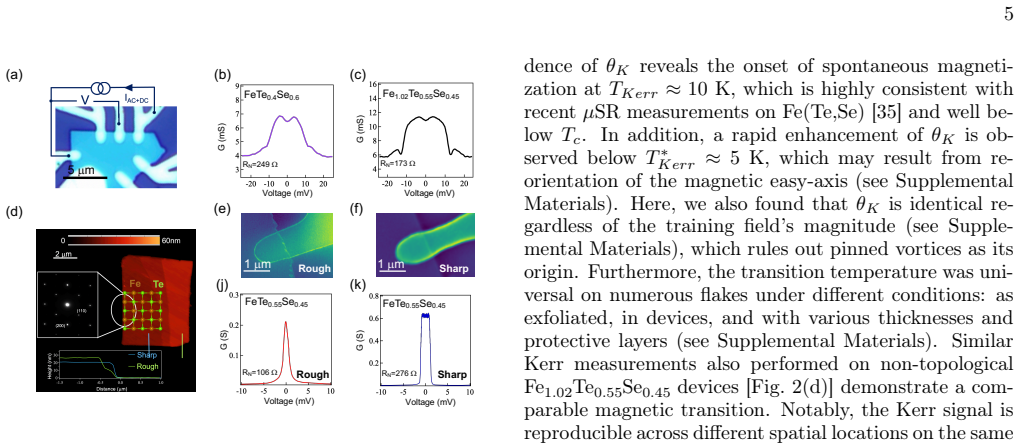
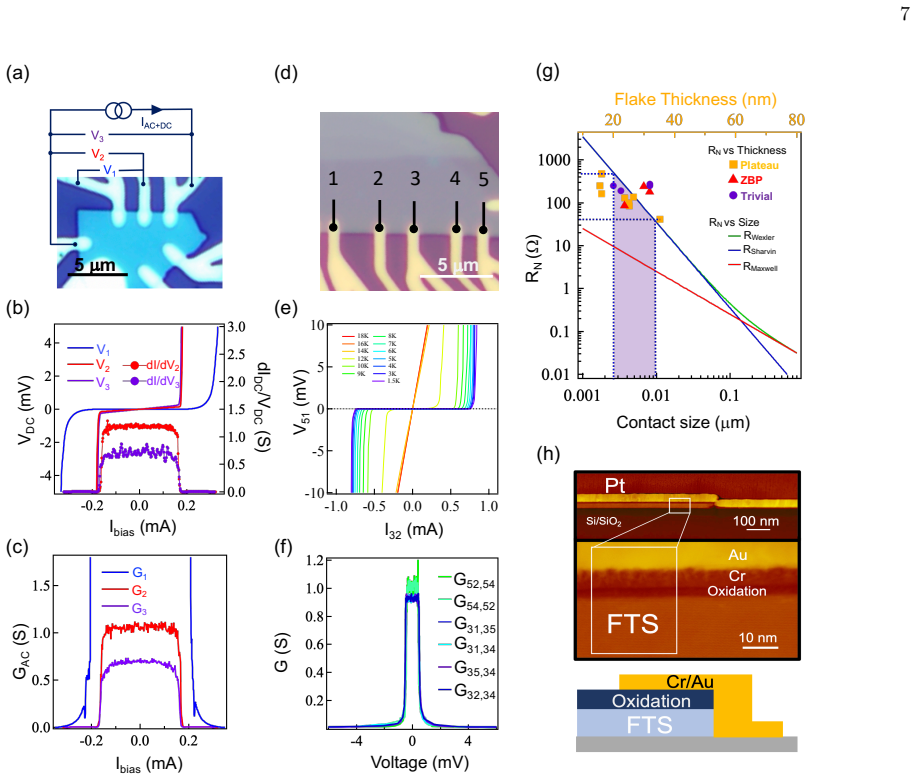
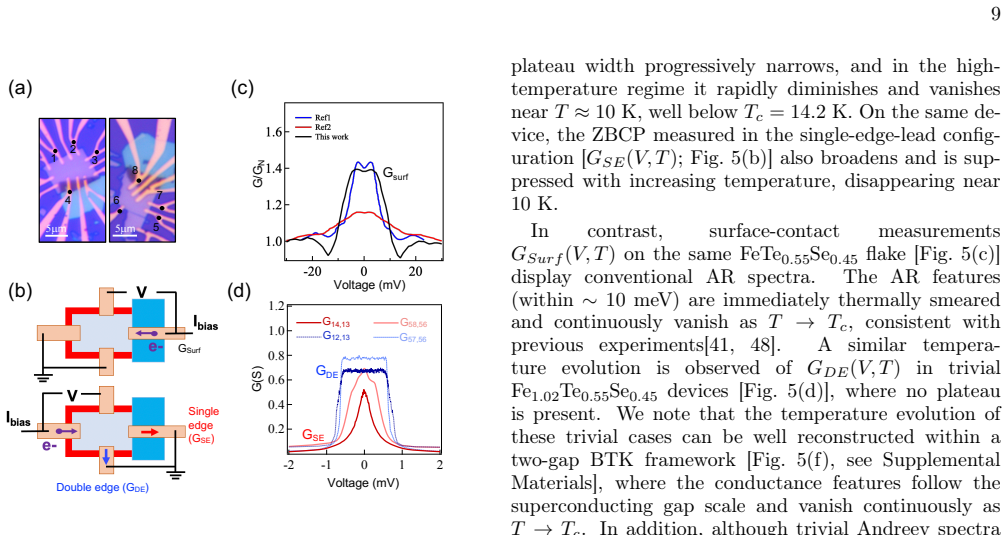
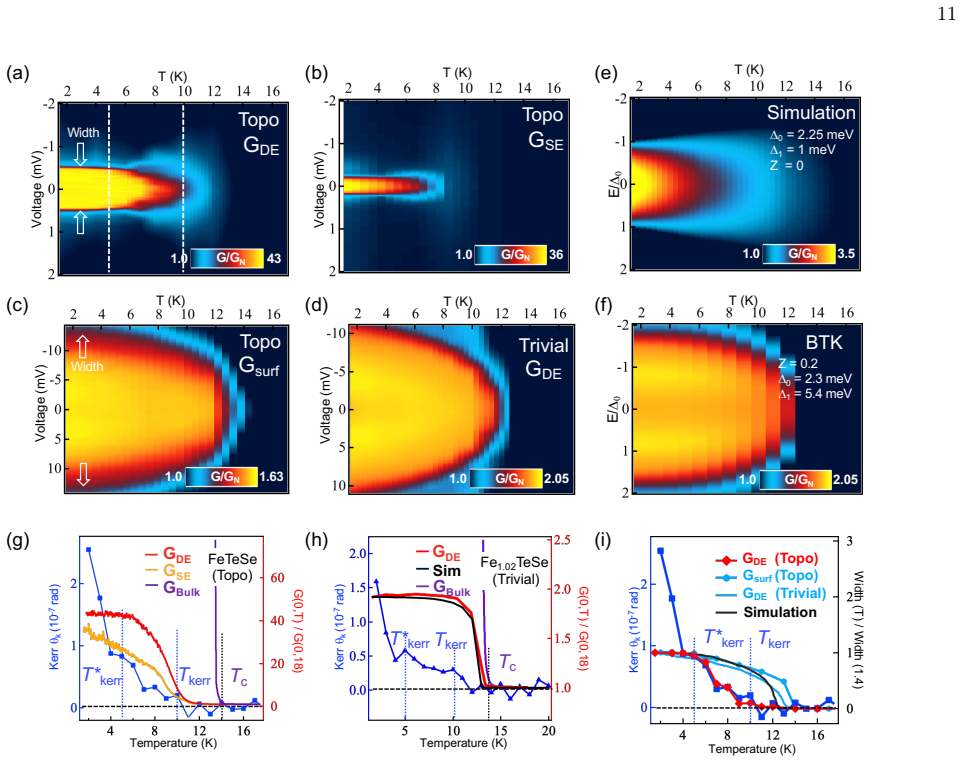
Topological FeTe0.55Se0.45 exhibits boundary-mediated superconducting transport, shown by a conductance plateau that requires sharp continuous edges, persists over long distances, collapses when contacts move to the top surface, and follows the TRSB onset temperature TKerr instead of Tc, while the same plateau is absent in topologically trivial FeTe0.40Se0.60 and Fe1.02Te0.55Se0.45.
What carries the argument
The anomalous conductance plateau measured with side-surface-dominant contacts along uninterrupted crystallographically sharp edges.
If this is right
- The plateau requires an uninterrupted sharp edge path between source and drain.
- It survives over micrometer separations much larger than the bulk coherence length.
- Its temperature dependence follows the TRSB scale TKerr rather than Tc.
- It vanishes when the drain contact is moved from the side surface to the top surface.
- The signatures are absent in topologically trivial compositions under comparable edge conditions.
Where Pith is reading between the lines
- Similar edge-selective transport measurements could be applied to other candidate topological superconductors to test for boundary states without requiring fabricated junctions.
- The long-range nature of the plateau implies that any mediating states maintain coherence over distances where bulk quasiparticles would be gapped.
- Phase-sensitive experiments that probe the symmetry of the boundary states would help distinguish between possible microscopic origins such as chiral Majorana modes or other TRSB-induced boundary modes.
Load-bearing premise
The plateau is produced by topological boundary states rather than conventional mechanisms such as Andreev reflection or disorder-induced states.
What would settle it
Observation of the same plateau in topologically trivial FeTe0.40Se0.60 devices that also have continuous sharp edges connecting source and drain contacts.
Figures
read the original abstract
The interplay of superconductivity, band topology, and spontaneous time-reversal-symmetry breaking (TRSB) is expected to enable topological superconducting boundary states. FeTe0.55Se0.45 provides a promising single-material platform because it combines superconductivity, nontrivial band topology, and spontaneous magnetization in the superconducting state. Here we report evidence for a boundary-mediated superconducting transport response in exfoliated Fe(Te,Se) devices. Polar Kerr measurements show that TRSB emerges below TKerr < Tc and coexists with superconductivity across multiple compositions, providing an independent symmetry-breaking scale for transport. Using crystallographically sharp, continuous edges and side-surface-dominant contacts, we find that topological FeTe0.55Se0.45 exhibits an anomalous conductance plateau absent in topologically trivial FeTe0.40Se0.60 and Fe1.02Te0.55Se0.45 under comparable measurements. This plateau requires uninterrupted sharp edges connecting source and drain, persists over micrometer-scale separations far exceeding the bulk coherence length, shows strongly suppressed thermal broadening, and collapses when the drain is moved to the top surface. Its temperature evolution follows the TRSB scale: the plateau remains weakly broadened below T*Kerr and disappears near TKerr rather than Tc. These doping-selective, edge-geometry-dependent, TRSB-correlated, and long-range nonlocal signatures establish experimental criteria for identifying boundary-mediated superconducting transport in FeTe0.55Se0.45 and motivate phase-sensitive and theoretical studies of its microscopic origin.
Editorial analysis
A structured set of objections, weighed in public.
Referee Report
Summary. The manuscript reports experimental evidence from polar Kerr and transport measurements on exfoliated Fe(Te,Se) devices, claiming that FeTe0.55Se0.45 exhibits a doping-selective, edge-geometry-dependent conductance plateau that is long-range (micrometer scale), shows suppressed thermal broadening, collapses when the drain contact is moved to the top surface, and tracks the TRSB temperature scale TKerr rather than Tc; this plateau is absent in topologically trivial compositions (FeTe0.40Se0.60 and Fe1.02Te0.55Se0.45), establishing criteria for boundary-mediated superconducting transport.
Significance. If the central interpretation holds, the work would supply concrete experimental signatures (doping selectivity, edge continuity requirement, TRSB correlation, and nonlocal character) for identifying boundary-mediated transport in a single-material platform that combines superconductivity, band topology, and spontaneous TRSB. The use of multiple orthogonal controls is a positive feature, though the absence of quantitative modeling or simulations weakens the ability to claim the signatures are unique to topological boundary states.
major comments (1)
- [Abstract and transport results] The central claim that the observed conductance plateau originates from topological boundary states (rather than conventional Andreev reflection or disorder-induced states) is load-bearing for the interpretation but rests on indirect controls; the manuscript contrasts compositions and edge geometries but does not provide a microscopic model or simulation demonstrating that expected conventional signals would be absent or qualitatively different under the reported contact positions, edge sharpness, and micrometer separations (see abstract description of plateau properties and the comparison to trivial compositions).
minor comments (2)
- [Transport measurements] The manuscript should include quantitative error bars, full raw datasets, and statistical measures of the plateau robustness to allow readers to assess the strength of the reported features.
- [Throughout] Notation for TKerr and T*Kerr should be clarified for consistency across the text and figures.
Simulated Author's Rebuttal
We thank the referee for their careful reading and constructive comments on the manuscript. We address the single major comment below.
read point-by-point responses
-
Referee: [Abstract and transport results] The central claim that the observed conductance plateau originates from topological boundary states (rather than conventional Andreev reflection or disorder-induced states) is load-bearing for the interpretation but rests on indirect controls; the manuscript contrasts compositions and edge geometries but does not provide a microscopic model or simulation demonstrating that expected conventional signals would be absent or qualitatively different under the reported contact positions, edge sharpness, and micrometer separations (see abstract description of plateau properties and the comparison to trivial compositions).
Authors: The manuscript is an experimental study whose central claim rests on a combination of orthogonal controls rather than a single indirect indicator. The anomalous plateau is observed exclusively in the topologically nontrivial composition FeTe0.55Se0.45, is absent under identical measurement conditions in the two trivial compositions, requires uninterrupted crystallographically sharp edges between source and drain, persists over micrometer separations far beyond the bulk coherence length, collapses when the drain contact is relocated to the top surface, and tracks the independently measured TRSB scale TKerr (with suppressed thermal broadening) rather than Tc. Conventional Andreev processes or disorder-induced states are not expected to exhibit this specific combination of doping selectivity, geometric requirement, nonlocal character, and TRSB correlation. While a quantitative microscopic model or simulation would strengthen uniqueness arguments, the work is experimental in scope and explicitly motivates such theoretical studies in the abstract. We therefore maintain that the reported controls are sufficient to establish the stated experimental criteria without requiring additional modeling in the present manuscript. revision: no
Circularity Check
No circularity: purely experimental report with no derivation chain
full rationale
The manuscript is an experimental study reporting measured conductance plateaus, Kerr rotation, and comparisons across doping levels and device geometries in Fe(Te,Se). No equations, fitted parameters, theoretical derivations, or self-citation chains are invoked to derive the central claims; the evidence consists of direct observations (doping selectivity, edge dependence, temperature evolution relative to TKerr) contrasted against control samples. The attribution to boundary-mediated transport relies on these empirical controls rather than any reduction to inputs by construction. This is the standard case of a self-contained experimental paper with no load-bearing circular steps.
Axiom & Free-Parameter Ledger
axioms (2)
- standard math Standard assumptions of superconductivity (finite coherence length) and band topology in iron-based materials
- domain assumption Polar Kerr rotation measures spontaneous time-reversal symmetry breaking
Reference graph
Works this paper leans on
-
[1]
Fu and C
L. Fu and C. L. Kane, Superconducting proximity effect and majorana fermions at the surface of a topological insulator, Physical review letters100, 096407 (2008)
2008
-
[2]
R. M. Lutchyn, J. D. Sau, and S. D. Sarma, Majo- rana fermions and a topological phase transition in semiconductor-superconductor heterostructures, Phys- ical review letters105, 077001 (2010)
2010
-
[3]
Qi and S.-C
X.-L. Qi and S.-C. Zhang, Topological insulators and superconductors, Reviews of Modern Physics83, 1057 (2011)
2011
-
[4]
Linder and J
J. Linder and J. W. Robinson, Superconducting spin- tronics, Nature Physics11, 307 (2015)
2015
-
[5]
R. Cai, I. Žutić, and W. Han, Superconduc- tor/ferromagnet heterostructures: a platform for super- conducting spintronics and quantum computation, Ad- vanced Quantum Technologies6, 2200080 (2023)
2023
-
[6]
Yi, Y.-F
H. Yi, Y.-F. Zhao, Y.-T. Chan, J. Cai, R. Mei, X. Wu, Z.-J. Yan, L.-J. Zhou, R. Zhang, Z. Wang,et al., Interface-induced superconductivity in magnetic topo- logical insulators, Science383, 634 (2024)
2024
-
[7]
P. Wan, O. Zheliuk, N. F. Yuan, X. Peng, L. Zhang, M. Liang, U. Zeitler, S. Wiedmann, N. E. Hussey, T. T. Palstra,et al., Orbital fulde–ferrell–larkin–ovchinnikov state in an ising superconductor, Nature619, 46 (2023)
2023
-
[8]
N. F. Yuan and L. Fu, Supercurrent diode effect and finite-momentum superconductors, Proceedings of the National Academy of Sciences119, e2119548119 (2022)
2022
-
[9]
K. Chen, B. Karki, and P. Hosur, Intrinsic supercon- ducting diode effects in tilted weyl and dirac semimet- als, Physical Review B109, 064511 (2024)
2024
-
[10]
Kallin, Chiral p-wave order in sr2ruo4, Reports on Progress in Physics75, 042501 (2012)
C. Kallin, Chiral p-wave order in sr2ruo4, Reports on Progress in Physics75, 042501 (2012)
2012
-
[11]
Alicea, New directions in the pursuit of majorana fermions in solid state systems, Reports on progress in physics75, 076501 (2012)
J. Alicea, New directions in the pursuit of majorana fermions in solid state systems, Reports on progress in physics75, 076501 (2012)
2012
-
[12]
Yazdani, F
A. Yazdani, F. von Oppen, B. I. Halperin, and A. Ya- coby, Hunting for majoranas, Science380, eade0850 (2023)
2023
-
[13]
M. Z. Hasan, S.-Y. Xu, and G. Bian, Topological in- sulators, topological superconductors and weyl fermion semimetals: discoveries, perspectives and outlooks, Physica Scripta164, 014001 (2015)
2015
-
[14]
S. Kim, S. Lei, L. M. Schoop, R. Cava, and N. Ong, Edge supercurrent reveals competition between conden- sates in a weyl superconductor, Nature Physics20, 261 (2024)
2024
-
[15]
Kayyalha, D
M. Kayyalha, D. Xiao, R. Zhang, J. Shin, J. Jiang, F. Wang, Y.-F. Zhao, R. Xiao, L. Zhang, K. M. Fi- jalkowski,et al., Absence of evidence for chiral majo- rana modes in quantum anomalous hall-superconductor devices, Science367, 64 (2020)
2020
-
[16]
S. D. Sarma and H. Pan, Disorder-induced zero-bias peaks in majorana nanowires, Physical Review B103, 195158 (2021)
2021
-
[17]
H.-Y. Hui, J. D. Sau, and S. D. Sarma, Bulk disorder in the superconductor affects proximity-induced topolog- ical superconductivity, Physical Review B92, 174512 (2015)
2015
-
[18]
Gifford, G
J. Gifford, G. Zhao, B. Li, J. Zhang, D. Kim, and T. Chen, Zero bias anomaly in andreev reflection spec- troscopy, Journal of Applied Physics120(2016)
2016
-
[19]
Serban, B
I. Serban, B. Béri, A. Akhmerov, and C. Beenakker, Do- main wall in a chiral p-wave superconductor: A path- way for electrical current, Physical review letters104, 147001 (2010)
2010
-
[20]
J. J. He, J. Wu, T.-P. Choy, X.-J. Liu, Y. Tanaka, and K. T. Law, Correlated spin currents generated by resonant-crossed andreev reflections in topological su- perconductors, Nature communications5, 3232 (2014)
2014
-
[21]
Zhang, Z
Y.-T. Zhang, Z. Hou, X. Xie, and Q.-F. Sun, Quantum perfect crossed andreev reflection in top-gated quan- tum anomalous hall insulator–superconductor junc- tions, Physical Review B95, 245433 (2017)
2017
-
[22]
S.Ikegaya, Y.Asano,andD.Manske,Anomalousnonlo- cal conductance as a fingerprint of chiral majorana edge states, Physical Review Letters123, 207002 (2019)
2019
-
[23]
Z. Wang, P. Zhang, G. Xu, L. Zeng, H. Miao, X. Xu, T. Qian, H. Weng, P. Richard, A. V. Fedorov,et al., Topological nature of the fese 0.5 te 0.5 superconductor, Physical Review B92, 115119 (2015)
2015
-
[24]
Zhang, K
P. Zhang, K. Yaji, T. Hashimoto, Y. Ota, T. Kondo, K. Okazaki, Z. Wang, J. Wen, G. Gu, H. Ding,et al., Observationoftopologicalsuperconductivityonthesur- face of an iron-based superconductor, Science360, 182 (2018)
2018
-
[25]
Y. Li, N. Zaki, V. O. Garlea, A. T. Savici, D. Fobes, Z. Xu, F. Camino, C. Petrovic, G. Gu, P. D. John- son,et al., Electronic properties of the bulk and surface states of fe1+ y te1- x se x, Nature Materials20, 1221 (2021)
2021
- [26]
-
[27]
E.-M. Choi, K. I. Sim, K. S. Burch, and Y. H. Lee, Emergent multifunctional magnetic proximity in van der waals layered heterostructures, Advanced Science9, 2200186 (2022)
2022
-
[28]
Hatefipour, J
M. Hatefipour, J. J. Cuozzo, J. Kanter, W. M. Strick- land, C. R. Allemang, T.-M. Lu, E. Rossi, and J. Sha- bani,InducedSuperconductingPairinginIntegerQuan- tum Hall Edge States, Nano Letters22, 6173 (2022)
2022
-
[29]
Z. Wang, J. O. Rodriguez, L. Jiao, S. Howard, M. Gra- ham, G. Gu, T. L. Hughes, D. K. Morr, and V. Mad- havan, Evidence for dispersing 1d majorana channels in an iron-based superconductor, Science367, 104 (2020)
2020
-
[30]
Jenkins, N
M.J.Gray, J.Freudenstein, S.Y.F.Zhao, R.O’Connor, S. Jenkins, N. Kumar, M. Hoek, A. Kopec, S. Huh, T. Taniguchi,et al., Evidence for helical hinge zero modes in an fe-based superconductor, Nano letters19, 4890 (2019)
2019
-
[31]
N. Zaki, G. Gu, A. Tsvelik, C. Wu, and P. D. Johnson, Time-reversal symmetry breaking in the fe-chalcogenide superconductors, Proceedings of the National Academy of Sciences118, e2007241118 (2021)
2021
-
[32]
N. J. McLaughlin, H. Wang, M. Huang, E. Lee-Wong, L. Hu, H. Lu, G. Q. Yan, G. Gu, C. Wu, Y.-Z. You, et al., Strong correlation between superconductivity and ferromagnetism in an fe-chalcogenide superconductor, Nano Letters21, 7277 (2021)
2021
-
[33]
Matsuura, M
K. Matsuura, M. Roppongi, M. Qiu, Q. Sheng, Y. Cai, 14 K. Yamakawa, Z. Guguchia, R. P. Day, K. M. Ko- jima, A. Damascelli,et al., Two superconducting states with broken time-reversal symmetry in fese1- x s x, Proceedings of the National Academy of Sciences120, e2208276120 (2023)
2023
-
[34]
Farhang, N
C. Farhang, N. Zaki, J. Wang, G. Gu, P. D. Johnson, and J. Xia, Revealing the origin of time-reversal sym- metry breaking in fe-chalcogenide superconductor fete 1- x se x, Physical Review Letters130, 046702 (2023)
2023
-
[35]
Roppongi, Y
M. Roppongi, Y. Cai, K. Ogawa, S. Liu, G. Zhao, M. Oudah, T. Fujii, K. Imamura, S. Fang, K. Ishihara, et al., Topology meets time-reversal symmetry breaking in fese1- x te x superconductors, Nature communica- tions16, 6573 (2025)
2025
-
[36]
Meng and L
T. Meng and L. Balents, Weyl superconductors, Physical Review B—Condensed Matter and Materials Physics86, 054504 (2012)
2012
-
[37]
J. D. Sau and S. Tewari, Topologically protected surface majorana arcs and bulk weyl fermions in ferromagnetic superconductors, Physical Review B—Condensed Mat- ter and Materials Physics86, 104509 (2012)
2012
-
[38]
X. Wu, S. B. Chung, C. Liu, and E.-A. Kim, Topological orders competing for the dirac surface state in fesete surfaces, Physical Review Research3, 013066 (2021)
2021
-
[39]
Hu and R.-X
L.-H. Hu and R.-X. Zhang, Dislocation majorana bound states in iron-based superconductors, Nature Communi- cations15, 2337 (2024)
2024
-
[40]
Daghero and R
D. Daghero and R. Gonnelli, Probing multiband super- conductivity by point-contact spectroscopy, Supercon- ductor Science and Technology23, 043001 (2010)
2010
-
[41]
F. Tang, P. Wang, P. Wang, Y. Gan, G. D. Gu, W. Zhang, M. He, and L. Zhang, Quasi-2d supercon- ductivity in fete0. 55se0. 45 ultrathin film, Journal of Physics: Condensed Matter31, 265702 (2019)
2019
-
[42]
Zalic, S
A. Zalic, S. Simon, S. Remennik, A. Vakahi, G. D. Gu, and H. Steinberg, Fete 0.55 se 0.45 van der waals tun- neling devices, Physical Review B100, 064517 (2019)
2019
-
[43]
Sheet, S
G. Sheet, S. Mukhopadhyay, and P. Raychaudhuri, Role of critical current on the point-contact andreev reflec- tion spectra between a normal metal and a supercon- ductor, Physical Review B69, 134507 (2004)
2004
-
[44]
Russo, M
S. Russo, M. Kroug, T. Klapwijk, and A. Morpurgo, Experimental observation of bias-dependent nonlocal andreev reflection, Physical review letters95, 027002 (2005)
2005
-
[45]
Cadden-Zimansky and V
P. Cadden-Zimansky and V. Chandrasekhar, Nonlocal correlations in normal-metal superconducting systems, Physical review letters97, 237003 (2006)
2006
-
[46]
J. P. Morten, A. Brataas, and W. Belzig, Circuit theory of crossed andreev reflection, Physical Re- view B—Condensed Matter and Materials Physics74, 214510 (2006)
2006
-
[47]
Galluzzi, K
A. Galluzzi, K. Buchkov, E. Nazarova, V. Tomov, G. Grimaldi, A. Leo, S. Pace, and M. Polichetti, Trans- port properties and high upper critical field of a fe (se, te) iron based superconductor, The European Physical Journal Special Topics228, 725 (2019)
2019
-
[48]
W. Park, C. Hunt, H. Arham, Z. Xu, J. Wen, Z. Lin, Q. Li, G. Gu, and L. Greene, Strong coupling super- conductivity in iron-chalcogenide fete0.55se0.45, arXiv preprint arXiv:1005.0190 (2010)
Pith/arXiv arXiv 2010
-
[49]
Deutscher, Andreev–saint-james reflections: A probe of cuprate superconductors, Reviews of modern physics 77, 109 (2005)
G. Deutscher, Andreev–saint-james reflections: A probe of cuprate superconductors, Reviews of modern physics 77, 109 (2005)
2005
-
[50]
L. Zhao, E. G. Arnault, A. Bondarev, A. Seredinski, T. F. Larson, A. W. Draelos, H. Li, K. Watanabe, T. Taniguchi, F. Amet,et al., Interference of chiral an- dreev edge states, Nature Physics16, 862 (2020)
2020
-
[51]
Daghero, M
D. Daghero, M. Tortello, G. Ummarino, and R. Gonnelli, Directional point-contact andreev- reflection spectroscopy of fe-based superconductors: Fermi surface topology, gap symmetry, and electron– boson interaction, Reports on Progress in Physics74, 124509 (2011)
2011
-
[52]
D. Wang, L. Kong, P. Fan, H. Chen, S. Zhu, W. Liu, L. Cao, Y. Sun, S. Du, J. Schneeloch,et al., Evidence for majorana bound states in an iron-based supercon- ductor, Science362, 333 (2018)
2018
-
[53]
Daghero, M
D. Daghero, M. Tortello, G. Ummarino, J.-C. Griveau, E. Colineau, R. Eloirdi, A. Shick, J. Kolorenc, A. Licht- enstein, and R. Caciuffo, Strong-coupling d-wave super- conductivity in pucoga5 probed by point-contact spec- troscopy, Nature communications3, 786 (2012)
2012
-
[54]
Ghanbarian, A
B. Ghanbarian, A. G. Hunt, R. P. Ewing, and M. Sahimi, Tortuosity in porous media: a critical re- view, Soil science society of America journal77, 1461 (2013)
2013
-
[55]
W. G. Vandenberghe and M. V. Fischetti, Imperfect two-dimensional topological insulator field-effect tran- sistors, Nature communications8, 14184 (2017)
2017
-
[56]
P. N. Argyres, Theory of the Faraday and Kerr Effects in Ferromagnetics, Phys. Rev.97, 334 (1955), publisher: American Physical Society
1955
-
[57]
A. Duif, A. Jansen, and P. Wyder, Point-contact spec- troscopy, Journal of Physics: Condensed Matter1, 3157 (1989)
1989
-
[58]
T. Chen, S. Huang, and C. Chien, Pronounced effects of additional resistance in andreev reflection spectroscopy, Physical Review B—Condensed Matter and Materials Physics81, 214444 (2010)
2010
-
[59]
M. J. Gray, N. Kumar, R. O’Connor, M. Hoek, E. Sheri- dan, M. C. Doyle, M. L. Romanelli, G. B. Osterhoudt, Y. Wang, V. Plisson,et al., A cleanroom in a glovebox, Review of Scientific Instruments91(2020)
2020
-
[60]
S. Lee, V. Stanev, X. Zhang, D. Stasak, J. Flowers, J. S. Higgins, S. Dai, T. Blum, X. Pan, V. M. Yakovenko, et al.,Perfectandreevreflectionduetothekleinparadox in a topological superconducting state, Nature570, 344 (2019)
2019
-
[61]
Z. Y. Zeng, L. Zhou, J. Hong, and B. Li, Local and nonlocal entanglement for quasiparticle pairs induced by andreev reflection, Physical Review B—Condensed Matter and Materials Physics74, 085312 (2006)
2006
-
[62]
K. T. Law, P. A. Lee, and T. K. Ng, Majorana fermion induced resonant andreev reflection, Physical review let- ters103, 237001 (2009)
2009
-
[63]
Casas-Barrera, S
O. Casas-Barrera, S. Gómez Páez, and W. J. Herrera, Long-range cooper pair splitting by chiral majorana edge states, Physical Review B110, 045415 (2024)
2024
-
[64]
T. L. Hughes, H. Yao, and X.-L. Qi, Majorana zero modes in dislocations of sr 2 ruo 4, Physical Review B90, 235123 (2014)
2014
-
[65]
Mascot, S
E. Mascot, S. Cocklin, M. Graham, M. Mashkoori, S. Rachel, and D. K. Morr, Topological surface su- perconductivity in fese0. 45te0. 55, Communications Physics5, 188 (2022)
2022
-
[66]
M. Kim, S. Choi, W. H. Brito, and G. Kotliar, Orbital- Selective Mott Transition Effects and Nontrivial Topol- 15 ogy of Iron Chalcogenide, Physical Review Letters132, 136504 (2024), 2304.05002
arXiv 2024
-
[67]
Read and D
N. Read and D. Green, Paired states of fermions in two dimensions with breaking of parity and time-reversal symmetries and the fractional quantum hall effect, Physical Review B61, 10267 (2000)
2000
-
[68]
P. Zareapour, A. Hayat, S. Y. F. Zhao, M. Kreshchuk, Z. Xu, T. S. Liu, G. D. Gu, S. Jia, R. J. Cava, H.-Y. Yang, Y.Ran, andK. S.Burch, Andreevreflection with- out Fermi surface alignment in high-T c van der Waals heterostructures, New Journal of Physics19, 043026 (2017), 1705.03518
Pith/arXiv arXiv 2017
-
[69]
Nayak, S
C. Nayak, S. H. Simon, A. Stern, M. Freedman, and S. D. Sarma, Non-abelian anyons and topological quan- tum computation, Reviews of Modern Physics80, 1083 (2008)
2008
-
[70]
Vignaud, D
H. Vignaud, D. Perconte, W. Yang, B. Kousar, E. Wag- ner, F. Gay, K. Watanabe, T. Taniguchi, H. Courtois, Z. Han, H. Sellier, and B. Sacépé, Evidence for chiral supercurrent in quantum Hall Josephson junctions, Na- ture , 1 (2023)
2023
-
[71]
S. M. Albrecht, A. P. Higginbotham, M. Madsen, F.Kuemmeth, T.S.Jespersen, J.Nygård, P.Krogstrup, and C. Marcus, Exponential protection of zero modes in majorana islands, Nature531, 206 (2016)
2016
-
[72]
D. J. Clarke, J. Alicea, and K. Shtengel, Exotic non- abelian anyons from conventional fractional quantum hall states, Nature communications4, 1348 (2013)
2013
-
[73]
N. H. Lindner, E. Berg, G. Refael, and A. Stern, Frac- tionalizing majorana fermions: Non-abelian statistics on the edges of abelian quantum hall states, Physical Review X2, 041002 (2012)
2012
-
[74]
D. J. Clarke, J. Alicea, and K. Shtengel, Exotic circuit elements from zero-modes in hybrid superconductor– quantum-hall systems, Nature Physics10, 877 (2014)
2014
-
[75]
F. Amet, C. T. Ke, I. V. Borzenets, J. Wang, K. Watan- abe, T. Taniguchi, R. S. Deacon, M. Yamamoto, Y. Bomze, S. Tarucha,et al., Supercurrent in the quan- tum hall regime, Science352, 966 (2016)
2016
-
[76]
Veyrat, C
L. Veyrat, C. Déprez, A. Coissard, X. Li, F. Gay, K. Watanabe, T. Taniguchi, Z. Han, B. A. Piot, H. Sel- lier,et al., Helical quantum hall phase in graphene on srtio3, Science367, 781 (2020)
2020
-
[77]
R. S. Mong, D. J. Clarke, J. Alicea, N. H. Lindner, P. Fendley, C. Nayak, Y. Oreg, A. Stern, E. Berg, K. Shtengel,et al., Universal topological quantum com- putation from a superconductor-abelian quantum hall heterostructure, Physical Review X4, 011036 (2014)
2014
-
[78]
J. Wang, Q. Zhou, B. Lian, and S.-C. Zhang, Chi- ral topological superconductor and half-integer conduc- tance plateau from quantum anomalous hall plateau transition, Physical Review B92, 064520 (2015)
2015
-
[79]
Trang, N
C. Trang, N. Shimamura, K. Nakayama, S. Souma, K. Sugawara, I. Watanabe, K. Yamauchi, T. Oguchi, K. Segawa, T. Takahashi,et al., Conversion of a conven- tional superconductor into a topological superconductor by topological proximity effect, Nature communications 11, 159 (2020)
2020
-
[80]
Y. Hao, G. Zhang, D. Liu, and D. E. Liu, Anomalous universal conductance as a hallmark of non-locality in a majorana-hosted superconducting island, Nature Com- munications13, 6699 (2022)
2022
discussion (0)
Sign in with ORCID, Apple, or X to comment. Anyone can read and Pith papers without signing in.