REVIEW 2 major objections 4 minor 115 references
Ground to Dust: Collisional Cascades and the Fate of Kardashev II Megaswarms
T0 review · 2 major / 4 minor · reviewed 2026-08-16 · deepseek-v4-flash
Pith's one-line read Abandoned Dyson-style swarms grind themselves to dust
desk verdict A serious, clearly caveated theory paper: the collision-time argument is robust, the cascade-speed scaling is real but rests on borrowed impact physics, and the broad short-lifetime conclusion survives anyway. read the letter →
The pith
A machine-rendered reading of the paper's core claim, the machinery that carries it, and where it could break.
The reading
What carries the argument
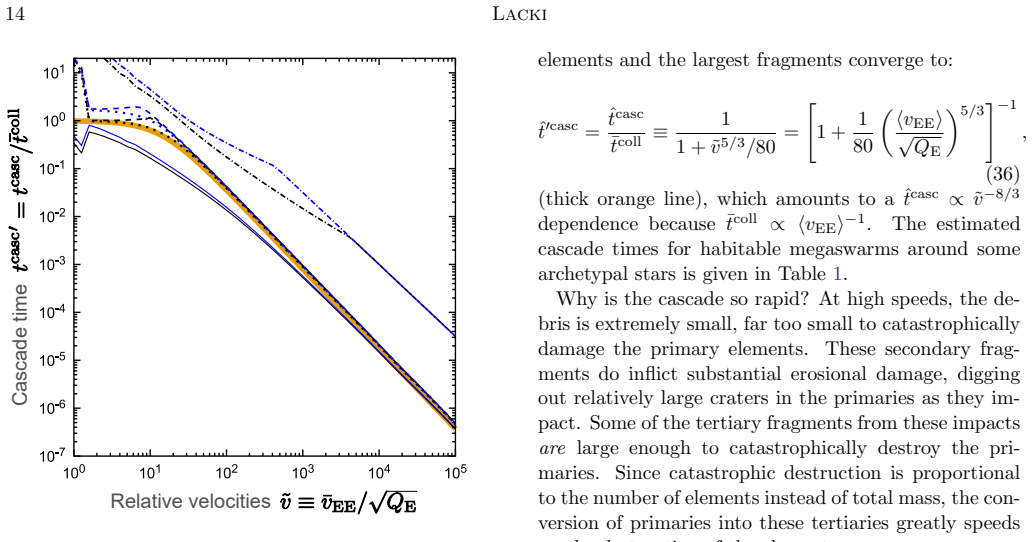
The load-bearing object is the collisional cascade, a runaway process in which fragments from each impact become projectiles for further impacts, modelled here by a one-zone Boltzmann-like equation for the mass distribution of swarm elements with catastrophic shattering and erosive cratering terms. Its controlling parameter is $\tilde v = \langle v_{EE}\rangle/\sqrt{Q_E}$, the mean relative collision speed divided by the square root of the assumed impact strength; this sets the critical velocity for shattering, shapes the debris mass spectrum, and produces the steep $\langle v_{EE}\rangle^{-8/3}$ cascade scaling. The companion mechanism is the orbit-packing argument: a swarm shell divided into inclined belts admits only about $r_S/r_B$ non-crossing belts, and phase-space conservation implies that filling the shell forces orbital crossings at high relative speed. Together these make the naive collisional time a robust baseline and the cascade an accelerant on top of it.
What would settle it
One decisive check would be a large laboratory campaign firing hypervelocity projectiles into thin, modular, reflective panels to measure the energy per gram needed to shatter them and the fragment mass distribution; if engineered panels resist breakup far above $10^9\,\mathrm{erg\,g^{-1}}$ or fragment into far fewer large pieces than the adopted power law, the predicted $t_{\rm casc}\propto\langle v_{EE}\rangle^{-8/3}$ acceleration would not apply. Observationally, finding an old, unmaintained stellar megaswarm around an isolated low-metallicity star with no giant planets would also refute the claim that most megaswarms are short-lived.
Extended reading notes
Core claim
On the paper's own terms, the central discovery is that an abandoned stellar megaswarm is a transient technosignature, not an eonic monument. Starting from the swarm geometry, the collision rate sets $t_{\rm coll}\sim t_{\rm orb}/(2\pi F_S)$, where $t_{\rm orb}$ is the orbital period and $F_S$ the covering fraction; Liouville's theorem and a pigeonhole count of orbital belts show that no ordering of circular orbits can evade this rate while still filling the shell in all directions. Numerical solutions of a one-zone Boltzmann-like cascade equation then give $\hat t_{\rm casc}/\bar t_{\rm coll} = [1 + \tilde v^{5/3}/80]^{-1}$, so for hypervelocity collisions the cascade time falls as $\langle v_{EE}\rangle^{-8/3}$. Companion stars, planets, the swarm's own mass, stellar oblateness, passing stars, and radiation-driven Yarkovsky drift all act to raise eccentricities and disperse orbits, typically on timescales well under geological time; the final residue is micron dust that is blown out by radiation pressure or a dilute ion cloud. Hence most megaswarms are likely to be short-lived on cosmic timescales without active upkeep.
Load-bearing premise
The quick-destruction forecast depends on assuming that a swarm element shatters like a rocky asteroid or ordinary satellite—roughly a $10^9\,\mathrm{erg\,g^{-1}}$ threshold and the laboratory fragment-size distribution—and that elements are thin flat plates; if real elements are much tougher, repair themselves, or have different shapes, the cascade could take orders of magnitude longer.
Editorial extensions
If this is right
- Stellar Dyson and occulter swarms are not permanent artifacts; searches for megastructure waste heat should expect surviving swarms to be actively maintained, not abandoned.
- A long-lived stellar megaswarm would be strong evidence that the builders or their autonomous agents have kept it up for millions of years, not merely that a civilization once existed.
- The most durable stellar swarms should sit in isolated, low-metallicity systems with no stellar or giant-planet companions, where general-relativistic precession or stellar oblateness suppresses Lidov-Kozai cycles, or far out where collision rates are negligible.
- A dying swarm should produce a brief opacity pulse—the host star dimmed by processed dust, then an infrared excess that fades as grains are blown out or ionized.
- Galactic-scale swarms embedded in the interstellar medium are the plausible long-lived survivors, because their dynamical timescale is hundreds of millions of years rather than a single orbital period.
Reading between the lines
- If the short-lifetime conclusion holds, an efficient search would prioritize old, metal-poor, single stars with no detected close companions; a convincing Dyson candidate there would strain the model.
- The cascade scaling could be calibrated on Earth by hypervelocity impact tests into thin, modular panels, turning the unknown impact strength and fragment index into measured inputs rather than assumptions.
- A corollary the paper leaves implicit: a civilization that destroys or ejects planets to protect its swarms may leave behind systems that are anomalously planet-free, which future high-contrast imaging of Dyson candidates could test.
- The final dust pulse may be an easier technosignature to catch than the intact structure, since it is a sharp photometric event rather than a steady excess.
Signed reviews
Editorial analysis
A structured set of objections, weighed in public.
Referee Report
Summary. The paper argues that abandoned (passively maintained) stellar megaswarms are collisional-cascade-limited and therefore short-lived on cosmic timescales. It derives the naive collision time for a randomized swarm as roughly an orbital period divided by the covering fraction (Eq. 4), argues that packing orbital belts cannot avoid this because the unused phase space is large, and then uses a one-zone kinetic model to show that once a cascade starts, the destruction time scales as the mean collision velocity to the -8/3 power for hypervelocity impacts (Eq. 36). The paper further inventories gravitational and radiative perturbations - Lidov-Kozai cycles from companions, stellar oblateness, general-relativistic precession, stellar flybys, and the Yarkovsky effect - that can raise collision velocities and trigger cascades. It concludes that most stellar megaswarms require active upkeep and proposes that the longest-lived passive megastructures are either far-out minimal occulter swarms, close-in swarms in stabilized niches, or galactic-scale dust swarms.
Significance. If the central result holds, the paper substantially changes the SETI search strategy for megastructures: Dyson swarms and dense occulter swarms would be transient technosignatures rather than eonic monuments, and their end states (opacity pulses, dust blowout, or ion clouds) become observational targets. The analytic estimates in Sections 2 and 4 are internally consistent and grounded in standard kinetic theory and secular dynamics, and the Liouville argument in Section 2.6 is a genuine robustness result. The paper also makes a useful, concrete census of how common destabilizing companions are. The main caveat, acknowledged by the author, is that the cascade speed is built on impact-strength and debris prescriptions calibrated to rocky asteroid and satellite impacts; the headline time scaling is not yet demonstrated to be robust across the plausible range of engineered-materials parameters.
major comments (2)
- [Sections 3.3-3.5, Eq. (36)] The central quantitative claim, t_casc proportional to v^(-8/3) in the hypervelocity limit, is obtained from a single-valued impact strength Q_E = 10^9 erg/g, a planar area-mass relation A_E = m_E/4, a delta-function velocity distribution, and debris laws (Eqs. 31-34) calibrated to rocky asteroid and satellite impacts. Raising Q_E to the paper's own chemical limit of 1.2e12 erg/g lengthens the hypervelocity cascade phase by roughly (1.2e12/1e9)^(5/6) ~ 300 under Eq. (36), and varying the debris-slope parameters q and xi in Eqs. (33)-(34) can shift the fitted exponent. The author explicitly flags these as simplifications in Section 3.3, but no parameter sweep or error budget is provided. Because Eq. (36) is the quantitative core of the claim that most megaswarms are short-lived, the manuscript needs a sensitivity analysis over Q_E, q, xi, and geometry before that claim can be considered established, especially for sparse outer occulter swarms where the initial collision time is long.
- [Sections 3.4 and 3.9] The one-zone cascade model assumes a fixed relative-velocity distribution and neglects velocity evolution and dissipation. The paper itself shows in Eq. (41) that dissipational effects can greatly alter the cascade when the collision velocity is below about 1.4 km/s for Q_E = 10^9 erg/g, which is precisely the regime expected in isolated narrow belts (Section 2.4). The fixed-velocity approximation may therefore overstate the early cascade growth rate. Since the author notes that a full treatment is warranted, the manuscript should at least include a simple test of how including a cooling or velocity-damping term changes the fitted timescale in Eq. (36), or state more explicitly which parameter regime the rapid-cascade conclusion is meant to cover.
minor comments (4)
- [Eq. (57), Section 4.2.2] The displayed ratio in Eq. (57) is inverted for the case a_P > a_E. From Eqs. (52) and (53), t_P;q / t_P;o = a_E/a_P for an exterior perturber, not a_P/a_E. The value cited in footnote 19 for Jupiter's effect on Earth's eccentricity (~0.01) uses the correct ratio, so the qualitative conclusion survives, but the equation must be corrected.
- [Section 3.4] There is a typo: 'stoppped' should be 'stopped'.
- [Section 3.5] There is a typo: 'characterisitc' should be 'characteristic'.
- [Section 3.4] The numerical method is described in prose, but no code or tabulated output is provided. For reproducibility, a supplementary repository or at least a detailed pseudocode/algorithm listing would be helpful.
Circularity Check
No significant circularity; the derivation is self-contained and rests on external calibration.
full rationale
The paper's central chain is not circular. The initial collisional time (Eq. 4) follows from standard kinetic theory and the shell geometry, with no fitted parameter tied to the conclusion. The cascade calculation is a one-zone numerical integration of a Boltzmann-like mass distribution equation (Eq. 19), using debris and impact-strength prescriptions taken from external experimental and modeling literature (Rossi et al. 1994; Fujiwara et al. 1977; Greenberg et al. 1978), not from the paper's own conclusion. Equation 36 is presented as an approximation to the numerical solution for the cascade time, so it is an output of the simulation rather than an input. The impact strength Q_E is assumed as a material parameter (10^9 erg g^-1) and is explicitly flagged by the author as a simplification: "The simple models I present here, like the Rossi et al. (1994) model of a Kessler cascade, assume a single impact strength, but this is clearly inadequate." That is an acknowledged modeling uncertainty about external validity, not a definitional or fitted circularity. Self-citations (Lacki 2016, 2019b, 2020) supply context and prior hypotheticals, but none is load-bearing for the collisional-time or cascade derivation. No step reduces to its own input by construction, and the conclusion is not forced by a self-citation chain.
Assumptions & free parameters
free parameters (6)
- Impact strength Q_E =
10^9 erg/g (assumed; chemical upper bound approximately 1.2e12 erg/g)
- Debris power-law index q =
5/3 for erosional; 2 + mmax_D/m2 divided by 1 + mmax_D/m1 for catastrophic; asymptotes to 2
- Maximum debris mass exponent xi =
Not specified numerically; from Fujiwara et al. 1977 scaling (v/v_c)^(-xi)
- Element geometry relation A_E = m_E/4 =
Planar area = m'/4 in dimensionless code
- Erosional mass fraction epsilon =
0.1
- Swarm surface density Sigma_E =
100 g/cm^2 for mass estimates
assumptions (7)
- standard math Collision rate in a randomized swarm is t ~ V/(N sigma v)
- domain assumption Debris physics from Rossi et al. 1994 and Fujiwara et al. 1977 applies to artificial megastructure elements
- domain assumption Elements have conventional solid material strengths (Q_E = 1e9 erg/g or near the chemical bound)
- domain assumption Swarm is abandoned without active upkeep
- domain assumption One-zone homogeneous cascade model captures the relevant evolution
- domain assumption Base configuration of circular belts with an inclination gradient represents likely long-lived swarm designs
- domain assumption Velocity distribution is a delta function; impacts occur at a single relative speed
Cite this review
Pith. "Pith review of Ground to Dust: Collisional Cascades and the Fate of Kardashev II Megaswarms." pith.science (2026). https://pith.science/paper/T2RONQ4Q
@misc{pith2026250421151,
  author       = {Pith},
  title        = {Pith review of: Ground to Dust: Collisional Cascades and the Fate of Kardashev II Megaswarms},
  year         = {2026},
  howpublished = {\url{https://pith.science/paper/T2RONQ4Q}},
  note         = {Machine review of arXiv:2504.21151}
}
read the original abstract
Extraterrestrial intelligences are speculated to surround stars with structures to collect their energy or to signal distant observers. If they exist, these most likely are megaswarms, vast constellations of satellites (elements) in orbit around the hosts. Although long-lived megaswarms are extremely powerful technosignatures, they are liable to be subject to collisional cascades once guidance systems start failing. The collisional time is roughly an orbital period divided by the covering fraction of the swarm. Structuring the swarm orbits does not prolong the initial collisional time as long as there is enough randomness to ensure collisions, although it can reduce collision velocities. I further show that once the collisional cascade begins, it can develop extremely rapidly for hypervelocity collisions. Companion stars or planets in the stellar system induce perturbations through the Lidov-Kozai effect among others, which can result in orbits crossing within some millions of years. Radiative perturbations, including the Yarkovsky effect, also can destabilize swarms. Most megaswarms are thus likely to be short-lived on cosmic timescales without active upkeep. I discuss possible mitigation strategies and implications for megastructure searches.
Figures


Figures from the paper (6 more)


Reference graph
Works this paper leans on
-
[1]
Benedict, G. F. 2021, AJ, 162, 14, doi: 10.3847/1538-3881/abfaff
-
[2]
2024, A&A, 683, A118, doi: 10.1051/0004-6361/202348899
Andama, G., Mah, J., & Bitsch, B. 2024, A&A, 683, A118, doi: 10.1051/0004-6361/202348899
-
[3]
Antognini, J. M. O. 2015, MNRAS, 452, 3610, doi: 10.1093/mnras/stv1552
-
[4]
Arnold, L. F. A. 2005, ApJ, 627, 534, doi: 10.1086/430437
doi:10.1086/430437 2005
-
[5]
P., M´ erand, A., Coud´ e du Foresto, V., et al
Aufdenberg, J. P., M´ erand, A., Coud´ e du Foresto, V., et al. 2006, ApJ, 645, 664, doi: 10.1086/504149
doi:10.1086/504149 2006
-
[6]
Badhwar, G. D., & Anz-Meador, P. D. 1989, Earth Moon and Planets, 45, 29, doi: 10.1007/BF00054659
-
[7]
Balbi, A., & ´Cirkovi´ c, M. M. 2021, AJ, 161, 222, doi: 10.3847/1538-3881/abec48
-
[8]
Barnes, S. A. 2007, ApJ, 669, 1167, doi: 10.1086/519295 Beaug´ e, C., Nesvorn´ y, D., & Dones, L. 2006, AJ, 131, 2299, doi: 10.1086/500048
doi:10.1086/519295 2007
Show all 115 references
-
[9]
1987, Galactic dynamics (Princeton: Princeton University Press) Megastructures and Collisional Cascades 35
Binney, J., & Tremaine, S. 1987, Galactic dynamics (Princeton: Princeton University Press) Megastructures and Collisional Cascades 35
1987
-
[10]
Snellen, I. A. G. 2017, AJ, 153, 138, doi: 10.3847/1538-3881/aa5c87
2017 doi
-
[11]
C., & Byers, M
Boley, A. C., & Byers, M. 2021, Scientific Reports, 11, 10642, doi: 10.1038/s41598-021-89909-7
2021 doi
-
[12]
P., & Nesvorn´ y, D
Bottke, William F., J., Vokrouhlick´ y, D., Rubincam, D. P., & Nesvorn´ y, D. 2006, Annual Review of Earth and Planetary Sciences, 34, 157, doi: 10.1146/annurev.earth.34.031405.125154
2006
-
[13]
F., Durda, D
Bottke, W. F., Durda, D. D., Nesvorn´ y, D., et al. 2005, Icarus, 175, 111, doi: 10.1016/j.icarus.2004.10.026
2005 doi
-
[14]
2010, AJ, 139, 994, doi: 10.1088/0004-6256/139/3/994
Morbidelli, A. 2010, AJ, 139, 994, doi: 10.1088/0004-6256/139/3/994
2010 doi
-
[15]
Bradbury, R. J. 2000, Matrioshka Brains. http://citeseerx. ist.psu.edu/viewdoc/download?doi=10.1.1.692.6584
2000
-
[16]
J., Cirkovic, M
Bradbury, R. J., Cirkovic, M. M., & Dvorsky, G. 2011, Journal of the British Interplanetary Society, 64, 156
2011
-
[17]
A., Lamy, P
Burns, J. A., Lamy, P. L., & Soter, S. 1979, Icarus, 40, 1, doi: 10.1016/0019-1035(79)90050-2
1979 doi
-
[18]
2001, PASP, 113, 1449, doi: 10.1086/324269
Calzetti, D. 2001, PASP, 113, 1449, doi: 10.1086/324269
2001 doi
-
[19]
Carrigan, R. A. 2012, Acta Astronautica, 78, 121, doi: 10.1016/j.actaastro.2011.12.002
2012 doi
-
[20]
2015, NewA, 34, 245, doi: 10.1016/j.newast.2014.07.011
Werthimer, D. 2015, NewA, 34, 245, doi: 10.1016/j.newast.2014.07.011
2015 doi
-
[21]
R., Ostro, S
Chesley, S. R., Ostro, S. J., Vokrouhlick´ y, D., et al. 2003, Science, 302, 1739, doi: 10.1126/science.1091452
2003 doi
-
[22]
S., Do, T., Hees, A., et al
Chu, D. S., Do, T., Hees, A., et al. 2018, ApJ, 854, 12, doi: 10.3847/1538-4357/aaa3eb
2018 doi
-
[23]
Criswell, D. R. 1985, in Interstellar migration and the human experience, ed. B. R. Finney & E. M. Jones, 50
1985
-
[24]
R., Ryan, E
Davis, D. R., Ryan, E. V., & Farinella, P. 1994, Planet. Space Sci., 42, 599, doi: 10.1016/0032-0633(94)90035-3
1994 doi
-
[25]
Draine, B. T. 2011, Physics of the Interstellar and Intergalactic Medium (Princeton: Princeton University Press)
2011
-
[26]
Dyson, F. J. 1960, Science, 131, 1667, doi: 10.1126/science.131.3414.1667
1960
-
[27]
B., Kozinsky, B., & Rasio, F
Ford, E. B., Kozinsky, B., & Rasio, F. A. 2000, ApJ, 535, 385, doi: 10.1086/308815
2000 doi
-
[28]
R., et al
Fujiwara, A., Cerroni, P., Davis, D. R., et al. 1989, in Asteroids II, ed. R. P. Binzel, T. Gehrels, & M. S. Matthews, 240–265
1989
-
[29]
1977, Icarus, 31, 277, doi: 10.1016/0019-1035(77)90038-0
Fujiwara, A., Kamimoto, G., & Tsukamoto, A. 1977, Icarus, 31, 277, doi: 10.1016/0019-1035(77)90038-0
1977 doi
-
[30]
T., & Johnson, J
Ghezzi, L., Montet, B. T., & Johnson, J. A. 2018, ApJ, 860, 109, doi: 10.3847/1538-4357/aac37c
2018 doi
-
[31]
L., & Ptuskin, V
Ginzburg, V. L., & Ptuskin, V. S. 1976, Reviews of Modern Physics, 48, 161, doi: 10.1103/RevModPhys.48.161 GRAVITY Collaboration, Abuter, R., Amorim, A., et al. 2020, A&A, 636, L5, doi: 10.1051/0004-6361/202037813
1976 doi
-
[32]
Chapman, C. R. 1978, Icarus, 35, 1, doi: 10.1016/0019-1035(78)90057-X
1978 doi
-
[33]
R., & Williams, A
Hainaut, O. R., & Williams, A. P. 2020, A&A, 636, A121, doi: 10.1051/0004-6361/202037501
2020 doi
-
[34]
C., & Rasio, F
Heggie, D. C., & Rasio, F. A. 1996, MNRAS, 282, 1064, doi: 10.1093/mnras/282.3.1064
1996 doi
-
[35]
Heller, R., & Pudritz, R. E. 2016, Astrobiology, 16, 259, doi: 10.1089/ast.2015.1358
2016
-
[36]
1997, Nature, 386, 254, doi: 10.1038/386254a0
Holman, M., Touma, J., & Tremaine, S. 1997, Nature, 386, 254, doi: 10.1038/386254a0
1997 doi
-
[37]
Y.-Y., Goto, T., Hashimoto, T., et al
Hsiao, T. Y.-Y., Goto, T., Hashimoto, T., et al. 2021, MNRAS, 506, 1723, doi: 10.1093/mnras/stab1832
2021 doi
-
[38]
M., Duchˆ ene, G., & Matthews, B
Hughes, A. M., Duchˆ ene, G., & Matthews, B. C. 2018, ARA&A, 56, 541, doi: 10.1146/annurev-astro-081817-052035
2018 doi
-
[39]
2022, ApJ, 924, 78, doi: 10.3847/1538-4357/ac3421
Huston, M., & Wright, J. 2022, ApJ, 924, 78, doi: 10.3847/1538-4357/ac3421
2022 doi
-
[40]
2011, Journal of the British Interplanetary Society, 64, 59
Inoue, M., & Yokoo, H. 2011, Journal of the British Interplanetary Society, 64, 59
2011
-
[41]
2003, Celestial Mechanics and Dynamical Astronomy, 86, 277, doi: 10.1023/A:1024223200686 —
Iorio, L. 2003, Celestial Mechanics and Dynamical Astronomy, 86, 277, doi: 10.1023/A:1024223200686 —. 2008, Ap&SS, 318, 51, doi: 10.1007/s10509-008-9889-1 —. 2011, PhRvD, 84, 124001, doi: 10.1103/PhysRevD.84.124001 —. 2019, MNRAS, 484, 4811, doi: 10.1093/mnras/stz304 —. 2024, ...
2003 doi
-
[42]
S., Shakht, N
Izmailov, I. S., Shakht, N. A., Polyakov, E. V., Gorshanov, D. L., & Pogodin, M. A. 2021, Astrophysics, 64, 160, doi: 10.1007/s10511-021-09677-0
2021 doi
-
[43]
A., Aller, K
Johnson, J. A., Aller, K. M., Howard, A. W., & Crepp, J. R. 2010, PASP, 122, 905, doi: 10.1086/655775
2010 doi
- [44]
-
[45]
Kardashev, N. S. 1964, Soviet Ast., 8, 217
1964
-
[46]
Kardashev, N. S. 1985, in The Search for Extraterrestrial Life: Recent Developments, ed. M. D. Papagiannis, Vol. 112, 497–504
1985
-
[47]
2011, PhRvL, 107, 181101, doi: 10.1103/PhysRevLett.107.181101
Katz, B., Dong, S., & Malhotra, R. 2011, PhRvL, 107, 181101, doi: 10.1103/PhysRevLett.107.181101
2011 doi
-
[48]
Kawaler, S. D. 1987, PASP, 99, 1322, doi: 10.1086/132120
1987 doi
-
[49]
2008, A&A, 488, 667, doi: 10.1051/0004-6361:200810080
Kervella, P., M´ erand, A., Pichon, B., et al. 2008, A&A, 488, 667, doi: 10.1051/0004-6361:200810080
2008 doi
-
[50]
Kessler, D. J. 1981, Icarus, 48, 39, doi: 10.1016/0019-1035(81)90151-2 36 Lacki
1981 doi
-
[51]
J., & Cour-Palais, B
Kessler, D. J., & Cour-Palais, B. G. 1978, J. Geophys. Res., 83, 2637, doi: 10.1029/JA083iA06p02637
1978 doi
-
[52]
2019, Research Notes of the American Astronomical Society, 3, 91, doi: 10.3847/2515-5172/ab2fdb
Kipping, D. 2019, Research Notes of the American Astronomical Society, 3, 91, doi: 10.3847/2515-5172/ab2fdb
2019 doi
-
[53]
2020, International Journal of Astrobiology, 19, 430, doi: 10.1017/S1473550420000208
Kipping, D., Frank, A., & Scharf, C. 2020, International Journal of Astrobiology, 19, 430, doi: 10.1017/S1473550420000208
2020 doi
- [54]
-
[55]
Kraft, R. P. 1967, ApJ, 150, 551, doi: 10.1086/149359
1967 doi
-
[56]
Lacki, B. C. 2016, arXiv e-prints, arXiv:1604.07844. https://arxiv.org/abs/1604.07844 —. 2019a, PASP, 131, 084401, doi: 10.1088/1538-3873/ab1304 —. 2019b, PASP, 131, 024102, doi: 10.1088/1538-3873/aaf3df —. 2020, ApJ, 905, 18, doi: 10.3847/1538-4357/abc1e3 —. 2024, ApJ, 966, 1...
2016 arXiv
-
[57]
2004, A&A, 428, 261, doi: 10.1051/0004-6361:20041335 Le May, S., Gehly, S., Carter, B
Laskar, J., Robutel, P., Joutel, F., et al. 2004, A&A, 428, 261, doi: 10.1051/0004-6361:20041335 Le May, S., Gehly, S., Carter, B. A., & Flegel, S. 2018, Acta Astronautica, 151, 445, doi: 10.1016/j.actaastro.2018.06.036
2004 doi
-
[58]
1991, Reviews of Geophysics, 29, 505, doi: 10.1029/91RG01895
Lean, J. 1991, Reviews of Geophysics, 29, 505, doi: 10.1029/91RG01895
1991 doi
-
[59]
G., Swinerd, G
Lewis, H. G., Swinerd, G. G., Newland, R. J., & Saunders, A. 2009, Advances in Space Research, 44, 568, doi: 10.1016/j.asr.2009.05.018
2009 doi
-
[60]
Lidov, M. L. 1962, Planet. Space Sci., 9, 719, doi: 10.1016/0032-0633(62)90129-0
1962 doi
-
[61]
H., Fenner, Y., & Gibson, B
Lineweaver, C. H., Fenner, Y., & Gibson, B. K. 2004, Science, 303, 59, doi: 10.1126/science.1092322
2004 doi
-
[62]
C., Hall, D
Liou, J. C., Hall, D. T., Krisko, P. H., & Opiela, J. N. 2004, Advances in Space Research, 34, 981, doi: 10.1016/j.asr.2003.02.027
2004 doi
-
[63]
2011, ApJ, 742, 94, doi: 10.1088/0004-637X/742/2/94
Lithwick, Y., & Naoz, S. 2011, ApJ, 742, 94, doi: 10.1088/0004-637X/742/2/94
2011 doi
-
[64]
2023, Research Notes of the American Astronomical Society, 7, 43, doi: 10.3847/2515-5172/acc10d
Loeb, A. 2023, Research Notes of the American Astronomical Society, 7, 43, doi: 10.3847/2515-5172/acc10d
2023 doi
-
[65]
Lovell, A. C. B., Blackwell, M. R., D. E., & Wilson, R. 1962, QJRAS, 3, 100
1962
-
[66]
I., & Sivaraman, K
Makarov, V. I., & Sivaraman, K. R. 1989, SoPh, 123, 367, doi: 10.1007/BF00149112
1989 doi
-
[67]
McDowell, J. C. 2020, ApJL, 892, L36, doi: 10.3847/2041-8213/ab8016
2020 doi
-
[68]
1995, International Journal of Impact Engineering, 17, 547
McKnight, D., Maher, R., & Nagl, L. 1995, International Journal of Impact Engineering, 17, 547
1995
-
[69]
2014, ApJS, 211, 24, doi: 10.1088/0067-0049/211/2/24
McQuillan, A., Mazeh, T., & Aigrain, S. 2014, ApJS, 211, 24, doi: 10.1088/0067-0049/211/2/24
2014 doi
-
[70]
2021, MNRAS, 506, 2671, doi: 10.1093/mnras/stab1827
Mecheri, R., & Meftah, M. 2021, MNRAS, 506, 2671, doi: 10.1093/mnras/stab1827
2021 doi
-
[71]
T., & Simon, J
Montet, B. T., & Simon, J. D. 2016, ApJL, 830, L39, doi: 10.3847/2041-8205/830/2/L39
2016 doi
-
[72]
E., J., & MacLellan, D
Morrow, W. E., J., & MacLellan, D. C. 1961, AJ, 66, 107, doi: 10.1086/108384
1961 doi
-
[73]
2016, ARA&A, 54, 441, doi: 10.1146/annurev-astro-081915-023315
Naoz, S. 2016, ARA&A, 54, 441, doi: 10.1146/annurev-astro-081915-023315
2016 doi
-
[74]
2013a, MNRAS, 431, 2155, doi: 10.1093/mnras/stt302
Teyssandier, J. 2013a, MNRAS, 431, 2155, doi: 10.1093/mnras/stt302
-
[75]
2013b, ApJ, 773, 187, doi: 10.1088/0004-637X/773/2/187 Nesvorn´ y, D., Alvarellos, J
Naoz, S., Kocsis, B., Loeb, A., & Yunes, N. 2013b, ApJ, 773, 187, doi: 10.1088/0004-637X/773/2/187 Nesvorn´ y, D., Alvarellos, J. L. A., Dones, L., & Levison, H. F. 2003, AJ, 126, 398, doi: 10.1086/375461 Nesvorn´ y, D., Beaug´ e, C., & Dones, L. 2004, AJ, 127, 1768, doi: 10.1...
2003 doi
-
[76]
L., De Rosa, R
Nielsen, E. L., De Rosa, R. J., Macintosh, B., et al. 2019, AJ, 158, 13, doi: 10.3847/1538-3881/ab16e9
2019 doi
-
[77]
2022, International Journal of Impact Engineering, 168, 104313
Francesconi, A. 2022, International Journal of Impact Engineering, 168, 104313
2022
-
[78]
2016, International Journal of Astrobiology, 15, 127, doi: 10.1017/S1473550415000257
Osmanov, Z. 2016, International Journal of Astrobiology, 15, 127, doi: 10.1017/S1473550415000257
2016 doi
-
[79]
Pitjeva, E. V. 2005, Astronomy Letters, 31, 340, doi: 10.1134/1.1922533
2005 doi
-
[80]
A., Henry, T
Raghavan, D., McAlister, H. A., Henry, T. J., et al. 2010, ApJS, 190, 1, doi: 10.1088/0067-0049/190/1/1
2010 doi
-
[81]
2013, Journal of Astrophysics and Astronomy, 34, 341, doi: 10.1007/s12036-013-9186-4
Renzetti, G. 2013, Journal of Astrophysics and Astronomy, 34, 341, doi: 10.1007/s12036-013-9186-4
2013 doi
-
[82]
2004, Nature, 431, 47, doi: 10.1038/nature02884
Rose, C., & Wright, G. 2004, Nature, 431, 47, doi: 10.1038/nature02884
2004 doi
-
[83]
2005, Serbian Astronomical Journal, 170, 1, doi: 10.2298/SAJ0570001R
Rossi, A. 2005, Serbian Astronomical Journal, 170, 1, doi: 10.2298/SAJ0570001R
2005 doi
-
[84]
Rossi, A., Cordelli, A., Farinella, P., & Anselmo, L. 1994, J. Geophys. Res., 99, 23195, doi: 10.1029/94JE02320
1994 doi
-
[85]
J., & Crawford-Taylor, K
Sallmen, S., Korpela, E. J., & Crawford-Taylor, K. 2019, AJ, 158, 258, doi: 10.3847/1538-3881/ab5300
2019 doi
-
[86]
1963, Science, 141, 797, doi: 10.1126/science.141.3583.797
Sandage, A., & Kowal, C. 1963, Science, 141, 797, doi: 10.1126/science.141.3583.797
1963 doi
-
[87]
2021, Acta Astronautica, 178, 265, doi: 10.1016/j.actaastro.2020.09.014
Schimmerohn, M., Matura, P., Watson, E., et al. 2021, Acta Astronautica, 178, 265, doi: 10.1016/j.actaastro.2020.09.014
2021 doi
-
[88]
2011, A&A, 532, A79, doi: 10.1051/0004-6361/201116713
Zolotukhin, I. 2011, A&A, 532, A79, doi: 10.1051/0004-6361/201116713
2011 doi
- [89]
-
[90]
Shapiro, I. I. 1966, Science, 154, 1445, doi: 10.1126/science.154.3755.1445
1966
-
[91]
Sheikh, S. Z. 2020, International Journal of Astrobiology, 19, 237, doi: 10.1017/S1473550419000284
2020 doi
-
[92]
2018, ApJ, 855, 110, doi: 10.3847/1538-4357/aaae66
Socas-Navarro, H. 2018, ApJ, 855, 110, doi: 10.3847/1538-4357/aaae66
2018 doi
-
[93]
Solanki, S. K. 2003, A&A Rv, 11, 153, doi: 10.1007/s00159-003-0018-4
2003 doi
-
[94]
S., Raymond, S
Spiegel, D. S., Raymond, S. N., Dressing, C. D., Scharf, C. A., & Mitchell, J. L. 2010, ApJ, 721, 1308, doi: 10.1088/0004-637X/721/2/1308
2010 doi
-
[95]
C., & Lin, D
Spurzem, R., Giersz, M., Heggie, D. C., & Lin, D. N. C. 2009, ApJ, 697, 458, doi: 10.1088/0004-637X/697/1/458
2009 doi
-
[96]
Statler, T. S. 2009, Icarus, 202, 502, doi: 10.1016/j.icarus.2009.03.003
2009 doi
-
[97]
A., & Durda, D
Stern, S. A., & Durda, D. D. 2000, Icarus, 143, 360, doi: 10.1006/icar.1999.6263 Su´ arez Mascare˜ no, A., Faria, J. P., Figueira, P., et al. 2020, A&A, 639, A77, doi: 10.1051/0004-6361/202037745
2000
-
[98]
K., et al
Suazo, M., Zackrisson, E., Mahto, P. K., et al. 2024, MNRAS, 531, 695, doi: 10.1093/mnras/stae1186
2024 doi
-
[99]
2022, MNRAS, 512, 2988, doi: 10.1093/mnras/stac280
Huston, M. 2022, MNRAS, 512, 2988, doi: 10.1093/mnras/stac280
2022 doi
-
[100]
Talent, D. L. 1992, Journal of Spacecraft and Rockets, 29, 508, doi: 10.2514/3.25493
1992 doi
-
[101]
2014, AJ, 147, 86, doi: 10.1088/0004-6256/147/4/86
Tokovinin, A. 2014, AJ, 147, 86, doi: 10.1088/0004-6256/147/4/86
2014 doi
-
[102]
2015, ApJ, 807, 26, doi: 10.1088/0004-637X/807/1/26 van Belle, G
Torres, G., Claret, A., Pavlovski, K., & Dotter, A. 2015, ApJ, 807, 26, doi: 10.1088/0004-637X/807/1/26 van Belle, G. T. 2012, A&A Rv, 20, 51, doi: 10.1007/s00159-012-0051-2 van Belle, G. T., Ciardi, D. R., Thompson, R. R., Akeson, R. L., & Lada, E. A. 2001, ApJ, 559, 1155, do...
2015
-
[103]
Wang, L., & Stark, J. P. W. 1999, Journal of Spacecraft and Rockets, 36, 114, doi: 10.2514/2.3423
1999 doi
-
[104]
A., & Heller, R
Wells, R., Poppenhaeger, K., Watson, C. A., & Heller, R. 2018, MNRAS, 473, 345, doi: 10.1093/mnras/stx2077
2018 doi
-
[105]
G., Henry, T
Winters, J. G., Henry, T. J., Jao, W.-C., et al. 2019, AJ, 157, 216, doi: 10.3847/1538-3881/ab05dc
2019 doi
-
[106]
Wright, J. T. 2020, Serbian Astronomical Journal, 200, 1, doi: 10.2298/SAJ2000001W —. 2023, ApJ, 956, 34, doi: 10.3847/1538-4357/acf44f
2020 doi
-
[107]
T., Cartier, K
Wright, J. T., Cartier, K. M. S., Zhao, M., Jontof-Hutter, D., & Ford, E. B. 2016, ApJ, 816, 17, doi: 10.3847/0004-637X/816/1/17
2016 doi
-
[108]
T., Mullan, B., Sigurdsson, S., & Povich, M
Wright, J. T., Mullan, B., Sigurdsson, S., & Povich, M. S. 2014, ApJ, 792, 26, doi: 10.1088/0004-637X/792/1/26
2014 doi
-
[109]
Wyatt, M. C. 2008, ARA&A, 46, 339, doi: 10.1146/annurev.astro.45.051806.110525
2008 arXiv
-
[110]
C., & Dent, W
Wyatt, M. C., & Dent, W. R. F. 2002, MNRAS, 334, 589, doi: 10.1046/j.1365-8711.2002.05533.x
2002
-
[111]
C., Dermott, S
Wyatt, M. C., Dermott, S. F., Telesco, C. M., et al. 1999, ApJ, 527, 918, doi: 10.1086/308093
1999 doi
-
[112]
M., Scott, N., Serra, P., et al
Young, L. M., Scott, N., Serra, P., et al. 2014, MNRAS, 444, 3408, doi: 10.1093/mnras/stt2474
2014 doi
-
[113]
2016, ApJ, 833, 214, doi: 10.3847/1538-4357/833/2/214
Zackrisson, E., Calissendorff, P., Gonz´ alez, J., et al. 2016, ApJ, 833, 214, doi: 10.3847/1538-4357/833/2/214
2016 doi
-
[114]
J., Wehrhahn, A., & Reiter, J
Zackrisson, E., Korn, A. J., Wehrhahn, A., & Reiter, J. 2018, ApJ, 862, 21, doi: 10.3847/1538-4357/aac386
2018 doi
-
[115]
P., Ranc, C., & Morel, P
Zahn, J. P., Ranc, C., & Morel, P. 2010, A&A, 517, A7, doi: 10.1051/0004-6361/200913817
2010 doi
Reviewed August 16, 2026 · model on record in the stance chip above.
Discussion (0). Continue with ORCID to comment.