REVIEW 4 major objections 4 minor 53 references
Brain2Model Transfer: Training sensory and decision models with human neural activity as a teacher
T0 review · 4 major / 4 minor · reviewed 2026-08-06 · deepseek-v4-flash
Pith's one-line read Adding a brain-derived alignment loss to standard training improves both accuracy and convergence speed in RNN and VAE learners.
desk verdict The RNN experiment's contrastive loss is a no-op at batch size 1 as written, so the headline result is unsupported; the VAE part is more credible. read the letter →
The pith
A machine-rendered reading of the paper's core claim, the machinery that carries it, and where it could break.
The reading
What carries the argument
The load-bearing object is the combined loss $L_{\text{total}}=(1-\alpha)L_{\text{task}}+\alpha L_{\text{transfer}}$ with a scalar transfer weight $\alpha$. The transfer term takes one of two forms. Brain Contrastive Transfer builds a similarity matrix between brain embeddings and model embeddings for a batch of shared inputs and applies a contrastive (InfoNCE-style) loss that rewards matching the same input while repelling different inputs. Brain Latent Transfer instead minimizes the mean squared error between the model's embedding of an input and the precomputed brain embedding of that input, which is used when the human and model training sets are related but not identical. The brain embeddings themselves are produced by a self-supervised multi-session contrastive embedding method applied to the neural recordings, matched in dimensionality to the model's embedding layer.
What would settle it
Run the B2M training protocol with the brain embeddings replaced by a matched null signal, for example shuffled or permuted brain embeddings, or Gaussian noise with the same mean, variance, and temporal autocorrelation as the real embeddings, and compare final accuracy and loss. If the null signal reproduces the real-brain gains, then the specific content of the brain representation is not what drives the improvement.
Extended reading notes
Core claim
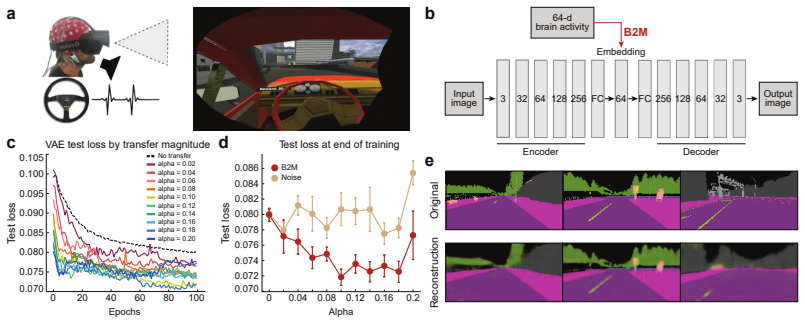
The central claim is that low-dimensional human brain representations, extracted while people perform a task, can serve as a teacher signal that improves how artificial networks learn that same class of task. The paper demonstrates this with a total loss $L_{\text{total}}=(1-\alpha)L_{\text{task}}+\alpha L_{\text{transfer}}$, where $\alpha$ controls how much weight the model places on matching brain embeddings versus solving the task. Brain Contrastive Transfer uses a contrastive objective over pairs of brain and model embeddings of the same input, and Brain Latent Transfer uses a mean-squared-error regression between model embeddings and brain-derived features on related inputs. The reported outcomes are higher final accuracy with faster convergence in both settings, with the RNN improving from 0.967 to 0.987 test accuracy at $\alpha=0.02$ and the VAE improving from 0.080 to 0.071 reconstruction loss; replacing the brain signal with standard Gaussian noise degrades performance below the no-transfer baseline.
Load-bearing premise
The premise that carries the paper is that the improvement comes from the cognitive information in human brain representations, and not from a generic regularizing effect of adding any structured auxiliary signal; the paper's Gaussian-noise control does not fully rule out this alternative, as the authors acknowledge in Section 6.
Editorial extensions
If this is right
- At small $\alpha$ values, brain transfer speeds up convergence compared with no transfer, which could shorten training time for comparable final performance.
- The RNN reaches higher final accuracy with brain transfer (0.987 versus 0.967), so the benefit is not only faster learning but also a better optimum.
- The VAE result shows the benefit appears with non-invasive EEG and a different architecture, suggesting the framework is not tied to one recording modality or one model class.
- The Gaussian-noise control performing worse than no transfer indicates the benefit is not simply any auxiliary signal, although the paper flags that structured noise has not been ruled out.
- The same weighted-loss recipe is portable to any task where neural and model embeddings can be aligned, including other sensory and decision-making domains.
Reading between the lines
- A stricter test than the Gaussian control would replace brain embeddings with permuted or synthetic signals matched to the mean, variance, and temporal structure of the real neural data; if gains persist, the transfer benefit is generic regularization rather than brain-specific information.
- The motivation that brains learn from fewer data suggests B2M's advantage should grow as the artificial training set shrinks; this is not tested in the paper and could be checked by re-running the experiments with subsampled task data.
- Because the transfer loss only constrains geometry, it may be compatible with many student architectures and could be combined with foundation-model pretraining rather than replacing it.
Editorial analysis
A structured set of objections, weighed in public.
Referee Report
Summary. The paper introduces Brain2Model Transfer Learning (B2M), a framework that uses human neural activity as a teacher signal for training artificial neural networks. It proposes two alignment losses: Brain Contrastive Transfer, an InfoNCE-style objective aligning brain and model embeddings, and Brain Latent Transfer, an MSE regression between brain-derived embeddings and model embeddings. The framework is validated in two settings: a GRU-based RNN trained on a memory-based goal-switching task using intracranial recordings, and a VAE trained for driving-scene reconstruction using EEG data from a VR driving task. The authors report that intermediate values of the transfer weight alpha yield faster convergence and better final test performance than training without transfer, and that controls with standard Gaussian noise perform worse. The paper's Limitations section acknowledges that structured-noise controls are still needed to disentangle information transfer from regularization.
Significance. If the reported effects reflect genuine information transfer from human brain representations, this would be a useful proof-of-concept at the intersection of cognitive neuroscience and machine learning, with potential applications in efficient sensory and decision-model training. The use of two qualitatively different tasks and architectures (RNN on episodic memory, VAE on scene reconstruction), real human datasets, and explicit reporting of computational cost are strengths. However, the central claim is currently underdetermined: the contrastive loss as described cannot be computed with the stated batch size, and the noise control does not rule out a generic regularization effect of structured auxiliary signals. For these reasons the paper is not yet ready for acceptance, but the main issues are addressable.
major comments (4)
- [§4.2, Eq. (2)] The stated training setup is inconsistent with the transfer loss. Eq. (2) defines an InfoNCE loss over a batch of b examples; with b=1, the negative-pair sum over i≠j is empty and L_transfer,i = -log(exp(S_i,i)/exp(S_i,i)) = 0 for every anchor. Section 4.2 states 'batch size of 1' for all configurations. Under this description, the transfer term in Eq. (1) is identically zero, so the observed improvement at alpha=0.02 (0.987 vs 0.967) cannot be produced by the defined B2M mechanism. Please specify the effective contrastive batch dimension (e.g., treating time steps or episodes as batch elements) or provide the exact computation used; if b=1 was truly used, explain what alpha is acting on.
- [§5.2] Five of 110 VAE runs with diverging test loss (loss >1) were excluded from the analysis, but the excluded runs are not reported by alpha condition. If divergence is more frequent under some transfer strengths, the reported means and p-values are biased. Please report per-alpha divergence counts and provide a sensitivity analysis that includes the diverging runs (e.g., with a robust loss or capping), or justify the exclusion more rigorously.
- [§6, Figs. 2e and 3d] The noise control replaces brain embeddings with standard Gaussian noise. Because the brain-derived embeddings have non-trivial temporal structure, dimensionality, and scale, a Gaussian control does not isolate the information content of the brain signal from a generic regularizing effect of a structured auxiliary target. The paper's own Limitations section acknowledges this possibility. This is load-bearing for the central claim that brain representations are valuable; please add a matched-noise control (e.g., permuted embeddings, temporally shuffled signals, or synthetic signals with matched statistics) or soften the causal claim to a demonstration of auxiliary-signal-guided training.
- [§4.3, §5.2] The statistical comparisons use a one-sided Wilcoxon rank-sum test at each of 11 alpha values without multiple-comparison control. With 11 tests, some nominal p<0.01 results are expected by chance. Please report corrected p-values (e.g., FDR or Bonferroni) or use an omnibus test across alpha values before claiming that specific transfer strengths significantly outperform no-transfer.
minor comments (4)
- [§2] Several citations are malformed (e.g., 'McClure and Kriegeskorte (2016, the authors' is missing a parenthesis; 'Fong et. al, 2018' and 'Nishida et al. (2020, the authors' have inconsistent punctuation).
- [§4.3, §5.2] The claim that all non-zero alpha values lead to faster convergence is supported only by visual inspection of learning curves; please provide a quantitative convergence criterion, such as epochs needed to reach a fixed accuracy or loss threshold.
- [§3.1, Eq. (2)] The text says L_transfer = sum_i L_transfer,i but Eq. (2) writes L_transfer,i without explicitly indicating the summation range; please define the index set and the relationship between the per-anchor and total losses more precisely.
- [Technical Appendix] The paper does not report code or data availability. Given the batch-size ambiguity and the centrality of the training details, releasing code and preprocessed embeddings (under appropriate ethics constraints) would greatly improve reproducibility.
Circularity Check
No circularity: held-out task performance is the independent test; brain transfer is a fixed teacher signal.
full rationale
None of the paper's load-bearing steps reduces to its inputs by construction. The claimed predictions (RNN test accuracy 0.987 vs 0.967; VAE test loss 0.071 vs 0.080) are measured on held-out simulated task sequences and CARLA scenes that were not used to construct the CEBRA or EEG teacher signals, so the improvement is an empirical outcome rather than a definitional consequence. The teacher embeddings are fixed before student training; L_transfer in Eqs. 2 and 3 compares student activations to those fixed targets, and L_total in Eq. 1 is an auxiliary objective, not a derivation of the test metric. The only self-citations ([46], [50], [51]) are background, motivation, or support for the noise-control design and are not load-bearing. Section 6 candidly notes that part of the improvement could be a structured-regularization effect, but that is a possible confound, not circularity. The reported batch-size of 1 for the RNN (Sec. 4.2) would make Eq. 2's negative-pair sum empty, which is an internal inconsistency or reproducibility concern, but it does not constitute a circular derivation. Therefore the paper is self-contained against external held-out benchmarks and receives a score of 0.
Assumptions & free parameters
free parameters (8)
- Transfer weight alpha =
alpha=0.02 for RNN task; alpha in {0.06,0.08,0.1,0.12,0.14,0.16,0.18} for VAE
- InfoNCE temperature tau =
0.1
- CEBRA embedding dimension =
7
- VAE embedding dimension =
64
- Spike filter kernel =
20 zeros followed by e^{-0.5x} with x in [0,0.5,...,10]
- Pre/post stimulus windows =
-1s to 0 and 0 to reaction time, 10ms bins
- Test sequence length =
26 steps
- Diverging-run exclusion =
5 of 110 VAE runs excluded
assumptions (5)
- domain assumption CEBRA embeddings faithfully represent task-relevant neural activity.
- domain assumption Raw EEG channels are directly usable as target embeddings for latent regression without normalization.
- standard math InfoNCE loss maximizes a lower bound on mutual information between brain and model embeddings.
- domain assumption The artificial task and human task are aligned well enough that representation matching helps learning.
- standard math Wilcoxon rank-sum test across random seeds is a valid inference for comparing training runs.
Cite this review
Pith. "Pith review of Brain2Model Transfer: Training sensory and decision models with human neural activity as a teacher." pith.science (2026). https://pith.science/paper/T3GFE726
@misc{pith2026250620834,
  author       = {Pith},
  title        = {Pith review of: Brain2Model Transfer: Training sensory and decision models with human neural activity as a teacher},
  year         = {2026},
  howpublished = {\url{https://pith.science/paper/T3GFE726}},
  note         = {Machine review of arXiv:2506.20834}
}
read the original abstract
Transfer learning enhances the training of novel sensory and decision models by employing rich feature representations from large, pre-trained teacher models. Cognitive neuroscience shows that the human brain creates low-dimensional, abstract representations for efficient sensorimotor coding. Importantly, the brain can learn these representations with significantly fewer data points and less computational power than artificial models require. We introduce Brain2Model Transfer Learning (B2M), a framework where neural activity from human sensory and decision-making tasks acts as the teacher model for training artificial neural networks. We propose two B2M strategies: (1) Brain Contrastive Transfer, which aligns brain activity and network activations through a contrastive objective; and (2) Brain Latent Transfer, which projects latent dynamics from similar cognitive tasks onto student networks via supervised regression of brain-derived features. We validate B2M in memory-based decision-making with a recurrent neural network and scene reconstruction for autonomous driving with a variational autoencoder. The results show that student networks benefiting from brain-based transfer converge faster and achieve higher predictive accuracy than networks trained in isolation. Our findings indicate that the brain's representations are valuable for artificial learners, paving the way for more efficient learning of complex decision-making representations, which would be costly or slow through purely artificial training.
Figures


Figures from the paper (1 more)

Reference graph
Works this paper leans on
-
[1]
David Sussillo, Mark M Churchland, Matthew T Kaufman, and Krishna V Shenoy. A neural net- work that finds a naturalistic solution for the production of muscle activity.Nature Neuroscience, 18(7):1025–1033, 2015
work page 2015
-
[2]
On simplicity and complexity in the brave new world of large-scale neuroscience.Current opinion in neurobiology, 32:148–155, 2015
Peiran Gao and Surya Ganguli. On simplicity and complexity in the brave new world of large-scale neuroscience.Current opinion in neurobiology, 32:148–155, 2015
2015
-
[3]
Neural manifolds for the control of movement.Neuron, 94(5):978–984, 2017
Juan A Gallego, Matthew G Perich, Lee E Miller, and Sara A Solla. Neural manifolds for the control of movement.Neuron, 94(5):978–984, 2017
2017
-
[4]
The geometry of abstraction in the hippocampus and prefrontal cortex.Cell, 183(4):954–967, 2020
Silvia Bernardi, Marcus K Benna, Mattia Rigotti, Jérôme Munuera, Stefano Fusi, and C Daniel Salzman. The geometry of abstraction in the hippocampus and prefrontal cortex.Cell, 183(4):954–967, 2020
work page 2020
-
[5]
Semi-orthogonal subspaces for value mediate a binding and generalization trade-off
W Jeffrey Johnston, Justin M Fine, Seng Bum Michael Yoo, R Becket Ebitz, and Benjamin Y Hayden. Semi-orthogonal subspaces for value mediate a binding and generalization trade-off. Nature Neuroscience, 27(11):2218–2230, 2024
work page 2024
-
[6]
Performance-optimized hierarchical models predict neural responses in higher visual cortex.Proceedings of the national academy of sciences, 111(23):8619–8624, 2014
Daniel LK Yamins, Ha Hong, Charles F Cadieu, Ethan A Solomon, Darren Seibert, and James J DiCarlo. Performance-optimized hierarchical models predict neural responses in higher visual cortex.Proceedings of the national academy of sciences, 111(23):8619–8624, 2014
2014
-
[7]
Brain encoding models based on multimodal transformers can transfer across language and vision.Advances in neural information processing systems, 36:29654–29666, 2023
Jerry Tang, Meng Du, Vy V o, Vasudev Lal, and Alexander Huth. Brain encoding models based on multimodal transformers can transfer across language and vision.Advances in neural information processing systems, 36:29654–29666, 2023
2023
-
[8]
Semantic reconstruction of continuous language from non-invasive brain recordings.Nature Neuroscience, 26(5):858–866, 2023
Jerry Tang, Amanda LeBel, Shailee Jain, and Alexander G Huth. Semantic reconstruction of continuous language from non-invasive brain recordings.Nature Neuroscience, 26(5):858–866, 2023
2023
Show all 53 references
-
[9]
A unifying framework for functional organization in early and higher ventral visual cortex.Neuron, 112(14):2435–2451, 2024
Eshed Margalit, Hyodong Lee, Dawn Finzi, James J DiCarlo, Kalanit Grill-Spector, and Daniel LK Yamins. A unifying framework for functional organization in early and higher ventral visual cortex.Neuron, 112(14):2435–2451, 2024
2024
-
[10]
Explanatory models in neuroscience, part 1: Taking mechanistic abstraction seriously.Cognitive Systems Research, 87:101244, 2024
Rosa Cao and Daniel Yamins. Explanatory models in neuroscience, part 1: Taking mechanistic abstraction seriously.Cognitive Systems Research, 87:101244, 2024
2024
-
[11]
Deep residual learning for image recognition
Kaiming He, Xiangyu Zhang, Shaoqing Ren, and Jian Sun. Deep residual learning for image recognition. InProceedings of the IEEE conference on computer vision and pattern recognition, pages 770–778, 2016
2016
-
[12]
Searching for mobilenetv3
Andrew Howard, Mark Sandler, Grace Chu, Liang-Chieh Chen, Bo Chen, Mingxing Tan, Weijun Wang, Yukun Zhu, Ruoming Pang, Vijay Vasudevan, et al. Searching for mobilenetv3. InProceedings of the IEEE/CVF international conference on computer vision, pages 1314–1324, 2019
2019
-
[13]
Learning transferable visual models from natural language supervision
Alec Radford, Jong Wook Kim, Chris Hallacy, Aditya Ramesh, Gabriel Goh, Sandhini Agarwal, Girish Sastry, Amanda Askell, Pamela Mishkin, Jack Clark, et al. Learning transferable visual models from natural language supervision. InInternational conference on machine learning, pag...
2021
-
[14]
Dinov2: Learning robust visual features without supervision.arXiv preprint arXiv:2304.07193, 2023
Maxime Oquab, Timothée Darcet, Théo Moutakanni, Huy V o, Marc Szafraniec, Vasil Khalidov, Pierre Fernandez, Daniel Haziza, Francisco Massa, Alaaeldin El-Nouby, et al. Dinov2: Learning robust visual features without supervision.arXiv preprint arXiv:2304.07193, 2023
2023 arXiv
-
[15]
Sentence-bert: Sentence embeddings using siamese bert- networks.arXiv preprint arXiv:1908.10084, 2019
Nils Reimers and Iryna Gurevych. Sentence-bert: Sentence embeddings using siamese bert- networks.arXiv preprint arXiv:1908.10084, 2019
1908 arXiv
-
[16]
Tweet- eval: Unified benchmark and comparative evaluation for tweet classification.arXiv preprint arXiv:2010.12421, 2020
Francesco Barbieri, Jose Camacho-Collados, Leonardo Neves, and Luis Espinosa-Anke. Tweet- eval: Unified benchmark and comparative evaluation for tweet classification.arXiv preprint arXiv:2010.12421, 2020. 11
2010 arXiv
-
[17]
Gpt-4 technical report.arXiv preprint arXiv:2303.08774, 2023
Josh Achiam, Steven Adler, Sandhini Agarwal, Lama Ahmad, Ilge Akkaya, Florencia Leoni Aleman, Diogo Almeida, Janko Altenschmidt, Sam Altman, Shyamal Anadkat, et al. Gpt-4 technical report.arXiv preprint arXiv:2303.08774, 2023
2023 arXiv
-
[18]
Llama: Open and efficient foundation language models.arXiv preprint arXiv:2302.13971, 2023
Hugo Touvron, Thibaut Lavril, Gautier Izacard, Xavier Martinet, Marie-Anne Lachaux, Timo- thée Lacroix, Baptiste Rozière, Naman Goyal, Eric Hambro, Faisal Azhar, et al. Llama: Open and efficient foundation language models.arXiv preprint arXiv:2302.13971, 2023
2023 arXiv
-
[19]
Deepseek-v3 technical report.arXiv preprint arXiv:2412.19437, 2024
Aixin Liu, Bei Feng, Bing Xue, Bingxuan Wang, Bochao Wu, Chengda Lu, Chenggang Zhao, Chengqi Deng, Chenyu Zhang, Chong Ruan, et al. Deepseek-v3 technical report.arXiv preprint arXiv:2412.19437, 2024
2024 arXiv
-
[20]
Human-level control through deep reinforcement learning.nature, 518(7540):529–533, 2015
V olodymyr Mnih, Koray Kavukcuoglu, David Silver, Andrei A Rusu, Joel Veness, Marc G Bellemare, Alex Graves, Martin Riedmiller, Andreas K Fidjeland, Georg Ostrovski, et al. Human-level control through deep reinforcement learning.nature, 518(7540):529–533, 2015
2015
-
[21]
Mastering the game of go without human knowledge.Nature, 550(7676):354–359, 2017
David Silver, Julian Schrittwieser, Karen Simonyan, Ioannis Antonoglou, Aja Huang, Arthur Guez, Thomas Hubert, Lucas Baker, Matthew Lai, Adrian Bolton, et al. Mastering the game of go without human knowledge.Nature, 550(7676):354–359, 2017
2017
-
[22]
A general reinforcement learning algorithm that masters chess, shogi, and go through self-play.Science, 362(6419):1140–1144, 2018
David Silver, Thomas Hubert, Julian Schrittwieser, Ioannis Antonoglou, Matthew Lai, Arthur Guez, Marc Lanctot, Laurent Sifre, Dharshan Kumaran, Thore Graepel, et al. A general reinforcement learning algorithm that masters chess, shogi, and go through self-play.Science, 362(641...
2018
-
[23]
Building machines that learn and think like people.Behavioral and brain sciences, 40:e253, 2017
Brenden M Lake, Tomer D Ullman, Joshua B Tenenbaum, and Samuel J Gershman. Building machines that learn and think like people.Behavioral and brain sciences, 40:e253, 2017
2017
-
[24]
Human few-shot learning of compositional instructions.arXiv preprint arXiv:1901.04587, 2019
Brenden M Lake, Tal Linzen, and Marco Baroni. Human few-shot learning of compositional instructions.arXiv preprint arXiv:1901.04587, 2019
1901 arXiv
-
[25]
Heterogeneous domain adaptation using manifold alignment
Chang Wang and Sridhar Mahadevan. Heterogeneous domain adaptation using manifold alignment. InIJCAI proceedings-international joint conference on artificial intelligence, volume 22, page 1541. Citeseer, 2011
2011
-
[26]
Learning with augmented features for heterogeneous domain adaptation.arXiv preprint arXiv:1206.4660, 2012
Lixin Duan, Dong Xu, and Ivor Tsang. Learning with augmented features for heterogeneous domain adaptation.arXiv preprint arXiv:1206.4660, 2012
2012 arXiv
-
[27]
Hybrid heterogeneous transfer learning through deep learning
Joey Zhou, Sinno Pan, Ivor Tsang, and Yan Yan. Hybrid heterogeneous transfer learning through deep learning. InProceedings of the AAAI Conference on Artificial Intelligence, volume 28, 2014
2014
-
[28]
A survey of transfer learning.Journal of Big Data, 3:1–40, 2016
Karl Weiss, Taghi M Khoshgoftaar, and DingDing Wang. A survey of transfer learning.Journal of Big Data, 3:1–40, 2016
2016
-
[29]
A survey on deep transfer learning
Chuanqi Tan, Fuchun Sun, Tao Kong, Wenchang Zhang, Chao Yang, and Chunfang Liu. A survey on deep transfer learning. InArtificial Neural Networks and Machine Learning–ICANN 2018: 27th International Conference on Artificial Neural Networks, Rhodes, Greece, October 4-7, 2018, Pro...
2018
-
[30]
Transfer learning via inter-task mappings for temporal difference learning.Journal of Machine Learning Research, 8(9), 2007
Matthew E Taylor, Peter Stone, et al. Transfer learning via inter-task mappings for temporal difference learning.Journal of Machine Learning Research, 8(9), 2007
2007
-
[31]
Learning from limited demonstrations.Advances in Neural Information Processing Systems, 26, 2013
Beomjoon Kim, Amir-massoud Farahmand, Joelle Pineau, and Doina Precup. Learning from limited demonstrations.Advances in Neural Information Processing Systems, 26, 2013
2013
-
[32]
Distilling policy distillation
Wojciech M Czarnecki, Razvan Pascanu, Simon Osindero, Siddhant Jayakumar, Grzegorz Swirszcz, and Max Jaderberg. Distilling policy distillation. InThe 22nd International Confer- ence on Artificial Intelligence and Statistics, pages 1331–1340. PMLR, 2019
2019
-
[33]
Transfer learning in deep reinforce- ment learning: A survey.IEEE Transactions on Pattern Analysis and Machine Intelligence, 45(11):13344–13362, 2023
Zhuangdi Zhu, Kaixiang Lin, Anil K Jain, and Jiayu Zhou. Transfer learning in deep reinforce- ment learning: A survey.IEEE Transactions on Pattern Analysis and Machine Intelligence, 45(11):13344–13362, 2023. 12
2023
-
[34]
A survey on transfer learning.IEEE Transactions on Knowledge and Data Engineering, 22(10):1345–1359, 2010
Sinno Jialin Pan and Qiang Yang. A survey on transfer learning.IEEE Transactions on Knowledge and Data Engineering, 22(10):1345–1359, 2010
2010
-
[35]
Representational distance learning for deep neural networks.Frontiers in Computational Neuroscience, 10:131, 2016
Patrick McClure and Nikolaus Kriegeskorte. Representational distance learning for deep neural networks.Frontiers in Computational Neuroscience, 10:131, 2016
2016
-
[36]
Using human brain activity to guide machine learning.Scientific Reports, 8(1):5397, 2018
Ruth C Fong, Walter J Scheirer, and David D Cox. Using human brain activity to guide machine learning.Scientific Reports, 8(1):5397, 2018
2018
-
[37]
Brain-mediated transfer learning of convolutional neural networks
Satoshi Nishida, Yusuke Nakano, Antoine Blanc, Naoya Maeda, Masataka Kado, and Shinji Nishimoto. Brain-mediated transfer learning of convolutional neural networks. InProceedings of the AAAI Conference on Artificial Intelligence, volume 34, pages 5281–5288, 2020
2020
-
[38]
Towards personalized human ai interaction-adapting the behavior of ai agents using neural signatures of subjective interest
Victor Shih, David C Jangraw, Paul Sajda, and Sameer Saproo. Towards personalized human ai interaction-adapting the behavior of ai agents using neural signatures of subjective interest. arXiv preprint arXiv:1709.04574, 2017
2017 arXiv
-
[39]
Systems and methods for deep reinforcement learning using a brain-artificial intelligence interface, September 12 2023
Paul Sajda, Sameer Saproo, Victor Shih, Sonakshi Bose Roy, and David Jangraw. Systems and methods for deep reinforcement learning using a brain-artificial intelligence interface, September 12 2023. US Patent 11,755,108
2023
-
[40]
Alignment with human representations supports robust few-shot learning.Advances in Neural Information Processing Systems, 36:73464–73479, 2023
Ilia Sucholutsky and Tom Griffiths. Alignment with human representations supports robust few-shot learning.Advances in Neural Information Processing Systems, 36:73464–73479, 2023
2023
-
[41]
Representation learning with contrastive predictive coding.arXiv preprint arXiv:1807.03748, 2018
Aaron van den Oord, Yazhe Li, and Oriol Vinyals. Representation learning with contrastive predictive coding.arXiv preprint arXiv:1807.03748, 2018
2018 arXiv
-
[42]
A simple framework for contrastive learning of visual representations
Ting Chen, Simon Kornblith, Mohammad Norouzi, and Geoffrey Hinton. A simple framework for contrastive learning of visual representations. InInternational conference on machine learning, pages 1597–1607. PmLR, 2020
2020
-
[43]
Widespread temporal coding of cognitive control in the human prefrontal cortex.Nature Neuroscience, 22(11):1883–1891, 2019
Elliot H Smith, Guillermo Horga, Mark J Yates, Charles B Mikell, Garrett P Banks, Yagna J Pathak, Catherine A Schevon, Guy M McKhann, Benjamin Y Hayden, Matthew M Botvinick, et al. Widespread temporal coding of cognitive control in the human prefrontal cortex.Nature Neuroscien...
2019
-
[44]
Dynamic categorization rules alter representations in human visual cortex.Nature Communications, 16:3459, 2025
Margaret M Henderson, John T Serences, and Nuttida Rungratsameetaweemana. Dynamic categorization rules alter representations in human visual cortex.Nature Communications, 16:3459, 2025
2025
-
[45]
Learning and language in the unconscious human hippocampus.bioRxiv, pages 2025–04, 2025
Kalman A Katlowitz, Shraddha Shah, Melissa C Franch, Joshua Adkinson, James L Belanger, Raissa K Mathura, Domokos Meszéna, Elizabeth A Mickiewicz, Matthew McGinley, William Muñoz, et al. Learning and language in the unconscious human hippocampus.bioRxiv, pages 2025–04, 2025
2025
-
[46]
Neurons in human pre-supplementary motor area encode key computations for value-based choice.Nature Human Behaviour, 7(6):970–985, 2023
Tomas G Aquino, Jeffrey Cockburn, Adam N Mamelak, Ueli Rutishauser, and John P O’Doherty. Neurons in human pre-supplementary motor area encode key computations for value-based choice.Nature Human Behaviour, 7(6):970–985, 2023
2023
-
[47]
Unsupervised spike detection and sorting with wavelets and superparamagnetic clustering.Neural Computation, 16(8):1661–1687, 2004
R Quian Quiroga, Zoltan Nadasdy, and Yoram Ben-Shaul. Unsupervised spike detection and sorting with wavelets and superparamagnetic clustering.Neural Computation, 16(8):1661–1687, 2004
2004
-
[48]
Learnable latent embeddings for joint behavioural and neural analysis.Nature, pages 1–9, 2023
Steffen Schneider, Jin Hwa Lee, and Mackenzie Weygandt Mathis. Learnable latent embeddings for joint behavioural and neural analysis.Nature, pages 1–9, 2023
2023
-
[49]
Explicit regularisation in gaussian noise injections.Advances in Neural Information Processing Systems, 33:16603–16614, 2020
Alexander Camuto, Matthew Willetts, Umut Simsekli, Stephen J Roberts, and Chris C Holmes. Explicit regularisation in gaussian noise injections.Advances in Neural Information Processing Systems, 33:16603–16614, 2020
2020
-
[50]
Random noise promotes slow heterogeneous synaptic dynamics important for robust working memory computation.Proceedings of the National Academy of Sciences, 122(3):e2316745122, 2025
Nuttida Rungratsameetaweemana, Robert Kim, Thiparat Chotibut, and Terrence J Sejnowski. Random noise promotes slow heterogeneous synaptic dynamics important for robust working memory computation.Proceedings of the National Academy of Sciences, 122(3):e2316745122, 2025. 13
2025
-
[51]
Pupil-linked arousal correlates with neural activity prior to sensorimotor decisions.Journal of Neural Engineering, 20(6):066031, 2023
Sharath Koorathota, Jia Li Ma, Josef Faller, Linbi Hong, Pawan Lapborisuth, and Paul Sajda. Pupil-linked arousal correlates with neural activity prior to sensorimotor decisions.Journal of Neural Engineering, 20(6):066031, 2023
2023
-
[52]
Implementing a deep reinforcement learning model for autonomous driving
Raza Asad Idrees. Implementing a deep reinforcement learning model for autonomous driving. Bachelor’s thesis, Budapest University of Technology and Economics, 2022
2022
-
[53]
CARLA: An open urban driving simulator
Alexey Dosovitskiy, German Ros, Felipe Codevilla, Antonio Lopez, and Vladlen Koltun. CARLA: An open urban driving simulator. InProceedings of the 1st Annual Conference on Robot Learning, pages 1–16, 2017. 14 Technical Appendix Computer Resources All experiments were performed ...
2017
Reviewed August 6, 2026 · model on record in the stance chip above.
Discussion (0). Continue with ORCID to comment.