REVIEW 3 major objections 4 minor 290 references
A null detection of the 21-cm forest already disfavours cold, largely neutral intergalactic gas at z≈5.6, including mean temperatures below about 27 K at 10% neutral fraction.
Reviewed by Pith at T0; open to challenge. T0 means a machine referee read the full paper against a public rubric. the ladder, T0–T4 →
T0 review · deepseek-v4-flash
2026-08-01 23:37 UTC pith:T3GJGOWS
load-bearing objection First real-data 21-cm forest power spectrum; null detection is solid, but the exclusion contours rest on model choices and unquantified proximity effects, so treat them as preliminary rather than decisive. the 3 major comments →
Forest without Trees is still Fruitful: Constraints on the thermal state of the neutral IGM at zapprox5.6 with the 21-cm forest power spectrum
The pith
A machine-rendered reading of the paper's core claim, the machinery that carries it, and where it could break.
Core claim
On the paper's own terms, the central discovery is a null-detection exclusion. The first observational estimate of the 21-cm forest 1D power spectrum, measured from 17.5 hours of archival uGMRT observations (11.73 effective hours after flagging, at 3.62 mJy beam^-1 per 6.1 kHz channel) of the z=5.82 quasar J352-15, is statistically indistinguishable from noise (KS p=0.353). Yet a Gaussian likelihood with a model-dependent covariance matrix, comparing the noise-subtracted spectrum against forward-modelled spectra from simulations spanning ⟨x_HI⟩∈[0,1] and ⟨T_HI⟩ from ~14 K to ~10^4 K, excludes cold and substantially neutral IGM models at z≈5.6. At the 68% credible level, the analysis disfavou
What carries the argument
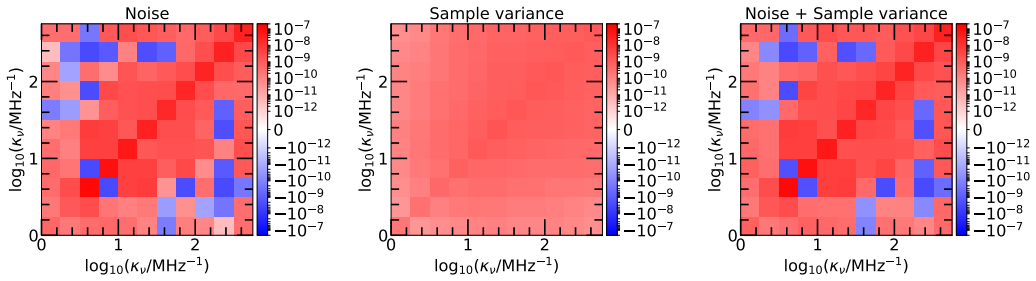
The load-bearing object is the one-dimensional power spectrum P21(κν) of the 21-cm forest, defined from the flux fluctuation δF21 = F21 − 1 = S/S_cont − 1 and computed with a Lomb–Scargle periodogram over 13 logarithmically spaced bins in κν from 0.316 to 562 MHz^−1, with wavenumbers below 1 MHz^−1 discarded as sidelobe-contaminated. Because the 21-cm optical depth scales roughly as τ21 ∝ x_HI/T_S, colder or more neutral gas produces stronger absorption fluctuations and hence a larger power spectrum; this is why a noise-level measurement can still bound the x_HI–T_HI combination. The inference machinery is a Gaussian likelihood whose model-dependent covariance matrix combines empirically mea
Load-bearing premise
The load-bearing premise is that the likelihood's covariance matrix — built from off-source sightline noise and 1000 simulated sightlines — fully represents the variance of the measured power spectrum; if unmodelled systematics (such as the residual excess seen at 3–20 MHz^−1) add correlated power, the 68% exclusion curves shift.
What would settle it
A deeper re-observation of J352-15 settles it: if the excess power at 3–20 MHz^−1 persists as thermal noise drops, it is a systematic artifact and the exclusions are biased; conversely, if synthetic 21-cm forest signals at the level of the excluded cold models are injected into the off-source noise and recovered by the same pipeline, the null-detection exclusion is genuine.
If this is right
- The 21-cm forest has entered the regime of observationally informative statistics: a null detection now places meaningful constraints on the thermal and ionization state of the neutral IGM.
- The excluded cold models imply the neutral IGM at z≈5.6 has been substantially pre-heated above the adiabatic cooling floor, in a region of parameter space that Lyα and 21-cm tomography observations still allow.
- Deeper observations of J352-15 (roughly 100 total hours) would either make a statistical detection likely if the IGM is cold and neutral, or tighten the lower limits on ⟨T_HI⟩ to 35–160 K across ⟨x_HI⟩=0.1–0.8.
- The independent MWA measurement, though less sensitive, is consistent with noise-dominated fluctuations, showing that 21-cm forest power spectra can be pursued with multiple low-frequency radio facilities.
- Because the forest power spectrum is sensitive to both neutral fraction and temperature simultaneously, it complements Lyα (ionization) and 21-cm tomography (temperature) probes, jointly constraining the UV and X-ray source populations driving reionization.
Where Pith is reading between the lines
- If the exclusions hold, they imply the first galaxies or black holes produced enough X-rays to heat the neutral IGM to tens of kelvin by z≈5.6, sharpening the allowed X-ray efficiency of early sources beyond what Lyα and 21-cm tomography alone imply.
- Extending the same power-spectrum analysis to the ~34 known radio-loud quasars at z>5.5 would build a multi-sightline sample, reducing sample variance and testing whether the inferred pre-heating is uniform across different lines of sight.
- The measured excess power at intermediate scales (3≲κν≲20 MHz^−1) over idealized noise is itself a candidate signal; a targeted search for its coherence across sightlines — or its persistence in deeper data — could convert it into a detection or reveal an unmodelled bandpass artifact.
- The statistical framework is portable to other narrow absorption structures in quasar spectra, such as minihalos or metal lines, since the same power-spectrum statistic responds to any small-scale absorption feature.
Editorial analysis
A structured set of objections, weighed in public.
Referee Report
Summary. The paper presents the first observational estimate of the 1D power spectrum of the 21-cm forest, using archival uGMRT observations of the z=5.82 quasar J352–15. After direction-dependent calibration, continuum subtraction, wavelet-based bandpass removal, and channel flagging, the authors obtain a noise level of 3.62 mJy/beam per 6.1 kHz channel and a spectrum over 209–222.5 MHz. The measured power spectrum is statistically indistinguishable from off-source sightlines (KS and AD tests), so no 21-cm forest detection is claimed. The authors then compare the noise-subtracted power spectrum with forward models from 21cmFAST-generated simulations spanning a grid of ⟨x_HI⟩ and ⟨T_HI⟩, using a Gaussian likelihood with a parameter-dependent covariance matrix. The resulting Bayesian constraints are presented as 68% credible exclusions in the ⟨T_HI⟩–⟨x_HI⟩ plane, including disfavouring ⟨T_HI⟩ ≲ 27 K at ⟨x_HI⟩ = 0.1. An independent MWA measurement is presented but is not used for inference. Forecasts for a deeper campaign are also given. The central claim is that even a null detection can exclude cold, substantially neutral IGM states that are still allowed by Lyα and 21-cm tomography observations.
Significance. If the result holds, this is a milestone: it would be the first observational measurement of the 21-cm forest 1D power spectrum and the first demonstration that current-generation data can constrain the thermal state of the neutral IGM at z≈5.6. The paper has real strengths: careful use of archival data with direction-dependent calibration, an empirical noise model rather than a purely radiometric one, explicit null tests using off-source sightlines, and a forward-model grid from previously validated simulations. The claimed constraints are complementary to Lyα and global/tomographic 21-cm limits and, if robust, would indicate substantial pre-heating of the neutral IGM. However, the quantitative exclusion contours rest on modelling assumptions that are acknowledged but not quantified, so the strength of the headline limits is not yet established.
major comments (3)
- [Sec. 2.1, Sec. 2.6, Eq. (8)] The main quantitative result, Fig. 11, is an exclusion boundary in the ⟨T_HI⟩–⟨x_HI⟩ plane. But most of the quoted quasar proximity region is included in the analysed band. Sec. 2.1 states the proximity zone can extend to ~66 cMpc, which is ~5 MHz at 208 MHz, yet only the 208–209 MHz interval is masked while the band 209–222.5 MHz is fit with forward models that assume a globally neutral, coeval IGM with no quasar feedback. Since τ21 ∝ x_HI/T_S (Eq. 8), photoionized or X-ray-heated gas near the quasar suppresses the predicted 1D power spectrum, which is exactly the direction that disfavours cold, neutral models. This is listed as the first limitation in Sec. 6, but its impact on the exclusion boundary is not quantified. I ask for a quantitative assessment: either mask the full expected proximity band, include a simple radiative-transfer treatment, or demonstrate that the contours in Fig.
- [Sec. 3.2, Sec. 4, Eq. (9), Fig. 10] The likelihood in Eq. (9) assumes that the covariance matrix C(θ) fully describes the variance of the measured power spectrum. This covariance is built from off-source sightline noise and simulated sample variance. However, Sec. 3.2 explicitly reports 'excess power at intermediate scales, 3 MHz−1 ≲ κν ≲ 20 MHz−1, likely reflecting residual systematic effects beyond idealized thermal noise.' No signal-injection or null tests are presented; Sec. 6 defers them to future work. If the observed excess is due to unmodeled systematics that inflate or correlate the noise, the 68% contours in Fig. 11 will be too aggressive. I recommend validating the likelihood by comparing the target χ² against the distribution of off-source χ² values under the same covariance model, or by adding a systematic covariance term and rerunning the inference. This is necessary to secure the quoted exclusion levels.
- [Sec. 3.1, Sec. 6] The forward models are generated at z=6, while the observations span z≈5.4–5.8. The text in Sec. 3.1 argues that the redshift offset is modest, but Sec. 6 later acknowledges that both the neutral fraction and thermal state may evolve significantly along the 200 cMpc sightline during the final stages of reionization. A coeval z=6 model will generally overpredict absorption at the lower-redshift end of the band, again suppressing the model power spectrum relative to the data and biasing the exclusion in the same direction as the proximity effect. I ask the authors to quantify this: for example, run the same inference with lightcone-based forward models or with the band split into two redshift intervals to show that the Fig. 11 contours do not shift by more than the quoted 68% uncertainties.
minor comments (4)
- [Eq. (1)] The typesetting of the radiometer equation is garbled; the factor (A_eff/T_sys)^{-1} and the N_d dependence are difficult to parse. Please rewrite cleanly.
- [Fig. 7 caption] The caption says the vertical line marks the 'highest κν-bin expected to be dominated by sidelobe contamination,' but the line marks the κν,SL = 1 MHz−1 cutoff and the excluded modes are below this value. Please reword to avoid confusion.
- [Sec. 2.6] The sentence 'The signal κνP21 aligns with the spread of the noise-only cases' should read 'The measured κνP21' for clarity.
- [References] Some references are formatted inconsistently, e.g. 'Villanueva-Domingo & Ichiki 2022, PASJ[arXiv:2104.10695]' lacks a volume/page or DOI. Please unify the reference list.
Circularity Check
No significant circularity: the null power spectrum is compared against independent forward simulations; self-citations are methodological, not load-bearing.
full rationale
The derivation chain is externally anchored at each link. The measured 1D power spectrum comes from uGMRT visibilities through calibration, continuum subtraction, wavelet bandpass removal, and a Lomb–Scargle periodogram; the noise model is empirical, built from 1000 off-source sightlines. The signal templates are forward-modelled spectra from 21cmFAST simulations spanning a grid of ionizing and X-ray efficiencies, with the likelihood (Eqs. 9–10) forming residuals between the observed noise-subtracted spectrum and simulated signal-only spectra. No parameter is fitted to the measured power spectrum and then renamed a prediction: the inferred ⟨T_HI⟩ and ⟨x_HI⟩ are MCMC outputs, not inputs to the data calibration or noise characterization. The substantial self-citations (Šoltinský et al. 2025 for the simulation/estimator framework; Patil et al. 2026 for method A2; Šoltinský et al. 2021 for T_S=T_K) are methodological reuse of published, code-based work, not an unverified authority invoked to forbid alternatives; no uniqueness theorem or ansatz is smuggled in via citation. The paper's own stated limitations (Sec. 6: quasar radiative feedback, missing minihalos, coeval IGM, excursion-set ionization; Sec. 3.2: excess power at intermediate scales likely from residual systematics) are external-validity and correctness risks that could shift the exclusion boundary, but they do not make any equation reduce to its own input. Therefore no circular step is present.
Axiom & Free-Parameter Ledger
free parameters (5)
- mean neutral hydrogen fraction ⟨x_HI⟩ =
posterior; uniform prior [0,1]
- mean neutral IGM temperature ⟨T_HI⟩ =
posterior; uniform prior in log10(⟨T_HI⟩/K) over [log10(15),4]
- X-ray heating efficiency f_X =
log10 f_X ∈ [-4,1] grid over 534 models
- ionizing efficiency HII_EFF_FACTOR =
varied to set ⟨x_HI⟩ across models
- empirical noise-scaling exponent (Eq. 2) =
-0.45
axioms (6)
- standard math 21-cm optical depth formalism of Furlanetto & Loeb (2002), Eq. 8
- domain assumption Saturated spin-temperature coupling, T_S = T_K
- domain assumption 21cmFAST excursion-set ionization field at z=6 approximates the z=5.4–5.8 lightcone probed by the observations
- domain assumption Background quasar is a point source with no radiative feedback on the surrounding IGM
- domain assumption Unresolved small-scale absorbers (minihalos, dense structures) do not significantly affect the 1D power spectrum
- domain assumption Gaussian likelihood with model-dependent covariance is adequate
read the original abstract
Neutral regions of the intergalactic medium (IGM) during the Epoch of Reionization (EoR) remain largely unexplored due to the limitations of existing probes. Owing to discoveries of numerous high-redshift radio-bright sources, the 21-cm forest, a series of absorption features imprinted by the neutral IGM in the spectra of such sources, now offers an attractive probe of the thermal and ionization state of the predominantly neutral IGM at $z\gtrsim5.5$. We analyse archival upgraded Giant Metrewave Radio Telescope (uGMRT) observations of J352-15, the brightest known radio-loud quasar in the EoR ($z=5.82$), to measure the one-dimensional (1D) power spectrum of the 21-cm forest. By comparing the observed power spectrum with forward-modelled synthetic spectra generated from cosmological simulations spanning a wide range of ionization and X-ray pre-heating scenarios, we perform Bayesian inference even in the absence of a statistical detection. We also present an independent Murchison Widefield Array measurement, although its lower sensitivity prevents competitive constraints. Using uGMRT, we achieve a sensitivity of $3.62\,\rm mJy\,beam^{-1}$ per $6.1\,\rm kHz$ channel. While we do not detect the 21-cm forest statistically, the null detection jointly constrains the mean neutral hydrogen fraction, $\langle x_{\rm HI}\rangle$, and the mean temperature of the neutral IGM, $\langle T_{\rm HI}\rangle$. At the $68\%$ credible level, our analysis disfavours cold and substantially neutral IGM models at $z\approx5.6$, including models with $\langle T_{\rm HI}\rangle \lesssim 27\,\rm K$ for $\langle x_{\rm HI}\rangle=0.1$. These limits probe parameter space allowed by existing Ly$\alpha$ and 21-cm observations, indicating substantial pre-heating of the neutral IGM above the adiabatic cooling floor. This demonstrates that the 21-cm forest has entered the regime of observationally informative statistics.
Figures




Reference graph
Works this paper leans on
-
[1]
P., Tollerud , E
Astropy Collaboration , Robitaille , T. P., Tollerud , E. J., et al. 2013, , 558, A33
2013
-
[2]
2018, , 861, L14
Ba \ n ados , E., Carilli , C., Walter , F., et al. 2018, , 861, L14
2018
-
[3]
2021, , 909, 80
Ba \ n ados , E., Mazzucchelli , C., Momjian , E., et al. 2021, , 909, 80
2021
-
[4]
2025, Nature Astronomy, 9, 293
Ba \ n ados , E., Momjian , E., Connor , T., et al. 2025, Nature Astronomy, 9, 293
2025
-
[5]
P., et al
Ba \ n ados , E., Schindler , J.-T., Venemans , B. P., et al. 2023, , 265, 29
2023
-
[6]
D., Bolton, J
Becker, G. D., Bolton, J. S., Madau, P., et al. 2015, , 447, 3402
2015
-
[7]
D., Bolton , J
Becker , G. D., Bolton , J. S., Zhu , Y., & Hashemi , S. 2024, , 533, 1525
2024
-
[8]
D., D'Aloisio , A., Christenson , H
Becker , G. D., D'Aloisio , A., Christenson , H. M., et al. 2021, , 508, 1853
2021
-
[9]
D., Pettini , M., Rafelski , M., et al
Becker , G. D., Pettini , M., Rafelski , M., et al. 2019, , 883, 163
2019
-
[10]
2020, , 635, L7
Belladitta , S., Moretti , A., Caccianiga , A., et al. 2020, , 635, L7
2020
-
[11]
2022, , 517, 2331
Bhagwat , A., Ciardi , B., Zackrisson , E., & Schaye , J. 2022, , 517, 2331
2022
-
[12]
Bosman , S. E. I., Davies , F. B., Becker , G. D., et al. 2022, , 514, 55
2022
-
[13]
D., Cairns , I., Kaplan , D
Bowman , J. D., Cairns , I., Kaplan , D. L., et al. 2013, , 30, e031
2013
-
[14]
D., Rogers, A
Bowman, J. D., Rogers, A. E. E., Monsalve, R. A., Mozdzen, T. J., & Mahesh, N. 2018, Nature, 555, 67–70
2018
-
[15]
Briggs , D. S. 1995, in American Astronomical Society Meeting Abstracts, Vol. 187, American Astronomical Society Meeting Abstracts, 112.02
1995
-
[16]
Cain , C., D'Aloisio , A., Gangolli , N., & Becker , G. D. 2021, , 917, L37
2021
-
[17]
2026, arXiv e-prints, arXiv:2606.24665
Cang , J., Ciardi , B., Maity , B., et al. 2026, arXiv e-prints, arXiv:2606.24665
Pith/arXiv arXiv 2026
-
[18]
C., Rogers , A
Cappallo , R. C., Rogers , A. E. E., Lonsdale , C. J., et al. 2025, , 137, 125002
2025
-
[19]
L., Gnedin, N
Carilli, C. L., Gnedin, N. Y., & Owen, F. 2002, , 577, 22
2002
-
[20]
L., Wang , R., van Hoven , M
Carilli , C. L., Wang , R., van Hoven , M. B., et al. 2007, , 133, 2841
2007
-
[21]
2026, arXiv e-prints, arXiv:2606.26435
CD Science Working Group , Bernardi , G., Breitman , D., et al. 2026, arXiv e-prints, arXiv:2606.26435
Pith/arXiv arXiv 2026
-
[22]
K., Ben \' tez-Llambay , A., Theuns , T., Frenk , C., & Bower , R
Chan , T. K., Ben \' tez-Llambay , A., Theuns , T., Frenk , C., & Bower , R. 2024, , 528, 1296
2024
-
[23]
M., Becker , G
Christenson , H. M., Becker , G. D., Furlanetto , S. R., et al. 2021, , 923, 87
2021
-
[24]
B., et al
Ciardi , B., Inoue , S., Abdalla , F. B., et al. 2015, , 453, 101
2015
-
[25]
2013, , 428, 1755
Ciardi, B., Labropoulos, P., Maselli, A., et al. 2013, , 428, 1755
2013
-
[26]
J., Cotton , W
Condon , J. J., Cotton , W. D., Greisen , E. W., et al. 1998, , 115, 1693
1998
-
[27]
2021, , 911, 120
Connor , T., Ba \ n ados , E., Stern , D., et al. 2021, , 911, 120
2021
-
[28]
K., Bharadwaj , S., & Choudhury , T
Datta , K. K., Bharadwaj , S., & Choudhury , T. R. 2007, , 382, 809
2007
-
[29]
B., Bosman , S
Davies , F. B., Bosman , S. E. I., D'Odorico , V., et al. 2026, , 545, staf1862
2026
-
[30]
de Lera Acedo , E., de Villiers , D. I. L., Razavi-Ghods , N., et al. 2022, Nature Astronomy, 6, 984
2022
-
[31]
R., Parsons , A
DeBoer , D. R., Parsons , A. R., Aguirre , J. E., et al. 2017, , 129, 045001
2017
-
[32]
E., Hall , P
Dewdney , P. E., Hall , P. J., Schilizzi , R. T., & Lazio , T. J. L. W. 2009, IEEE Proceedings, 97, 1482
2009
-
[33]
2025, , 544, 1608
Dhandha , J., Fialkov , A., Gessey-Jones , T., et al. 2025, , 544, 1608
2025
-
[34]
P., Lyu , J., et al
Endsley , R., Stark , D. P., Lyu , J., et al. 2023, , 520, 4609
2023
-
[35]
J., et al
Euclid Collaboration , Barnett , R., Warren , S. J., et al. 2019, , 631, A85
2019
-
[36]
S., Mesinger, A., & Hewitt, J
Ewall-Wice, A., Dillon, J. S., Mesinger, A., & Hewitt, J. 2014, , 441, 2476
2014
-
[37]
A., Becker , R
Fan , X., Strauss , M. A., Becker , R. H., et al. 2006, , 132, 117
2006
-
[38]
& Solanki , S
Fligge , M. & Solanki , S. K. 1997, , 124, 579
1997
-
[39]
2016, The Journal of Open Source Software, 1, 24
Foreman-Mackey, D. 2016, The Journal of Open Source Software, 1, 24
2016
-
[40]
W., Lang , D., & Goodman , J
Foreman-Mackey , D., Hogg , D. W., Lang , D., & Goodman , J. 2013, , 125, 306
2013
-
[41]
Furlanetto, S. R. 2006, , 371, 867
2006
-
[42]
Furlanetto, S. R. & Loeb, A. 2002, , 579, 1
2002
-
[43]
R., Peng Oh, S., & Briggs, F
Furlanetto, S. R., Peng Oh, S., & Briggs, F. H. 2006, , 433, 181
2006
-
[44]
G., Davies , F
Gaikwad , P., Haehnelt , M. G., Davies , F. B., et al. 2023, , 525, 4093
2023
-
[45]
G., et al
Gaikwad, P., Rauch, M., Haehnelt, M. G., et al. 2020, , 494, 5091
2020
-
[46]
2025, , 699, A109
Ghara , R., Zaroubi , S., Ciardi , B., et al. 2025, , 699, A109
2025
-
[47]
J., Duncan , K
Gloudemans , A. J., Duncan , K. J., Saxena , A., et al. 2022, , 668, A27
2022
-
[48]
J., Saxena , A., Intema , H., et al
Gloudemans , A. J., Saxena , A., Intema , H., et al. 2023, , 678, A128
2023
-
[49]
& Weare , J
Goodman , J. & Weare , J. 2010, Communications in Applied Mathematics and Computational Science, 5, 65
2010
-
[50]
Greig , B., Mesinger , A., Koopmans , L. V. E., et al. 2021 a , , 501, 1
2021
-
[51]
M., Barry , N., et al
Greig , B., Trott , C. M., Barry , N., et al. 2021 b , , 500, 5322
2021
-
[52]
2021, , 255, 28
Gupta , N., Srianand , R., Shukla , G., et al. 2021, , 255, 28
2021
-
[53]
S., et al
Gupta , Y., Ajithkumar , B., Kale , H. S., et al. 2017, Current Science, 113, 707
2017
-
[54]
R., Jarrod Millman , K., van der Walt , S
Harris , C. R., Jarrod Millman , K., van der Walt , S. J., et al. 2020, Nature, 585, 357
2020
-
[55]
F., Davies , F
Hennawi , J. F., Davies , F. B., Wang , F., & O \ n orbe , J. 2021, , 506, 2963
2021
-
[56]
2023, , 945, 124
HERA Collaboration . 2023, , 945, 124
2023
-
[57]
L., Jarvis , M
Heywood , I., Hale , C. L., Jarvis , M. J., et al. 2020, , 496, 3469
2020
-
[58]
J., Hale , C
Heywood , I., Jarvis , M. J., Hale , C. L., et al. 2022, , 509, 2150
2022
-
[59]
A., Maddox , N., et al
Heywood , I., Ponomareva , A. A., Maddox , N., et al. 2024, , 534, 76
2024
-
[60]
Hunter , J. D. 2007, Computing in Science and Engineering, 9, 90
2007
-
[61]
2021, , 647, L11
Ighina , L., Belladitta , S., Caccianiga , A., et al. 2021, , 647, L11
2021
-
[62]
2023, , 519, 2060
Ighina , L., Caccianiga , A., Moretti , A., et al. 2023, , 519, 2060
2023
-
[63]
2024, , 692, A241
Ighina , L., Caccianiga , A., Moretti , A., et al. 2024, , 692, A241
2024
-
[64]
T., Jagannathan , P., Mooley , K
Intema , H. T., Jagannathan , P., Mooley , K. P., & Frail , D. A. 2017, , 598, A78
2017
-
[65]
& M \'e sz \'a ros , P
Ioka , K. & M \'e sz \'a ros , P. 2005, , 619, 684
2005
-
[66]
A., McLaughlin , M
Jiang , M., Cui , B.-Y., Schmid , N. A., McLaughlin , M. A., & Cao , Z.-C. 2017, , 847, 75
2017
-
[67]
Jordan, C., Null, D., Trott, C., et al. 2025, in 2025 URSI Asia-Pacific Radio Science Meeting, AP-RASC 2025, 2025 URSI Asia-Pacific Radio Science Meeting, AP-RASC 2025 (Institute of Electrical and Electronics Engineers Inc.), publisher Copyright: 2025 URSI.; 2025 URSI Asia-Pacific Radio Science Meeting, AP-RASC 2025 ; Conference date: 17-08-2025 Through 2...
2025
-
[68]
2023, , 2023, 017
Kadota , K., Villanueva-Domingo , P., Ichiki , K., Hasegawa , K., & Naruse , G. 2023, , 2023, 017
2023
-
[69]
2025, arXiv e-prints, arXiv:2503.07074
Kakiichi , K., Jin , X., Wang , F., et al. 2025, arXiv e-prints, arXiv:2503.07074
Pith/arXiv arXiv 2025
-
[70]
2022, , 511, 4005
Kannan , R., Garaldi , E., Smith , A., et al. 2022, , 511, 4005
2022
-
[71]
J., Shibuya , T., Ouchi , M., & Kashikawa , N
Kashino , D., Lilly , S. J., Shibuya , T., Ouchi , M., & Kashikawa , N. 2020, , 888, 6
2020
-
[72]
C., Haehnelt , M
Keating , L. C., Haehnelt , M. G., Becker , G. D., & Bolton , J. S. 2014, , 438, 1820
2014
-
[73]
C., Weinberger, L
Keating, L. C., Weinberger, L. H., Kulkarni, G., et al. 2020, , 491, 1736
2020
-
[74]
S., Smirnov , O
Kenyon , J. S., Smirnov , O. M., Grobler , T. L., & Perkins , S. J. 2018, , 478, 2399
2018
-
[75]
Kist , T., Hennawi , J. F., & Davies , F. B. 2025, arXiv e-prints, arXiv:2508.21812
Pith/arXiv arXiv 2025
-
[76]
N., Hardcastle , M
Kondapally , R., Best , P. N., Hardcastle , M. J., et al. 2021, , 648, A3
2021
-
[77]
C., Haehnelt, M
Kulkarni, G., Keating, L. C., Haehnelt, M. G., et al. 2019, , 485, L24
2019
-
[78]
2021, , 908, 124
Liu , Y., Wang , R., Momjian , E., et al. 2021, , 908, 124
2021
-
[79]
Lomb , N. R. 1976, , 39, 447
1976
-
[80]
P., Leonard , A., Starck , J.-L., Abdalla , F
Machado , D. P., Leonard , A., Starck , J.-L., Abdalla , F. B., & Jouvel , S. 2013, , 560, A83
2013
discussion (0)
Sign in with ORCID, Apple, or X to comment. Anyone can read and Pith papers without signing in.