REVIEW 2 major objections 5 minor 117 references
MLSYSIM: First-Principles Infrastructure Modeling for Machine Learning Systems
T0 review · 2 major / 5 minor · reviewed 2026-07-12 · grok-4.5
Pith's one-line read ML systems can be reasoned about as 22 physics walls solved in under a second, without hardware in hand.
desk verdict Solid engineering artifact: unifies known first-principles models into a dimensionally strict, registry-backed engine with transparent first-order validation; useful for education and early design, not new physics. read the letter →
The pith
A machine-rendered reading of the paper's core claim, the machinery that carries it, and where it could break.
The reading
What carries the argument
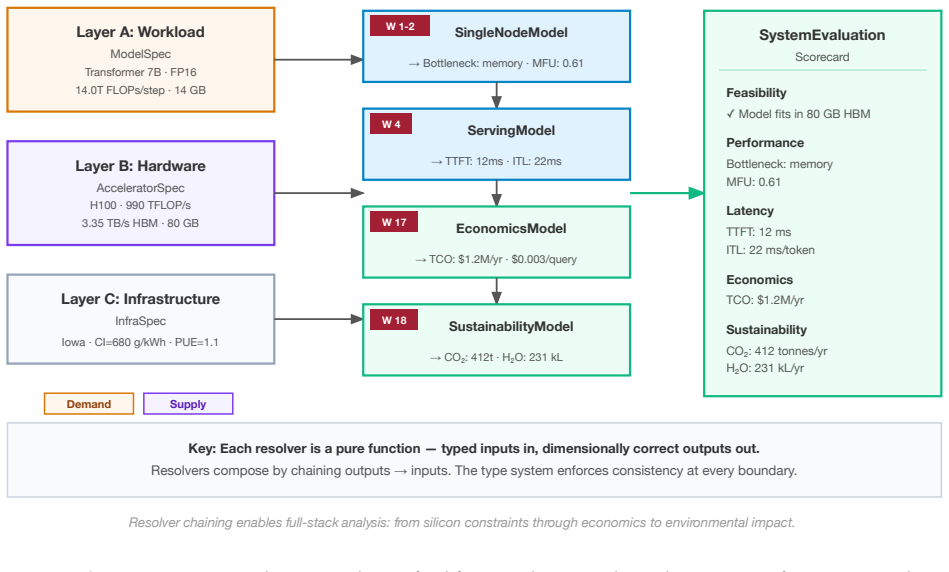
The 5-layer demand–supply stack and the 22 Systems Walls: workload demand is lowered once into a hardware-agnostic computation graph; silicon, grid and topology supply remain separate; 28 pure resolvers (models, solvers, optimizers) compose through typed, pint-enforced quantities to produce a Feasibility–Performance–Macro scorecard and an inverse-Roofline synthesis path.
What would settle it
Take a published multi-node training or serving result whose binding constraint is known from profiling; if MLSYSIM’s predicted binding wall, MFU or carbon figure systematically disagrees beyond the claimed envelope after the stated efficiency defaults are applied, the central claim fails.
Extended reading notes
Core claim
A demand–supply architecture plus a taxonomy of 22 Systems Walls, resolved by 28 composable, dimensionally strict resolvers, is sufficient to identify the binding constraint and to synthesize ideal hardware specifications for full-stack ML systems in sub-second time, matching published empirical anchors within roughly seven percent.
Load-bearing premise
A single efficiency number (and a few related overlap defaults) can soak up all the messy micro-architectural, runtime and congestion effects so that simple first-principles equations still correctly name which wall is binding.
Editorial analysis
A structured set of objections, weighed in public.
Referee Report
Summary. MLSYS·IM is a pure-Python analytical framework for first-principles modeling of ML systems infrastructure. It separates computational demand from silicon supply and environmental context via a five-layer architecture and a hardware-agnostic ComputationGraph IR, enforces SI units at runtime with pint, and draws every numeric input from typed, provenance-tracked registries (the MLSys Zoo). On this engine the authors codify 22 Systems Walls across six domains (Node, Data, Algorithm, Fleet, Operations, Analysis), resolved by 28 composable models, solvers, and optimizers that produce a three-level SystemEvaluation (Feasibility, Performance, Macro) in sub-second time. The framework identifies binding constraints, synthesizes minimum hardware from SLAs (inverse Roofline), and is validated against seven published anchors spanning training, inference, scaling laws, carbon, and parallelism search, with design-space sweeps of >1000 configurations in under one second on a laptop.
Significance. If the engineering claim holds, the paper fills a real gap between cycle-accurate simulators (hours per config) and ad-hoc spreadsheets (no dimensional safety, narrow scope). The combination of demand–supply separation, runtime unit enforcement, provenance-tracked registries, and a full-stack wall taxonomy is a genuine contribution for education and early co-design. Explicit strengths include open pure-Python execution, machine-checked structural invariants (862-test suite), seven independent empirical anchors (Table 6), and clear pedagogical integration with the companion textbook. The work is useful even when absolute latency is only first-order accurate, because the ordinal ranking of binding walls is the actionable output.
major comments (2)
- §6.1 Anchors 1–4 and Table 6: several headline matches (ResNet-50 throughput, Llama-3 MFU 39.1% vs 38–43%, PaLM MFU 43% vs 46.2%) depend on choosing η (and η_overlap) from the same literature that supplies the target. The paper is transparent that η is an exposed free parameter (Eqs. 1, 6; §6.3), and two anchors need no η, but the manuscript should state more clearly which anchors are pure first-principles predictions versus literature-calibrated regime checks. Without that distinction, the “within ~7%” claim can be read as stronger than the evidence supports for uncalibrated what-if use.
- §4.1 Wall 4 (Serving) and §4.4 Wall 14 (Communication): modern serving features (chunked prefill, speculative decoding, hierarchical AllReduce with overlap) are modeled with coarse analytical proxies (e.g., decode_stall_bound, η_overlap default 0.85). These are reasonable for first-order ranking, but the paper should quantify sensitivity of the binding-wall label to these defaults on at least one multi-wall case (e.g., the LLaMA-70B 512-GPU audit in §7.3.3), so readers know when the ordinal ranking is robust versus when it flips under plausible η_overlap or service_time_cv variation.
minor comments (5)
- Abstract and title use both MLSYSIM and MLSYS·IM; pick one spelling consistently (including the arXiv identifier line).
- Table 1 lists 22 walls but the prose sometimes says “20 walls + 2 diagnostics”; align the wording with the table so the count is unambiguous.
- Figure 1 panel (d) and §7.3.3 report concrete TCO/carbon numbers; ensure the registry snapshot (Appendix B) and provenance catalog make those exact inputs reconstructible without private defaults.
- §2.3 comparison to Calculon, Lumos, Vidur, GenZ is fair but could briefly note which of their equations are reused versus re-derived, to help readers map the taxonomy onto prior analytical tools.
- Notation Table 5 is helpful; a few symbols (e.g., β_opt, γ routing imbalance) appear later without a forward pointer from the table—add them or cite the table at first use.
Circularity Check
No significant circularity: first-principles equations plus explicit free parameters are checked against independent published anchors, not re-derived from the targets.
full rationale
MLSYSIM's central claim is an engineering artifact (demand–supply separation, dimensional strictness, 22-wall taxonomy, 28 resolvers) that composes published first-principles formulas (Roofline, Ring AllReduce, Chinchilla C=6PD, Erlang-C, Young–Daly, TCO, operational carbon). Validation Anchors 1–7 compare outputs to external sources (MLPerf, vLLM/Kwon, Meta Llama-3 report, PaLM, Hoffmann Chinchilla, Patterson carbon). Two anchors need no efficiency parameter at all. Where η or overlap coefficients appear, the paper treats them as explicit free parameters taken from the same literature or stated defaults, not as quantities fitted inside a closed loop that re-predicts the fitted target. Self-citations (companion textbook, TinyTorch) are pedagogical companions, not uniqueness theorems that force the modeling results. The taxonomy and engine are new software organization, not a renaming of a single known equation set equal to itself. Score 1 reflects only the ordinary, non-load-bearing use of literature-sourced η ranges; the derivation chain does not reduce by construction to its inputs.
Assumptions & free parameters
free parameters (4)
- η (hardware utilization / MFU)
- η_overlap (compute–comm overlap)
- service_time_cv / Kingman correction
- β_opt (optimizer-state multiplier)
assumptions (8)
- domain assumption Classical Roofline: T = max(OPs/(Peak·η), |W|/BW)
- domain assumption Chinchilla scaling C = 6PD, D* ≈ 20P
- domain assumption Erlang-C / M/M/c for P99 tail latency
- domain assumption Young–Daly optimal checkpoint interval τ_opt = √(2δ·MTBF)
- domain assumption Independent exponential failures → MTBF_cluster = MTBF_node / N
- domain assumption Static bisection bandwidth fraction β by topology (Fat-Tree=1, Dragonfly≈0.85, Torus≈0.67)
- standard math Dimensional quantities must be closed under pint arithmetic; FLOP is a base dimension
- domain assumption Linear CapEx amortization over 3–5 years; energy-proportional power (idle = 30 % TDP)
invented entities (3)
-
22 Systems Walls taxonomy
-
5-layer demand–supply architecture + ComputationGraph IR
-
MLSys Zoo (8 typed, provenance-tracked registries)
Cite this review
Pith. "Pith review of MLSYSIM: First-Principles Infrastructure Modeling for Machine Learning Systems." pith.science (2026). https://pith.science/paper/T3ITN2E6
@misc{pith2026260702558,
  author       = {Pith},
  title        = {Pith review of: MLSYSIM: First-Principles Infrastructure Modeling for Machine Learning Systems},
  year         = {2026},
  howpublished = {\url{https://pith.science/paper/T3ITN2E6}},
  note         = {Machine review of arXiv:2607.02558}
}
read the original abstract
As machine learning shifts from laboratory curiosity to critical infrastructure, the systems that sustain it span an extraordinary range, from sub-milliwatt microcontrollers to multi-gigawatt datacenter fleets. Reasoning across this range is hard: empirical profiling requires the target hardware in hand, while cycle-accurate simulation costs hours per configuration, leaving no tool for rapid, full-stack architectural reasoning. We present MLSYSIM (Machine Learning Systems Infrastructure Modeling), a first-principles analytical framework that formalizes the "physics of systems" into a dimensionally-strict Python engine. MLSysim is built on a demand-supply abstraction that decouples computational demand from silicon supply and environmental context, and it enforces unit integrity at runtime so the silent conversion errors that plague ad-hoc modeling cannot occur. Every input is drawn from a typed, provenance-tracked registry, so no number enters an analysis without a documented source. On this engine we codify a taxonomy of 22 "Systems Walls" resolved by 28 composable models and solvers, enabling sub-second design-space exploration that identifies binding constraints and synthesizes ideal hardware specifications across the entire ML systems lifecycle.
Figures


Figures from the paper (5 more)



Reference graph
Works this paper leans on
-
[2]
and Tumanov, Alexey and Ramjee, Ramachandran , year =
Agrawal, Amey and Kedia, Nitin and Panwar, Ashish and Mohan, Jayashree and Kwatra, Nipun and Gulavani, Bhargav S. and Tumanov, Alexey and Ramjee, Ramachandran , year =. Taming Throughput-Latency Tradeoff in. Proceedings of the 18th USENIX Symposium on Operating Systems Design and Implementation (OSDI) , publisher =
-
[3]
and Tumanov, Alexey and Ramjee, Ramachandran , year =
Agrawal, Amey and Kedia, Nitin and Panwar, Ashish and Mohan, Jayashree and Kwatra, Nipun and Gulavani, Bhargav S. and Tumanov, Alexey and Ramjee, Ramachandran , year =. Vidur: A Large-Scale Simulation Framework For. Proceedings of Machine Learning and Systems (MLSys) , publisher =
-
[4]
OpenAI Blog , publisher =
Amodei, Dario and Hernandez, Danny , year =. OpenAI Blog , publisher =
-
[7]
2018 , publisher =
The Datacenter as a Computer: Designing Warehouse-Scale Machines , author =. 2018 , publisher =
2018
-
[11]
Journal of Machine Learning Research , volume =
Chowdhery, Aakanksha and Narang, Sharan and Devlin, Jacob and others , year =. Journal of Machine Learning Research , volume =
-
[12]
Frans and Morris, Robert , year =
Cox, Russ and Kaashoek, M. Frans and Morris, Robert , year =. xv6: A Simple,
-
[14]
and Ermon, Stefano and Rudra, Atri and R
Dao, Tri and Fu, Daniel Y. and Ermon, Stefano and Rudra, Atri and R. 2022 , booktitle =
2022
-
[15]
2012 , journal =
Large Scale Distributed Deep Networks , author =. 2012 , journal =
2012
Show all 117 references
-
[18]
2022 , booktitle =
Check-N-Run: A Checkpointing System for Training Deep Learning Recommendation Models , author =. 2022 , booktitle =
2022
-
[19]
Proceedings of the 12th International Conference on Learning Representations (ICLR) , publisher =
Faiz, Ahmad and Kannan, Sotaro and Rishi, James and Chuber, James and Addanki, Raviteja and Noman, Abdulrahman , year =. Proceedings of the 12th International Conference on Learning Representations (ICLR) , publisher =
-
[20]
Proceedings of the 11th International Conference on Learning Representations (ICLR) , publisher =
Frantar, Elias and Ashkboos, Saleh and Hoefler, Torsten and Alistarh, Dan , year =. Proceedings of the 11th International Conference on Learning Representations (ICLR) , publisher =
-
[21]
2021 , journal =
A Survey of Quantization Methods for Efficient Neural Network Inference , author =. 2021 , journal =
2021
-
[22]
and Brooks, David and Wu, Carole-Jean , year =
Gupta, Udit and Elgamal, Mariam and Hills, Gage and Wei, Gu-Yeon and Lee, Hsien-Hsin S. and Brooks, David and Wu, Carole-Jean , year =. Proceedings of the 49th Annual International Symposium on Computer Architecture (ISCA) , publisher =. doi:10.1145/3470496.3527408 , x-verified =
-
[23]
2022 , booktitle =
Chasing Carbon: The Elusive Environmental Footprint of Computing , author =. 2022 , booktitle =. doi:10.1109/HPCA53966.2022.00076 , x-verified =
2022 doi
-
[24]
2016 , booktitle =
Deep Compression: Compressing Deep Neural Networks with Pruning, Trained Quantization and Huffman Coding , author =. 2016 , booktitle =
2016
-
[25]
2024 , publisher =
Computer Architecture: A Quantitative Approach , author =. 2024 , publisher =
2024
-
[26]
2022 , booktitle =
Training Compute-Optimal Large Language Models , author =. 2022 , booktitle =
2022
-
[27]
2019 , booktitle =
Beyond Data and Model Parallelism for Deep Neural Networks , author =. 2019 , booktitle =
2019
-
[28]
2017 , booktitle =
In-Datacenter Performance Analysis of a Tensor Processing Unit , author =. 2017 , booktitle =. doi:10.1145/3079856.3080246 , x-verified =
2017 doi
-
[29]
2020 , journal =
Scaling Laws for Neural Language Models , author =. 2020 , journal =
2020
-
[30]
2023 , note =
llm-analysis: Latency and Memory Analysis of Transformer Models , author =. 2023 , note =
2023
-
[32]
1985 , journal =
Fat-Trees: Universal Networks for Hardware-Efficient Supercomputing , author =. 1985 , journal =
1985
-
[33]
2023 , booktitle =
Fast Inference from Transformers via Speculative Decoding , author =. 2023 , booktitle =
2023
-
[34]
Lumos: Efficient Performance Modeling and Estimation for Large-scale
Liang, Mingyu and Kassa, Hiwot Tadese and Fu, Wenyin and Coutinho, Brian and Feng, Louis and Delimitrou, Christina , year =. Lumos: Efficient Performance Modeling and Estimation for Large-scale. Proceedings of Machine Learning and Systems (MLSys) , publisher =
-
[35]
Cerebras Architecture Deep Dive: First Look Inside the
Lie, Sean , year =. Cerebras Architecture Deep Dive: First Look Inside the. IEEE Hot Chips 34 Symposium , publisher =
-
[36]
Proceedings of Machine Learning and Systems (MLSys) , publisher =
Lin, Ji and Tang, Jiaming and Tang, Haotian and Yang, Shang and Chen, Wei-Ming and Wang, Wei-Chen and Xiao, Guangxuan and Dang, Xingyu and Gan, Chuang and Han, Song , year =. Proceedings of Machine Learning and Systems (MLSys) , publisher =
-
[38]
2024 , journal =
The. 2024 , journal =
2024
-
[39]
2019 , howpublished =
Energy Usage Reports: Environmental Awareness as Part of Algorithmic Accountability , author =. 2019 , howpublished =
2019
-
[41]
2025 , publisher =
Machine Learning Systems: Principles and Practices of Engineering Artificially Intelligent Systems , author =. 2025 , publisher =
2025
-
[42]
Analyzing and Mitigating Data Stalls in
Mohan, Jayashree and Phanishayee, Amar and Raniwala, Ashish and Chidambaram, Vijay , year =. Analyzing and Mitigating Data Stalls in. Proceedings of the VLDB Endowment , volume =
-
[43]
2021 , booktitle =
tf.data: A Machine Learning Data Processing Framework , author =. 2021 , booktitle =
2021
-
[44]
2021 , journal =
Efficient Large-Scale Language Model Training on GPU Clusters Using Megatron-LM , author =. 2021 , journal =
2021
-
[47]
2014 , publisher =
Computer Organization and Design: The Hardware/Software Interface , author =. 2014 , publisher =
2014
-
[48]
2021 , journal =
Carbon Emissions and Large Neural Network Training , author =. 2021 , journal =
2021
-
[49]
2023 , journal =
Efficiently Scaling Transformer Inference , author =. 2023 , journal =
2023
-
[50]
and Talwalkar, Ameet , year =
Qi, Hang and Sparks, Evan R. and Talwalkar, Ameet , year =. Proceedings of the 5th International Conference on Learning Representations (ICLR) , publisher =
-
[52]
ACM SIGKDD International Conference on Knowledge Discovery and Data Mining , publisher =
Rasley, Jeff and Rajbhandari, Samyam and Ruwase, Olatunji and He, Yuxiong , year =. ACM SIGKDD International Conference on Knowledge Discovery and Data Mining , publisher =. doi:10.1145/3394486.3406703 , x-verified =
-
[53]
2017 , booktitle =
Outrageously Large Neural Networks: The Sparsely-Gated Mixture-of-Experts Layer , author =. 2017 , booktitle =
2017
-
[55]
Snell, Charlie and Lee, Jaehoon and Xu, Kelvin and Kumar, Aviral , year =. Scaling. Proceedings of the 13th International Conference on Learning Representations (ICLR) , publisher =
-
[56]
and LaPiana, Lia S
Stephenson, Arthur G. and LaPiana, Lia S. and Mulville, Daniel R. and Rutledge, Peter J. and Bauer, Frank H. and Folta, David and Dukeman, Greg A. and Sackheim, Robert and Norvig, Peter , year =
-
[57]
2019 , note =
The Bitter Lesson , author =. 2019 , note =
2019
-
[58]
2006 , publisher =
Operating Systems: Design and Implementation , author =. 2006 , publisher =
2006
-
[59]
Reddi, Vijay Janapa and others , year =
-
[60]
Proceedings of the 22nd USENIX Symposium on Networked Systems Design and Implementation (NSDI) , publisher =
Wang, Zhuo and Zheng, Weicheng and Liu, Chengwei and others , year =. Proceedings of the 22nd USENIX Symposium on Networked Systems Design and Implementation (NSDI) , publisher =
-
[63]
Machine Learning Fleet Efficiency: Analyzing and Optimizing Large-Scale
Wongpanich, Arissa and Oguntebi, Tayo and Baiocchi Paredes, Jose and Wang, Yu Emma and Phothilimthana, Phitchaya Mangpo and Mitra, Ritwika and Zhou, Zongwei and Kumar, Naveen and Reddi, Vijay Janapa , year =. Machine Learning Fleet Efficiency: Analyzing and Optimizing Large-Scale
-
[66]
2021 , booktitle =
Habitat: A Runtime-Based Computational Performance Predictor for Deep Neural Network Training , author =. 2021 , booktitle =
2021
-
[69]
arXiv preprint arXiv:2312.07104 , x-verified =
Zheng, Lianmin and Yin, Liangsheng and Xie, Zhiqiang and others , year =. arXiv preprint arXiv:2312.07104 , x-verified =
-
[70]
Proceedings of the 18th USENIX Symposium on Operating Systems Design and Implementation (OSDI) , publisher =
Zhong, Yinmin and Liu, Shengyu and Chen, Junda and Hu, Jianbo and Zhu, Yibo and Liu, Xuanzhe and Jin, Xin and Zhang, Hao , year =. Proceedings of the 18th USENIX Symposium on Operating Systems Design and Implementation (OSDI) , publisher =
-
[71]
Deep learning with differential privacy
Martin Abadi, Andy Chu, Ian Goodfellow, et al. Deep learning with differential privacy. In Proceedings of the 2016 ACM SIGSAC Conference on Computer and Communications Security, pages 308--318. ACM, 2016. doi:10.1145/2976749.2978318. URL https://doi.org/10.1145/2976749.2978318
2016 doi
-
[72]
Taming Throughput-Latency tradeoff in LLM inference with Sarathi-Serve
Amey Agrawal, Nitin Kedia, Ashish Panwar, Jayashree Mohan, Nipun Kwatra, Bhargav Gulavani, Alexey Tumanov, and Ramachandran Ramjee. Taming Throughput-Latency tradeoff in LLM inference with Sarathi-Serve . In 18th USENIX Symposium on Operating Systems Design and Implementation ...
2024
-
[73]
Gulavani, Alexey Tumanov, and Ramachandran Ramjee
Amey Agrawal, Nitin Kedia, Ashish Panwar, Jayashree Mohan, Nipun Kwatra, Bhargav S. Gulavani, Alexey Tumanov, and Ramachandran Ramjee. Vidur: A large-scale simulation framework for LLM inference. In Proceedings of Machine Learning and Systems (MLSys). mlsys.org, 2024 b . URL h...
2024 arXiv
-
[74]
Demystifying platform requirements for diverse LLM inference use cases
Abhimanyu Bambhaniya, Ritik Raj, Geonhwa Jeong, Souvik Kundu, Sudarshan Srinivasan, Midhilesh Elavazhagan, Madhu Kumar, and Tushar Krishna. Demystifying platform requirements for diverse LLM inference use cases. arXiv preprint arXiv:2406.01698, 2024
2024 arXiv
-
[75]
The case for energy-proportional computing
Luiz Andr \'e Barroso and Urs H \"o lzle. The case for energy-proportional computing. Computer, 40 0 (12): 0 33--37, 2007. ISSN 0018-9162. doi:10.1109/mc.2007.443. URL https://doi.org/10.1109/mc.2007.443
2007 doi
-
[76]
The Datacenter as a Computer
Luiz Andr \'e Barroso, Urs H \"o lzle, and Parthasarathy Ranganathan. The Datacenter as a Computer. Synthesis Lectures on Computer Architecture. Springer International Publishing, 3rd edition, 2018. ISBN 9783031006333, 9783031017612. doi:10.1007/978-3-031-01761-2. URL https://...
2018 doi
-
[77]
The gem5 simulator
Nathan Binkert, Bradford Beckmann, Gabriel Black, et al. The gem5 simulator. ACM SIGARCH Computer Architecture News, 39 0 (2): 0 1--7, 2011. ISSN 0163-5964. doi:10.1145/2024716.2024718. URL https://doi.org/10.1145/2024716.2024718
2011 doi
-
[78]
George E. P. Box. Science and statistics. J. Am. Stat. Assoc., 71 0 (356): 0 791--799, None 1976. ISSN 0162-1459, 1537-274X. doi:10.1080/01621459.1976.10480949. URL https://doi.org/10.1080/01621459.1976.10480949
1976 doi
-
[79]
PaLM : Scaling language modeling with pathways
Aakanksha Chowdhery, Sharan Narang, Jacob Devlin, et al. PaLM : Scaling language modeling with pathways. Journal of Machine Learning Research, 24 0 (240): 0 1--113, 2023
2023
-
[80]
Frans Kaashoek, and Robert Morris
Russ Cox, M. Frans Kaashoek, and Robert Morris. xv6: A simple, Unix -like teaching operating system. MIT PDOS, 2011. URL https://pdos.csail.mit.edu/6.828/xv6
2011
-
[81]
John T. Daly. A higher order estimate of the optimum checkpoint interval for restart dumps. Future Gener. Comput. Syst., 22 0 (3): 0 303--312, 2006. ISSN 0167-739X. doi:10.1016/j.future.2004.11.016. URL https://doi.org/10.1016/j.future.2004.11.016
2006 doi
-
[82]
Fu, Stefano Ermon, Atri Rudra, and Christopher R \'e
Tri Dao, Daniel Y. Fu, Stefano Ermon, Atri Rudra, and Christopher R \'e . Flashattention: Fast and memory-efficient exact attention with io-awareness. In Advances in Neural Information Processing Systems 35, volume 35, pages 16344--16359. Neural Information Processing Systems ...
2022 doi
-
[83]
The tail at scale
Jeffrey Dean and Luiz Andr \'e Barroso. The tail at scale. Communications of the ACM, 56 0 (2): 0 74--80, 2013. ISSN 0001-0782, 1557-7317. doi:10.1145/2408776.2408794. URL https://doi.org/10.1145/2408776.2408794
2013 doi
-
[84]
Corrado, Rajat Monga, et al
Jeffrey Dean, Greg S. Corrado, Rajat Monga, et al. Large scale distributed deep networks. Advances in Neural Information Processing Systems, 25: 0 1223--1231, 2012
2012
-
[85]
Insights into deepseek-v3: Scaling challenges and reflections on hardware for ai architectures
DeepSeek-AI . Insights into deepseek-v3: Scaling challenges and reflections on hardware for ai architectures. In Proceedings of the 52nd Annual International Symposium on Computer Architecture, pages 1731--1745. ACM, 2025. doi:10.1145/3695053.3731412. URL https://doi.org/10.11...
2025 doi
-
[86]
Check-n-run: a checkpointing system for training deep learning recommendation models
Assaf Eisenman, Kiran Kumar Matam, Steven Ingram, Dheevatsa Mudigere, Raghuraman Krishnamoorthi, Krishnakumar Nair, Misha Smelyanskiy, and Murali Annavaram. Check-n-run: a checkpointing system for training deep learning recommendation models. In Proceedings of the 19th USENIX ...
2022
-
[87]
LLMCarbon : Modeling the end-to-end carbon footprint of large language models
Ahmad Faiz, Sotaro Kaneda, Ruhan Wang, Rita Osi, Prateek Sharma, Fan Chen, and Lei Jiang. LLMCarbon : Modeling the end-to-end carbon footprint of large language models. In Proceedings of the 12th International Conference on Learning Representations (ICLR). OpenReview.net, 2024
2024
-
[88]
Switch transformers: Scaling to trillion parameter models with simple and efficient sparsity
William Fedus, Barret Zoph, and Noam Shazeer. Switch transformers: Scaling to trillion parameter models with simple and efficient sparsity. Journal of Machine Learning Research, 23 0 (120): 0 1--39, 2022. URL https://www.jmlr.org/papers/v23/21-0998.html
2022
-
[89]
GPTQ : Accurate post-training quantization for generative pre-trained transformers
Elias Frantar, Saleh Ashkboos, Torsten Hoefler, and Dan Alistarh. GPTQ : Accurate post-training quantization for generative pre-trained transformers. In Proceedings of the 11th International Conference on Learning Representations (ICLR). OpenReview.net, 2023
2023
-
[90]
A Survey of Quantization Methods for Efficient Neural Network Inference, pages 291--326
Amir Gholami, Sehoon Kim, Zhen Dong, et al. A Survey of Quantization Methods for Efficient Neural Network Inference, pages 291--326. Chapman and Hall/CRC, 2021. ISBN 9781003162810. doi:10.1201/9781003162810-13. URL https://doi.org/10.1201/9781003162810-13
2021 doi
-
[91]
Chasing carbon: The elusive environmental footprint of computing
Udit Gupta, Young Geun Kim, Sylvia Lee, Jordan Tse, Hsien-Hsin S Lee, Gu-Yeon Wei, David Brooks, and Carole-Jean Wu. Chasing carbon: The elusive environmental footprint of computing. In IEEE International Symposium on High-Performance Computer Architecture (HPCA), pages 85--99...
2022 doi
-
[92]
Song Han, Huizi Mao, and William J. Dally. Deep compression: Compressing deep neural networks with pruning, trained quantization and huffman coding. In Proceedings of the 4th International Conference on Learning Representations (ICLR). OpenReview.net, 2016
2016
-
[93]
Hennessy, David A
John L. Hennessy, David A. Patterson, and Christos Kozyrakis. Computer Architecture: A Quantitative Approach. Morgan Kaufmann, 7th edition, 2024. ISBN 978-0443154065
2024
-
[94]
Training compute-optimal large language models
Jordan Hoffmann, Sebastian Borgeaud, Arthur Mensch, et al. Training compute-optimal large language models. In Advances in Neural Information Processing Systems 35, volume 35, pages 30016--30030. Neural Information Processing Systems Foundation, Inc. (NeurIPS), 2022. doi:10.522...
2022 doi
-
[95]
Calculon: A methodology and tool for high-level co-design of systems and large language models
Mikhail Isaev, Nic McDonald, Larry Dennison, and Richard Vuduc. Calculon: A methodology and tool for high-level co-design of systems and large language models. In Proceedings of the International Conference for High Performance Computing, Networking, Storage and Analysis, page...
2023 doi
-
[96]
Beyond data and model parallelism for deep neural networks
Zhihao Jia, Matei Zaharia, and Alex Aiken. Beyond data and model parallelism for deep neural networks. In Proceedings of Machine Learning and Systems (MLSys). mlsys.org, 2019. URL https://arxiv.org/abs/1807.05358
2019 arXiv
-
[97]
Reducing activation recomputation in large transformer models
Vijay Anand Korthikanti, Jared Casper, Sangkug Lym, Lawrence McAfee, Michael Andersch, Mohammad Shoeybi, and Bryan Catanzaro. Reducing activation recomputation in large transformer models. Proceedings of Machine Learning and Systems, 5, 2023. URL https://proceedings.mlsys.org/...
2023
-
[98]
Efficient memory management for large language model serving with pagedattention
Woosuk Kwon, Zhuohan Li, Siyuan Zhuang, et al. Efficient memory management for large language model serving with pagedattention. In Proceedings of the 29th Symposium on Operating Systems Principles, pages 611--626. ACM, 2023. doi:10.1145/3600006.3613165. URL https://doi.org/10...
2023 doi
-
[99]
Leiserson
Charles E. Leiserson. Fat-trees: Universal networks for hardware-efficient supercomputing. IEEE Transactions on Computers, C-34 0 (10): 0 892--901, 1985. ISSN 0018-9340. doi:10.1109/tc.1985.6312192. URL https://doi.org/10.1109/tc.1985.6312192
1985 doi
-
[100]
GShard : Scaling giant models with conditional computation and automatic sharding
Dmitry Lepikhin, HyoukJoong Lee, Yuanzhong Xu, Dehao Chen, Orhan Firat, Yanping Huang, Maxim Krikun, Noam Shazeer, and Zhifeng Chen. GShard : Scaling giant models with conditional computation and automatic sharding. arXiv preprint arXiv:2006.16668, 2020. URL https://arxiv.org/...
2006 arXiv
-
[101]
Fast inference from transformers via speculative decoding
Yaniv Leviathan, Matan Kalman, and Yossi Matias. Fast inference from transformers via speculative decoding. In Proceedings of the 40th International Conference on Machine Learning (ICML). PMLR, 2023
2023
-
[102]
llm-analysis: Latency and memory analysis of transformer models
Cheng Li. llm-analysis: Latency and memory analysis of transformer models. https://github.com/cli99/llm-analysis, 2023. Accessed: 2025-01-15
2023
-
[103]
Lumos: Efficient performance modeling and estimation for large-scale LLM training
Mingyu Liang, Hiwot Tadese Kassa, Wenyin Fu, Brian Coutinho, Louis Feng, and Christina Delimitrou. Lumos: Efficient performance modeling and estimation for large-scale LLM training. In Proceedings of Machine Learning and Systems (MLSys). mlsys.org, 2025
2025
-
[104]
Cerebras architecture deep dive: First look inside the HW/SW co-design for deep learning
Sean Lie. Cerebras architecture deep dive: First look inside the HW/SW co-design for deep learning. In IEEE Hot Chips 34 Symposium. IEEE, 2022
2022
-
[105]
Awq: Activation-aware weight quantization for on-device llm compression and acceleration
Ji Lin, Jiaming Tang, Haotian Tang, Shang Yang, Wei-Ming Chen, Wei-Chen Wang, Guangxuan Xiao, Xingyu Dang, Chuang Gan, and Song Han. Awq: Activation-aware weight quantization for on-device llm compression and acceleration. GetMobile: Mobile Computing and Communications, 28 0 (...
2024 doi
-
[106]
John D. C. Little. A proof for the queuing formula: <i>l</i> = <i>w</i>. Oper. Res., 9 0 (3): 0 383--387, 1961. ISSN 0030-364X, 1526-5463. doi:10.1287/opre.9.3.383. URL https://doi.org/10.1287/opre.9.3.383
1961 doi
-
[107]
The Llama 3 herd of models
Llama Team, AI \@ Meta . The Llama 3 herd of models. arXiv preprint arXiv:2407.21783, 2024
2024 arXiv
-
[108]
Friedler, and Jonathan P
Kadan Lottick, Silvia Susai, Sorelle A. Friedler, and Jonathan P. Wilson. Energy usage reports: Environmental awareness as part of algorithmic accountability. arXiv preprint arXiv:1911.08354, 2019
1911 arXiv
-
[109]
Mlperf: An industry standard benchmark suite for machine learning performance
Peter Mattson, Christine Cheng, Gregory Diamos, et al. Mlperf: An industry standard benchmark suite for machine learning performance. IEEE Micro, 40 0 (2): 0 8--16, 2020. ISSN 0272-1732, 1937-4143. doi:10.1109/mm.2020.2974843. URL https://doi.org/10.1109/mm.2020.2974843
2020 doi
-
[110]
Analyzing and mitigating data stalls in dnn training
Jayashree Mohan, Amar Phanishayee, Ashish Raniwala, and Vijay Chidambaram. Analyzing and mitigating data stalls in dnn training. Proc. VLDB Endow., 14 0 (5): 0 771--784, 2021. ISSN 2150-8097. doi:10.14778/3446095.3446100. URL https://doi.org/10.14778/3446095.3446100
2021 doi
-
[111]
Murray, Jiri Simsa, Ana Klimovic, and Ihor Indyk
Derek G. Murray, Jiri Simsa, Ana Klimovic, and Ihor Indyk. tf.data: A machine learning data processing framework. Proceedings of the VLDB Endowment, 14 0 (12): 0 2945--2958, 2021
2021
-
[112]
Efficient large-scale language model training on gpu clusters using megatron-lm
Deepak Narayanan, Mohammad Shoeybi, Jared Casper, et al. Efficient large-scale language model training on gpu clusters using megatron-lm. In Proceedings of the International Conference for High Performance Computing, Networking, Storage and Analysis, pages 1--15. ACM, 2021. do...
2021 doi
-
[113]
NVIDIA H100 Tensor Core GPU datasheet
NVIDIA Corporation . NVIDIA H100 Tensor Core GPU datasheet. https://www.nvidia.com/en-us/data-center/h100/, 2023. Accessed: 2024-06-15
2023
-
[114]
Timeloop: A systematic approach to dnn accelerator evaluation
Angshuman Parashar, Priyanka Raina, Yakun Sophia Shao, Yu-Hsin Chen, Joel Emer, et al. Timeloop: A systematic approach to dnn accelerator evaluation. In 2019 IEEE International Symposium on Performance Analysis of Systems and Software (ISPASS), pages 304--315. IEEE, 2019. doi:...
2019 doi
-
[115]
Splitwise: Efficient generative llm inference using phase splitting
Pratyush Patel, Esha Choukse, Chaojie Zhang, Aashaka Shah, \'I \ n igo Goiri, Saeed Maleki, and Ricardo Bianchini. Splitwise: Efficient generative llm inference using phase splitting. In 2024 ACM/IEEE 51st Annual International Symposium on Computer Architecture (ISCA), pages 1...
2024 doi
-
[116]
Carbon emissions and large neural network training
David Patterson, Joseph Gonzalez, Quoc Le, et al. Carbon emissions and large neural network training. arXiv preprint arXiv:2104.10350, 2021
2021 arXiv
-
[117]
Patterson and John L
David A. Patterson and John L. Hennessy. Computer Organization and Design: The Hardware/Software Interface. Morgan Kaufmann, 5th edition, 2014. ISBN 978-0124077263
2014
-
[118]
Efficiently scaling transformer inference
Reiner Pope, Sholto Douglas, Aakanksha Chowdhery, et al. Efficiently scaling transformer inference. In Proceedings of Machine Learning and Systems (MLSys), volume 5. mlsys.org, 2023. URL https://proceedings.mlsys.org/paper_files/paper/2023/hash/c4be71ab8d24cdfb45e3d06dbfca2780...
2023
-
[119]
Sparks, and Ameet Talwalkar
Hang Qi, Evan R. Sparks, and Ameet Talwalkar. PALEO : A performance model for deep neural networks. In Proceedings of the 5th International Conference on Learning Representations (ICLR). OpenReview.net, 2017
2017
-
[120]
Zero: Memory optimizations toward training trillion parameter models
Samyam Rajbhandari, Jeff Rasley, Olatunji Ruwase, and Yuxiong He. Zero: Memory optimizations toward training trillion parameter models. In SC20: International Conference for High Performance Computing, Networking, Storage and Analysis, pages 1--16. IEEE, 2020. doi:10.1109/sc41...
-
[121]
Machine Learning Systems: Principles and Practices of Engineering Artificially Intelligent Systems
Vijay Janapa Reddi et al. Machine Learning Systems: Principles and Practices of Engineering Artificially Intelligent Systems. Harvard University, 2025 a . URL https://mlsysbook.ai
2025
-
[122]
TinyTorch : A progressive educational framework for machine learning systems
Vijay Janapa Reddi et al. TinyTorch : A progressive educational framework for machine learning systems. Harvard University, 2025 b . URL https://mlsysbook.ai/tinytorch
2025
-
[123]
Outrageously large neural networks: The sparsely-gated mixture-of-experts layer
Noam Shazeer, Azalia Mirhoseini, Krzysztof Maziarz, et al. Outrageously large neural networks: The sparsely-gated mixture-of-experts layer. In Proceedings of the 5th International Conference on Learning Representations (ICLR). OpenReview.net, 2017
2017
-
[124]
Megatron-LM : Training multi-billion parameter language models using model parallelism
Mohammad Shoeybi, Mostofa Patwary, Raul Puri, Patrick LeGresley, Jared Casper, and Bryan Catanzaro. Megatron-LM : Training multi-billion parameter language models using model parallelism. arXiv preprint arXiv:1909.08053, 2019
1909 arXiv
-
[125]
Scaling LLM test-time compute optimally can be more effective than scaling model parameters
Charlie Snell, Jaehoon Lee, Kelvin Xu, and Aviral Kumar. Scaling LLM test-time compute optimally can be more effective than scaling model parameters. In Proceedings of the 13th International Conference on Learning Representations (ICLR). OpenReview.net, 2025
2025
-
[126]
Stephenson, Lia S
Arthur G. Stephenson, Lia S. LaPiana, Daniel R. Mulville, Peter J. Rutledge, Frank H. Bauer, David Folta, Greg A. Dukeman, Robert Sackheim, and Peter Norvig. Mars Climate Orbiter Mishap Investigation Board Phase I Report . Technical report, National Aeronautics and Space Admin...
1999
-
[127]
The bitter lesson
Rich Sutton. The bitter lesson. http://www.incompleteideas.net/IncIdeas/BitterLesson.html, 2019. Accessed: 2024-06-15
2019
-
[128]
Tanenbaum and Albert S
Andrew S. Tanenbaum and Albert S. Woodhull. Operating Systems: Design and Implementation. Prentice Hall, 3rd edition, 2006
2006
-
[129]
SimAI : Unifying architecture design and performance tuning for large-scale large language model training with scalability and precision
Xizheng Wang et al. SimAI : Unifying architecture design and performance tuning for large-scale large language model training with scalability and precision. In Proceedings of the 22nd USENIX Symposium on Networked Systems Design and Implementation (NSDI). USENIX Association, 2025
2025
-
[130]
Roofline
Samuel Williams, Andrew Waterman, and David Patterson. Roofline. Communications of the ACM, 52 0 (4): 0 65--76, 2009. ISSN 0001-0782, 1557-7317. doi:10.1145/1498765.1498785. URL https://doi.org/10.1145/1498765.1498785
2009 doi
-
[131]
Astra-sim2.0: Modeling hierarchical networks and disaggregated systems for large-model training at scale
William Won, Taekyung Heo, Saeed Rashidi, Srinivas Sridharan, Sudarshan Srinivasan, and Tushar Krishna. Astra-sim2.0: Modeling hierarchical networks and disaggregated systems for large-model training at scale. In 2023 IEEE International Symposium on Performance Analysis of Sys...
2023 doi
-
[132]
Machine learning fleet efficiency: Analyzing and optimizing large-scale Google TPU systems with ML productivity goodput, 2025
Arissa Wongpanich, Tayo Oguntebi, Jose Baiocchi Paredes, Yu Emma Wang, Phitchaya Mangpo Phothilimthana, Ritwika Mitra, Zongwei Zhou, Naveen Kumar, and Vijay Janapa Reddi. Machine learning fleet efficiency: Analyzing and optimizing large-scale Google TPU systems with ML product...
2025 arXiv
-
[133]
Emer, and Vivienne Sze
Yannan Nellie Wu, Joel S. Emer, and Vivienne Sze. Accelergy: An architecture-level energy estimation methodology for accelerator designs. In 2019 IEEE/ACM International Conference on Computer-Aided Design (ICCAD), pages 1--8. IEEE, 2019. doi:10.1109/iccad45719.2019.8942149. UR...
2019 doi
-
[134]
John W. Young. A first order approximation to the optimum checkpoint interval. Communications of the ACM, 17 0 (9): 0 530--531, 1974. ISSN 0001-0782, 1557-7317. doi:10.1145/361147.361115. URL https://doi.org/10.1145/361147.361115
1974 doi
-
[135]
Yu, Yubo Gao, Pavel Golikov, and Gennady Pekhimenko
Geoffrey X. Yu, Yubo Gao, Pavel Golikov, and Gennady Pekhimenko. Habitat: A runtime-based computational performance predictor for deep neural network training. In Proceedings of the 2021 USENIX Annual Technical Conference (ATC). USENIX Association, 2021
2021
-
[136]
LLM inference unveiled: Survey and roofline model insights
Zhihang Yuan, Yuzhang Shang, Yang Zhou, et al. LLM inference unveiled: Survey and roofline model insights. arXiv preprint arXiv:2402.16363, 2024
2024 arXiv
-
[137]
Llmcompass: Enabling efficient hardware design for large language model inference
Hengrui Zhang, August Ning, Rohan Baskar Prabhakar, and David Wentzlaff. Llmcompass: Enabling efficient hardware design for large language model inference. In 2024 ACM/IEEE 51st Annual International Symposium on Computer Architecture (ISCA), pages 1080--1096. IEEE, 2024. doi:1...
2024 doi
-
[138]
Sglang: Efficient execution of structured language model programs
Lianmin Zheng, Liangsheng Yin, Zhiqiang Xie, et al. Sglang: Efficient execution of structured language model programs. In Advances in Neural Information Processing Systems 37, pages 62557--62583. Neural Information Processing Systems Foundation, Inc. (NeurIPS), 2024. doi:10.52...
2024 doi
-
[139]
DistServe : Disaggregating prefill and decoding for goodput-optimized large language model serving
Yinmin Zhong, Shengyu Liu, Junda Chen, Jianbo Hu, Yibo Zhu, Xuanzhe Liu, Xin Jin, and Hao Zhang. DistServe : Disaggregating prefill and decoding for goodput-optimized large language model serving. In 18th USENIX Symposium on Operating Systems Design and Implementation (OSDI 24...
2024
Reviewed July 12, 2026 · model on record in the stance chip above.
Discussion (0). Sign in to comment.