Probing dipole and quadrupole anisotropy in Gamma-ray bursts from Swift dataset
Pith reviewed 2026-06-26 13:51 UTC · model grok-4.3
The pith
After correcting for Swift's exposure biases, GRB directions show no significant dipole or quadrupole anisotropy.
A machine-rendered reading of the paper's core claim, the machinery that carries it, and where it could break.
Core claim
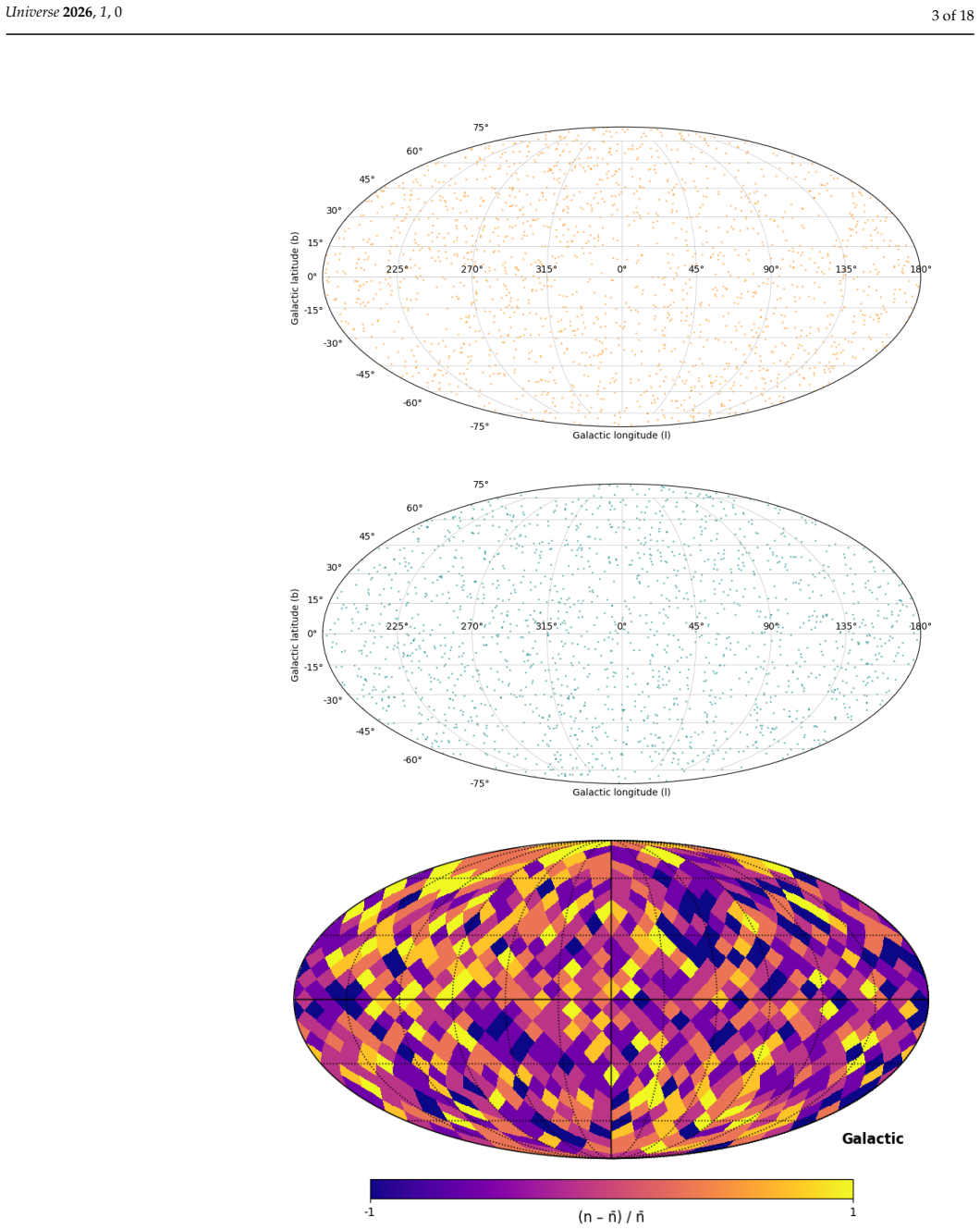
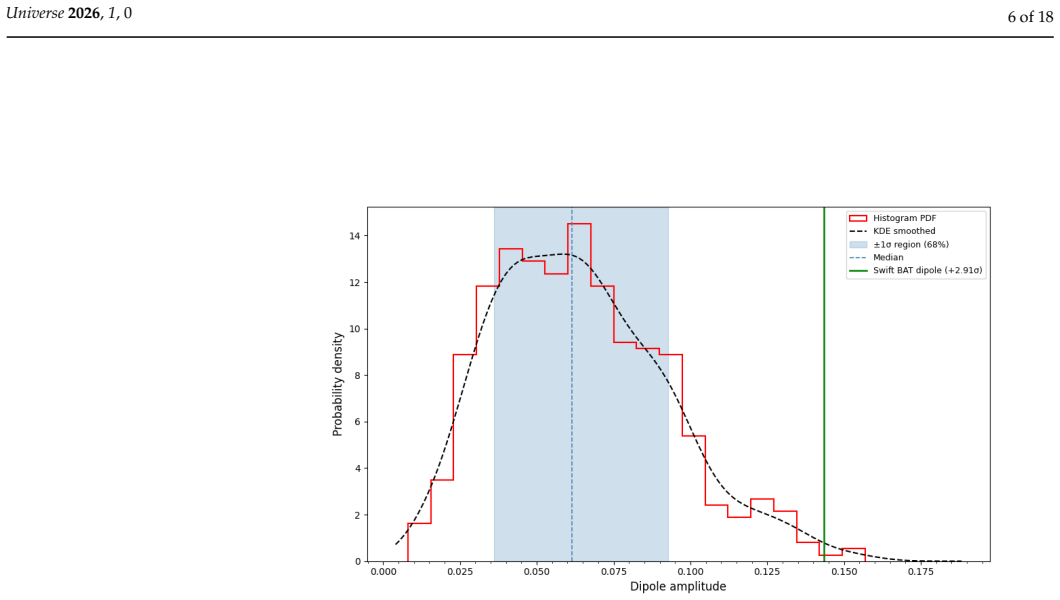
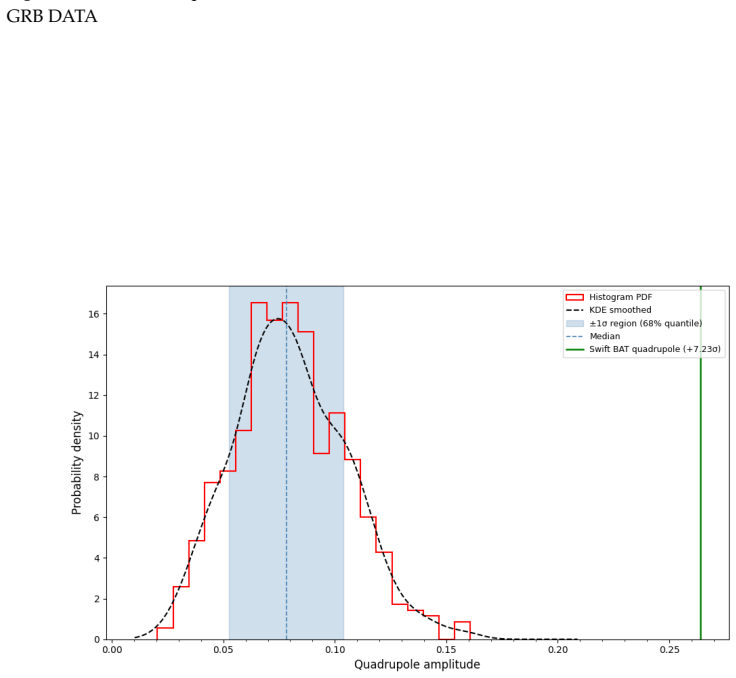
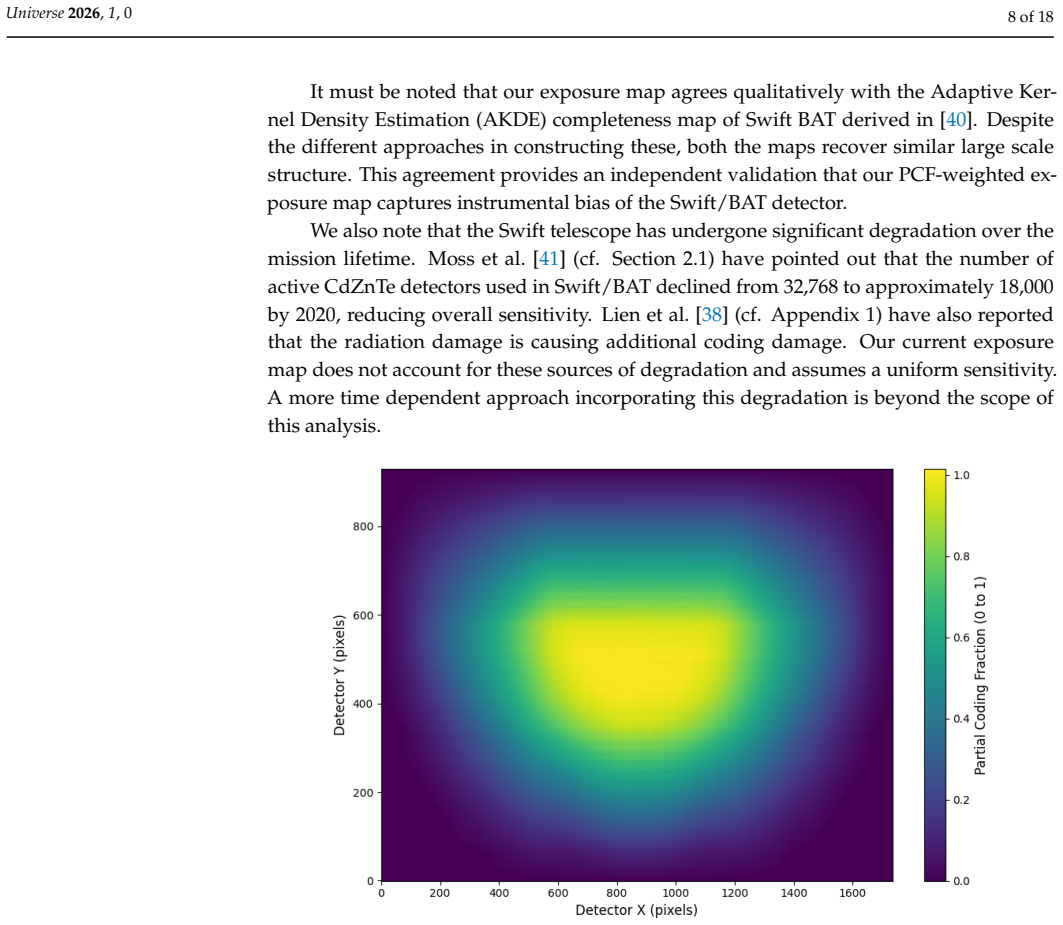
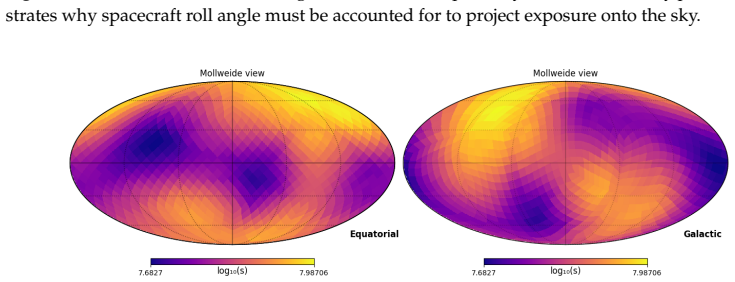
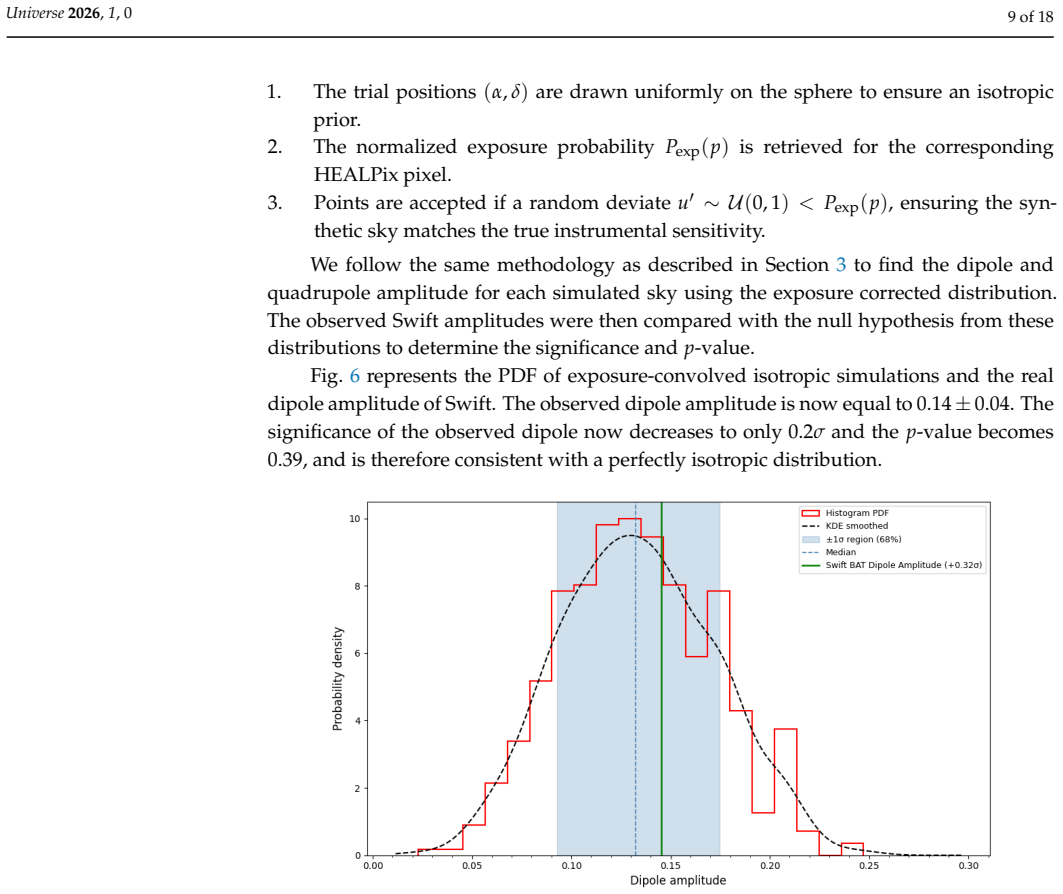
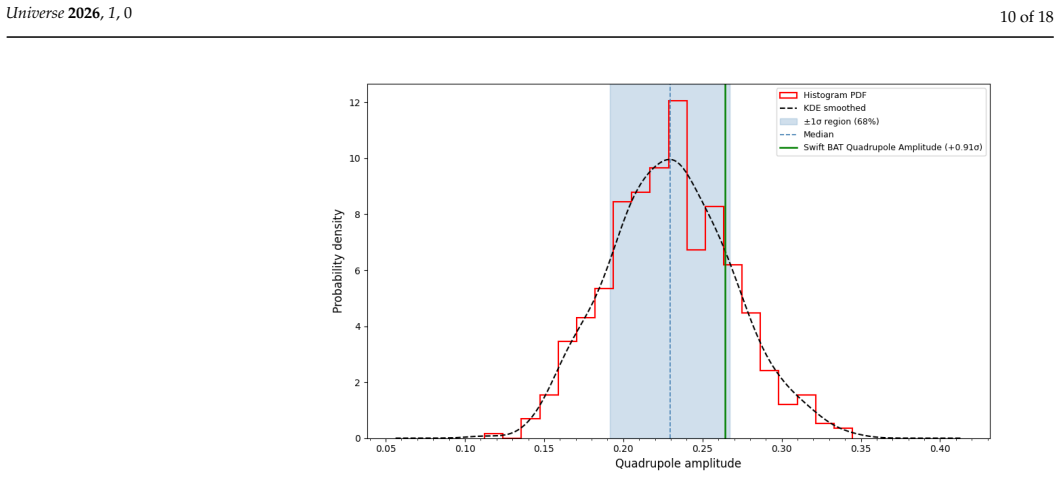
Using the HEALPix spherical harmonic decomposition, we estimate the dipole and quadrupole amplitudes and compare them against the null hypothesis obtained from 500 isotropic Monte Carlo realizations. Our results show 2.9 sigma dipole and 7.2 sigma quadrupole amplitude when applied to the raw data. To account for observational biases, we then create an exposure map using the pointing history, roll angle, and the partial coding fraction of the Swift Telescope. Reevaluating the null hypothesis using this map reduces the significance of these anisotropies to less than 1 sigma. Therefore, our findings confirm statistical isotropy of the GRB sky using the Swift data, consistent with previous studi
What carries the argument
HEALPix spherical harmonic decomposition of GRB directions, tested against 500 Monte Carlo realizations modulated by an exposure map built from Swift pointing history, roll angle, and partial coding fraction.
If this is right
- The GRB sky is statistically isotropic once observational biases are modeled.
- Raw catalogs can produce spurious anisotropy signals if exposure variations are ignored.
- The released exposure map supports future isotropy tests on Swift data.
- These findings align with and reinforce prior GRB isotropy results from other instruments.
Where Pith is reading between the lines
- Exposure-map techniques developed here could be adapted to test isotropy in other transient catalogs such as those from Fermi or future missions.
- If GRBs trace the large-scale matter distribution, their confirmed isotropy places limits on the scale at which homogeneity holds.
- Uniform all-sky coverage in next-generation surveys would reduce reliance on complex exposure corrections for similar tests.
Load-bearing premise
The exposure map derived from pointing history, roll angle, and partial coding fraction fully accounts for all directional selection effects in the observations.
What would settle it
Reanalysis of the same Swift GRB catalog with an independently derived exposure map that recovers dipole or quadrupole amplitudes above 1 sigma would falsify the isotropy conclusion.
Figures
read the original abstract
Testing the validity of the cosmological principle's assumption of large-scale isotropy remains crucial for modern cosmology. We investigate the angular distributions of gamma-ray bursts using the GRB catalog from Neil Gehrels Swift Observatory (Swift) for an independent probe of isotropy. Using the HEALPix spherical harmonic decomposition, we estimate the dipole and quadrupole amplitudes and compare them against the null hypothesis obtained from 500 isotropic Monte Carlo realizations. Our results show 2.9$\sigma$ dipole and 7.2$\sigma$ quadrupole amplitude when applied to the raw data. To account for observational biases, we then create an exposure map using the pointing history, roll angle, and the partial coding fraction of the Swift Telescope. Reevaluating the null hypothesis using this map reduces the significance of these anisotropies to less than $1\sigma$. Therefore, our findings confirm statistical isotropy of the GRB sky using the Swift data, consistent with previous studies. We have also made the Swift exposure map publicly available.
Editorial analysis
A structured set of objections, weighed in public.
Referee Report
Summary. The paper analyzes the angular distribution of Swift GRBs using HEALPix spherical harmonic decomposition to extract dipole and quadrupole amplitudes. Raw data show 2.9σ dipole and 7.2σ quadrupole deviations from isotropy. An exposure map is constructed from pointing history, roll angle, and partial coding fraction; 500 isotropic Monte Carlo realizations re-weighted by this map reduce both amplitudes to <1σ, supporting statistical isotropy of the GRB sky. The exposure map is released publicly.
Significance. If the exposure map is shown to be complete, the result supplies an independent high-redshift test of isotropy using GRBs, reinforcing the cosmological principle at scales probed by these events. The public map release is a concrete asset for the community and enables reproducibility or follow-up analyses.
major comments (2)
- [Methods (exposure map)] Exposure map construction (Methods section): The reduction of significances from 2.9σ/7.2σ to <1σ rests entirely on the Monte Carlo null distribution generated with the exposure map. The manuscript provides no explicit validation (e.g., comparison of the map against the observed GRB sky density or an external catalog) that all directional selection effects are captured; any unmodeled bias would invalidate the corrected null hypothesis.
- [Results] Monte Carlo procedure (Results section): With only 500 realizations, the precision of the tail probabilities used to assign <1σ significance is limited; the paper should report the exact percentile ranks or bootstrap uncertainties on the amplitude distributions to substantiate the isotropy conclusion.
minor comments (2)
- [Abstract] The abstract states the raw-data significances but does not quote the numerical amplitude values (A_dipole, A_quadrupole); these should be added for quantitative comparison with prior work.
- [Methods] Notation for the HEALPix multipole amplitudes should be defined explicitly (e.g., relation to a_{1m} or a_{2m} coefficients) to avoid ambiguity when readers compare with other spherical-harmonic analyses.
Simulated Author's Rebuttal
We thank the referee for the careful and constructive review. We address each major comment below and have revised the manuscript to incorporate the requested improvements.
read point-by-point responses
-
Referee: [Methods (exposure map)] Exposure map construction (Methods section): The reduction of significances from 2.9σ/7.2σ to <1σ rests entirely on the Monte Carlo null distribution generated with the exposure map. The manuscript provides no explicit validation (e.g., comparison of the map against the observed GRB sky density or an external catalog) that all directional selection effects are captured; any unmodeled bias would invalidate the corrected null hypothesis.
Authors: We agree that explicit validation of the exposure map is necessary to confirm that all relevant directional selection effects have been captured. In the revised manuscript we will add a direct comparison of the exposure map against the observed GRB sky density (e.g., a sky map overlay and a quantitative correlation test) to demonstrate consistency with the data-driven selection function. revision: yes
-
Referee: [Results] Monte Carlo procedure (Results section): With only 500 realizations, the precision of the tail probabilities used to assign <1σ significance is limited; the paper should report the exact percentile ranks or bootstrap uncertainties on the amplitude distributions to substantiate the isotropy conclusion.
Authors: We acknowledge that 500 realizations limit the precision of tail probabilities. In the revised manuscript we will report the exact percentile ranks of the observed dipole and quadrupole amplitudes within the Monte Carlo distributions and, where appropriate, include bootstrap uncertainties on those ranks. revision: yes
Circularity Check
No circularity; isotropy test uses independent exposure map and MC null
full rationale
The derivation computes raw dipole/quadrupole amplitudes on the GRB catalog, then generates a null distribution from 500 isotropic Monte Carlo realizations modulated by an exposure map constructed from pointing history, roll angle, and partial coding fraction. This map is an external observational input, not fitted to the anisotropy statistics or defined in terms of the target amplitudes. The drop from 2.9σ/7.2σ to <1σ is a direct statistical comparison, not a reduction by construction. No self-citations, ansatzes, or uniqueness theorems are invoked as load-bearing steps. The test is self-contained against the MC benchmark.
Axiom & Free-Parameter Ledger
axioms (2)
- standard math HEALPix decomposition accurately measures dipole and quadrupole amplitudes from directional data
- domain assumption Monte Carlo realizations generated with the exposure map represent the correct null distribution for isotropy
Reference graph
Works this paper leans on
-
[1]
The physics of gamma-ray bursts ; Cambridge University Press, 2018
Zhang, B. The physics of gamma-ray bursts ; Cambridge University Press, 2018. https://doi.org/10.1017/9781139047241
-
[2]
Identifica- tion of two classes of gamma-ray bursts
Kouveliotou, C.; Meegan, C.A.; Fishman, G.J.; Bhat, N.P .; Briggs, M.S.; Koshut, T.M.; Paciesas, W.S.; Pendleton, G.N. Identifica- tion of two classes of gamma-ray bursts. Astrophys. J. Lett. 1993, 413, L101–L104. https://doi.org/10.1086/186969
-
[3]
The Supernova -- Gamma-Ray Burst Connection
Woosley, S.E.; Bloom, J.S. The supernova–gamma-ray burst connection. Annu. Rev. Astron. Astrophys. 2006, 44, 507–556, [astro-ph/0609142]. https://doi.org/10.1146/annurev .astro.43.072103.150558
work page internal anchor Pith review Pith/arXiv arXiv doi:10.1146/annurev 2006
-
[4]
Nakar, E. Short-hard gamma-ray bursts. Phys. Rep. 2007, 442, 166–236, [astro-ph/0701748]. https://doi.org/10.1016/j.physrep. 2007.02.005
work page internal anchor Pith review Pith/arXiv arXiv doi:10.1016/j.physrep 2007
-
[5]
A lanthanide-rich kilonova in the aftermath of a long gamma-ray burst
Yang, Y .H.; Troja, E.; O’Connor, B.; Fryer, C.L.; Im, M.; Durbak, J.; Paek, G.S.H.; Ricci, R.; Bom, C.R.; Gillanders, J.H.; et al. A lanthanide-rich kilonova in the aftermath of a long gamma-ray burst. Nature 2024, 626, 742–745, [arXiv:astro-ph.HE/2308.00638]. https://doi.org/10.1038/s41586-023-06979-5
-
[6]
Cosmology; Oxford University Press, 2008
Weinberg, S. Cosmology; Oxford University Press, 2008
2008
-
[7]
A measurement of excess antenna temperature at 4080 Mc/s
Penzias, A.A.; Wilson, R.W. A measurement of excess antenna temperature at 4080 Mc/s. Astrophys. J. 1965, 142, 419–421. https://doi.org/10.1086/148307
-
[8]
Structure in the COBE differential microwave radiometer first-year maps
Smoot, G.F.; Bennett, C.L.; Kogut, A.; et al. Structure in the COBE differential microwave radiometer first-year maps. Astrophys. J. Lett. 1992, 396, L1. https://doi.org/10.1086/186504
-
[9]
Detection of the velocity dipole in the radio galaxies of the NRAO VLA Sky Survey
Blake, C.; Wall, J. A velocity dipole in the distribution of radio galaxies. Nature 2002, 416, 150–152, [astro-ph/0203385]. https: //doi.org/10.1038/416150a
work page internal anchor Pith review Pith/arXiv arXiv doi:10.1038/416150a 2002
-
[10]
Probing cosmological isotropy with Planck Sunyaev-Zeldovich galaxy clusters
Bengaly, C.A.P .; Bernui, A.; Ferreira, I.S.; Alcaniz, J.S. Probing cosmological isotropy with Planck Sunyaev-Zeldovich galaxy clusters. MNRAS 2017, 466, 2799–2804, [arXiv:astro-ph.CO/1511.09414]. https://doi.org/10.1093/mnras/stw3233
work page internal anchor Pith review Pith/arXiv arXiv doi:10.1093/mnras/stw3233 2017
-
[11]
New Evidence for the Dynamical Decay of a Multiple System in the Orion Kleinmann-Low Nebula
Pandey, B. Testing isotropy in the two micron all-sky redshift survey with information entropy. Mon. Not. R. Astron. Soc. 2017, 468, 1953–1961, [1703.05159]. https://doi.org/10.1093/mnras/stx692
work page internal anchor Pith review Pith/arXiv arXiv doi:10.1093/mnras/stx692 2017
-
[12]
Testing isotropy in the universe using photometric and spectroscopic data from the SDSS
Sarkar, S.; Pandey, B.; Khatri, R. Testing isotropy in the universe using photometric and spectroscopic data from the SDSS. Mon. Not. R. Astron. Soc. 2019, 483, 2453–2464, [1810.03315]. https://doi.org/10.1093/mnras/sty3282
-
[13]
Probing cosmic isotropy in the local universe
Franco, C.; Avila, F.; Bernui, A. Probing cosmic isotropy in the local universe. Mon. Not. R. Astron. Soc. 2024, 527, 7400–7413, [2311.12798]. https://doi.org/10.1093/mnras/stad3496
-
[14]
A test of the cosmological principle with quasars
Secrest, N.J.; von Hausegger, S.; Rameez, M.; Mohayaee, R.; Sarkar, S.; Colin, J. A test of the cosmological principle with quasars. Astrophys. J. Lett. 2021, 908, L51, [2009.14826]. https://doi.org/10.3847/2041-8213/abdd40
-
[15]
A challenge to the standard cosmological model
Secrest, N.; von Hausegger, S.; Rameez, M.; Mohayaee, R.; Sarkar, S. A challenge to the standard cosmological model. arXiv e-prints 2022, [2206.05624]
arXiv 2022
-
[16]
A study of dipolar signal in distant quasars with various observables
Kothari, R.; Panwar, M.; Singh, G.; Tiwari, P .; Jain, P . A study of dipolar signal in distant quasars with various observables. Eur. Phys. J. C 2024, 84, 75, [2310.13329]. https://doi.org/10.1140/epjc/s10052-024-12401-y
-
[17]
Evidence for a ~300 Mpc Scale Under-density in the Local Galaxy Distribution
Keenan, R.C.; Barger, A.J.; Cowie, L.L. Evidence for a ∼300 megaparsec scale under-density in the local galaxy distribution. Astrophys. J. 2013, 775, 62, [1304.2884]. https://doi.org/10.1088/0004-637X/775/1/62
work page internal anchor Pith review Pith/arXiv arXiv doi:10.1088/0004-637x/775/1/62 2013
-
[18]
Haslbauer, M.; Banik, I.; Kroupa, P . The KBC void and Hubble tension contradict ΛCDM on a Gpc scalemilgromian dynamics as a possible solution. Mon. Not. R. Astron. Soc. 2020, 499, 2845–2883, [2009.11292]. https://doi.org/10.1093/mnras/staa2348
-
[20]
Gamma-ray bursts as cosmological probes
Ghirlanda, G.; Ghisellini, G.; Firmani, C. Gamma-ray bursts as cosmological probes. New J. Phys. 2006, 8, 123, [astro- ph/0607573]. https://doi.org/10.1088/1367-2630/8/7/123
-
[21]
Spatial distribution of gamma-ray bursts
Meegan, C.A.; Fishman, G.J.; Wilson, R.B.; Paciesas, W.S.; Pendleton, G.N.; Horack, J.M.; Brock, M.N.; Kouveliotou, C. Spatial distribution of gamma-ray bursts. Nature 1992, 355, 143–145. https://doi.org/10.1038/355143a0
-
[22]
BATSE observations of the large-scale isotropy of gamma-ray bursts
Briggs, M.S.; Paciesas, W.S.; Pendleton, G.N.; Meegan, C.A.; Fishman, G.J.; Horack, J.M.; Brock, M.N.; Kouveliotou, C.; Hart- mann, D.H.; Hakkila, J. BATSE observations of the large-scale isotropy of gamma-ray bursts. Astrophys. J. 1996, 459, 40. https://doi.org/10.1086/176865
-
[23]
Noise induced phenomena in point Josephson junctions
Vavrek, R.; Balázs, L.G.; Mészáros, A.; Horváth, I.; Bagoly, Z. Testing the randomness in the sky-distribution of gamma-ray bursts. Mon. Not. R. Astron. Soc. 2008, 391, 1741–1748, [0810.1654]. https://doi.org/10.1111/j.1365-2966.2008.14022.x
work page internal anchor Pith review Pith/arXiv arXiv doi:10.1111/j.1365-2966.2008.14022.x 2008
-
[24]
Tarnopolski, M. Testing the anisotropy in the angular distribution of Fermi/GBM gamma-ray bursts. Mon. Not. R. Astron. Soc. 2017, 472, 4819–4831, [1704.08418]. https://doi.org/10.1093/mnras/stx2356
work page internal anchor Pith review Pith/arXiv arXiv doi:10.1093/mnras/stx2356 2017
-
[25]
Some statistical remarks on the Giant GRB Ring
Balázs, L.G.; Rejt˝ o, L.; Tusnády, G. Some statistical remarks on the giant GRB ring.Mon. Not. R. Astron. Soc. 2018, 473, 3169–3179, [1710.01621]. https://doi.org/10.1093/mnras/stx2550
work page internal anchor Pith review Pith/arXiv arXiv doi:10.1093/mnras/stx2550 2018
-
[26]
Mapping the Universe with gamma-ray bursts
Horváth, I.; Bagoly, Z.; Balázs, L.G.; Hakkila, J.; Horváth, Z.; Joó, A.P .; Pintér, S.; Tóth, L.V .; V eres, P .; Rácz, I.I. Mapping the Universe with gamma-ray bursts. Mon. Not. R. Astron. Soc. 2024, 527, 7191–7202, [2312.10050]. https://doi.org/10.1093/ mnras/stad3669. https://doi.org/10.3390/universe1010000 Universe 2026, 1, 0 18 of 18
-
[27]
Revisiting the statistical isotropy of GRB sky distribution
Andrade, U.; Bengaly, C.A.P .; Alcaniz, J.S.; Capozziello, S. Revisiting the statistical isotropy of GRB sky distribution. Mon. Not. R. Astron. Soc. 2019, 490, 4481–4488, [1905.08864]. https://doi.org/10.1093/mnras/stz2828
-
[28]
Testing Isotropic Universe Using the Gamma-Ray Burst Data of Fermi / GBM
ˇRípa, J.; Shafieloo, A. Testing the Isotropic Universe Using the Gamma-Ray Burst Data of Fermi/GBM. ApJ 2017, 851, 15, [arXiv:astro-ph.HE/1706.03556]. https://doi.org/10.3847/1538-4357/aa9708
work page internal anchor Pith review Pith/arXiv arXiv doi:10.3847/1538-4357/aa9708 2017
-
[29]
Update on Testing the Isotropy of the Properties of Gamma-Ray Bursts
ˇRípa, J.; Shafieloo, A. Update on testing the isotropy of the properties of gamma-ray bursts. MNRAS 2019, 486, 3027–3040, [arXiv:astro-ph.HE/1809.03973]. https://doi.org/10.1093/mnras/stz921
work page internal anchor Pith review Pith/arXiv arXiv doi:10.1093/mnras/stz921 2019
-
[30]
Reanalysing large-scale structure using an updated gamma-ray burst spatial density approach
Horvath, I.; Bagoly, Z.; Hakkila, J.; Balazs, L.G.; Horvath, J.; Pinter, S.; Racz, I.I.; V eres, P .; Toth, L.V . Reanalysing large-scale structure using an updated gamma-ray burst spatial density approach. arXiv e-prints 2026, p. arXiv:2604.13712, [arXiv:astro- ph.CO/2604.13712]. https://doi.org/10.48550/arXiv .2604.13712
work page internal anchor Pith review Pith/arXiv arXiv doi:10.48550/arxiv 2026
-
[31]
Mondal, D.; Pandey, B.; Mondal, A. Probing cosmic isotropy with Gamma-ray bursts: A dipole and quadrupole analysis of BATSE and Fermi GBM data. J. High Energy Astrophys. 2026, 51, 100549, [arXiv:astro-ph.HE/2510.27644]. https://doi.org/10.1 016/j.jheap.2026.100549
arXiv 2026
-
[32]
The Third Swift Burst Alert Telescope Gamma-Ray Burst Catalog
Lien, A.; Sakamoto, T.; Barthelmy, S.D.; Baumgartner, W.H.; Cannizzo, J.K.; Chen, K.; Collins, R.S.; Cummings, J.R.; Gehrels, N.; Krimm, H.A.; et al. The third Swift Burst Alert Telescope gamma-ray burst catalog. Astrophys. J. 2016, 829, 7, [1606.01956]. https://doi.org/10.3847/0004-637X/829/1/7
work page internal anchor Pith review Pith/arXiv arXiv doi:10.3847/0004-637x/829/1/7 2016
-
[33]
The Swift Gamma-Ray Burst Mission
Gehrels, N.; Chincarini, G.; Giommi, P .; Mason, K.O.; Nousek, J.A.; Wells, A.A.; White, N.E.; Barthelmy, S.D.; Burrows, D.N.; Cominsky, L.R.; et al. The Swift gamma-ray burst mission. Astrophys. J. 2004, 611, 1005–1020, [astro-ph/0405233]. https: //doi.org/10.1086/422091
work page internal anchor Pith review Pith/arXiv arXiv doi:10.1086/422091 2004
-
[34]
Górski, K.M.; Hivon, E.; Banday, A.J.; Wandelt, B.D.; Hansen, F.K.; Reinecke, M.; Bartelmann, M. HEALPix: A Framework for High-Resolution Discretization and Fast Analysis of Data Distributed on the Sphere. ApJ 2005, 622, 759–771, [arXiv:astro- ph/astro-ph/0409513]. https://doi.org/10.1086/427976
work page internal anchor Pith review Pith/arXiv arXiv doi:10.1086/427976 2005
-
[35]
healpy: equal area pixelization and spherical harmonics transforms for data on the sphere in Python
Zonca, A.; Singer, L.; Lenz, D.; Reinecke, M.; Rosset, C.; Hivon, E.; Górski, K.M. healpy: equal area pixelization and spherical harmonics transforms for data on the sphere in Python. J. Open Source Softw. 2019, 4, 1298. https://doi.org/10.21105/joss.01298
-
[36]
Density estimation for statistics and data analysis ; V ol
Silverman, B.W. Density estimation for statistics and data analysis ; V ol. 26, CRC press, 1986
1986
-
[37]
Asymptotic formulae for likelihood-based tests of new physics
Cowan, G.; Cranmer, K.; Gross, E.; Vitells, O. Asymptotic formulae for likelihood-based tests of new physics. European Physical Journal C 2011, 71, 1554, [arXiv:physics.data-an/1007.1727]. https://doi.org/10.1140/epjc/s10052-011-1554-0
work page internal anchor Pith review Pith/arXiv arXiv doi:10.1140/epjc/s10052-011-1554-0 2011
-
[38]
The 157 Month Swift/BAT All-sky Hard X-Ray Survey
Lien, A.Y .; Krimm, H.A.; Markwardt, C.B.; Oh, K.; Marcotulli, L.; Mushotzky, R.; Collins, N.R.; Barthelmy, S.D.; Baumgart- ner, W.H.; Cenko, S.B.; et al. The 157 Month Swift/BAT All-sky Hard X-Ray Survey . ApJ 2025, 989, 161, [arXiv:astro- ph.HE/2506.04109]. https://doi.org/10.3847/1538-4357/ade676
-
[39]
Representations of world coordinates in FITS
Greisen, E.W.; Calabretta, M.R. Representations of world coordinates in FITS. Astronomy & Astrophysics 2002, 395, 1061–1075, [arXiv:astro-ph/astro-ph/0207407]. https://doi.org/10.1051/0004-6361:20021326
work page internal anchor Pith review Pith/arXiv arXiv doi:10.1051/0004-6361:20021326 2002
-
[40]
Recovering Gamma-Ray Burst Redshift Completeness Maps via Spherical Generalized Additive Models
Bagoly, Z.; Rácz, I.I. Recovering Gamma-Ray Burst Redshift Completeness Maps via Spherical Generalized Additive Models. Universe 2026, 12, 31. https://doi.org/10.3390/universe12020031
-
[41]
Instrumental Tip-of-the-iceberg Effects on the Prompt Emission of Swift/BAT Gamma-ray Bursts
Moss, M.; Lien, A.; Guiriec, S.; Cenko, S.B.; Sakamoto, T. Instrumental Tip-of-the-iceberg Effects on the Prompt Emission of Swift/BAT Gamma-ray Bursts. ApJ 2022, 927, 157, [arXiv:astro-ph.HE/2111.13392]. https://doi.org/10.3847/1538-4357/ac497 3
-
[42]
Evidence for anisotropy in the distribution of short-lived gamma-ray bursts
Magliocchetti, M.; Ghirlanda, G.; Celotti, A. Evidence for anisotropy in the distribution of short-lived gamma-ray bursts. MN- RAS 2003, 343, 255–258, [arXiv:astro-ph/astro-ph/0302009]. https://doi.org/10.1046/j.1365-8711.2003.06657.x. https://doi.org/10.3390/universe1010000
work page internal anchor Pith review Pith/arXiv arXiv doi:10.1046/j.1365-8711.2003.06657.x 2003
discussion (0)
Sign in with ORCID, Apple, or X to comment. Anyone can read and Pith papers without signing in.