REVIEW 2 major objections 6 minor 28 references
Modular system for fluorescence-based single photon generation using retro-reflector
T0 review · 2 major / 6 minor · reviewed 2026-08-14 · deepseek-v4-flash
Pith's one-line read A retroreflector-based self-test makes single-photon sources stable over an hour
desk verdict The modular retroreflector-based self-test architecture is a genuine, reimplementable engineering advance, but the 0.07% stability headline is not verifiable as written and needs a documented shot-noise treatment. read the letter →
The pith
A machine-rendered reading of the paper's core claim, the machinery that carries it, and where it could break.
The reading
What carries the argument
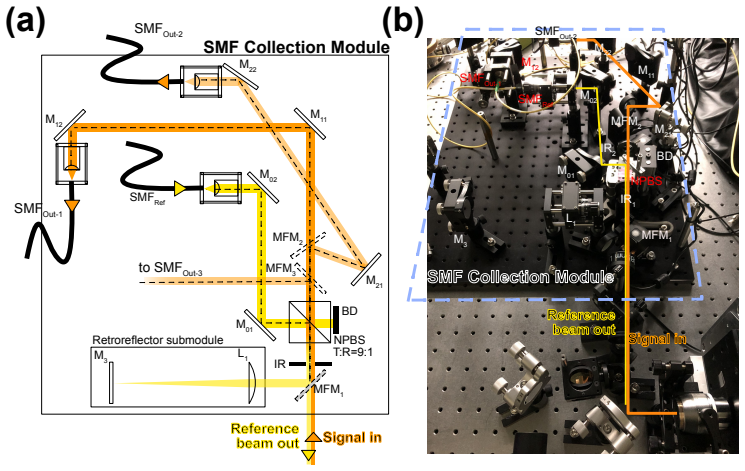
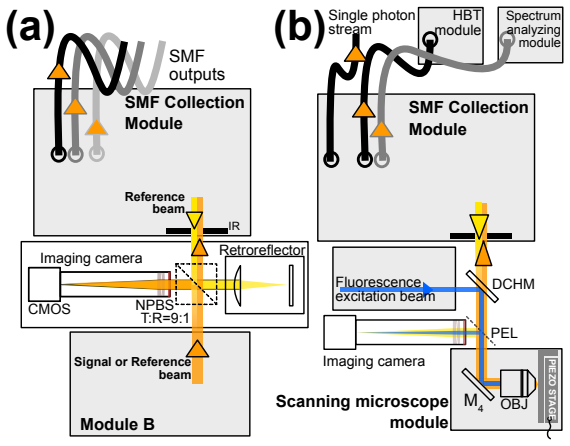
The central mechanism is the retroreflector-based self-test inside the single-mode-fiber collection module. A plano-convex lens and a mirror form a retroreflector that returns a reference beam along the path a fluorescence signal will take; when the reference is optimally coupled to the single-mode fiber, the module's alignment is memorized. Between modules, the same reference-beam idea works: each module emits a reference beam, and an imaging camera checks that the two spots coincide in angle and position, making the free-space connection a visual alignment task rather than an iterative search. The reference beam approximates the signal as a Gaussian mode matched to the fiber's fundamental mode, which is what makes the self-test meaningful and also what limits collection of dipole radiation.
What would settle it
Place a single hBN defect with known dipole orientation at the focus, run the retroreflector self-test, then scan the collection mirrors around the recorded optimum while monitoring fluorescence counts; if the count-rate maximum sits at a different mirror position than the reference-beam maximum, or if rotating the dipole shifts the optimum, the central emulation assumption is false.
Extended reading notes
Core claim
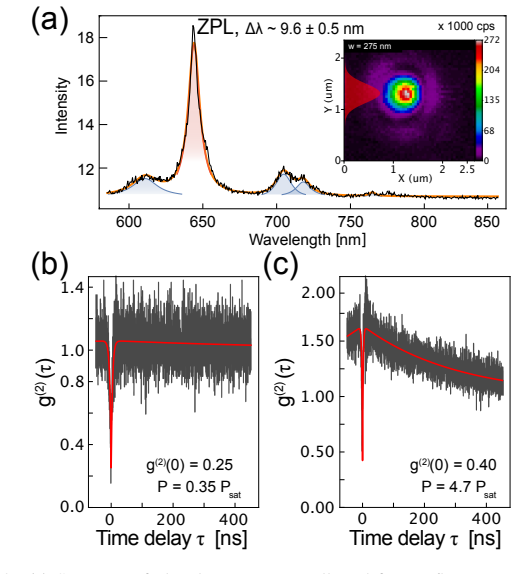
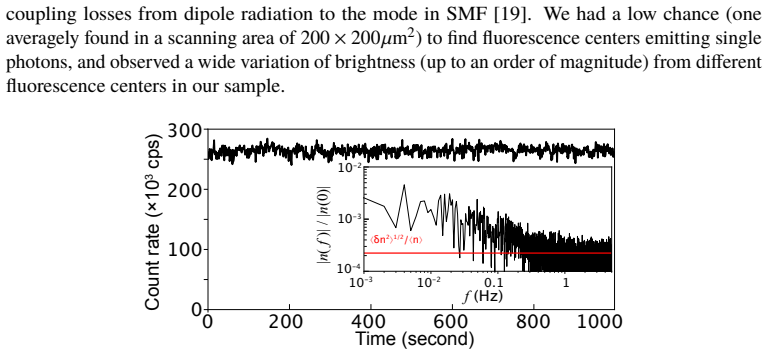
The central discovery is procedural: an optical system for single-photon generation can be modularized so that each module is optimized and validated against its own internal reference beam, and the modules can then be linked by aligning those reference beams to each other. The key demonstration uses a retroreflector inside the single-mode-fiber collection module to create a reference beam that retraces the signal path; after self-test, the reference is released and used to connect the microscope module, so no global alignment search is needed. The resulting instrument produced antibunched light from an hBN defect (g2(0)=0.25 at 0.35 Psat; 0.4 at 4.7 Psat), with maximum count rate $3x10^{5}$ counts per second and 0.07% rms count-rate fluctuation over 1000 seconds, stable to the eye over one hour. The authors present this as evidence that their modular architecture supports the count-rate stability required for quantum radiometry.
Load-bearing premise
The load-bearing premise is that a Gaussian reference beam bounced off a retroreflector emulates the real fluorescence signal well enough that optimizing the reference into the single-mode fiber also maximizes signal collection; the authors note that dipole radiation includes non-Gaussian modes that couple poorly to the fiber, so this emulation is an approximation.
Editorial extensions
If this is right
- A single-photon source built this way can be disassembled, moved, or reconnected without re-aligning the whole optical train; each module's self-test restores its own optimum.
- The 0.07% rms count-rate stability over 1000 seconds and hour-scale endurance are in the range needed for absolute single-photon radiometry, the application the authors explicitly identify.
- Because module interfaces are standardized as reference beams, additional single-mode-fiber outputs or characterization modules such as HBT and spectrometer can be appended by aligning one reference beam, which is the scalability claim of the design.
- The measured g2(0)=0.25 indicates a stream dominated by single photons, with the residual attributed to background or noise photons; at high excitation the rise to g2(0)=0.4 reflects dark-state shelving but remains in the single-photon-dominant regime.
Reading between the lines
- The same retroreflector self-test idea should extend to any fluorescence-based emitter whose emission can be approximated by the fiber mode, not just hBN; testing it with quantum dots or other color centers would separate the architecture's benefit from the emitter's intrinsic brightness.
- The paper's own admission that dipole radiation contains non-Gaussian components suggests a testable refinement: using few-mode fiber or antenna/cavity structures at the sample could improve collection efficiency while keeping the modular alignment scheme intact.
- Because the reference beam and signal share the same free-space path, drifts in module temperature or mechanical creep that alter that path could be detected live by monitoring reference-beam coupling, turning the self-test into a continuous alignment monitor.
- The measured stability was achieved with controlled humidity and temperature and vibration-isolated components; reproducing the same 0.07% rms without those controls would be a stronger claim, and the paper does not make it.
Signed reviews
Editorial analysis
A structured set of objections, weighed in public.
Referee Report
Summary. The paper presents a modular confocal microscope system for fluorescence-based single-photon generation. Each module is aligned and tested independently using a retro-reflector-based reference beam, and modules are connected in free space by matching reference beams on an imaging camera. The authors demonstrate the system with an hBN nano-flake emitter, reporting g2(0)=0.25 at 0.35 Psat and 0.40±0.03 at 4.7 Psat, a maximum total count rate of 3×10^5 cps, and a 0.07% rms count-rate fluctuation over 1000 s, with no noticeable change over one hour. They argue that this stability makes the modular system suitable for quantum radiometry.
Significance. If the claims are substantiated, the modular architecture with a built-in self-test and switchable fiber outputs is a practical contribution to single-photon-source packaging and distribution. The paper includes the standard g2 characterization, reports a concrete stability metric, and explicitly discloses a key limitation in Sec. 5: non-Gaussian dipole modes couple poorly to single-mode fiber. However, the headline stability figure is not reproducible from the information given, and the reference-beam emulation is acknowledged to be an approximation. These issues leave the central stability and modularity claims only partially supported, despite the overall plausibility of the demonstration.
major comments (2)
- [Sec. 4, Fig. 5] The reported 0.07% rms count-rate fluctuation is below the Poisson shot-noise floor for raw 1-s photon counting at any rate consistent with the stated detector count rates. For the maximum rate of 3×10^5 cps, the shot-noise floor is 1/sqrt(3×10^5) ≈ 0.18%, and at the 'moderate' rate used for the stability trace the floor is larger. The text says the original data were acquired at 100 Hz and 'reproduced in Fourier domain' but it does not state the effective integration time, whether the trace was smoothed, or whether shot noise was subtracted. As written, the 0.07% number cannot be computed from the raw counts, and the claim that the system is stable at the level suitable for quantum radiometry is not verifiable. Please specify the binning and filtering, report the mean count rate for the trace, and provide the raw (or minimally processed) time series with an explicit shot-noise comparison.
- [Sec. 3 and Sec. 5] The self-test procedure uses a Gaussian reference beam reflected by a retroreflector to emulate the fluorescence signal, but the paper itself states in Sec. 5 that dipole radiation contains non-Gaussian and higher-order modes that couple poorly to the single-mode fiber, and in Sec. 3 that the real point-dipole coupling efficiency 'will be smaller' than the mirror-based estimate. Therefore the modular self-test cannot be claimed to verify the optimized collection of the actual signal beam; it verifies only the Gaussian-mode-compatible component. The manuscript should quantify this difference, for example by measuring the fluorescence-to-SMF collection efficiency of a known emitter and comparing it with the reference-beam coupling efficiency, or by explicitly limiting the modularity claim to Gaussian-mode compatibility.
minor comments (6)
- [Sec. 2] The statement that coupling efficiencies into the three SMFs were 'measured to be > 80% in most cases' lacks measurement methodology; please state the number of measurements, the power-ratio method, and the uncertainty.
- [Sec. 4] The 'moderate' count rate used for the stability trace is not specified; without the mean rate, the stability number cannot be interpreted against shot noise. Please include the average count rate in the figure or text.
- [Fig. 5 inset] The inset axes are unlabeled, and 'reproduced in Fourier domain' is not a standard description of data processing. Please provide the processing recipe and label all axes, including the normalization of |n(f)|/|n(0)|.
- [Fig. 4(b,c)] The g2(0) values for the two excitation conditions are not accompanied by a fitting model or uncertainties (only 0.40±0.03 is given). Please state the fit function, normalization procedure, and uncertainty for both values.
- [Sec. 4] The statement that the observed stability is 'acceptable compared to monolithic designs with no modularization' is asserted without a measured baseline or a quantitative comparison. Either provide such a comparison or temper the claim.
- [General] The affiliation line contains a typo ('Reasearch' instead of 'Research'), and the text 'out of the photo range in (b), and shorten in (a)' near Fig. 2 is unclear and should be rephrased.
Circularity Check
No circularity: the modular self-test is an alignment procedure, not a derivation, and the central single-photon and stability claims are direct measurements.
full rationale
The paper's central claims are experimental demonstrations: g(2)(0) values of 0.25 and 0.40, a maximum count rate of 3 x 10^5 cps, and a 0.07% rms count-rate fluctuation over 1000 s. These are measured outputs using standard definitions of single-photon purity and stability, not quantities derived from fitted parameters or from the modular-alignment concept itself. The retroreflector-based self-test is an engineering alignment procedure: a reference beam is coupled into the SMF, and the resulting alignment is used to guide the signal beam. This is an assumption that the reference beam adequately emulates the signal beam, and the authors explicitly acknowledge its limitation in Sec. 5: 'Non-Gaussian and higher order modes inevitably occur for dipole radiation, and they are not suitably coupled to SMF.' The success of the system is not defined circularly by the reference-beam coupling; it is verified by independent measurements of the actual fluorescence signal. The PSF waist fit (275 nm) is a characterization of the emitter, not a fitted input used to produce the g(2) or stability results. The only apparent self-citation is Ref. [26], involving co-author H.-J. Lim, used for the interpretation of noise-photon fraction in g(2)(0); this is not load-bearing. The possible concern that the 0.07% stability figure may lie below the Poisson shot-noise floor is a question of data processing documentation and verifiability, not circularity, and cannot be assessed as a reduction of the claim to its inputs. Overall, the derivation chain is self-contained against direct measurements, and no circular step is present.
Assumptions & free parameters
assumptions (3)
- domain assumption Reference beam reflected by the retroreflector behaves like the fluorescence signal beam after propagating through the same optics.
- domain assumption The objective lens and flat sample act as a retroreflector for the reference beam, so aiming the reflected beam through the iris compensates the objective's tilt and displacement.
- domain assumption Fluorescence defects in hBN are single-photon emitters identified by the g2(0) dip below 0.5.
Cite this review
Pith. "Pith review of Modular system for fluorescence-based single photon generation using retro-reflector." pith.science (2026). https://pith.science/paper/T44LI7RH
@misc{pith2026190801468,
  author       = {Pith},
  title        = {Pith review of: Modular system for fluorescence-based single photon generation using retro-reflector},
  year         = {2026},
  howpublished = {\url{https://pith.science/paper/T44LI7RH}},
  note         = {Machine review of arXiv:1908.01468}
}
read the original abstract
Apparatus for fluorescence-based single photon generation includes collection optics and various setups for characterization. Managing this system often reveals complexity in such a way that adjusting in a small region changes optimal alignments of others. We suggest here a modular system, where the optimal alignment is given to each compartment and tested independently. Based on this concept, we built a system for single photon generation with fluorescence center in hexagonal boron nitride nano-flake, advantageous for scaling up the number of single mode fiber output and a high degree of stability. The system allowed for a practical use of single photon stream extended over an hour with a uniform count rate of small fluctuation levels.
Figures

Figures from the paper (2 more)
Reference graph
Works this paper leans on
-
[1]
E. Neu, D. Steinmetz, J. Riedrich-Möller, S. Gsell, M. Fischer, M. Schreck, and C. Becher, “Single photon emission from silicon-vacancy colour centres in chemical vapour deposition nano-diamonds on iridium,” New J. Phys.13, 025012 (2011)
work page 2011
-
[2]
Single photon emission from ZnO nanoparticles,
S. Choi, B. C. Johnson, S. Castelletto, C. Ton-That, M. R. Phillips, and I. Aharonovich, “Single photon emission from ZnO nanoparticles,” Appl. Phys. Lett.104, 261101 (2014)
work page 2014
-
[3]
Robust Multicolor Single Photon Emission from Point Defects in Hexagonal Boron Nitride,
T. T. Tran, C. Elbadawi, D. Totonjian, C. J. Lobo, G. Grosso, H. Moon, D. R. Englund, M. J. Ford, I. Aharonovich, and M. Toth, “Robust Multicolor Single Photon Emission from Point Defects in Hexagonal Boron Nitride,” ACS Nano 10, 7331–7338 (2016)
work page 2016
-
[4]
A. Reigue, J. Iles-Smith, F. Lux, L. Monniello, M. Bernard, F. Margaillan, A. Lemaitre, A. Martinez, D. P. S. McCutcheon, J. Mørk, R. Hostein, and V. Voliotis, “Probing electron-phonon interaction through two-photon interference in resonantly driven semiconductor quantum dots,” Phys. Rev. Lett.118, 233602 (2017)
work page 2017
-
[5]
Light Scattering from Solid-State Quantum Emitters: Beyond the Atomic Picture
A. J. Brash, J. Iles-Smith, C. L. Phillips, D. P. S. McCutcheon, J. O’Hara, E. Clarke, B. Royall, J. Mørk, M. S. Skolnick, A. M. Fox, and A. Nazir, “Light scattering from solid-state quantum emitters: Beyond the atomic picture,” arXiv:1904.05284 (2019)
work page Pith review arXiv 2019
-
[6]
Coupling loss from free space to large mode area photonic crystal fibers,
N. K. Nahar and R. G. Rojas, “Coupling loss from free space to large mode area photonic crystal fibers,” J. Light. Technol 26, 3669–3676 (2008)
work page 2008
-
[7]
Variational approximations forlpl1 modes of graded-index few-mode fibers,
H. Mohapatra and S. I. Hosain, “Variational approximations forlpl1 modes of graded-index few-mode fibers,” IEEE Photonics Technol. Lett.26, 372–375 (2014)
work page 2014
-
[8]
T.Sakamoto,T.Mori,T.Yamamoto,L.Ma,N.Hanzawa,S.Aozasa,K.Tsujikawa,andS.Tomita,“Transmissionover large-core few-mode photonic crystal fiber using distance-independent modal dispersion compensation technique,” Opt. Express19, B478–B485 (2011)
work page 2011
Show all 28 references
-
[9]
On-Demand Semiconductor Source of Entangled Photons Which Simultaneously Has High Fidelity, Efficiency, and Indistinguishability,
H. Wang, H. Hu, T. H. Chung, J. Qin, X. Yang, J. P. Li, R. Z. Liu, H. S. Zhong, Y. M. He, X. Ding, Y. H. Deng, Q. Dai, Y. H. Huo, S. Höfling, C.-Y. Lu, and J.-W. Pan, “On-Demand Semiconductor Source of Entangled Photons Which Simultaneously Has High Fidelity, Efficiency, and Indi...
2019
-
[10]
Highly-efficient extraction of entangled photons from quantum dots using a broadband optical antenna,
Y. Chen, M. Zopf, R. Keil, F. Ding, and O. G. Schmidt, “Highly-efficient extraction of entangled photons from quantum dots using a broadband optical antenna,” Nat. Commun.9, 2994 (2018)
2018
-
[11]
Nanoassembly of quantum emitters in hexagonal boron nitride and gold nanospheres,
M. Nguyen, S. Kim, T. T. Tran, Z.-Q. Xu, M. Kianinia, M. Toth, and I. Aharonovich, “Nanoassembly of quantum emitters in hexagonal boron nitride and gold nanospheres,” Nanoscale10, 2267–2274 (2018)
2018
-
[12]
Experimental realization of an absolute single-photon source based on a single nitrogen vacancy center in a nanodiamond,
B. Rodiek, M. Lopez, H. Hofer, G. Porrovecchio, M. Smid, X. L. Chu, S. Gotzinger, V. Sandoghdar, S. Lindner, C. Becher, and S. Kuck, “Experimental realization of an absolute single-photon source based on a single nitrogen vacancy center in a nanodiamond,” Optica4, 71–76 (2017)
2017
-
[13]
Quantum emission from hexagonal boron nitride monolayers,
T. T. Tran, K. Bray, M. J. Ford, M. Toth, and I. Aharonovich, “Quantum emission from hexagonal boron nitride monolayers,” Nat. Nanotechnol.11, 37–41 (2016)
2016
-
[14]
Overlap relation between free-space Laguerre Gaussian modes and step-index fiber modes,
R. Brüning, Y. Zhang, M. McLaren, M. Duparré, and A. Forbes, “Overlap relation between free-space Laguerre Gaussian modes and step-index fiber modes,” J. Opt. Soc. Am. A32, 1678–1682 (2015)
2015
-
[15]
Double-pass acousto-optic modulator system,
E. A. Donley, T. P. Heavner, F. Levi, and M. O. Tataw, “Double-pass acousto-optic modulator system,” Rev. Sci. Instrum. 76, 063112 (2005)
2005
-
[16]
Maximum fiber coupling efficiency and optimum beam size in the presence of random angular jitter for free-space laser systems and their applications,
M. Toyoshima, “Maximum fiber coupling efficiency and optimum beam size in the presence of random angular jitter for free-space laser systems and their applications,” J. Opt. Soc. Am. A23, 2246–2250 (2006)
2006
-
[17]
Basic wavefront aberration theory for optical metrology,
J. C. Wyant and K. Creath, “Basic wavefront aberration theory for optical metrology,” inApplied Optics and Optical Engineering, Volume XI,vol. 11 R. R. Shannon and J. C. Wyant, eds. (Academic Press, 1992), chap. 1
1992
-
[18]
Siegman,Lasers(University Science Books, 1986)
A. Siegman,Lasers(University Science Books, 1986)
1986
-
[19]
Numerical optimization of the extraction efficiency of a quantum-dot based single-photon emitter into a single-mode fiber,
P.-I. Schneider, N. Srocka, S. Rodt, L. Zschiedrich, S. Reitzenstein, and S. Burger, “Numerical optimization of the extraction efficiency of a quantum-dot based single-photon emitter into a single-mode fiber,” Opt. Express26, 8479–8492 (2018)
2018
-
[20]
Directmeasurementofquantumefficiencyofsingle-photonemittersinhexagonalboronnitride,
N. Nikolay, N. Mendelson, E. Özelci, B. Sontheimer, F. Böhm, G. Kewes, M. Toth, I. Aharonovich, and O. Benson, “Directmeasurementofquantumefficiencyofsingle-photonemittersinhexagonalboronnitride,”Optica 6,1084–1088 (2019)
2019
-
[21]
Novotny and B
L. Novotny and B. Hecht,Principles of Nano-Optics(Cambridge University Press, 2006)
2006
-
[22]
Optical Absorption and Emission Mechanisms of Single Defects in Hexagonal Boron Nitride,
N. R. Jungwirth and G. D. Fuchs, “Optical Absorption and Emission Mechanisms of Single Defects in Hexagonal Boron Nitride,” Phys. Rev. Lett.119, 057401 (2017)
2017
-
[23]
Tunableandhigh-purityroomtemperaturesingle-photonemissionfromatomicdefectsinhexagonal boron nitride,
G. Grosso, H. Moon, B. Lienhard, S. Ali, D. K. Efetov, M. M. Furchi, P. Jarillo-Herrero, M. J. Ford, I. Aharonovich, andD.Englund,“Tunableandhigh-purityroomtemperaturesingle-photonemissionfromatomicdefectsinhexagonal boron nitride,” Nat. Commun.8, 705 (2017)
2017
-
[24]
Loudon,The Quantum Theory of Light, Oxford Science Publications (OUP Oxford, 2000)
R. Loudon,The Quantum Theory of Light, Oxford Science Publications (OUP Oxford, 2000)
2000
-
[25]
Single-photon generation with InAs quantum dots,
C. Santori, D. Fattal, J. Vučković, G. S. Solomon, and Y. Yamamoto, “Single-photon generation with InAs quantum dots,” New J. Phys.6, 89–89 (2004)
2004
-
[26]
Microfiber-microcavity system for efficient single photon collection,
C.-M. Lee, H.-J. Lim, M. Lee, C. Schneider, S. Maier, S. Höfling, M. Kamp, and Y.-H. Lee, “Microfiber-microcavity system for efficient single photon collection,” Opt. Express24, 23471–23480 (2016)
2016
-
[27]
Submicrosecond correlations in photoluminescence from inas quantum dots,
C. Santori, D. Fattal, J. Vučković, G. S. Solomon, E. Waks, and Y. Yamamoto, “Submicrosecond correlations in photoluminescence from inas quantum dots,” Phys. Rev. B69, 205324 (2004)
2004
-
[28]
Bright Room-Temperature Single-Photon Emission from Defects in Gallium Nitride,
A. M. Berhane, K.-Y. Jeong, Z. Bodrog, S. Fiedler, T. Schröder, N. V. Triviño, T. Palacios, A. Gali, M. Toth, D. Englund, and I. Aharonovich, “Bright Room-Temperature Single-Photon Emission from Defects in Gallium Nitride,” Adv. Mater.29, 1605092–7 (2017)
2017
Reviewed August 14, 2026 · model on record in the stance chip above.
Discussion (0). Continue with ORCID to comment.