Truncated Wigner dynamics of biclique quantum spin glasses
Pith reviewed 2026-06-26 15:19 UTC · model grok-4.3
The pith
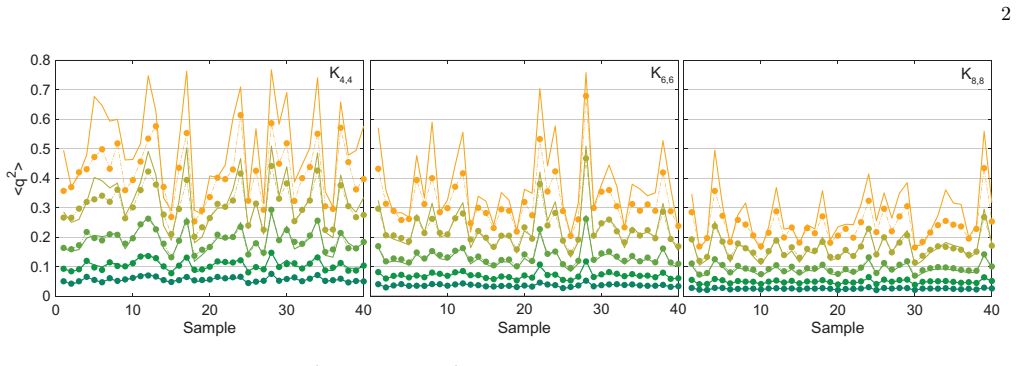
The discrete truncated Wigner approximation recovers sample-to-sample fluctuations of the Edwards-Anderson order parameter in biclique quantum spin glasses with increasing fidelity for larger systems.
A machine-rendered reading of the paper's core claim, the machinery that carries it, and where it could break.
Core claim
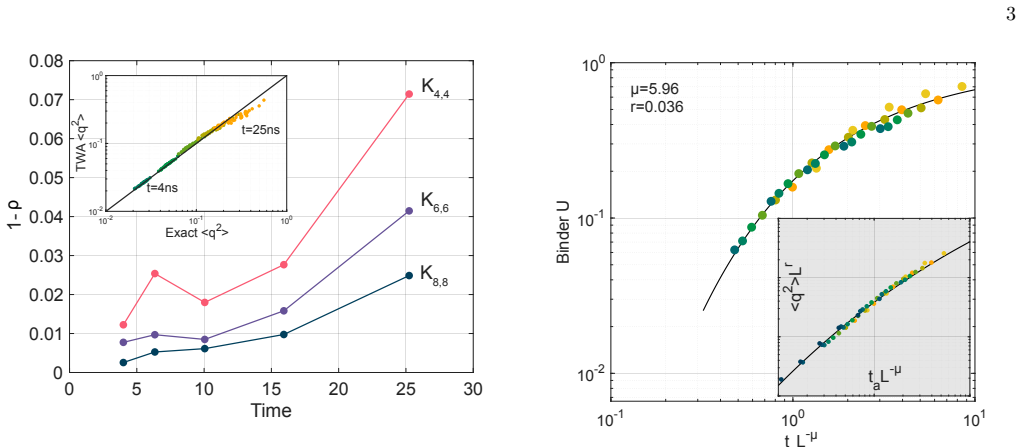
Within the discrete truncated Wigner approximation the near-adiabatic dynamics of biclique quantum spin glasses produce sample-to-sample fluctuations of the Edwards-Anderson order parameter that agree with exact benchmarks on small instances and improve with system size; the resulting Binder cumulants yield critical exponents consistent with theory and with recent quantum experiments.
What carries the argument
The discrete truncated Wigner approximation applied to spin dynamics on biclique graphs.
If this is right
- Fluctuations of the order parameter become accessible in systems far beyond exact diagonalization.
- Critical exponents can be extracted reliably from the Binder cumulant.
- The method remains practical for annealing times spanning a wide range.
- Quantum spin glass models with up to tens of thousands of spins can be simulated at low cost.
Where Pith is reading between the lines
- Similar semi-classical methods may prove useful for other classes of quantum disordered systems.
- The observed scaling of accuracy with size suggests the approximation captures the essential physics in the thermodynamic limit.
- This approach could help evaluate the performance of quantum optimization algorithms on large spin glass instances.
Load-bearing premise
Benchmarks on small systems suffice to guarantee that the discrete truncated Wigner approximation stays accurate when the system size is increased into the regime where it is most needed.
What would settle it
A calculation on an intermediate-size system using a more accurate method that shows the TWA deviations from the true Edwards-Anderson fluctuations or Binder cumulant do not shrink with size.
Figures
read the original abstract
Quantum spin glasses are often considered testbeds for studying quantum optimization algorithms and as such have been the subject of various quantum advantage claims. Here we investigate the near adiabatic dynamics of biclique quantum spin glasses within the (discrete) truncated Wigner approximation (TWA). Benchmarks on small systems show that TWA recovers sample-to-sample fluctuations of the Edwards-Anderson order parameter, over a wide range of annealing times, with increasing fidelity when the system size increases. We extract critical exponents from the Binder cumulant in line with theoretical expectations, reproducing recent quantum experiments. The computational cost of the method is minimal and it can easily be applied to tens of thousands of qubits.
Editorial analysis
A structured set of objections, weighed in public.
Referee Report
Summary. The manuscript applies the discrete truncated Wigner approximation (TWA) to the near-adiabatic dynamics of biclique quantum spin glasses. Small-system benchmarks are reported to show that TWA recovers sample-to-sample fluctuations of the Edwards-Anderson order parameter across a range of annealing times, with fidelity improving as system size increases. Critical exponents are extracted from the Binder cumulant and stated to agree with theoretical expectations and recent quantum experiments. The method is presented as computationally cheap and directly extensible to systems of tens of thousands of qubits.
Significance. If the extrapolation of accuracy to large N and near-adiabatic regimes holds, the work supplies an efficient semiclassical route to simulate quantum spin-glass dynamics at scales relevant to quantum optimization studies, while reproducing experimental Binder-cumulant scaling at negligible cost.
major comments (2)
- [Abstract and benchmarks section] Abstract and benchmarks section: the central claim that discrete TWA fidelity improves with system size and remains reliable when annealing times approach the adiabatic limit up to N ~ 10^4 is load-bearing for the scalability assertion, yet the manuscript provides no quantitative scaling of truncation or discretization errors with N or annealing time; small-system benchmarks alone do not establish that these errors continue to decrease or remain controlled.
- [Implementation details (implicit in the benchmark description)] Implementation details (implicit in the benchmark description): no information is given on the choice of truncation parameters, discretization scheme, or post-selection criteria, nor on how these choices affect the reported recovery of Edwards-Anderson fluctuations and the Binder-cumulant exponent extraction; without such controls the increasing-fidelity statement cannot be assessed for robustness.
Simulated Author's Rebuttal
We thank the referee for their careful reading and constructive comments on our manuscript. The points raised regarding error scaling and implementation details are well taken, and we address them point by point below. We have revised the manuscript to incorporate additional information and discussion as detailed in the responses.
read point-by-point responses
-
Referee: [Abstract and benchmarks section] Abstract and benchmarks section: the central claim that discrete TWA fidelity improves with system size and remains reliable when annealing times approach the adiabatic limit up to N ~ 10^4 is load-bearing for the scalability assertion, yet the manuscript provides no quantitative scaling of truncation or discretization errors with N or annealing time; small-system benchmarks alone do not establish that these errors continue to decrease or remain controlled.
Authors: We agree that the manuscript does not include explicit quantitative scaling of truncation or discretization errors versus N or annealing time, and that small-system benchmarks alone cannot rigorously prove the trend persists to N ~ 10^4. Our benchmarks demonstrate a clear improvement in fidelity with system size for the Edwards-Anderson fluctuations and Binder cumulant, consistent with the semiclassical nature of TWA where relative fluctuations decrease as 1/sqrt(N). In the revised manuscript we will add a new subsection discussing the expected error scaling from the underlying Wigner-function truncation and provide quantitative error estimates extracted from the existing benchmarks to better support the extrapolation claim. revision: yes
-
Referee: [Implementation details (implicit in the benchmark description)] Implementation details (implicit in the benchmark description): no information is given on the choice of truncation parameters, discretization scheme, or post-selection criteria, nor on how these choices affect the reported recovery of Edwards-Anderson fluctuations and the Binder-cumulant exponent extraction; without such controls the increasing-fidelity statement cannot be assessed for robustness.
Authors: The original manuscript omitted these technical details for conciseness. We will revise by adding a dedicated paragraph (or subsection) specifying the truncation parameters (number of trajectories, phase-space sampling), the discretization scheme employed for the discrete TWA, any post-selection criteria used, and the results of sensitivity tests showing that the reported recovery of sample-to-sample Edwards-Anderson fluctuations and the extracted Binder-cumulant exponent remain stable under reasonable variations of these choices. revision: yes
Circularity Check
No significant circularity; numerical benchmarks against external data
full rationale
The paper reports numerical application of discrete TWA to biclique spin glasses, with results benchmarked on small systems against sample-to-sample fluctuations and Binder cumulant exponents, then compared to independent quantum experiments. No equations, fitted parameters, or self-citations are shown to reduce the central claims (recovery of EA fluctuations, exponent extraction) to inputs by construction. The derivation chain consists of standard TWA propagation plus direct comparison to external benchmarks, remaining self-contained.
Axiom & Free-Parameter Ledger
axioms (1)
- domain assumption The discrete truncated Wigner approximation accurately captures near-adiabatic quantum dynamics of the biclique spin-glass model
Reference graph
Works this paper leans on
-
[1]
Adiabatic quan- tum computation,
Tameem Albash and Daniel A. Lidar, “Adiabatic quan- tum computation,” Rev. Mod. Phys. 90, 015002 (2018)
2018
-
[2]
Quantum critical dynamics in a 5,000-qubit programmable spin glass,
Andrew D. King, Jack Raymond, Trevor Lanting, Richard Harris, Alex Zucca, Fabio Altomare, Andrew J. Berkley, Kelly Boothby, Sara Ejtemaee, Colin Enderud, Emile Hoskinson, Shuiyuan Huang, Eric Ladizinsky, Al- lison J. R. MacDonald, Gaelen Marsden, Reza Molavi, Travis Oh, Gabriel Poulin-Lamarre, Mauricio Reis, Chris Rich, Yuki Sato, Nicholas Tsai, Mark Volk...
2023
-
[3]
Beyond-classical computation in quantum simulation,
Andrew D. King, Alberto Nocera, Marek M. Rams, Jacek Dziarmaga, Roeland Wiersema, William Bernoudy, Jack Raymond, Nitin Kaushal, Niclas Heinsdorf, Richard Harris, Kelly Boothby, Fabio Altomare, Mohsen Asad, Andrew J. Berkley, Martin Boschnak, Kevin Chern, Holly Christiani, Samantha Cibere, Jake Connor, Mar- tin H. Dehn, Rahul Deshpande, Sara Ejtemaee, Pau...
2025
-
[4]
Tensor networks contraction and the belief propagation algorithm,
R. Alkabetz and I. Arad, “Tensor networks contraction and the belief propagation algorithm,” Phys. Rev. Res. 3, 023073 (2021)
2021
-
[5]
Fast and converged classical simulations of evi- dence for the utility of quantum computing before fault tolerance,
Tomislav Begui, Johnnie Gray, and Garnet Kin-Lic Chan, “Fast and converged classical simulations of evi- dence for the utility of quantum computing before fault tolerance,” Science Advances 10, eadk4321 (2024)
2024
-
[6]
Efficient tensor network simula- tion of ibm’s eagle kicked ising experiment,
Joseph Tindall, Matthew Fishman, E. Miles Stouden- mire, and Dries Sels, “Efficient tensor network simula- tion of ibm’s eagle kicked ising experiment,” PRX Quan- tum 5, 010308 (2024)
2024
-
[7]
Dy- namics of disordered quantum systems with two- and three-dimensional tensor networks,
Joseph Tindall, Antonio Francesco Mello, Matthew Fish- man, E. Miles Stoudenmire, and Dries Sels, “Dy- namics of disordered quantum systems with two- and three-dimensional tensor networks,” Science 392, 868– 872 (2026)
2026
-
[8]
Andrew D. King, Alberto Nocera, Marek M. Rams, Jacek Dziarmaga, Jack Raymond, Nitin Kaushal, Anders W. Sandvik, Gonzalo Alvarez, Juan Carrasquilla, Marcel Franz, and Mohammad H. Amin, “Comment on: "dy- namics of disordered quantum systems with two- and three-dimensional tensor networks" arxiv:2503.05693,” (2025), arXiv:2504.06283 [quant-ph]
Pith/arXiv arXiv 2025
-
[9]
Andrew King, Alberto Nocera, Marek Rams, Jacek Dziarmaga, Jack Raymond, Nitin Kaushal, Anders Sand- vik, Gonzalo Alvarez, Marcel Franz, and Mohammad Amin, “Strengths and limitations of the loop-corrected bp-tns algorithm,” Science eLetter, https://www. science.org/doi/10.1126/science.adx2728 (June 4, 2026), [Accessed 16-06-2026]
-
[10]
Still beyond classical. — linkedin.com,
Andrew King, “Still beyond classical. — linkedin.com,” https://www.linkedin.com/pulse/ still-beyond-classical-andrew-king-yxpic/ (May 26, 2026), [Accessed 16-06-2026]
2026
-
[11]
D-Wave’s Quantum Supremacy Result Stands — dwavequantum.com,
D-Wave Quantum inc., “D-Wave’s Quantum Supremacy Result Stands — dwavequantum.com,” https://www. dwavequantum.com/company/newsroom/press-release/ d-wave-s-quantum-supremacy-result-stands/ (May 26, 2026), [Accessed 16-06-2026]
2026
-
[12]
Distribution functions in physics: Fundamen- tals,
M. Hillery, R.F. O’Connell, M.O. Scully, and E.P. Wigner, “Distribution functions in physics: Fundamen- tals,” Physics Reports 106, 121–167 (1984)
1984
-
[13]
A wigner-function formulation of finite-state quantum mechanics,
William K Wootters, “A wigner-function formulation of finite-state quantum mechanics,” Annals of Physics 176, 1–21 (1987)
1987
-
[14]
Phase space representation of quantum dynamics,
Anatoli Polkovnikov, “Phase space representation of quantum dynamics,” Annals of Physics 325, 1790–1852 (2010)
2010
-
[15]
Many- body quantum spin dynamics with monte carlo trajecto- ries on a discrete phase space,
J. Schachenmayer, A. Pikovski, and A. M. Rey, “Many- body quantum spin dynamics with monte carlo trajecto- ries on a discrete phase space,” Phys. Rev. X 5, 011022 (2015)
2015
-
[16]
Dynamics of correlations in two-dimensional quantum spin models with long-range interactions: a phase-space monte-carlo study,
J Schachenmayer, A Pikovski, and A M Rey, “Dynamics of correlations in two-dimensional quantum spin models with long-range interactions: a phase-space monte-carlo study,” New Journal of Physics 17, 065009 (2015)
2015
-
[17]
Discrete truncated wigner approach to dynamical phase transi- tions in ising models after a quantum quench,
Reyhaneh Khasseh, Angelo Russomanno, Markus Schmitt, Markus Heyl, and Rosario Fazio, “Discrete truncated wigner approach to dynamical phase transi- tions in ising models after a quantum quench,” Phys. Rev. B 102, 014303 (2020)
2020
-
[18]
Quantum echo dynamics in the Sherrington- Kirkpatrick model,
Silvia Pappalardi, Anatoli Polkovnikov, and Alessan- dro Silva, “Quantum echo dynamics in the Sherrington- Kirkpatrick model,” SciPost Phys. 9, 021 (2020)
2020
-
[19]
It would be straightforward to add
I don’t simulate the dimerization as it seems to be a feature particular to the embedding into D-wave’s device, not a feature of the problem. It would be straightforward to add
-
[20]
Solvable spin glass of quantum rotors,
J. Ye, S. Sachdev, and N. Read, “Solvable spin glass of quantum rotors,” Phys. Rev. Lett. 70, 4011–4014 (1993)
1993
-
[21]
Zero-temperature critical behavior of the infinite-range quantum ising spin glass,
Jonathan Miller and David A. Huse, “Zero-temperature critical behavior of the infinite-range quantum ising spin glass,” Phys. Rev. Lett. 70, 3147–3150 (1993)
1993
-
[22]
Cluster truncated wigner approximation in strongly interacting systems,
Jonathan Wurtz, Anatoli Polkovnikov, and Dries Sels, “Cluster truncated wigner approximation in strongly interacting systems,” Annals of Physics 395, 341–365 (2018)
2018
-
[23]
Tensor network surrogate models for variational quantum com- putation,
Ryo Watanabe, Dries Sels, and Joseph Tindall, “Tensor network surrogate models for variational quantum com- putation,” (2026), arXiv:2604.20180 [quant-ph]
Pith/arXiv arXiv 2026
-
[24]
Variational iterative rotation algorithm: Combinato- rial optimization with classical kicked tops,
Flaviano Morone, Andrew D. Kent, and Dries Sels, “Variational iterative rotation algorithm: Combinato- rial optimization with classical kicked tops,” (2026), arXiv:2604.01512 [cond-mat.dis-nn]
arXiv 2026
-
[25]
Opening the black box inside grover’s algorithm,
E. M. Stoudenmire and Xavier Waintal, “Opening the black box inside grover’s algorithm,” Phys. Rev. X 14, 041029 (2024)
2024
discussion (0)
Sign in with ORCID, Apple, or X to comment. Anyone can read and Pith papers without signing in.